Japan Semiconductor LiDAR Module Market Size & Growth Rate
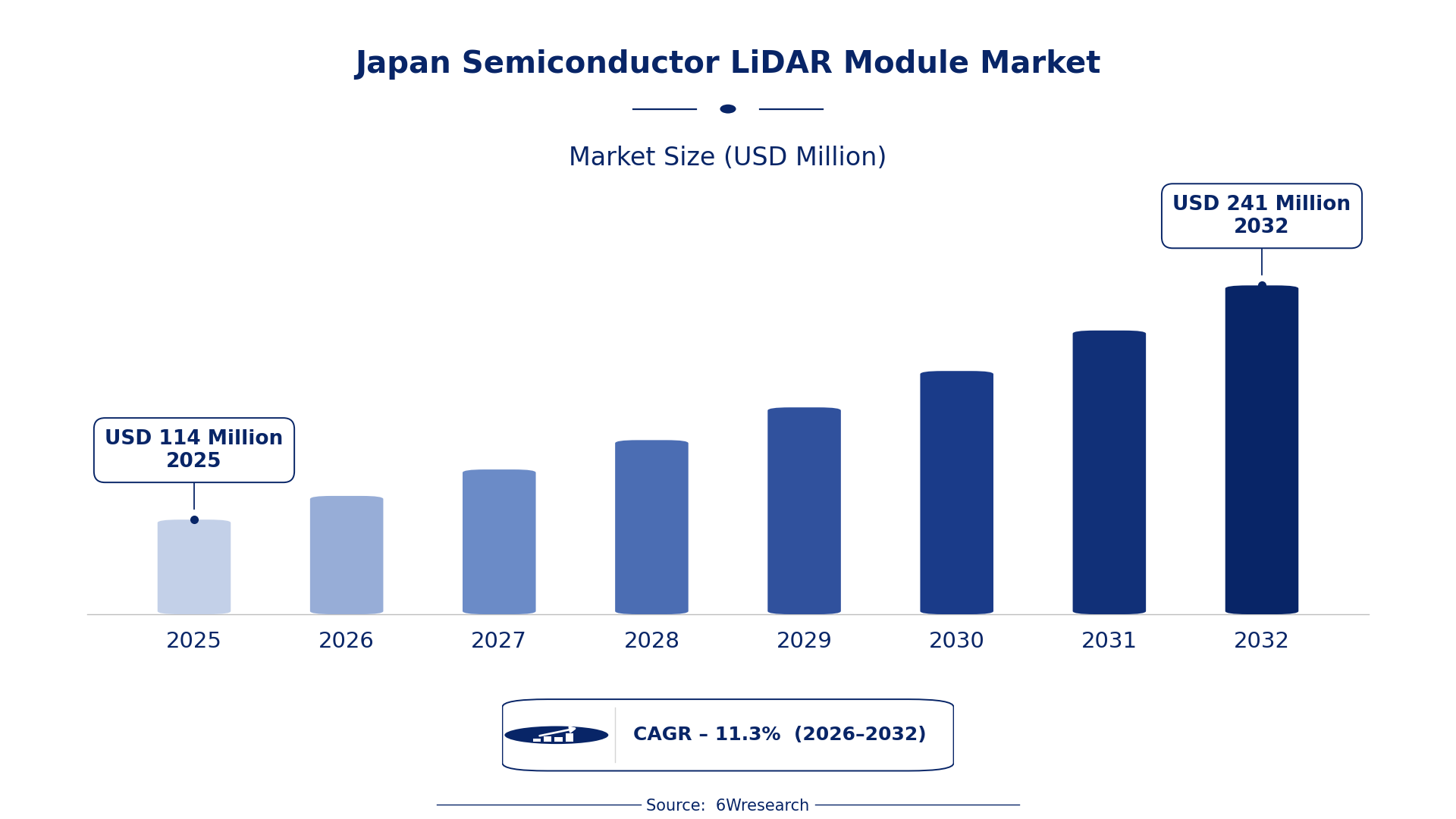
According to 6Wresearch internal database and industry insights, the Japan Semiconductor LiDAR Module Market was valued at USD 114 Million in 2025 and is projected to reach USD 241 Million by 2032, growing at a CAGR of approximately 11.3% during 2026–2032.
Japan Semiconductor LiDAR Module Market Highlights
| Report Metric | Details |
| Report Name | Japan Semiconductor LiDAR Module Market (2026-2032) |
| Market Size 2025 | USD 114 Million |
| Market Size 2032 | USD 241 Million |
| Absolute Growth 2025–2032 | USD 127 Million |
| CAGR 2026–2032 | 11.3% |
| Peak Annual Growth | 14.4% in 2026 |
| Forecast Period | 2026–2032 |
| Historical Data | 2022–2025 |
| Base Year | 2025 |
| Leading Module Type, 2025 | Flash LiDAR (37% share) |
| Leading Light Source Type, 2025 | Solid-State Laser (47% share) |
| Leading Application Area, 2025 | ADAS (45% share) |
| Leading End User, 2025 | Electric Vehicle Makers (36% share) |
| Fastest-Growing Module Type | MEMS-Based LiDAR (15.7% CAGR) |
| Fastest-Growing Light Source Type | Mechanical Beam Steering (15.1% CAGR) |
| Fastest-Growing Application Area | Urban Navigation (13.5% CAGR) |
| Fastest-Growing End User | AV Startups (14.5% CAGR) |
| Growing Sector | Electric Vehicles |
| Key End Users | Electric Vehicle Makers, Automation Firms, AV Startups, Robo-Taxi Manufacturers |
Japan Semiconductor LiDAR Module Market Year-wise Growth Rate and Key Drivers (2022–2032)
This graph illustrates the annual growth rates of the market from 2022 to 2032, highlighting a steady upward trajectory and projected market expansion over the forecast period.
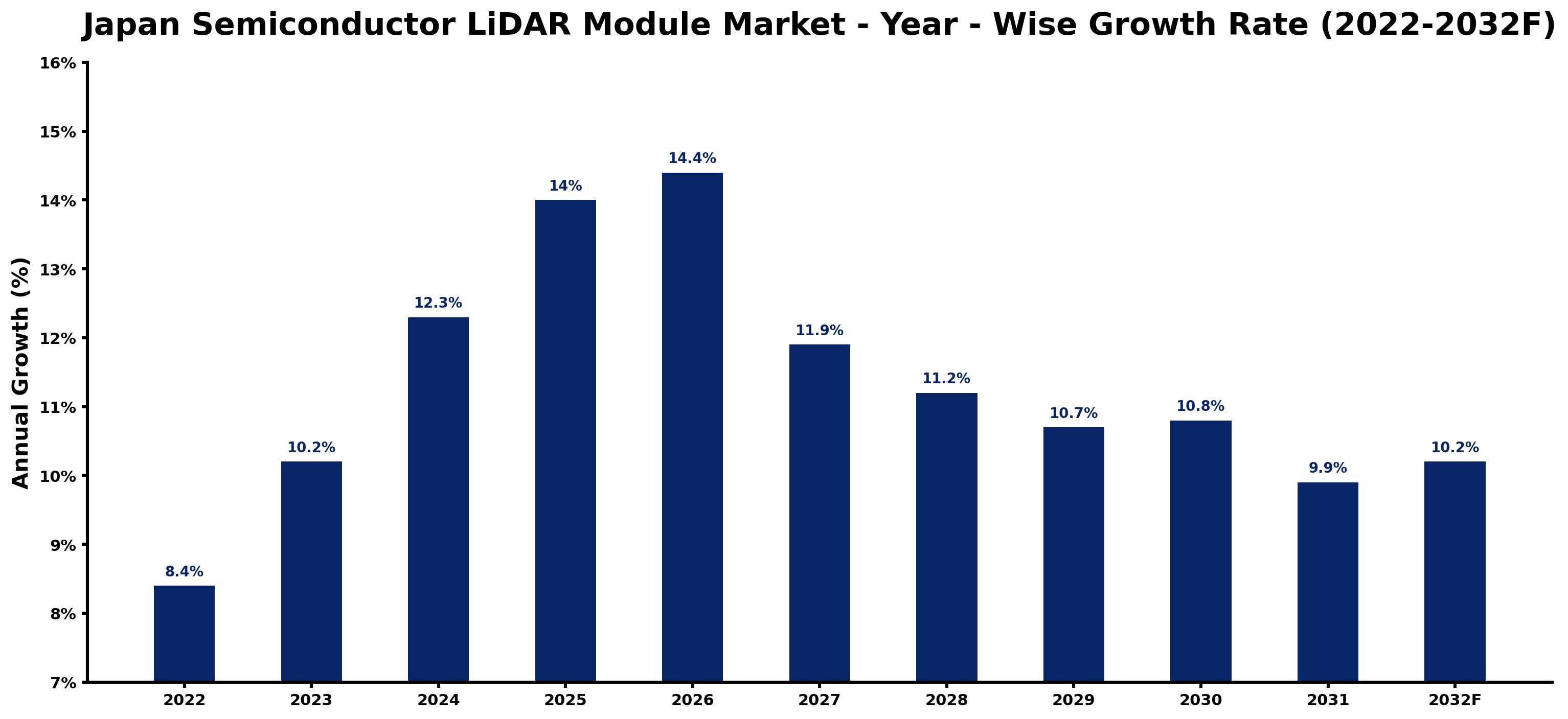
Below, each year's estimated growth is shown next to the factor that most influenced it.
| Year | Estimated Annual Growth (%) | Market Rationale |
| 2022 | 8.4 | The market was driven by increasing adoption of advanced sensing technologies. |
| 2023 | 10.2 | Growth accelerated due to rising demand from electric vehicle manufacturers. |
| 2024 | 12.3 | Demand surged as more companies integrated LiDAR into their automation processes. |
| 2025 | 14.0 | The peak growth was supported by investments in autonomous vehicle technologies. |
| 2026 | 14.4 | The market experienced its highest growth due to widespread adoption in various sectors. |
| 2027 | 11.9 | Growth slowed as market saturation began to impact new investments. |
| 2028 | 11.2 | A continued slowdown occurred as competition intensified among suppliers. |
| 2029 | 10.7 | The market maintained growth, albeit at a slower rate as innovation continued. |
| 2030 | 10.8 | Demand increased again as new applications for LiDAR technology emerged. |
| 2031 | 9.9 | Growth slowed due to stabilisation in the electric vehicle market. |
| 2032 | 10.2 | The market will rise again as new standards are adopted. |
Note: Market size estimations and growth projections presented in this report are based on 6Wresearch's proprietary forecasting methodology, utilizing the latest available industry data, government publications, and primary research inputs.
Japan Semiconductor LiDAR Module Market Synopsis
Semiconductor LiDAR modules are advanced sensing devices that measure distances using laser light, primarily used in autonomous vehicle navigation, industrial automation, and environmental monitoring. The Japan Semiconductor LiDAR Module Market is expanding rapidly, driven by the domestic semiconductor industry valued at over 4 trillion yen and strong demand from electric vehicle manufacturers. The adoption rate of LiDAR in electric vehicles is projected to reach 70% by 2025, supported by government strategies focused on autonomous vehicle technologies.
Market Dynamics Impact Analysis (2026–2032)
| Factor | Type | Impact | Primary Segment Affected |
| Rising adoption of LiDAR technology in electric vehicles | Driver | High | ADAS |
| Significant investments in automation and smart city projects | Driver | High | Urban Navigation |
| Growing demand for high-resolution imaging solutions | Opportunity | High | Flash LiDAR |
| Increasing integration of LiDAR in industrial automation | Opportunity | Medium | Industrial Robots |
| High costs associated with LiDAR technology development | Restraint | High | MEMS-Based LiDAR |
| Limited awareness of LiDAR applications among potential users | Restraint | Medium | Long-Range Detection |
| Intense competition among manufacturers leading to price wars | Challenge | High | Hybrid LiDAR Modules |
| Technological challenges in achieving compact designs | Challenge | Medium | FMCW LiDAR |
Evaluation of Drivers in Japan Semiconductor LiDAR Module Market (2026–2032)
The factors lifting demand, and the evidence behind each, are summarised below.
| Drivers | Primary Segment Affected | Why It Matters (Evidence) |
| Increased electric vehicle production | ADAS | The adoption rate of LiDAR in electric vehicles is projected to reach 70% by 2025, driving demand from automotive manufacturers. |
| Investment in smart city initiatives | Urban Navigation | Tokyo's smart city projects incorporate LiDAR technology, improving urban navigation systems and increasing demand. |
| Demand for high-resolution imaging | Flash LiDAR | Flash LiDAR is essential for automotive applications, with a growing need for precise imaging solutions. |
| Integration of automation in industries | Industrial Robots | Automation firms are increasingly adopting LiDAR for navigation, boosting demand in the industrial sector. |
| Technological advancements in LiDAR systems | MEMS-Based LiDAR | Innovations in MEMS technology are creating compact solutions, attracting new buyers in various applications. |
Much of the new demand traces back to the increasing production of electric vehicles, with projections indicating that the adoption rate of LiDAR technology will reach 70% by 2025. Investments in smart city projects, particularly in Tokyo, are driving the integration of LiDAR into urban navigation systems. Demand for high-resolution imaging solutions is rising, especially in automotive applications where precise imaging is crucial. Automation in industrial robots reflects a broader trend towards improved operational efficiency. Advancements in MEMS-based systems are creating compact solutions that appeal to various sectors, further supporting market growth.
Evaluation of Restraints in Japan Semiconductor LiDAR Module Market
The following restraints limit how fast demand can grow.
| Market Restraint | Primary Segment Affected | Why It Matters (Evidence) |
| High development costs for LiDAR technology | MEMS-Based LiDAR | The costs associated with developing advanced LiDAR systems can deter smaller firms from entering the market. |
| Limited awareness of LiDAR applications | Long-Range Detection | Potential users often lack knowledge about the benefits of LiDAR, hindering market growth. |
| Inconsistent quality standards across manufacturers | Hybrid LiDAR Modules | Variability in product quality can lead to buyer hesitation and reduced market confidence. |
| Regulatory hurdles for new technologies | FMCW LiDAR | Emerging technologies face stringent regulations that can delay market entry and adoption. |
| Dependence on semiconductor supply chains | Flash LiDAR | Disruptions in semiconductor supply chains can impact the availability of LiDAR modules. |
Japan Semiconductor LiDAR Module Market Challenges
High input costs challenge buyers in Japan's semiconductor industry, driven by reliance on imported raw materials, which can inflate prices by up to 20%. Skills shortages in semiconductor fabrication limit production efficiency, causing delays of approximately 15% in project timelines for manufacturers. The need for advanced expertise to integrate LiDAR technology into vehicles raises development costs for suppliers, potentially increasing expenses by 10%. Supply chain disruptions, exacerbated by global events, lead to component availability delays, hindering timely launches of new electric vehicle models for producers.
Trends in the Japan Semiconductor LiDAR Module Market
Several trends are reshaping the Japan Semiconductor LiDAR Module Market; the most important are set out below.
- Shift Towards Urban Navigation Technologies: Tokyo's smart city projects have increased the integration of LiDAR technology, with over 1 million registered electric vehicles in Japan as of 2023. This trend is reshaping urban navigation systems.
- Emergence of Advanced Driver-Assistance Systems: ADAS has become a focal point for electric vehicle makers, with a 45% market share in 2025. This focus is driving demand for high-performance LiDAR solutions.
- Transition from Mechanical to Solid-State Lasers: The shift began in 2023 as manufacturers sought more reliable and compact solutions. Solid-State Laser technology now holds a 47% share in the light source segment.
- Growth in Autonomous Vehicle Startups: AV startups are increasingly adopting LiDAR technology, with a projected CAGR of 14.5% through 2032. This growth reflects the rising demand for autonomous navigation solutions.
Investment Opportunities in the Japan Semiconductor LiDAR Module Market
Where to invest in the Japan Semiconductor LiDAR Module Market: the main openings are set out below.
- Supply of Advanced LiDAR Modules: With the increasing adoption of LiDAR in electric vehicles, there is an opportunity to supply advanced modules. The projected adoption rate of 70% by 2025 highlights this gap.
- Partnerships for Smart City Projects: The timing is ideal for forming partnerships with local governments to supply LiDAR technology for smart city initiatives. Tokyo's ongoing projects present a strong entry point.
- Investment in Compact LiDAR Solutions: The demand for compact LiDAR solutions is rising, particularly in urban navigation applications. Investing in MEMS-based technology can address this growing need.
- Expansion into Industrial Automation: The industrial sector is increasingly integrating LiDAR for automation. Engaging with automation firms can open new avenues for growth in this segment.
Government Initiatives in the Japan Semiconductor LiDAR Module Market
The GX Promotion Act of 2023 establishes a framework for semiconductor technology, building on the Semiconductor and Digital Industry Strategy from 2021. This new act aims to secure domestic manufacturing and promote innovation in LiDAR technologies, ensuring that producers meet evolving industry standards.
The Ministry of Economy, Trade and Industry approves funding for projects aimed at advancing semiconductor technologies. This agency supports initiatives that strengthen the capabilities of semiconductor manufacturers, ensuring they can compete in the global market.
Future Insight of the Japan Semiconductor LiDAR Module Market
A policy-driven shift towards enhancing autonomous vehicle technologies will reshape the semiconductor LiDAR module market by 2032. Established standards under JIS B 9950 will simplify production processes, offering advantages to suppliers. With over 1 million registered electric vehicles in 2023, the demand for LiDAR technology will surge, prompting advancements in sensor capabilities. Smart city initiatives led by the Tokyo Metropolitan Government will further embed LiDAR applications, opening new market avenues for buyers and suppliers.
Market Segmentation Analysis
Japan Semiconductor LiDAR Module Market report covers a detailed analysis of the following market segments:
By Module Type – Flash LiDAR Leads, MEMS-Based LiDAR Expected to Grow Fastest
According to Saurav Kr Singh, Senior Research Analyst at 6Wresearch, Flash LiDAR took 37% of module type revenue in 2025, more than any other category. Flash LiDAR holds the largest share due to its essential function in high-resolution imaging for automotive applications. This technology is crucial for enhancing safety features in the expanding electric vehicle market, which has over 1 million registered vehicles in Japan as of 2023. Over 2026–2032, MEMS-Based LiDAR is expected to post the fastest growth, at a CAGR of 15.7%. MEMS-Based LiDAR is witnessing rapid growth because it provides compact solutions that are well-suited for various sensing applications. The increasing demand for space-efficient technologies, particularly in densely populated urban areas, is propelling this segment forward. Suppliers should focus on developing compact LiDAR solutions to meet the growing needs of urban navigation and automotive applications.
By Light Source Type – Solid-State Laser Leads, Mechanical Beam Steering Expected to Grow Fastest
In 2025, Solid-State Laser led the light source type split with a 47% share. Solid-State Laser commands the largest market share as it is essential for generating laser light in LiDAR systems, particularly in automotive applications. Its reliability and efficiency have made it the preferred choice among manufacturers in Japan's robust semiconductor industry. Mechanical Beam Steering is set to record the highest CAGR in this split, 15.1% over 2026–2032. Mechanical Beam Steering is experiencing growth as it is still used in traditional systems, although it is becoming less popular. The transition towards more advanced technologies is driving this segment's expansion as manufacturers adapt to market changes. Buyers will benefit from advancements in laser technologies that will improve the performance of LiDAR systems.
By Application Area – ADAS Leads, Urban Navigation Expected to Grow Fastest
With 45% of application area revenue in 2025, ADAS was the largest category. ADAS is the leading application area, essential for advanced driver-assistance systems that are increasingly incorporated into new vehicle models. The strong emphasis on safety and automation within Japan's automotive industry propels the demand for this technology. The quickest growth will come from Urban Navigation, forecast to expand at a CAGR of 13.5% between 2026 and 2032. Urban Navigation is the fastest-growing segment as it supports navigation systems in densely populated urban areas. The rising urban population and the push for smart city initiatives are key factors driving this segment's growth. Suppliers must focus on solutions tailored for urban navigation to seize emerging market opportunities.
By End User – Electric Vehicle Makers Lead, AV Startups Expected to Grow Fastest
Electric Vehicle Makers accounted for 36% of the market by end user in 2025. Electric Vehicle Makers lead the market as the primary end-users of LiDAR technology, motivated by the need for enhanced safety and automation in their vehicles. The substantial number of registered electric vehicles in Japan underscores this increasing demand for advanced sensing solutions. AV Startups are projected to grow fastest, at a CAGR of 14.5% during 2026–2032. AV Startups are rapidly growing as they develop innovative autonomous vehicle solutions. The influx of investment and heightened interest in autonomous technologies is significantly driving this segment's expansion. Suppliers should actively engage with AV startups to tap into emerging opportunities in the fast-evolving autonomous vehicle market.
Key Attractiveness of the Report
- 10 Years of Market Numbers
- Historical Data Starting from 2022 to 2025
- Base Year 2025
- Forecast Data until 2032
- Key Performance Indicators Impacting the Market
- Major Upcoming Developments and Projects
Key Highlights of the Report:
- Japan Semiconductor LiDAR Module Market Outlook
- Market Size of Japan Semiconductor LiDAR Module Market, 2025
- Forecast of Japan Semiconductor LiDAR Module Market, 2032
- Historical Data and Forecast of Japan Semiconductor LiDAR Module Revenues & Volume for the Period 2022-2032F
- Japan Semiconductor LiDAR Module Market Trend Evolution
- Japan Semiconductor LiDAR Module Market Drivers and Challenges
- Japan Semiconductor LiDAR Module Price Trends
- Japan Semiconductor LiDAR Module Porter's Five Forces
- Japan Semiconductor LiDAR Module Industry Life Cycle
- Historical Data and Forecast of Japan Semiconductor LiDAR Module Market Revenues & Volume By Module Type for the Period 2022-2032F
- Historical Data and Forecast of Japan Semiconductor LiDAR Module Market Revenues & Volume By Flash LiDAR for the Period 2022-2032F
- Historical Data and Forecast of Japan Semiconductor LiDAR Module Market Revenues & Volume By MEMS-Based LiDAR for the Period 2022-2032F
- Historical Data and Forecast of Japan Semiconductor LiDAR Module Market Revenues & Volume By Hybrid LiDAR Modules for the Period 2022-2032F
- Historical Data and Forecast of Japan Semiconductor LiDAR Module Market Revenues & Volume By FMCW LiDAR for the Period 2022-2032F
- Historical Data and Forecast of Japan Semiconductor LiDAR Module Market Revenues & Volume By Light Source Type for the Period 2022-2032F
- Historical Data and Forecast of Japan Semiconductor LiDAR Module Market Revenues & Volume By Solid-State Laser for the Period 2022-2032F
- Historical Data and Forecast of Japan Semiconductor LiDAR Module Market Revenues & Volume By Mechanical Beam Steering for the Period 2022-2032F
- Historical Data and Forecast of Japan Semiconductor LiDAR Module Market Revenues & Volume By Beam Scanning + Flash for the Period 2022-2032F
- Historical Data and Forecast of Japan Semiconductor LiDAR Module Market Revenues & Volume By Frequency Modulation for the Period 2022-2032F
- Historical Data and Forecast of Japan Semiconductor LiDAR Module Market Revenues & Volume By Application Area for the Period 2022-2032F
- Historical Data and Forecast of Japan Semiconductor LiDAR Module Market Revenues & Volume By ADAS for the Period 2022-2032F
- Historical Data and Forecast of Japan Semiconductor LiDAR Module Market Revenues & Volume By Urban Navigation for the Period 2022-2032F
- Historical Data and Forecast of Japan Semiconductor LiDAR Module Market Revenues & Volume By Industrial Robots for the Period 2022-2032F
- Historical Data and Forecast of Japan Semiconductor LiDAR Module Market Revenues & Volume By Long-Range Detection for the Period 2022-2032F
- Historical Data and Forecast of Japan Semiconductor LiDAR Module Market Revenues & Volume By End User for the Period 2022-2032F
- Historical Data and Forecast of Japan Semiconductor LiDAR Module Market Revenues & Volume By Electric Vehicle Makers for the Period 2022-2032F
- Historical Data and Forecast of Japan Semiconductor LiDAR Module Market Revenues & Volume By AV Startups for the Period 2022-2032F
- Historical Data and Forecast of Japan Semiconductor LiDAR Module Market Revenues & Volume By Automation Firms for the Period 2022-2032F
- Historical Data and Forecast of Japan Semiconductor LiDAR Module Market Revenues & Volume By Robo-Taxi Manufacturers for the Period 2022-2032F
- Japan Semiconductor LiDAR Module Import Export Trade Statistics
- Market Opportunity Assessment By Module Type
- Market Opportunity Assessment By Light Source Type
- Market Opportunity Assessment By Application Area
- Market Opportunity Assessment By End User
- Japan Semiconductor LiDAR Module Top Companies Market Share
- Japan Semiconductor LiDAR Module Competitive Benchmarking By Technical and Operational Parameters
- Japan Semiconductor LiDAR Module Company Profiles
- Japan Semiconductor LiDAR Module Key Strategic Recommendations
Market Covered
The study includes the following segmentation.
By Module Type
- Flash LiDAR
- MEMS-Based LiDAR
- Hybrid LiDAR Modules
- FMCW LiDAR
By Light Source Type
- Solid-State Laser
- Mechanical Beam Steering
- Beam Scanning + Flash
- Frequency Modulation
By Application Area
- ADAS
- Urban Navigation
- Industrial Robots
- Long-Range Detection
By End User
- Electric Vehicle Makers
- AV Startups
- Automation Firms
- Robo-Taxi Manufacturers































