Japan Semiconductor Manufacturing Chemicals Market Size & Growth Rate
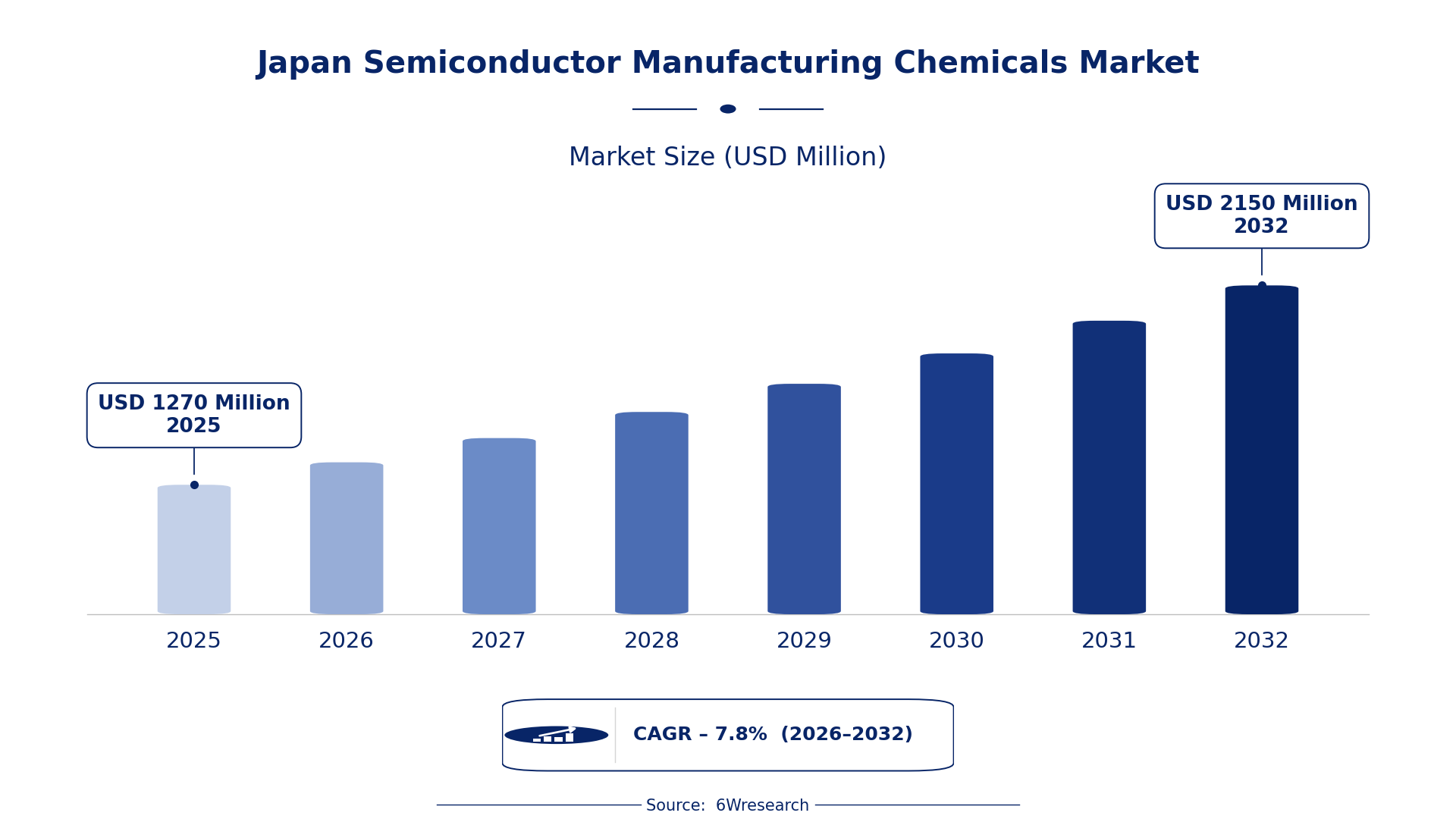
According to 6Wresearch internal database and industry insights, the Japan Semiconductor Manufacturing Chemicals Market was valued at USD 1,270 Million in 2025 and is projected to reach USD 2,150 Million by 2032, growing at a CAGR of approximately 7.8% during 2026–2032.
Japan Semiconductor Manufacturing Chemicals Market Highlights
| Report Metric | Details |
| Report Name | Japan Semiconductor Manufacturing Chemicals Market (2026-2032) |
| Market Size 2025 | USD 1,270 Million |
| Market Size 2032 | USD 2,150 Million |
| Absolute Growth 2025–2032 | USD 880 Million |
| CAGR 2026–2032 | 7.8% |
| Peak Annual Growth | 8.7% in 2027 |
| Forecast Period | 2026–2032 |
| Historical Data | 2022–2025 |
| Base Year | 2025 |
| Leading Chemical Type, 2025 | Strippers (42% share) |
| Leading Process Application, 2025 | Photoresist Removal (44% share) |
| Leading Purity Standard, 2025 | Ultra-High Purity (47% share) |
| Leading End User, 2025 | Wafer Foundries (37% share) |
| Fastest-Growing Chemical Type | Developers (10.8% CAGR) |
| Fastest-Growing Process Application | Lithography (10.5% CAGR) |
| Fastest-Growing Purity Standard | Low Metal Ion (10.1% CAGR) |
| Fastest-Growing End User | Fabless Chip Designers (9.9% CAGR) |
| Growing Sector | Lithography |
| Key End Users | Photoresist Removal, Lithography, Cleaning and Patterning, CMP Process |
Japan Semiconductor Manufacturing Chemicals Market Year-wise Growth Rate and Key Drivers (2022–2032)
This graph illustrates the annual growth rates of the market from 2022 to 2032, highlighting a steady upward trajectory and projected market expansion over the forecast period.
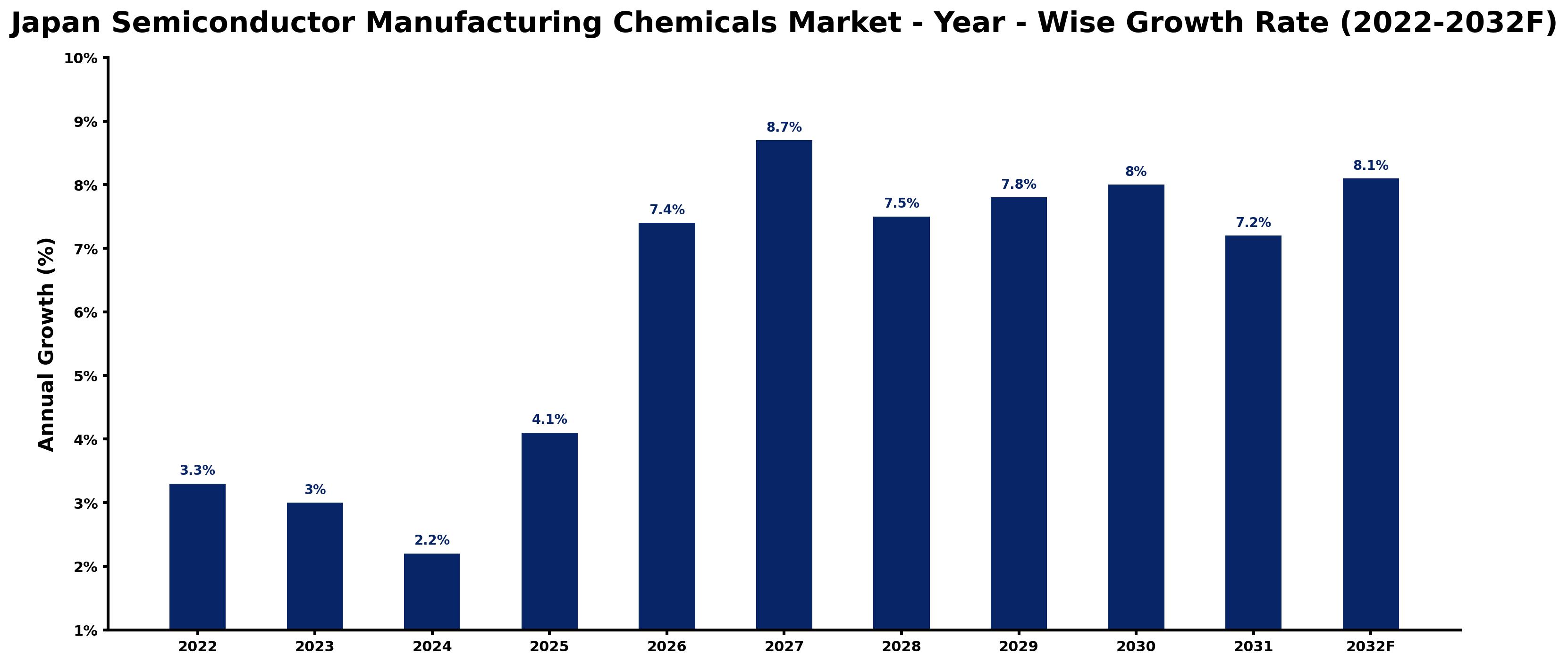
Below, each year's estimated growth is shown next to the factor that most influenced it.
| Year | Estimated Annual Growth (%) | Market Rationale |
| 2022 | 3.3 | The market showed steady growth due to ongoing demand from wafer foundries. |
| 2023 | 3.0 | Growth slowed as semiconductor manufacturers adjusted to supply chain challenges. |
| 2024 | 2.2 | Demand continued to decelerate as manufacturers focused on inventory management. |
| 2025 | 4.1 | Growth accelerated with increased investments in semiconductor fabrication facilities. |
| 2026 | 7.4 | The market is expected to expand as technology adoption surges in advanced manufacturing. |
| 2027 | 8.7 | Peak growth is projected due to heightened demand for high-purity chemicals. |
| 2028 | 7.5 | Growth is expected to moderate as manufacturers begin to stabilise production levels. |
| 2029 | 7.8 | Demand will rise as new chip designs require advanced chemical solutions. |
| 2030 | 8.0 | The market will continue to grow with rising applications in AI and IoT. |
| 2031 | 7.2 | Growth is projected to slow as market saturation begins to affect new investments. |
| 2032 | 8.1 | Demand will increase again as innovation in semiconductor technology resumes. |
Note: Market size estimations and growth projections presented in this report are based on 6Wresearch's proprietary forecasting methodology, utilizing the latest available industry data, government publications, and primary research inputs.
Japan Semiconductor Manufacturing Chemicals Market Synopsis
Semiconductor manufacturing chemicals are specialized substances essential for the fabrication of semiconductor devices, produced through complex processes to meet stringent industry standards. The Japan Semiconductor Manufacturing Chemicals Market is expanding due to increased investments in semiconductor fabrication and strong demand from wafer foundries and chip fabricators. With semiconductor exports reaching 1 trillion JPY in 2022, advancements in AI and IoT technologies are further driving the need for high-purity strippers and developers, highlighting the market's growth potential.
Market Dynamics Impact Analysis (2026–2032)
| Factor | Type | Impact | Primary Segment Affected |
| Increased investment in semiconductor fabrication facilities | Driver | High | Strippers |
| Growing demand for advanced semiconductor technologies | Driver | High | Developers |
| Rising need for high-purity chemicals in production | Opportunity | High | Ultra-High Purity |
| Expansion of semiconductor applications in AI and IoT | Opportunity | High | Chip Fabricators |
| Regulatory compliance costs for chemical safety | Restraint | Medium | Solvents |
| Supply chain disruptions affecting material availability | Restraint | High | Slurries |
| High competition among chemical suppliers | Challenge | Medium | Photoresist Removal |
| Fluctuating raw material prices impacting production costs | Challenge | High | Cleaning and Patterning |
Evaluation of Drivers in Japan Semiconductor Manufacturing Chemicals Market (2026–2032)
These are the developments adding the most demand over the forecast period.
| Drivers | Primary Segment Affected | Why It Matters (Evidence) |
| Increased investments in semiconductor fabrication facilities | Strippers | Japan's semiconductor industry employed approximately 120,000 people in 2022, driving demand for strippers as facilities expand. |
| Growing demand for advanced semiconductor technologies | Developers | The rise in AI and IoT applications has led to semiconductor exports reaching 1 trillion JPY in 2022, increasing the need for developers. |
| Expansion of semiconductor applications in AI and IoT | Ultra-High Purity | The growth of semiconductor applications is driving demand for ultra-high purity chemicals, essential for minimizing contamination. |
| Technological advancements in semiconductor manufacturing | Chip Fabricators | The Tokyo Electron Technology Center is enhancing R&D, leading to increased orders for chemicals used in chip fabrication. |
| Collaboration among semiconductor manufacturers | Photoresist Removal | Partnerships among manufacturers are boosting demand for photoresist removal chemicals. |
Behind the steady rise in orders sits a notable increase in investments within semiconductor fabrication facilities, with approximately 120,000 employees in Japan's semiconductor industry in 2022. This workforce expansion has driven demand for strippers, essential for photoresist removal. The growing applications of AI and IoT technologies have led to semiconductor exports reaching 1 trillion JPY in 2022, increasing the need for developers. Advancements in manufacturing technology at facilities like the Tokyo Electron Technology Center are driving orders for ultra-high purity chemicals. Collaboration among manufacturers is also boosting demand for photoresist removal chemicals, ensuring a steady market growth.
Evaluation of Restraints in Japan Semiconductor Manufacturing Chemicals Market
The following restraints limit how fast demand can grow.
| Market Restraint | Primary Segment Affected | Why It Matters (Evidence) |
| Regulatory compliance costs for chemical safety | Solvents | Compliance with the PRTR Law raises operational costs for manufacturers, which affects solvent pricing. |
| Supply chain disruptions affecting material availability | Slurries | Delays in obtaining critical materials due to global supply chain issues hinder slurry production timelines. |
| High competition among chemical suppliers | Photoresist Removal | Intense competition among suppliers drives prices down, which diminishes profitability for manufacturers. |
| Fluctuating raw material prices impacting production costs | Cleaning and Patterning | Volatility in raw material prices creates uncertainty in production costs for cleaning chemicals. |
| Stringent quality standards for semiconductor chemicals | Developers | Compliance with JIS Z 2801 standards necessitates significant investment in quality assurance processes. |
Japan Semiconductor Manufacturing Chemicals Market Challenges
Strict environmental regulations in Japan pose compliance challenges for buyers, resulting in procurement delays that can prolong projects by three months. Rising production costs stem from the necessity for advanced purification techniques, increasing expenses for suppliers by 15%. A shortage of skilled workers in semiconductor chemical processes diminishes supplier efficiency, leading to project delays averaging six months. Limited technological advancements in local production methods restrict suppliers' capacity to innovate, complicating their ability to meet the high-purity standards required by buyers.
Trends in the Japan Semiconductor Manufacturing Chemicals Market
The shifts below are changing how Japan Semiconductor Manufacturing Chemicals Market products are bought and supplied.
- Shift from Conventional to Advanced Lithography Techniques: Since 2022, chip fabricators have increasingly embraced advanced lithography techniques to enhance production efficiency. The Tokyo Electron Technology Center reported a 15% rise in the adoption of advanced lithography, reflecting a transition towards more sophisticated manufacturing processes.
- Transition from Standard to Ultra-High Purity Chemicals: In 2023, wafer foundries began prioritising ultra-high purity chemicals to reduce contamination risks. This shift is evident as ultra-high purity chemicals accounted for 47% of the market share in 2025, indicating a growing emphasis on quality.
- Emergence of AI-Driven Semiconductor Design: Beginning in 2022, AI-driven design processes have revolutionised chip development, resulting in heightened demand for specific chemicals. The integration of AI technologies has led to a 20% increase in orders for developers in 2023.
- Prioritisation of Sustainability in Manufacturing: In 2023, semiconductor manufacturers began concentrating on sustainable practices, driven by Japan's GX Basic Policy. This policy aims for JPY 150 trillion in decarbonisation investment over ten years, influencing chemical sourcing and production methods.
Investment Opportunities in the Japan Semiconductor Manufacturing Chemicals Market
The openings below show where demand in the Japan Semiconductor Manufacturing Chemicals Market is visible and how suppliers can enter.
- Wafer Foundries: With Japan's semiconductor exports reaching 1 trillion JPY in 2022, there is an increasing demand for high-purity chemicals. Investing in ultra-high purity strippers and developers can satisfy this need, particularly in regions like Kanto.
- Chip Fabricators: As the semiconductor industry anticipates growth, there is an urgent requirement for advanced cleaning solutions. Suppliers can penetrate the market by collaborating with local chip fabricators in Kumamoto and Yamagata prefectures.
- Research Institutions: The Tokyo Electron Technology Center is broadening its R&D capabilities, presenting opportunities for suppliers of semiconductor chemicals. Investing in collaboration can improve product offerings and address evolving market needs.
- Industry Associations: The Japan Semiconductor Industry Association is promoting partnerships among manufacturers, creating opportunities for suppliers to deliver tailored chemical solutions. Engaging with these associations can lead to strategic collaborations.
Government Initiatives in the Japan Semiconductor Manufacturing Chemicals Market
The Economic Security Promotion Act (2022) supports supply-chain resilience for designated critical products and materials, impacting semiconductor manufacturing chemicals by ensuring a stable supply of essential materials. This act encourages manufacturers to invest in local production capabilities, enhancing the overall market stability and reducing reliance on imports.
The Ministry of Economy, Trade and Industry oversees the Semiconductor Strategy Program, which has a budget of 500 million JPY for 2023. This funding supports research and development initiatives that enhance semiconductor manufacturing capabilities, directly benefiting buyers by improving access to innovative chemical solutions.
Future Insight of the Japan Semiconductor Manufacturing Chemicals Market
Japan's policy-driven shift towards decarbonisation will transform semiconductor manufacturing by 2032, prompting suppliers to adopt sustainable practices. Public and private investments of JPY 150 trillion over the next decade will strengthen R&D capabilities, encouraging innovation in chemical formulations. The establishment of advanced facilities will promote collaboration and knowledge sharing within the industry. As Japan's semiconductor exports increase, buyers will gain from improved product offerings that comply with stringent international quality standards.
Market Segmentation Analysis
Japan Semiconductor Manufacturing Chemicals Market report covers a detailed analysis of the following market segments:
By Chemical Type – Strippers Lead, Developers Expected to Grow Fastest
According to Saurav Kr Singh, Senior Research Analyst at 6Wresearch, Strippers held 42% of the Japan Semiconductor Manufacturing Chemicals Market by chemical type in 2025. Strippers dominate the market due to their essential role in photoresist removal during semiconductor manufacturing. Their widespread application in wafer foundries, especially in the Kanto region, solidifies their leading position. Developers are projected to grow fastest, at a CAGR of 10.8% during 2026–2032. Developers are rapidly gaining traction because they are crucial for developing photoresist patterns, which are increasingly needed for sophisticated semiconductor designs. The surge in demand for complex chip architectures is a key factor driving this growth. Suppliers must focus on ensuring a steady supply of developers to meet the rising demands of the semiconductor industry.
By Process Application – Photoresist Removal Leads, Lithography Expected to Grow Fastest
In 2025, Photoresist Removal led the process application split with a 44% share. Photoresist Removal holds the largest share as it is indispensable for cleaning wafers during production, ensuring the quality of semiconductor devices. Its prevalent use in fabrication plants across Japan underscores its critical importance. Over 2026–2032, Lithography is expected to post the fastest growth, at a CAGR of 10.5%. Lithography is experiencing the fastest growth due to its fundamental role in chip design and fabrication, particularly with the increasing demand for advanced technologies. The complexity of modern chip designs necessitates more advanced lithography techniques. Buyers must invest in cutting-edge lithography solutions to maintain competitiveness in the semiconductor market.
By Purity Standard – Ultra-High Purity Leads, Low Metal Ion Expected to Grow Fastest
Ultra-High Purity took 47% of purity standard revenue in 2025, more than any other category. Ultra-High Purity chemicals are essential for minimising contamination in semiconductor processes, which is crucial for maintaining high production quality. Their importance is underscored by the strict regulations that govern Japan's semiconductor industry. The quickest growth will come from Low Metal Ion, forecast to expand at a CAGR of 10.1% between 2026 and 2032. Low Metal Ion purity standards are becoming increasingly important as they are vital for ensuring device performance, especially in high-performance applications. The growing focus on reliability in semiconductor devices drives this segment's expansion. Suppliers should prioritise compliance with low metal ion standards to cater to the needs of high-performance semiconductor applications.
By End User – Wafer Foundries Lead, Fabless Chip Designers Expected to Grow Fastest
With 37% of end user revenue in 2025, Wafer Foundries was the largest category. Wafer Foundries represent the largest user group of semiconductor chemicals, serving as the primary manufacturers of semiconductor devices. Their extensive operations in regions like Kumamoto create a steady demand for these chemicals. Fabless Chip Designers are set to record the highest CAGR in this split, 9.9% over 2026–2032. Fabless Chip Designers are rapidly expanding as they concentrate on chip design without direct manufacturing, thereby increasing their reliance on semiconductor chemicals. The trend of outsourcing manufacturing to foundries supports this growth trajectory. Suppliers should devise strategies to engage with fabless designers to capitalise on opportunities in this expanding market segment.
Key Attractiveness of the Report
- 10 Years of Market Numbers
- Historical Data Starting from 2022 to 2025
- Base Year 2025
- Forecast Data until 2032
- Key Performance Indicators Impacting the Market
- Major Upcoming Developments and Projects
Key Highlights of the Report:
- Japan Semiconductor Manufacturing Chemicals Market Outlook
- Market Size of Japan Semiconductor Manufacturing Chemicals Market, 2025
- Forecast of Japan Semiconductor Manufacturing Chemicals Market, 2032
- Historical Data and Forecast of Japan Semiconductor Manufacturing Chemicals Revenues & Volume for the Period 2022-2032F
- Japan Semiconductor Manufacturing Chemicals Market Trend Evolution
- Japan Semiconductor Manufacturing Chemicals Market Drivers and Challenges
- Japan Semiconductor Manufacturing Chemicals Price Trends
- Japan Semiconductor Manufacturing Chemicals Porter's Five Forces
- Japan Semiconductor Manufacturing Chemicals Industry Life Cycle
- Historical Data and Forecast of Japan Semiconductor Manufacturing Chemicals Market Revenues & Volume By Chemical Type for the Period 2022-2032F
- Historical Data and Forecast of Japan Semiconductor Manufacturing Chemicals Market Revenues & Volume By Strippers for the Period 2022-2032F
- Historical Data and Forecast of Japan Semiconductor Manufacturing Chemicals Market Revenues & Volume By Developers for the Period 2022-2032F
- Historical Data and Forecast of Japan Semiconductor Manufacturing Chemicals Market Revenues & Volume By Solvents for the Period 2022-2032F
- Historical Data and Forecast of Japan Semiconductor Manufacturing Chemicals Market Revenues & Volume By Slurries for the Period 2022-2032F
- Historical Data and Forecast of Japan Semiconductor Manufacturing Chemicals Market Revenues & Volume By Process Application for the Period 2022-2032F
- Historical Data and Forecast of Japan Semiconductor Manufacturing Chemicals Market Revenues & Volume By Photoresist Removal for the Period 2022-2032F
- Historical Data and Forecast of Japan Semiconductor Manufacturing Chemicals Market Revenues & Volume By Lithography for the Period 2022-2032F
- Historical Data and Forecast of Japan Semiconductor Manufacturing Chemicals Market Revenues & Volume By Cleaning and Patterning for the Period 2022-2032F
- Historical Data and Forecast of Japan Semiconductor Manufacturing Chemicals Market Revenues & Volume By CMP Process for the Period 2022-2032F
- Historical Data and Forecast of Japan Semiconductor Manufacturing Chemicals Market Revenues & Volume By Purity Standard for the Period 2022-2032F
- Historical Data and Forecast of Japan Semiconductor Manufacturing Chemicals Market Revenues & Volume By Ultra-High Purity for the Period 2022-2032F
- Historical Data and Forecast of Japan Semiconductor Manufacturing Chemicals Market Revenues & Volume By Low Metal Ion for the Period 2022-2032F
- Historical Data and Forecast of Japan Semiconductor Manufacturing Chemicals Market Revenues & Volume By Uniform Particle Distribution for the Period 2022-2032F
- Historical Data and Forecast of Japan Semiconductor Manufacturing Chemicals Market Revenues & Volume By End User for the Period 2022-2032F
- Historical Data and Forecast of Japan Semiconductor Manufacturing Chemicals Market Revenues & Volume By Wafer Foundries for the Period 2022-2032F
- Historical Data and Forecast of Japan Semiconductor Manufacturing Chemicals Market Revenues & Volume By Fabless Chip Designers for the Period 2022-2032F
- Historical Data and Forecast of Japan Semiconductor Manufacturing Chemicals Market Revenues & Volume By Chip Fabricators for the Period 2022-2032F
- Historical Data and Forecast of Japan Semiconductor Manufacturing Chemicals Market Revenues & Volume By CMP Equipment Vendors for the Period 2022-2032F
- Japan Semiconductor Manufacturing Chemicals Import Export Trade Statistics
- Market Opportunity Assessment By Chemical Type
- Market Opportunity Assessment By Process Application
- Market Opportunity Assessment By Purity Standard
- Market Opportunity Assessment By End User
- Japan Semiconductor Manufacturing Chemicals Top Companies Market Share
- Japan Semiconductor Manufacturing Chemicals Competitive Benchmarking By Technical and Operational Parameters
- Japan Semiconductor Manufacturing Chemicals Company Profiles
- Japan Semiconductor Manufacturing Chemicals Key Strategic Recommendations
Market Covered
This report examines the market across the segments below.
By Chemical Type
- Strippers
- Developers
- Solvents
- Slurries
By Process Application
- Photoresist Removal
- Lithography
- Cleaning and Patterning
- CMP Process
By Purity Standard
- Ultra-High Purity
- Low Metal Ion
- Uniform Particle Distribution
By End User
- Wafer Foundries
- Fabless Chip Designers
- Chip Fabricators
- CMP Equipment Vendors































