Japan Senior Living Communities Market Size & Growth Rate
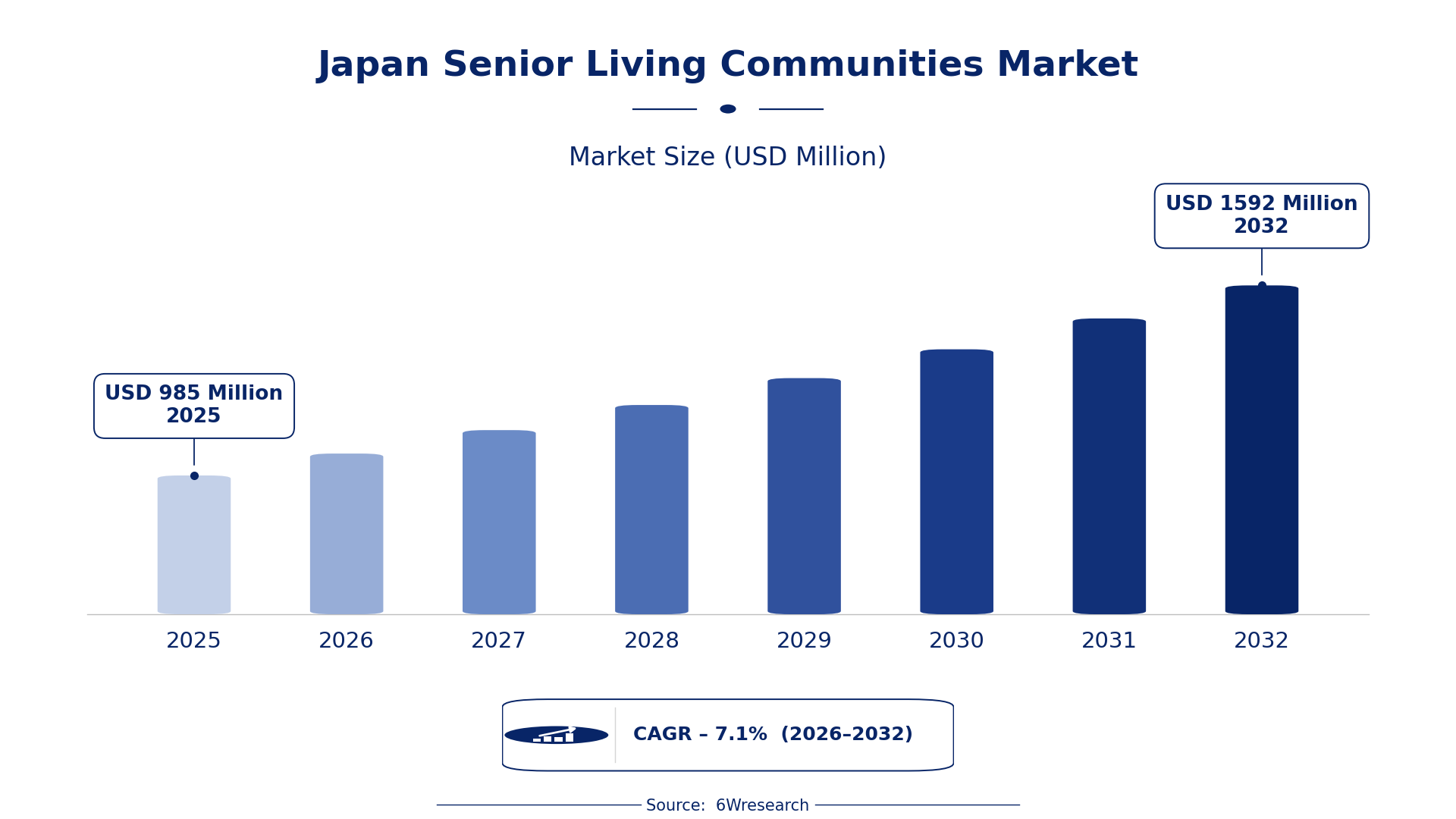
According to 6Wresearch internal database and industry insights, the Japan Senior Living Communities Market was valued at USD 985 Million in 2025 and is projected to reach USD 1,592 Million by 2032, growing at a CAGR of approximately 7.1% during 2026–2032.
Japan Senior Living Communities Market Highlights
| Report Metric | Details |
| Report Name | Japan Senior Living Communities Market (2026-2032) |
| Market Size 2025 | USD 985 Million |
| Market Size 2032 | USD 1,592 Million |
| Absolute Growth 2025–2032 | USD 607 Million |
| CAGR 2026–2032 | 7.1% |
| Peak Annual Growth | 8.0% in 2028 |
| Forecast Period | 2026–2032 |
| Historical Data | 2022–2025 |
| Base Year | 2025 |
| Leading Community Type, 2025 | Independent Living (38% share) |
| Leading Service Offering, 2025 | Basic Amenities (48% share) |
| Leading Housing Structure, 2025 | Apartment/Villa (48% share) |
| Leading End User, 2025 | Active Seniors (40% share) |
| Fastest-Growing Community Type | Assisted Living (9.8% CAGR) |
| Fastest-Growing Service Offering | Nursing/Medical Aid (9.5% CAGR) |
| Fastest-Growing Housing Structure | Shared Complexes (9.2% CAGR) |
| Fastest-Growing End User | Elderly with Mild Dependency (9.0% CAGR) |
| Growing Sector | Senior Living Communities |
| Key End Users | Elderly with Mild Dependency, Long-Term Residents, Alzheimer's Patients |
Japan Senior Living Communities Market Year-wise Growth Rate and Key Drivers (2022–2032)
This graph illustrates the annual growth rates of the market from 2022 to 2032, highlighting a steady upward trajectory and projected market expansion over the forecast period.
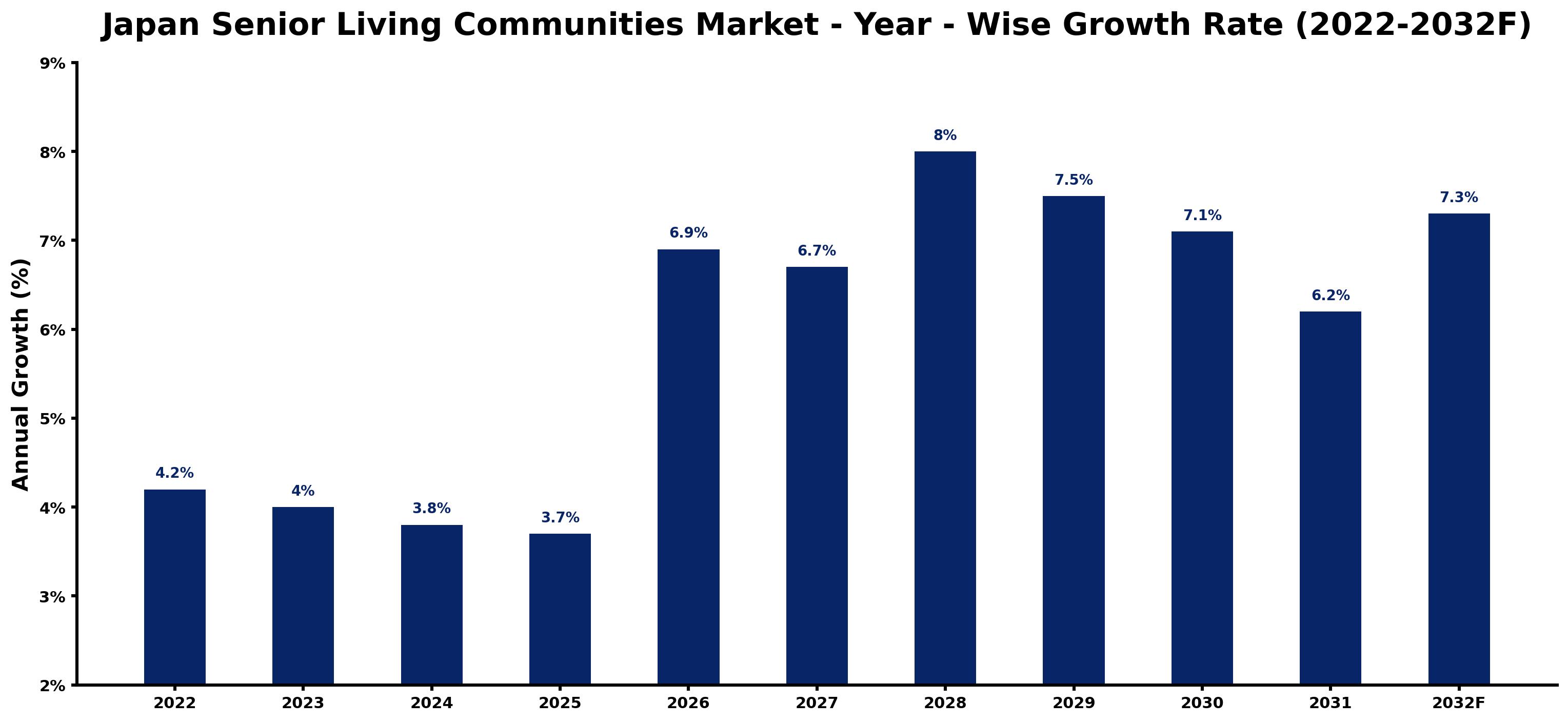
The table below sets out the estimated growth rate for each year and the main factor behind it.
| Year | Estimated Annual Growth (%) | Market Rationale |
| 2022 | 4.2 | The market experienced steady growth due to increasing awareness of senior care needs. |
| 2023 | 4.0 | Demand continued to rise, although growth slowed slightly compared to the previous year. |
| 2024 | 3.8 | The market maintained growth, driven by ongoing demographic changes and care requirements. |
| 2025 | 3.7 | Growth remained stable, reflecting consistent demand for various senior living options. |
| 2026 | 6.9 | The market is expected to accelerate as investments in senior living facilities increase. |
| 2027 | 6.7 | Growth is projected to slow slightly, influenced by market saturation in urban areas. |
| 2028 | 8.0 | The market will peak, driven by heightened demand for assisted living services. |
| 2029 | 7.5 | Growth is anticipated to slow as the market adjusts to new service offerings. |
| 2030 | 7.1 | The market is expected to grow at a moderate rate, reflecting demographic trends. |
| 2031 | 6.2 | Competition among service providers will increase, leading to a slowdown in growth. |
| 2032 | 7.3 | Demand is projected to rise again, driven by technological advancements in care. |
Note: Market size estimations and growth projections presented in this report are based on 6Wresearch's proprietary forecasting methodology, utilizing the latest available industry data, government publications, and primary research inputs.
Japan Senior Living Communities Market Synopsis
Senior Living Communities in Japan encompass various housing and support services designed for the elderly, including independent and assisted living options. The Japan Senior Living Communities Market is growing due to a rapidly aging population, with 29.3% of Japan's population aged 65 or older as of September 2024. Investments in dementia care training and the Long-Term Care Insurance system are improving service offerings, leading to increased demand for these communities. By 2040, the elderly population is projected to reach 36 million, further driving the need for senior living solutions.
Market Dynamics Impact Analysis (2026–2032)
| Factor | Type | Impact | Primary Segment Affected |
| Aging population driving demand for senior living communities | Driver | High | Independent Living |
| Increased investment in dementia care training and facilities | Driver | High | Assisted Living |
| Growing need for specialized care services for seniors | Opportunity | High | Memory Care |
| Rising demand for integrated living options for seniors | Opportunity | Medium | Shared Complexes |
| High operational costs affecting facility management | Restraint | High | Assisted Living |
| Limited availability of trained staff for specialized care | Restraint | Medium | Memory Care |
| Compliance with stringent regulations on care standards | Challenge | High | Nursing/Medical Aid |
| Capacity constraints in urban areas limiting expansion | Challenge | Medium | Independent Living |
Evaluation of Drivers in Japan Senior Living Communities Market (2026–2032)
The main growth drivers and the segments they affect most are set out below.
| Drivers | Primary Segment Affected | Why It Matters (Evidence) |
| Aging population increases demand for senior living options | Independent Living | 29.3% of Japan's population was aged 65 or older in September 2024, prompting more seniors to seek independent living solutions. |
| Investment in dementia care training improves service quality | Assisted Living | In 2023, the government launched a program to improve dementia care training, increasing the appeal of assisted living facilities. |
| Rising healthcare costs push seniors towards community living | Memory Care | The average monthly cost for assisted living is around ¥300,000, making community living a more attractive option for many. |
| Long-Term Care Insurance supports funding for eligible seniors | Nursing/Medical Aid | The Long-Term Care Insurance Act funds nursing care, making it easier for seniors to access necessary medical aid. |
| Increased awareness of mental health needs among seniors | Dementia-Specific | Dementia care units are increasingly integrated into assisted living facilities, reflecting a growing focus on mental health. |
Volumes grow on the back of a projected elderly population of 36 million by 2040, prompting higher demand for senior living communities. The average age of residents in assisted living facilities is 85 years, indicating a shift towards more comprehensive support solutions. With healthcare costs rising, many seniors are opting for community living to manage expenses more effectively.
Evaluation of Restraints in Japan Senior Living Communities Market
Several factors work against faster growth; the main ones are summarised below.
| Market Restraint | Primary Segment Affected | Why It Matters (Evidence) |
| High operational costs limit facility management capabilities | Assisted Living | The average monthly cost for assisted living is around ¥300,000, which can strain budgets for operators. |
| Shortage of trained staff for specialized care roles | Memory Care | The increasing need for dementia care has outpaced the availability of qualified personnel, affecting service delivery. |
| Regulatory compliance requirements increase operational complexity | Nursing/Medical Aid | Facilities must adhere to strict standards set by the Ministry of Health, Labour and Welfare, increasing administrative burdens. |
| Market saturation in urban areas limits growth potential | Independent Living | With a high concentration of senior living communities in Tokyo, new developments face stiff competition. |
| Limited funding for facility upgrades and expansions | Shared Complexes | Many facilities struggle to secure financing for necessary improvements due to high operational costs. |
Japan Senior Living Communities Market Challenges
High monthly costs for assisted living at around ¥300,000 strain families who pay for elderly care. Regulatory hurdles set by the Ministry of Health, Labour and Welfare can delay facility approvals for up to six months, impacting producers' ability to meet rising demand. Increased staffing costs are forcing communities to raise fees, making it challenging for buyers to access necessary services. Supply chain disruptions for essential care equipment can lead to service interruptions, compromising the quality of life for residents and creating dissatisfaction among families.
Trends in the Japan Senior Living Communities Market
These developments are changing demand patterns in the Japan Senior Living Communities Market.
- Shift towards Integrated Care Models: Japan is increasingly adopting integrated care models that combine housing, healthcare, and social activities for seniors. The Tokyo Metropolitan Government has initiated programs to promote senior-friendly housing, focusing on community engagement. This shift is expected to improve the quality of life for residents.
- Transition from Independent Living to Assisted Living: Since 2023, there has been a noticeable trend of seniors moving from independent living to assisted living facilities. Approximately 5,000 registered senior living communities in Japan are adapting to meet this growing demand, leading to expanded service offerings.
- Emergence of Dementia Care Units in Facilities: Dementia care units have become increasingly integrated into assisted living facilities since 2023, reflecting a growing recognition of specialized care needs. This trend is supported by the government's focus on enhancing dementia care training for staff.
- Growth of Shared Complexes for Social Interaction: Shared complexes are gaining popularity among seniors seeking social interaction and community engagement. With a projected CAGR of 9.2% for this segment, facilities are adapting to create more communal spaces.
Investment Opportunities in the Japan Senior Living Communities Market
The openings below show where demand in the Japan Senior Living Communities Market is visible and how suppliers can enter.
- Active Seniors seeking community engagement: Active seniors are increasingly looking for communities that offer social activities and support. With 36 million elderly individuals projected by 2040, there is a substantial opportunity to develop more engaging living environments.
- Tokyo's demand for senior-friendly housing: Tokyo has the highest concentration of senior living communities, creating a need for more tailored housing solutions. Investing in shared complexes can meet the demand for social interaction among residents.
- Immediate need for enhanced dementia care services: With the government's 2023 initiative for dementia care training, there is an immediate opportunity to invest in specialized facilities. This aligns with the growing elderly population and their care needs.
- Funding for facility upgrades available now: Many facilities require upgrades to meet new standards, with funding options available through the Long-Term Care Insurance Act. This provides a clear pathway for investment in nursing and medical aid services.
Government Initiatives in the Japan Senior Living Communities Market
The Long-Term Care Insurance Act, enacted in 1997 and in force since 2000, is essential for funding nursing care and support services for older individuals. This legislation enables seniors to access necessary care, impacting the demand for senior living communities. Facilities must comply with the standards set by the Ministry of Health, Labour and Welfare to qualify for funding, ensuring a minimum level of service quality.
The Ministry of Health, Labour and Welfare oversees the implementation of healthcare regulations for senior living facilities. This agency approves funding under the Long-Term Care Insurance Act, ensuring that eligible seniors receive the necessary support. In 2023, the government launched a program to enhance dementia care training for staff, further improving service standards across facilities.
Future Insight of the Japan Senior Living Communities Market
Technological advancements, such as remote monitoring systems, will reshape the demand for senior living communities by 2032. The integration of smart health devices will improve health management for residents, promoting greater independence. Government initiatives focused on improving dementia care training will elevate service quality across facilities. With Japan's elderly population projected to reach 36 million by 2040, communities must diversify their offerings to cater to the evolving needs of seniors.
Market Segmentation Analysis
Japan Senior Living Communities Market report covers a detailed analysis of the following market segments:
By Community Type – Independent Living Leads, Assisted Living Expected to Grow Fastest
According to Saurav Kr Singh, Senior Research Analyst at 6Wresearch, the largest community type category in 2025 was Independent Living, at 38% of revenue. Independent Living holds the largest share as it appeals to seniors seeking autonomy while still enjoying community resources. This trend is particularly pronounced in urban areas like Tokyo, where the demand for independent housing options is substantial. Over 2026–2032, Assisted Living is expected to post the fastest growth, at a CAGR of 9.8%. Assisted Living is experiencing rapid growth due to the increasing need for assistance with daily activities among the elderly population. The government's recent programme aimed at enhancing dementia care training for staff is expected to further accelerate this segment's development. Suppliers must focus on creating solutions that cater to the growing preference for assisted living options.
By Service Offering – Basic Amenities Lead, Nursing/Medical Aid Expected to Grow Fastest
Basic Amenities took 48% of service offering revenue in 2025, more than any other category. Basic Amenities dominate the market as they are essential for providing comfortable living conditions in senior communities. These amenities are often emphasised by facilities to attract residents, making them a critical component of their service offerings. Nursing/Medical Aid is projected to grow fastest, at a CAGR of 9.5% during 2026–2032. Nursing/Medical Aid is the fastest-growing segment, reflecting the urgent need for health management services among older adults. With the elderly population on the rise, there is a pressing demand for enhanced medical support within senior living environments. Buyers should seek facilities that offer comprehensive nursing and medical aid services to ensure adequate care.
By Housing Structure – Apartment/Villa Leads, Shared Complexes Expected to Grow Fastest
With 48% of housing structure revenue in 2025, Apartment/Villa was the largest category. Apartment/Villa structures are the primary choice for seniors, providing a balance of independence and community living. This type of housing is prevalent in areas with a high concentration of senior living communities, such as Tokyo. Shared Complexes are set to record the highest CAGR in this split, 9.2% over 2026–2032. Shared Complexes are gaining popularity as they encourage social interaction among residents, which is vital for mental well-being. The increasing focus on community engagement drives the demand for this housing type. Suppliers should consider developing more shared living options to meet the growing interest in social environments for seniors.
By End User – Active Seniors Lead, Elderly with Mild Dependency Expected to Grow Fastest
Active Seniors held 40% of the Japan Senior Living Communities Market by end user in 2025. Active Seniors form the largest segment as they pursue independent living options that support an engaging lifestyle. This group is particularly prominent in urban settings where social activities are plentiful and accessible. The quickest growth will come from Elderly with Mild Dependency, forecast to expand at a CAGR of 9.0% between 2026 and 2032. Elderly with Mild Dependency represent the fastest-growing demographic, indicating a rising need for assistance among seniors who wish to retain some level of independence. The anticipated growth of Japan's elderly population further accelerates this trend. Providers must adjust their services to effectively address the specific requirements of elderly individuals needing mild assistance.
Key Attractiveness of the Report
- 10 Years of Market Numbers
- Historical Data Starting from 2022 to 2025
- Base Year 2025
- Forecast Data until 2032
- Key Performance Indicators Impacting the Market
- Major Upcoming Developments and Projects
Key Highlights of the Report:
- Japan Senior Living Communities Market Outlook
- Market Size of Japan Senior Living Communities Market, 2025
- Forecast of Japan Senior Living Communities Market, 2032
- Historical Data and Forecast of Japan Senior Living Communities Revenues & Volume for the Period 2022-2032F
- Japan Senior Living Communities Market Trend Evolution
- Japan Senior Living Communities Market Drivers and Challenges
- Japan Senior Living Communities Price Trends
- Japan Senior Living Communities Porter's Five Forces
- Japan Senior Living Communities Industry Life Cycle
- Historical Data and Forecast of Japan Senior Living Communities Market Revenues & Volume By Community Type for the Period 2022-2032F
- Historical Data and Forecast of Japan Senior Living Communities Market Revenues & Volume By Independent Living for the Period 2022-2032F
- Historical Data and Forecast of Japan Senior Living Communities Market Revenues & Volume By Assisted Living for the Period 2022-2032F
- Historical Data and Forecast of Japan Senior Living Communities Market Revenues & Volume By Continuing Care for the Period 2022-2032F
- Historical Data and Forecast of Japan Senior Living Communities Market Revenues & Volume By Memory Care for the Period 2022-2032F
- Historical Data and Forecast of Japan Senior Living Communities Market Revenues & Volume By Service Offering for the Period 2022-2032F
- Historical Data and Forecast of Japan Senior Living Communities Market Revenues & Volume By Basic Amenities for the Period 2022-2032F
- Historical Data and Forecast of Japan Senior Living Communities Market Revenues & Volume By Nursing/Medical Aid for the Period 2022-2032F
- Historical Data and Forecast of Japan Senior Living Communities Market Revenues & Volume By Progressive Care Units for the Period 2022-2032F
- Historical Data and Forecast of Japan Senior Living Communities Market Revenues & Volume By Dementia-Specific for the Period 2022-2032F
- Historical Data and Forecast of Japan Senior Living Communities Market Revenues & Volume By Housing Structure for the Period 2022-2032F
- Historical Data and Forecast of Japan Senior Living Communities Market Revenues & Volume By Apartment/Villa for the Period 2022-2032F
- Historical Data and Forecast of Japan Senior Living Communities Market Revenues & Volume By Shared Complexes for the Period 2022-2032F
- Historical Data and Forecast of Japan Senior Living Communities Market Revenues & Volume By Mixed Living Options for the Period 2022-2032F
- Historical Data and Forecast of Japan Senior Living Communities Market Revenues & Volume By Secured Units for the Period 2022-2032F
- Historical Data and Forecast of Japan Senior Living Communities Market Revenues & Volume By End User for the Period 2022-2032F
- Historical Data and Forecast of Japan Senior Living Communities Market Revenues & Volume By Active Seniors for the Period 2022-2032F
- Historical Data and Forecast of Japan Senior Living Communities Market Revenues & Volume By Elderly with Mild Dependency for the Period 2022-2032F
- Historical Data and Forecast of Japan Senior Living Communities Market Revenues & Volume By Long-Term Residents for the Period 2022-2032F
- Historical Data and Forecast of Japan Senior Living Communities Market Revenues & Volume By Alzheimer's Patients for the Period 2022-2032F
- Japan Senior Living Communities Import Export Trade Statistics
- Market Opportunity Assessment By Community Type
- Market Opportunity Assessment By Service Offering
- Market Opportunity Assessment By Housing Structure
- Market Opportunity Assessment By End User
- Japan Senior Living Communities Top Companies Market Share
- Japan Senior Living Communities Competitive Benchmarking By Technical and Operational Parameters
- Japan Senior Living Communities Company Profiles
- Japan Senior Living Communities Key Strategic Recommendations
Market Covered
The report covers the following segments.
By Community Type
- Independent Living
- Assisted Living
- Continuing Care
- Memory Care
By Service Offering
- Basic Amenities
- Nursing/Medical Aid
- Progressive Care Units
- Dementia-Specific
By Housing Structure
- Apartment/Villa
- Shared Complexes
- Mixed Living Options
- Secured Units
By End User
- Active Seniors
- Elderly with Mild Dependency
- Long-Term Residents
- Alzheimer's Patients































