Japan Senior Living Facilities Market Size & Growth Rate
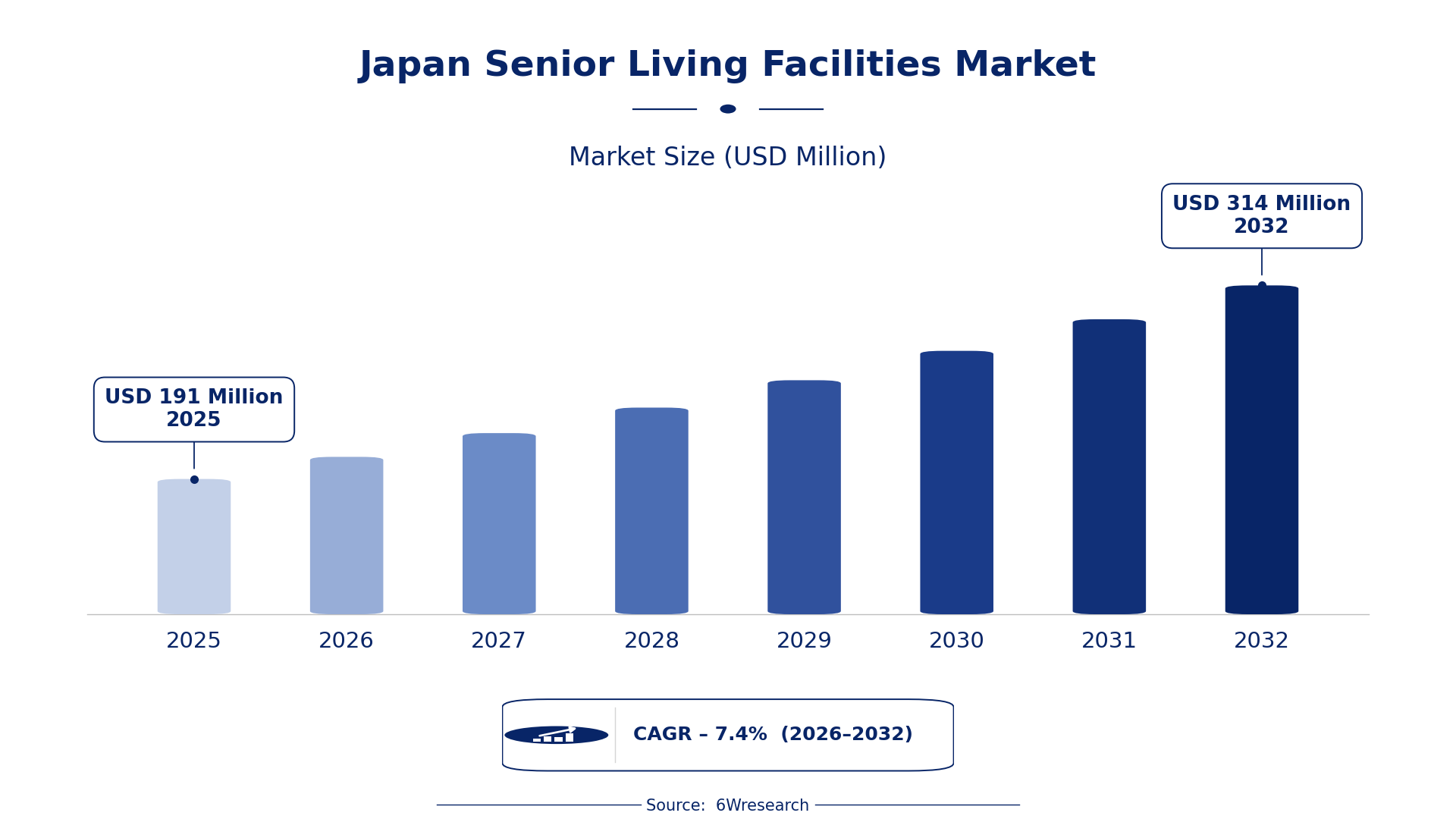
According to 6Wresearch internal database and industry insights, the Japan Senior Living Facilities Market was valued at USD 191 Million in 2025 and is projected to reach USD 314 Million by 2032, growing at a CAGR of approximately 7.4% during 2026–2032.
Japan Senior Living Facilities Market Highlights
| Report Metric | Details |
| Report Name | Japan Senior Living Facilities Market (2026-2032) |
| Market Size 2025 | USD 191 Million |
| Market Size 2032 | USD 314 Million |
| Absolute Growth 2025–2032 | USD 123 Million |
| CAGR 2026–2032 | 7.4% |
| Peak Annual Growth | 8.0% in 2030 |
| Forecast Period | 2026–2032 |
| Historical Data | 2022–2025 |
| Base Year | 2025 |
| Leading Facility Type, 2025 | Skilled Nursing Homes (49% share) |
| Leading Healthcare Integration, 2025 | 24/7 Medical Services (40% share) |
| Leading Licensing Type, 2025 | State Certified (39% share) |
| Leading End User, 2025 | Seniors with Disabilities (43% share) |
| Fastest-Growing Facility Type | Rehabilitation Centers (9.4% CAGR) |
| Fastest-Growing Healthcare Integration | Physical Therapy (9.6% CAGR) |
| Fastest-Growing Licensing Type | Government-Affiliated (10.2% CAGR) |
| Fastest-Growing End User | Post-Surgery Patients (9.5% CAGR) |
| Growing Sector | Senior Living Facilities |
| Key End Users | Seniors with Disabilities, Families Seeking Support, Post-Surgery Patients |
Japan Senior Living Facilities Market Year-wise Growth Rate and Key Drivers (2022–2032)
This graph illustrates the annual growth rates of the market from 2022 to 2032, highlighting a steady upward trajectory and projected market expansion over the forecast period.
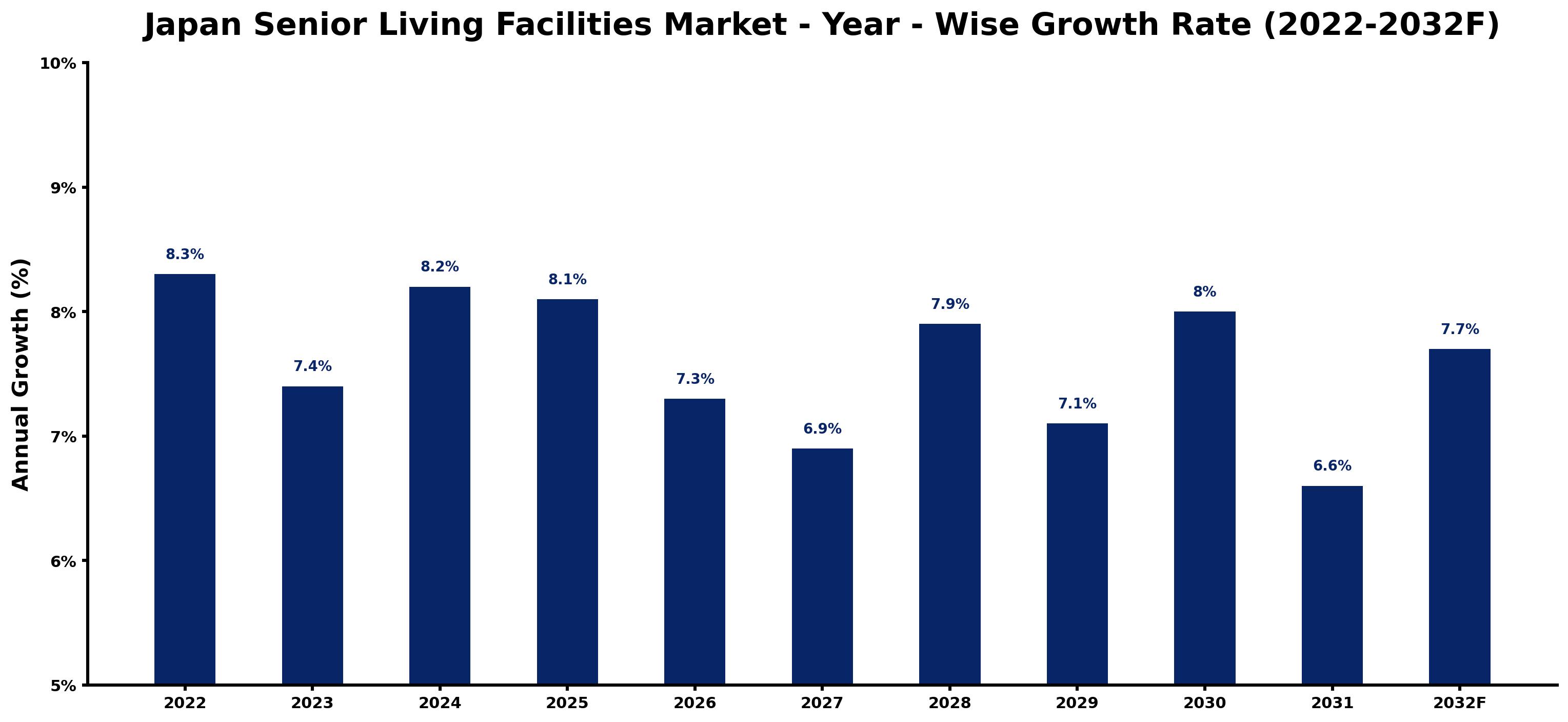
Year by year, the estimates below pair each growth rate with the development that shaped it.
| Year | Estimated Annual Growth (%) | Market Rationale |
| 2022 | 8.3 | Demand for senior living facilities remained strong, reflecting the aging population's needs. |
| 2023 | 7.4 | Growth slowed due to market saturation in urban areas, but demand continued to rise. |
| 2024 | 8.2 | Increased awareness of senior care options led to higher occupancy rates in facilities. |
| 2025 | 8.1 | Demand for rehabilitation centers grew, driven by an aging population recovering from surgeries. |
| 2026 | 7.3 | Market expansion is expected to slow as facilities reach capacity limits in major cities. |
| 2027 | 6.9 | Growth is projected to continue decelerating as competition intensifies among service providers. |
| 2028 | 7.9 | Rehabilitation centers are expected to gain traction as more seniors seek post-surgery care options. |
| 2029 | 7.1 | Demand for skilled nursing homes will remain steady, although growth rates are expected to moderate. |
| 2030 | 8.0 | Occupancy rates are projected to peak as facilities adapt to the evolving needs of seniors. |
| 2031 | 6.6 | Growth is expected to slow as the market stabilises, reflecting a mature sector. |
| 2032 | 7.7 | Increased investment in technology will drive demand for modernised senior living options. |
Note: Market size estimations and growth projections presented in this report are based on 6Wresearch's proprietary forecasting methodology, utilizing the latest available industry data, government publications, and primary research inputs.
Japan Senior Living Facilities Market Synopsis
Senior living facilities in Japan encompass a range of accommodations tailored for elderly individuals, including assisted living homes and skilled nursing homes. With over 8 million seniors aged 75 and older as of 2023, the Japan Senior Living Facilities Market is growing due to increasing demand for specialised care services and rehabilitation centres. The average occupancy rate stands at around 90%, demonstrating strong interest from families seeking support for elderly relatives, particularly in urban areas like Tokyo and Osaka.
Market Dynamics Impact Analysis (2026–2032)
| Factor | Type | Impact | Primary Segment Affected |
| Growing aging population | Driver | High | Skilled Nursing Homes |
| Increased demand for rehabilitation services | Driver | High | Rehabilitation Centers |
| Expansion of state-certified facilities | Opportunity | High | State Certified |
| Rising interest in community engagement | Opportunity | Medium | Retirement Villages |
| Limited availability of skilled nursing beds | Restraint | High | Skilled Nursing Homes |
| High operational costs for facilities | Restraint | Medium | Assisted Living Homes |
| Competition among service providers | Challenge | High | Rehabilitation Centers |
| Regulatory compliance costs | Challenge | Medium | Skilled Nursing Homes |
Evaluation of Drivers in Japan Senior Living Facilities Market (2026–2032)
Demand rests on the following drivers, each shown with the segment it touches most.
| Drivers | Primary Segment Affected | Why It Matters (Evidence) |
| Aging population increasing demand for care services | Skilled Nursing Homes | 29.3% of Japan's population was aged 65 or older in September 2024, driving demand for skilled nursing care. |
| Rising number of post-surgery patients | Rehabilitation Centers | Rehabilitation centers reported a 20% increase in admissions in 2023, reflecting higher demand for recovery services. |
| Government initiatives to expand certified facilities | State Certified | The Japanese government aims to increase certified facilities by 15% by 2025, enhancing service availability. |
| Growing awareness of senior care options | Assisted Living Homes | With an average age of 82 years for residents, families are increasingly seeking assisted living solutions. |
| Integration of physical therapy services | Physical Therapy | Physical therapy is integrated into 70% of skilled nursing homes, improving recovery outcomes for seniors. |
Buyers are adding capacity as the aging population drives demand for senior living facilities. In 2023, over 8 million seniors aged 75 and older highlighted the need for skilled nursing homes and rehabilitation centers. The average occupancy rate of approximately 90% indicates strong interest from families seeking care for elderly relatives. Integration of physical therapy services in skilled nursing homes is evident, with 70% of these facilities offering such services, which supports recovery for seniors and further boosts demand.
Evaluation of Restraints in Japan Senior Living Facilities Market
The main factors holding the market back are set out below.
| Market Restraint | Primary Segment Affected | Why It Matters (Evidence) |
| Limited availability of skilled nursing beds | Skilled Nursing Homes | As of 2023, the average length of stay in skilled nursing homes is around 2.5 years, limiting bed turnover. |
| High operational costs for facilities | Assisted Living Homes | Operational costs have increased by 15% over the last three years, impacting profitability. |
| Regulatory compliance costs | Skilled Nursing Homes | Facilities must adhere to the Long-Term Care Insurance Act, raising operational expenses by 10%. |
| Competition among service providers | Rehabilitation Centers | Growing competition has led to price wars, affecting profitability for rehabilitation centers by 20%. |
| Market saturation in urban areas | Retirement Villages | High occupancy rates in Tokyo and Osaka have resulted in limited growth opportunities in these regions. |
Japan Senior Living Facilities Market Challenges
Intense competition among senior living facilities in Japan leads to price wars, which erode profit margins for providers and restrict quality investments. Buyers encounter long waiting times for skilled nursing homes, with some regions experiencing delays of up to six months, deferring essential medical care for seniors. A shortage of skilled workers in the sector results in insufficient staffing, causing burnout among employees and compromising service quality for residents. Regulatory challenges under the Long-Term Care Insurance Act complicate compliance, leading to operational delays that hinder timely service delivery for seniors.
Trends in the Japan Senior Living Facilities Market
Four trends stand out in the Japan Senior Living Facilities Market.
- Shift towards Integrated Care Services: The trend towards integrated care services began in 2023, with 70% of skilled nursing homes incorporating physical therapy. This shift improves recovery outcomes for seniors and attracts more families seeking comprehensive care.
- Increase in Rehabilitation Center Demand: Since 2023, rehabilitation centers have reported a 20% increase in post-surgery patient admissions, indicating a growing preference for specialized recovery services among seniors.
- Expansion of State-Certified Facilities: The Japanese government initiated a program in 2023 to increase state-certified facilities by 15% by 2025, aiming to improve access to quality care for seniors.
- Rise of Community Engagement in Retirement Villages: In 2023, retirement villages began prioritising community engagement activities, reflecting a shift towards improving social interaction among active retirees.
Investment Opportunities in the Japan Senior Living Facilities Market
The opportunities below stand out in the Japan Senior Living Facilities Market for new entrants and existing suppliers.
- Families Seeking Support: Families searching for support for elderly relatives are increasingly turning to skilled nursing homes, with 29.3% of the population aged 65 or older. Investing in quality care services can address this growing demand.
- Tokyo's Retirement Villages: Tokyo's retirement villages are expanding due to high occupancy rates, with over 8 million seniors aged 75 and older. Investing in community amenities can draw in more residents.
- Need for More Rehabilitation Centers: With a 20% increase in post-surgery patient admissions in 2023, there is a pressing need for additional rehabilitation centres. Investing in these facilities can meet the demands of this expanding market.
- Investment in Assisted Living Homes: As families seek more options for elderly care, investing in assisted living homes can fulfil the demand generated by the ageing population, particularly in urban areas.
Government Initiatives in the Japan Senior Living Facilities Market
The Long-Term Care Insurance Act, implemented in 2000, provides funding for nursing care and support services for older individuals, ensuring that buyers can access necessary assistance. This legislation requires facilities to uphold specific quality standards, which helps guarantee safety and care in senior living. The act covers about 60% of nursing care costs for eligible seniors, encouraging families to seek certified facilities for their loved ones.
The Ministry of Health, Labour and Welfare supervises the implementation of the Long-Term Care Insurance Act, ensuring that facilities adhere to regulations. This agency also funds programmes that support elderly employment, benefiting families seeking care for their loved ones. In 2023, the ministry reported an increase in demand for rehabilitation centres, underscoring the necessity for more certified facilities.
Future Insight of the Japan Senior Living Facilities Market
Advanced technologies such as remote monitoring systems will reshape demand for senior living facilities, improving health management for residents. By 2032, the integration of smart home features will enhance safety and independence for seniors, increasing appeal for buyers. Government initiatives aim to raise the number of state-certified facilities by 15% by 2025, enhancing access to critical care services. The growth of community engagement programmes will promote social interaction, greatly enriching the lives of residents.
Market Segmentation Analysis
Japan Senior Living Facilities Market report covers a detailed analysis of the following market segments:
By Facility Type – Skilled Nursing Homes Lead, Rehabilitation Centers Expected to Grow Fastest
According to Saurav Kr Singh, Senior Research Analyst at 6Wresearch, Skilled Nursing Homes accounted for 49% of the market by facility type in 2025. Skilled nursing homes hold the largest share as they provide essential medical care for seniors with complex health needs, particularly in urban centres like Tokyo. With over 4,500 state-certified facilities, they are well-equipped to address the increasing demand for specialised elder care services. Over 2026–2032, Rehabilitation Centers are expected to post the fastest growth, at a CAGR of 9.4%. Rehabilitation centers are experiencing rapid growth, evidenced by a 20% increase in post-surgery patient admissions in 2023. This surge highlights the urgent need for facilities focusing on recovery and rehabilitation, particularly among the elderly demographic. Suppliers should prioritise the development of services in rehabilitation centers to align with the increasing demand.
By Healthcare Integration – 24/7 Medical Services Lead, Physical Therapy Expected to Grow Fastest
24/7 Medical Services took 40% of healthcare integration revenue in 2025, more than any other category. The presence of 24/7 medical services in skilled nursing homes solidifies their leading market position, as these services are crucial for continuous healthcare support for seniors. Facilities offering round-the-clock care are particularly appealing to families of elderly individuals with complex health conditions. Physical Therapy is set to record the highest CAGR in this split, 9.6% over 2026–2032. Physical therapy is the fastest-growing segment, as it plays a vital role in improving recovery and mobility for seniors. The integration of physical therapy services into skilled nursing homes is essential to effectively meet the rehabilitation needs of the elderly population. Buyers will gain advantages from facilities that emphasise comprehensive healthcare integration, particularly in physical therapy services.
By Licensing Type – State Certified Leads, Government-Affiliated Expected to Grow Fastest
In 2025, State Certified led the licensing type split with a 39% share. State certified facilities lead the market because they ensure compliance with government standards, which is essential for maintaining quality care. This certification is particularly critical in Japan's highly regulated senior living sector, where quality assurance is paramount. The quickest growth will come from Government-Affiliated, forecast to expand at a CAGR of 10.2% between 2026 and 2032. Government-affiliated facilities are witnessing rapid growth due to their additional oversight and support, which enhances the quality of care provided. This trend is likely to continue as the government aims to increase the number of certified facilities by 15% by 2025. Suppliers should align their offerings with government standards to secure partnerships with state-certified facilities.
By End User – Seniors with Disabilities Lead, Post-Surgery Patients Expected to Grow Fastest
The largest end user category in 2025 was Seniors with Disabilities, at 43% of revenue. Seniors with disabilities represent the largest user group, as they require specialised care tailored to their unique needs. This demographic is significant, with over 8 million seniors aged 75 and older in Japan, indicating a strong demand for appropriate living arrangements. Post-Surgery Patients are projected to grow fastest, at a CAGR of 9.5% during 2026–2032. Post-surgery patients are the fastest-growing segment, utilising facilities for recovery and rehabilitation after medical procedures. The rising number of surgeries among the elderly population drives the need for focused recovery services in senior living facilities. Facilities must adapt their services to cater to the specific needs of post-surgery patients to maintain competitiveness.
Key Attractiveness of the Report
- 10 Years of Market Numbers
- Historical Data Starting from 2022 to 2025
- Base Year 2025
- Forecast Data until 2032
- Key Performance Indicators Impacting the Market
- Major Upcoming Developments and Projects
Key Highlights of the Report:
- Japan Senior Living Facilities Market Outlook
- Market Size of Japan Senior Living Facilities Market, 2025
- Forecast of Japan Senior Living Facilities Market, 2032
- Historical Data and Forecast of Japan Senior Living Facilities Revenues & Volume for the Period 2022-2032F
- Japan Senior Living Facilities Market Trend Evolution
- Japan Senior Living Facilities Market Drivers and Challenges
- Japan Senior Living Facilities Price Trends
- Japan Senior Living Facilities Porter's Five Forces
- Japan Senior Living Facilities Industry Life Cycle
- Historical Data and Forecast of Japan Senior Living Facilities Market Revenues & Volume By Facility Type for the Period 2022-2032F
- Historical Data and Forecast of Japan Senior Living Facilities Market Revenues & Volume By Assisted Living Homes for the Period 2022-2032F
- Historical Data and Forecast of Japan Senior Living Facilities Market Revenues & Volume By Skilled Nursing Homes for the Period 2022-2032F
- Historical Data and Forecast of Japan Senior Living Facilities Market Revenues & Volume By Retirement Villages for the Period 2022-2032F
- Historical Data and Forecast of Japan Senior Living Facilities Market Revenues & Volume By Rehabilitation Centers for the Period 2022-2032F
- Historical Data and Forecast of Japan Senior Living Facilities Market Revenues & Volume By Healthcare Integration for the Period 2022-2032F
- Historical Data and Forecast of Japan Senior Living Facilities Market Revenues & Volume By On-Site Nurses for the Period 2022-2032F
- Historical Data and Forecast of Japan Senior Living Facilities Market Revenues & Volume By 24/7 Medical Services for the Period 2022-2032F
- Historical Data and Forecast of Japan Senior Living Facilities Market Revenues & Volume By Community-Only for the Period 2022-2032F
- Historical Data and Forecast of Japan Senior Living Facilities Market Revenues & Volume By Physical Therapy for the Period 2022-2032F
- Historical Data and Forecast of Japan Senior Living Facilities Market Revenues & Volume By Licensing Type for the Period 2022-2032F
- Historical Data and Forecast of Japan Senior Living Facilities Market Revenues & Volume By State Certified for the Period 2022-2032F
- Historical Data and Forecast of Japan Senior Living Facilities Market Revenues & Volume By Medicare Approved for the Period 2022-2032F
- Historical Data and Forecast of Japan Senior Living Facilities Market Revenues & Volume By Private Sector for the Period 2022-2032F
- Historical Data and Forecast of Japan Senior Living Facilities Market Revenues & Volume By Government-Affiliated for the Period 2022-2032F
- Historical Data and Forecast of Japan Senior Living Facilities Market Revenues & Volume By End User for the Period 2022-2032F
- Historical Data and Forecast of Japan Senior Living Facilities Market Revenues & Volume By Families Seeking Support for the Period 2022-2032F
- Historical Data and Forecast of Japan Senior Living Facilities Market Revenues & Volume By Seniors with Disabilities for the Period 2022-2032F
- Historical Data and Forecast of Japan Senior Living Facilities Market Revenues & Volume By Active Retirees for the Period 2022-2032F
- Historical Data and Forecast of Japan Senior Living Facilities Market Revenues & Volume By Post-Surgery Patients for the Period 2022-2032F
- Japan Senior Living Facilities Import Export Trade Statistics
- Market Opportunity Assessment By Facility Type
- Market Opportunity Assessment By Healthcare Integration
- Market Opportunity Assessment By Licensing Type
- Market Opportunity Assessment By End User
- Japan Senior Living Facilities Top Companies Market Share
- Japan Senior Living Facilities Competitive Benchmarking By Technical and Operational Parameters
- Japan Senior Living Facilities Company Profiles
- Japan Senior Living Facilities Key Strategic Recommendations
Market Covered
The following segment groups are covered in the report.
By Facility Type
- Assisted Living Homes
- Skilled Nursing Homes
- Retirement Villages
- Rehabilitation Centers
By Healthcare Integration
- On-Site Nurses
- 24/7 Medical Services
- Community-Only
- Physical Therapy
By Licensing Type
- State Certified
- Medicare Approved
- Private Sector
- Government-Affiliated
By End User
- Families Seeking Support
- Seniors with Disabilities
- Active Retirees
- Post-Surgery Patients































