Japan Senior Living Services Market Size & Growth Rate
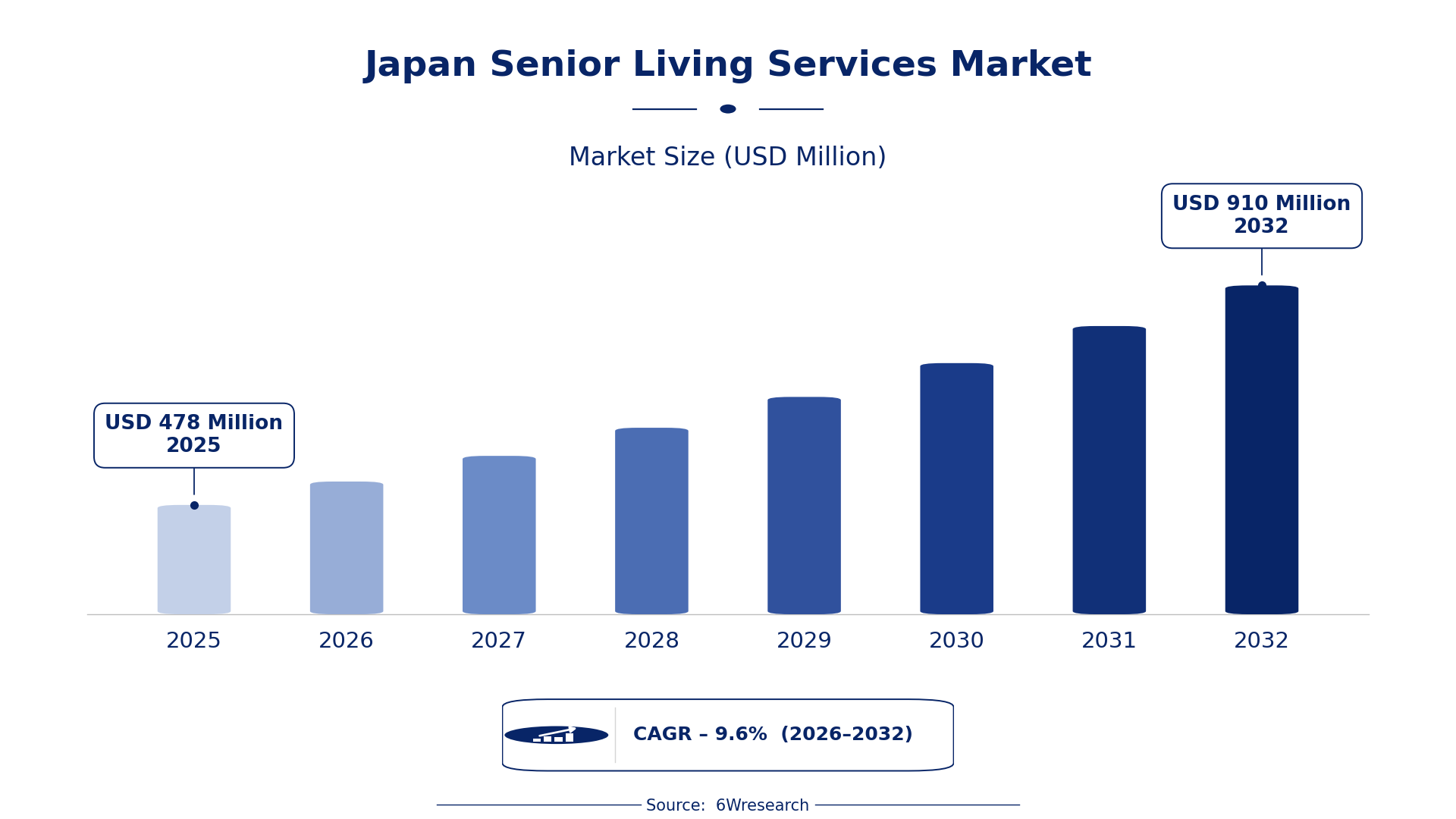
According to 6Wresearch internal database and industry insights, the Japan Senior Living Services Market was valued at USD 478 Million in 2025 and is projected to reach USD 910 Million by 2032, growing at a CAGR of approximately 9.6% during 2026–2032.
Japan Senior Living Services Market Highlights
| Report Metric | Details |
| Report Name | Japan Senior Living Services Market (2026-2032) |
| Market Size 2025 | USD 478 Million |
| Market Size 2032 | USD 910 Million |
| Absolute Growth 2025–2032 | USD 432 Million |
| CAGR 2026–2032 | 9.6% |
| Peak Annual Growth | 10.4% in 2027 |
| Forecast Period | 2026–2032 |
| Historical Data | 2022–2025 |
| Base Year | 2025 |
| Leading Service Type, 2025 | Personal Care (49% share) |
| Leading Delivery Model, 2025 | Facility-Based (49% share) |
| Leading Payment Structure, 2025 | Private/Insurance (44% share) |
| Leading End User, 2025 | Aging at Home (43% share) |
| Fastest-Growing Service Type | Mental Health Support (12.7% CAGR) |
| Fastest-Growing Delivery Model | Telehealth/In-Person (12.3% CAGR) |
| Fastest-Growing Payment Structure | Package-Based (12.9% CAGR) |
| Growing Sector | Senior Living Services |
| Key End Users | Seniors, Caregivers, Healthcare Providers, Facility Operators |
Japan Senior Living Services Market Year-wise Growth Rate and Key Drivers (2022–2032)
This graph illustrates the annual growth rates of the market from 2022 to 2032, highlighting a steady upward trajectory and projected market expansion over the forecast period.
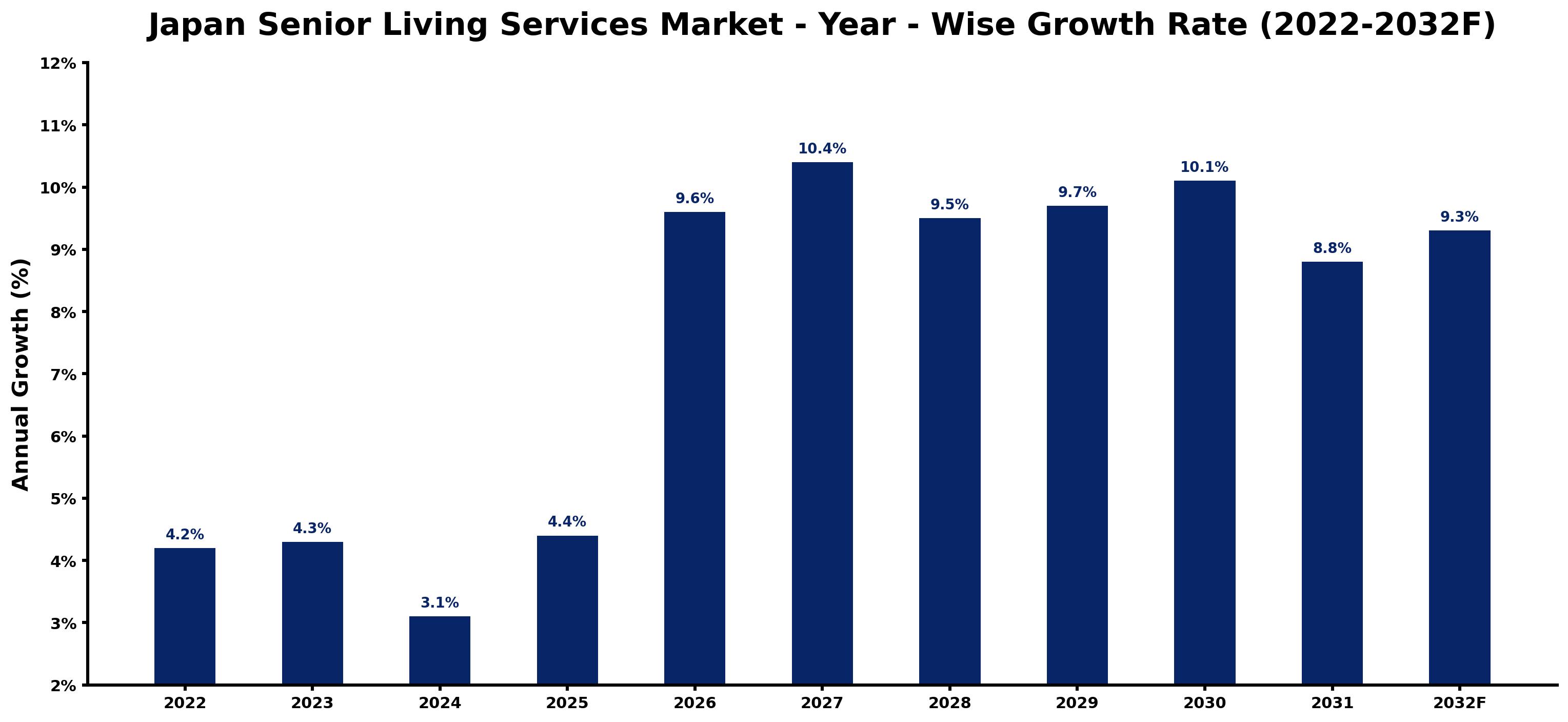
For each year, the table pairs the estimated growth rate with the leading influence on demand, showing how the drivers changed across the period.
| Year | Estimated Annual Growth (%) | Market Rationale |
| 2022 | 4.2 | The market experienced steady growth due to increasing demand for senior care services. |
| 2023 | 4.3 | Demand continued to rise as more seniors sought assistance with daily living activities. |
| 2024 | 3.1 | Growth slowed as market saturation began to affect new service uptake. |
| 2025 | 4.4 | The market saw a resurgence as facility-based services expanded in urban areas. |
| 2026 | 9.6 | Investment in mental health support services is projected to boost market growth. |
| 2027 | 10.4 | A surge in the aging population will drive peak growth this year. |
| 2028 | 9.5 | Growth is expected to slow slightly as the market adjusts to increased service capacity. |
| 2029 | 9.7 | Demand is anticipated to rise again as more seniors opt for facility-based care options. |
| 2030 | 10.1 | The market will continue to expand with new telehealth services gaining traction. |
| 2031 | 8.8 | Growth is projected to slow as the market begins to stabilise after rapid expansion. |
| 2032 | 9.3 | Ongoing investments in senior care facilities will keep demand strong. |
Note: Market size estimations and growth projections presented in this report are based on 6Wresearch's proprietary forecasting methodology, utilizing the latest available industry data, government publications, and primary research inputs.
Japan Senior Living Services Market Synopsis
Senior living services provide support options for the elderly, including personal care, meal services, and mental health support. The Japan Senior Living Services Market is growing due to an aging population, with 29.3% of the population aged 65 or older as of September 2024. The government allocated ¥1 trillion for elderly care services in 2023, driving demand for these offerings. The number of seniors is projected to reach 36 million by 2040, further contributing to market expansion.
Market Dynamics Impact Analysis (2026–2032)
| Factor | Type | Impact | Primary Segment Affected |
| Growing aging population | Driver | High | Personal Care |
| Expansion of facility-based services | Driver | High | Facility-Based |
| Increasing demand for mental health support | Opportunity | High | Mental Health Support |
| Rising telehealth services for seniors | Opportunity | Medium | Telehealth/In-Person |
| High operational costs for facilities | Restraint | High | Facility-Based |
| Limited availability of certified caregivers | Restraint | Medium | Personal Care |
| High costs of assisted living services | Challenge | High | Assisted Living Residents |
| Regulatory compliance burdens for facilities | Challenge | Medium | Seniors in Facilities |
Evaluation of Drivers in Japan Senior Living Services Market (2026–2032)
Below are the drivers that matter most for revenue growth, with supporting evidence.
| Drivers | Primary Segment Affected | Why It Matters (Evidence) |
| Aging population requiring assistance | Personal Care | 29.3% of Japan's population was aged 65 or older in September 2024, increasing demand for personal care services. |
| Growth in facility-based services | Facility-Based | With over 8,000 certified senior living facilities, more seniors are opting for facility-based care. |
| Investment in mental health services | Mental Health Support | The average age of residents in assisted living facilities is 85 years, highlighting the need for mental health support. |
| Rise in telehealth adoption | Telehealth/In-Person | The number of telehealth services for seniors increased by 30% in 2023, enhancing care options. |
| Government funding for elderly care | Insurance/Reimbursement | In 2023, the government allocated ¥1 trillion for elderly care services, supporting various care models. |
Behind the steady rise in orders sits the increasing number of seniors requiring assistance, with Japan's elderly population projected to reach 36 million by 2040. This demographic shift drives demand for personal care services, particularly in facility-based settings, which number over 8,000 across the country. The average age of residents in assisted living facilities is 85 years, highlighting the need for mental health support. The rise of telehealth services, which increased by 30% in 2023, provides seniors with more accessible care options. Funding of ¥1 trillion for elderly care services in 2023 supports the expansion of these essential offerings, ensuring that care needs are met effectively.
Evaluation of Restraints in Japan Senior Living Services Market
These are the pressures that could keep growth below its potential.
| Market Restraint | Primary Segment Affected | Why It Matters (Evidence) |
| High operational costs for facilities | Facility-Based | The average cost of assisted living in Japan is around ¥200,000 per month, limiting affordability for many families. |
| Limited availability of certified caregivers | Personal Care | The government aims to increase the number of certified caregivers by 15% by 2025, addressing workforce shortages. |
| Regulatory compliance burdens for facilities | Seniors in Facilities | Facilities must adhere to stringent regulations under the Long-Term Care Insurance Act, increasing operational complexity. |
| Rising costs of mental health services | Mental Health Support | Mental health support services for seniors are regulated under the Long-Term Care Insurance Act, impacting service pricing. |
| Market saturation in urban areas | Assisted Living Residents | Tokyo has the highest concentration of assisted living facilities, leading to increased competition and reduced margins. |
Japan Senior Living Services Market Challenges
In 2023, the average cost of assisted living in Japan reached ¥200,000 per month, straining budgets for families and forcing many to seek lower-quality alternatives. Increased competition among over 8,000 certified senior living facilities triggers price wars, undermining service quality and making it difficult for buyers to find reliable providers. Supply chain disruptions for essential care supplies delay service delivery, affecting 4.5 million seniors receiving home care services. Technology adoption lags, with only a 30% increase in telehealth services for seniors, limiting access and convenience for families seeking modern solutions.
Trends in the Japan Senior Living Services Market
Buyers and suppliers in the Japan Senior Living Services Market are adjusting to the following trends.
- Shift towards Telehealth Services: Seniors are increasingly adopting telehealth services, with over 1 million enrolled in 2023. This trend reflects a growing preference for remote care options, improving accessibility for elderly individuals.
- Increased Focus on Mental Health Support: A program launched by the Tokyo Metropolitan Government in 2023 aims to improve mental health services for seniors. This initiative addresses the rising need for emotional well-being among the elderly population.
- Growth of Facility-Based Care: Facility-based care continues to dominate, with 49% market share in 2025. The increasing number of certified facilities supports this trend, providing essential care for seniors.
- Rising Demand for Aging at Home: The number of independent seniors seeking services is rising, with 1.2 million reported in 2023. This trend indicates a preference for aging in place, driving demand for in-home care services.
Investment Opportunities in the Japan Senior Living Services Market
Below are the investment opportunities with the strongest case in the Japan Senior Living Services Market.
- Investment in Mental Health Services: Mental health support services represent a growing opportunity, with a projected increase in demand. Investing in these services can benefit facilities catering to seniors in urban areas.
- Expansion of Telehealth Services: With a 30% increase in telehealth services for seniors in 2023, there is an opportunity to invest in remote care technologies. Partnering with healthcare providers can facilitate entry into this market.
- Development of Package-Based Payment Models: The Package-Based payment structure is projected to grow, indicating an opportunity for service providers to offer bundled services. Targeting the Aging at Home segment can enhance market penetration.
- Enhancement of Facility-Based Services: With over 8,000 certified facilities, there is room for improvement in service offerings. Investing in facility upgrades can attract more residents and meet evolving care needs.
Government Initiatives in the Japan Senior Living Services Market
The Long-Term Care Insurance Act, established in 1997 and fully implemented in 2000, is essential for funding nursing care and support services for older individuals. This legislation ensures that seniors have access to necessary care, promoting a standard of living that aligns with their needs. Compliance with this act is vital for service providers to maintain eligibility for funding and support.
In 2023, the government allocated ¥1 trillion for elderly care services, administered by the Ministry of Health, Labour and Welfare. This funding aims to improve the quality of care and expand service availability, ensuring that seniors receive the support they need. The ministry plays a key role in overseeing the implementation of care standards and regulations.
Future Insight of the Japan Senior Living Services Market
The launch of new telehealth programs will provide remote care options for seniors, improving accessibility. By 2032, the number of certified caregivers will increase by 15%, ensuring better support for the elderly population. The Long-Term Care Insurance system will adapt, offering more comprehensive coverage for the growing number of seniors. The Tokyo Metropolitan Government's recent initiative will improve service quality and availability for buyers, addressing the rising need for senior living services.
Market Segmentation Analysis
Japan Senior Living Services Market report covers a detailed analysis of the following market segments:
By Service Type – Personal Care Leads, Mental Health Support Expected to Grow Fastest
According to Saurav Kr Singh, Senior Research Analyst at 6Wresearch, Personal Care took 49% of service type revenue in 2025, more than any other category. Personal care services are essential for seniors as they assist with daily living activities, making them a top choice for families. For instance, many residents in facilities depend on these services to maintain their quality of life. The quickest growth will come from Mental Health Support, forecast to expand at a CAGR of 12.7% between 2026 and 2032. The demand for mental health support is surging as awareness of its importance for seniors' emotional well-being increases. Government initiatives aimed at enhancing mental health services are significantly contributing to this growth. Suppliers should focus on expanding personal care services while integrating mental health support to meet the rising demands of the elderly.
By Delivery Model – Facility-Based Leads, Telehealth/In-Person Expected to Grow Fastest
Facility-Based accounted for 49% of the market by delivery model in 2025. Facility-based services dominate the market as they provide a comprehensive environment for various senior care options. With over 8,000 certified facilities in Japan, this model is well-established and trusted by families seeking care for their loved ones. Telehealth/In-Person is set to record the highest CAGR in this split, 12.3% over 2026–2032. Telehealth services are experiencing rapid growth, reflecting a shift towards more accessible care solutions for seniors. The 30% increase in telehealth services in 2023 highlights the demand for convenient healthcare options. Providers must invest in telehealth capabilities to complement facility-based services and align with changing consumer preferences.
By Payment Structure – Private/Insurance Leads, Package-Based Expected to Grow Fastest
The largest payment structure category in 2025 was Private/Insurance, at 44% of revenue. Private and insurance payments are the primary funding methods for senior living services, making them the leading payment structure. Many families rely on these methods to ensure quality care for their elderly relatives. Over 2026–2032, Package-Based is expected to post the fastest growth, at a CAGR of 12.9%. Package-based payment models are gaining traction as they simplify costs for families by offering bundled services. This trend is driven by the increasing complexity of care requirements among seniors. Suppliers should consider developing package-based offerings to attract cost-conscious consumers seeking comprehensive solutions.
By End User – Aging at Home Leads and Records the Fastest Growth
With 43% of end user revenue in 2025, Aging at Home was the largest category. Aging at home is the preferred choice for many seniors, allowing them to maintain independence while receiving necessary support. This trend is evident as more seniors opt for in-home care services to stay in familiar surroundings. Aging at Home is also forecast to expand faster than any other category, at a CAGR of 12.0% over 2026–2032. Aging at home is also the fastest-growing segment as the desire for familiar surroundings increases among seniors. This reinforces the critical importance of home care services in the overall market. Providers should enhance home care services to capture the expanding segment of seniors wishing to age in place.
Key Attractiveness of the Report
- 10 Years of Market Numbers
- Historical Data Starting from 2022 to 2025
- Base Year 2025
- Forecast Data until 2032
- Key Performance Indicators Impacting the Market
- Major Upcoming Developments and Projects
Key Highlights of the Report:
- Japan Senior Living Services Market Outlook
- Market Size of Japan Senior Living Services Market, 2025
- Forecast of Japan Senior Living Services Market, 2032
- Historical Data and Forecast of Japan Senior Living Services Revenues & Volume for the Period 2022-2032F
- Japan Senior Living Services Market Trend Evolution
- Japan Senior Living Services Market Drivers and Challenges
- Japan Senior Living Services Price Trends
- Japan Senior Living Services Porter's Five Forces
- Japan Senior Living Services Industry Life Cycle
- Historical Data and Forecast of Japan Senior Living Services Market Revenues & Volume By Service Type for the Period 2022-2032F
- Historical Data and Forecast of Japan Senior Living Services Market Revenues & Volume By Personal Care for the Period 2022-2032F
- Historical Data and Forecast of Japan Senior Living Services Market Revenues & Volume By Meal & Nutrition for the Period 2022-2032F
- Historical Data and Forecast of Japan Senior Living Services Market Revenues & Volume By Housekeeping for the Period 2022-2032F
- Historical Data and Forecast of Japan Senior Living Services Market Revenues & Volume By Mental Health Support for the Period 2022-2032F
- Historical Data and Forecast of Japan Senior Living Services Market Revenues & Volume By Delivery Model for the Period 2022-2032F
- Historical Data and Forecast of Japan Senior Living Services Market Revenues & Volume By In-Person for the Period 2022-2032F
- Historical Data and Forecast of Japan Senior Living Services Market Revenues & Volume By Facility-Based for the Period 2022-2032F
- Historical Data and Forecast of Japan Senior Living Services Market Revenues & Volume By On-Demand for the Period 2022-2032F
- Historical Data and Forecast of Japan Senior Living Services Market Revenues & Volume By Telehealth/In-Person for the Period 2022-2032F
- Historical Data and Forecast of Japan Senior Living Services Market Revenues & Volume By Payment Structure for the Period 2022-2032F
- Historical Data and Forecast of Japan Senior Living Services Market Revenues & Volume By Private/Insurance for the Period 2022-2032F
- Historical Data and Forecast of Japan Senior Living Services Market Revenues & Volume By Package-Based for the Period 2022-2032F
- Historical Data and Forecast of Japan Senior Living Services Market Revenues & Volume By Subscription for the Period 2022-2032F
- Historical Data and Forecast of Japan Senior Living Services Market Revenues & Volume By Insurance/Reimbursement for the Period 2022-2032F
- Historical Data and Forecast of Japan Senior Living Services Market Revenues & Volume By End User for the Period 2022-2032F
- Historical Data and Forecast of Japan Senior Living Services Market Revenues & Volume By Aging at Home for the Period 2022-2032F
- Historical Data and Forecast of Japan Senior Living Services Market Revenues & Volume By Assisted Living Residents for the Period 2022-2032F
- Historical Data and Forecast of Japan Senior Living Services Market Revenues & Volume By Independent Seniors for the Period 2022-2032F
- Historical Data and Forecast of Japan Senior Living Services Market Revenues & Volume By Seniors in Facilities for the Period 2022-2032F
- Japan Senior Living Services Import Export Trade Statistics
- Market Opportunity Assessment By Service Type
- Market Opportunity Assessment By Delivery Model
- Market Opportunity Assessment By Payment Structure
- Market Opportunity Assessment By End User
- Japan Senior Living Services Top Companies Market Share
- Japan Senior Living Services Competitive Benchmarking By Technical and Operational Parameters
- Japan Senior Living Services Company Profiles
- Japan Senior Living Services Key Strategic Recommendations
Market Covered
The study includes the following segmentation.
By Service Type
- Personal Care
- Meal & Nutrition
- Housekeeping
- Mental Health Support
By Delivery Model
- In-Person
- Facility-Based
- On-Demand
- Telehealth/In-Person
By Payment Structure
- Private/Insurance
- Package-Based
- Subscription
- Insurance/Reimbursement
By End User
- Aging at Home
- Assisted Living Residents
- Independent Seniors
- Seniors in Facilities































