Japan Senior Rehabilitation Services Market Size & Growth Rate
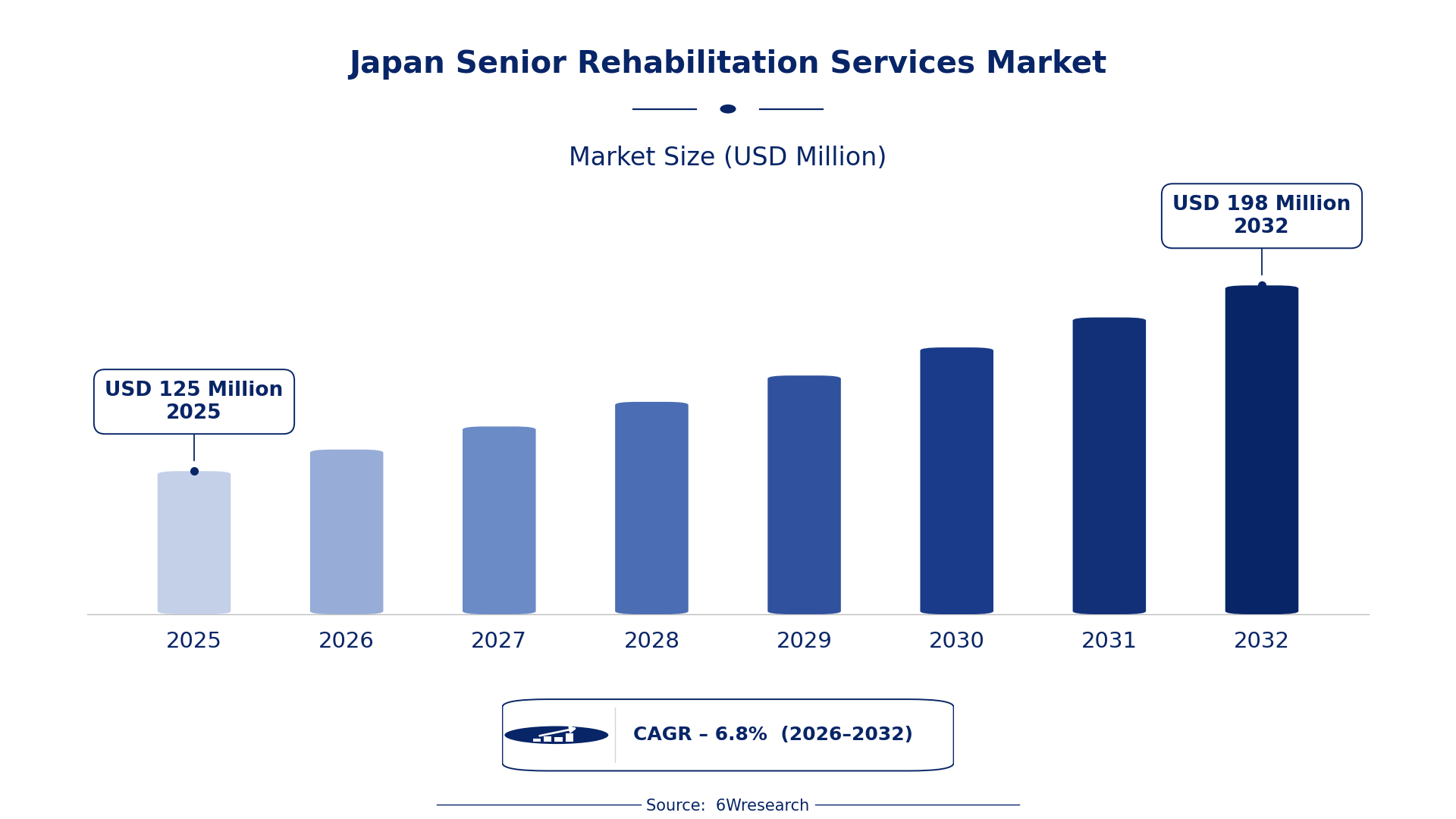
According to 6Wresearch internal database and industry insights, the Japan Senior Rehabilitation Services Market was valued at USD 125 Million in 2025 and is projected to reach USD 198 Million by 2032, growing at a CAGR of approximately 6.8% during 2026–2032.
Japan Senior Rehabilitation Services Market Highlights
| Report Metric | Details |
| Report Name | Japan Senior Rehabilitation Services Market (2026-2032) |
| Market Size 2025 | USD 125 Million |
| Market Size 2032 | USD 198 Million |
| Absolute Growth 2025–2032 | USD 73 Million |
| CAGR 2026–2032 | 6.8% |
| Peak Annual Growth | 8.1% in 2026 |
| Forecast Period | 2026–2032 |
| Historical Data | 2022–2025 |
| Base Year | 2025 |
| Leading Rehab Type, 2025 | Physical Therapy (44% share) |
| Leading Therapy Mode, 2025 | Manual/Device-Assisted (48% share) |
| Leading Service Location, 2025 | Outpatient Centers (53% share) |
| Leading End User, 2025 | Post-Surgery Seniors (43% share) |
| Fastest-Growing Rehab Type | Occupational Therapy (9.3% CAGR) |
| Fastest-Growing Therapy Mode | Daily Activity Focused (9.2% CAGR) |
| Fastest-Growing Service Location | In-Home or Facility (8.9% CAGR) |
| Fastest-Growing End User | Stroke Recovery Patients (8.7% CAGR) |
| Growing Sector | Stroke Recovery Patients |
| Key End Users | Post-Surgery Seniors, Stroke Recovery Patients, Neurological Rehab Cases, Hip/Knee Replacement Patients |
Japan Senior Rehabilitation Services Market Year-wise Growth Rate and Key Drivers (2022–2032)
This graph illustrates the annual growth rates of the market from 2022 to 2032, highlighting a steady upward trajectory and projected market expansion over the forecast period.
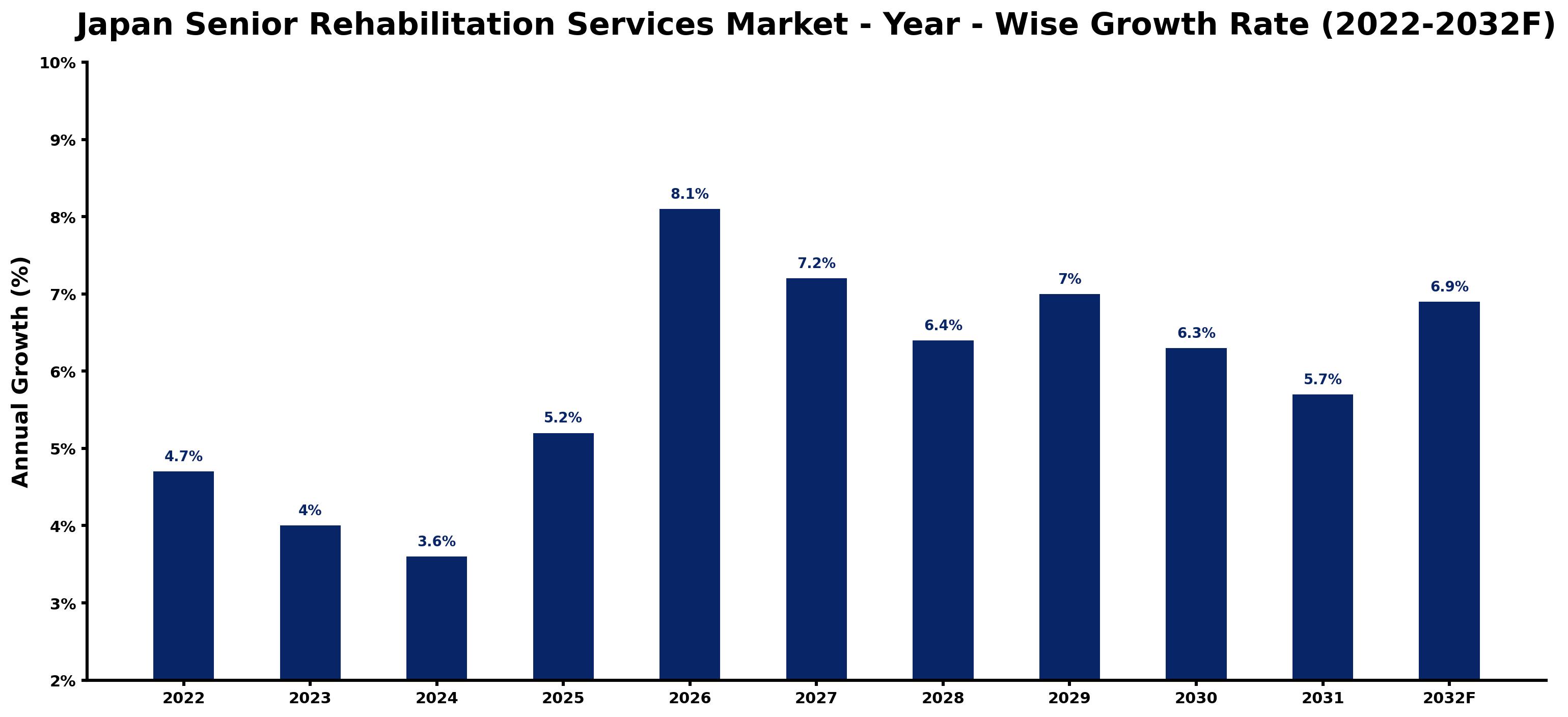
Annual growth estimates for each year appear below with the principal reason behind them, explaining the shifts that set the pace of the market.
| Year | Estimated Annual Growth (%) | Market Rationale |
| 2022 | 4.7 | The market experienced steady growth with increasing demand for rehabilitation services among seniors. |
| 2023 | 4.0 | Demand growth slowed due to market saturation and limited expansion of service locations. |
| 2024 | 3.6 | Demand continued to rise, albeit at a slower pace, as more seniors sought rehabilitation services. |
| 2025 | 5.2 | Growth accelerated as awareness of rehabilitation benefits increased among healthcare providers. |
| 2026 | 8.1 | A surge in demand will occur due to new rehabilitation programmes being introduced. |
| 2027 | 7.2 | Growth will slow as the market begins to stabilise following the peak in 2026. |
| 2028 | 6.4 | Demand will remain strong but show signs of normalising after previous rapid growth. |
| 2029 | 7.0 | Growth will rebound as new facilities open, catering to the increasing senior population. |
| 2030 | 6.3 | The market will experience a slight slowdown as competition intensifies among service providers. |
| 2031 | 5.7 | Growth will continue to decelerate, reflecting a more mature market environment. |
| 2032 | 6.9 | Demand is expected to rise as new rehabilitation technologies gain traction. |
Note: Market size estimations and growth projections presented in this report are based on 6Wresearch's proprietary forecasting methodology, utilizing the latest available industry data, government publications, and primary research inputs.
Japan Senior Rehabilitation Services Market Synopsis
Senior rehabilitation services involve therapeutic practices aimed at aiding recovery for elderly patients, delivered by trained professionals in outpatient centers and home care settings. The Japan Senior Rehabilitation Services Market is expanding due to a growing senior population, with approximately 36 million individuals aged 65 and older. Factors such as the integration of occupational therapy into rehabilitation plans and the government's 2023 initiative to improve services in rural areas are driving increased demand for these essential services.
Market Dynamics Impact Analysis (2026–2032)
| Factor | Type | Impact | Primary Segment Affected |
| Growing senior population | Driver | High | Physical Therapy |
| Integration of occupational therapy | Driver | High | Occupational Therapy |
| Expansion of outpatient centers | Opportunity | High | Outpatient Centers |
| Increased use of assistive technology | Opportunity | Medium | Assistive Technology |
| Limited availability of certified therapists | Restraint | High | Physical Therapy |
| High operational costs for facilities | Restraint | Medium | Facility-Based |
| Regulatory compliance challenges | Challenge | High | Outpatient Centers |
| Competition among service providers | Challenge | Medium | In-Home or Facility |
Evaluation of Drivers in Japan Senior Rehabilitation Services Market (2026–2032)
The table below links each growth driver to the segment it affects and the evidence for it.
| Drivers | Primary Segment Affected | Why It Matters (Evidence) |
| Increasing number of seniors requiring rehabilitation services | Physical Therapy | Approximately 36 million seniors aged 65 and older in Japan drive demand for physical therapy. |
| High integration of occupational therapy in rehabilitation plans | Occupational Therapy | Occupational therapy is included in 80% of rehabilitation plans for stroke patients, boosting demand. |
| Expansion of outpatient centers in urban areas | Outpatient Centers | The Tokyo metropolitan area hosts numerous outpatient centers to meet rising demand for services, with a focus on accessibility. |
| Growing adoption of assistive technology in rehabilitation | Assistive Technology | Assistive technology is used in 30% of rehabilitation cases, improving treatment effectiveness and patient outcomes. |
| Increased awareness of rehabilitation benefits among healthcare providers | Mobility Rehab | As more providers recognise the importance of rehabilitation, demand for mobility rehab services rises, enhancing recovery options. |
The primary driver of demand is the rising number of seniors needing rehabilitation services, with approximately 36 million individuals aged 65 and older in Japan. The inclusion of occupational therapy in rehabilitation plans fuels demand, as it features in 80% of stroke rehabilitation cases. The Tokyo metropolitan area boasts numerous outpatient centres to accommodate the escalating need for these services. The use of assistive technology in rehabilitation is apparent, currently employed in 30% of cases, improving treatment effectiveness. Increased awareness of rehabilitation benefits among healthcare providers contributes to a higher demand for mobility rehabilitation services, as they acknowledge its importance in recovery.
Evaluation of Restraints in Japan Senior Rehabilitation Services Market
The following restraints limit how fast demand can grow.
| Market Restraint | Primary Segment Affected | Why It Matters (Evidence) |
| Limited availability of certified rehabilitation therapists | Physical Therapy | With over 2,000 certified therapists in Japan, the demand often exceeds supply, causing delays in service. |
| High operational costs for facilities | Facility-Based | High operational costs limit the number of facilities that can offer rehabilitation services. |
| Regulatory compliance challenges | Outpatient Centers | Strict regulations from the Ministry of Health, Labour and Welfare complicate facility operations, leading to increased overhead. |
| Competition among service providers | In-Home or Facility | Intense competition can lead to price wars, affecting service quality and profitability for providers. |
| Market saturation in urban areas | Outpatient Centers | High concentration of facilities in urban areas limits growth opportunities for new entrants. |
Japan Senior Rehabilitation Services Market Challenges
High demand for senior rehabilitation services in Japan stems from a rapidly ageing population, with 29.3% of citizens aged 65 or older, resulting in supply shortages that hinder recovery for hospitals and rehabilitation centres. Strict regulations from the Ministry of Health, Labour and Welfare require extensive documentation for new service providers, prolonging approval times by up to six months and limiting options for buyers. Intense competition among urban rehabilitation centres drives prices down, compelling some suppliers to reduce costs, which adversely affects service quality for patients. Limited adoption of advanced technology means only 30% of cases utilise assistive devices, impeding recovery for seniors and decreasing efficiency for providers.
Trends in the Japan Senior Rehabilitation Services Market
The shifts below are changing how Japan Senior Rehabilitation Services Market products are bought and supplied.
- Shift from Facility-Based to Home Care: Since 2023, there has been a marked shift towards home care for rehabilitation services, especially in rural areas. This trend is driven by the government's programme to improve services in these regions, resulting in a 20% increase in home care adoption.
- Increase in Use of Assistive Technology: In 2023, 30% of rehabilitation cases included assistive technology, indicating a trend towards improving recovery processes. This shift is particularly noticeable in outpatient centres, where technology integration is becoming standard.
- Growing Demand for Occupational Therapy: Occupational therapy has become increasingly important, integrated into 80% of rehabilitation plans for stroke patients. This trend underscores the need for enhanced daily living skills among seniors, particularly in urban rehabilitation facilities.
- Expansion of Outpatient Centers: The number of outpatient centres has risen significantly in urban areas, especially in Tokyo, where demand is high. This trend is evidenced by a 15% increase in new centres opening in 2023.
Investment Opportunities in the Japan Senior Rehabilitation Services Market
The following opportunities in the Japan Senior Rehabilitation Services Market pair current demand with a clear way in.
- Partnerships with Local Healthcare Providers: Establishing joint ventures with local healthcare providers can improve service delivery. With a projected 36 million seniors by 2023, there is a substantial need for rehabilitation services in Japan.
- Investment in Home Care Services: Home care services are increasingly necessary, particularly in rural areas. The government's 2023 programme aims to improve access, presenting opportunities for investment in this sector, which is crucial for seniors.
- Expansion of Outpatient Facilities: The Tokyo metropolitan area is experiencing a surge in demand for outpatient services, with a projected growth rate of 15% in new facilities. This presents an opportunity for new entrants in the market to address this demand.
- Development of Assistive Technology Solutions: With 30% of rehabilitation cases using assistive technology, there is a growing market for advanced solutions. Collaborating with tech firms can facilitate entry into this expanding segment, improving patient care.
Government Initiatives in the Japan Senior Rehabilitation Services Market
The Medical Care Act of 1948 sets standards for hospitals and clinics, ensuring quality in rehabilitation services. The Long-Term Care Insurance Act, enacted in 1997, provides funding for nursing care, facilitating access to essential rehabilitation services for seniors.
The Ministry of Health, Labour and Welfare supervises the implementation of these laws, ensuring compliance and quality. The 2023 programme aimed at improving rehabilitation services in rural areas will increase funding for facilities, benefiting seniors who require care.
Future Insight of the Japan Senior Rehabilitation Services Market
By 2032, a notable shift will occur as the Japanese government enhances its programme to improve rehabilitation services in rural areas, increasing access for seniors. This change will encourage suppliers to invest in new outpatient centres, expanding service availability. As ISO 9001 standards become more widespread, facilities will enhance service quality, benefiting patients. The integration of advanced technology is expected to rise, with projections indicating that 30% of rehabilitation cases will incorporate assistive devices, streamlining recovery processes for elderly patients.
Market Segmentation Analysis
Japan Senior Rehabilitation Services Market report covers a detailed analysis of the following market segments:
By Rehab Type – Physical Therapy Leads, Occupational Therapy Expected to Grow Fastest
According to Saurav Kr Singh, Senior Research Analyst at 6Wresearch, Physical Therapy held 44% of the Japan Senior Rehabilitation Services Market by rehab type in 2025. Physical therapy commands the largest share due to its essential function in aiding recovery from surgeries and physical ailments among elderly patients. It is notably the most utilised service, accounting for 40% of all rehabilitation cases in Japan. The quickest growth will come from Occupational Therapy, forecast to expand at a CAGR of 9.3% between 2026 and 2032. Occupational therapy is experiencing rapid growth as it significantly improves daily living skills, crucial for maintaining seniors' independence. Its incorporation into 80% of rehabilitation plans for stroke patients underscores the increasing focus on this service. Suppliers should prioritise the expansion of occupational therapy services to meet rising demand.
By Therapy Mode – Manual/Device-Assisted Leads, Daily Activity Focused Expected to Grow Fastest
With 48% of therapy mode revenue in 2025, Manual/Device-Assisted was the largest category. Manual/device-assisted therapy is the leading mode as it is widely employed in physical rehabilitation processes, ensuring effective recovery for seniors. This method is prevalent in outpatient centres throughout Japan, illustrating its critical role. Daily Activity Focused is set to record the highest CAGR in this split, 9.2% over 2026–2032. Daily activity focused therapy is gaining momentum as it directly enhances seniors' daily life functionality. This approach is becoming increasingly vital in rehabilitation plans, particularly in home care settings. Providers must enhance their offerings in daily activity focused therapy to capture the growing market.
By Service Location – Outpatient Centers Lead, In-Home or Facility Expected to Grow Fastest
Outpatient Centers accounted for 53% of the market by service location in 2025. Outpatient centres lead the service location segment as they are the primary settings for rehabilitation services, catering to a large number of seniors. The Tokyo metropolitan area exemplifies this trend with its numerous facilities dedicated to rehabilitation. In-Home or Facility is projected to grow fastest, at a CAGR of 8.9% during 2026–2032. In-home or facility services are rapidly gaining traction as they provide personalised care, which is increasingly favoured by seniors. The recent government initiative aimed at enhancing services in rural areas further supports this trend. Investing in in-home rehabilitation services will be essential for suppliers to adapt to changing consumer preferences.
By End User – Post-Surgery Seniors Lead, Stroke Recovery Patients Expected to Grow Fastest
The largest end user category in 2025 was Post-Surgery Seniors, at 43% of revenue. Post-surgery seniors represent the largest end user group, as they constitute a significant demographic requiring rehabilitation following surgical procedures. This group is particularly prevalent in Japan, where a considerable portion of the population is aged 65 and older. Over 2026–2032, Stroke Recovery Patients are expected to post the fastest growth, at a CAGR of 8.7%. Stroke recovery patients are the fastest growing segment, reflecting a critical focus area for rehabilitation services. The increasing incidence of strokes among the elderly necessitates targeted rehabilitation efforts for this demographic. Suppliers should concentrate on developing specialised programmes for stroke recovery to address this urgent need.
Key Attractiveness of the Report
- 10 Years of Market Numbers
- Historical Data Starting from 2022 to 2025
- Base Year 2025
- Forecast Data until 2032
- Key Performance Indicators Impacting the Market
- Major Upcoming Developments and Projects
Key Highlights of the Report:
- Japan Senior Rehabilitation Services Market Outlook
- Market Size of Japan Senior Rehabilitation Services Market, 2025
- Forecast of Japan Senior Rehabilitation Services Market, 2032
- Historical Data and Forecast of Japan Senior Rehabilitation Services Revenues & Volume for the Period 2022-2032F
- Japan Senior Rehabilitation Services Market Trend Evolution
- Japan Senior Rehabilitation Services Market Drivers and Challenges
- Japan Senior Rehabilitation Services Price Trends
- Japan Senior Rehabilitation Services Porter's Five Forces
- Japan Senior Rehabilitation Services Industry Life Cycle
- Historical Data and Forecast of Japan Senior Rehabilitation Services Market Revenues & Volume By Rehab Type for the Period 2022-2032F
- Historical Data and Forecast of Japan Senior Rehabilitation Services Market Revenues & Volume By Physical Therapy for the Period 2022-2032F
- Historical Data and Forecast of Japan Senior Rehabilitation Services Market Revenues & Volume By Occupational Therapy for the Period 2022-2032F
- Historical Data and Forecast of Japan Senior Rehabilitation Services Market Revenues & Volume By Speech Therapy for the Period 2022-2032F
- Historical Data and Forecast of Japan Senior Rehabilitation Services Market Revenues & Volume By Mobility Rehab for the Period 2022-2032F
- Historical Data and Forecast of Japan Senior Rehabilitation Services Market Revenues & Volume By Therapy Mode for the Period 2022-2032F
- Historical Data and Forecast of Japan Senior Rehabilitation Services Market Revenues & Volume By Manual/Device-Assisted for the Period 2022-2032F
- Historical Data and Forecast of Japan Senior Rehabilitation Services Market Revenues & Volume By Daily Activity Focused for the Period 2022-2032F
- Historical Data and Forecast of Japan Senior Rehabilitation Services Market Revenues & Volume By Verbal/Cognitive Aid for the Period 2022-2032F
- Historical Data and Forecast of Japan Senior Rehabilitation Services Market Revenues & Volume By Assistive Technology for the Period 2022-2032F
- Historical Data and Forecast of Japan Senior Rehabilitation Services Market Revenues & Volume By Service Location for the Period 2022-2032F
- Historical Data and Forecast of Japan Senior Rehabilitation Services Market Revenues & Volume By Outpatient Centers for the Period 2022-2032F
- Historical Data and Forecast of Japan Senior Rehabilitation Services Market Revenues & Volume By In-Home or Facility for the Period 2022-2032F
- Historical Data and Forecast of Japan Senior Rehabilitation Services Market Revenues & Volume By Clinics or Home-Based for the Period 2022-2032F
- Historical Data and Forecast of Japan Senior Rehabilitation Services Market Revenues & Volume By Facility-Based for the Period 2022-2032F
- Historical Data and Forecast of Japan Senior Rehabilitation Services Market Revenues & Volume By End User for the Period 2022-2032F
- Historical Data and Forecast of Japan Senior Rehabilitation Services Market Revenues & Volume By Post-Surgery Seniors for the Period 2022-2032F
- Historical Data and Forecast of Japan Senior Rehabilitation Services Market Revenues & Volume By Stroke Recovery Patients for the Period 2022-2032F
- Historical Data and Forecast of Japan Senior Rehabilitation Services Market Revenues & Volume By Neurological Rehab Cases for the Period 2022-2032F
- Historical Data and Forecast of Japan Senior Rehabilitation Services Market Revenues & Volume By Hip/Knee Replacement Patients for the Period 2022-2032F
- Japan Senior Rehabilitation Services Import Export Trade Statistics
- Market Opportunity Assessment By Rehab Type
- Market Opportunity Assessment By Therapy Mode
- Market Opportunity Assessment By Service Location
- Market Opportunity Assessment By End User
- Japan Senior Rehabilitation Services Top Companies Market Share
- Japan Senior Rehabilitation Services Competitive Benchmarking By Technical and Operational Parameters
- Japan Senior Rehabilitation Services Company Profiles
- Japan Senior Rehabilitation Services Key Strategic Recommendations
Market Covered
This report examines the market across the segments below.
By Rehab Type
- Physical Therapy
- Occupational Therapy
- Speech Therapy
- Mobility Rehab
By Therapy Mode
- Manual/Device-Assisted
- Daily Activity Focused
- Verbal/Cognitive Aid
- Assistive Technology
By Service Location
- Outpatient Centers
- In-Home or Facility
- Clinics or Home-Based
- Facility-Based
By End User
- Post-Surgery Seniors
- Stroke Recovery Patients
- Neurological Rehab Cases
- Hip/Knee Replacement Patients































