Japan Senior Safety Devices Market Size & Growth Rate
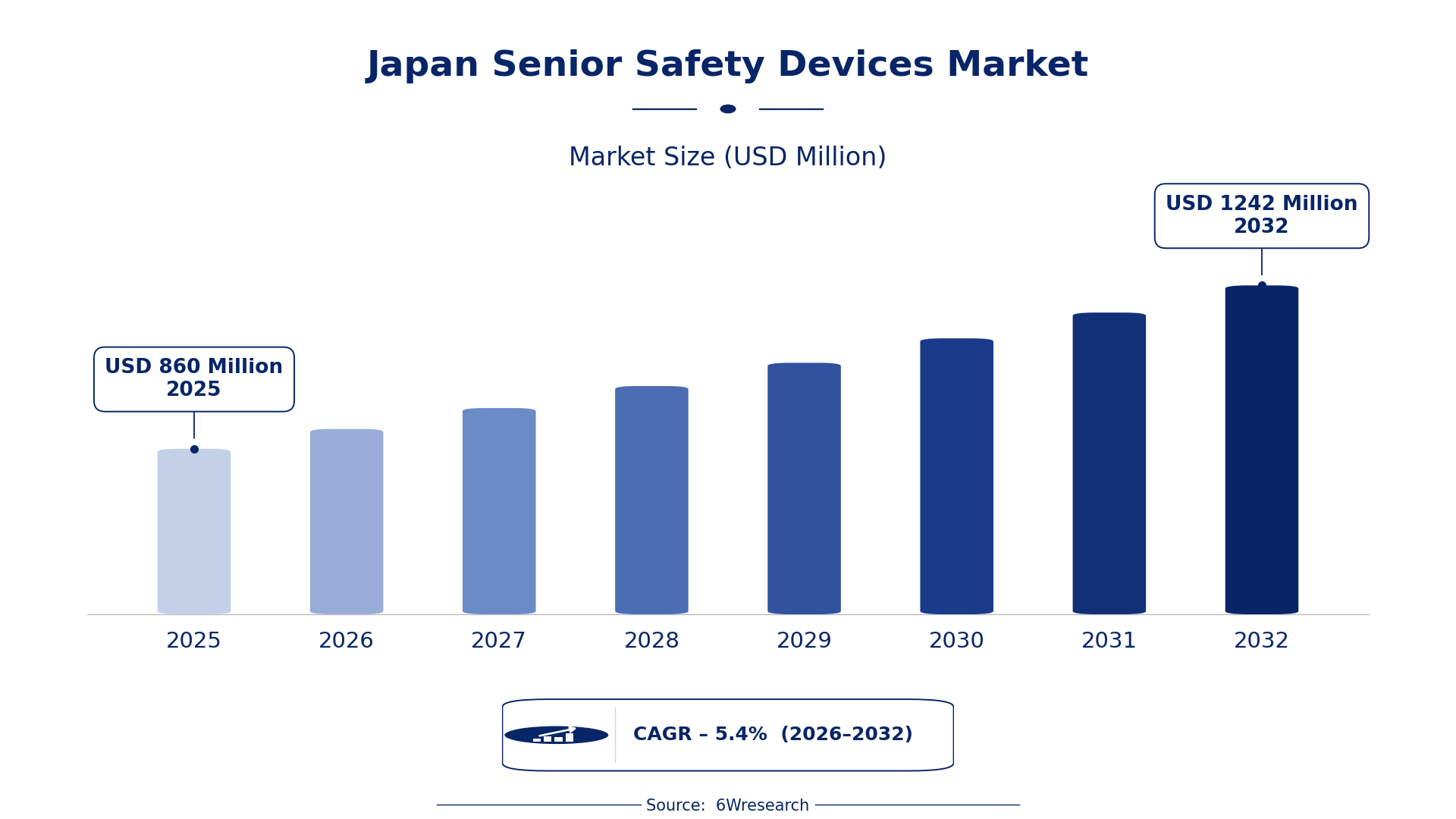
According to 6Wresearch internal database and industry insights, the Japan Senior Safety Devices Market was valued at USD 860 Million in 2025 and is projected to reach USD 1,242 Million by 2032, growing at a CAGR of approximately 5.4% during 2026–2032.
Japan Senior Safety Devices Market Highlights
| Report Metric | Details |
| Report Name | Japan Senior Safety Devices Market (2026-2032) |
| Market Size 2025 | USD 860 Million |
| Market Size 2032 | USD 1,242 Million |
| Absolute Growth 2025–2032 | USD 382 Million |
| CAGR 2026–2032 | 5.4% |
| Peak Annual Growth | 6.4% in 2028 |
| Forecast Period | 2026–2032 |
| Historical Data | 2022–2025 |
| Base Year | 2025 |
| Leading Device Type, 2025 | Fall Detection Devices (48% share) |
| Leading Safety Function, 2025 | Motion Sensing (51% share) |
| Leading Connectivity Mode, 2025 | Wi-Fi/Bluetooth (45% share) |
| Leading End User, 2025 | Seniors at Risk (42% share) |
| Fastest-Growing Device Type | Medical Alert Systems (8.1% CAGR) |
| Fastest-Growing Safety Function | Emergency Response (7.2% CAGR) |
| Fastest-Growing Connectivity Mode | Cellular/GPS (7.3% CAGR) |
| Fastest-Growing End User | Nursing Homes (6.9% CAGR) |
| Growing Sector | Senior Care Technology |
| Key End Users | Seniors, Healthcare Providers, Nursing Homes, Caregivers |
Japan Senior Safety Devices Market Year-wise Growth Rate and Key Drivers (2022–2032)
This graph illustrates the annual growth rates of the market from 2022 to 2032, highlighting a steady upward trajectory and projected market expansion over the forecast period.
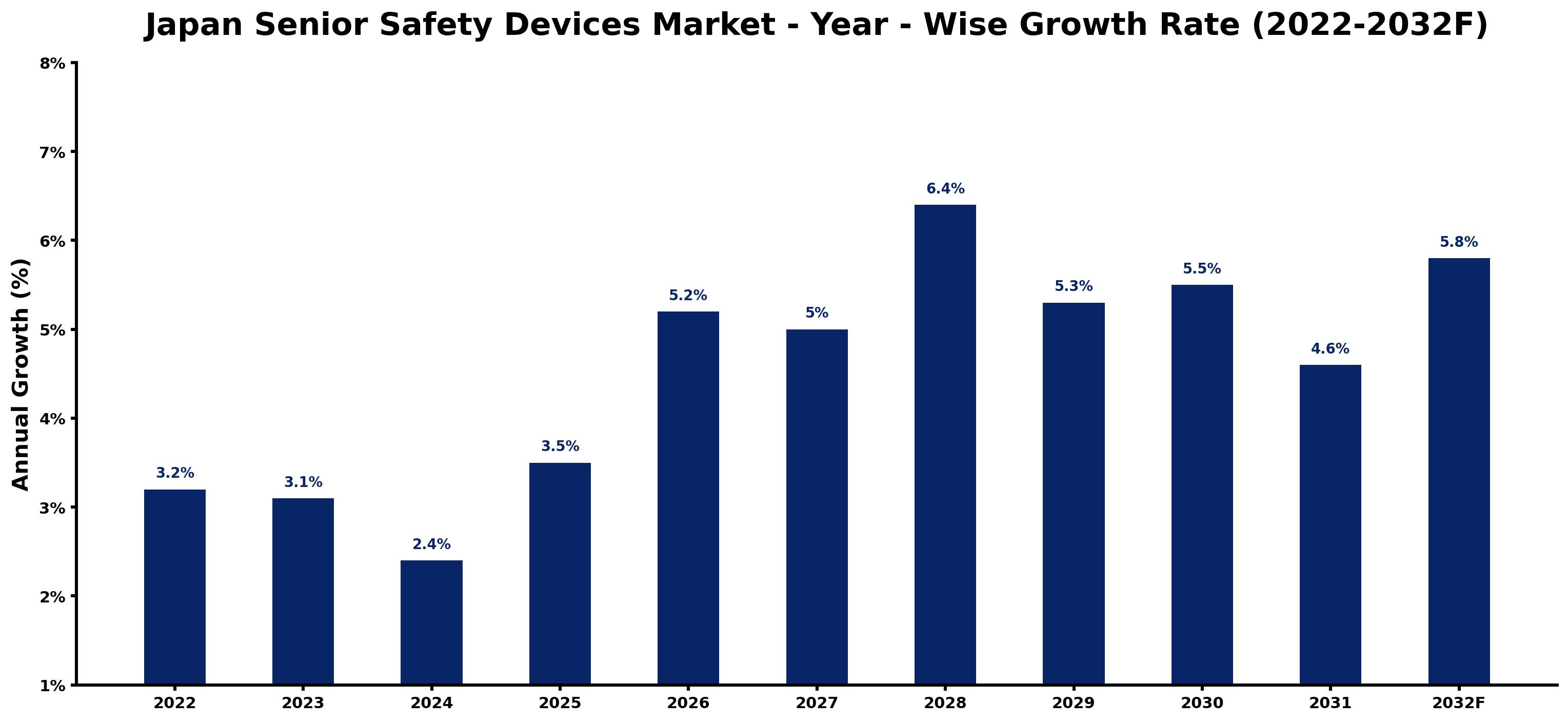
Below, each year's estimated growth is shown next to the factor that most influenced it.
| Year | Estimated Annual Growth (%) | Market Rationale |
| 2022 | 3.2 | The market showed steady growth with a strong focus on senior safety solutions. |
| 2023 | 3.1 | Growth slowed as the market adjusted to increasing competition and consumer awareness. |
| 2024 | 2.4 | Demand continued to rise, though at a slower pace due to market saturation. |
| 2025 | 3.5 | Growth accelerated as more seniors adopted safety devices for independent living. |
| 2026 | 5.2 | The market is expected to experience faster growth with increased investments in healthcare technology. |
| 2027 | 5.0 | Growth will slow slightly as existing users become more selective in device upgrades. |
| 2028 | 6.4 | The market is projected to peak with heightened awareness of senior safety and health monitoring. |
| 2029 | 5.3 | Growth will moderate as new entrants begin to saturate the market. |
| 2030 | 5.5 | Demand is expected to rise again as technological advancements improve device functionality. |
| 2031 | 4.6 | Growth will slow as the market matures and competition intensifies. |
| 2032 | 5.8 | The market is expected to grow as the aging population continues to demand safety solutions. |
Note: Market size estimations and growth projections presented in this report are based on 6Wresearch's proprietary forecasting methodology, utilizing the latest available industry data, government publications, and primary research inputs.
Japan Senior Safety Devices Market Synopsis
Senior Safety Devices in Japan encompass technologies designed to improve the safety and well-being of seniors, including fall detection and emergency alert systems. The market is growing due to Japan's aging population, with 29.3% of the population aged 65 or older in 2024. Increasing demand from healthcare providers and seniors living independently drives this growth, supported by initiatives such as the Tokyo Health Care Association's promotion of monitoring devices in care facilities and the government’s funding for senior safety initiatives.
Market Dynamics Impact Analysis (2026–2032)
| Factor | Type | Impact | Primary Segment Affected |
| Aging population leading to increased demand for safety devices | Driver | High | Fall Detection Devices |
| Growing healthcare expenditure on senior care solutions | Driver | High | Medical Alert Systems |
| Expansion of telehealth services for seniors | Opportunity | High | Vital Monitoring Wearables |
| Increased adoption of smart technologies in urban areas | Opportunity | Medium | Smart Door Sensors |
| High costs associated with advanced safety devices | Restraint | High | Emergency Response |
| Limited awareness among seniors about available technologies | Restraint | Medium | Motion Sensing |
| Compliance with stringent regulations for medical devices | Challenge | High | Medical Alert Systems |
| Capacity constraints in manufacturing and supply chain | Challenge | Medium | Fall Detection Devices |
Evaluation of Drivers in Japan Senior Safety Devices Market (2026–2032)
The table below links each growth driver to the segment it affects and the evidence for it.
| Drivers | Primary Segment Affected | Why It Matters (Evidence) |
| Increasing number of seniors aged 65 and above | Fall Detection Devices | In 2023, over 36 million seniors were in Japan, driving demand for fall detection solutions. |
| Rising healthcare expenditure | Medical Alert Systems | Japan's national medical care expenditure was about JPY 46.7 trillion in 2022, boosting investment in safety devices. |
| Technological advancements in health monitoring | Vital Monitoring Wearables | The average heart rate monitoring device costs around ¥15,000, making it accessible for seniors. |
| Government initiatives promoting senior safety | Emergency Response | The government allocated ¥10 billion for senior safety initiatives in 2023, promoting device adoption. |
| Growing urbanisation leading to higher adoption rates | Smart Door Sensors | Smart door sensors are increasingly used in urban areas with high senior populations, improving safety. |
Most of the extra volume comes from the increasing number of seniors aged 65 and above, which reached over 36 million in 2023. This demographic shift drives demand for fall detection devices, as families seek solutions to ensure their loved ones' safety. Rising healthcare expenditure, approximately JPY 46.7 trillion in 2022, fuels investment in medical alert systems. Technological advancements have made vital monitoring wearables more accessible, with average costs around ¥15,000. These factors support the market's growth prospects.
Evaluation of Restraints in Japan Senior Safety Devices Market
These are the pressures that could keep growth below its potential.
| Market Restraint | Primary Segment Affected | Why It Matters (Evidence) |
| High costs associated with advanced safety devices | Emergency Response | The average cost of advanced safety devices can be prohibitive for many seniors, limiting adoption. |
| Limited awareness among seniors about available technologies | Motion Sensing | Many seniors remain unaware of the benefits of motion sensing devices, which hinders market growth. |
| Compliance with stringent regulations for medical devices | Medical Alert Systems | Manufacturers face challenges in meeting the regulatory standards set by the PMDA, affecting product availability. |
| Capacity constraints in manufacturing and supply chain | Fall Detection Devices | Manufacturers struggle to keep up with demand due to limited production capacity and supply chain issues. |
| Market saturation leading to intense competition | Smart Door Sensors | An influx of new entrants has created a saturated market, making it difficult for established players to maintain market share. |
Japan Senior Safety Devices Market Challenges
Limited technology integration affects senior safety devices, as many systems lack real-time monitoring, resulting in delayed alerts for caregivers. Price competition among local manufacturers reduces product quality, undermining device reliability for hospitals and nursing homes. A shortage of skilled personnel hinders effective training on new safety technologies, causing underutilisation of devices in care facilities. Supply chain issues have led to delays in acquiring critical components, extending lead times for producers and reducing device availability for seniors, with average hospital stays of 12 days highlighting the urgency for timely solutions.
Trends in the Japan Senior Safety Devices Market
Buyers and suppliers in the Japan Senior Safety Devices Market are adjusting to the following trends.
- Shift towards Integrated Health Monitoring Solutions: In 2023, the Tokyo Health Care Association promoted integrated health monitoring devices for seniors, improving safety and health tracking. This trend is reflected in the growing adoption of such devices in nursing homes.
- Transition from Traditional to Smart Safety Devices: The market is seeing a shift from traditional safety devices to smart technologies, with increased use of smart door sensors in urban areas. This change is driven by the need for better safety features.
- Emergency Response Systems Gaining Popularity: Emergency response systems are becoming increasingly popular among seniors, with a projected growth rate of 7.2% for this segment. The rising awareness of safety needs is a key factor behind this trend.
- Increased Focus on Remote Health Monitoring: Remote health monitoring is becoming a priority for healthcare providers, with the Japan Telemedicine Association supporting its adoption. This focus is important as the aging population demands more accessible healthcare solutions.
Investment Opportunities in the Japan Senior Safety Devices Market
Investors looking at the Japan Senior Safety Devices Market should consider the following areas.
- Gap in Advanced Safety Device Adoption: With 29.3% of the population aged 65 or older in 2024, there is a notable gap in advanced safety device adoption. Investing in education and outreach programs can help bridge this gap, especially in rural areas.
- Partnerships with Healthcare Providers: Establishing partnerships with healthcare providers can facilitate the entry of new safety devices into the market. Collaborating with nursing homes can improve device visibility and usage among seniors.
- Supply of Telehealth Solutions: The growing demand for telehealth services presents an opportunity to supply innovative remote monitoring devices. Engaging with the Japan Telemedicine Association can provide insights into market needs.
- Focus on Urban Areas for Smart Devices: Urban areas are prime locations for the supply of smart safety devices, given the high senior population density. Targeting these regions can yield substantial returns for manufacturers.
Government Initiatives in the Japan Senior Safety Devices Market
The Long-Term Care Insurance Act, enacted in 1997, provides funding for nursing care and support services, ensuring access to essential safety devices for seniors. The PMD Act, renamed in 2014, regulates the approval and quality of medical devices, impacting producers by enforcing strict compliance standards.
In 2023, the government allocated ¥10 billion for senior safety initiatives, administered by the Ministry of Health, Labour and Welfare. This funding supports the development and implementation of safety devices, ensuring they meet regulatory requirements and are accessible to seniors.
Future Insight of the Japan Senior Safety Devices Market
Investment in senior safety devices will increase by 2032, driven by a ¥10 billion government allocation for senior safety initiatives. The demand for telehealth services will rise with the aging population, creating opportunities for suppliers to develop advanced technologies. Standards like ISO 13485 for medical devices will improve safety and quality for users. With 4.5 million seniors living alone, the market will increasingly adopt smart monitoring solutions, resulting in better health outcomes and increased reassurance for families.
Market Segmentation Analysis
Japan Senior Safety Devices Market report covers a detailed analysis of the following market segments:
By Device Type – Fall Detection Devices Lead, Medical Alert Systems Expected to Grow Fastest
According to Saurav Kr Singh, Senior Research Analyst at 6Wresearch, in 2025, Fall Detection Devices led the device type split with a 48% share. Fall detection devices dominate the market as they provide critical alerts during falls, essential for seniors living independently. With over 36 million seniors aged 65 and above, the reliance on these devices is substantial. Medical Alert Systems are set to record the highest CAGR in this split, 8.1% over 2026–2032. Medical alert systems are rapidly gaining traction as they facilitate emergency communication for seniors, especially with 4.5 million seniors living alone in 2022. The sustained demand for fall detection devices will likely strengthen their market position further. Suppliers should enhance fall detection device features to meet the increasing safety requirements of seniors.
By Safety Function – Motion Sensing Leads, Emergency Response Expected to Grow Fastest
Motion Sensing took 51% of safety function revenue in 2025, more than any other category. Motion sensing technology leads the market by effectively detecting movement, ensuring safety for seniors at risk of falls. This function is particularly vital in nursing homes, where monitoring is essential for resident safety. Emergency Response is projected to grow fastest, at a CAGR of 7.2% during 2026–2032. Emergency response functions are experiencing rapid growth as they are crucial for immediate assistance during emergencies, emphasising the need for prompt action in senior care. The expansion of this function will likely enhance overall safety offerings in the market. Buyers should prioritise devices with strong emergency response capabilities to ensure timely assistance.
By Connectivity Mode – Wi-Fi/Bluetooth Leads, Cellular/GPS Expected to Grow Fastest
The largest connectivity mode category in 2025 was Wi-Fi/Bluetooth, at 45% of revenue. Wi-Fi and Bluetooth connectivity hold the largest share as they enable device connectivity and communication, essential for effective monitoring of seniors. This technology is widely adopted in home settings and nursing facilities, ensuring seamless integration of safety devices. The quickest growth will come from Cellular/GPS, forecast to expand at a CAGR of 7.3% between 2026 and 2032. Cellular and GPS connectivity is growing quickly, supporting location tracking for safety, which is increasingly important for seniors living independently. This trend indicates a shift towards comprehensive safety solutions that include real-time location capabilities. Suppliers should invest in advanced connectivity features to address the rising demand for location tracking in safety devices.
By End User – Seniors at Risk Leads, Nursing Homes Expected to Grow Fastest
Seniors at Risk accounted for 42% of the market by end user in 2025. Seniors at risk represent the largest user group, being the primary target for safety devices aimed at preventing accidents and ensuring well-being. With a significant portion of Japan's population aged 65 and above, this segment is critical for market growth. Over 2026–2032, Nursing Homes are expected to post the fastest growth, at a CAGR of 6.9%. Nursing homes are the fastest-growing end user segment, as they are major users of safety devices to protect their residents. The increasing number of nursing homes, approximately 8,000, indicates a strong demand for comprehensive safety solutions in these facilities. Suppliers should customise their offerings to meet the specific needs of nursing homes to capitalise on this expanding market segment.
Key Attractiveness of the Report
- 10 Years of Market Numbers
- Historical Data Starting from 2022 to 2025
- Base Year 2025
- Forecast Data until 2032
- Key Performance Indicators Impacting the Market
- Major Upcoming Developments and Projects
Key Highlights of the Report:
- Japan Senior Safety Devices Market Outlook
- Market Size of Japan Senior Safety Devices Market, 2025
- Forecast of Japan Senior Safety Devices Market, 2032
- Historical Data and Forecast of Japan Senior Safety Devices Revenues & Volume for the Period 2022-2032F
- Japan Senior Safety Devices Market Trend Evolution
- Japan Senior Safety Devices Market Drivers and Challenges
- Japan Senior Safety Devices Price Trends
- Japan Senior Safety Devices Porter's Five Forces
- Japan Senior Safety Devices Industry Life Cycle
- Historical Data and Forecast of Japan Senior Safety Devices Market Revenues & Volume By Device Type for the Period 2022-2032F
- Historical Data and Forecast of Japan Senior Safety Devices Market Revenues & Volume By Fall Detection Devices for the Period 2022-2032F
- Historical Data and Forecast of Japan Senior Safety Devices Market Revenues & Volume By Medical Alert Systems for the Period 2022-2032F
- Historical Data and Forecast of Japan Senior Safety Devices Market Revenues & Volume By Smart Door Sensors for the Period 2022-2032F
- Historical Data and Forecast of Japan Senior Safety Devices Market Revenues & Volume By Vital Monitoring Wearables for the Period 2022-2032F
- Historical Data and Forecast of Japan Senior Safety Devices Market Revenues & Volume By Safety Function for the Period 2022-2032F
- Historical Data and Forecast of Japan Senior Safety Devices Market Revenues & Volume By Motion Sensing for the Period 2022-2032F
- Historical Data and Forecast of Japan Senior Safety Devices Market Revenues & Volume By Emergency Response for the Period 2022-2032F
- Historical Data and Forecast of Japan Senior Safety Devices Market Revenues & Volume By Entry/Exit Monitoring for the Period 2022-2032F
- Historical Data and Forecast of Japan Senior Safety Devices Market Revenues & Volume By Heart Rate/BP Tracker for the Period 2022-2032F
- Historical Data and Forecast of Japan Senior Safety Devices Market Revenues & Volume By Connectivity Mode for the Period 2022-2032F
- Historical Data and Forecast of Japan Senior Safety Devices Market Revenues & Volume By Wi-Fi/Bluetooth for the Period 2022-2032F
- Historical Data and Forecast of Japan Senior Safety Devices Market Revenues & Volume By Cellular/GPS for the Period 2022-2032F
- Historical Data and Forecast of Japan Senior Safety Devices Market Revenues & Volume By App-Based for the Period 2022-2032F
- Historical Data and Forecast of Japan Senior Safety Devices Market Revenues & Volume By 24/7 Tracking for the Period 2022-2032F
- Historical Data and Forecast of Japan Senior Safety Devices Market Revenues & Volume By End User for the Period 2022-2032F
- Historical Data and Forecast of Japan Senior Safety Devices Market Revenues & Volume By Seniors at Risk for the Period 2022-2032F
- Historical Data and Forecast of Japan Senior Safety Devices Market Revenues & Volume By Nursing Homes for the Period 2022-2032F
- Historical Data and Forecast of Japan Senior Safety Devices Market Revenues & Volume By Memory Care Units for the Period 2022-2032F
- Historical Data and Forecast of Japan Senior Safety Devices Market Revenues & Volume By Remote Health Providers for the Period 2022-2032F
- Japan Senior Safety Devices Import Export Trade Statistics
- Market Opportunity Assessment By Device Type
- Market Opportunity Assessment By Safety Function
- Market Opportunity Assessment By Connectivity Mode
- Market Opportunity Assessment By End User
- Japan Senior Safety Devices Top Companies Market Share
- Japan Senior Safety Devices Competitive Benchmarking By Technical and Operational Parameters
- Japan Senior Safety Devices Company Profiles
- Japan Senior Safety Devices Key Strategic Recommendations
Market Covered
Coverage by segment is as follows.
By Device Type
- Fall Detection Devices
- Medical Alert Systems
- Smart Door Sensors
- Vital Monitoring Wearables
By Safety Function
- Motion Sensing
- Emergency Response
- Entry/Exit Monitoring
- Heart Rate/BP Tracker
By Connectivity Mode
- Wi-Fi/Bluetooth
- Cellular/GPS
- App-Based
- 24/7 Tracking
By End User
- Seniors at Risk
- Nursing Homes
- Memory Care Units
- Remote Health Providers































