Japan Sensor-Based Vehicle Collision Prevention Systems Market Size & Growth Rate
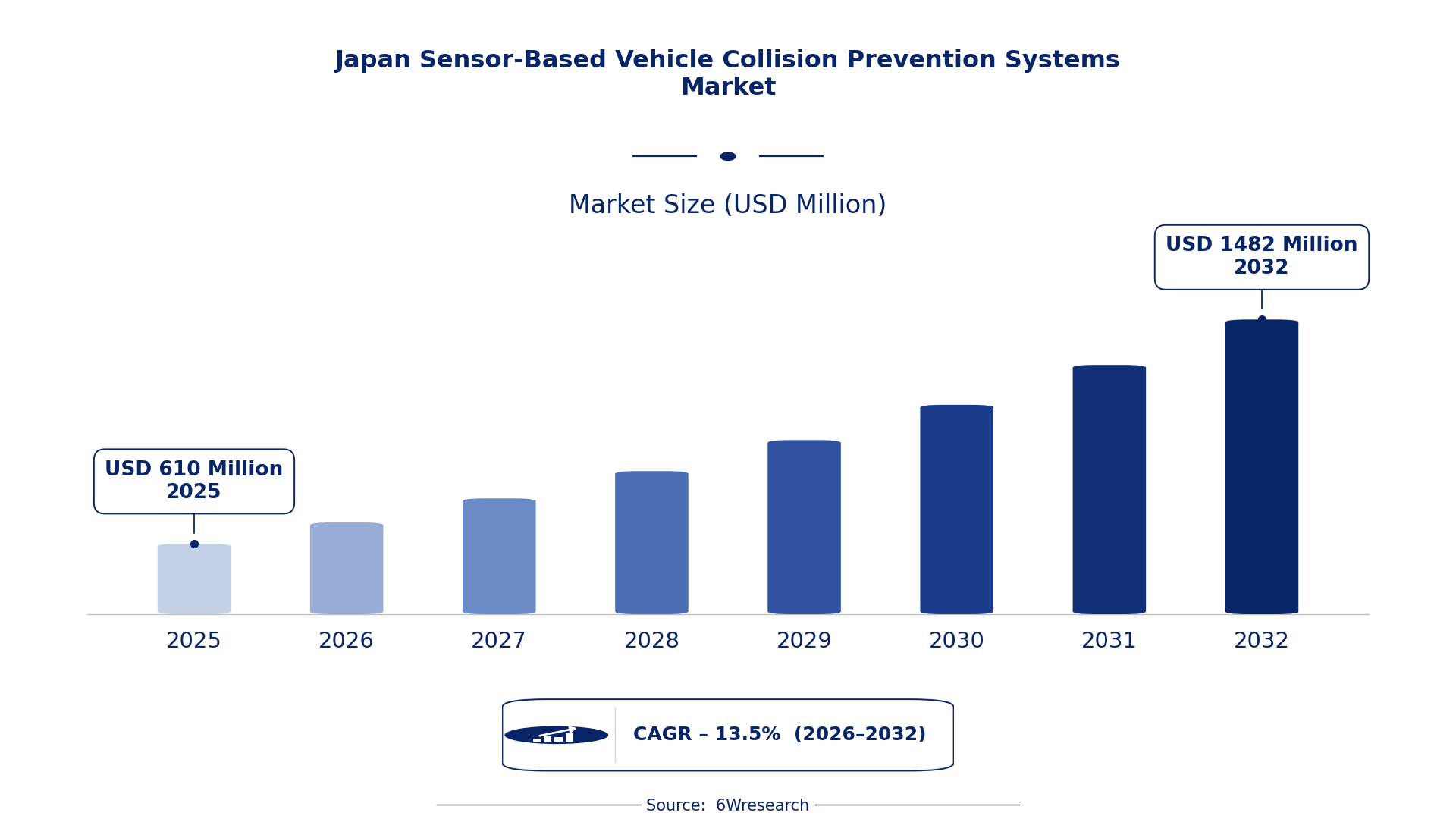
According to 6Wresearch internal database and industry insights, the Japan Sensor-Based Vehicle Collision Prevention Systems Market was valued at USD 610 Million in 2025 and is projected to reach USD 1,482 Million by 2032, growing at a CAGR of approximately 13.5% during 2026–2032.
Japan Sensor-Based Vehicle Collision Prevention Systems Market Highlights
| Report Metric | Details |
| Report Name | Japan Sensor-Based Vehicle Collision Prevention Systems Market (2026-2032) |
| Market Size 2025 | USD 610 Million |
| Market Size 2032 | USD 1,482 Million |
| Absolute Growth 2025–2032 | USD 872 Million |
| CAGR 2026–2032 | 13.5% |
| Peak Annual Growth | 15.5% in 2026 |
| Forecast Period | 2026–2032 |
| Historical Data | 2022–2025 |
| Base Year | 2025 |
| Leading System Type, 2025 | Front-Collision Assist (36% share) |
| Leading Sensor Integration, 2025 | Camera + Radar (38% share) |
| Leading Functionality, 2025 | Auto Emergency Brake (43% share) |
| Leading End User, 2025 | Passenger Car OEMs (41% share) |
| Fastest-Growing System Type | 360-Degree Systems (18.1% CAGR) |
| Fastest-Growing Sensor Integration | Sensor Fusion Units (17.7% CAGR) |
| Fastest-Growing Functionality | Lane Monitoring (16.7% CAGR) |
| Fastest-Growing End User | EV Manufacturers (17.5% CAGR) |
| Growing Sector | automotive safety technologies |
| Key End Users | Passenger Car OEMs, Commercial Vehicle Makers, EV Manufacturers, Premium Car OEMs |
Japan Sensor-Based Vehicle Collision Prevention Systems Market Year-wise Growth Rate and Key Drivers (2022–2032)
This graph illustrates the annual growth rates of the market from 2022 to 2032, highlighting a steady upward trajectory and projected market expansion over the forecast period.
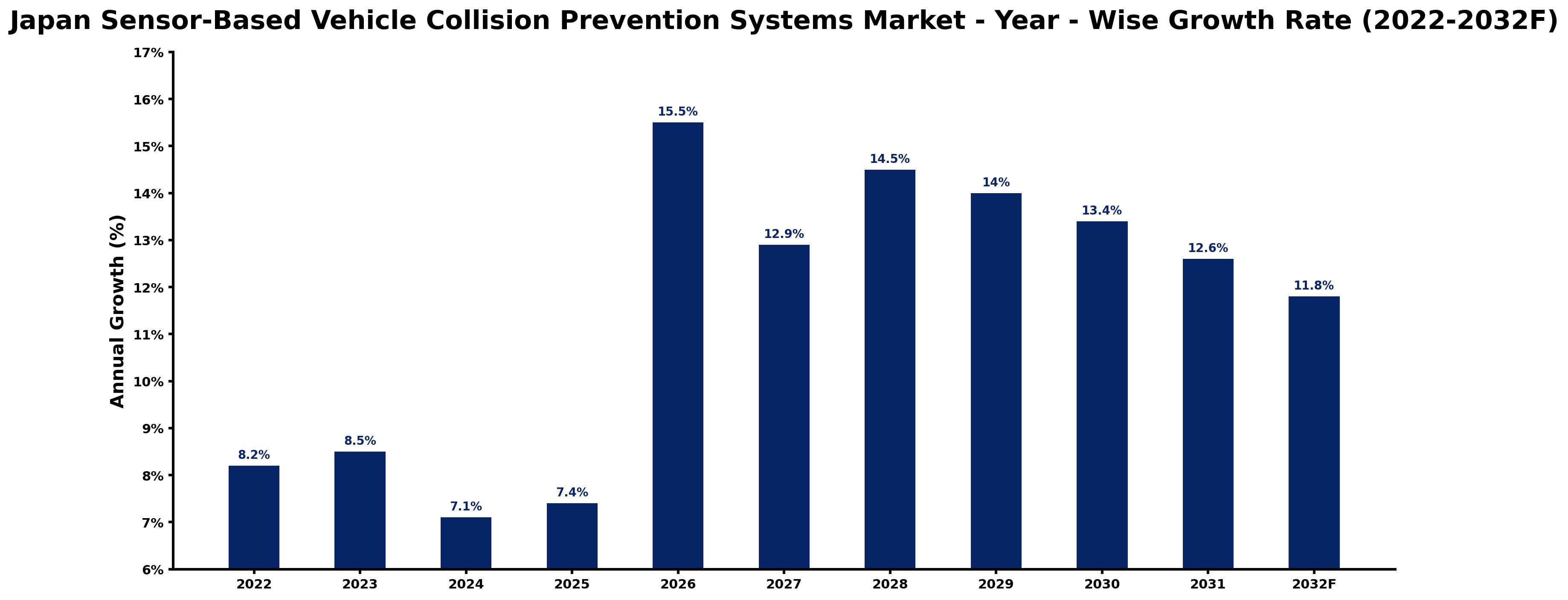
Annual growth estimates for each year appear below with the principal reason behind them, explaining the shifts that set the pace of the market.
| Year | Estimated Annual Growth (%) | Market Rationale |
| 2022 | 8.2 | The market exhibited steady growth as consumer awareness of vehicle safety increased. |
| 2023 | 8.5 | Growth accelerated due to heightened demand for advanced safety technologies among manufacturers. |
| 2024 | 7.1 | Growth slowed as manufacturers faced supply chain disruptions affecting production schedules. |
| 2025 | 7.4 | Demand improved as vehicle production rebounded, driven by consumer preference for safety features. |
| 2026 | 15.5 | The market is expected to peak as new regulations and safety standards boost adoption rates. |
| 2027 | 12.9 | Growth is projected to moderate as the market begins to stabilise after the peak in demand. |
| 2028 | 14.5 | Demand is expected to surge again with increased focus on safety systems in vehicles. |
| 2029 | 14.0 | Growth will slow slightly as the market adjusts to new technological integrations. |
| 2030 | 13.4 | The market will continue to grow, driven by ongoing innovations in vehicle safety technologies. |
| 2031 | 12.6 | Growth is projected to decelerate as market saturation begins to influence purchasing decisions. |
| 2032 | 11.8 | The market is expected to maintain steady growth as safety regulations evolve further. |
Note: Market size estimations and growth projections presented in this report are based on 6Wresearch's proprietary forecasting methodology, utilizing the latest available industry data, government publications, and primary research inputs.
Japan Sensor-Based Vehicle Collision Prevention Systems Market Synopsis
Sensor-Based Vehicle Collision Prevention Systems utilise advanced technologies to improve vehicle safety by preventing accidents. These systems integrate sensors, cameras, and algorithms to assist drivers in avoiding collisions and maintaining lane discipline. The Japan Sensor-Based Vehicle Collision Prevention Systems Market is expanding due to rising demand from domestic manufacturers, a strong focus on innovation, and a commitment to reducing traffic fatalities by 50% by 2030. With Japan's automotive market producing 8.3 million vehicles in 2022, the need for improved safety technologies is critical for ensuring safer roads.
Market Dynamics Impact Analysis (2026–2032)
| Factor | Type | Impact | Primary Segment Affected |
| Rising safety standards and regulations | Driver | High | Auto Emergency Brake |
| Increasing production of electric vehicles | Driver | High | EV Manufacturers |
| Growing demand for comprehensive safety systems | Opportunity | High | 360-Degree Systems |
| Expansion of automotive innovation hubs in Tokyo | Opportunity | Medium | Passenger Car OEMs |
| Supply chain disruptions affecting component availability | Restraint | High | Rear Collision System |
| High costs associated with advanced technology integration | Restraint | Medium | Camera + Radar |
| Competition from alternative safety technologies | Challenge | High | Blind Spot Detection |
| Rapid technological advancements leading to obsolescence | Challenge | Medium | Lane Monitoring |
Evaluation of Drivers in Japan Sensor-Based Vehicle Collision Prevention Systems Market (2026–2032)
The following drivers explain most of the expected growth.
| Drivers | Primary Segment Affected | Why It Matters (Evidence) |
| Increased focus on vehicle safety regulations | Auto Emergency Brake | Japan's government aims to reduce traffic fatalities by 50% by 2030, driving demand for safety features. |
| Surge in electric vehicle production | EV Manufacturers | The number of EVs in Japan reached 1.5 million in 2023, increasing the need for advanced safety systems. |
| Technological advancements in sensor integration | 360-Degree Systems | Tokyo is a major hub for automotive innovation, leading to the development of advanced safety systems. |
| Consumer preference for high safety ratings | Passenger Car OEMs | Japan produced 8.3 million vehicles in 2022, with buyers prioritising vehicles with advanced safety features. |
| Government initiatives promoting safety technology adoption | Camera + Radar | The launch of a government program in 2023 supports the development of vehicle safety technologies. |
Much of the new demand traces back to Japan's commitment to reducing traffic fatalities by 50% by 2030, prompting manufacturers to invest in new safety features. The installed base of approximately 78 million passenger vehicles in Japan creates a strong market for collision prevention systems. As electric vehicle production surged to 1.5 million units in 2023, integrating advanced safety technologies became essential. Tokyo's status as an automotive innovation hub drives the development of these systems, further increasing demand. Preferences for vehicles with high safety ratings continue to influence purchasing decisions, resulting in increased sales of systems like Auto Emergency Brake and Blind Spot Detection.
Evaluation of Restraints in Japan Sensor-Based Vehicle Collision Prevention Systems Market
The table below lists the restraints and the evidence behind each.
| Market Restraint | Primary Segment Affected | Why It Matters (Evidence) |
| Supply chain disruptions affecting sensor availability | Rear Collision System | Japan's automotive industry faced delays in component delivery, impacting production timelines for safety systems. |
| High integration costs for advanced technologies | Camera + Radar | Manufacturers must allocate substantial budgets for integrating sophisticated safety features, limiting widespread adoption. |
| Emerging technologies diverting investment | Blind Spot Detection | New technologies may shift funding away from traditional collision prevention systems, affecting market growth. |
| Market saturation in established segments | Lane Monitoring | As the market matures, growth potential diminishes, resulting in slower adoption rates for existing technologies. |
| Regulatory compliance challenges | Auto Emergency Brake | Meeting stringent safety standards requires extensive testing and certification, delaying product launches. |
Japan Sensor-Based Vehicle Collision Prevention Systems Market Challenges
Producers struggle to adopt new technologies in sensor-based vehicle collision prevention systems, as rapid advancements often outpace their development capabilities, delaying product launches and reducing competitiveness. Compliance with regulations from the Ministry of Land, Infrastructure, Transport and Tourism presents challenges, as meeting standards like JIS D 5805 requires significant investment, diverting resources from other vital projects. Buyers face increased costs when integrating advanced safety features, with average price hikes reaching 15% per vehicle, which can reduce overall affordability. Rising compliance demands with ISO 26262 standards inflate operational costs for manufacturers, potentially raising consumer prices and limiting market access.
Trends in the Japan Sensor-Based Vehicle Collision Prevention Systems Market
The following changes are redrawing the Japan Sensor-Based Vehicle Collision Prevention Systems Market.
- Shift towards Advanced Safety Technologies: The automotive industry is increasingly adopting advanced safety technologies, integrating multiple systems for better protection. The Tokyo Motor Show in 2023 showcased advancements in collision prevention technologies, reflecting a market shift towards improved safety solutions.
- Transition from Traditional to Modern Sensors: Japan's automotive sector is moving from traditional sensors to modern systems like Sensor Fusion Units. In 2023, the government launched a programme to enhance vehicle safety technologies, promoting the adoption of these new solutions.
- Emergence of EV Manufacturers as Key Players: The rise of electric vehicle manufacturers is reshaping the market dynamics for collision prevention systems. With 1.5 million EVs on the road in 2023, these manufacturers are increasingly integrating advanced safety features into their designs.
- Focus on Regulatory Compliance and Safety Standards: The automotive industry is prioritising compliance with evolving safety standards, such as JIS D 5805. The Japan Automobile Manufacturers Association promotes these standards, ensuring that manufacturers adhere to safety regulations.
Investment Opportunities in the Japan Sensor-Based Vehicle Collision Prevention Systems Market
Below are the investment opportunities with the strongest case in the Japan Sensor-Based Vehicle Collision Prevention Systems Market.
- Passenger Car OEMs Seeking Advanced Safety Solutions: Passenger Car OEMs are increasingly investing in advanced safety technologies, driven by consumer demand for safer vehicles. With Japan's automotive market producing 8.3 million vehicles in 2022, suppliers can partner with these manufacturers to provide effective solutions.
- Tokyo as a Hub for Automotive Innovation: Tokyo's focus on automotive innovation creates opportunities for suppliers of collision prevention systems. With the government targeting a 46% cut in greenhouse-gas emissions by 2030, there is a growing need for advanced safety technologies.
- Growing Demand for 360-Degree Systems: The demand for 360-Degree Systems is rising as consumers seek integrated safety features. Suppliers can enter this market by collaborating with OEMs in Japan to develop effective solutions.
- Investment in EV Safety Technologies: With EV Manufacturers rapidly increasing their production, there is an opportunity for suppliers to provide advanced safety systems. Collaborating with these manufacturers can lead to successful market entry.
Government Initiatives in the Japan Sensor-Based Vehicle Collision Prevention Systems Market
Japan's automotive safety regulations are shaped by laws such as the Economic Security Promotion Act (2022) and the Semiconductor and Digital Industry Strategy (June 2021). These regulations compel manufacturers to adopt advanced safety technologies, ensuring that vehicles meet stringent safety standards. The government has implemented measures to support supply-chain resilience for critical products, improving the overall safety of vehicles on the road.
The Ministry of Land, Infrastructure, Transport and Tourism oversees vehicle safety regulations and approves safety technologies. The agency has funded various initiatives to promote the development of collision prevention systems, including the Semiconductor and Digital Industry Strategy launched in June 2021, which aims to secure domestic semiconductor manufacturing and enhance safety technology adoption.
Future Insight of the Japan Sensor-Based Vehicle Collision Prevention Systems Market
The shift towards achieving net zero emissions by 2050 will drive advancements in sensor-based vehicle collision prevention systems, prompting suppliers to innovate. A government programme aimed at improving vehicle safety technologies will encourage manufacturers to adopt new standards, resulting in safer vehicles on the road. By 2032, the installed base of passenger vehicles is expected to include advanced collision prevention systems, with the number of EVs projected to reach 3 million, thereby increasing demand for these technologies. The Tokyo Motor Show will continue to showcase breakthroughs, shaping buyer expectations and influencing future product developments.
Market Segmentation Analysis
Japan Sensor-Based Vehicle Collision Prevention Systems Market report covers a detailed analysis of the following market segments:
By System Type – Front-Collision Assist Leads, 360-Degree Systems Expected to Grow Fastest
According to Saurav Kr Singh, Senior Research Analyst at 6Wresearch, in 2025, Front-Collision Assist led the system type split with a 36% share. Front-Collision Assist holds the largest share as it is essential for preventing head-on collisions, a critical safety issue for drivers. This system's widespread adoption is evident in the production of 8.3 million vehicles in Japan in 2022. The quickest growth will come from 360-Degree Systems, forecast to expand at a CAGR of 18.1% between 2026 and 2032. 360-Degree Systems are experiencing rapid growth because they offer comprehensive awareness of surroundings, which is crucial in urban areas like Tokyo. The government's ongoing programme to enhance vehicle safety technologies is further driving this demand. Suppliers should prioritise the advancement of 360-Degree Systems to align with increasing safety standards and consumer expectations.
By Sensor Integration – Camera + Radar Leads, Sensor Fusion Units Expected to Grow Fastest
Camera + Radar accounted for 38% of the market by sensor integration in 2025. Camera + Radar leads the market due to its effectiveness in combining object recognition and distance measurement, both vital for collision prevention. This integration is particularly relevant for the installed base of approximately 78 million passenger vehicles in Japan. Sensor Fusion Units are projected to grow fastest, at a CAGR of 17.7% during 2026–2032. Sensor Fusion Units are growing quickly as they integrate multiple sensor data for improved accuracy, which is increasingly necessary as vehicle technology advances. The push for enhanced safety measures supports this trend, driving demand. Buyers will gain from investing in Sensor Fusion Units to improve the safety features of their vehicles.
By Functionality – Auto Emergency Brake Leads, Lane Monitoring Expected to Grow Fastest
Auto Emergency Brake held 43% of the Japan Sensor-Based Vehicle Collision Prevention Systems Market by functionality in 2025. Auto Emergency Brake is the leading functionality because it automatically prevents collisions, addressing a primary concern for vehicle safety. This feature is becoming standard in new vehicles, aligning with Japan's target to reduce traffic fatalities by 50% by 2030. Lane Monitoring is set to record the highest CAGR in this split, 16.7% over 2026–2032. Lane Monitoring is the fastest-growing functionality, assisting drivers in maintaining lane discipline, which is vital in urban settings. The increase in vehicle ownership in Japan amplifies the necessity for such safety features. Suppliers should focus on developing Lane Monitoring systems to meet the rising demand for enhanced driver assistance.
By End User – Passenger Car OEMs Lead, EV Manufacturers Expected to Grow Fastest
Passenger Car OEMs took 41% of end user revenue in 2025, more than any other category. Passenger Car OEMs dominate the market as they are the main users of sensor-based collision prevention systems, integrating them into a wide variety of vehicle models. This segment thrives due to Japan's strong automotive industry and high vehicle ownership rate. Over 2026–2032, EV Manufacturers are expected to post the fastest growth, at a CAGR of 17.5%. EV Manufacturers represent the fastest-growing end users, increasingly incorporating advanced safety features to satisfy consumer expectations. The growth of 1.5 million EVs in Japan underscores the urgent need for enhanced safety technologies. Suppliers should target EV Manufacturers to leverage the rapid expansion in the electric vehicle segment.
Key Attractiveness of the Report
- 10 Years of Market Numbers
- Historical Data Starting from 2022 to 2025
- Base Year 2025
- Forecast Data until 2032
- Key Performance Indicators Impacting the Market
- Major Upcoming Developments and Projects
Key Highlights of the Report:
- Japan Sensor-Based Vehicle Collision Prevention Systems Market Outlook
- Market Size of Japan Sensor-Based Vehicle Collision Prevention Systems Market, 2025
- Forecast of Japan Sensor-Based Vehicle Collision Prevention Systems Market, 2032
- Historical Data and Forecast of Japan Sensor-Based Vehicle Collision Prevention Systems Revenues & Volume for the Period 2022-2032F
- Japan Sensor-Based Vehicle Collision Prevention Systems Market Trend Evolution
- Japan Sensor-Based Vehicle Collision Prevention Systems Market Drivers and Challenges
- Japan Sensor-Based Vehicle Collision Prevention Systems Price Trends
- Japan Sensor-Based Vehicle Collision Prevention Systems Porter's Five Forces
- Japan Sensor-Based Vehicle Collision Prevention Systems Industry Life Cycle
- Historical Data and Forecast of Japan Sensor-Based Vehicle Collision Prevention Systems Market Revenues & Volume By System Type for the Period 2022-2032F
- Historical Data and Forecast of Japan Sensor-Based Vehicle Collision Prevention Systems Market Revenues & Volume By Rear Collision System for the Period 2022-2032F
- Historical Data and Forecast of Japan Sensor-Based Vehicle Collision Prevention Systems Market Revenues & Volume By Side Collision Alerts for the Period 2022-2032F
- Historical Data and Forecast of Japan Sensor-Based Vehicle Collision Prevention Systems Market Revenues & Volume By Front-Collision Assist for the Period 2022-2032F
- Historical Data and Forecast of Japan Sensor-Based Vehicle Collision Prevention Systems Market Revenues & Volume By 360-Degree Systems for the Period 2022-2032F
- Historical Data and Forecast of Japan Sensor-Based Vehicle Collision Prevention Systems Market Revenues & Volume By Sensor Integration for the Period 2022-2032F
- Historical Data and Forecast of Japan Sensor-Based Vehicle Collision Prevention Systems Market Revenues & Volume By Radar + Ultrasonic for the Period 2022-2032F
- Historical Data and Forecast of Japan Sensor-Based Vehicle Collision Prevention Systems Market Revenues & Volume By Camera + Radar for the Period 2022-2032F
- Historical Data and Forecast of Japan Sensor-Based Vehicle Collision Prevention Systems Market Revenues & Volume By LiDAR + Vision for the Period 2022-2032F
- Historical Data and Forecast of Japan Sensor-Based Vehicle Collision Prevention Systems Market Revenues & Volume By Sensor Fusion Units for the Period 2022-2032F
- Historical Data and Forecast of Japan Sensor-Based Vehicle Collision Prevention Systems Market Revenues & Volume By Functionality for the Period 2022-2032F
- Historical Data and Forecast of Japan Sensor-Based Vehicle Collision Prevention Systems Market Revenues & Volume By Brake Assist for the Period 2022-2032F
- Historical Data and Forecast of Japan Sensor-Based Vehicle Collision Prevention Systems Market Revenues & Volume By Lane Monitoring for the Period 2022-2032F
- Historical Data and Forecast of Japan Sensor-Based Vehicle Collision Prevention Systems Market Revenues & Volume By Auto Emergency Brake for the Period 2022-2032F
- Historical Data and Forecast of Japan Sensor-Based Vehicle Collision Prevention Systems Market Revenues & Volume By Blind Spot Detection for the Period 2022-2032F
- Historical Data and Forecast of Japan Sensor-Based Vehicle Collision Prevention Systems Market Revenues & Volume By End User for the Period 2022-2032F
- Historical Data and Forecast of Japan Sensor-Based Vehicle Collision Prevention Systems Market Revenues & Volume By Passenger Car OEMs for the Period 2022-2032F
- Historical Data and Forecast of Japan Sensor-Based Vehicle Collision Prevention Systems Market Revenues & Volume By Commercial Vehicle Makers for the Period 2022-2032F
- Historical Data and Forecast of Japan Sensor-Based Vehicle Collision Prevention Systems Market Revenues & Volume By EV Manufacturers for the Period 2022-2032F
- Historical Data and Forecast of Japan Sensor-Based Vehicle Collision Prevention Systems Market Revenues & Volume By Premium Car OEMs for the Period 2022-2032F
- Japan Sensor-Based Vehicle Collision Prevention Systems Import Export Trade Statistics
- Market Opportunity Assessment By System Type
- Market Opportunity Assessment By Sensor Integration
- Market Opportunity Assessment By Functionality
- Market Opportunity Assessment By End User
- Japan Sensor-Based Vehicle Collision Prevention Systems Top Companies Market Share
- Japan Sensor-Based Vehicle Collision Prevention Systems Competitive Benchmarking By Technical and Operational Parameters
- Japan Sensor-Based Vehicle Collision Prevention Systems Company Profiles
- Japan Sensor-Based Vehicle Collision Prevention Systems Key Strategic Recommendations
Market Covered
This report examines the market across the segments below.
By System Type
- Rear Collision System
- Side Collision Alerts
- Front-Collision Assist
- 360-Degree Systems
By Sensor Integration
- Radar + Ultrasonic
- Camera + Radar
- LiDAR + Vision
- Sensor Fusion Units
By Functionality
- Brake Assist
- Lane Monitoring
- Auto Emergency Brake
- Blind Spot Detection
By End User
- Passenger Car OEMs
- Commercial Vehicle Makers
- EV Manufacturers
- Premium Car OEMs































