Japan Sensor Fusion Systems Market Size & Growth Rate
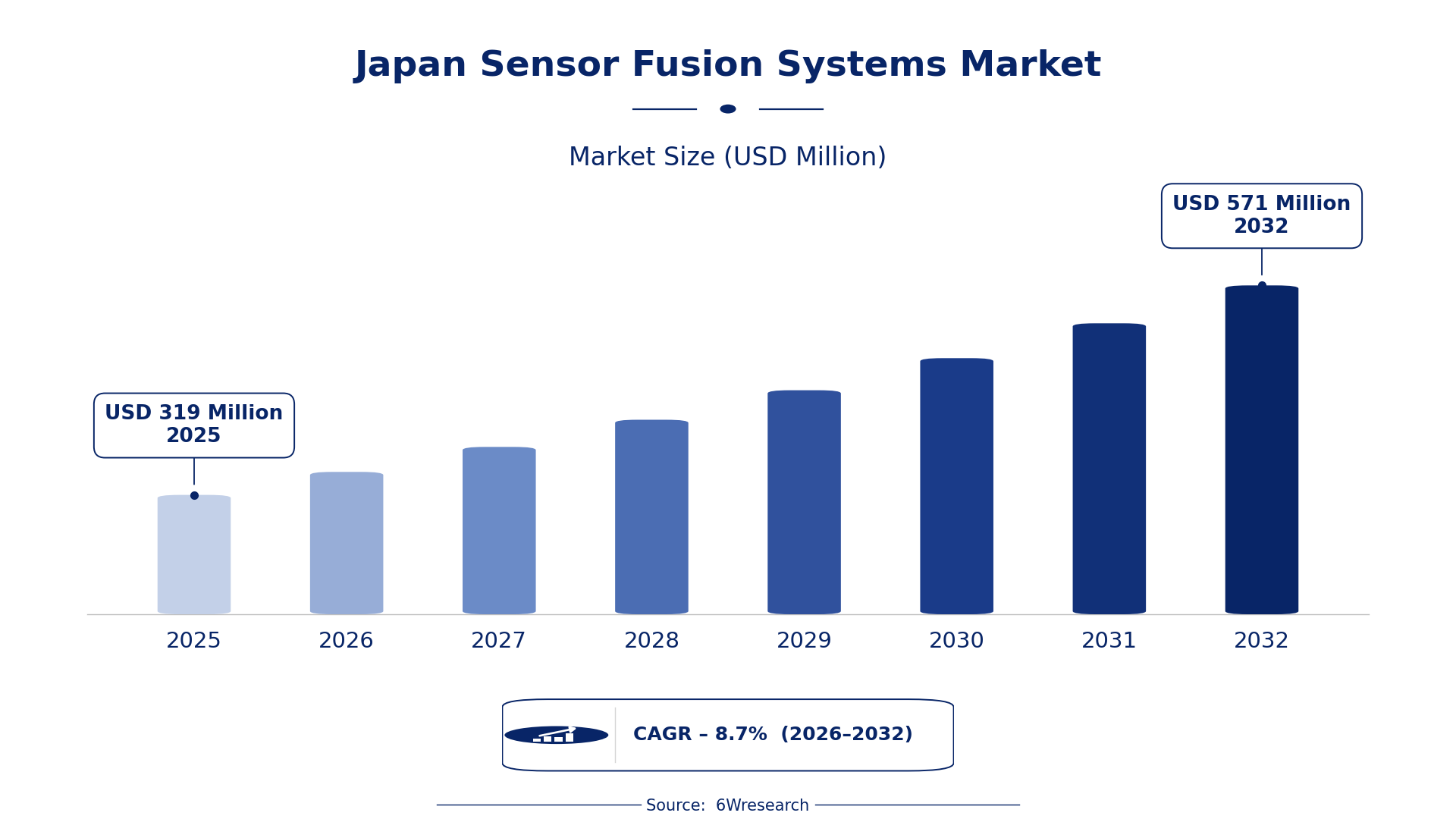
According to 6Wresearch internal database and industry insights, the Japan Sensor Fusion Systems Market was valued at USD 319 Million in 2025 and is projected to reach USD 571 Million by 2032, growing at a CAGR of approximately 8.7% during 2026–2032.
Japan Sensor Fusion Systems Market Highlights
| Report Metric | Details |
| Report Name | Japan Sensor Fusion Systems Market (2026-2032) |
| Market Size 2025 | USD 319 Million |
| Market Size 2032 | USD 571 Million |
| Absolute Growth 2025–2032 | USD 252 Million |
| CAGR 2026–2032 | 8.7% |
| Peak Annual Growth | 9.3% in 2027 |
| Forecast Period | 2026–2032 |
| Historical Data | 2022–2025 |
| Base Year | 2025 |
| Leading Fusion Type, 2025 | Multi-Sensor Fusion AI (47% share) |
| Leading Sensor Inputs, 2025 | Object Detection (47% share) |
| Leading Application Area, 2025 | ADAS Systems (45% share) |
| Leading End User, 2025 | Autonomous Car OEMs (39% share) |
| Fastest-Growing Sensor Inputs | Motion Navigation (11.7% CAGR) |
| Fastest-Growing Application Area | Robotics/Drone Control (10.9% CAGR) |
| Fastest-Growing End User | Self-Driving Platforms (11.2% CAGR) |
| Growing Sector | Automotive |
| Key End Users | Autonomous Car OEMs, Vehicle Electronics Makers, Robotics Developers |
Japan Sensor Fusion Systems Market Year-wise Growth Rate and Key Drivers (2022–2032)
This graph illustrates the annual growth rates of the market from 2022 to 2032, highlighting a steady upward trajectory and projected market expansion over the forecast period.
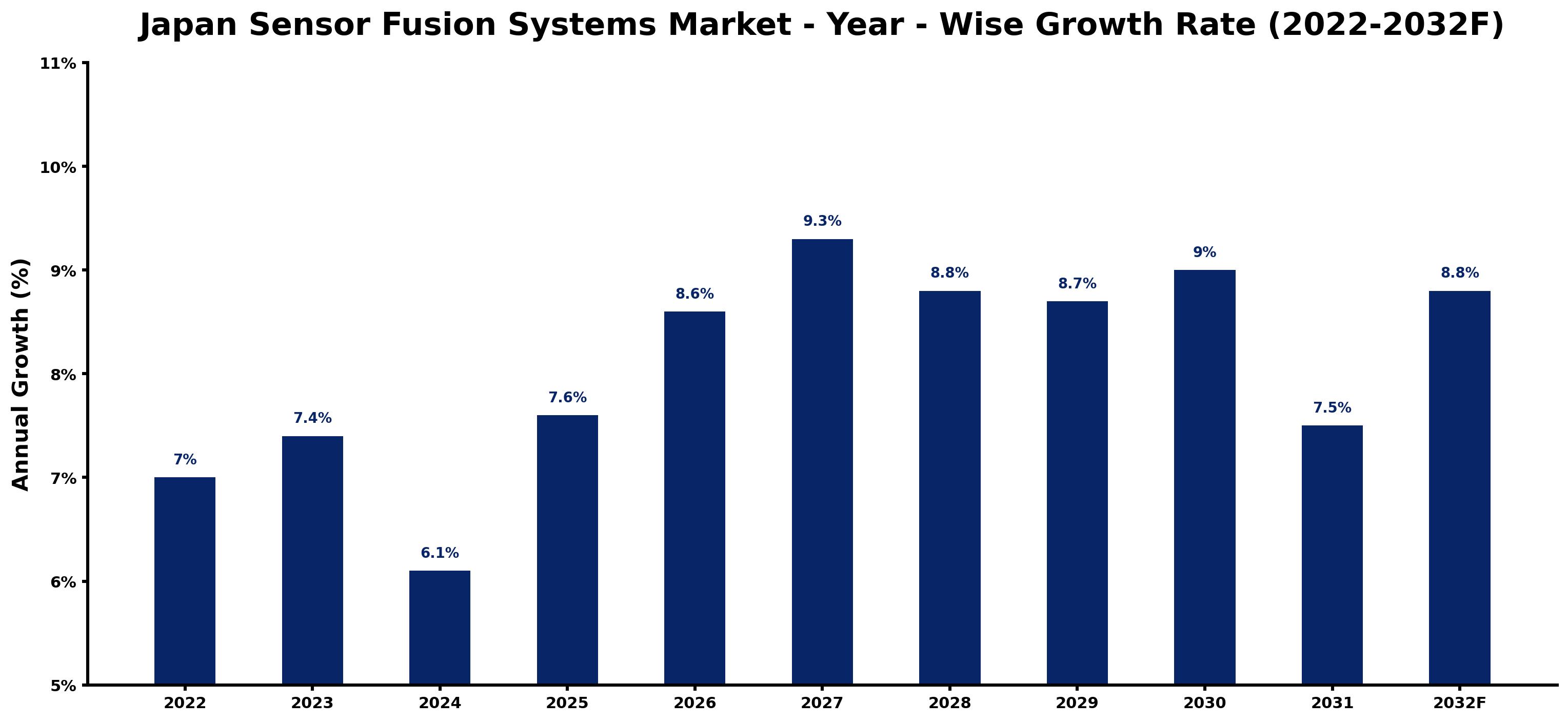
The yearly estimates that follow link every growth rate to its principal driver, so readers can see why the pace changed in each period.
| Year | Estimated Annual Growth (%) | Market Rationale |
| 2022 | 7.0 | The market exhibited steady growth, driven by advancements in automotive technologies. |
| 2023 | 7.4 | Growth accelerated as demand for autonomous vehicle systems increased. |
| 2024 | 6.1 | A slight slowdown occurred due to market adjustments and technology integration challenges. |
| 2025 | 7.6 | The market rebounded with heightened interest in ADAS systems and safety features. |
| 2026 | 8.6 | Demand surged as manufacturers expanded their sensor fusion capabilities for vehicles. |
| 2027 | 9.3 | The peak growth year saw substantial investments in autonomous vehicle technologies. |
| 2028 | 8.8 | Growth moderated slightly as the market stabilises after the peak. |
| 2029 | 8.7 | A continued slowdown was observed as the market adjusts to new technologies. |
| 2030 | 9.0 | Growth resumes as electric vehicle adoption increases, driving sensor demand. |
| 2031 | 7.5 | A slight deceleration occurs as the market matures and competition intensifies. |
| 2032 | 8.8 | The market rebounds with renewed interest in advanced sensor technologies. |
Note: Market size estimations and growth projections presented in this report are based on 6Wresearch's proprietary forecasting methodology, utilizing the latest available industry data, government publications, and primary research inputs.
Japan Sensor Fusion Systems Market Synopsis
Sensor Fusion Systems integrate data from various sensors, including LiDAR, cameras, and radar, to improve perception and decision-making in applications such as autonomous vehicles and robotics. The Japan Sensor Fusion Systems Market is driven by the automotive sector, producing over 5 million vehicles annually, with a projected 80% adoption of ADAS systems in new vehicles by 2025. Government investments in autonomous vehicle research, amounting to ¥10 billion in 2023, further fuel this growth, reflecting the increasing demand for advanced sensor technologies.
Market Dynamics Impact Analysis (2026–2032)
| Factor | Type | Impact | Primary Segment Affected |
| Rising demand for autonomous vehicles drives sensor fusion technology adoption. | Driver | High | Self-Driving Platforms |
| Increasing production of vehicles with advanced safety features boosts sensor integration. | Driver | High | ADAS Systems |
| Growing urbanisation creates opportunities for parking assist systems in vehicles. | Opportunity | Medium | Parking Assist |
| Investment in smart mobility solutions opens new markets for sensor fusion technologies. | Opportunity | High | ADAS Systems |
| High development costs for advanced sensor technologies limit market entry. | Restraint | High | Multi-Sensor Fusion AI |
| Complexity in integrating multiple sensor types can hinder deployment. | Restraint | Medium | IMU + GPS Fusion |
| Shortage of skilled workforce affects the pace of technology development. | Challenge | High | Object Detection |
| Intense competition among manufacturers can lead to price wars. | Challenge | Medium | Camera + Ultrasonic |
Evaluation of Drivers in Japan Sensor Fusion Systems Market (2026–2032)
The factors lifting demand, and the evidence behind each, are summarised below.
| Drivers | Primary Segment Affected | Why It Matters (Evidence) |
| Increased production of autonomous vehicles drives demand for sensor fusion systems. | Self-Driving Platforms | Japan's automotive sector produces over 5 million vehicles annually, necessitating advanced technologies. |
| Rising adoption of ADAS systems boosts safety features in vehicles. | ADAS Systems | With 80% of new vehicles expected to feature ADAS by 2025, demand for sensor fusion grows. |
| Investment in smart mobility initiatives promotes sensor fusion applications. | ADAS Systems | The Japanese government allocated ¥10 billion for autonomous vehicle research, boosting market potential. |
| Urbanisation increases the need for advanced parking assist systems. | Parking Assist | As urban areas expand, demand for parking solutions in vehicles rises. |
| Technological advancements in multi-sensor integration improve system performance. | Multi-Sensor Fusion AI | Better algorithms lead to improved decision-making capabilities in complex environments. |
Orders keep climbing as Japan's automotive sector aims for 50% electric or hybrid vehicles by 2030, increasing sensor demand. The allocation of ¥10 billion for autonomous vehicle research in 2023 supports innovations in sensor fusion technologies. With over 15 million ADAS-equipped vehicles expected by 2023, manufacturers are investing in advanced safety features. Continuous technological advancements in multi-sensor integration improve performance, attracting more buyers to adopt these systems.
Evaluation of Restraints in Japan Sensor Fusion Systems Market
The key brakes on demand, and where they bite hardest, are shown below.
| Market Restraint | Primary Segment Affected | Why It Matters (Evidence) |
| High development costs for advanced sensor technologies limit market entry. | Multi-Sensor Fusion AI | Development costs can exceed ¥1 billion, deterring new entrants in the market. |
| Complexity in integrating multiple sensor types can hinder deployment. | IMU + GPS Fusion | Integration challenges can delay product launches and increase time to market. |
| Regulatory compliance requirements can slow product approval processes. | ADAS Systems | Compliance with ISO 26262 standards requires extensive testing, adding to development time. |
| Limited availability of skilled professionals affects project timelines. | Object Detection | The lack of trained professionals can lead to project delays and increased costs. |
| Market saturation in certain segments may limit growth potential. | Camera + Ultrasonic | Intense competition can lead to price reductions, impacting profitability. |
Japan Sensor Fusion Systems Market Challenges
A major obstacle for buyers is the rapid evolution of technology in sensor fusion systems, leading to potential obsolescence within a year and necessitating constant investments in upgrades. High production costs challenge suppliers, as advanced materials and complex algorithms can inflate system prices by up to 30%, limiting access for smaller automotive firms. Buyers face deployment delays due to compliance with the JIS B 8411 standard, which can extend project timelines by six months and hinder market readiness. Skills shortages among the workforce impede suppliers from meeting rising demands, causing project delays of up to a year for technology firms.
Trends in the Japan Sensor Fusion Systems Market
Buyers and suppliers in the Japan Sensor Fusion Systems Market are adjusting to the following trends.
- Shift from Traditional to Advanced Parking Solutions: Urban areas are pushing the evolution of Parking Assist systems, with demand for advanced solutions rising. In Japan, the number of vehicles equipped with parking assist features is projected to grow significantly, reflecting changing consumer preferences.
- Transition from Basic to Multi-Sensor Fusion Technologies: The adoption of Multi-Sensor Fusion AI is increasing, especially in logistics and delivery services. In 2023, demand for these technologies surged, highlighting their role in improving operational efficiency.
- ADAS Systems Gaining Prominence: ADAS Systems are becoming standard in new vehicles, with a projected 80% adoption rate by 2025. This trend underscores the growing emphasis on vehicle safety and automation in the automotive sector.
- Emergence of Robotics and Drone Control Applications: Robotics and drone control applications are increasingly utilising sensor fusion technologies. The Robotics Society of Japan reported a rise in projects using these systems, indicating a shift towards automation.
Investment Opportunities in the Japan Sensor Fusion Systems Market
Where to invest in the Japan Sensor Fusion Systems Market: the main openings are set out below.
- Growing Demand for Smart Mobility Solutions: With urbanisation driving the need for efficient transportation, investing in smart mobility solutions is timely. The Tokyo region, a hub for automotive innovation, offers opportunities for sensor fusion suppliers.
- Investment in Autonomous Vehicle Technologies: The current focus on autonomous vehicles presents an opportunity for suppliers of sensor fusion systems. Collaborating with Autonomous Car OEMs in Japan can facilitate market entry.
- Expansion of ADAS Systems in New Vehicles: The expected rise in ADAS systems adoption creates a significant opportunity for sensor fusion technologies. Engaging with vehicle electronics makers can enhance market presence.
- Increased Focus on Safety Features: As safety becomes paramount, there is a growing need for advanced sensor technologies. Suppliers can target automotive manufacturers to meet this demand effectively.
Government Initiatives in the Japan Sensor Fusion Systems Market
The Semiconductor and Digital Industry Strategy launched in June 2021 aims to secure domestic semiconductor manufacturing, strengthening the production capabilities of sensor fusion systems. This strategy complements existing laws like the Industrial Standardization Act, promoting compliance with JIS standards for automotive technologies.
The Economic Security Promotion Act supports supply-chain resilience for critical products, benefiting automotive manufacturers. This act ensures that manufacturers can access necessary components for sensor fusion systems, facilitating smoother production processes.
Future Insight of the Japan Sensor Fusion Systems Market
Buyers in the automotive sector will increasingly seek sensor fusion systems as the integration of ADAS in new vehicles reaches 80% by 2025. By 2032, the demand for electric and hybrid vehicles will drive sensor requirements, aligning with the government's target for 50% of vehicles to be electric by 2030. Research at the Tokyo Institute of Technology will advance capabilities in sensor technologies, improving applications in various sectors. As urbanization progresses, innovations in mobility solutions will reshape transportation, addressing the growing need for efficient urban navigation.
Market Segmentation Analysis
Japan Sensor Fusion Systems Market report covers a detailed analysis of the following market segments:
By Fusion Type – Multi-Sensor Fusion AI Leads and Records the Fastest Growth
According to Saurav Kr Singh, Senior Research Analyst at 6Wresearch, Multi-Sensor Fusion AI accounted for 47% of the market by fusion type in 2025. Multi-Sensor Fusion holds the largest share due to its ability to enhance decision-making capabilities in complex environments, particularly for autonomous vehicles. The automotive sector's demand, especially in the Tokyo region, underscores its critical role in advancing technology. Its lead should widen, with a projected CAGR of 9.8% during 2026–2032, the highest in this split. The growth of Multi-Sensor Fusion is propelled by the Japanese government's ¥10 billion allocation for autonomous vehicle research in 2023. This investment will further strengthen its leading position as the automotive industry continues to evolve. Suppliers should prioritise the development of Multi-Sensor Fusion solutions to address the increasing demand from the automotive sector.
By Sensor Inputs – Object Detection Leads, Motion Navigation Expected to Grow Fastest
With 47% of sensor inputs revenue in 2025, Object Detection was the largest category. Object Detection leads this segment as it is fundamental for safety features in vehicles and robotics, ensuring reliable operation across various scenarios. Its crucial role in enhancing vehicle safety systems makes it a primary focus for manufacturers and developers. Motion Navigation is projected to grow fastest, at a CAGR of 11.7% during 2026–2032. Motion Navigation is experiencing rapid growth due to the rising need for effective navigation in autonomous vehicles and drones, which require precise movement control. This trend indicates a significant shift towards more advanced navigation solutions in the market. Buyers should invest in advanced Object Detection technologies to improve safety and reliability in their offerings.
By Application Area – ADAS Systems Lead, Robotics/Drone Control Expected to Grow Fastest
ADAS Systems took 45% of application area revenue in 2025, more than any other category. ADAS Systems dominate this area as they are a primary application for improving vehicle safety and automation, with projections indicating their presence in 80% of new vehicles by 2025. This widespread adoption highlights their vital role in the automotive industry. Robotics/Drone Control is set to record the highest CAGR in this split, 10.9% over 2026–2032. Robotics/Drone Control is witnessing the fastest growth driven by the increasing demand for autonomous operations in various robotic applications, necessitating sophisticated sensor integration. This trend reflects a broader shift towards automation across multiple sectors. Suppliers must focus on developing ADAS technologies to capitalise on the expanding market for vehicle safety improvements.
By End User – Autonomous Car OEMs Lead, Self-Driving Platforms Expected to Grow Fastest
In 2025, Autonomous Car OEMs led the end user split with a 39% share. Autonomous Car OEMs represent the largest user group of sensor fusion technologies, as they are the primary developers of automated vehicles that rely heavily on these systems. Their substantial investments in sensor technologies propel the market forward. Over 2026–2032, Self-Driving Platforms are expected to post the fastest growth, at a CAGR of 11.2%. Self-Driving Platforms are rapidly gaining traction as they depend on sensor fusion for the core functionality of autonomous driving, indicating a significant industry shift towards fully automated solutions. This trend suggests a continuous rise in demand for these platforms. Buyers should align their strategies with the needs of Autonomous Car OEMs to ensure effective integration of sensor technologies.
Key Attractiveness of the Report
- 10 Years of Market Numbers
- Historical Data Starting from 2022 to 2025
- Base Year 2025
- Forecast Data until 2032
- Key Performance Indicators Impacting the Market
- Major Upcoming Developments and Projects
Key Highlights of the Report:
- Japan Sensor Fusion Systems Market Outlook
- Market Size of Japan Sensor Fusion Systems Market, 2025
- Forecast of Japan Sensor Fusion Systems Market, 2032
- Historical Data and Forecast of Japan Sensor Fusion Systems Revenues & Volume for the Period 2022-2032F
- Japan Sensor Fusion Systems Market Trend Evolution
- Japan Sensor Fusion Systems Market Drivers and Challenges
- Japan Sensor Fusion Systems Price Trends
- Japan Sensor Fusion Systems Porter's Five Forces
- Japan Sensor Fusion Systems Industry Life Cycle
- Historical Data and Forecast of Japan Sensor Fusion Systems Market Revenues & Volume By Fusion Type for the Period 2022-2032F
- Historical Data and Forecast of Japan Sensor Fusion Systems Market Revenues & Volume By LiDAR + Radar Fusion for the Period 2022-2032F
- Historical Data and Forecast of Japan Sensor Fusion Systems Market Revenues & Volume By Camera + Ultrasonic for the Period 2022-2032F
- Historical Data and Forecast of Japan Sensor Fusion Systems Market Revenues & Volume By IMU + GPS Fusion for the Period 2022-2032F
- Historical Data and Forecast of Japan Sensor Fusion Systems Market Revenues & Volume By Multi-Sensor Fusion AI for the Period 2022-2032F
- Historical Data and Forecast of Japan Sensor Fusion Systems Market Revenues & Volume By Sensor Inputs for the Period 2022-2032F
- Historical Data and Forecast of Japan Sensor Fusion Systems Market Revenues & Volume By Object Detection for the Period 2022-2032F
- Historical Data and Forecast of Japan Sensor Fusion Systems Market Revenues & Volume By Parking Assist for the Period 2022-2032F
- Historical Data and Forecast of Japan Sensor Fusion Systems Market Revenues & Volume By Motion Navigation for the Period 2022-2032F
- Historical Data and Forecast of Japan Sensor Fusion Systems Market Revenues & Volume By All Sensor Streams for the Period 2022-2032F
- Historical Data and Forecast of Japan Sensor Fusion Systems Market Revenues & Volume By Application Area for the Period 2022-2032F
- Historical Data and Forecast of Japan Sensor Fusion Systems Market Revenues & Volume By ADAS Systems for the Period 2022-2032F
- Historical Data and Forecast of Japan Sensor Fusion Systems Market Revenues & Volume By Blind Spot/Obstacle Avoidance for the Period 2022-2032F
- Historical Data and Forecast of Japan Sensor Fusion Systems Market Revenues & Volume By Robotics/Drone Control for the Period 2022-2032F
- Historical Data and Forecast of Japan Sensor Fusion Systems Market Revenues & Volume By Real-Time Decision Support for the Period 2022-2032F
- Historical Data and Forecast of Japan Sensor Fusion Systems Market Revenues & Volume By End User for the Period 2022-2032F
- Historical Data and Forecast of Japan Sensor Fusion Systems Market Revenues & Volume By Autonomous Car OEMs for the Period 2022-2032F
- Historical Data and Forecast of Japan Sensor Fusion Systems Market Revenues & Volume By Vehicle Electronics Makers for the Period 2022-2032F
- Historical Data and Forecast of Japan Sensor Fusion Systems Market Revenues & Volume By Mobility Equipment Vendors for the Period 2022-2032F
- Historical Data and Forecast of Japan Sensor Fusion Systems Market Revenues & Volume By Self-Driving Platforms for the Period 2022-2032F
- Japan Sensor Fusion Systems Import Export Trade Statistics
- Market Opportunity Assessment By Fusion Type
- Market Opportunity Assessment By Sensor Inputs
- Market Opportunity Assessment By Application Area
- Market Opportunity Assessment By End User
- Japan Sensor Fusion Systems Top Companies Market Share
- Japan Sensor Fusion Systems Competitive Benchmarking By Technical and Operational Parameters
- Japan Sensor Fusion Systems Company Profiles
- Japan Sensor Fusion Systems Key Strategic Recommendations
Market Covered
The following segment groups are covered in the report.
By Fusion Type
- LiDAR + Radar Fusion
- Camera + Ultrasonic
- IMU + GPS Fusion
- Multi-Sensor Fusion AI
By Sensor Inputs
- Object Detection
- Parking Assist
- Motion Navigation
- All Sensor Streams
By Application Area
- ADAS Systems
- Blind Spot/Obstacle Avoidance
- Robotics/Drone Control
- Real-Time Decision Support
By End User
- Autonomous Car OEMs
- Vehicle Electronics Makers
- Mobility Equipment Vendors
- Self-Driving Platforms































