Japan Sepsis Treatment Devices Market Size & Growth Rate
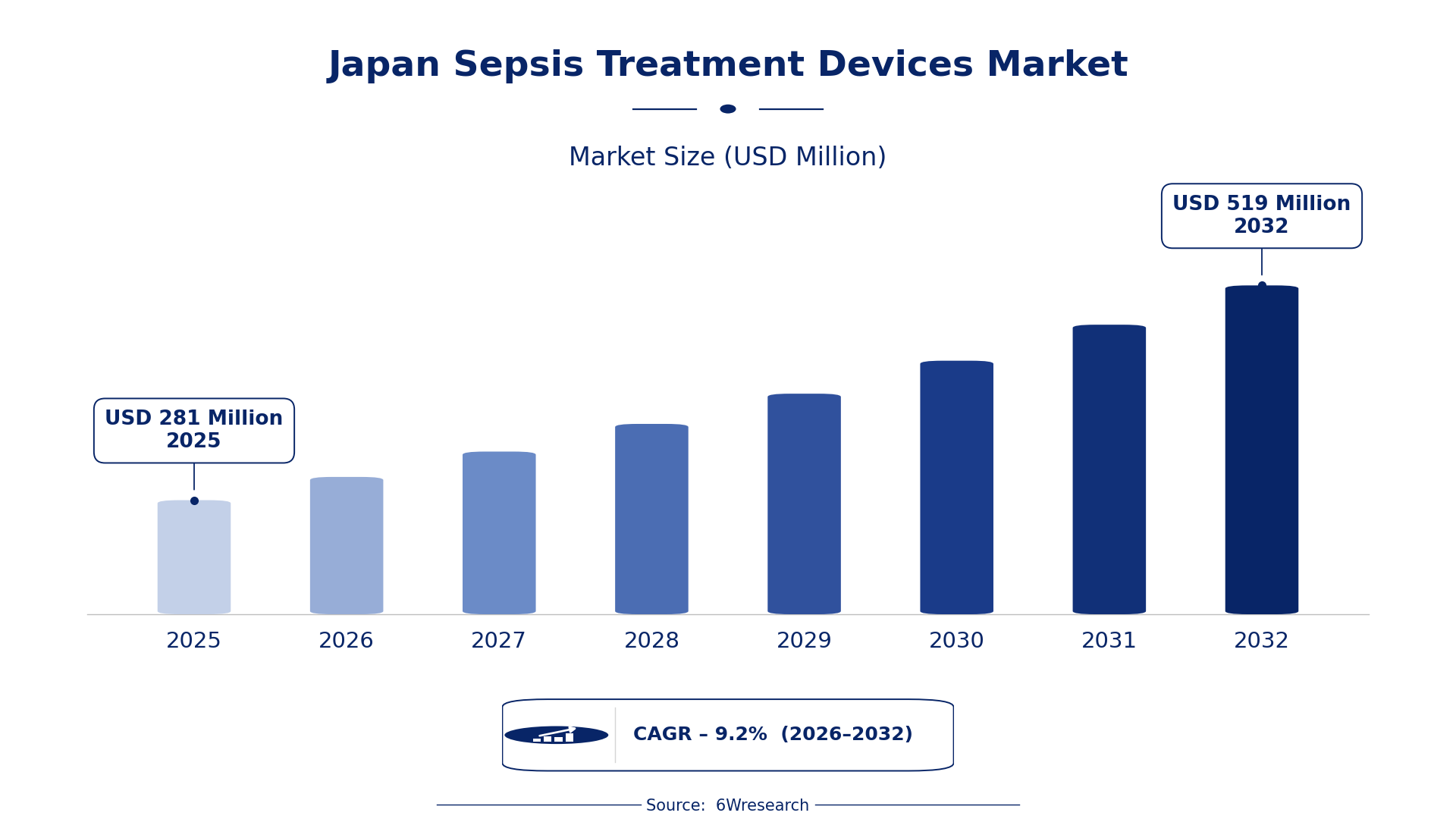
According to 6Wresearch internal database and industry insights, the Japan Sepsis Treatment Devices Market was valued at USD 281 Million in 2025 and is projected to reach USD 519 Million by 2032, growing at a CAGR of approximately 9.2% during 2026–2032.
Japan Sepsis Treatment Devices Market Highlights
| Report Metric | Details |
| Report Name | Japan Sepsis Treatment Devices Market (2026-2032) |
| Market Size 2025 | USD 281 Million |
| Market Size 2032 | USD 519 Million |
| Absolute Growth 2025–2032 | USD 238 Million |
| CAGR 2026–2032 | 9.2% |
| Peak Annual Growth | 9.8% in 2026 |
| Forecast Period | 2026–2032 |
| Historical Data | 2022–2025 |
| Base Year | 2025 |
| Leading Device Type, 2025 | Blood Purification (37% share) |
| Leading Functionality, 2025 | Cytokine Removal (33% share) |
| Leading Care Setting, 2025 | ICU (44% share) |
| Leading End User, 2025 | Hospitals (50% share) |
| Fastest-Growing Device Type | Infusion Pumps (12.4% CAGR) |
| Fastest-Growing Functionality | Controlled Dosing (11.5% CAGR) |
| Fastest-Growing Care Setting | Emergency Units (12.0% CAGR) |
| Fastest-Growing End User | Critical Care Centers (11.4% CAGR) |
| Growing Sector | critical care |
| Key End Users | hospitals, critical care centers, emergency physicians |
Japan Sepsis Treatment Devices Market Year-wise Growth Rate and Key Drivers (2022–2032)
This graph illustrates the annual growth rates of the market from 2022 to 2032, highlighting a steady upward trajectory and projected market expansion over the forecast period.
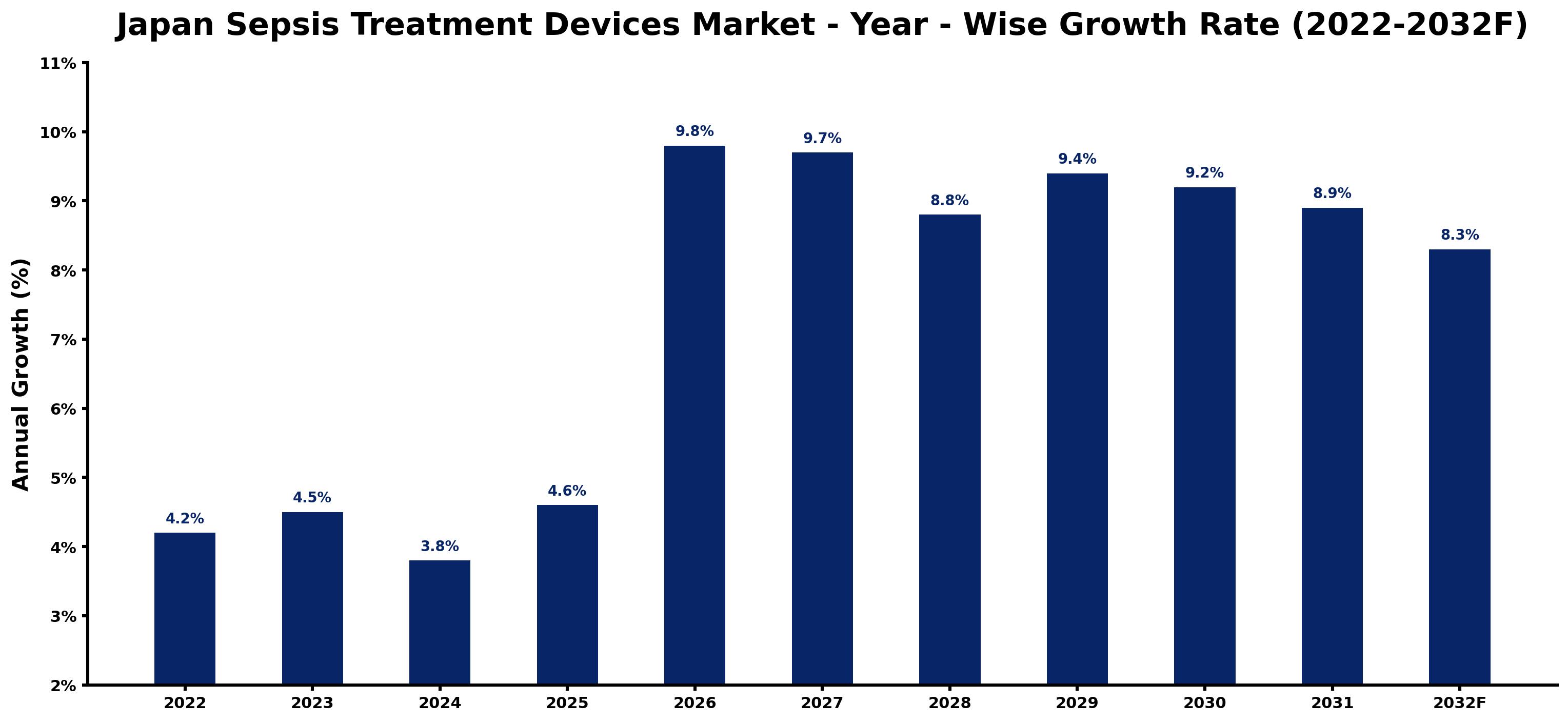
Below, each year's estimated growth is shown next to the factor that most influenced it.
| Year | Estimated Annual Growth (%) | Market Rationale |
| 2022 | 4.2 | The market experienced steady growth, supported by increasing awareness of sepsis management among healthcare providers. |
| 2023 | 4.5 | Demand rose due to heightened efforts in sepsis management and treatment protocols across hospitals. |
| 2024 | 3.8 | Growth slowed slightly as the market adjusted to evolving healthcare needs and patient demographics. |
| 2025 | 4.6 | The market saw a resurgence in growth driven by advancements in treatment technologies and protocols. |
| 2026 | 9.8 | Surging demand for infusion pumps is expected to propel the market to peak growth this year. |
| 2027 | 9.7 | Growth will moderate as the market adjusts to the rapid expansion of previous years and stabilises. |
| 2028 | 8.8 | A slight slowdown is projected as the market stabilises after peak demand in the previous years. |
| 2029 | 9.4 | Demand is expected to accelerate again, driven by increased hospitalisation rates for sepsis cases. |
| 2030 | 9.2 | Growth will slow as the market begins to normalise after several years of rapid expansion. |
| 2031 | 8.9 | The market will continue to grow, albeit at a slower pace compared to previous years and market saturation. |
| 2032 | 8.3 | Growth is projected to stabilise further as the market matures and competition increases. |
Note: Market size estimations and growth projections presented in this report are based on 6Wresearch's proprietary forecasting methodology, utilizing the latest available industry data, government publications, and primary research inputs.
Japan Sepsis Treatment Devices Market Synopsis
Sepsis treatment devices are advanced medical technologies used to manage sepsis, a severe condition caused by infection. These devices include blood purification systems, monitoring equipment, and infusion pumps, which are essential in critical care settings. The Japan Sepsis Treatment Devices Market is expanding due to rising sepsis cases, with approximately 150,000 reported annually, and increasing healthcare expenditure, which reached about JPY 46.7 trillion in 2022. The Tokyo region, with the highest concentration of critical care hospitals, is driving demand for these technologies, supported by ongoing education efforts in sepsis management and treatment protocols.
Market Dynamics Impact Analysis (2026–2032)
| Factor | Type | Impact | Primary Segment Affected |
| Rising sepsis cases drive demand for effective treatment solutions. | Driver | High | Blood Purification |
| Increased healthcare expenditure supports investment in advanced medical technologies. | Driver | High | Infusion Pumps |
| Growing awareness of sepsis management creates opportunities for device manufacturers. | Opportunity | High | Monitoring Devices |
| Expansion of critical care facilities enhances the market for sepsis treatment devices. | Opportunity | Medium | ICU |
| High costs associated with advanced treatment devices may limit accessibility. | Restraint | High | Blood Purification |
| Strict regulatory requirements can delay the approval of new devices. | Restraint | Medium | Infusion Pumps |
| Limited capacity in hospitals can hinder the adoption of new technologies. | Challenge | High | Monitoring Devices |
| Compliance with evolving standards can increase operational costs for producers. | Challenge | Medium | ICU |
Evaluation of Drivers in Japan Sepsis Treatment Devices Market (2026–2032)
Below are the drivers that matter most for revenue growth, with supporting evidence.
| Drivers | Primary Segment Affected | Why It Matters (Evidence) |
| Increase in sepsis cases necessitates effective treatment solutions. | Blood Purification | Approximately 150,000 sepsis cases reported annually in Japan drive demand for blood purification devices essential for patient recovery. |
| Healthcare expenditure growth supports investment in medical technologies. | Infusion Pumps | Japan's national medical care expenditure was about JPY 46.7 trillion, facilitating the purchase of advanced infusion pumps in critical care settings. |
| Rising awareness of sepsis management leads to increased device usage. | Monitoring Devices | The sepsis awareness program launched in 2023 boosted demand for monitoring devices, increasing their adoption in emergency units. |
| Technological advancements improve treatment efficacy and patient outcomes. | Cytokine Removal | Innovations in cytokine removal technology improve recovery rates, encouraging hospitals to invest in these advanced systems. |
| Integration of sepsis treatment protocols into clinical guidelines promotes device adoption. | Septic Shock Detection | The inclusion of sepsis treatment protocols in Japanese Clinical Practice Guidelines drives demand for detection devices in hospitals. |
Much of the new demand traces back to the increasing incidence of sepsis, with approximately 150,000 cases reported annually. This surge compels hospitals to invest in blood purification systems, which are essential in 60% of severe cases. Japan's healthcare expenditure, which reached about JPY 46.7 trillion, allows for the procurement of advanced infusion pumps widely used in over 80% of critical care centers. The integration of sepsis treatment protocols into clinical guidelines encourages hospitals to adopt cytokine removal technologies, improving patient outcomes and driving demand for these devices.
Evaluation of Restraints in Japan Sepsis Treatment Devices Market
The following restraints limit how fast demand can grow.
| Market Restraint | Primary Segment Affected | Why It Matters (Evidence) |
| High costs of advanced treatment devices may limit accessibility for some hospitals. | Blood Purification | The average hospital stay for sepsis patients is around 14 days, increasing treatment costs for healthcare providers. |
| Regulatory hurdles can delay the introduction of new devices to the market. | Infusion Pumps | Compliance with JIS standards for safety and efficacy can extend approval timelines, affecting market entry. |
| Limited hospital capacity affects the adoption of new medical technologies. | Monitoring Devices | With about 8,100 hospitals in Japan, not all can accommodate advanced monitoring systems due to space constraints. |
| Market competition can pressure pricing, impacting profitability for producers. | Cytokine Removal | As more companies enter the market, price wars may reduce profit margins for existing manufacturers. |
| Evolving standards require continuous investment in compliance and training. | Septic Shock Detection | Producers must invest in training and compliance to meet new regulatory requirements, increasing operational costs. |
Japan Sepsis Treatment Devices Market Challenges
In 2023, Japan reported approximately 150,000 sepsis cases annually, but a shortage of skilled healthcare professionals hampers effective treatment. This shortage stems from an ageing population, which intensifies competition for qualified staff among critical care centres. Regulatory hurdles prolong the approval process for new treatment devices, limiting options for producers and delaying patient care. Buyers experience increased costs, as the average hospital stay for sepsis patients is around 14 days, straining hospital budgets and escalating overall healthcare expenditures.
Trends in the Japan Sepsis Treatment Devices Market
Below are the shifts with the largest effect on the Japan Sepsis Treatment Devices Market.
- Shift towards Advanced Monitoring Technologies: In 2023, monitoring devices saw a 20% increase in usage in emergency units, reflecting a shift towards advanced patient monitoring. This trend is driven by the need for real-time data in critical care settings, improving patient outcomes.
- Integrated Sepsis Management Protocols: The Japanese Clinical Practice Guidelines now include sepsis treatment protocols, promoting the adoption of integrated management systems. This shift is expected to improve patient recovery rates and streamline treatment processes in hospitals.
- Focus on Blood Purification Innovations: Innovations in blood purification technologies are becoming increasingly important in Japan, with 60% of severe sepsis cases requiring these devices. Ongoing research at Tokyo Medical University is advancing these technologies.
- Expansion of Critical Care Facilities: The Tokyo region is experiencing a rise in critical care hospitals, with over 1,000 ICU beds available. This expansion is essential for accommodating the increasing number of sepsis cases and improving treatment access.
Investment Opportunities in the Japan Sepsis Treatment Devices Market
Investors looking at the Japan Sepsis Treatment Devices Market should consider the following areas.
- Joint Ventures for Device Development: Now is an opportune time for joint ventures in sepsis treatment device development, as Japan's healthcare expenditure reached JPY 46.7 trillion. Collaborations with hospitals can facilitate access to critical care settings.
- Investment in Monitoring Solutions: With a 20% increase in monitoring device usage, there is an opportunity to supply advanced monitoring solutions. Targeting emergency units in the Tokyo region can lead to successful market entry.
- Approval Pathways for Innovative Technologies: The current regulatory environment supports the approval of innovative sepsis treatment technologies, with the PMDA actively reviewing new devices. Engaging with local partners can streamline the approval process.
- Expansion of Research Initiatives: The government allocated ¥500 million for sepsis research initiatives in 2023, creating opportunities for investment in new treatment technologies. Collaborating with research institutions can enhance product development.
Government Initiatives in the Japan Sepsis Treatment Devices Market
The PMD Act governs the approval and quality of medical devices, ensuring that sepsis treatment devices meet safety standards. Compliance with this law is essential for manufacturers to market their products effectively in Japan, influencing the quality and safety of devices available to healthcare providers.
The Pharmaceuticals and Medical Devices Agency (PMDA) reviews medical devices and monitors post-market safety. Hospitals rely on PMDA approvals to ensure the devices they use are safe and effective, influencing their purchasing decisions and ensuring compliance with national health standards.
Future Insight of the Japan Sepsis Treatment Devices Market
New critical care facilities will emerge by 2032, enhancing access to advanced treatment technologies. The sepsis awareness programme will elevate education and training for healthcare professionals, improving patient outcomes. Government-funded research initiatives, with ¥500 million allocated in 2023, will spur innovation in treatment technologies. Collaboration between critical care centres and research institutions will lead to the development of more effective sepsis management protocols.
Market Segmentation Analysis
Japan Sepsis Treatment Devices Market report covers a detailed analysis of the following market segments:
By Device Type – Blood Purification Leads, Infusion Pumps Expected to Grow Fastest
According to Saurav Kr Singh, Senior Research Analyst at 6Wresearch, Blood Purification accounted for 37% of the market by device type in 2025. Blood purification devices are vital in the treatment of severe sepsis, being used in 60% of such cases. Their ability to effectively remove toxins from the blood makes them essential in hospitals with advanced treatment protocols, ensuring better patient outcomes. The quickest growth will come from Infusion Pumps, forecast to expand at a CAGR of 12.4% between 2026 and 2032. Infusion pumps are rapidly gaining traction, with over 80% of critical care centres employing them for medication delivery. This surge is driven by the need for precise dosing in emergency situations, which is crucial for improving patient care. Suppliers should focus on enhancing the availability and technology of infusion pumps to meet the increasing demands in critical care settings.
By Functionality – Cytokine Removal Leads, Controlled Dosing Expected to Grow Fastest
Cytokine Removal held 33% of the Japan Sepsis Treatment Devices Market by functionality in 2025. Cytokine removal is a critical aspect of sepsis treatment, specifically addressing the cytokine storm that can arise in severe cases. Its importance is underscored by clinical guidelines that promote this targeted therapy to enhance patient management. Controlled Dosing is projected to grow fastest, at a CAGR of 11.5% during 2026–2032. Controlled dosing is increasingly vital, ensuring accurate medication administration during sepsis treatment. This functionality is particularly crucial in emergency units, where timely and precise interventions can significantly influence patient survival rates. Buyers should prioritise devices that feature advanced controlled dosing capabilities to improve treatment efficacy.
By Care Setting – ICU Leads, Emergency Units Expected to Grow Fastest
ICU took 44% of care setting revenue in 2025, more than any other category. The ICU is the primary setting for intensive sepsis treatment, housing over 1,000 ICU beds in major hospitals across Japan. This concentration allows for specialised care and monitoring of critically ill patients. Over 2026–2032, Emergency Units are expected to post the fastest growth, at a CAGR of 12.0%. Emergency units are experiencing a surge in sepsis cases, reflecting their role as the first response area for such conditions. The increasing adoption of sepsis treatment protocols in these units is driving their rapid growth. Suppliers should consider tailoring their products to meet the specific needs of emergency units as demand continues to rise.
By End User – Hospitals Lead, Critical Care Centers Expected to Grow Fastest
In 2025, Hospitals led the end user split with a 50% share. Hospitals serve as the primary facilities for sepsis treatment, with approximately 8,100 hospitals operating in Japan. Their extensive infrastructure and resources enable effective management of sepsis cases across various medical departments, making them indispensable in patient care. Critical Care Centers are set to record the highest CAGR in this split, 11.4% over 2026–2032. Critical care centres are seeing increased utilisation for severe sepsis cases, reflecting a shift towards specialised care environments. This trend aligns with the annual rise in reported sepsis cases, highlighting the need for focused treatment. Providers must ensure that critical care centres are adequately equipped with the latest sepsis treatment devices to address the growing patient population.
Key Attractiveness of the Report
- 10 Years of Market Numbers
- Historical Data Starting from 2022 to 2025
- Base Year 2025
- Forecast Data until 2032
- Key Performance Indicators Impacting the Market
- Major Upcoming Developments and Projects
Key Highlights of the Report:
- Japan Sepsis Treatment Devices Market Outlook
- Market Size of Japan Sepsis Treatment Devices Market, 2025
- Forecast of Japan Sepsis Treatment Devices Market, 2032
- Historical Data and Forecast of Japan Sepsis Treatment Devices Revenues & Volume for the Period 2022-2032F
- Japan Sepsis Treatment Devices Market Trend Evolution
- Japan Sepsis Treatment Devices Market Drivers and Challenges
- Japan Sepsis Treatment Devices Price Trends
- Japan Sepsis Treatment Devices Porter's Five Forces
- Japan Sepsis Treatment Devices Industry Life Cycle
- Historical Data and Forecast of Japan Sepsis Treatment Devices Market Revenues & Volume By Device Type for the Period 2022-2032F
- Historical Data and Forecast of Japan Sepsis Treatment Devices Market Revenues & Volume By Blood Purification for the Period 2022-2032F
- Historical Data and Forecast of Japan Sepsis Treatment Devices Market Revenues & Volume By Infusion Pumps for the Period 2022-2032F
- Historical Data and Forecast of Japan Sepsis Treatment Devices Market Revenues & Volume By Monitoring Devices for the Period 2022-2032F
- Historical Data and Forecast of Japan Sepsis Treatment Devices Market Revenues & Volume By Dialysis Machines for the Period 2022-2032F
- Historical Data and Forecast of Japan Sepsis Treatment Devices Market Revenues & Volume By Functionality for the Period 2022-2032F
- Historical Data and Forecast of Japan Sepsis Treatment Devices Market Revenues & Volume By Cytokine Removal for the Period 2022-2032F
- Historical Data and Forecast of Japan Sepsis Treatment Devices Market Revenues & Volume By Controlled Dosing for the Period 2022-2032F
- Historical Data and Forecast of Japan Sepsis Treatment Devices Market Revenues & Volume By Septic Shock Detection for the Period 2022-2032F
- Historical Data and Forecast of Japan Sepsis Treatment Devices Market Revenues & Volume By Toxin Filtration for the Period 2022-2032F
- Historical Data and Forecast of Japan Sepsis Treatment Devices Market Revenues & Volume By Care Setting for the Period 2022-2032F
- Historical Data and Forecast of Japan Sepsis Treatment Devices Market Revenues & Volume By ICU for the Period 2022-2032F
- Historical Data and Forecast of Japan Sepsis Treatment Devices Market Revenues & Volume By Emergency Units for the Period 2022-2032F
- Historical Data and Forecast of Japan Sepsis Treatment Devices Market Revenues & Volume By Point-of-Care for the Period 2022-2032F
- Historical Data and Forecast of Japan Sepsis Treatment Devices Market Revenues & Volume By Chronic Care for the Period 2022-2032F
- Historical Data and Forecast of Japan Sepsis Treatment Devices Market Revenues & Volume By End User for the Period 2022-2032F
- Historical Data and Forecast of Japan Sepsis Treatment Devices Market Revenues & Volume By Hospitals for the Period 2022-2032F
- Historical Data and Forecast of Japan Sepsis Treatment Devices Market Revenues & Volume By Critical Care Centers for the Period 2022-2032F
- Historical Data and Forecast of Japan Sepsis Treatment Devices Market Revenues & Volume By Emergency Physicians for the Period 2022-2032F
- Historical Data and Forecast of Japan Sepsis Treatment Devices Market Revenues & Volume By Renal Treatment Clinics for the Period 2022-2032F
- Japan Sepsis Treatment Devices Import Export Trade Statistics
- Market Opportunity Assessment By Device Type
- Market Opportunity Assessment By Functionality
- Market Opportunity Assessment By Care Setting
- Market Opportunity Assessment By End User
- Japan Sepsis Treatment Devices Top Companies Market Share
- Japan Sepsis Treatment Devices Competitive Benchmarking By Technical and Operational Parameters
- Japan Sepsis Treatment Devices Company Profiles
- Japan Sepsis Treatment Devices Key Strategic Recommendations
Market Covered
Segments analysed in this report are listed below.
By Device Type
- Blood Purification
- Infusion Pumps
- Monitoring Devices
- Dialysis Machines
By Functionality
- Cytokine Removal
- Controlled Dosing
- Septic Shock Detection
- Toxin Filtration
By Care Setting
- ICU
- Emergency Units
- Point-of-Care
- Chronic Care
By End User
- Hospitals
- Critical Care Centers
- Emergency Physicians
- Renal Treatment Clinics































