Japan Serological Reagents Market Size & Growth Rate
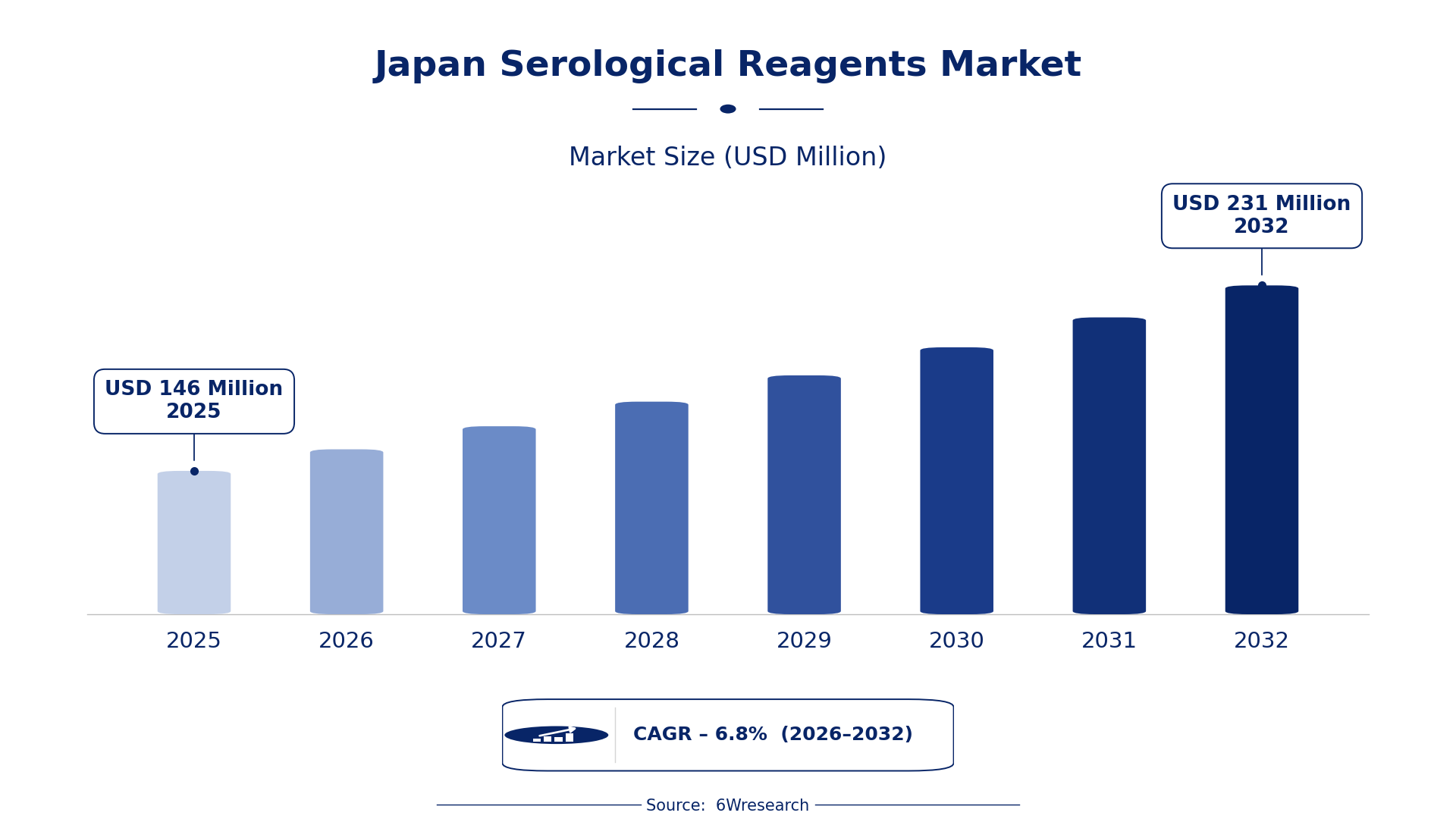
According to 6Wresearch internal database and industry insights, the Japan Serological Reagents Market was valued at USD 146 Million in 2025 and is projected to reach USD 231 Million by 2032, growing at a CAGR of approximately 6.8% during 2026–2032.
Japan Serological Reagents Market Highlights
| Report Metric | Details |
| Report Name | Japan Serological Reagents Market (2026-2032) |
| Market Size 2025 | USD 146 Million |
| Market Size 2032 | USD 231 Million |
| Absolute Growth 2025–2032 | USD 85 Million |
| CAGR 2026–2032 | 6.8% |
| Peak Annual Growth | 7.6% in 2028 |
| Forecast Period | 2026–2032 |
| Historical Data | 2022–2025 |
| Base Year | 2025 |
| Leading Reagent Type, 2025 | Antibodies (34% share) |
| Leading Target Marker, 2025 | Viral Antigens (47% share) |
| Leading Format, 2025 | Liquid (48% share) |
| Leading End User, 2025 | Diagnostic Labs (45% share) |
| Fastest-Growing Reagent Type | Antigens (9.4% CAGR) |
| Fastest-Growing Target Marker | Immune Response Trigger (8.9% CAGR) |
| Fastest-Growing Format | Freeze-Dried (9.6% CAGR) |
| Fastest-Growing End User | Research Institutions (8.7% CAGR) |
| Growing Sector | diagnostics |
| Key End Users | diagnostic labs, research institutions, blood banks, pathology labs |
Japan Serological Reagents Market Year-wise Growth Rate and Key Drivers (2022–2032)
This graph illustrates the annual growth rates of the market from 2022 to 2032, highlighting a steady upward trajectory and projected market expansion over the forecast period.
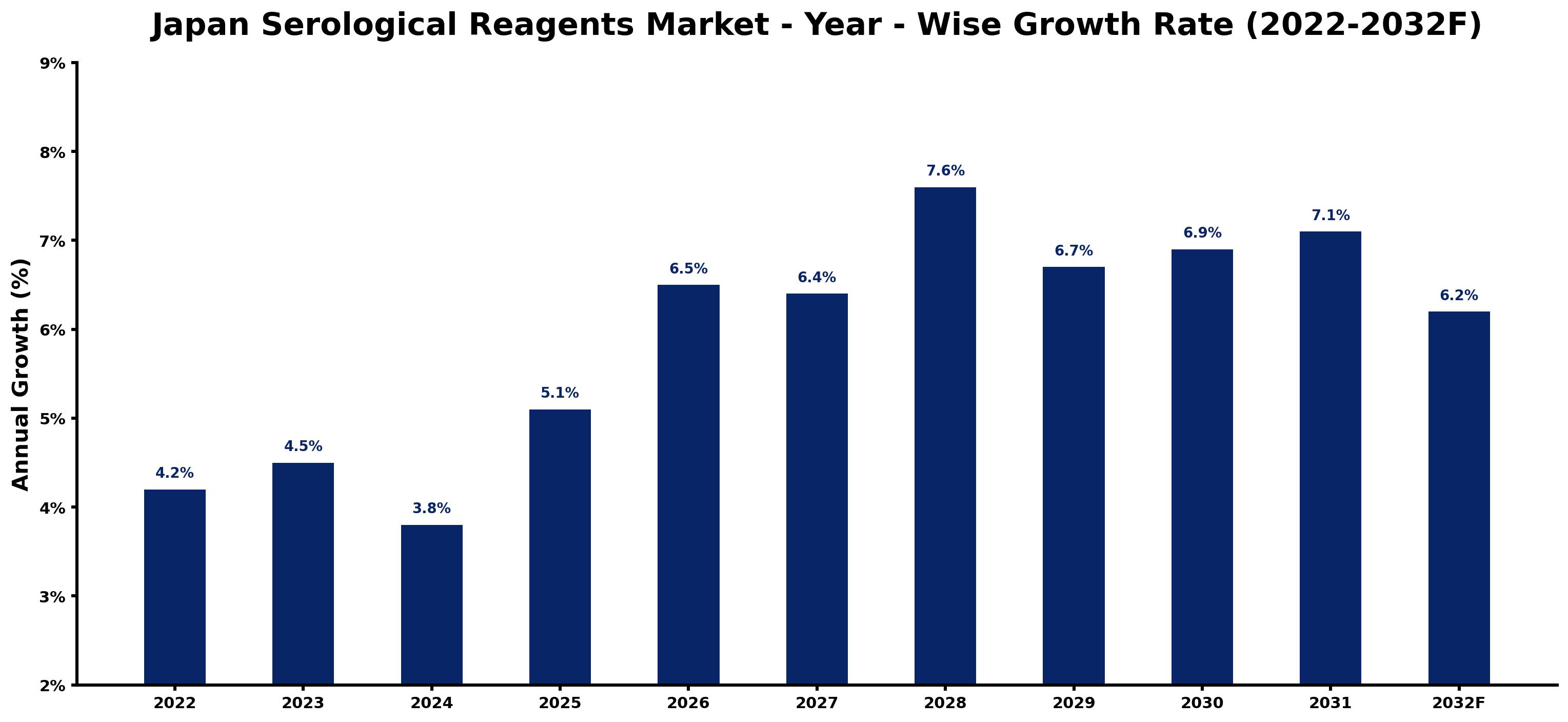
The yearly estimates that follow link every growth rate to its principal driver, so readers can see why the pace changed in each period.
| Year | Estimated Annual Growth (%) | Market Rationale |
| 2022 | 4.2 | The market was active with established diagnostic labs and research institutions driving demand. |
| 2023 | 4.5 | Demand increased as healthcare facilities expanded their testing capabilities and services. |
| 2024 | 3.8 | Growth slowed due to market saturation in some regions, though demand remained strong overall. |
| 2025 | 5.1 | A surge in testing for infectious diseases contributed to faster growth this year. |
| 2026 | 6.5 | The introduction of new testing technologies is expected to boost demand across various sectors. |
| 2027 | 6.4 | Growth is projected to slow slightly as the market adjusts to the previous year's surge. |
| 2028 | 7.6 | The peak growth will be driven by heightened awareness of infectious diseases and testing. |
| 2029 | 6.7 | Demand growth is expected to slow as the market stabilises after the peak in 2028. |
| 2030 | 6.9 | Testing advancements will continue to support demand, leading to a slight increase. |
| 2031 | 7.1 | The market is projected to experience steady growth as healthcare facilities improve their capabilities. |
| 2032 | 6.2 | Growth will slow as the market matures, but demand for diagnostics will remain strong. |
Note: Market size estimations and growth projections presented in this report are based on 6Wresearch's proprietary forecasting methodology, utilizing the latest available industry data, government publications, and primary research inputs.
Japan Serological Reagents Market Synopsis
Serological reagents are biochemical substances used to detect antibodies or antigens in blood samples, primarily produced through complex biochemical processes. Their main applications include diagnostics for infectious diseases, blood typing, and immunology research. The Japan Serological Reagents Market is expanding due to high demand from over 1,000 diagnostic labs, extensive testing in blood banks processing around 1.5 million units annually, and ongoing research by institutions conducting over 5,000 studies each year. New guidelines issued in 2023 are further propelling this demand.
Market Dynamics Impact Analysis (2026–2032)
| Factor | Type | Impact | Primary Segment Affected |
| Increasing prevalence of infectious diseases | Driver | High | Antibodies |
| Growing research activities in immunology | Driver | High | Antigens |
| Expansion of diagnostic labs in urban areas | Opportunity | High | Diagnostic Labs |
| Rising investments in healthcare infrastructure | Opportunity | Medium | Research Institutions |
| Stringent quality standards for reagents | Restraint | High | Detection Reagents |
| Market saturation in certain regions | Restraint | Medium | Blood Banks |
| High costs of advanced testing technologies | Challenge | High | Pathology Labs |
| Limited access to innovative reagents in rural areas | Challenge | Medium | Diagnostic Labs |
Evaluation of Drivers in Japan Serological Reagents Market (2026–2032)
The table below links each growth driver to the segment it affects and the evidence for it.
| Drivers | Primary Segment Affected | Why It Matters (Evidence) |
| Increased testing for infectious diseases | Antibodies | Japan's population of approximately 126 million drives demand for diagnostics, leading to higher purchases of serological reagents. |
| Growing number of research studies | Antigens | Over 5,000 studies conducted annually by research institutions increase the need for specific reagents. |
| Expansion of diagnostic facilities | Detection Reagents | With over 1,000 diagnostic labs in Japan, the demand for reagents continues to rise. |
| Rising blood donation rates | Viral Antigens | Blood banks processing around 1.5 million units require extensive testing, boosting reagent purchases. |
| Implementation of new testing guidelines | IgG/IgM | The 2023 guidelines from the Ministry of Health, Labour and Welfare enhance the quality of serological testing. |
What keeps demand rising is the increased testing for infectious diseases, with Japan's population contributing to a high annual testing rate exceeding 10 million patients. The growth of research activities, with over 5,000 studies conducted annually, drives the need for specific serological reagents. The expansion of diagnostic facilities, with more than 1,000 labs, boosts reagent purchases. New guidelines issued in 2023 have prompted healthcare providers to invest in advanced reagents. The Tokyo region's concentration of diagnostic labs improves accessibility to these critical products.
Evaluation of Restraints in Japan Serological Reagents Market
These are the pressures that could keep growth below its potential.
| Market Restraint | Primary Segment Affected | Why It Matters (Evidence) |
| Strict quality control requirements | Detection Reagents | Compliance with JIS Z 2801 standards increases costs for manufacturers, impacting pricing for buyers. |
| Market saturation in metropolitan areas | Blood Banks | High competition among diagnostic labs limits growth opportunities in densely populated regions. |
| High costs of advanced testing technologies | Pathology Labs | Investment in advanced technologies can deter smaller labs from upgrading their systems. |
| Limited availability of new reagents | Antibodies | Access to new products is constrained in rural areas, affecting overall market growth. |
| Regulatory hurdles for new product introductions | Antigens | Stringent regulations delay the launch of new reagents, impacting supply. |
Japan Serological Reagents Market Challenges
Compliance with the new serological testing standards has imposed costs exceeding ¥500 million on diagnostic labs, straining their budgets. Many facilities face challenges in upgrading outdated technology, leading to delays in results for over 2 million patients annually. Disruptions in the supply chain for biochemical materials have raised prices, causing shortages that impact producers' ability to meet demand. A shortage of skilled technicians in specialised laboratory techniques affects over 1,000 diagnostic labs, resulting in longer turnaround times for critical tests and potentially compromising patient care.
Trends in the Japan Serological Reagents Market
The trends below show where the Japan Serological Reagents Market is heading.
- Transformation in Testing Approaches: In 2023, the introduction of rapid testing kits has transformed diagnostic practices in Japan, with over 10 million patients tested annually using these methods.
- Rise of Freeze-Dried Reagents: Starting in 2026, freeze-dried serological reagents are gaining traction due to their extended shelf life, with a projected CAGR of 9.6% in this segment.
- Implementation of New Quality Standards: The implementation of the JIS Z 2801 standard in 2023 has led to improved quality assurance in serological reagents, ensuring higher reliability for diagnostic labs.
- Increasing Focus on Research: With over 5,000 studies conducted annually, research institutions are prioritising new serological reagents to advance immunology research.
Investment Opportunities in the Japan Serological Reagents Market
Several openings in the Japan Serological Reagents Market merit attention from investors.
- Diagnostic Labs Seeking Advanced Reagents: Diagnostic labs are looking for high-quality serological reagents to meet rising testing demands, with over 1,000 labs in Japan requiring effective solutions.
- Research Institutions Expanding Capabilities: Research institutions are investing in advanced serological reagents, with over 5,000 studies annually driving the need for new products and technologies.
- Blood Banks Upgrading Testing Protocols: Blood banks are focusing on improving testing protocols, requiring extensive serological reagents to process around 1.5 million blood units each year.
- Entry into the Growing Freeze-Dried Segment: Investing in freeze-dried serological reagents, projected to grow at 9.6%, can open new markets for suppliers targeting diagnostic labs.
Government Initiatives in the Japan Serological Reagents Market
The Clinical Trials Act, effective from 2018, sets rules for conducting clinical research, ensuring that serological reagents meet specific testing standards to support research activities. The Plastic Resource Circulation Act, enacted in 2021, promotes the reduction, reuse, and recycling of plastics, impacting packaging standards for serological reagents.
In 2023, the Japanese government allocated ¥2 billion for research on infectious disease diagnostics, overseen by the Japan Agency for Medical Research and Development (AMED), which funds projects in this sector. The Pharmaceuticals and Medical Devices Agency (PMDA) reviews and monitors the safety of medical devices, including serological reagents, ensuring compliance with national standards.
Future Insight of the Japan Serological Reagents Market
Advancements in automation will reshape testing processes, streamlining operations in diagnostic labs and reducing costs for buyers. The implementation of rigorous quality management systems will enhance the reliability of serological reagents. Increased research funding will spur innovation in infectious disease diagnostics, leading to the development of novel methodologies. As the Tokyo region continues to thrive as a research and diagnostics hub, collaboration among institutions will facilitate substantial progress in serological testing capabilities.
Market Segmentation Analysis
Japan Serological Reagents Market report covers a detailed analysis of the following market segments:
By Reagent Type – Antibodies Lead, Antigens Expected to Grow Fastest
According to Saurav Kr Singh, Senior Research Analyst at 6Wresearch, Antibodies held 34% of the Japan Serological Reagents Market by reagent type in 2025. Antibodies dominate the market because they are integral to diagnostic tests and research applications within Japan's extensive network of over 1,000 diagnostic labs. Their widespread use is underscored by the annual testing of more than 10 million patients, reflecting their importance in healthcare. Antigens are set to record the highest CAGR in this split, 9.4% over 2026–2032. Antigens are experiencing rapid growth as they are crucial for the detection of specific pathogens, a need that is becoming increasingly urgent in infectious disease diagnostics. The government's recent allocation of ¥2 billion for research in this area further fuels the demand for antigen reagents. This trend suggests that suppliers should focus on enhancing their offerings of antigen reagents to align with market demands.
By Target Marker – Viral Antigens Lead, Immune Response Trigger Expected to Grow Fastest
In 2025, Viral Antigens led the target marker split with a 47% share. Viral Antigens lead the market as they are vital for diagnosing viral infections, a necessity in a country that prioritises accurate diagnostics. The strong focus on viral testing within Japan's healthcare framework reinforces their dominant position. Over 2026–2032, Immune Response Trigger is expected to post the fastest growth, at a CAGR of 8.9%. The Immune Response Trigger segment is growing quickly because of its specialised applications in research, which are gaining traction in Japan's research institutions. This growth suggests a movement towards more targeted testing methodologies. Buyers in research institutions should consider increasing their procurement of immune response trigger reagents to remain competitive in their research efforts.
By Format – Liquid Leads, Freeze-Dried Expected to Grow Fastest
Liquid accounted for 48% of the market by format in 2025. The Liquid format is the most common for serological reagents, primarily due to its ease of use in diagnostic labs where over 10 million patients are tested annually. This format's convenience has solidified its leading position in the market. Freeze-Dried is projected to grow fastest, at a CAGR of 9.6% during 2026–2032. Freeze-Dried formats are gaining traction as they offer improved stability for reagents, which is becoming increasingly important in the context of long-term storage and transport. This shift indicates a growing preference for formats that ensure reagent efficacy over time. Suppliers should consider expanding their freeze-dried product lines to meet the rising demand for stable reagent formats.
By End User – Diagnostic Labs Lead, Research Institutions Expected to Grow Fastest
Diagnostic Labs took 45% of end user revenue in 2025, more than any other category. Diagnostic Labs are the primary users of serological reagents, utilising them extensively for testing in Japan's healthcare system. With over 1,000 diagnostic labs operating nationwide, their high volume of tests drives this segment's leading share. The quickest growth will come from Research Institutions, forecast to expand at a CAGR of 8.7% between 2026 and 2032. Research Institutions are experiencing the fastest growth, largely due to their involvement in over 5,000 studies annually that require serological reagents. This trend highlights the increasing importance of research in the overall market. Suppliers should target research institutions more aggressively to capture the growth potential in this segment.
Key Attractiveness of the Report
- 10 Years of Market Numbers
- Historical Data Starting from 2022 to 2025
- Base Year 2025
- Forecast Data until 2032
- Key Performance Indicators Impacting the Market
- Major Upcoming Developments and Projects
Key Highlights of the Report:
- Japan Serological Reagents Market Outlook
- Market Size of Japan Serological Reagents Market, 2025
- Forecast of Japan Serological Reagents Market, 2032
- Historical Data and Forecast of Japan Serological Reagents Revenues & Volume for the Period 2022-2032F
- Japan Serological Reagents Market Trend Evolution
- Japan Serological Reagents Market Drivers and Challenges
- Japan Serological Reagents Price Trends
- Japan Serological Reagents Porter's Five Forces
- Japan Serological Reagents Industry Life Cycle
- Historical Data and Forecast of Japan Serological Reagents Market Revenues & Volume By Reagent Type for the Period 2022-2032F
- Historical Data and Forecast of Japan Serological Reagents Market Revenues & Volume By Antibodies for the Period 2022-2032F
- Historical Data and Forecast of Japan Serological Reagents Market Revenues & Volume By Antigens for the Period 2022-2032F
- Historical Data and Forecast of Japan Serological Reagents Market Revenues & Volume By Detection Reagents for the Period 2022-2032F
- Historical Data and Forecast of Japan Serological Reagents Market Revenues & Volume By Conjugate Reagents for the Period 2022-2032F
- Historical Data and Forecast of Japan Serological Reagents Market Revenues & Volume By Target Marker for the Period 2022-2032F
- Historical Data and Forecast of Japan Serological Reagents Market Revenues & Volume By Viral Antigens for the Period 2022-2032F
- Historical Data and Forecast of Japan Serological Reagents Market Revenues & Volume By Immune Response Trigger for the Period 2022-2032F
- Historical Data and Forecast of Japan Serological Reagents Market Revenues & Volume By IgG/IgM for the Period 2022-2032F
- Historical Data and Forecast of Japan Serological Reagents Market Revenues & Volume By Enzyme-Linked for the Period 2022-2032F
- Historical Data and Forecast of Japan Serological Reagents Market Revenues & Volume By Format for the Period 2022-2032F
- Historical Data and Forecast of Japan Serological Reagents Market Revenues & Volume By Liquid for the Period 2022-2032F
- Historical Data and Forecast of Japan Serological Reagents Market Revenues & Volume By Freeze-Dried for the Period 2022-2032F
- Historical Data and Forecast of Japan Serological Reagents Market Revenues & Volume By Kits for the Period 2022-2032F
- Historical Data and Forecast of Japan Serological Reagents Market Revenues & Volume By Dropper Bottles for the Period 2022-2032F
- Historical Data and Forecast of Japan Serological Reagents Market Revenues & Volume By End User for the Period 2022-2032F
- Historical Data and Forecast of Japan Serological Reagents Market Revenues & Volume By Diagnostic Labs for the Period 2022-2032F
- Historical Data and Forecast of Japan Serological Reagents Market Revenues & Volume By Research Institutions for the Period 2022-2032F
- Historical Data and Forecast of Japan Serological Reagents Market Revenues & Volume By Blood Banks for the Period 2022-2032F
- Historical Data and Forecast of Japan Serological Reagents Market Revenues & Volume By Pathology Labs for the Period 2022-2032F
- Japan Serological Reagents Import Export Trade Statistics
- Market Opportunity Assessment By Reagent Type
- Market Opportunity Assessment By Target Marker
- Market Opportunity Assessment By Format
- Market Opportunity Assessment By End User
- Japan Serological Reagents Top Companies Market Share
- Japan Serological Reagents Competitive Benchmarking By Technical and Operational Parameters
- Japan Serological Reagents Company Profiles
- Japan Serological Reagents Key Strategic Recommendations
Market Covered
The report covers the following segments.
By Reagent Type
- Antibodies
- Antigens
- Detection Reagents
- Conjugate Reagents
By Target Marker
- Viral Antigens
- Immune Response Trigger
- IgG/IgM
- Enzyme-Linked
By Format
- Liquid
- Freeze-Dried
- Kits
- Dropper Bottles
By End User
- Diagnostic Labs
- Research Institutions
- Blood Banks
- Pathology Labs































