Japan Shade Nets Market Size & Growth Rate
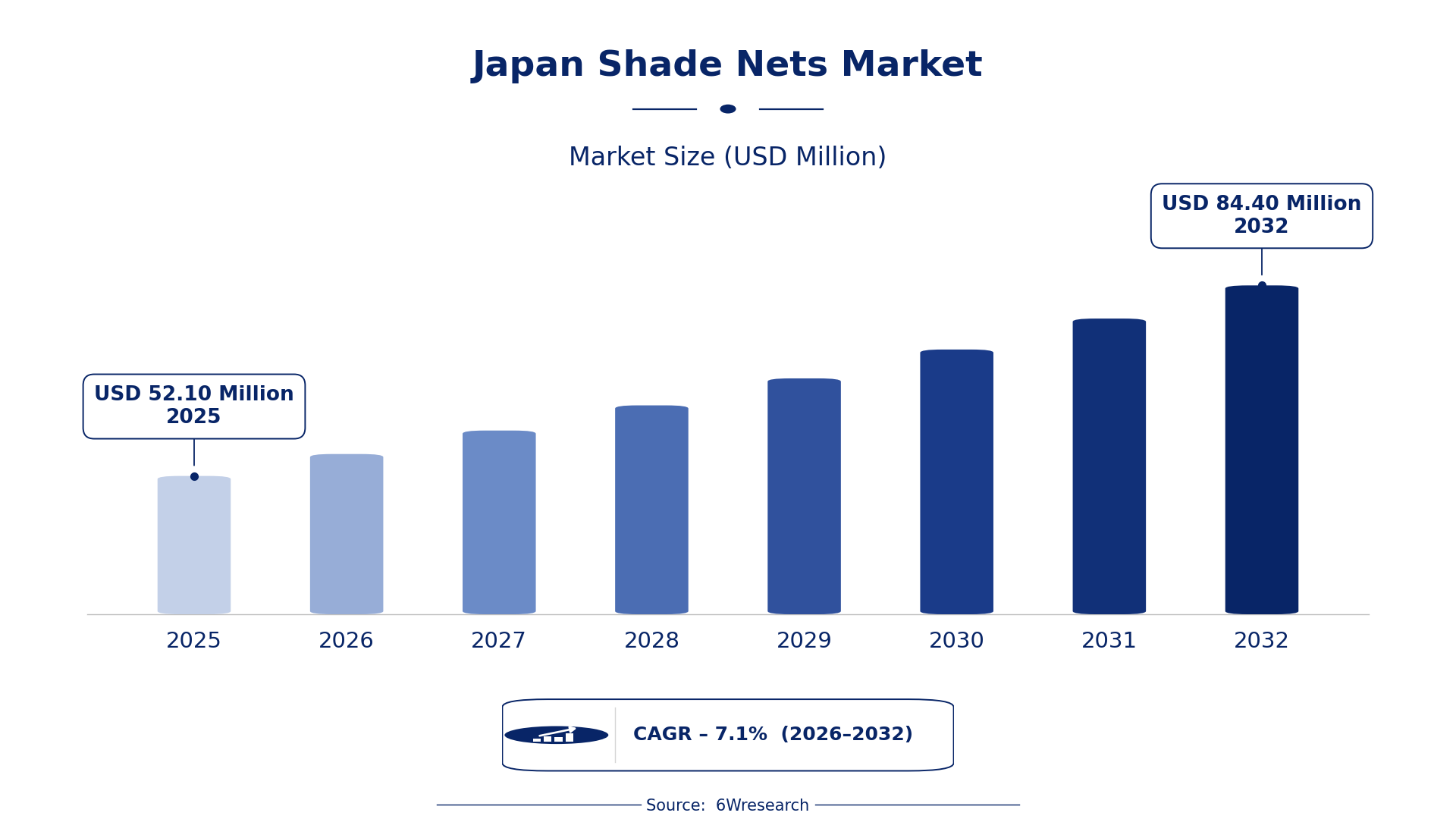
According to 6Wresearch internal database and industry insights, the Japan Shade Nets Market was valued at USD 52.10 Million in 2025 and is projected to reach USD 84.40 Million by 2032, growing at a CAGR of approximately 7.1% during 2026–2032.
Japan Shade Nets Market Highlights
| Report Metric | Details |
| Report Name | Japan Shade Nets Market (2026-2032) |
| Market Size 2025 | USD 52.10 Million |
| Market Size 2032 | USD 84.40 Million |
| Absolute Growth 2025–2032 | USD 32.30 Million |
| CAGR 2026–2032 | 7.1% |
| Peak Annual Growth | 8.5% in 2027 |
| Forecast Period | 2026–2032 |
| Historical Data | 2022–2025 |
| Base Year | 2025 |
| Leading Net Type, 2025 | Greenhouse Shade Nets (41% share) |
| Leading Material Type, 2025 | HDPE (46% share) |
| Leading Application Area, 2025 | Temperature Control (36% share) |
| Leading End User, 2025 | Agri Nurseries (49% share) |
| Fastest-Growing Net Type | Agro Shade Nets (9.8% CAGR) |
| Fastest-Growing Material Type | UV-Stabilized Poly (9.6% CAGR) |
| Fastest-Growing Application Area | Crop Protection (8.2% CAGR) |
| Fastest-Growing End User | Horticulture Businesses (8.8% CAGR) |
| Growing Sector | Agriculture |
| Key End Users | Agricultural Nurseries, Construction Companies, Horticulture Businesses, Farmers |
Japan Shade Nets Market Year-wise Growth Rate and Key Drivers (2022–2032)
This graph illustrates the annual growth rates of the market from 2022 to 2032, highlighting a steady upward trajectory and projected market expansion over the forecast period.
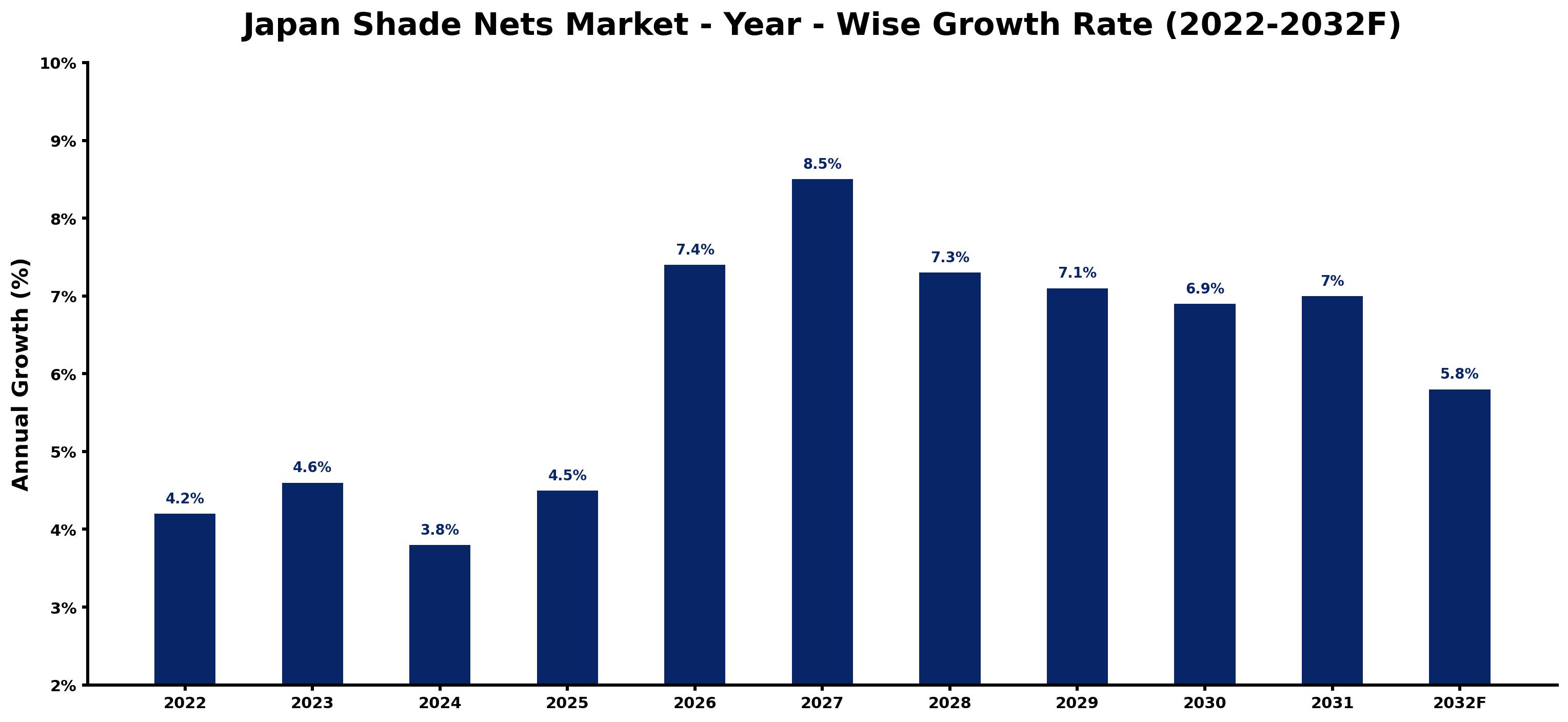
For each year, the table pairs the estimated growth rate with the leading influence on demand, showing how the drivers changed across the period.
| Year | Estimated Annual Growth (%) | Market Rationale |
| 2022 | 4.2 | The market experienced steady demand from agricultural nurseries and construction sites. |
| 2023 | 4.6 | Growth was supported by a rise in horticulture businesses and population demand. |
| 2024 | 3.8 | Demand slowed as market adjustments occurred following previous growth rates. |
| 2025 | 4.5 | Increased agricultural activities and safety regulations boosted market performance. |
| 2026 | 7.4 | Demand is expected to surge due to heightened focus on crop protection and safety standards. |
| 2027 | 8.5 | The peak growth will be driven by investments in agricultural innovation. |
| 2028 | 7.3 | Growth is projected to moderate as the market stabilises after the peak in 2027. |
| 2029 | 7.1 | A further slowdown is expected as demand begins to normalise post-peak. |
| 2030 | 6.9 | Market growth is anticipated to continue slowing as saturation in some segments becomes apparent. |
| 2031 | 7.0 | Demand will pick up again as new technologies and materials gain traction. |
| 2032 | 5.8 | The market is projected to stabilise as demand levels off after rapid growth. |
Note: Market size estimations and growth projections presented in this report are based on 6Wresearch's proprietary forecasting methodology, utilizing the latest available industry data, government publications, and primary research inputs.
Japan Shade Nets Market Synopsis
Shade nets protect crops and workers from sunlight and harsh weather, primarily constructed from HDPE and UV-stabilized poly. The Japan Shade Nets Market is growing due to rising agricultural activities, supported by a population of 127 million and a 15% increase in horticulture businesses in 2023. Government subsidies promote agro shade nets, driving demand from agricultural nurseries and construction sectors. This expansion is further reinforced by a strong emphasis on crop protection and safety regulations in urban areas.
Market Dynamics Impact Analysis (2026–2032)
| Factor | Type | Impact | Primary Segment Affected |
| Rising agricultural activities and population growth are driving demand for shade nets. | Driver | High | Agro Shade Nets |
| Increased focus on worker safety regulations is boosting the use of shade nets in construction. | Driver | High | Construction Shade Nets |
| The growing number of agricultural nurseries presents a significant opportunity for suppliers. | Opportunity | High | Agri Nurseries |
| The rise in urban gardening projects creates demand for innovative shade net solutions. | Opportunity | Medium | Nursery Shade Nets |
| Market saturation in certain segments may limit growth potential. | Restraint | Medium | Greenhouse Shade Nets |
| High competition among suppliers could lead to price pressures. | Restraint | Medium | HDPE |
| Regulatory changes can impose additional compliance costs on producers. | Challenge | High | Construction Shade Nets |
| Supply chain disruptions may delay product availability for buyers. | Challenge | Medium | Agro Shade Nets |
Evaluation of Drivers in Japan Shade Nets Market (2026–2032)
The main growth drivers and the segments they affect most are set out below.
| Drivers | Primary Segment Affected | Why It Matters (Evidence) |
| Increased agricultural production leads to higher demand for shade nets. | Agro Shade Nets | Japan's horticulture sector accounts for 20% of agricultural output, driving purchases. |
| Safety regulations mandate the use of shade nets in construction sites. | Construction Shade Nets | The Ministry of Land, Infrastructure, Transport and Tourism enforces safety standards. |
| Growing urban gardening trends are boosting demand for shade nets. | Nursery Shade Nets | Urban gardening projects surged by 15% in 2023, raising purchases. |
| The rise in extreme weather events necessitates effective crop protection. | Greenhouse Shade Nets | Agro shade nets are essential for protecting crops from harsh conditions. |
| Technological advancements improve shade net durability and effectiveness. | UV-Stabilized Poly | UV-stabilized nets are preferred for their longevity, attracting buyer interest. |
Purchasing is picking up as agricultural production rises, with horticulture contributing 20% to Japan's output. The number of registered farmers reached approximately 2 million in 2023, leading to increased demand for shade nets. Urban gardening projects surged by 15%, boosting interest in nursery shade nets. Technological advancements in UV-stabilized poly materials improve their effectiveness, attracting buyers seeking durable solutions. These factors drive demand in the agricultural and construction sectors.
Evaluation of Restraints in Japan Shade Nets Market
Several factors work against faster growth; the main ones are summarised below.
| Market Restraint | Primary Segment Affected | Why It Matters (Evidence) |
| Market saturation in certain segments limits growth opportunities. | Greenhouse Shade Nets | With over 1,000 agricultural nurseries, competition is intensifying in this area. |
| High competition among suppliers may lead to price pressures. | HDPE | As more manufacturers enter the market, pricing strategies may be affected. |
| Compliance with safety regulations can increase operational costs for producers. | Construction Shade Nets | The Industrial Safety and Health Act imposes strict guidelines on materials used. |
| Supply chain disruptions can delay product availability for buyers. | Agro Shade Nets | Global supply chain issues have affected material procurement for manufacturers. |
| Limited awareness of new shade net technologies may hinder adoption. | Nursery Shade Nets | Some buyers remain hesitant to invest in advanced materials without proven benefits. |
Japan Shade Nets Market Challenges
In 2023, agricultural nurseries in Japan experienced a 15% rise in operational costs due to increasing prices for shade nets, caused by supply chain disruptions that restrict material availability. Many producers face challenges with outdated technology, which extends production times and delays efficiency improvements, ultimately impacting nursery output. Buyers in urban areas encounter regulatory hurdles, as construction safety standards specify certain net types, complicating procurement and prolonging project timelines. Compliance with JIS standards incurs additional costs for manufacturers, raising prices for end-users and diminishing competitiveness in the market.
Trends in the Japan Shade Nets Market
These developments are changing demand patterns in the Japan Shade Nets Market.
- Shift from Traditional to Advanced Shade Net Materials: Since 2023, the uptake of UV-stabilized poly shade nets has risen, as these materials are favoured for their durability. Approximately 60% of new installations now use these materials, indicating a trend towards higher quality in agricultural applications.
- Emergence of Urban Gardening Projects: In 2023, urban gardening projects increased by 15%, resulting in heightened demand for nursery shade nets. This trend underscores a shift towards sustainable practices among city residents, creating new market opportunities for suppliers.
- Growing Importance of Safety Regulations in Construction: Since 2022, construction companies have increasingly adopted shade nets due to stringent safety regulations. The Tokyo metropolitan area has seen a 20% rise in compliance-driven purchases, reflecting a strong market shift.
- Increased Focus on Crop Protection: The rise in extreme weather events since 2023 has underscored the need for effective crop protection. Agro shade nets are now regarded as crucial, with a notable increase in demand reported in the Tohoku region.
Investment Opportunities in the Japan Shade Nets Market
Several openings in the Japan Shade Nets Market merit attention from investors.
- Partnering with Local Nurseries for Supply: Now is an opportune time to collaborate with agricultural nurseries, which comprise over 1,000 registered entities in Japan. Suppliers can enhance their market presence by partnering with these buyers to meet growing demand.
- Investing in Advanced Shade Net Solutions: With the rise of urban gardening projects, there is a demand for advanced shade net solutions. Suppliers can target horticulture businesses in urban areas to satisfy this need, forming local partnerships.
- Entering the Construction Sector with Safety Products: Construction companies are required to use shade nets for safety, creating a timely opportunity for suppliers. Collaborating with firms in the Tokyo metropolitan area can facilitate entry into this expanding market.
- Expanding Offerings in UV-Stabilized Poly Products: The preference for UV-stabilized poly shade nets is on the rise, driven by their longevity. Suppliers should focus on broadening their offerings in this material to meet the agricultural sector's needs.
Government Initiatives in the Japan Shade Nets Market
The Building Energy Efficiency Act, amended in 2022, impacts shade net producers by requiring compliance with energy standards in new buildings. This regulation encourages the use of energy-efficient materials, prompting manufacturers to invest in higher-quality shade nets that meet these criteria. Additionally, the GX Basic Policy aims for JPY 150 trillion in public-private decarbonisation investment over 10 years, promoting sustainable practices in agriculture and construction.
The Ministry of Agriculture and the Ministry of Land, Infrastructure, Transport and Tourism oversee regulations affecting shade net usage. The former allocates ¥500 million for agricultural innovation programs, supporting the development of advanced shade net technologies. Meanwhile, the latter enforces safety standards that construction companies must adhere to, ensuring that shade nets are used effectively on sites.
Future Insight of the Japan Shade Nets Market
A policy-driven shift towards agricultural innovation will prompt increased funding for technology advancements by 2032. Suppliers will adopt new materials that improve durability and performance, providing buyers with superior products. Urban gardening initiatives will create higher demand for knitted fabric shade nets, aligning with sustainable practices. Stricter JAS guidelines will compel suppliers to innovate, ensuring they meet market requirements and maintain their competitive edge.
Market Segmentation Analysis
Japan Shade Nets Market report covers a detailed analysis of the following market segments:
By Net Type – Greenhouse Shade Nets Lead, Agro Shade Nets Expected to Grow Fastest
According to Saurav Kr Singh, Senior Research Analyst at 6Wresearch, in 2025, Greenhouse Shade Nets led the net type split with a 41% share. Greenhouse shade nets hold the largest share due to their widespread application in over 1,000 agricultural nurseries across Japan. Their critical role in temperature control and crop protection is particularly significant in regions like Tohoku, where agricultural output is high. Over 2026–2032, Agro Shade Nets are expected to post the fastest growth, at a CAGR of 9.8%. Agro shade nets are experiencing rapid growth because they are essential for protecting crops from extreme weather, with government subsidies encouraging their adoption. The 15% increase in horticulture businesses in 2023 further propels the demand for these nets. Suppliers should focus on agro shade nets to meet the rising needs of horticulture businesses and enhance their market presence.
By Material Type – HDPE Leads, UV-Stabilized Poly Expected to Grow Fastest
HDPE accounted for 46% of the market by material type in 2025. HDPE shade nets lead the market because of their durability and effectiveness in diverse weather conditions. This material is highly favoured by agricultural nurseries, ensuring a strong installed base throughout Japan. UV-Stabilized Poly is projected to grow fastest, at a CAGR of 9.6% during 2026–2032. UV-stabilised poly shade nets are rapidly gaining popularity as they offer long-lasting protection against sunlight, essential for crop health. Their adoption is increasing in line with the heightened focus on quality standards in agriculture. Buyers are expected to increasingly prefer UV-stabilised poly options for their durability, prompting suppliers to focus on this material in their offerings.
By Application Area – Temperature Control Leads, Crop Protection Expected to Grow Fastest
The largest application area category in 2025 was Temperature Control, at 36% of revenue. Temperature control is the leading application area for shade nets, as it is critical for maintaining plant health in Japan's agricultural sector. This focus is particularly relevant for the extensive network of agricultural nurseries across the country. Crop Protection is set to record the highest CAGR in this split, 8.2% over 2026–2032. Crop protection is the fastest-growing application area, driven by the need to safeguard crops from extreme weather events and pests. The rise in horticulture businesses further accelerates this demand for effective protective measures. Suppliers should consider expanding their product offerings to cater to the increasing need for crop protection solutions.
By End User – Agri Nurseries Lead, Horticulture Businesses Expected to Grow Fastest
With 49% of end user revenue in 2025, Agri Nurseries was the largest category. Agri nurseries represent the largest end-user segment, as they are the main consumers of shade nets for crop cultivation. With approximately 2 million registered farmers in Japan, this segment benefits from a substantial installed base. The quickest growth will come from Horticulture Businesses, forecast to expand at a CAGR of 8.8% between 2026 and 2032. Horticulture businesses are the fastest-growing end-user segment, fuelled by the increasing emphasis on plant cultivation and the growth of horticultural enterprises. Government support for agricultural innovation also boosts their demand for shade nets. Suppliers need to adapt their strategies to better connect with horticulture businesses, which are gaining prominence in the shade nets market.
Key Attractiveness of the Report
- 10 Years of Market Numbers
- Historical Data Starting from 2022 to 2025
- Base Year 2025
- Forecast Data until 2032
- Key Performance Indicators Impacting the Market
- Major Upcoming Developments and Projects
Key Highlights of the Report:
- Japan Shade Nets Market Outlook
- Market Size of Japan Shade Nets Market, 2025
- Forecast of Japan Shade Nets Market, 2032
- Historical Data and Forecast of Japan Shade Nets Revenues & Volume for the Period 2022-2032F
- Japan Shade Nets Market Trend Evolution
- Japan Shade Nets Market Drivers and Challenges
- Japan Shade Nets Price Trends
- Japan Shade Nets Porter's Five Forces
- Japan Shade Nets Industry Life Cycle
- Historical Data and Forecast of Japan Shade Nets Market Revenues & Volume By Net Type for the Period 2022-2032F
- Historical Data and Forecast of Japan Shade Nets Market Revenues & Volume By Greenhouse Shade Nets for the Period 2022-2032F
- Historical Data and Forecast of Japan Shade Nets Market Revenues & Volume By Agro Shade Nets for the Period 2022-2032F
- Historical Data and Forecast of Japan Shade Nets Market Revenues & Volume By Construction Shade Nets for the Period 2022-2032F
- Historical Data and Forecast of Japan Shade Nets Market Revenues & Volume By Nursery Shade Nets for the Period 2022-2032F
- Historical Data and Forecast of Japan Shade Nets Market Revenues & Volume By Material Type for the Period 2022-2032F
- Historical Data and Forecast of Japan Shade Nets Market Revenues & Volume By HDPE for the Period 2022-2032F
- Historical Data and Forecast of Japan Shade Nets Market Revenues & Volume By UV-Stabilized Poly for the Period 2022-2032F
- Historical Data and Forecast of Japan Shade Nets Market Revenues & Volume By Knitted Fabric for the Period 2022-2032F
- Historical Data and Forecast of Japan Shade Nets Market Revenues & Volume By Monofilament for the Period 2022-2032F
- Historical Data and Forecast of Japan Shade Nets Market Revenues & Volume By Application Area for the Period 2022-2032F
- Historical Data and Forecast of Japan Shade Nets Market Revenues & Volume By Temperature Control for the Period 2022-2032F
- Historical Data and Forecast of Japan Shade Nets Market Revenues & Volume By Crop Protection for the Period 2022-2032F
- Historical Data and Forecast of Japan Shade Nets Market Revenues & Volume By Worker Safety for the Period 2022-2032F
- Historical Data and Forecast of Japan Shade Nets Market Revenues & Volume By Sapling Growth Control for the Period 2022-2032F
- Historical Data and Forecast of Japan Shade Nets Market Revenues & Volume By End User for the Period 2022-2032F
- Historical Data and Forecast of Japan Shade Nets Market Revenues & Volume By Agri Nurseries for the Period 2022-2032F
- Historical Data and Forecast of Japan Shade Nets Market Revenues & Volume By Farmers for the Period 2022-2032F
- Historical Data and Forecast of Japan Shade Nets Market Revenues & Volume By Construction Companies for the Period 2022-2032F
- Historical Data and Forecast of Japan Shade Nets Market Revenues & Volume By Horticulture Businesses for the Period 2022-2032F
- Japan Shade Nets Import Export Trade Statistics
- Market Opportunity Assessment By Net Type
- Market Opportunity Assessment By Material Type
- Market Opportunity Assessment By Application Area
- Market Opportunity Assessment By End User
- Japan Shade Nets Top Companies Market Share
- Japan Shade Nets Competitive Benchmarking By Technical and Operational Parameters
- Japan Shade Nets Company Profiles
- Japan Shade Nets Key Strategic Recommendations
Market Covered
The following segment groups are covered in the report.
By Net Type
- Greenhouse Shade Nets
- Agro Shade Nets
- Construction Shade Nets
- Nursery Shade Nets
By Material Type
- HDPE
- UV-Stabilized Poly
- Knitted Fabric
- Monofilament
By Application Area
- Temperature Control
- Crop Protection
- Worker Safety
- Sapling Growth Control
By End User
- Agri Nurseries
- Farmers
- Construction Companies
- Horticulture Businesses































