Japan Ship Building and Repairing Market Size & Growth Rate
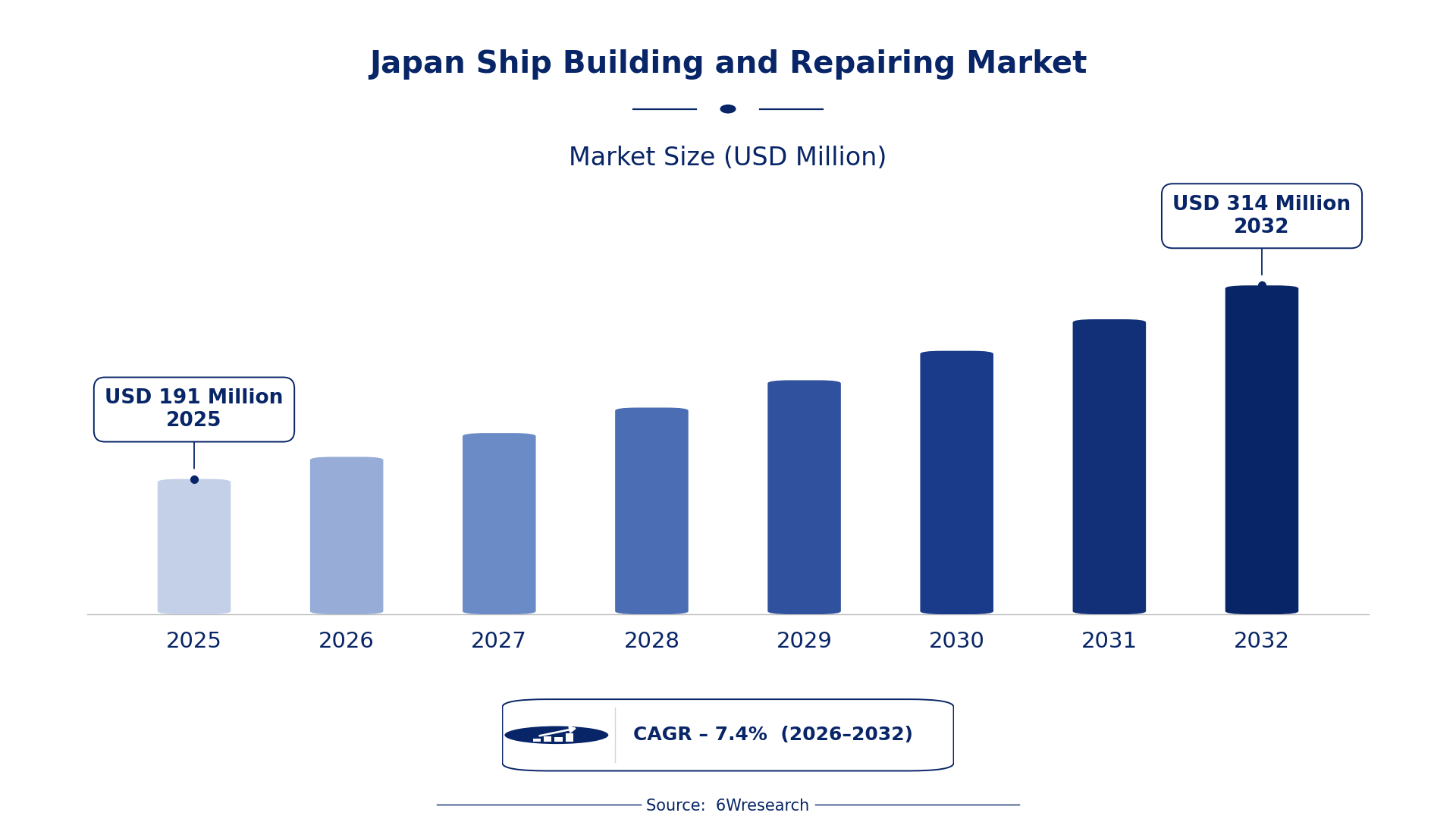
According to 6Wresearch internal database and industry insights, the Japan Ship Building and Repairing Market was valued at USD 191 Million in 2025 and is projected to reach USD 314 Million by 2032, growing at a CAGR of approximately 7.4% during 2026–2032.
Japan Ship Building and Repairing Market Highlights
| Report Metric | Details |
| Report Name | Japan Ship Building and Repairing Market (2026-2032) |
| Market Size 2025 | USD 191 Million |
| Market Size 2032 | USD 314 Million |
| Absolute Growth 2025–2032 | USD 123 Million |
| CAGR 2026–2032 | 7.4% |
| Peak Annual Growth | 8.9% in 2026 |
| Forecast Period | 2026–2032 |
| Historical Data | 2022–2025 |
| Base Year | 2025 |
| Leading Type, 2025 | Ship Building (58% share) |
| Leading Vessel Types, 2025 | Oil And Chemical Tankers (45% share) |
| Leading Applications, 2025 | General Services (35% share) |
| Fastest-Growing Type | Ship Repairing (9.7% CAGR) |
| Fastest-Growing Vessel Types | Container Ships (10.2% CAGR) |
| Fastest-Growing Applications | Dockage (10.4% CAGR) |
| Growing Sector | Offshore Operations |
| Key End Users | Shipping companies, offshore energy firms, maritime transport services |
Japan Ship Building and Repairing Market Year-wise Growth Rate and Key Drivers (2022–2032)
This graph illustrates the annual growth rates of the market from 2022 to 2032, highlighting a steady upward trajectory and projected market expansion over the forecast period.
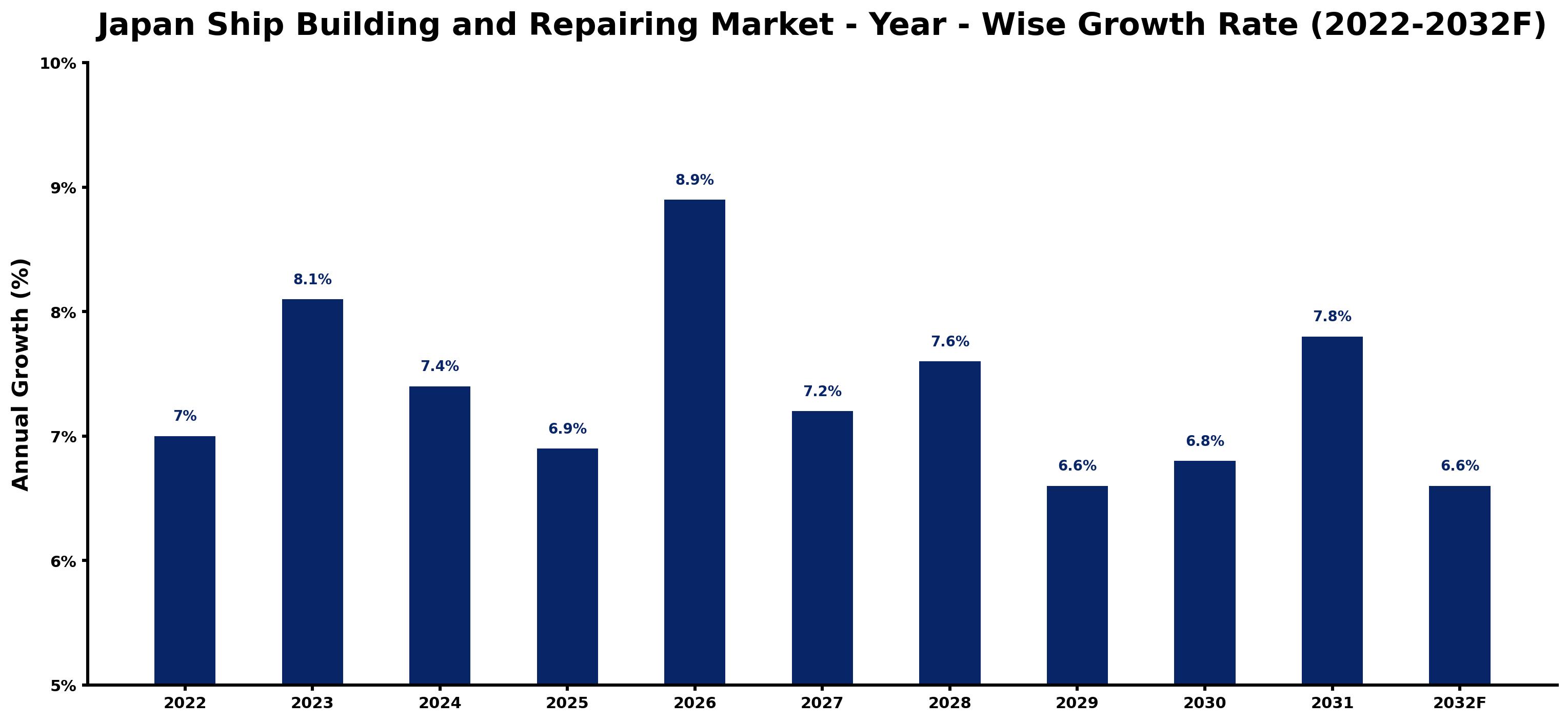
Below, each year's estimated growth is shown next to the factor that most influenced it.
| Year | Estimated Annual Growth (%) | Market Rationale |
| 2022 | 7.0 | The market experienced steady demand from domestic users and exports. |
| 2023 | 8.1 | Growth accelerated due to increased activity in shipbuilding and repairing. |
| 2024 | 7.4 | The market saw a slowdown as demand stabilised after the previous year's surge. |
| 2025 | 6.9 | Growth continued to slow as the market adjusted to new production levels. |
| 2026 | 8.9 | The market is expected to rebound with heightened demand for new vessels. |
| 2027 | 7.2 | Growth is projected to slow as the market stabilises after rapid expansion. |
| 2028 | 7.6 | Demand is anticipated to rise again due to increased offshore activities. |
| 2029 | 6.6 | Growth is expected to decelerate as market conditions normalise. |
| 2030 | 6.8 | The market is projected to see a slight uptick as vessel replacements increase. |
| 2031 | 7.8 | Growth is anticipated to rise again as new technologies are adopted. |
| 2032 | 6.6 | The market is expected to stabilise as demand aligns with production capacity. |
Note: Market size estimations and growth projections presented in this report are based on 6Wresearch's proprietary forecasting methodology, utilizing the latest available industry data, government publications, and primary research inputs.
Japan Ship Building and Repairing Market Synopsis
Ship Building and Repairing involves constructing and maintaining vessels using advanced technologies and skilled labour. The industry serves commercial shipping, offshore operations, and transportation needs. The Japan Ship Building and Repairing Market is expanding due to rising domestic demand and exports, with government initiatives promoting sustainable practices and investment in green technologies. Recent measures focus on encouraging eco-friendly practices, driving further investment and innovation in the sector, with the ship repair market valued at approximately ¥300 billion.
Market Dynamics Impact Analysis (2026–2032)
| Factor | Type | Impact | Primary Segment Affected |
| Increasing demand for new vessels due to global trade growth | Driver | High | Ship Building |
| Rising need for maintenance of aging vessels in the fleet | Driver | High | Ship Repairing |
| Investment in green technologies presents new market opportunities | Opportunity | High | Ship Building |
| Growing offshore operations require specialised vessels and services | Opportunity | High | Offshore Vessels |
| High competition from other shipbuilding nations limits market share | Restraint | Medium | Ship Building |
| Aging workforce may hinder production capacity | Restraint | Medium | Ship Repairing |
| Supply chain disruptions can delay production schedules | Challenge | High | Ship Building |
| Fluctuations in raw material prices impact profitability | Challenge | Medium | Ship Repairing |
Evaluation of Drivers in Japan Ship Building and Repairing Market (2026–2032)
Demand rests on the following drivers, each shown with the segment it touches most.
| Drivers | Primary Segment Affected | Why It Matters (Evidence) |
| Rising global trade volumes | Ship Building | The increase in global trade drives demand for new vessels, with Japan exporting over 50% of its production. |
| Aging fleet requiring repairs | Ship Repairing | With an average vessel age of around 15 years, ship repairs are essential for maintaining operational efficiency. |
| Government support for sustainable practices | Ship Building | Investment in green technologies encourages shipbuilders to adopt eco-friendly practices, boosting competitiveness. |
| Expansion of offshore energy projects | Offshore Vessels | Growing offshore operations require specialised vessels, increasing demand for new builds and repairs. |
| Technological advancements in shipbuilding | Ship Building | Innovative technologies improve production efficiency, attracting investment and increasing output in shipyards. |
Volumes grow on the back of rising global trade volumes, which drive demand for new vessels, with Japan exporting over 50% of its production. The aging fleet, with an average vessel age of around 15 years, necessitates repairs to maintain operational efficiency. The expansion of offshore energy projects creates a need for specialised vessels, increasing demand for new builds and repairs. Innovative technologies in shipbuilding improve production efficiency, attracting investment and boosting output in shipyards across the Yokohama region.
Evaluation of Restraints in Japan Ship Building and Repairing Market
The key brakes on demand, and where they bite hardest, are shown below.
| Market Restraint | Primary Segment Affected | Why It Matters (Evidence) |
| High competition from other shipbuilding nations | Ship Building | Intense competition limits market share and pricing power, affecting profitability for local shipbuilders. |
| Aging workforce may hinder production capacity | Ship Repairing | The aging workforce presents challenges in maintaining skilled labour levels, impacting production efficiency. |
| Supply chain disruptions can delay production schedules | Ship Building | Delays in vessel construction occur due to disruptions in supply chains, affecting delivery timelines. |
| Fluctuations in raw material prices impact profitability | Ship Repairing | Rising costs of materials can squeeze margins for repair services, impacting overall profitability. |
| Regulatory compliance increases operational costs | Ship Building | Compliance with stringent regulations raises operational costs, impacting competitiveness. |
Japan Ship Building and Repairing Market Challenges
Yokohama's shipyards struggle with supply chain disruptions due to imported steel, delaying production timelines for builders. Buyers contend with increased expenses as the average price of steel has risen by 20% over the past year, straining project budgets. Foreign shipbuilders gain an edge as local producers face competition from lower labour costs abroad, which threatens their market share. Repair costs escalate for transport companies as the ship repair market, valued at ¥300 billion, experiences skilled labour shortages, resulting in longer vessel downtime and lost revenue.
Trends in the Japan Ship Building and Repairing Market
The following changes are redrawing the Japan Ship Building and Repairing Market.
- Shift Towards Green Ship Technologies: Japan's shipbuilding industry is increasingly adopting green technologies, with the government allocating ¥5 billion for R&D in 2023. This shift aims to meet environmental targets and improve competitiveness in global markets.
- Emergence of Advanced Vessel Designs: Since 2022, there has been a notable trend towards advanced vessel designs, particularly in offshore vessels. This shift is driven by the need for efficiency and sustainability in maritime operations.
- Increase in Domestic Ship Repair Facilities: The number of domestic ship repair facilities has been rising since 2022, reflecting the growing need for maintenance services. This trend supports the operational efficiency of Japan's aging fleet.
- Expansion of Container Ship Production: Container Ships are becoming a focal point of production, with a projected CAGR of 10.2% from 2026 to 2032. This trend is driven by the increasing demand for global trade.
Investment Opportunities in the Japan Ship Building and Repairing Market
The following opportunities in the Japan Ship Building and Repairing Market pair current demand with a clear way in.
- Joint Ventures for Technological Collaboration: Collaborations between local and international firms are essential for advancing shipbuilding technologies. This is particularly relevant in Yokohama, where innovation is a priority, backed by government support.
- Investment in Offshore Vessel Production: The growing offshore energy sector presents an investment opportunity in specialised vessel production. Companies focusing on offshore vessels can benefit from increased demand in regions like Nagasaki.
- Certification for Sustainable Practices: Now is the time for companies to invest in certifications that promote sustainable practices, aligning with government initiatives. This is important for shipbuilders aiming to access global markets.
- Expansion of Repair Services in Major Ports: Investing in repair services in major ports like Yokohama is timely, given the rising demand for maintenance. This opportunity allows for improved service offerings to local and international clients.
Government Initiatives in the Japan Ship Building and Repairing Market
The 'Building Energy Efficiency Act' (2015, amended 2022) requires all new buildings, including shipyards, to meet energy standards from April 2025. This measure builds on previous regulations, ensuring shipbuilders adopt eco-friendly technologies and practices to meet future demands. The 'GX Basic Policy' (adopted 2023) aims at approximately JPY 150 trillion of public-private decarbonisation investment over 10 years, further supporting sustainable practices in shipbuilding.
The Ministry of Infrastructure, Transport and Tourism oversees the implementation of maritime regulations, ensuring compliance with quality standards. This agency supports shipbuilders in obtaining necessary certifications, facilitating smoother operations and market access for buyers.
Future Insight of the Japan Ship Building and Repairing Market
By 2032, buyers will see shipyards adopting advanced technologies as the government allocates a ¥5 billion budget for R&D in green ship technologies. Sustainable practices will align with Japan's target for net zero emissions by 2050, prompting suppliers to innovate. The average age of vessels will decline as new production methods improve efficiency, leading to safer and more reliable fleets. Stricter quality management standards will elevate industry performance, making Japanese vessels more appealing to international buyers.
Market Segmentation Analysis
Japan Ship Building and Repairing Market report covers a detailed analysis of the following market segments:
By Type – Ship Building Leads, Ship Repairing Expected to Grow Fastest
According to Ravi Bhandari, Research Head at 6Wresearch, Ship Building held 58% of the Japan Ship Building and Repairing Market by type in 2025. Ship Building holds the largest share as it is essential for constructing new vessels, with Japan producing 80 large vessels in 2022. This segment is particularly strong in regions like Yokohama and Nagasaki, where advanced technology and skilled labour are readily available. Over 2026–2032, Ship Repairing is expected to post the fastest growth, at a CAGR of 9.7%. Ship Repairing is experiencing rapid growth due to the average age of vessels in Japan's fleet being around 15 years, necessitating regular maintenance. The government's focus on sustainability and compliance with maritime regulations further drives the demand for repair services. Suppliers should enhance their repair capabilities to meet the increasing maintenance needs of an ageing fleet.
By Vessel Types – Oil And Chemical Tankers Lead, Container Ships Expected to Grow Fastest
Oil And Chemical Tankers took 45% of vessel types revenue in 2025, more than any other category. Oil And Chemical Tankers lead the market as they are crucial for transporting goods, reflecting Japan's strong export orientation with over 50% of ship production exported. This segment's significance is underscored by Japan's maritime transport serving over 127 million passengers annually. The quickest growth will come from Container Ships, forecast to expand at a CAGR of 10.2% between 2026 and 2032. Container Ships are projected to grow rapidly due to their critical role in global trade, spurred by the rising demand for efficient transport solutions. The continuous expansion of international shipping routes further fuels this segment's development. Buyers should invest in container ship capabilities to align with the growing demands of global trade.
By Applications – General Services Lead, Dockage Expected to Grow Fastest
In 2025, General Services led the applications split with a 35% share. General Services dominates the market as it encompasses a wide range of supportive operations vital for shipbuilding and maintenance. This segment benefits from adherence to ISO 9001 quality management standards, ensuring high operational quality across various services. Dockage is projected to grow fastest, at a CAGR of 10.4% during 2026–2032. Dockage is the fastest-growing application, driven by the need for efficient vessel berthing as maritime traffic increases. Ongoing enhancements in port facilities to accommodate larger vessels also contribute to this segment's growth. Suppliers must improve dockage services to effectively support the rising volume of maritime operations.
Key Attractiveness of the Report
- 10 Years of Market Numbers
- Historical Data Starting from 2022 to 2025
- Base Year 2025
- Forecast Data until 2032
- Key Performance Indicators Impacting the Market
- Major Upcoming Developments and Projects
Key Highlights of the Report:
- Japan Ship Building and Repairing Market Outlook
- Market Size of Japan Ship Building and Repairing Market, 2025
- Forecast of Japan Ship Building and Repairing Market, 2032
- Historical Data and Forecast of Japan Ship Building and Repairing Revenues & Volume for the Period 2022-2032
- Japan Ship Building and Repairing Market Trend Evolution
- Japan Ship Building and Repairing Market Drivers and Challenges
- Japan Ship Building and Repairing Price Trends
- Japan Ship Building and Repairing Porter's Five Forces
- Japan Ship Building and Repairing Industry Life Cycle
- Historical Data and Forecast of Japan Ship Building and Repairing Market Revenues & Volume By Type for the Period 2022-2032
- Historical Data and Forecast of Japan Ship Building and Repairing Market Revenues & Volume By Ship Building for the Period 2022-2032
- Historical Data and Forecast of Japan Ship Building and Repairing Market Revenues & Volume By Ship Repairing for the Period 2022-2032
- Historical Data and Forecast of Japan Ship Building and Repairing Market Revenues & Volume By Vessel Types for the Period 2022-2032
- Historical Data and Forecast of Japan Ship Building and Repairing Market Revenues & Volume By Oil And Chemical Tankers for the Period 2022-2032
- Historical Data and Forecast of Japan Ship Building and Repairing Market Revenues & Volume By Container Ships for the Period 2022-2032
- Historical Data and Forecast of Japan Ship Building and Repairing Market Revenues & Volume By Gas Carriers for the Period 2022-2032
- Historical Data and Forecast of Japan Ship Building and Repairing Market Revenues & Volume By Offshore Vessels for the Period 2022-2032
- Historical Data and Forecast of Japan Ship Building and Repairing Market Revenues & Volume By Passenger Ships And Ferries for the Period 2022-2032
- Historical Data and Forecast of Japan Ship Building and Repairing Market Revenues & Volume By Applications for the Period 2022-2032
- Historical Data and Forecast of Japan Ship Building and Repairing Market Revenues & Volume By General Services for the Period 2022-2032
- Historical Data and Forecast of Japan Ship Building and Repairing Market Revenues & Volume By Dockage for the Period 2022-2032
- Historical Data and Forecast of Japan Ship Building and Repairing Market Revenues & Volume By Hull Part for the Period 2022-2032
- Historical Data and Forecast of Japan Ship Building and Repairing Market Revenues & Volume By Engine Parts for the Period 2022-2032
- Historical Data and Forecast of Japan Ship Building and Repairing Market Revenues & Volume By Electric Works for the Period 2022-2032
- Historical Data and Forecast of Japan Ship Building and Repairing Market Revenues & Volume By Auxiliary Services for the Period 2022-2032
- Japan Ship Building and Repairing Import Export Trade Statistics
- Market Opportunity Assessment By Type
- Market Opportunity Assessment By Vessel Types
- Market Opportunity Assessment By Applications
- Japan Ship Building and Repairing Top Companies Market Share
- Japan Ship Building and Repairing Competitive Benchmarking By Technical and Operational Parameters
- Japan Ship Building and Repairing Company Profiles
- Japan Ship Building and Repairing Key Strategic Recommendations
Market Covered
The report covers the following segments.
By Type
- Ship Building
- Ship Repairing
By Vessel Types
- Oil And Chemical Tankers
- Container Ships
- Gas Carriers
- Offshore Vessels
- Passenger Ships And Ferries
By Applications
- General Services
- Dockage
- Hull Part
- Engine Parts
- Electric Works
- Auxiliary Services































