Japan Ship Hull Protection Market Size & Growth Rate
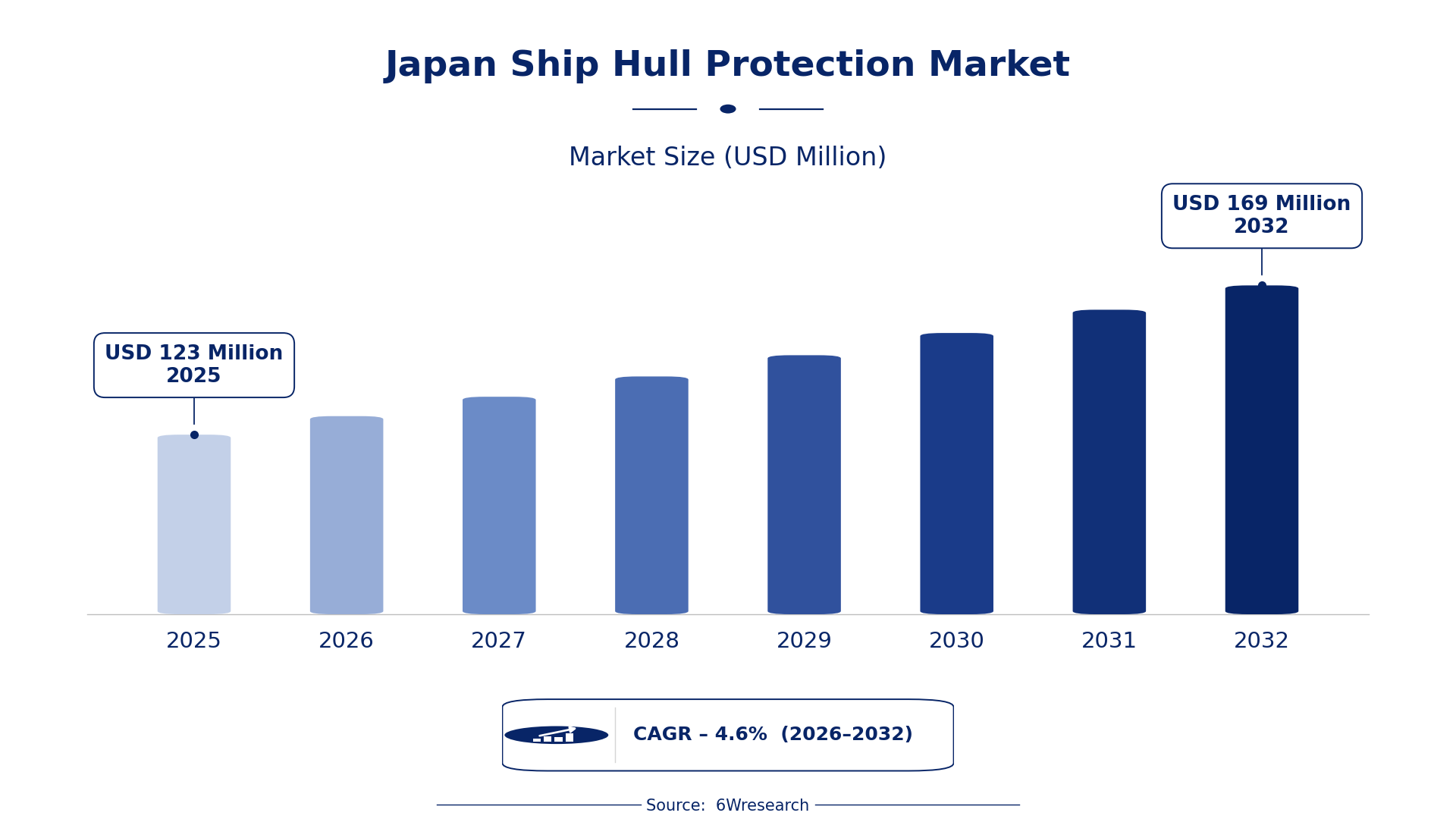
According to 6Wresearch internal database and industry insights, the Japan Ship Hull Protection Market was valued at USD 123 Million in 2025 and is projected to reach USD 169 Million by 2032, growing at a CAGR of approximately 4.6% during 2026–2032.
Japan Ship Hull Protection Market Highlights
| Report Metric | Details |
| Report Name | Japan Ship Hull Protection Market (2026-2032) |
| Market Size 2025 | USD 123 Million |
| Market Size 2032 | USD 169 Million |
| Absolute Growth 2025–2032 | USD 46 Million |
| CAGR 2026–2032 | 4.6% |
| Peak Annual Growth | 5.9% in 2032 |
| Forecast Period | 2026–2032 |
| Historical Data | 2022–2025 |
| Base Year | 2025 |
| Leading Protection Type, 2025 | Anti-Fouling Coatings (36% share) |
| Leading Coating Technology, 2025 | Biocide-Based (45% share) |
| Leading Target Area, 2025 | Below Waterline Hull (48% share) |
| Leading End User, 2025 | Shipbuilders (38% share) |
| Fastest-Growing Protection Type | Corrosion-Resistant Paint (6.5% CAGR) |
| Fastest-Growing Coating Technology | Epoxy/Polyurethane (6.6% CAGR) |
| Fastest-Growing End User | Marine Maintenance Cos. (6.1% CAGR) |
| Growing Sector | Shipbuilding and Marine Maintenance |
| Key End Users | Shipbuilders, Marine Maintenance Companies, Naval Shipyards, Defense & Commercial Vessels |
Japan Ship Hull Protection Market Year-wise Growth Rate and Key Drivers (2022–2032)
This graph illustrates the annual growth rates of the market from 2022 to 2032, highlighting a steady upward trajectory and projected market expansion over the forecast period.
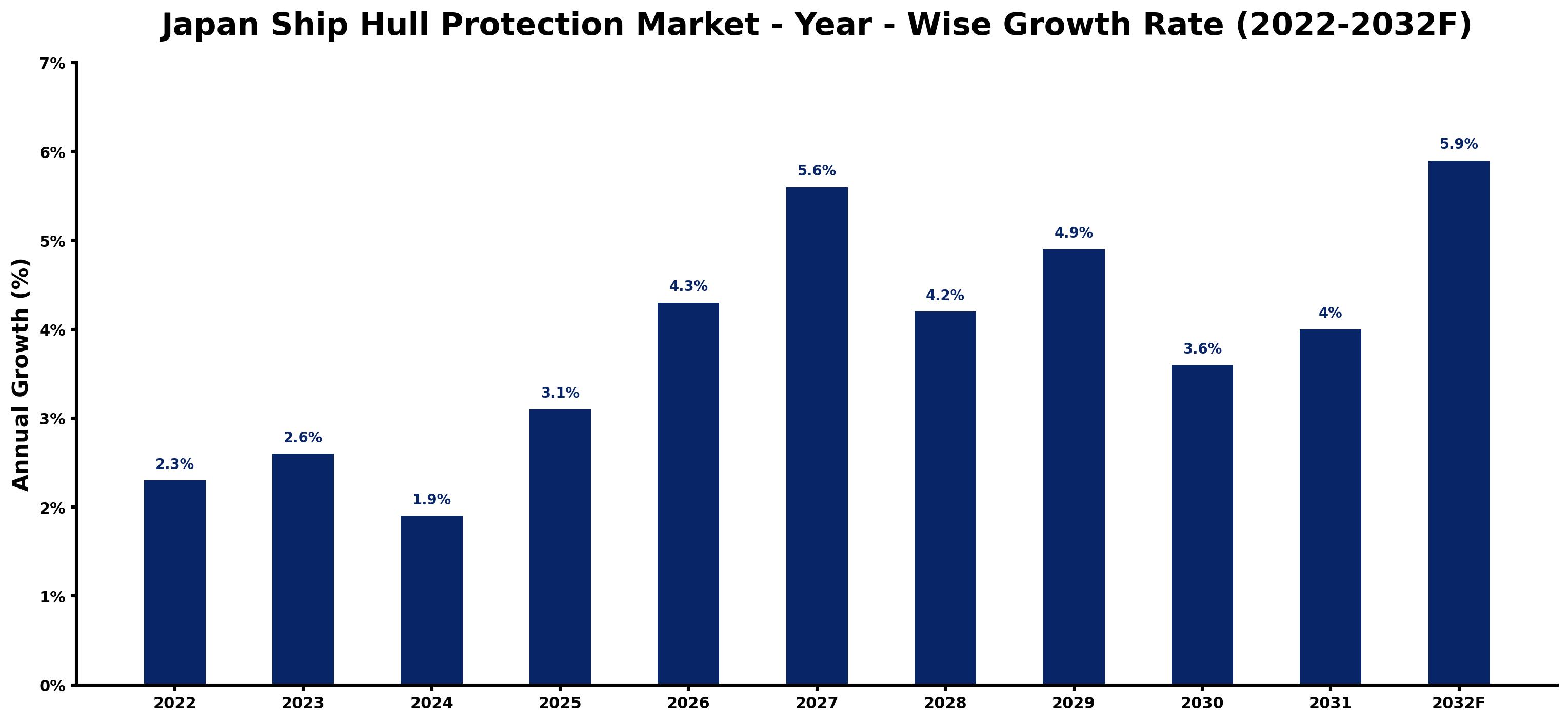
Annual growth estimates for each year appear below with the principal reason behind them, explaining the shifts that set the pace of the market.
| Year | Estimated Annual Growth (%) | Market Rationale |
| 2022 | 2.3 | The market experienced steady growth, driven by ongoing shipbuilding activities. |
| 2023 | 2.6 | Growth accelerated due to increased demand for eco-friendly coatings. |
| 2024 | 1.9 | Growth slowed as market adjustments occurred following previous peaks. |
| 2025 | 3.1 | The market rebounded with renewed investments in ship maintenance. |
| 2026 | 4.3 | Demand is expected to surge as shipbuilders expand their production capabilities. |
| 2027 | 5.6 | Growth will continue as marine maintenance companies increase their service offerings. |
| 2028 | 4.2 | Growth is projected to slow slightly as the market stabilises after rapid expansion. |
| 2029 | 4.9 | Demand is expected to rise again, driven by improvements in coating technologies. |
| 2030 | 3.6 | Growth will decelerate as buyers adjust to market conditions. |
| 2031 | 4.0 | The market will see a resurgence as new projects are initiated. |
| 2032 | 5.9 | Peak growth is expected to be reached, driven by heightened demand for sustainable solutions. |
Note: Market size estimations and growth projections presented in this report are based on 6Wresearch's proprietary forecasting methodology, utilizing the latest available industry data, government publications, and primary research inputs.
Japan Ship Hull Protection Market Synopsis
Ship hull protection involves coatings and systems designed to prevent marine growth and corrosion on ships, typically made from advanced polymers and biocides. The Japan Ship Hull Protection Market is expanding due to strong demand from domestic shipbuilders and marine maintenance companies, with biocide-based coatings accounting for about 60% of usage. The launch of a programme in 2023 to promote eco-friendly ship coatings is further driving market growth, supported by Japan's coastal population of approximately 30 million.
Market Dynamics Impact Analysis (2026–2032)
| Factor | Type | Impact | Primary Segment Affected |
| Increased investment in shipbuilding and maintenance facilities | Driver | High | Shipbuilders |
| Growing awareness of environmental regulations | Driver | High | Marine Maintenance Cos. |
| Expansion of eco-friendly coating technologies | Opportunity | High | Anti-Fouling Coatings |
| Rising demand for corrosion-resistant solutions | Opportunity | Medium | Corrosion-Resistant Paint |
| High costs associated with advanced coating materials | Restraint | High | Anti-Fouling Coatings |
| Limited availability of skilled workers in marine maintenance | Restraint | Medium | Marine Maintenance Cos. |
| Compliance with stringent environmental regulations | Challenge | High | Shipbuilders |
| Investment in research and development for new coatings | Challenge | Medium | Anti-Fouling Coatings |
Evaluation of Drivers in Japan Ship Hull Protection Market (2026–2032)
The main growth drivers and the segments they affect most are set out below.
| Drivers | Primary Segment Affected | Why It Matters (Evidence) |
| Increased shipbuilding activities | Shipbuilders | Japan's shipbuilding industry produced over 100 vessels in 2022, driving demand for protective coatings. |
| Rising environmental awareness | Marine Maintenance Cos. | The population of Japan's coastal regions, approximately 30 million, drives demand for eco-friendly solutions. |
| Technological advancements in coatings | Anti-Fouling Coatings | The average lifespan of a ship hull coating is around 5-10 years, necessitating regular upgrades. |
| Regulatory requirements for corrosion protection | Corrosion-Resistant Paint | ISO 12944 is a standard for corrosion protection, influencing purchasing decisions. |
| Demand from naval shipyards | Naval Shipyards | Specific standards for naval vessels' hull protection are enforced. |
Purchasing is picking up as Japan's shipbuilding industry produced over 100 vessels in 2022, creating robust demand for protective coatings. Coastal regions, home to around 30 million people, are increasingly aware of environmental issues, driving interest in eco-friendly solutions. The average lifespan of a ship hull coating is 5-10 years, necessitating regular upgrades, particularly for corrosion-resistant paint. Compliance with ISO 12944 standards for corrosion protection influences purchasing decisions among shipbuilders. The strict standards for naval vessels further boosts demand for advanced coatings.
Evaluation of Restraints in Japan Ship Hull Protection Market
The following restraints limit how fast demand can grow.
| Market Restraint | Primary Segment Affected | Why It Matters (Evidence) |
| High costs of advanced coating materials | Anti-Fouling Coatings | The average cost of anti-fouling coatings ranges from ¥1,000 to ¥3,000 per square meter, impacting purchasing decisions. |
| Shortage of skilled marine maintenance workers | Marine Maintenance Cos. | With over 10,000 workers employed, marine maintenance companies face limitations in service capacity. |
| Strict compliance requirements for chemical substances | Anti-Fouling Coatings | The Chemical Substances Control Law mandates evaluation and control of new chemical substances. |
| Limited market for specialized coatings | Silicone-Based Coating | Occasional use of silicone-based coatings limits their market growth potential. |
| Slow adoption of new technologies | Epoxy/Polyurethane | The average ship repair time in Japan is around 30 days, affecting the speed of adopting new solutions. |
Japan Ship Hull Protection Market Challenges
Regulatory hurdles for marine coatings create lengthy approval processes, delaying product launches by up to six months for producers. Buyers face rising costs as eco-friendly coatings become limited, with anti-fouling coatings priced at ¥3,000 per square meter, straining budgets for marine maintenance companies. Technological advancements are slow to be adopted, limiting buyers' access to hull protection solutions that could reduce maintenance intervals. Supply chain disruptions, particularly with biocide-based coatings, can extend ship repair times by an average of 30 days, impacting operations for marine maintenance firms.
Trends in the Japan Ship Hull Protection Market
These developments are changing demand patterns in the Japan Ship Hull Protection Market.
- Shift Towards Eco-Friendly Coatings: Since 2023, Japan has seen a shift towards eco-friendly ship coatings, driven by new regulations. The government allocated ¥500 million for research on sustainable marine coatings, encouraging innovation in this area.
- Transition from Traditional to Advanced Coatings: The introduction of advanced epoxy coatings has gained traction among shipbuilders, with a projected CAGR of 6.6% for the segment. This shift is clear in the Tokyo Bay area, a major hub for ship maintenance.
- Emergence of Biocide Alternatives: In recent years, marine maintenance companies are exploring biocide alternatives as environmental regulations tighten. Approximately 60% of the market still relies on biocide-based coatings, indicating a need for innovation.
- Focus on Corrosion Resistance: The demand for corrosion-resistant solutions has intensified, particularly in naval shipyards. With the Japanese Coast Guard enforcing strict standards, the market for corrosion-resistant paint is expanding.
Investment Opportunities in the Japan Ship Hull Protection Market
Where to invest in the Japan Ship Hull Protection Market: the main openings are set out below.
- Shipbuilders Seeking Advanced Coatings: Shipbuilders are increasingly looking for advanced coatings to meet regulatory standards. The Tokyo Maritime Safety Agency's regulations create an opportunity for suppliers to provide compliant solutions.
- Naval Shipyards Upgrading Facilities: Naval shipyards are investing in upgrading their facilities to improve maintenance capabilities. The government has allocated funds to support these upgrades, creating opportunities for suppliers of protective coatings.
- Marine Maintenance Companies Expanding Services: Marine maintenance companies are expanding their service offerings to include eco-friendly solutions. The average ship repair time of around 30 days highlights the need for efficient, sustainable products.
- Growing Demand for Sustainable Solutions: With a focus on sustainability, there is an increasing requirement for eco-friendly coatings. The launch of the 2023 programme to promote such coatings presents a timely opportunity for suppliers.
Government Initiatives in the Japan Ship Hull Protection Market
The Economic Security Promotion Act of 2022 supports supply-chain resilience for designated critical products, including ship hull protection materials. This act ensures that producers can maintain consistent supply levels, which is important for meeting the increasing needs in the shipbuilding sector. Additionally, the PRTR Law requires businesses to report releases of chemical substances, ensuring compliance and safety in production processes.
The Chemical Substances Control Law is utilised by the Japan Maritime Association to evaluate and control new chemical substances in hull protection products. This ensures that marine maintenance companies can confidently use compliant materials, building trust in the safety and effectiveness of coatings.
Future Insight of the Japan Ship Hull Protection Market
A new initiative for eco-friendly ship coatings will begin by 2032, driven by ¥500 million in government funding for research on sustainable solutions. This effort will encourage suppliers to develop products that comply with evolving environmental standards. Upgrades to ship maintenance facilities in key regions will improve service efficiency for buyers. As the average lifespan of ship hull coatings extends to 10 years, buyers will benefit from reduced maintenance costs and longer intervals between repairs.
Market Segmentation Analysis
Japan Ship Hull Protection Market report covers a detailed analysis of the following market segments:
By Protection Type – Anti-Fouling Coatings Lead, Corrosion-Resistant Paint Expected to Grow Fastest
According to Saurav Kr Singh, Senior Research Analyst at 6Wresearch, Anti-Fouling Coatings accounted for 36% of the market by protection type in 2025. Anti-fouling coatings hold the largest share as they are vital for preventing marine organisms from attaching to ship hulls, particularly in regions like Tokyo Bay, which is a key maintenance hub. Their widespread adoption among shipbuilders ensures operational efficiency for the over 100 vessels produced in Japan's shipbuilding industry. The quickest growth will come from Corrosion-Resistant Paint, forecast to expand at a CAGR of 6.5% between 2026 and 2032. Corrosion-resistant paint is experiencing rapid growth as shipbuilders increasingly recognise the need for strong protection against rust, especially given the average ship repair time of around 30 days. This segment's expansion will likely continue due to tightening environmental regulations. Suppliers must focus on developing advanced corrosion-resistant solutions to meet the growing demand from shipbuilders.
By Coating Technology – Biocide-Based Leads, Epoxy/Polyurethane Expected to Grow Fastest
With 45% of coating technology revenue in 2025, Biocide-Based was the largest category. Biocide-based coatings lead the market, accounting for 60% of usage, as they are effectively employed in anti-fouling applications to eliminate marine growth on ship hulls. Their established presence, particularly among marine maintenance companies, solidifies their dominant position. Over 2026–2032, Epoxy/Polyurethane is expected to post the fastest growth, at a CAGR of 6.6%. Epoxy/polyurethane coatings are experiencing rapid growth due to their strong adhesion and durability, which are vital for maintaining ship hull integrity in harsh marine conditions. This growth is encouraged by the government's allocation of ¥500 million for research on sustainable marine coatings. Buyers should consider investing in epoxy/polyurethane technologies to ensure long-lasting protection for vessels.
By Target Area – Below Waterline Hull Leads and Records the Fastest Growth
The largest target area category in 2025 was Below Waterline Hull, at 48% of revenue. The below waterline hull area is the primary focus for protection products, as it is the most susceptible to marine growth and corrosion. This critical area directly impacts the performance and longevity of vessels operating in Japan's coastal waters. Below Waterline Hull is also forecast to expand faster than any other category, at a CAGR of 5.6% over 2026–2032. The below waterline hull segment is also the fastest-growing, driven by increased awareness of the importance of hull protection in enhancing vessel durability and reducing maintenance costs. As the shipbuilding industry continues to thrive, this segment's growth is expected to accelerate further. Suppliers should prioritise innovations in below waterline protection to capitalise on the expanding market.
By End User – Shipbuilders Lead, Marine Maintenance Cos. Expected to Grow Fastest
In 2025, Shipbuilders led the end user split with a 38% share. Shipbuilders represent the largest end user of hull protection products, motivated by the need to ensure the longevity and performance of newly constructed vessels. The production of over 100 vessels in 2022 highlights their significant demand for effective protection solutions. Marine Maintenance Cos. is set to record the highest CAGR in this split, 6.1% over 2026–2032. Marine maintenance companies are the fastest-growing end user segment, as they play a crucial role in the upkeep and repair of vessels, particularly with an average ship repair time of around 30 days. Their workforce of over 10,000 workers underscores their increasing influence in the market. Suppliers should enhance their offerings to meet the specific needs of marine maintenance companies.
Key Attractiveness of the Report
- 10 Years of Market Numbers
- Historical Data Starting from 2022 to 2025
- Base Year 2025
- Forecast Data until 2032
- Key Performance Indicators Impacting the Market
- Major Upcoming Developments and Projects
Key Highlights of the Report:
- Japan Ship Hull Protection Market Outlook
- Market Size of Japan Ship Hull Protection Market, 2025
- Forecast of Japan Ship Hull Protection Market, 2032
- Historical Data and Forecast of Japan Ship Hull Protection Revenues & Volume for the Period 2022-2032F
- Japan Ship Hull Protection Market Trend Evolution
- Japan Ship Hull Protection Market Drivers and Challenges
- Japan Ship Hull Protection Price Trends
- Japan Ship Hull Protection Porter's Five Forces
- Japan Ship Hull Protection Industry Life Cycle
- Historical Data and Forecast of Japan Ship Hull Protection Market Revenues & Volume By Protection Type for the Period 2022-2032F
- Historical Data and Forecast of Japan Ship Hull Protection Market Revenues & Volume By Anti-Fouling Coatings for the Period 2022-2032F
- Historical Data and Forecast of Japan Ship Hull Protection Market Revenues & Volume By Corrosion-Resistant Paint for the Period 2022-2032F
- Historical Data and Forecast of Japan Ship Hull Protection Market Revenues & Volume By Cathodic Protection for the Period 2022-2032F
- Historical Data and Forecast of Japan Ship Hull Protection Market Revenues & Volume By Silicone-Based Coating for the Period 2022-2032F
- Historical Data and Forecast of Japan Ship Hull Protection Market Revenues & Volume By Coating Technology for the Period 2022-2032F
- Historical Data and Forecast of Japan Ship Hull Protection Market Revenues & Volume By Biocide-Based for the Period 2022-2032F
- Historical Data and Forecast of Japan Ship Hull Protection Market Revenues & Volume By Epoxy/Polyurethane for the Period 2022-2032F
- Historical Data and Forecast of Japan Ship Hull Protection Market Revenues & Volume By Anode Systems for the Period 2022-2032F
- Historical Data and Forecast of Japan Ship Hull Protection Market Revenues & Volume By Low-Friction Layer for the Period 2022-2032F
- Historical Data and Forecast of Japan Ship Hull Protection Market Revenues & Volume By Target Area for the Period 2022-2032F
- Historical Data and Forecast of Japan Ship Hull Protection Market Revenues & Volume By Below Waterline Hull for the Period 2022-2032F
- Historical Data and Forecast of Japan Ship Hull Protection Market Revenues & Volume By Hull Exterior for the Period 2022-2032F
- Historical Data and Forecast of Japan Ship Hull Protection Market Revenues & Volume By Metal Hulls for the Period 2022-2032F
- Historical Data and Forecast of Japan Ship Hull Protection Market Revenues & Volume By High-Speed Hulls for the Period 2022-2032F
- Historical Data and Forecast of Japan Ship Hull Protection Market Revenues & Volume By End User for the Period 2022-2032F
- Historical Data and Forecast of Japan Ship Hull Protection Market Revenues & Volume By Shipbuilders for the Period 2022-2032F
- Historical Data and Forecast of Japan Ship Hull Protection Market Revenues & Volume By Marine Maintenance Cos. for the Period 2022-2032F
- Historical Data and Forecast of Japan Ship Hull Protection Market Revenues & Volume By Defense & Commercial Vessels for the Period 2022-2032F
- Historical Data and Forecast of Japan Ship Hull Protection Market Revenues & Volume By Naval Shipyards for the Period 2022-2032F
- Japan Ship Hull Protection Import Export Trade Statistics
- Market Opportunity Assessment By Protection Type
- Market Opportunity Assessment By Coating Technology
- Market Opportunity Assessment By Target Area
- Market Opportunity Assessment By End User
- Japan Ship Hull Protection Top Companies Market Share
- Japan Ship Hull Protection Competitive Benchmarking By Technical and Operational Parameters
- Japan Ship Hull Protection Company Profiles
- Japan Ship Hull Protection Key Strategic Recommendations
Market Covered
Coverage by segment is as follows.
By Protection Type
- Anti-Fouling Coatings
- Corrosion-Resistant Paint
- Cathodic Protection
- Silicone-Based Coating
By Coating Technology
- Biocide-Based
- Epoxy/Polyurethane
- Anode Systems
- Low-Friction Layer
By Target Area
- Below Waterline Hull
- Hull Exterior
- Metal Hulls
- High-Speed Hulls
By End User
- Shipbuilders
- Marine Maintenance Cos.
- Defense & Commercial Vessels
- Naval Shipyards































