Japan Ship Loader and Unloader Market Size & Growth Rate
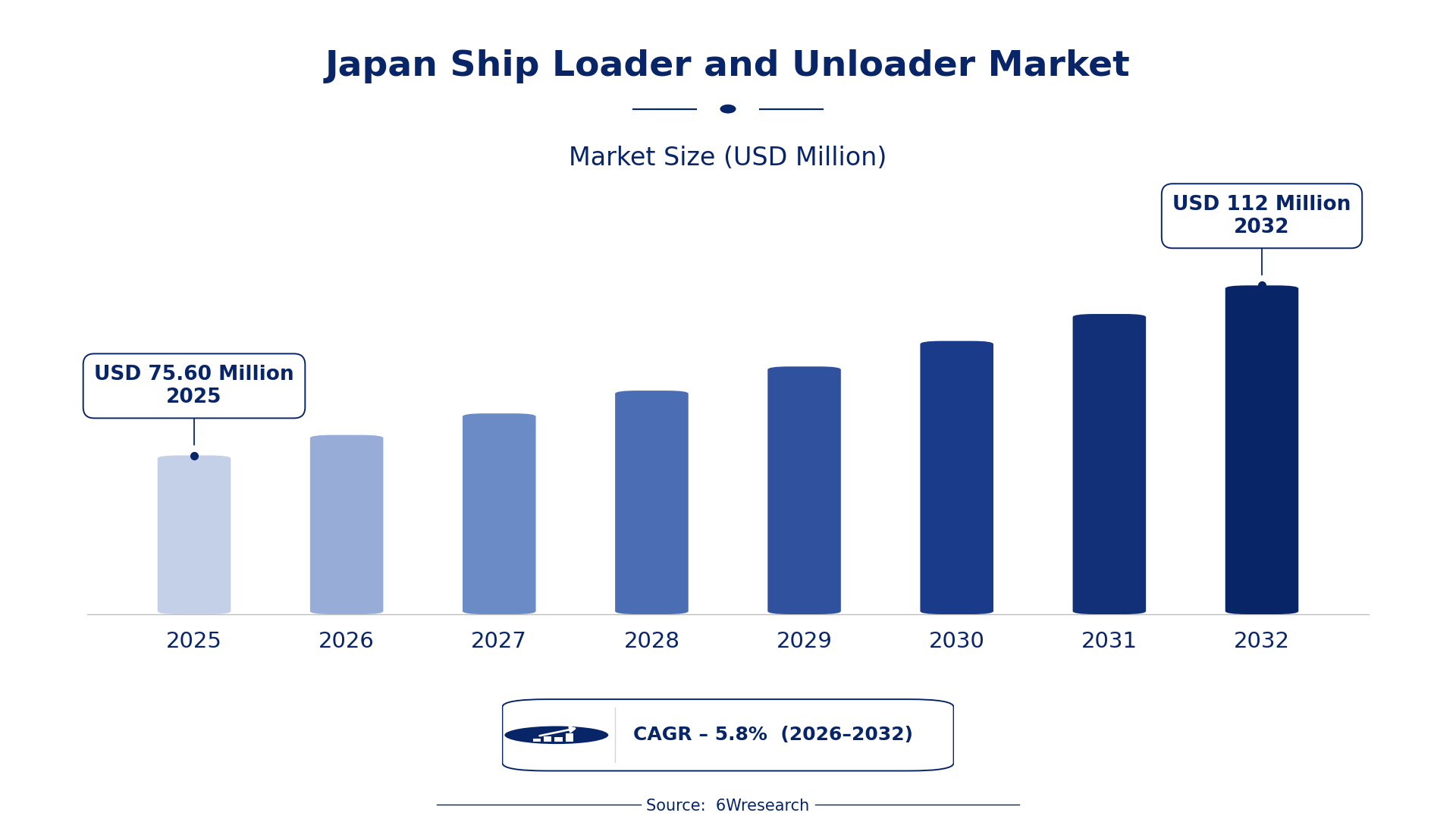
According to 6Wresearch internal database and industry insights, the Japan Ship Loader and Unloader Market was valued at USD 75.60 Million in 2025 and is projected to reach USD 112 Million by 2032, growing at a CAGR of approximately 5.8% during 2026–2032.
Japan Ship Loader and Unloader Market Highlights
| Report Metric | Details |
| Report Name | Japan Ship Loader and Unloader Market (2026-2032) |
| Market Size 2025 | USD 75.60 Million |
| Market Size 2032 | USD 112 Million |
| Absolute Growth 2025–2032 | USD 36.40 Million |
| CAGR 2026–2032 | 5.8% |
| Peak Annual Growth | 6.4% in 2026 |
| Forecast Period | 2026–2032 |
| Historical Data | 2022–2025 |
| Base Year | 2025 |
| Leading Product Type, 2025 | Stationary (57% share) |
| Leading Technology Type, 2025 | Mechanical (65% share) |
| Leading Bulk Type, 2025 | Dry (54% share) |
| Leading Application, 2025 | Mining (44% share) |
| Fastest-Growing Product Type | Mobile (8.3% CAGR) |
| Fastest-Growing Technology Type | Pneumatic (7.9% CAGR) |
| Fastest-Growing Bulk Type | Liquid (8.2% CAGR) |
| Fastest-Growing Application | Packaging (8.0% CAGR) |
| Growing Sector | maritime logistics |
| Key End Users | mining operations, sea ports, logistics companies, construction firms |
Japan Ship Loader and Unloader Market Year-wise Growth Rate and Key Drivers (2022–2032)
This graph illustrates the annual growth rates of the market from 2022 to 2032, highlighting a steady upward trajectory and projected market expansion over the forecast period.
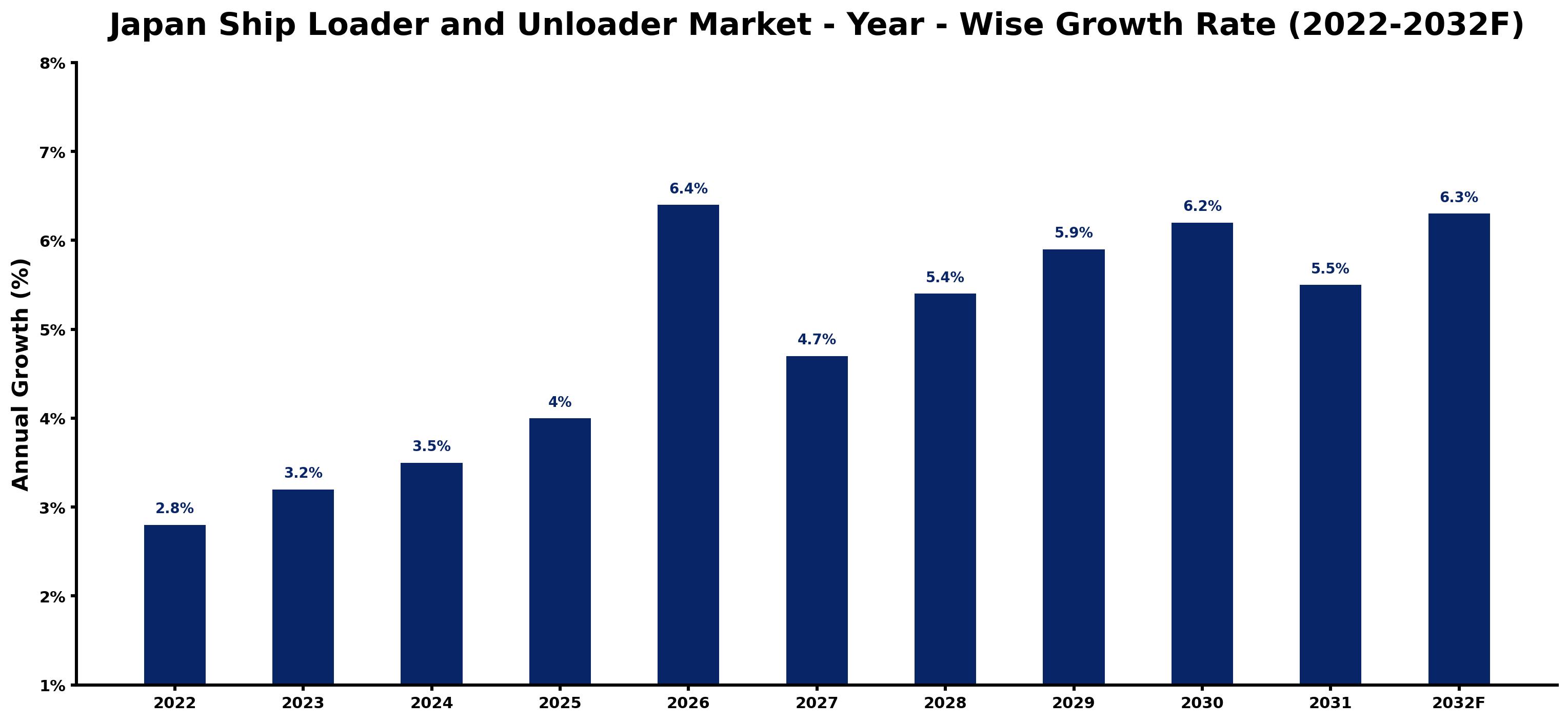
The yearly estimates that follow link every growth rate to its principal driver, so readers can see why the pace changed in each period.
| Year | Estimated Annual Growth (%) | Market Rationale |
| 2022 | 2.8 | The market showed steady operations, reflecting ongoing demand from domestic users. |
| 2023 | 3.2 | Growth accelerated due to increased activity at major sea ports, particularly in Tokyo. |
| 2024 | 3.5 | Demand continued to rise as port modernization efforts gained momentum across the country. |
| 2025 | 4.0 | The market reached a historical peak, driven by investments in infrastructure. |
| 2026 | 6.4 | Growth is expected to peak as modernization initiatives lead to higher operational efficiency at ports. |
| 2027 | 4.7 | Growth is projected to slow as the market adjusts to the previous year's peak performance. |
| 2028 | 5.4 | A resurgence in demand is anticipated as more projects are initiated in the Tokyo Bay area. |
| 2029 | 5.9 | Continued investments in eco-friendly technologies will spur further growth in the sector. |
| 2030 | 6.2 | Growth is expected to remain strong, supported by rising exports of minerals from mining operations. |
| 2031 | 5.5 | A slight slowdown is projected as the market stabilises after rapid expansion. |
| 2032 | 6.3 | The market is expected to resume growth as new projects are planned for the coming years. |
Note: Market size estimations and growth projections presented in this report are based on 6Wresearch's proprietary forecasting methodology, utilizing the latest available industry data, government publications, and primary research inputs.
Japan Ship Loader and Unloader Market Synopsis
Ship loaders and unloaders are essential mechanical devices for transferring bulk materials at sea ports, primarily handling dry bulk like coal and grain. The Japan Ship Loader and Unloader Market is experiencing growth due to increased maritime logistics activity, driven by investments in port modernization and eco-friendly technologies. The maritime transport sector contributes approximately 3% to the national GDP, indicating strong demand from key buyers such as mining operations and major sea ports.
Market Dynamics Impact Analysis (2026–2032)
| Factor | Type | Impact | Primary Segment Affected |
| Increased port modernization initiatives | Driver | High | Stationary |
| Rising exports of minerals from mining operations | Driver | High | Mining |
| Growing demand for eco-friendly technologies | Opportunity | High | Mechanical |
| Expansion of major sea ports in the Tokyo Bay area | Opportunity | High | Sea Ports |
| High initial investment costs for new loaders | Restraint | Medium | Mobile |
| Limited adoption of pneumatic systems in the market | Restraint | Medium | Pneumatic |
| Aging infrastructure at some ports | Challenge | High | Stationary |
| Competition from alternative bulk handling methods | Challenge | Medium | Dry |
Evaluation of Drivers in Japan Ship Loader and Unloader Market (2026–2032)
Key forces behind demand, with the segment each one moves most, are listed below.
| Drivers | Primary Segment Affected | Why It Matters (Evidence) |
| Increased investment in port facilities | Stationary | Japan has over 30 major sea ports equipped with loaders, boosting operational capacity. |
| Growing mineral exports from mining | Mining | The mining sector requires efficient loaders, contributing to rising export volumes. |
| Adoption of eco-friendly technologies | Mechanical | The Japanese government promotes eco-friendly technologies in port operations through subsidies. |
| Modernization programs for port infrastructure | Sea Ports | In 2023, the Ministry of Land, Infrastructure, Transport and Tourism launched a program to modernize port facilities. |
| Rising cargo volumes at busy ports | Dry | The Port of Tokyo handles millions of tons of cargo annually, driving demand for loaders. |
Most of the extra volume comes from increased investment in port facilities, with over 30 major sea ports equipped with loaders boosting operational capacity. The mining sector is a key driver, as it requires efficient loaders for exporting minerals, contributing to rising export volumes. The Port of Osaka, a key hub, facilitates millions of tons of cargo movements annually, driving demand for dry bulk loaders.
Evaluation of Restraints in Japan Ship Loader and Unloader Market
Below are the constraints most often cited by buyers and suppliers, with the segment each affects.
| Market Restraint | Primary Segment Affected | Why It Matters (Evidence) |
| High initial investment costs for new loaders | Mobile | Mobile loaders are less frequently adopted due to their higher costs compared to stationary types. |
| Limited adoption of pneumatic systems | Pneumatic | Pneumatic systems are not prevalent, restricting their market share in bulk handling applications. |
| Aging infrastructure at some ports | Stationary | Older facilities may not support the latest loading technologies, affecting operational efficiency. |
| Competition from alternative bulk handling methods | Dry | Emerging technologies in bulk handling may divert investments away from traditional loaders. |
| Regulatory compliance costs for eco-friendly technologies | Mechanical | Investments in eco-friendly technologies may impose additional financial burdens on producers. |
Japan Ship Loader and Unloader Market Challenges
Producers face outdated technology in ship loaders, which raises operational costs and decreases efficiency. Many loaders exceed 20 years in age, causing maintenance expenses to rise by 15% for producers. Buyers struggle with fluctuating demand for dry bulk materials, as the maritime transport sector contributes only 3% to the national GDP, complicating procurement strategies. Regulatory compliance with ISO 9001 standards necessitates investments in quality management systems, potentially delaying project timelines by several months. Increased competition from emerging markets forces local suppliers to lower prices, which can compromise quality for buyers.
Trends in the Japan Ship Loader and Unloader Market
The trends below show where the Japan Ship Loader and Unloader Market is heading.
- Shift towards Eco-Friendly Technologies in Ports: Japan is increasingly adopting eco-friendly technologies in port operations, driven by government subsidies. In 2023, the Ministry of Land, Infrastructure, Transport and Tourism launched a program to modernize port facilities, promoting sustainability efforts.
- Rising Demand for Mobile Loaders: Mobile loaders are gaining traction, with an expected CAGR of 8.3% from 2026 to 2032. This shift reflects the need for flexibility in loading operations at various ports across Japan.
- Increased Focus on Dry Bulk Handling: Dry bulk handling remains a priority, accounting for 70% of operations in Japan. The Port of Osaka serves as a key hub for these activities, facilitating significant cargo movements annually.
- Expansion of Major Sea Ports: The Tokyo Bay area is experiencing rapid expansion, with significant investments in port infrastructure. This region is set to handle increased cargo volumes, driving demand for ship loaders.
Investment Opportunities in the Japan Ship Loader and Unloader Market
The opportunities below stand out in the Japan Ship Loader and Unloader Market for new entrants and existing suppliers.
- Invest in Eco-Friendly Loader Technologies: With the government promoting eco-friendly technologies, now is the time to invest in sustainable loader systems. The mining sector, a key buyer, is increasingly seeking greener solutions.
- Partner with Port Authorities for Modernization: Collaboration with port authorities is essential as modernization programs are underway. The Tokyo Bay area represents a significant opportunity for partnerships to enhance loading capabilities.
- Address the Demand for Mobile Loaders: The market gap for mobile loaders is evident, with an expected CAGR of 8.3%. Targeting mining operations and logistics companies can yield substantial returns.
- Expand Offerings for Dry Bulk Applications: The dry bulk segment is a primary application area, accounting for 70% of operations. Focusing on this segment can attract major buyers like the Port of Osaka.
Government Initiatives in the Japan Ship Loader and Unloader Market
The Building Energy Efficiency Act, amended in 2022, mandates that all new buildings meet energy standards from April 2025, impacting port facilities. Compliance with these standards is essential for producers and operators to ensure efficient energy use in loading operations. The Food Sanitation Act amendment introduced in 2018 requires strict hygiene management in food-related operations, affecting how materials are handled at ports.
The Japan Port Association oversees standards and regulations for port operations, approving new technologies and practices. The association funds initiatives aimed at improving port efficiency, with a focus on eco-friendly technologies and modernization efforts.
Future Insight of the Japan Ship Loader and Unloader Market
By 2032, buyers will benefit from the modernisation programme launched in 2023, which will upgrade port facilities. Suppliers will increasingly adopt eco-friendly technologies, driven by government subsidies that promote sustainability. Advanced automation will be integrated into ship loaders, boosting loading efficiency and throughput. As the Port of Tokyo continues to manage millions of tons of cargo annually, suppliers must meet elevated operational standards to maintain competitiveness.
Market Segmentation Analysis
Japan Ship Loader and Unloader Market report covers a detailed analysis of the following market segments:
By Product Type – Stationary Leads, Mobile Expected to Grow Fastest
According to Vasudha, AM at 6Wresearch, Stationary accounted for 57% of the market by product type in 2025. Stationary loaders dominate the market as they are essential for continuous operations at major ports, particularly at the Port of Tokyo, which manages millions of tons of cargo each year. Their design provides reliability for the efficient loading and unloading of dry bulk materials. Mobile is set to record the highest CAGR in this split, 8.3% over 2026–2032. Mobile loaders are witnessing rapid growth due to modernisation efforts at ports, with initiatives encouraging the integration of mobile solutions for increased operational flexibility. This trend is particularly pronounced in the Tokyo Bay area, where diverse loading tasks are increasingly necessary. Suppliers should focus on enhancing the adaptability of mobile loaders to meet the changing operational demands of ports.
By Technology Type – Mechanical Leads, Pneumatic Expected to Grow Fastest
With 65% of technology type revenue in 2025, Mechanical was the largest category. Mechanical systems are prevalent in Japan, as they are the most common technology used for ship loading and unloading, particularly in major ports. Their efficiency in handling bulk materials has established them as the standard in the industry. Pneumatic is projected to grow fastest, at a CAGR of 7.9% during 2026–2032. Pneumatic technology is emerging as a growth area, especially for specific applications that require careful handling of materials. The increasing need for specialised solutions in the logistics sector is driving interest in pneumatic systems. Buyers may benefit from exploring pneumatic options for niche applications to optimise their loading processes.
By Bulk Type – Dry Leads, Liquid Expected to Grow Fastest
Dry took 54% of bulk type revenue in 2025, more than any other category. Dry bulk handling represents the primary application for ship loaders in Japan, accounting for a substantial portion of operations at major ports. This segment's importance is underscored by the high volume of minerals and agricultural products exported. Over 2026–2032, Liquid is expected to post the fastest growth, at a CAGR of 8.2%. The liquid bulk segment is expected to grow as demand for transporting specific cargo types increases, particularly in response to changing trade patterns. This shift is likely influenced by the diversification of cargo handled at ports. Suppliers should consider expanding their product offerings to include solutions for liquid bulk handling to capture emerging market opportunities.
By Application – Mining Leads, Packaging Expected to Grow Fastest
The largest application category in 2025 was Mining, at 44% of revenue. Mining is the leading application for ship loaders, driven by the necessity to export substantial volumes of minerals efficiently. This demand is particularly pronounced in areas with significant mining operations, such as the Tokyo Bay region, which supports extensive shipping activities. The quickest growth will come from Packaging, forecast to expand at a CAGR of 8.0% between 2026 and 2032. The packaging sector is rapidly increasing its use of ship loaders to streamline logistics for shipping finished goods, reflecting a growing focus on efficient supply chain management. This trend highlights broader changes in Japan's logistics sector, where integrated solutions are becoming critical. Suppliers need to create tailored solutions for the packaging industry to take advantage of its rising logistics needs.
Key Attractiveness of the Report
- 10 Years of Market Numbers
- Historical Data Starting from 2022 to 2025
- Base Year 2025
- Forecast Data until 2032
- Key Performance Indicators Impacting the Market
- Major Upcoming Developments and Projects
Key Highlights of the Report:
- Japan Ship Loader and Unloader Market Outlook
- Market Size of Japan Ship Loader and Unloader Market, 2025
- Forecast of Japan Ship Loader and Unloader Market, 2032
- Historical Data and Forecast of Japan Ship Loader and Unloader Revenues & Volume for the Period 2022-2032
- Japan Ship Loader and Unloader Market Trend Evolution
- Japan Ship Loader and Unloader Market Drivers and Challenges
- Japan Ship Loader and Unloader Price Trends
- Japan Ship Loader and Unloader Porter's Five Forces
- Japan Ship Loader and Unloader Industry Life Cycle
- Historical Data and Forecast of Japan Ship Loader and Unloader Market Revenues & Volume By Product Type for the Period 2022-2032
- Historical Data and Forecast of Japan Ship Loader and Unloader Market Revenues & Volume By Stationary for the Period 2022-2032
- Historical Data and Forecast of Japan Ship Loader and Unloader Market Revenues & Volume By Mobile for the Period 2022-2032
- Historical Data and Forecast of Japan Ship Loader and Unloader Market Revenues & Volume By Technology Type for the Period 2022-2032
- Historical Data and Forecast of Japan Ship Loader and Unloader Market Revenues & Volume By Mechanical for the Period 2022-2032
- Historical Data and Forecast of Japan Ship Loader and Unloader Market Revenues & Volume By Pneumatic for the Period 2022-2032
- Historical Data and Forecast of Japan Ship Loader and Unloader Market Revenues & Volume By Bulk Type for the Period 2022-2032
- Historical Data and Forecast of Japan Ship Loader and Unloader Market Revenues & Volume By Dry for the Period 2022-2032
- Historical Data and Forecast of Japan Ship Loader and Unloader Market Revenues & Volume By Liquid for the Period 2022-2032
- Historical Data and Forecast of Japan Ship Loader and Unloader Market Revenues & Volume By Application for the Period 2022-2032
- Historical Data and Forecast of Japan Ship Loader and Unloader Market Revenues & Volume By Mining for the Period 2022-2032
- Historical Data and Forecast of Japan Ship Loader and Unloader Market Revenues & Volume By Packaging for the Period 2022-2032
- Historical Data and Forecast of Japan Ship Loader and Unloader Market Revenues & Volume By Construction for the Period 2022-2032
- Historical Data and Forecast of Japan Ship Loader and Unloader Market Revenues & Volume By Manufacturing for the Period 2022-2032
- Historical Data and Forecast of Japan Ship Loader and Unloader Market Revenues & Volume By Sea Ports for the Period 2022-2032
- Historical Data and Forecast of Japan Ship Loader and Unloader Market Revenues & Volume By Others for the Period 2022-2032
- Japan Ship Loader and Unloader Import Export Trade Statistics
- Market Opportunity Assessment By Product Type
- Market Opportunity Assessment By Technology Type
- Market Opportunity Assessment By Bulk Type
- Market Opportunity Assessment By Application
- Japan Ship Loader and Unloader Top Companies Market Share
- Japan Ship Loader and Unloader Competitive Benchmarking By Technical and Operational Parameters
- Japan Ship Loader and Unloader Company Profiles
- Japan Ship Loader and Unloader Key Strategic Recommendations
Market Covered
The study includes the following segmentation.
By Product Type
- Stationary
- Mobile
By Technology Type
- Mechanical
- Pneumatic
By Bulk Type
- Dry
- Liquid
By Application
- Mining
- Packaging
- Construction
- Manufacturing
- Sea Ports
- Others































