Japan Shipborne C4ISR Market Size & Growth Rate
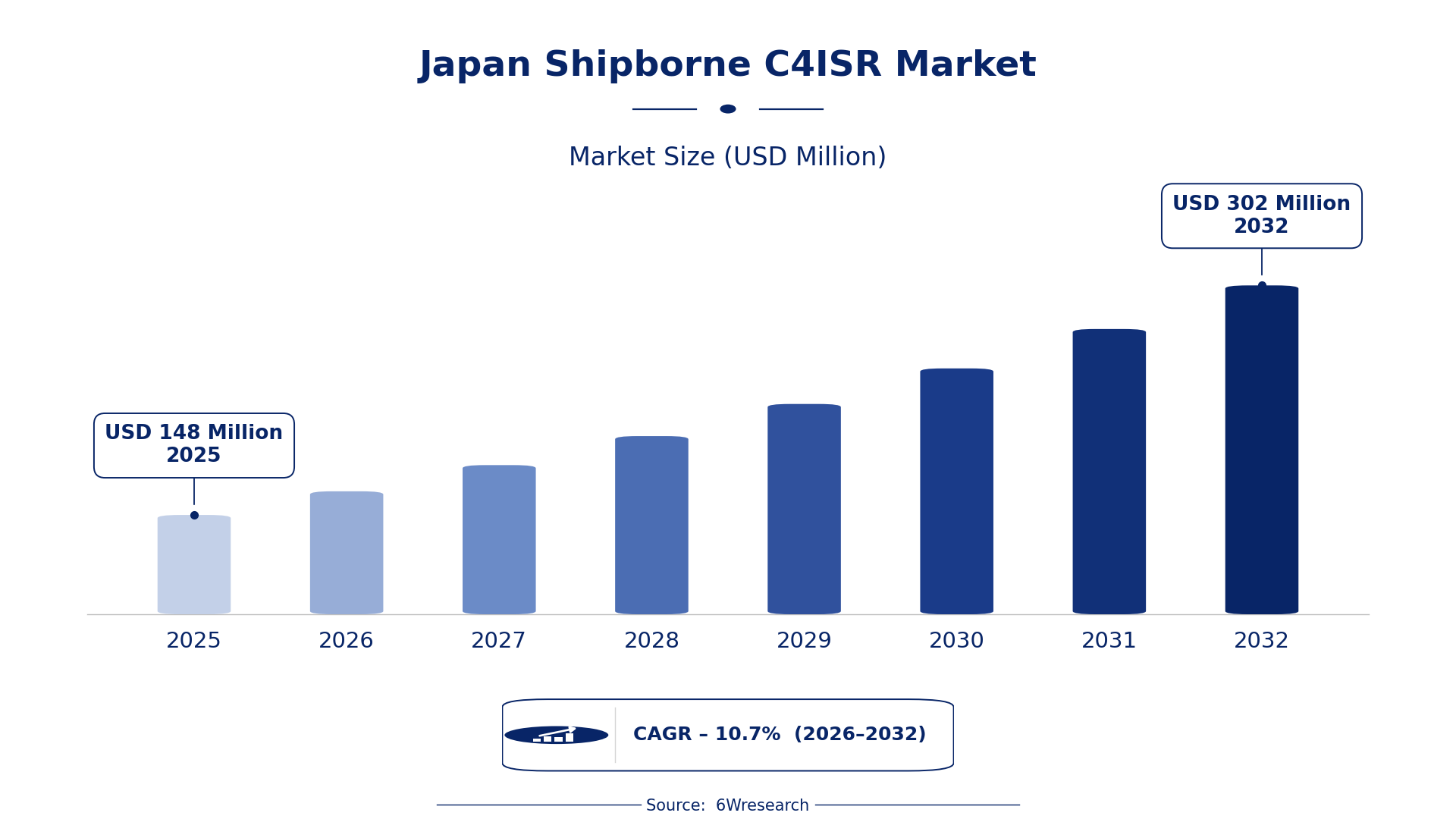
According to 6Wresearch internal database and industry insights, the Japan Shipborne C4ISR Market was valued at USD 148 Million in 2025 and is projected to reach USD 302 Million by 2032, growing at a CAGR of approximately 10.7% during 2026–2032.
Japan Shipborne C4ISR Market Highlights
| Report Metric | Details |
| Report Name | Japan Shipborne C4ISR Market (2026-2032) |
| Market Size 2025 | USD 148 Million |
| Market Size 2032 | USD 302 Million |
| Absolute Growth 2025–2032 | USD 154 Million |
| CAGR 2026–2032 | 10.7% |
| Peak Annual Growth | 14.7% in 2032 |
| Forecast Period | 2026–2032 |
| Historical Data | 2022–2025 |
| Base Year | 2025 |
| Leading System Type, 2025 | Command Systems (36% share) |
| Leading Functionality, 2025 | Strategic Control (46% share) |
| Leading Platform Integration, 2025 | Frigates/Destroyers (47% share) |
| Leading End User, 2025 | Naval Forces (42% share) |
| Fastest-Growing System Type | Communication Systems (15.1% CAGR) |
| Fastest-Growing Functionality | Secure Transmission (14.0% CAGR) |
| Fastest-Growing Platform Integration | Warships & Submarines (15.6% CAGR) |
| Fastest-Growing End User | Defense Agencies (13.9% CAGR) |
| Growing Sector | Naval Defense |
| Key End Users | Naval Forces, Defense Agencies, Military Intelligence |
Japan Shipborne C4ISR Market Year-wise Growth Rate and Key Drivers (2022–2032)
This graph illustrates the annual growth rates of the market from 2022 to 2032, highlighting a steady upward trajectory and projected market expansion over the forecast period.
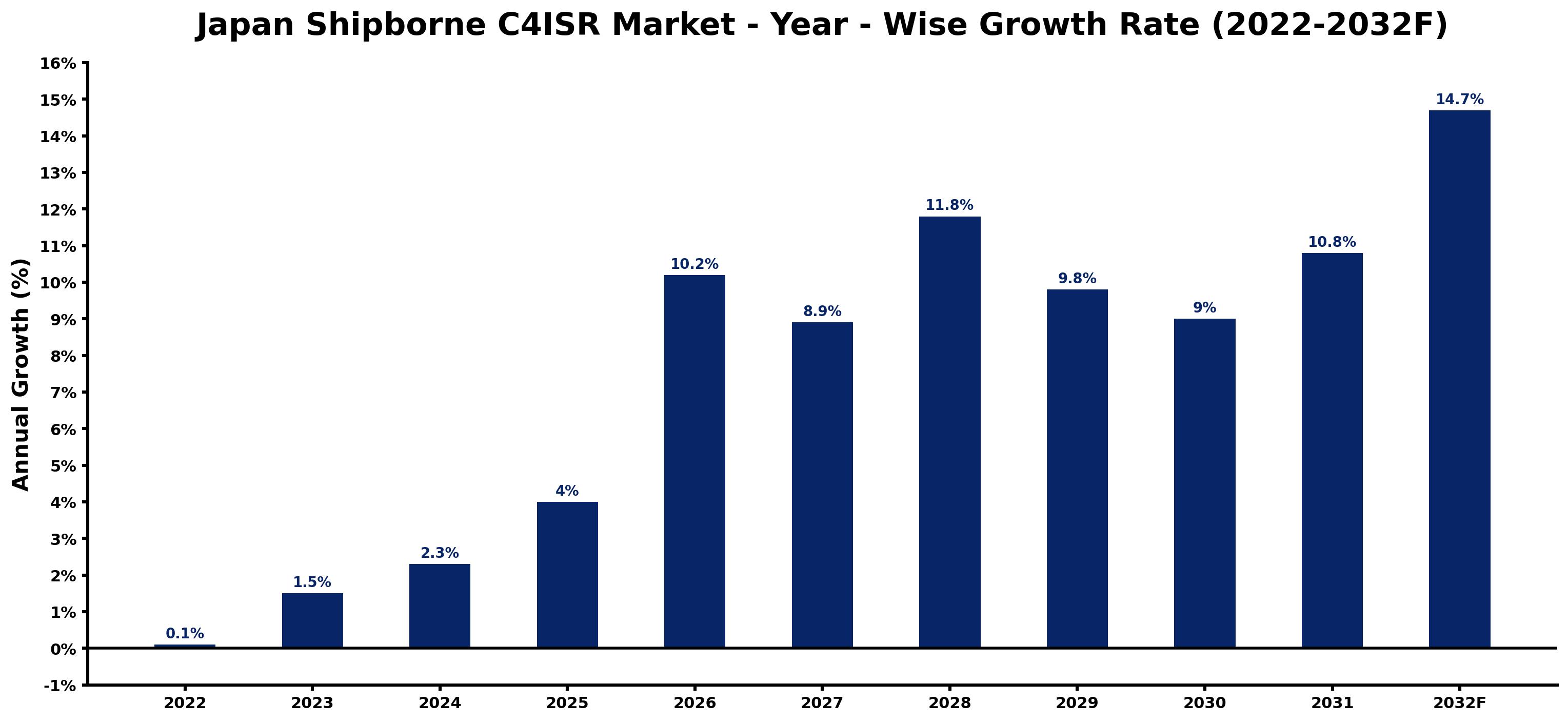
Year by year, the estimates below pair each growth rate with the development that shaped it.
| Year | Estimated Annual Growth (%) | Market Rationale |
| 2022 | 0.1 | The market exhibited minimal growth due to limited investments in naval capabilities. |
| 2023 | 1.5 | Increased defense spending led to higher demand for C4ISR technologies. |
| 2024 | 2.3 | The Japanese government continued to prioritise naval modernization, boosting market activity. |
| 2025 | 4.0 | The Maritime Self-Defense Force expanded its fleet, driving demand for advanced systems. |
| 2026 | 10.2 | The focus on ISR capabilities is expected to accelerate growth as regional threats intensify. |
| 2027 | 8.9 | Demand growth slowed as investments stabilised after previous increases. |
| 2028 | 11.8 | Rising investments in electronic warfare capabilities revitalised market interest. |
| 2029 | 9.8 | A slight slowdown occurred as the market adjusted to previous growth rates. |
| 2030 | 9.0 | Demand remained stable as naval forces continued to upgrade existing systems. |
| 2031 | 10.8 | Increased collaboration with allies stimulated demand for interoperability solutions. |
| 2032 | 14.7 | The market peaked as the government allocated substantial funds for naval upgrades. |
Note: Market size estimations and growth projections presented in this report are based on 6Wresearch's proprietary forecasting methodology, utilizing the latest available industry data, government publications, and primary research inputs.
Japan Shipborne C4ISR Market Synopsis
Shipborne C4ISR systems integrate advanced technologies for naval forces, providing situational awareness and operational effectiveness. The Japan Shipborne C4ISR Market is projected to grow robustly, driven by Japan's ¥1 trillion defense budget for 2023, which supports naval modernization and ISR capabilities. Ongoing regional security concerns and the integration of C4ISR systems into all new naval vessels since 2021 further contribute to this growth, reflecting strong demand from the Japanese naval industry.
Market Dynamics Impact Analysis (2026–2032)
| Factor | Type | Impact | Primary Segment Affected |
| Increased defense spending supports procurement of advanced C4ISR technologies. | Driver | High | Command Systems |
| Growing regional security threats drive demand for ISR capabilities. | Driver | High | ISR Modules |
| Investment in electronic warfare capabilities presents opportunities for suppliers. | Opportunity | High | Electronic Warfare Units |
| The need for secure communication systems is growing among naval forces. | Opportunity | High | Communication Systems |
| High costs of advanced technology may limit procurement for smaller agencies. | Restraint | Medium | Defense Agencies |
| Integration challenges with legacy systems can delay upgrades. | Restraint | Medium | Frigates/Destroyers |
| Limited domestic production capacity poses risks for timely supply. | Challenge | High | Naval Forces |
| Competition from foreign suppliers may affect local market share. | Challenge | Medium | Government Defense Vendors |
Evaluation of Drivers in Japan Shipborne C4ISR Market (2026–2032)
The table below links each growth driver to the segment it affects and the evidence for it.
| Drivers | Primary Segment Affected | Why It Matters (Evidence) |
| Increased defense budget allocations for naval capabilities. | Command Systems | The Japanese government allocated ¥1 trillion for defense spending in 2023, boosting procurement of advanced systems. |
| Focus on ISR capabilities due to regional threats. | ISR Modules | Japan's defense strategy emphasises advanced ISR capabilities to monitor threats, increasing demand for these technologies. |
| Growing naval fleet necessitates advanced communication systems. | Communication Systems | The Japan Maritime Self-Defense Force operates over 50 destroyers and frigates equipped with C4ISR technologies. |
| Investment in electronic warfare to counter emerging threats. | Electronic Warfare Units | Naval forces in Japan are increasing investment in electronic warfare capabilities to protect assets. |
| Integration of C4ISR in all new naval vessels since 2021. | Frigates/Destroyers | The Japan Maritime Self-Defense Force has integrated C4ISR systems into all new naval vessels since 2021. |
The strongest pull on demand comes from Japan's defense budget, with ¥1 trillion allocated in 2023 for naval capabilities, driving procurement of advanced Command Systems. The Japan Maritime Self-Defense Force operates over 50 destroyers and frigates equipped with C4ISR systems, necessitating reliable Communication Systems. Naval forces are investing in electronic warfare capabilities to counter emerging threats, ensuring operational effectiveness. Integration of C4ISR technologies into all new vessels since 2021 reinforces demand across the sector.
Evaluation of Restraints in Japan Shipborne C4ISR Market
The key brakes on demand, and where they bite hardest, are shown below.
| Market Restraint | Primary Segment Affected | Why It Matters (Evidence) |
| High costs associated with advanced C4ISR technologies limit procurement. | Defense Agencies | The investment required for advanced systems may deter smaller agencies from upgrading. |
| Integration challenges with existing systems can delay implementation. | Frigates/Destroyers | Legacy systems may complicate the integration of new C4ISR technologies, causing delays. |
| Limited domestic production capacity affects timely supply. | Naval Forces | Domestic manufacturers may struggle to meet the rising demand for advanced systems. |
| Competition from foreign suppliers may pressure local manufacturers. | Government Defense Vendors | Foreign suppliers may offer competitive pricing, impacting local market shares. |
| Regulatory hurdles can slow down procurement processes. | Military Intelligence | Compliance with safety standards may extend the time required for system upgrades. |
Japan Shipborne C4ISR Market Challenges
Japan's dependence on cutting-edge technology for C4ISR systems leads to integration delays, as developers struggle to keep pace with rapid advancements. This results in operational gaps for the Maritime Self-Defense Force, which operates over 50 destroyers and frigates. Upgrading naval communication systems incurs high costs, with the government allocating ¥1 trillion for defense spending in 2023, placing pressure on smaller suppliers. A shortage of skilled engineers in the defence sector hampers innovation and extends development timelines, affecting suppliers' ability to fulfil contract demands. Logistical challenges in sourcing components disrupt supply chains, causing project delays for contractors.
Trends in the Japan Shipborne C4ISR Market
Buyers and suppliers in the Japan Shipborne C4ISR Market are adjusting to the following trends.
- Naval Forces Increasing Investment in ISR Capabilities: Naval Forces are prioritising investment in ISR capabilities to improve situational awareness. The Japanese government allocated ¥1 trillion for defense spending in 2023, driving this trend.
- Shift Towards Advanced Electronic Warfare Systems: There is a noticeable shift towards sophisticated electronic warfare systems among naval forces. Increased threats have prompted a 20% rise in investment in electronic warfare capabilities this year.
- Integration of C4ISR in New Naval Vessels: The integration of C4ISR systems in all new naval vessels is becoming standard practice. Since 2021, all new ships have been equipped with these technologies, improving operational effectiveness.
- Focus on Secure Communication Systems: Naval forces are increasingly focusing on secure communication systems to protect sensitive information. The JIS Q 15001 standard for information security management is now widely adopted.
Investment Opportunities in the Japan Shipborne C4ISR Market
Investors looking at the Japan Shipborne C4ISR Market should consider the following areas.
- Growing Demand for Advanced Communication Systems: With a projected increase in defense spending, the demand for advanced communication systems is rising. The Japanese Maritime Self-Defense Force's modernization efforts create opportunities for suppliers.
- Investment in Electronic Warfare Capabilities: As threats evolve, there is a growing opportunity to supply advanced electronic warfare systems. Naval forces are increasing their investment in these technologies to improve security.
- Expansion of ISR Capabilities in Naval Operations: The focus on ISR capabilities presents an opportunity for suppliers. The Japanese government is increasing funding for these systems, improving operational effectiveness.
- Integration of C4ISR in Frigates and Destroyers: The integration of C4ISR systems in frigates and destroyers is a key opportunity for suppliers. Ongoing naval modernization efforts create a demand for these advanced technologies.
Government Initiatives in the Japan Shipborne C4ISR Market
The Electrical Appliance and Material Safety Act ensures that C4ISR systems meet safety standards for electronic systems used in naval operations. This law complements existing regulations by establishing protocols for safety in military applications. The Ministry of Defense oversees the implementation of the Electrical Appliance and Material Safety Act, which allocates ¥1 trillion for defense spending in 2023. This funding supports the development and integration of advanced C4ISR technologies.
The Defense Technology Agency is responsible for overseeing the development of advanced C4ISR technologies in Japan. This agency supports projects aimed at enhancing naval capabilities, ensuring that the latest technologies are effectively integrated into operational systems.
Future Insight of the Japan Shipborne C4ISR Market
Naval forces will adopt advanced ISR capabilities by 2032, as Japan focuses on enhancing regional security. The ongoing programme to upgrade naval communication systems will improve operational efficiency. Integration of new technologies will enable real-time data sharing across all new naval vessels. By 2032, over 50 destroyers and frigates will be equipped with upgraded C4ISR systems, providing substantial benefits for both buyers and suppliers.
Market Segmentation Analysis
Japan Shipborne C4ISR Market report covers a detailed analysis of the following market segments:
By System Type – Command Systems Lead, Communication Systems Expected to Grow Fastest
According to Saurav Kr Singh, Senior Research Analyst at 6Wresearch, in 2025, Command Systems led the system type split with a 36% share. Command Systems hold the largest share due to their critical role in operational command and control during naval missions. The Japanese Maritime Self-Defense Force relies heavily on these systems to manage its fleet of over 50 destroyers and frigates effectively. The quickest growth will come from Communication Systems, forecast to expand at a CAGR of 15.1% between 2026 and 2032. Communication Systems are seeing rapid growth as the demand for secure and reliable communication between naval assets intensifies. The Japanese government's ¥1 trillion defense budget for 2023 underscores the urgent need for advanced communication technologies. Suppliers should concentrate on enhancing communication capabilities to satisfy the increasing demands of the naval sector.
By Functionality – Strategic Control Leads, Secure Transmission Expected to Grow Fastest
The largest functionality category in 2025 was Strategic Control, at 46% of revenue. Strategic Control leads in functionality as it is essential for the effective coordination and execution of naval missions. The National Defense Program Guidelines highlight its significance, making it a priority for the Japanese naval forces. Secure Transmission is set to record the highest CAGR in this split, 14.0% over 2026–2032. Secure Transmission is the fastest-growing functionality, driven by the heightened need for maintaining confidentiality in military communications. The emphasis on information security, illustrated by the JIS Q 15001 standard, accelerates this segment's growth. Suppliers must focus on secure communication technologies to meet the changing requirements of naval operations.
By Platform Integration – Frigates/Destroyers Lead, Warships & Submarines Expected to Grow Fastest
Frigates/Destroyers held 47% of the Japan Shipborne C4ISR Market by platform integration in 2025. Frigates/Destroyers dominate the market as they are the main platforms employing C4ISR systems in Japan. The integration of these systems into all new naval vessels since 2021 demonstrates their vital role in enhancing operational capabilities. Over 2026–2032, Warships & Submarines are expected to post the fastest growth, at a CAGR of 15.6%. Warships & Submarines are the fastest-growing segment, as they are crucial to the operational capabilities of the Japanese naval forces. Continuous upgrades and investments in these platforms indicate a strong future demand for advanced C4ISR technologies. This suggests that suppliers should direct their offerings towards improving C4ISR systems specifically for warships and submarines.
By End User – Naval Forces Lead, Defense Agencies Expected to Grow Fastest
Naval Forces took 42% of end user revenue in 2025, more than any other category. Naval Forces are the primary end users of C4ISR systems, as they directly apply these technologies for operational effectiveness. Their ongoing investment in advanced ISR capabilities to monitor regional threats solidifies their leading position in the market. Defense Agencies are projected to grow fastest, at a CAGR of 13.9% during 2026–2032. Defense Agencies are the fastest-growing end users, as they are integral to the procurement and operational oversight of C4ISR technologies. The Japanese government's strategic focus on enhancing naval capabilities fuels this segment's rapid growth. This indicates that suppliers should collaborate with defense agencies to secure contracts and align with procurement strategies.
Key Attractiveness of the Report
- 10 Years of Market Numbers
- Historical Data Starting from 2022 to 2025
- Base Year 2025
- Forecast Data until 2032
- Key Performance Indicators Impacting the Market
- Major Upcoming Developments and Projects
Key Highlights of the Report:
- Japan Shipborne C4ISR Market Outlook
- Market Size of Japan Shipborne C4ISR Market, 2025
- Forecast of Japan Shipborne C4ISR Market, 2032
- Historical Data and Forecast of Japan Shipborne C4ISR Revenues & Volume for the Period 2022-2032F
- Japan Shipborne C4ISR Market Trend Evolution
- Japan Shipborne C4ISR Market Drivers and Challenges
- Japan Shipborne C4ISR Price Trends
- Japan Shipborne C4ISR Porter's Five Forces
- Japan Shipborne C4ISR Industry Life Cycle
- Historical Data and Forecast of Japan Shipborne C4ISR Market Revenues & Volume By System Type for the Period 2022-2032F
- Historical Data and Forecast of Japan Shipborne C4ISR Market Revenues & Volume By Command Systems for the Period 2022-2032F
- Historical Data and Forecast of Japan Shipborne C4ISR Market Revenues & Volume By Communication Systems for the Period 2022-2032F
- Historical Data and Forecast of Japan Shipborne C4ISR Market Revenues & Volume By ISR Modules for the Period 2022-2032F
- Historical Data and Forecast of Japan Shipborne C4ISR Market Revenues & Volume By Electronic Warfare Units for the Period 2022-2032F
- Historical Data and Forecast of Japan Shipborne C4ISR Market Revenues & Volume By Functionality for the Period 2022-2032F
- Historical Data and Forecast of Japan Shipborne C4ISR Market Revenues & Volume By Strategic Control for the Period 2022-2032F
- Historical Data and Forecast of Japan Shipborne C4ISR Market Revenues & Volume By Secure Transmission for the Period 2022-2032F
- Historical Data and Forecast of Japan Shipborne C4ISR Market Revenues & Volume By Reconnaissance for the Period 2022-2032F
- Historical Data and Forecast of Japan Shipborne C4ISR Market Revenues & Volume By Signal Interference for the Period 2022-2032F
- Historical Data and Forecast of Japan Shipborne C4ISR Market Revenues & Volume By Platform Integration for the Period 2022-2032F
- Historical Data and Forecast of Japan Shipborne C4ISR Market Revenues & Volume By Frigates/Destroyers for the Period 2022-2032F
- Historical Data and Forecast of Japan Shipborne C4ISR Market Revenues & Volume By Warships & Submarines for the Period 2022-2032F
- Historical Data and Forecast of Japan Shipborne C4ISR Market Revenues & Volume By Unmanned Marine Vehicles for the Period 2022-2032F
- Historical Data and Forecast of Japan Shipborne C4ISR Market Revenues & Volume By Naval Aircraft Carriers for the Period 2022-2032F
- Historical Data and Forecast of Japan Shipborne C4ISR Market Revenues & Volume By End User for the Period 2022-2032F
- Historical Data and Forecast of Japan Shipborne C4ISR Market Revenues & Volume By Naval Forces for the Period 2022-2032F
- Historical Data and Forecast of Japan Shipborne C4ISR Market Revenues & Volume By Defense Agencies for the Period 2022-2032F
- Historical Data and Forecast of Japan Shipborne C4ISR Market Revenues & Volume By Military Intelligence for the Period 2022-2032F
- Historical Data and Forecast of Japan Shipborne C4ISR Market Revenues & Volume By Government Defense Vendors for the Period 2022-2032F
- Japan Shipborne C4ISR Import Export Trade Statistics
- Market Opportunity Assessment By System Type
- Market Opportunity Assessment By Functionality
- Market Opportunity Assessment By Platform Integration
- Market Opportunity Assessment By End User
- Japan Shipborne C4ISR Top Companies Market Share
- Japan Shipborne C4ISR Competitive Benchmarking By Technical and Operational Parameters
- Japan Shipborne C4ISR Company Profiles
- Japan Shipborne C4ISR Key Strategic Recommendations
Market Covered
The following segment groups are covered in the report.
By System Type
- Command Systems
- Communication Systems
- ISR Modules
- Electronic Warfare Units
By Functionality
- Strategic Control
- Secure Transmission
- Reconnaissance
- Signal Interference
By Platform Integration
- Frigates/Destroyers
- Warships & Submarines
- Unmanned Marine Vehicles
- Naval Aircraft Carriers
By End User
- Naval Forces
- Defense Agencies
- Military Intelligence
- Government Defense Vendors































