Japan Smart Customer Service System Market Size & Growth Rate
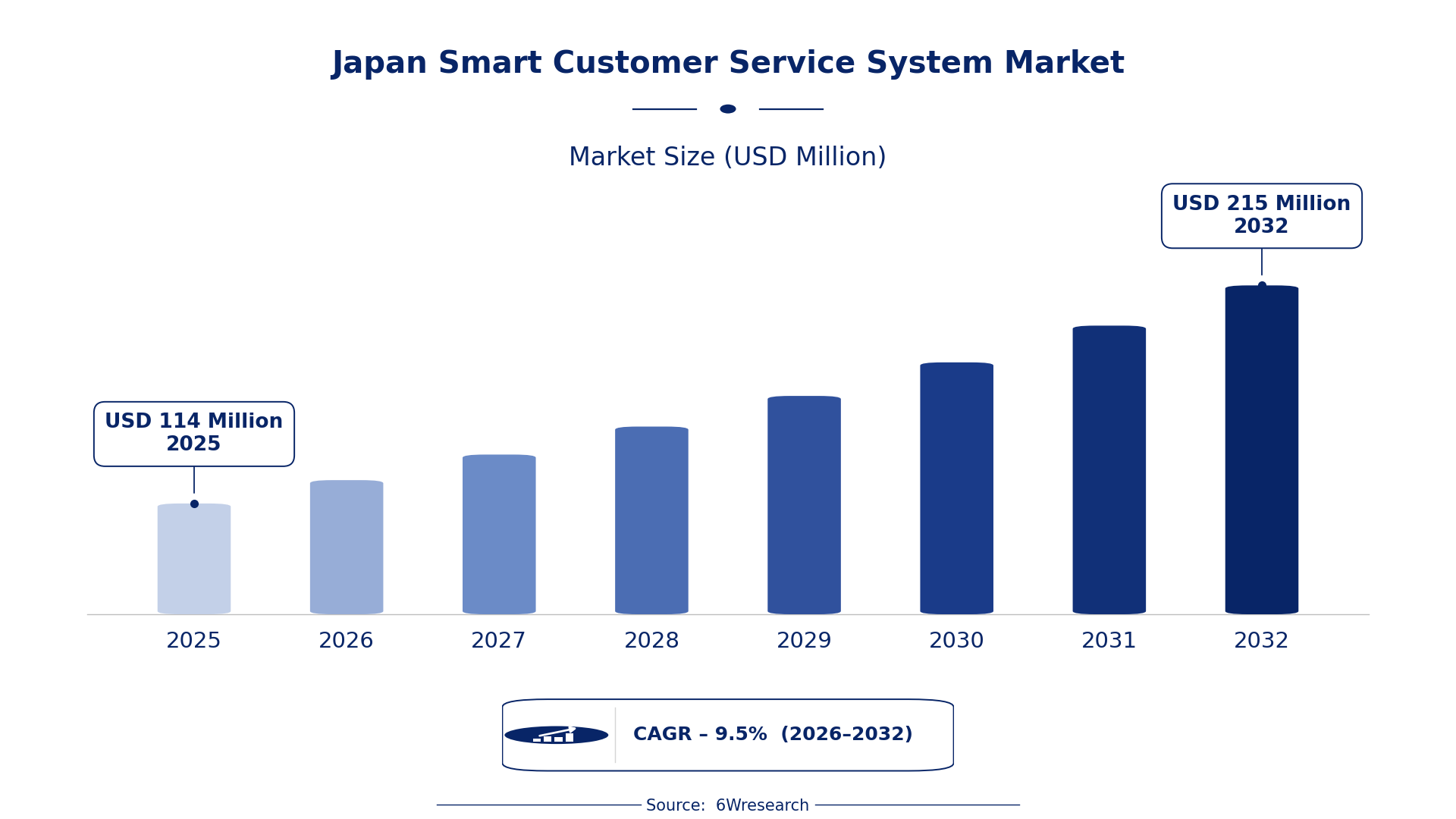
According to 6Wresearch internal database and industry insights, the Japan Smart Customer Service System Market was valued at USD 114 Million in 2025 and is projected to reach USD 215 Million by 2032, growing at a CAGR of approximately 9.5% during 2026–2032.
Japan Smart Customer Service System Market Highlights
| Report Metric | Details |
| Report Name | Japan Smart Customer Service System Market (2026-2032) |
| Market Size 2025 | USD 114 Million |
| Market Size 2032 | USD 215 Million |
| Absolute Growth 2025–2032 | USD 101 Million |
| CAGR 2026–2032 | 9.5% |
| Peak Annual Growth | 10.8% in 2027 |
| Forecast Period | 2026–2032 |
| Historical Data | 2022–2025 |
| Base Year | 2025 |
| Leading System Type, 2025 | AI-Powered Call Centers (38% share) |
| Leading AI Features, 2025 | Natural Language Processing (50% share) |
| Leading Communication Channel, 2025 | Omnichannel Support (34% share) |
| Leading Deployment Type, 2025 | Cloud-Based (50% share) |
| Leading End User, 2025 | E-Commerce (39% share) |
| Fastest-Growing System Type | Self-Service Portals (13.9% CAGR) |
| Fastest-Growing AI Features | Predictive Analytics (12.8% CAGR) |
| Fastest-Growing Communication Channel | Live Chat (11.9% CAGR) |
| Fastest-Growing End User | Healthcare (12.9% CAGR) |
| Growing Sector | E-Commerce |
| Key End Users | E-Commerce, Healthcare, Retail, IT & Telecom |
Japan Smart Customer Service System Market Year-wise Growth Rate and Key Drivers (2022–2032)
This graph illustrates the annual growth rates of the market from 2022 to 2032, highlighting a steady upward trajectory and projected market expansion over the forecast period.
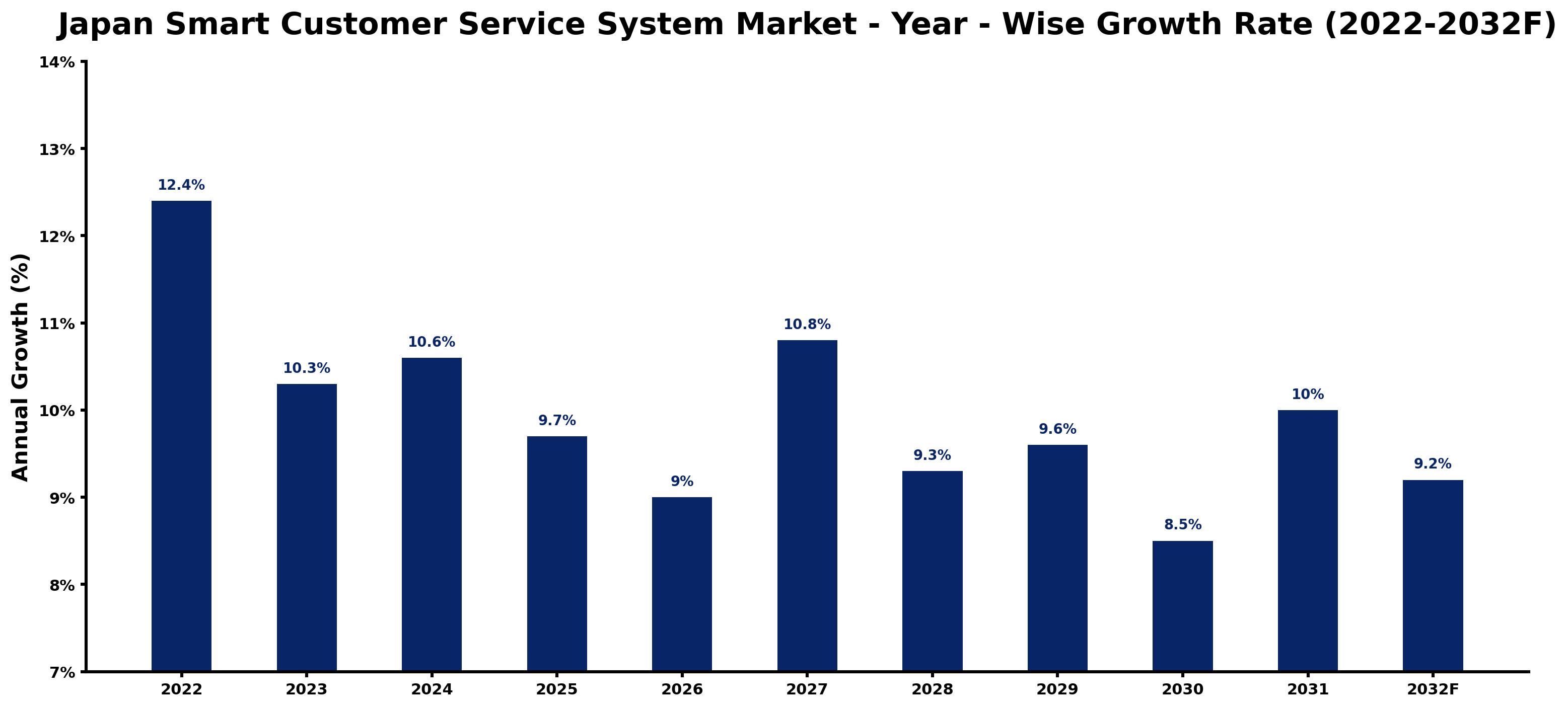
Below, each year's estimated growth is shown next to the factor that most influenced it.
| Year | Estimated Annual Growth (%) | Market Rationale |
| 2022 | 12.4 | The market experienced strong activity driven by e-commerce growth and technological adoption. |
| 2023 | 10.3 | Growth slowed as companies adjusted to previous investments and market saturation began to appear. |
| 2024 | 10.6 | Increased demand for efficiency in customer service propelled growth beyond the previous year. |
| 2025 | 9.7 | A slight slowdown occurred as market players consolidated their positions and focused on integration. |
| 2026 | 9.0 | Growth is expected to slow as the market stabilises, reflecting a mature phase in technology adoption. |
| 2027 | 10.8 | Demand is projected to surge again as new AI capabilities are integrated into customer service systems. |
| 2028 | 9.3 | The market is expected to experience another slowdown as competition intensifies and innovation plateaus. |
| 2029 | 9.6 | Growth is anticipated to pick up as companies seek to differentiate through improved customer experiences. |
| 2030 | 8.5 | A slowdown is expected as market saturation becomes more pronounced in key sectors. |
| 2031 | 10.0 | Demand will increase again as businesses invest in advanced customer service technologies. |
| 2032 | 9.2 | Growth is projected to slow slightly as companies focus on optimising existing systems. |
Note: Market size estimations and growth projections presented in this report are based on 6Wresearch's proprietary forecasting methodology, utilizing the latest available industry data, government publications, and primary research inputs.
Japan Smart Customer Service System Market Synopsis
Smart Customer Service Systems are technology solutions that utilise AI and automation to improve customer interactions, employing machine learning and natural language processing techniques. The Japan Smart Customer Service System Market is driven by strong demand from sectors such as e-commerce, which reached ¥19 trillion in 2022, and healthcare, with over 8 million telehealth users. The introduction of digital service improvement programmes and a high smartphone penetration rate further supports market growth.
Market Dynamics Impact Analysis (2026–2032)
| Factor | Type | Impact | Primary Segment Affected |
| Rising e-commerce activity | Driver | High | E-Commerce |
| Increased adoption of AI technologies | Driver | High | AI-Powered Call Centers |
| Growing demand for self-service options | Opportunity | High | Self-Service Portals |
| Expansion of telehealth services | Opportunity | High | Healthcare |
| High competition among service providers | Restraint | Medium | AI-Powered Call Centers |
| Integration challenges with legacy systems | Restraint | Medium | Cloud-Based |
| Talent shortages in AI and tech fields | Challenge | High | IT & Telecom |
| Rapid technological changes | Challenge | Medium | Voice Assistants |
Evaluation of Drivers in Japan Smart Customer Service System Market (2026–2032)
Below are the drivers that matter most for revenue growth, with supporting evidence.
| Drivers | Primary Segment Affected | Why It Matters (Evidence) |
| E-commerce growth | E-Commerce | The e-commerce market reached ¥19 trillion in 2022, driving demand for efficient customer service solutions. |
| AI technology adoption | Healthcare | The healthcare sector has over 8 million telehealth users, increasing the need for AI-driven customer interactions. |
| Demand for self-service solutions | Self-Service Portals | Retailers are investing heavily in self-service portals to improve customer experience and reduce operational costs. |
| Telehealth service expansion | Healthcare | The rise in telehealth services has led to increased demand for customer service technologies in the healthcare sector. |
| High smartphone penetration | Mobile-Based | With a smartphone penetration rate of over 90%, consumers expect efficient mobile customer service experiences. |
Purchasing is picking up as e-commerce activity surged, with the market reaching ¥19 trillion in 2022, prompting retailers to invest in customer service technologies. The healthcare sector, with over 8 million telehealth users, is increasingly adopting AI solutions to improve customer interactions. High smartphone penetration drives demand for mobile-based customer service systems, while the expansion of self-service portals allows customers to resolve issues independently. The integration of AI technologies is propelling growth in various sectors, leading to increased purchases of advanced customer service solutions.
Evaluation of Restraints in Japan Smart Customer Service System Market
The main factors holding the market back are set out below.
| Market Restraint | Primary Segment Affected | Why It Matters (Evidence) |
| Intense competition among service providers | AI-Powered Call Centers | The market's competitiveness leads to pricing pressures, affecting profitability for providers. |
| Integration difficulties with existing systems | Cloud-Based | Many companies face challenges integrating new cloud solutions with legacy systems, delaying implementation. |
| Shortage of skilled AI professionals | IT & Telecom | The lack of qualified talent in AI and tech fields hampers the growth of customer service technologies. |
| Rapid technological advancements | Voice Assistants | Keeping up with fast-paced technological changes can strain resources and impact service quality. |
| High operational costs | Self-Service Portals | Investments in technology and infrastructure for self-service options can be substantial, limiting adoption. |
Japan Smart Customer Service System Market Challenges
Buyers in the customer service sector face skills shortages, as training programmes for AI technologies are insufficient, delaying project implementation by up to six months. Suppliers encounter supply chain disruptions due to limited local production of essential components, resulting in a 15% rise in project costs. Clinics and e-commerce companies grapple with escalating operational expenses, incurring an additional ¥2 million annually for system updates and maintenance. Competition grows as new technologies emerge, compelling established providers to innovate rapidly or risk losing market share.
Trends in the Japan Smart Customer Service System Market
Several trends are reshaping the Japan Smart Customer Service System Market; the most important are set out below.
- Shift towards AI-driven customer interactions: Japan is adopting AI-driven customer service solutions, with natural language processing technologies becoming standard. The installed base of chatbots reached approximately 1 million units in 2023, improving customer engagement.
- Transition from traditional to digital support channels: Tokyo is experiencing a transition from traditional customer service to digital channels, with omnichannel support gaining traction. The retail sector is expected to invest heavily in these solutions by 2025, reflecting changing consumer preferences.
- E-commerce prioritising self-service options: E-commerce platforms are prioritising self-service options to improve customer satisfaction. The e-commerce market reached ¥19 trillion in 2022, driving demand for efficient customer service technologies.
- Healthcare sector embracing telehealth solutions: The healthcare sector is embracing telehealth solutions to improve patient support. With over 8 million patients using telehealth services, the demand for efficient customer service systems is on the rise.
Investment Opportunities in the Japan Smart Customer Service System Market
Several openings in the Japan Smart Customer Service System Market merit attention from investors.
- Investment in AI technologies for customer service: Tokyo's tech startups are seeking investments in AI technologies to improve customer service capabilities. With the healthcare sector expected to grow, now is an ideal time for partnerships.
- Growing demand for omnichannel support: As e-commerce continues to thrive, the need for omnichannel support is rising. Retailers in Japan are looking to improve their customer service offerings, creating opportunities for technology providers.
- Expansion of telehealth services: The healthcare sector is rapidly expanding telehealth services, with over 8 million users. Suppliers can enter this market through partnerships with healthcare providers.
- Cloud-based solutions gaining traction: With a high adoption rate of cloud-based solutions, companies are investing in scalable customer service technologies. The retail sector's investment plans by 2025 present a significant opportunity for technology firms.
Government Initiatives in the Japan Smart Customer Service System Market
The programme launched in 2023 aims to improve digital customer service capabilities across various sectors. This initiative builds on existing laws, such as the PMD Act, which regulates the quality of customer service technologies, ensuring that producers meet high standards. The Japan Association of Call Centers also promotes industry standards, enhancing service quality across the market.
The Ministry of Economy, Trade and Industry oversees the implementation of customer service technology regulations. It approves funding for initiatives that promote AI adoption, supporting businesses in improving their customer service systems. The ministry's backing is crucial for ensuring compliance and facilitating the adoption of advanced technologies.
Future Insight of the Japan Smart Customer Service System Market
By 2032, a shift towards AI integration will reshape customer service operations, prompting suppliers to refine their solutions for improved interactions. New digital service initiatives will drive investment in sophisticated support systems. The installed base of chatbots is expected to reach 3 million units, enhancing operational efficiency. Cloud-based customer service solutions will dominate, with the retail sector projected to invest over ¥5 trillion in AI technologies by 2025.
Market Segmentation Analysis
Japan Smart Customer Service System Market report covers a detailed analysis of the following market segments:
By System Type – AI-Powered Call Centers Lead, Self-Service Portals Expected to Grow Fastest
According to Bhawna Singh, Assistant Manager at 6Wresearch, AI-Powered Call Centers took 38% of system type revenue in 2025, more than any other category. AI-Powered Call Centers dominate the market due to their effectiveness in managing customer interactions, particularly in the thriving e-commerce sector which reached ¥19 trillion in 2022. Their ability to enhance operational efficiency makes them indispensable for businesses aiming to improve customer satisfaction. Self-Service Portals are projected to grow fastest, at a CAGR of 13.9% during 2026–2032. Self-Service Portals are experiencing rapid growth as they empower customers to resolve issues independently, reflecting a shift towards greater user autonomy in service interactions. The recent initiative launched in 2023 to enhance digital customer service capabilities will further accelerate this trend. Suppliers should prioritise the development of user-friendly self-service solutions to meet the increasing expectations of customers.
By AI Features – Natural Language Processing Leads, Predictive Analytics Expected to Grow Fastest
In 2025, Natural Language Processing led the ai features split with a 50% share. Natural Language Processing leads the market as it enables a better understanding of customer queries, making it essential for businesses that aim to provide tailored experiences. Its widespread application across sectors such as e-commerce and healthcare highlights its critical role in improving customer service. The quickest growth will come from Predictive Analytics, forecast to expand at a CAGR of 12.8% between 2026 and 2032. Predictive Analytics is witnessing rapid growth as it allows businesses to anticipate customer needs based on historical data, facilitating proactive issue resolution. This capability is increasingly sought after as companies strive to enhance customer satisfaction and loyalty. Buyers will benefit from investing in predictive analytics to refine their customer engagement and retention strategies.
By Communication Channel – Omnichannel Support Leads, Live Chat Expected to Grow Fastest
With 34% of communication channel revenue in 2025, Omnichannel Support was the largest category. Omnichannel Support is the preferred option, delivering consistent service across multiple platforms, which is vital for maintaining customer satisfaction in a competitive landscape. This approach is particularly important in Japan, where consumers expect seamless interactions across different channels. Live Chat is set to record the highest CAGR in this split, 11.9% over 2026–2032. Live Chat is the fastest growing communication channel, providing real-time assistance that meets the immediate needs of customers. As consumer behaviour shifts towards instant communication, this channel is becoming essential for businesses to remain competitive. Suppliers must focus on integrating live chat features to meet the growing demand for prompt customer support.
By Deployment Type – Cloud-Based Leads and Records the Fastest Growth
Cloud-Based held 50% of the Japan Smart Customer Service System Market by deployment type in 2025. Cloud-Based solutions lead the market as they provide remote access and scalability, crucial for businesses adapting to changing customer needs. The high adoption rate of cloud technologies in Japan reinforces this trend, enabling flexible customer service operations. Cloud-Based is also forecast to expand faster than any other category, at a CAGR of 11.3% over 2026–2032. Cloud-Based solutions are also the fastest segment, as their scalability and accessibility continue to attract businesses looking to optimise customer service capabilities. This dual role highlights the importance of cloud technologies in the market. Providers should enhance their cloud offerings to align with the increasing preference for flexible deployment options.
By End User – E-Commerce Leads, Healthcare Expected to Grow Fastest
E-Commerce accounted for 39% of the market by end user in 2025. E-Commerce is the leading end user, playing a significant role in facilitating online retail customer interactions necessary for driving sales in a booming digital marketplace. The sector's expansion necessitates advanced customer service systems to meet rising consumer expectations. Healthcare is projected to grow fastest, at a CAGR of 12.9% during 2026–2032. Healthcare is the fastest growing end user, as it improves patient support and communication, especially with over 8 million patients using telehealth services. This growth highlights the sector's urgent need for effective customer service solutions. Vendors should tailor their offerings to meet the specific needs of the healthcare sector to capitalise on this growth opportunity.
Key Attractiveness of the Report
- 10 Years of Market Numbers
- Historical Data Starting from 2022 to 2025
- Base Year 2025
- Forecast Data until 2032
- Key Performance Indicators Impacting the Market
- Major Upcoming Developments and Projects
Key Highlights of the Report:
- Japan Smart Customer Service System Market Outlook
- Market Size of Japan Smart Customer Service System Market,2025
- Forecast of Japan Smart Customer Service System Market, 2032
- Historical Data and Forecast of Japan Smart Customer Service System Revenues & Volume for the Period 2022-2032
- Japan Smart Customer Service System Market Trend Evolution
- Japan Smart Customer Service System Market Drivers and Challenges
- Japan Smart Customer Service System Price Trends
- Japan Smart Customer Service System Porter's Five Forces
- Japan Smart Customer Service System Industry Life Cycle
- Historical Data and Forecast of Japan Smart Customer Service System Market Revenues & Volume By System Type for the Period 2022-2032
- Historical Data and Forecast of Japan Smart Customer Service System Market Revenues & Volume By Chatbots for the Period 2022-2032
- Historical Data and Forecast of Japan Smart Customer Service System Market Revenues & Volume By Voice Assistants for the Period 2022-2032
- Historical Data and Forecast of Japan Smart Customer Service System Market Revenues & Volume By AI-Powered Call Centers for the Period 2022-2032
- Historical Data and Forecast of Japan Smart Customer Service System Market Revenues & Volume By Self-Service Portals for the Period 2022-2032
- Historical Data and Forecast of Japan Smart Customer Service System Market Revenues & Volume By CRM with AI Capabilities for the Period 2022-2032
- Historical Data and Forecast of Japan Smart Customer Service System Market Revenues & Volume By AI Features for the Period 2022-2032
- Historical Data and Forecast of Japan Smart Customer Service System Market Revenues & Volume By Natural Language Processing for the Period 2022-2032
- Historical Data and Forecast of Japan Smart Customer Service System Market Revenues & Volume By AI Sentiment Analysis for the Period 2022-2032
- Historical Data and Forecast of Japan Smart Customer Service System Market Revenues & Volume By Predictive Analytics for the Period 2022-2032
- Historical Data and Forecast of Japan Smart Customer Service System Market Revenues & Volume By Automated Ticketing for the Period 2022-2032
- Historical Data and Forecast of Japan Smart Customer Service System Market Revenues & Volume By Customer Behavior Tracking for the Period 2022-2032
- Historical Data and Forecast of Japan Smart Customer Service System Market Revenues & Volume By Communication Channel for the Period 2022-2032
- Historical Data and Forecast of Japan Smart Customer Service System Market Revenues & Volume By Omnichannel Support for the Period 2022-2032
- Historical Data and Forecast of Japan Smart Customer Service System Market Revenues & Volume By Email Support for the Period 2022-2032
- Historical Data and Forecast of Japan Smart Customer Service System Market Revenues & Volume By Social Media for the Period 2022-2032
- Historical Data and Forecast of Japan Smart Customer Service System Market Revenues & Volume By Live Chat for the Period 2022-2032
- Historical Data and Forecast of Japan Smart Customer Service System Market Revenues & Volume By Video Call Support for the Period 2022-2032
- Historical Data and Forecast of Japan Smart Customer Service System Market Revenues & Volume By Deployment Type for the Period 2022-2032
- Historical Data and Forecast of Japan Smart Customer Service System Market Revenues & Volume By Cloud-Based for the Period 2022-2032
- Historical Data and Forecast of Japan Smart Customer Service System Market Revenues & Volume By On-Premises for the Period 2022-2032
- Historical Data and Forecast of Japan Smart Customer Service System Market Revenues & Volume By Hybrid for the Period 2022-2032
- Historical Data and Forecast of Japan Smart Customer Service System Market Revenues & Volume By API-Integrated for the Period 2022-2032
- Historical Data and Forecast of Japan Smart Customer Service System Market Revenues & Volume By Mobile-Based for the Period 2022-2032
- Historical Data and Forecast of Japan Smart Customer Service System Market Revenues & Volume By End User for the Period 2022-2032
- Historical Data and Forecast of Japan Smart Customer Service System Market Revenues & Volume By E-Commerce for the Period 2022-2032
- Historical Data and Forecast of Japan Smart Customer Service System Market Revenues & Volume By Banking & Finance for the Period 2022-2032
- Historical Data and Forecast of Japan Smart Customer Service System Market Revenues & Volume By Healthcare for the Period 2022-2032
- Historical Data and Forecast of Japan Smart Customer Service System Market Revenues & Volume By Retail & Consumer Goods for the Period 2022-2032
- Historical Data and Forecast of Japan Smart Customer Service System Market Revenues & Volume By IT & Telecom for the Period 2022-2032
- Japan Smart Customer Service System Import Export Trade Statistics
- Market Opportunity Assessment By System Type
- Market Opportunity Assessment By AI Features
- Market Opportunity Assessment By Communication Channel
- Market Opportunity Assessment By Deployment Type
- Market Opportunity Assessment By End User
- Japan Smart Customer Service System Top Companies Market Share
- Japan Smart Customer Service System Competitive Benchmarking By Technical and Operational Parameters
- Japan Smart Customer Service System Company Profiles
- Japan Smart Customer Service System Key Strategic Recommendations
Market Covered
The study includes the following segmentation.
By System Type
- Chatbots
- Voice Assistants
- AI-Powered Call Centers
- Self-Service Portals
- CRM with AI Capabilities
By AI Features
- Natural Language Processing
- AI Sentiment Analysis
- Predictive Analytics
- Automated Ticketing
- Customer Behavior Tracking
By Communication Channel
- Omnichannel Support
- Email Support
- Social Media
- Live Chat
- Video Call Support
By Deployment Type
- Cloud-Based
- On-Premises
- Hybrid
- API-Integrated
- Mobile-Based
By End User
- E-Commerce
- Banking & Finance
- Healthcare
- Retail & Consumer Goods
- IT & Telecom






































