Japan Smart Fabrics in Fashion and Entertainment Market Size & Growth Rate
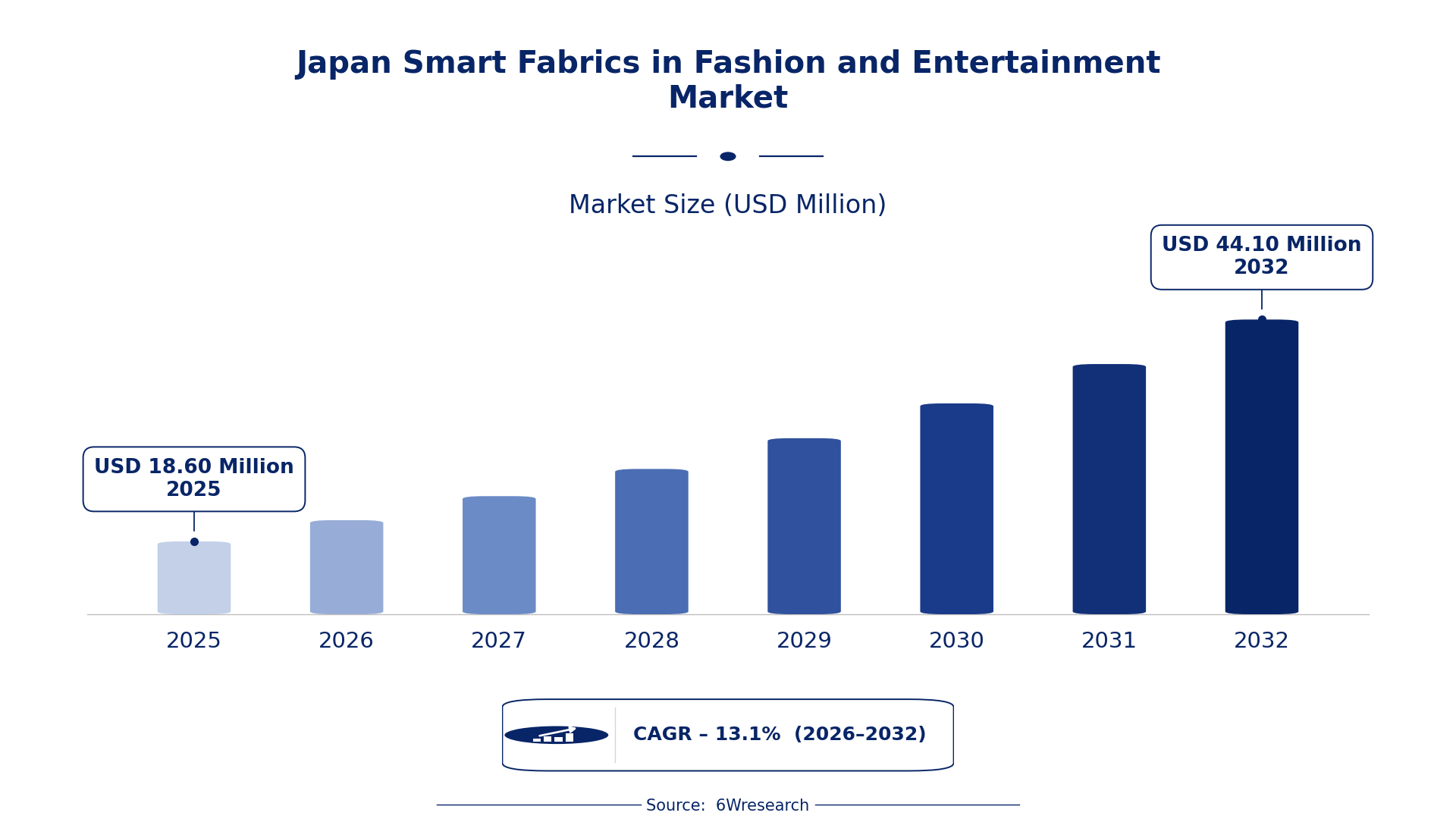
According to 6Wresearch internal database and industry insights, the Japan Smart Fabrics in Fashion and Entertainment Market was valued at USD 18.60 Million in 2025 and is projected to reach USD 44.10 Million by 2032, growing at a CAGR of approximately 13.1% during 2026–2032.
Japan Smart Fabrics in Fashion and Entertainment Market Highlights
| Report Metric | Details |
| Report Name | Japan Smart Fabrics in Fashion and Entertainment Market (2026-2032) |
| Market Size 2025 | USD 18.60 Million |
| Market Size 2032 | USD 44.10 Million |
| Absolute Growth 2025–2032 | USD 25.50 Million |
| CAGR 2026–2032 | 13.1% |
| Peak Annual Growth | 14.9% in 2027 |
| Forecast Period | 2026–2032 |
| Historical Data | 2022–2025 |
| Base Year | 2025 |
| Leading Product, 2025 | Active Smart Textiles (42% share) |
| Leading Material, 2025 | Light Emitting (40% share) |
| Fastest-Growing Material | Color Changing (17.4% CAGR) |
| Growing Sector | fashion and entertainment |
| Key End Users | fashion designers, theatrical producers, wearable tech developers |
Japan Smart Fabrics in Fashion and Entertainment Market Year-wise Growth Rate and Key Drivers (2022–2032)
This graph illustrates the annual growth rates of the market from 2022 to 2032, highlighting a steady upward trajectory and projected market expansion over the forecast period.
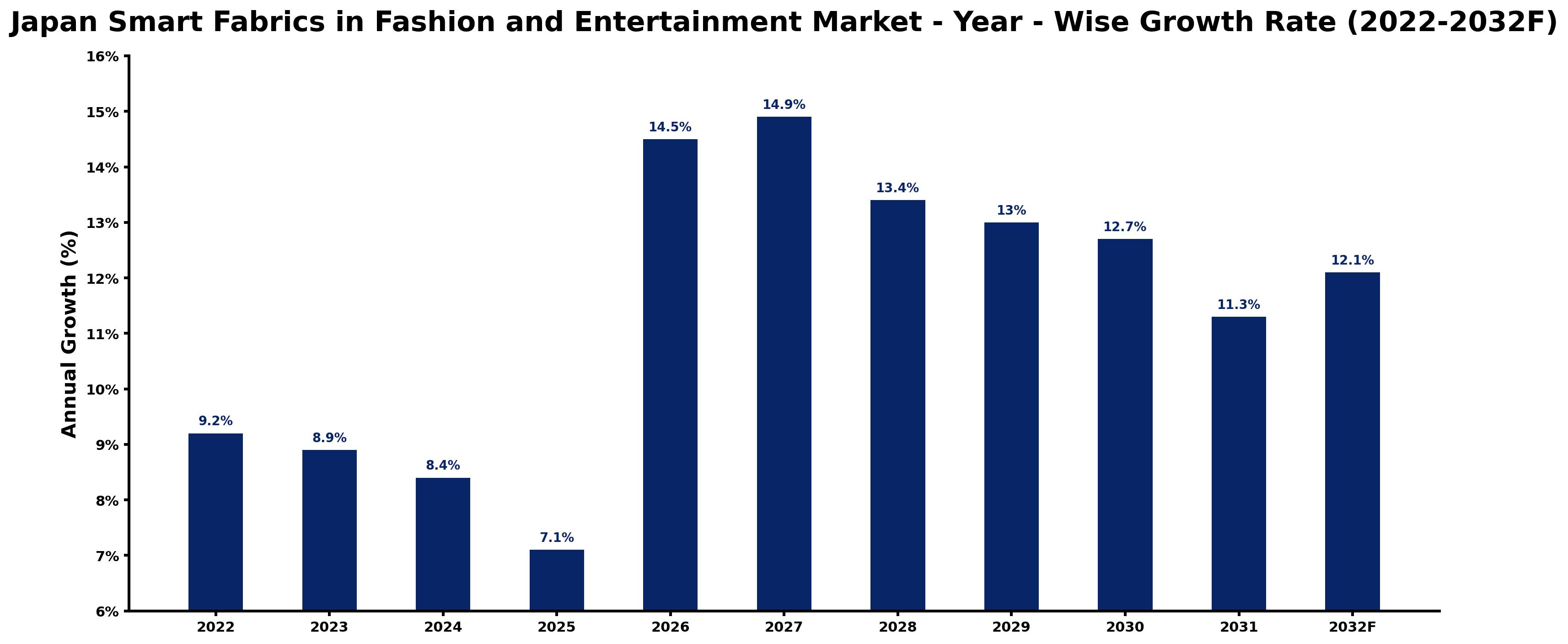
For each year, the table pairs the estimated growth rate with the leading influence on demand, showing how the drivers changed across the period.
| Year | Estimated Annual Growth (%) | Market Rationale |
| 2022 | 9.2 | The market experienced strong demand from fashion designers and theatrical productions. |
| 2023 | 8.9 | Growth slowed as the market adjusted to previous high levels of activity. |
| 2024 | 8.4 | Demand continued to moderate, reflecting a shift in consumer preferences. |
| 2025 | 7.1 | The market saw a further slowdown as competition intensified among textile producers. |
| 2026 | 14.5 | Growth is expected to accelerate due to increased investment in smart textile technology. |
| 2027 | 14.9 | Demand is projected to peak as active smart textiles gain popularity in entertainment. |
| 2028 | 13.4 | Growth is anticipated to slow slightly as market saturation begins to set in. |
| 2029 | 13.0 | A further slowdown is expected as innovation cycles lengthen in the sector. |
| 2030 | 12.7 | Demand is projected to moderate as the market stabilises after previous peaks. |
| 2031 | 11.3 | Growth is expected to slow as competition and market maturity impact expansion. |
| 2032 | 12.1 | Demand is expected to rise again as new technologies are introduced. |
Note: Market size estimations and growth projections presented in this report are based on 6Wresearch's proprietary forecasting methodology, utilizing the latest available industry data, government publications, and primary research inputs.
Japan Smart Fabrics in Fashion and Entertainment Market Synopsis
Smart fabrics in fashion and entertainment are advanced textiles that incorporate technology to enhance functionality. They are made using various materials and techniques, including weaving electronic components into the fabric. The Japan Smart Fabrics in Fashion and Entertainment Market is growing due to increasing interest in wearable tech and advanced textiles, driven by domestic designers and international collaborations. In 2023, a government program allocated ¥500 million for textile technology research, boosting market potential and attracting investments.
Market Dynamics Impact Analysis (2026–2032)
| Factor | Type | Impact | Primary Segment Affected |
| Increasing demand for interactive clothing and wearable technology | Driver | High | Active Smart Textiles |
| Growing interest in theatrical productions using smart textiles | Driver | High | Light Emitting |
| Expansion of youth fashion markets seeking innovative designs | Opportunity | High | Color Changing |
| Emerging collaborations between domestic and international designers | Opportunity | Medium | Active Smart Textiles |
| Intense competition among textile producers leading to price pressures | Restraint | High | Passive Smart Textiles |
| Limited consumer awareness of smart fabric benefits | Restraint | Medium | Ultra Smart Textiles |
| High production costs associated with advanced textile technologies | Challenge | High | Active Smart Textiles |
| Slow adoption rates in traditional fashion sectors | Challenge | Medium | Color Changing |
Evaluation of Drivers in Japan Smart Fabrics in Fashion and Entertainment Market (2026–2032)
The table below links each growth driver to the segment it affects and the evidence for it.
| Drivers | Primary Segment Affected | Why It Matters (Evidence) |
| Rising interest in wearable technology | Active Smart Textiles | This trend is reflected in the growing number of smart textile applications in fashion, with a projected increase in demand for active textiles by 15% by 2025. |
| Increased investment in textile technology research | Light Emitting | The government allocated ¥500 million in 2023 for research, stimulating innovation in smart textiles used in theatrical productions. |
| Growing popularity of interactive clothing among youth | Color Changing | Youth fashion markets are increasingly adopting color-changing fabrics, which are projected to grow at a rate of 17.4%. |
| Tokyo Fashion Week showcasing smart fabric innovations | Active Smart Textiles | The annual event highlights advancements in smart textiles, driving interest and purchases among designers and consumers. |
| Collaborations between domestic and international designers | Ultra Smart Textiles | These partnerships are increasing the development of niche applications, raising market demand. |
Most of the extra volume comes from the rising interest in wearable technology, with active smart textiles projected to gain popularity in the entertainment sector by 2025. The annual Tokyo Fashion Week showcases advancements in smart fabrics, driving demand among designers and consumers. The youth fashion market is increasingly adopting colour-changing fabrics, reflecting a trend towards dynamic clothing options. These developments are expected to raise market demand significantly as new applications emerge.
Evaluation of Restraints in Japan Smart Fabrics in Fashion and Entertainment Market
The following restraints limit how fast demand can grow.
| Market Restraint | Primary Segment Affected | Why It Matters (Evidence) |
| High production costs associated with advanced textile technologies | Active Smart Textiles | Producers face rising costs, impacting pricing strategies and limiting market access for some buyers. |
| Limited consumer awareness of smart fabric benefits | Ultra Smart Textiles | Many consumers remain unaware of the advantages of smart textiles, hindering broader adoption. |
| Intense competition among textile producers leading to price pressures | Passive Smart Textiles | Producers are forced to lower prices, affecting profitability and investment in innovation. |
| Slow adoption rates in traditional fashion sectors | Color Changing | Traditional fashion buyers are hesitant to invest in new technologies, limiting market expansion. |
| Regulatory compliance costs for textile manufacturers | Light Emitting | Manufacturers must invest in compliance measures, increasing operational costs. |
Japan Smart Fabrics in Fashion and Entertainment Market Challenges
Smart textiles in theatrical productions often face high costs due to limited local suppliers, forcing buyers to seek materials overseas, which can delay projects by up to six months. Buyers encounter inconsistent quality from suppliers, as many manufacturers lack ISO 9001 certification, resulting in increased returns and wasted resources. Regulatory hurdles complicate the introduction of new smart fabrics, as compliance with safety standards can extend product development timelines by 30% for producers. Competition from international markets, particularly in pricing, pressures local producers, leading to potential market share losses for domestic brands.
Trends in the Japan Smart Fabrics in Fashion and Entertainment Market
The shifts below are changing how Japan Smart Fabrics in Fashion and Entertainment Market products are bought and supplied.
- Tokyo Fashion Week Showcasing Smart Fabrics: Tokyo Fashion Week has become a platform for smart fabric innovations, with over 30% of showcased designs incorporating advanced textiles in 2023. This trend encourages designers to explore new functionalities.
- Shift Towards Interactive Clothing: The fashion industry is increasingly focusing on interactive clothing, with a notable rise in demand for active smart textiles. This shift is reflected in the growing number of fashion shows featuring such innovations.
- Emergence of Color Changing Fabrics in Youth Fashion: Colour changing fabrics are gaining traction in youth fashion markets, with a 17.4% growth rate projected. This trend reflects the demand for unique and dynamic clothing options among young consumers.
- Integration of Smart Textiles in Theatrical Productions: Smart textiles are increasingly used in theatrical productions across Japan, enhancing visual effects and audience engagement. This trend is supported by a growing interest in innovative performance art.
Investment Opportunities in the Japan Smart Fabrics in Fashion and Entertainment Market
The openings below show where demand in the Japan Smart Fabrics in Fashion and Entertainment Market is visible and how suppliers can enter.
- Tokyo as a Hub for Textile Innovation: Tokyo's vibrant fashion scene presents a notable opportunity for smart fabric suppliers, with the textile industry valued at approximately ¥1.5 trillion. Collaborating with local designers can facilitate market entry.
- Supply of Active Smart Textiles for Wearable Tech: With active smart textiles projected to gain popularity, suppliers can target the entertainment sector, which is rapidly adopting these technologies. Establishing partnerships with local fashion designers can facilitate market entry.
- Color Changing Fabrics for Youth Fashion Markets: The youth fashion market is expanding, with a notable demand for colour changing fabrics. Suppliers can invest in this area to meet the needs of young consumers seeking innovative designs.
- Investment in Theatrical Productions Using Smart Textiles: Theatrical productions across Japan are increasingly incorporating smart textiles, creating opportunities for suppliers. Collaborating with production companies can help tap into this growing market.
Government Initiatives in the Japan Smart Fabrics in Fashion and Entertainment Market
The PRTR Law (1999) mandates businesses to report on the release and transfer of specific chemical substances, ensuring environmental safety in textile production. The Chemical Substances Control Law (1973) requires manufacturers to evaluate and manage chemical substances, affecting their operations. The Industrial Safety and Health Act (1972) sets employer responsibilities for hazardous substances, influencing production practices in the textile sector.
The GX Promotion Act (2023) provides a framework for promoting sustainable practices among textile producers. The Ministry of Economy, Trade and Industry oversees funding for textile technology research, supporting innovation. The Japan Textile Federation advocates for smart textile development, ensuring compliance with industry standards.
Future Insight of the Japan Smart Fabrics in Fashion and Entertainment Market
New textile research programmes will emerge by 2032, driven by a government initiative that allocated ¥500 million for technology development. Tokyo Fashion Week will increasingly showcase smart fabric innovations, encouraging collaboration between designers and technologists. By 2032, the use of smart textiles in entertainment is projected to rise, with an estimated 30% increase in adoption. The Japan Fashion Association will continue to advocate for sustainable practices, aligning with global trends and improving the appeal of local products.
Market Segmentation Analysis
Japan Smart Fabrics in Fashion and Entertainment Market report covers a detailed analysis of the following market segments:
By Product – Active Smart Textiles Lead and Record the Fastest Growth
According to Summon Dutta, Assistant Manager at 6Wresearch, Active Smart Textiles took 42% of product revenue in 2025, more than any other category. Active smart textiles hold the largest share due to their integration of sensors that allow for dynamic responses in fashion, especially within Japan's vibrant entertainment sector. Their application in interactive clothing significantly enhances theatrical performances, making them a top choice for designers. Its lead should widen, with a projected CAGR of 15.0% during 2026–2032, the highest in this split. The rapid advancements in active smart textiles will likely maintain their leading position, as their adoption in theatrical productions across Japan continues to rise. This trend aligns with the increasing consumer interest in wearable technology, which propels market expansion. Suppliers must prioritise the development of active smart textiles to cater to the growing demand from the fashion and entertainment sectors.
By Material – Light Emitting Leads, Color Changing Expected to Grow Fastest
In 2025, Light Emitting led the material split with a 40% share. Light emitting materials hold the largest share due to their extensive use in costumes and stage performances, providing captivating visual effects. Their established presence is reinforced by industry bodies promoting smart textile development and ongoing research support. Color Changing is set to record the highest CAGR in this split, 17.4% over 2026–2032. Color changing materials are experiencing rapid growth as they appeal to youth fashion markets, where aesthetic and interactive designs are highly sought after. This trend indicates a shift towards more visually engaging textiles in the fashion industry. Buyers should consider incorporating colour changing materials to attract the younger demographic and stay competitive in the market.
Key Attractiveness of the Report
- 10 Years of Market Numbers
- Historical Data Starting from 2022 to 2025
- Base Year 2025
- Forecast Data until 2032
- Key Performance Indicators Impacting the Market
- Major Upcoming Developments and Projects
Key Highlights of the Report:
- Japan Smart Fabrics in Fashion and Entertainment Market Outlook
- Market Size of Japan Smart Fabrics in Fashion and Entertainment Market, 2025
- Forecast of Japan Smart Fabrics in Fashion and Entertainment Market, 2032
- Historical Data and Forecast of Japan Smart Fabrics in Fashion and Entertainment Revenues & Volume for the Period 2022-2032
- Japan Smart Fabrics in Fashion and Entertainment Market Trend Evolution
- Japan Smart Fabrics in Fashion and Entertainment Market Drivers and Challenges
- Japan Smart Fabrics in Fashion and Entertainment Price Trends
- Japan Smart Fabrics in Fashion and Entertainment Porter's Five Forces
- Japan Smart Fabrics in Fashion and Entertainment Industry Life Cycle
- Historical Data and Forecast of Japan Smart Fabrics in Fashion and Entertainment Market Revenues & Volume By Product for the Period 2022-2032
- Historical Data and Forecast of Japan Smart Fabrics in Fashion and Entertainment Market Revenues & Volume By Passive Smart Textiles for the Period 2022-2032
- Historical Data and Forecast of Japan Smart Fabrics in Fashion and Entertainment Market Revenues & Volume By Active Smart Textiles for the Period 2022-2032
- Historical Data and Forecast of Japan Smart Fabrics in Fashion and Entertainment Market Revenues & Volume By Ultra Smart Textiles for the Period 2022-2032
- Historical Data and Forecast of Japan Smart Fabrics in Fashion and Entertainment Market Revenues & Volume By Material for the Period 2022-2032
- Historical Data and Forecast of Japan Smart Fabrics in Fashion and Entertainment Market Revenues & Volume By Color Changing for the Period 2022-2032
- Historical Data and Forecast of Japan Smart Fabrics in Fashion and Entertainment Market Revenues & Volume By Light Emitting for the Period 2022-2032
- Historical Data and Forecast of Japan Smart Fabrics in Fashion and Entertainment Market Revenues & Volume By Temperature Changing for the Period 2022-2032
- Historical Data and Forecast of Japan Smart Fabrics in Fashion and Entertainment Market Revenues & Volume By Other Materials for the Period 2022-2032
- Japan Smart Fabrics in Fashion and Entertainment Import Export Trade Statistics
- Market Opportunity Assessment By Product
- Market Opportunity Assessment By Material
- Japan Smart Fabrics in Fashion and Entertainment Top Companies Market Share
- Japan Smart Fabrics in Fashion and Entertainment Competitive Benchmarking By Technical and Operational Parameters
- Japan Smart Fabrics in Fashion and Entertainment Company Profiles
- Japan Smart Fabrics in Fashion and Entertainment Key Strategic Recommendations
Market Covered
Coverage by segment is as follows.
By Product
- Passive Smart Textiles
- Active Smart Textiles
- Ultra Smart Textiles
By Material
- Color Changing
- Light Emitting
- Temperature Changing
- Other Materials































