Japan Smart LED Indoor Signage Market Size & Growth Rate
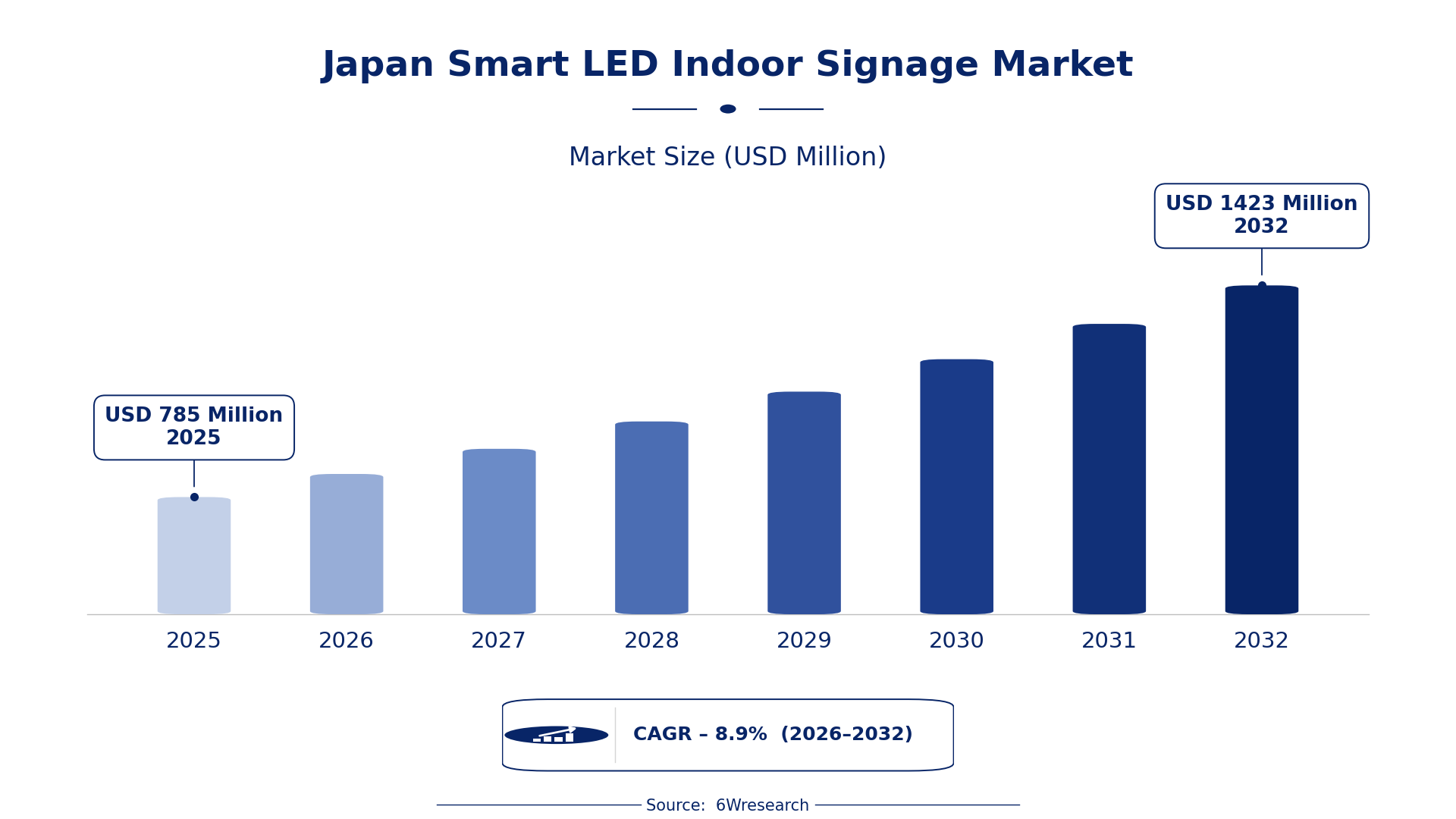
According to 6Wresearch internal database and industry insights, the Japan Smart LED Indoor Signage Market was valued at USD 785 Million in 2025 and is projected to reach USD 1,423 Million by 2032, growing at a CAGR of approximately 8.9% during 2026–2032.
Japan Smart LED Indoor Signage Market Highlights
| Report Metric | Details |
| Report Name | Japan Smart LED Indoor Signage Market (2026-2032) |
| Market Size 2025 | USD 785 Million |
| Market Size 2032 | USD 1,423 Million |
| Absolute Growth 2025–2032 | USD 638 Million |
| CAGR 2026–2032 | 8.9% |
| Peak Annual Growth | 10.4% in 2027 |
| Forecast Period | 2026–2032 |
| Historical Data | 2022–2025 |
| Base Year | 2025 |
| Leading Screen Size, 2025 | Less Than 32'' (50% share) |
| Leading End User, 2025 | Retail (39% share) |
| Fastest-Growing Screen Size | 32-35'' (10.9% CAGR) |
| Fastest-Growing End User | Corporate (11.1% CAGR) |
| Growing Sector | Corporate |
| Key End Users | Retail, Corporate, Public, Sports |
Japan Smart LED Indoor Signage Market Year-wise Growth Rate and Key Drivers (2022–2032)
This graph illustrates the annual growth rates of the market from 2022 to 2032, highlighting a steady upward trajectory and projected market expansion over the forecast period.
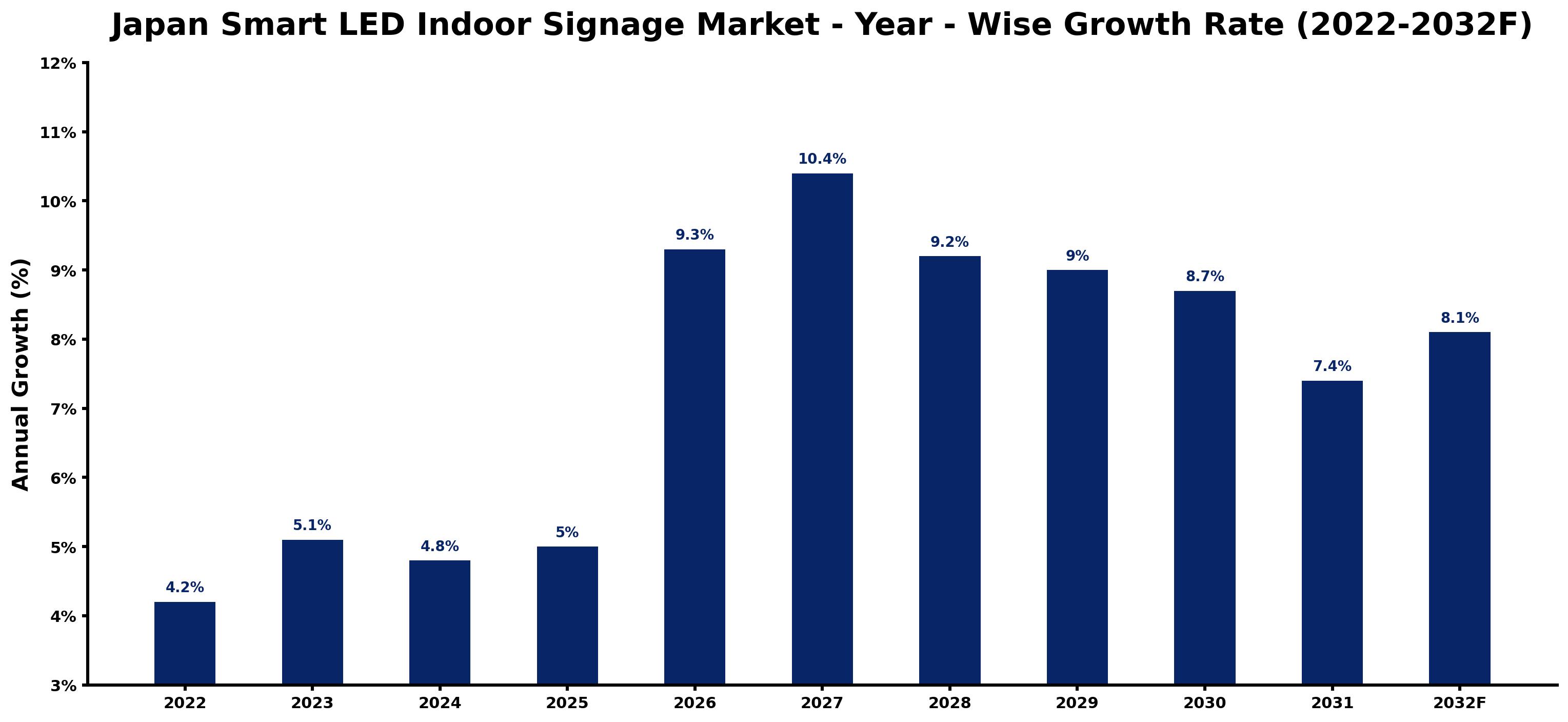
Each row of the following table gives one year's estimated growth and the event or demand shift that explains it.
| Year | Estimated Annual Growth (%) | Market Rationale |
| 2022 | 4.2 | The market experienced steady demand from various sectors, particularly retail. |
| 2023 | 5.1 | Growth was driven by increased adoption of digital signage in corporate environments. |
| 2024 | 4.8 | Demand slowed slightly as market saturation began in smaller retail spaces. |
| 2025 | 5.0 | Corporate sector investment in smart signage increased, boosting market growth. |
| 2026 | 9.3 | New technologies will lead to a surge in installations across sectors. |
| 2027 | 10.4 | Peak growth will be achieved as urban areas enhance digital signage for public engagement. |
| 2028 | 9.2 | Growth is expected to slow as the market matures and competition intensifies. |
| 2029 | 9.0 | Adoption rates will remain high, but new installations will face challenges from existing systems. |
| 2030 | 8.7 | Demand will continue to grow as public transport systems upgrade their signage. |
| 2031 | 7.4 | The market is projected to stabilise with consistent investments from corporate buyers. |
| 2032 | 8.1 | Growth will accelerate again due to renewed interest in smart urban solutions. |
Note: Market size estimations and growth projections presented in this report are based on 6Wresearch's proprietary forecasting methodology, utilizing the latest available industry data, government publications, and primary research inputs.
Japan Smart LED Indoor Signage Market Synopsis
Smart LED indoor signage utilises light-emitting diodes to deliver dynamic information and advertisements, primarily used in retail, corporate, and public settings. The Japan Smart LED Indoor Signage Market is expanding due to rising demand from the corporate sector, which is expected to account for 30% of the market by 2025. The Digital Signage Promotion Council, established in 2021, supports industry growth and drives further investments and technological advancements in this sector, while public transportation systems are increasingly adopting these solutions for real-time updates.
Market Dynamics Impact Analysis (2026–2032)
| Factor | Type | Impact | Primary Segment Affected |
| Increased adoption of digital signage in corporate environments | Driver | High | Corporate |
| Growing demand for real-time information in public transport | Driver | High | Public |
| Emerging opportunities in urban development projects | Opportunity | High | Public |
| Rising interest in smart signage for retail promotions | Opportunity | High | Retail |
| Market saturation in smaller retail spaces | Restraint | Medium | Retail |
| High initial investment costs for advanced systems | Restraint | Medium | Corporate |
| Competition from traditional signage solutions | Challenge | High | Public |
| Technological integration challenges in existing infrastructures | Challenge | Medium | Corporate |
Evaluation of Drivers in Japan Smart LED Indoor Signage Market (2026–2032)
These are the developments adding the most demand over the forecast period.
| Drivers | Primary Segment Affected | Why It Matters (Evidence) |
| Corporate sector investment | Corporate | The corporate sector is projected to account for 30% of the market by 2025, driving demand for smart signage solutions. |
| Public transport upgrades | Public | Public transportation systems have integrated smart LED signage for real-time updates, improving user experience. |
| Retail promotion strategies | Retail | The average screen size preferred in retail is 55 inches, which boosts consumer engagement and advertising effectiveness. |
| Technological advancements | Corporate | The adoption rate of smart LED signage in corporate offices is estimated at 25% as of 2023, indicating growing demand for modern communication tools. |
| Urban development initiatives | Public | Tokyo accounts for 40% of total demand, reflecting the need for improved signage solutions in urban areas. |
A wider customer base explains much of the growth, as the corporate sector is projected to account for 30% of the market by 2025. Public transportation systems have integrated smart LED signage for real-time updates, improving user experience. The average screen size preferred in retail is 55 inches, which boosts consumer engagement. The adoption rate of smart LED signage in corporate offices is estimated at 25% as of 2023, indicating increased demand for modern communication tools. Urban areas like Tokyo, which account for 40% of total demand, are driving investments in advanced signage solutions.
Evaluation of Restraints in Japan Smart LED Indoor Signage Market
These are the pressures that could keep growth below its potential.
| Market Restraint | Primary Segment Affected | Why It Matters (Evidence) |
| Market saturation in smaller retail spaces | Retail | Limited space availability in smaller retail settings restricts the deployment of larger signage solutions. |
| High initial investment costs for advanced systems | Corporate | The costs associated with implementing smart LED signage can deter smaller businesses from investing. |
| Competition from traditional signage solutions | Public | Established signage methods remain popular, making it difficult for smart solutions to gain market share. |
| Technological integration challenges in existing infrastructures | Corporate | Existing systems may not support new technologies, complicating upgrades for businesses. |
| Consumer resistance to change | Retail | Some retailers prefer traditional signage methods, which slows the transition to smart solutions. |
Japan Smart LED Indoor Signage Market Challenges
Regulatory compliance with the JIS Z 9110 standard creates additional costs for buyers, potentially increasing project timelines by 15%. Suppliers encounter difficulties in sourcing high-quality components, leading to extended lead times that can delay deliveries by 20%. Technology limitations hinder the implementation of advanced features, preventing producers from meeting the evolving demands of buyers in a competitive landscape. Skills shortages in digital signage installation result in higher labour costs, forcing clinics and retailers to allocate an extra 10% of their budgets for workforce training.
Trends in the Japan Smart LED Indoor Signage Market
These developments are changing demand patterns in the Japan Smart LED Indoor Signage Market.
- Shift to Digital Signage in Retail: Retail spaces are increasingly adopting smart LED signage to improve customer engagement, with 55-inch screens becoming the average preference. This shift is particularly noticeable in urban areas like Tokyo, where demand is high.
- Corporate Sector Embracing Smart Solutions: Corporate environments are increasingly utilising smart LED signage for internal communications and presentations. The adoption rate is estimated at 25% in 2023, reflecting a growing trend towards digital solutions.
- Public Transport Systems Enhancing Signage: Public transportation systems in Japan are integrating smart LED signage for real-time updates. This trend is reshaping commuter experiences, particularly in major cities like Tokyo, where efficient information dissemination is crucial.
- Growth of Smart City Initiatives: The Digital Signage Promotion Council launched in 2021 aims to improve digital signage in urban areas. This programme has led to significant investments in smart signage solutions, enhancing urban infrastructure.
Investment Opportunities in the Japan Smart LED Indoor Signage Market
Several openings in the Japan Smart LED Indoor Signage Market merit attention from investors.
- Demand for Advanced Signage Solutions: The corporate sector is projected to account for 30% of the market by 2025, indicating a need for advanced signage solutions. Investing in corporate signage can yield substantial returns for suppliers.
- Investment in Public Transport Upgrades: Public transportation systems are integrating smart LED signage for real-time updates, with a budget of ¥500 million allocated for such projects in 2023. Suppliers can partner with local authorities to provide these solutions.
- Retail Advertising Opportunities: With the average screen size preferred in retail being 55 inches, there is a growing need for effective advertising solutions. Retailers in urban areas can benefit from partnerships with signage providers.
- Urban Development Projects Driving Demand: Tokyo's demand for smart signage solutions is high, driven by urban development initiatives. Collaborating with local developers can open new avenues for suppliers.
Government Initiatives in the Japan Smart LED Indoor Signage Market
The Industrial Standardization Act, amended in 2019, governs JIS product and test standards, ensuring compliance for smart LED indoor signage. This law encourages investment in advanced signage technologies and sets quality standards for products, benefiting both producers and buyers by ensuring reliability and performance.
Public transportation systems are utilising the allocated ¥500 million budget from the Ministry of Internal Affairs for smart signage projects. This funding supports the integration of real-time updates, improving information dissemination for commuters.
Future Insight of the Japan Smart LED Indoor Signage Market
Corporate offices will increasingly adopt smart LED indoor signage by 2025, driven by the need for effective communication. Public transportation systems will evolve with enhanced integration of smart LED displays, providing real-time updates to improve passenger experiences. By 2032, the sports sector will see a significant rise in the use of smart LED signage during events, reflecting a growing focus on fan engagement. The government's budget allocation of ¥500 million for smart signage in public spaces will stimulate innovation and investment, creating a more connected urban environment.
Market Segmentation Analysis
Japan Smart LED Indoor Signage Market report covers a detailed analysis of the following market segments:
By Screen Size – Less Than 32'' Leads, 32-35'' Expected to Grow Fastest
According to Summon Dutta, Assistant Manager at 6Wresearch, Less Than 32'' took 50% of screen size revenue in 2025, more than any other category. The sub-segment of less than 32 inches holds the largest share due to its suitability for limited space environments, making it ideal for small retail outlets. This size is often preferred in locations where space constraints limit larger displays, ensuring effective communication in compact areas. 32-35'' is projected to grow fastest, at a CAGR of 10.9% during 2026–2032. The sub-segment of 32 inches is experiencing the fastest growth as it is commonly used in small retail settings, where it effectively engages consumers without overwhelming the space. This size strikes a balance between visibility and footprint, appealing to a growing number of retailers. Suppliers should focus on developing products that cater to the specific needs of small retail environments.
By End User – Retail Leads, Corporate Expected to Grow Fastest
Retail held 39% of the Japan Smart LED Indoor Signage Market by end user in 2025. The retail sector dominates the smart LED signage market, accounting for a substantial portion of demand as it is widely used for promotions and advertisements. Retailers leverage these displays to attract customers and enhance the shopping experience, making them essential in competitive environments. Over 2026–2032, Corporate is expected to post the fastest growth, at a CAGR of 11.1%. The corporate sector is witnessing the fastest growth as businesses increasingly adopt smart LED signage for internal communications and presentations. This trend reflects a shift towards modern communication methods, with companies recognising the value of effective information dissemination. Buyers in the corporate sector should consider investing in advanced signage solutions to improve internal communication efficiency.
Key Attractiveness of the Report
- 10 Years of Market Numbers
- Historical Data Starting from 2022 to 2025
- Base Year 2025
- Forecast Data until 2032
- Key Performance Indicators Impacting the Market
- Major Upcoming Developments and Projects
Key Highlights of the Report:
- Japan Smart LED Indoor Signage Market Outlook
- Market Size of Japan Smart LED Indoor Signage Market, 2025
- Forecast of Japan Smart LED Indoor Signage Market, 2032
- Historical Data and Forecast of Japan Smart LED Indoor Signage Revenues & Volume for the Period 2022-2032
- Japan Smart LED Indoor Signage Market Trend Evolution
- Japan Smart LED Indoor Signage Market Drivers and Challenges
- Japan Smart LED Indoor Signage Price Trends
- Japan Smart LED Indoor Signage Porter's Five Forces
- Japan Smart LED Indoor Signage Industry Life Cycle
- Historical Data and Forecast of Japan Smart LED Indoor Signage Market Revenues & Volume By Screen Size for the Period 2022-2032
- Historical Data and Forecast of Japan Smart LED Indoor Signage Market Revenues & Volume By Less Than 32'' for the Period 2022-2032
- Historical Data and Forecast of Japan Smart LED Indoor Signage Market Revenues & Volume By 32-35'' for the Period 2022-2032
- Historical Data and Forecast of Japan Smart LED Indoor Signage Market Revenues & Volume By 55''+ for the Period 2022-2032
- Historical Data and Forecast of Japan Smart LED Indoor Signage Market Revenues & Volume By End User for the Period 2022-2032
- Historical Data and Forecast of Japan Smart LED Indoor Signage Market Revenues & Volume By Retail for the Period 2022-2032
- Historical Data and Forecast of Japan Smart LED Indoor Signage Market Revenues & Volume By Corporate for the Period 2022-2032
- Historical Data and Forecast of Japan Smart LED Indoor Signage Market Revenues & Volume By Public for the Period 2022-2032
- Historical Data and Forecast of Japan Smart LED Indoor Signage Market Revenues & Volume By Sports for the Period 2022-2032
- Historical Data and Forecast of Japan Smart LED Indoor Signage Market Revenues & Volume By Others for the Period 2022-2032
- Japan Smart LED Indoor Signage Import Export Trade Statistics
- Market Opportunity Assessment By Screen Size
- Market Opportunity Assessment By End User
- Japan Smart LED Indoor Signage Top Companies Market Share
- Japan Smart LED Indoor Signage Competitive Benchmarking By Technical and Operational Parameters
- Japan Smart LED Indoor Signage Company Profiles
- Japan Smart LED Indoor Signage Key Strategic Recommendations
Market Covered
The following segment groups are covered in the report.
By Screen Size
- Less Than 32''
- 32-35''
- 55''+
By End User
- Retail
- Corporate
- Public
- Sports
- Others































