Japan Smart Mobility Market Size & Growth Rate
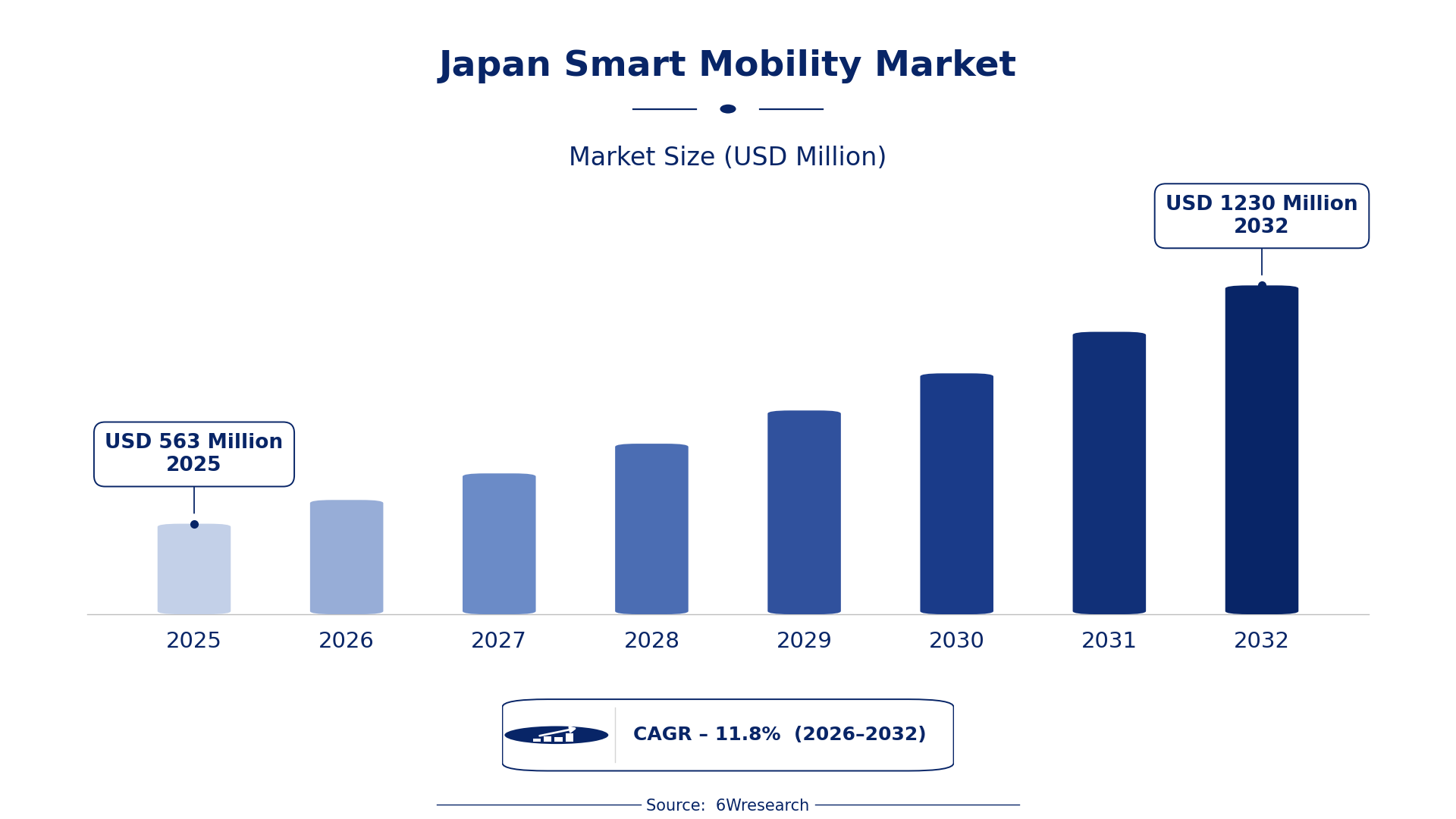
According to 6Wresearch internal database and industry insights, the Japan Smart Mobility Market was valued at USD 563 Million in 2025 and is projected to reach USD 1,230 Million by 2032, growing at a CAGR of approximately 11.8% during 2026–2032.
Japan Smart Mobility Market Highlights
| Report Metric | Details |
| Report Name | Japan Smart Mobility Market (2026-2032) |
| Market Size 2025 | USD 563 Million |
| Market Size 2032 | USD 1,230 Million |
| Absolute Growth 2025–2032 | USD 667 Million |
| CAGR 2026–2032 | 11.8% |
| Peak Annual Growth | 13.4% in 2032 |
| Forecast Period | 2026–2032 |
| Historical Data | 2022–2025 |
| Base Year | 2025 |
| Leading Technology, 2025 | 3G and 4G (32% share) |
| Leading Solution, 2025 | Traffic Management (51% share) |
| Leading Element, 2025 | Bike Commuting (45% share) |
| Fastest-Growing Technology | Wi-Fi (17.3% CAGR) |
| Fastest-Growing Solution | Parking Management (15.3% CAGR) |
| Fastest-Growing Element | Car Sharing (15.2% CAGR) |
| Growing Sector | urban transportation |
| Key End Users | government agencies, urban planners, technology providers, transportation companies |
Japan Smart Mobility Market Year-wise Growth Rate and Key Drivers (2022–2032)
This graph illustrates the annual growth rates of the market from 2022 to 2032, highlighting a steady upward trajectory and projected market expansion over the forecast period.
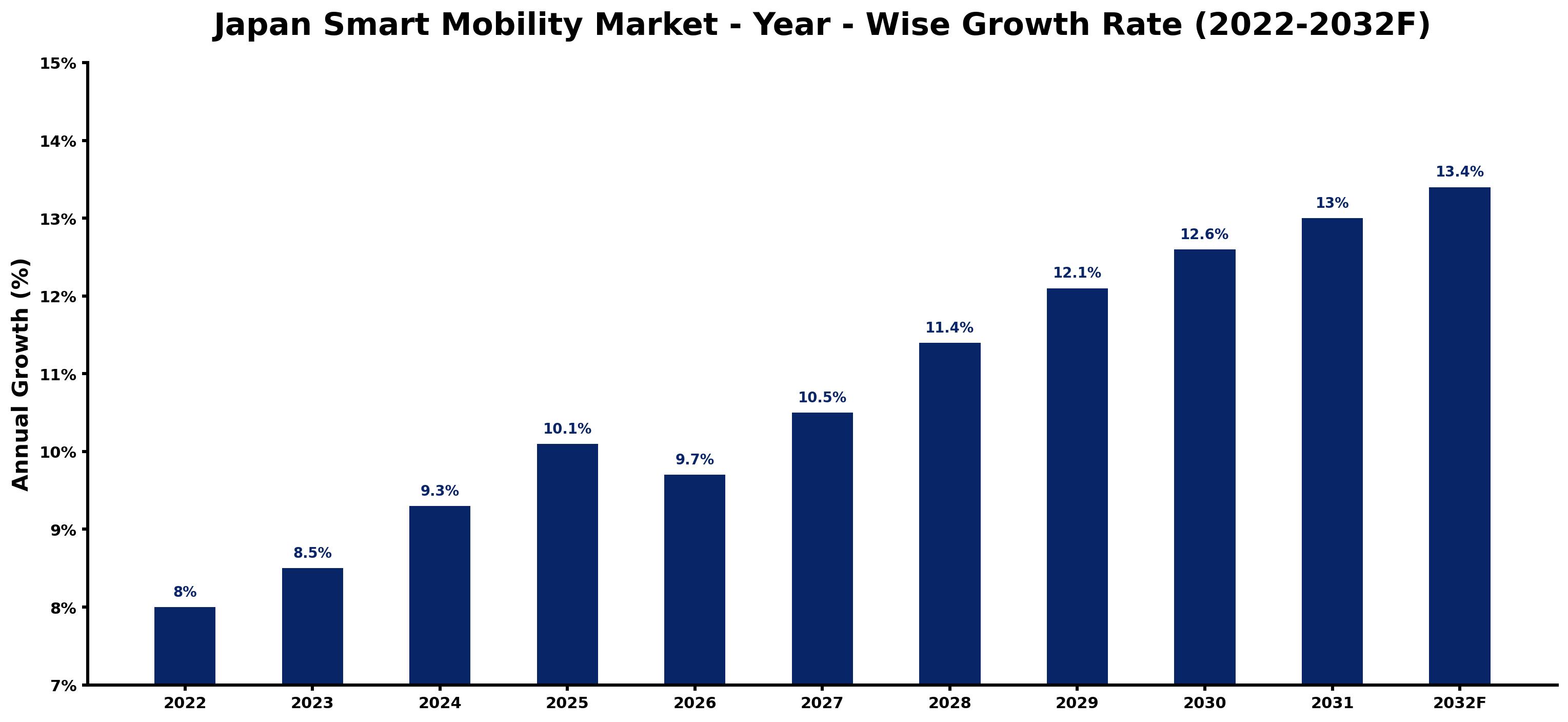
The yearly estimates that follow link every growth rate to its principal driver, so readers can see why the pace changed in each period.
| Year | Estimated Annual Growth (%) | Market Rationale |
| 2022 | 8.0 | The market experienced steady growth as urban areas adopted smart mobility solutions. |
| 2023 | 8.5 | Growth accelerated due to increased investments in urban infrastructure and city projects. |
| 2024 | 9.3 | Demand continued to rise as technological advancements improved traffic management systems. |
| 2025 | 10.1 | The market peaked historically as cities implemented smart mobility strategies. |
| 2026 | 9.7 | Growth is expected to slow slightly as the market stabilises after rapid expansion. |
| 2027 | 10.5 | A resurgence in demand is projected as new mobility solutions gain traction among users. |
| 2028 | 11.4 | The market is expected to expand further as public awareness of sustainable transport options increases. |
| 2029 | 12.1 | Growth will continue as urban populations embrace new mobility solutions. |
| 2030 | 12.6 | Demand is projected to rise with the introduction of new smart mobility initiatives in major cities. |
| 2031 | 13.0 | The market will maintain strong growth as consumer preferences shift towards shared mobility. |
| 2032 | 13.4 | The peak annual growth is expected, driven by extensive investments in infrastructure. |
Note: Market size estimations and growth projections presented in this report are based on 6Wresearch's proprietary forecasting methodology, utilizing the latest available industry data, government publications, and primary research inputs.
Japan Smart Mobility Market Synopsis
Smart mobility encompasses technologies that improve transportation efficiency and sustainability, including GPS and traffic management systems. Urban areas like Tokyo are leading initiatives to improve traffic flow and reduce congestion. The Japan Smart Mobility Market is growing due to rising urban populations, increased government investment in smart city projects, and a shift towards sustainable transportation modes, with ¥1 billion allocated for mobility solutions in 2023.
Market Dynamics Impact Analysis (2026–2032)
| Factor | Type | Impact | Primary Segment Affected |
| Increased urbanisation drives demand for efficient transport solutions. | Driver | High | Traffic Management |
| Growing interest in sustainable transport options boosts adoption rates. | Driver | High | Bike Commuting |
| Rising demand for smart city initiatives creates investment opportunities. | Opportunity | High | Parking Management |
| Expansion of bike-sharing programs presents growth potential. | Opportunity | High | Bike Commuting |
| High costs of implementing smart mobility systems can deter investment. | Restraint | High | Traffic Management |
| Limited public awareness of smart mobility benefits may restrict growth. | Restraint | Medium | Mobility Management |
| Infrastructure challenges can delay project implementation timelines. | Challenge | High | Traffic Management |
| Competition among mobility solutions can lead to market fragmentation. | Challenge | Medium | Car Sharing |
Evaluation of Drivers in Japan Smart Mobility Market (2026–2032)
Below are the drivers that matter most for revenue growth, with supporting evidence.
| Drivers | Primary Segment Affected | Why It Matters (Evidence) |
| Urban population growth increases demand for efficient transport solutions. | Traffic Management | In 2023, Japan's population is approximately 125 million, leading to greater traffic congestion. |
| Technological advancements enhance the functionality of smart mobility systems. | Global Positioning System (GPS) | The use of GPS technology in public transport systems has increased by 30% in the last five years. |
| Government investment in smart city projects drives market expansion. | Parking Management | The government allocated ¥1 billion for smart city projects, including mobility solutions. |
| Rising consumer interest in shared mobility options boosts adoption rates. | Car Sharing | As of 2023, over 1 million users are engaged in car-sharing services across major cities. |
| Innovations in urban planning promote the integration of smart mobility solutions. | Bike Commuting | The Tokyo Metropolitan Government has launched a bike-sharing program with 10,000 bikes available. |
Spending rises because Japan's urban population of approximately 125 million drives demand for efficient transport solutions. The use of GPS technology in public transport has increased by 30%, prompting more users to adopt smart mobility systems. Investment in smart city projects, with ¥1 billion allocated in 2023, encourages the development of parking management solutions. As of 2023, over 1 million users are engaged in car-sharing services, reflecting a growing interest in shared mobility options.
Evaluation of Restraints in Japan Smart Mobility Market
These are the pressures that could keep growth below its potential.
| Market Restraint | Primary Segment Affected | Why It Matters (Evidence) |
| High costs of implementing smart mobility systems can deter investment. | Traffic Management | The initial investment for smart mobility infrastructure can exceed ¥100 million, limiting participation. |
| Limited public awareness of smart mobility benefits may restrict growth. | Mobility Management | Many consumers remain unaware of the advantages of smart mobility solutions, hindering adoption. |
| Infrastructure challenges can delay project implementation timelines. | Parking Management | Existing urban infrastructure may require upgrades, causing project delays. |
| Regulatory hurdles can complicate the deployment of new technologies. | Car Sharing | Compliance with local regulations can slow the rollout of car-sharing services. |
| Market fragmentation can create confusion among consumers. | Bike Commuting | Numerous bike-sharing programs with varying features may overwhelm potential users. |
Japan Smart Mobility Market Challenges
Buyers of smart mobility solutions encounter supply chain disruptions due to dependence on specific technology components, potentially delaying project timelines by up to six months. Producers face inefficiencies stemming from outdated technology standards, which can increase operational costs by about 20%. Regulatory hurdles from the Ministry of Land, Infrastructure, Transport and Tourism may prolong approval processes by three months for new initiatives. High implementation costs discourage urban planners, with initial investments frequently surpassing ¥100 million per project, hindering the adoption of advanced transportation solutions.
Trends in the Japan Smart Mobility Market
The following changes are redrawing the Japan Smart Mobility Market.
- Shift from Traditional to Smart Traffic Management: Since 2022, urban areas in Japan have increasingly adopted smart traffic management systems. Tokyo's focus on optimising traffic flow has led to a 20% reduction in congestion during peak hours.
- Transition from Ownership to Shared Mobility: The rise of car-sharing services has transformed urban transport preferences. In 2023, over 1 million users engaged in car-sharing, reflecting a shift towards more sustainable transport options.
- Bike Commuting Gaining Popularity: Since 2023, bike commuting has become a preferred transport mode in urban areas. The Tokyo Metropolitan Government's bike-sharing program promotes this sustainable option.
- Emergence of Integrated Mobility Solutions: The Smart City Development Program aims to integrate smart mobility solutions in 10 major cities by 2025, improving urban transport efficiency and sustainability.
Investment Opportunities in the Japan Smart Mobility Market
The opportunities below stand out in the Japan Smart Mobility Market for new entrants and existing suppliers.
- Smart Traffic Management Solutions: With urban areas grappling with congestion, there is a demand for advanced traffic management technologies. The Tokyo Metropolitan Government's initiatives offer opportunities for suppliers to create solutions.
- Parking Management Technologies: As cities grow, the need for efficient parking solutions increases. The government allocated ¥1 billion for smart city projects, generating a market for parking management systems.
- Electric Bike Supply: The recent subsidy programme for electric bike purchases underscores the rising demand for sustainable commuting options. Suppliers can focus on urban consumers seeking eco-friendly transport alternatives.
- Integration of Mobility Services: The Smart City Development Program aims to unify various transport services, creating opportunities for technology providers to deliver solutions to urban planners.
Government Initiatives in the Japan Smart Mobility Market
The GX Basic Policy, adopted in 2023, aims for about JPY 150 trillion of public-private decarbonisation investment over 10 years, strengthening the framework for smart mobility initiatives. This policy builds on the Industrial Standardization Act of 1949, which governs product standards, ensuring quality in smart mobility technologies.
The Consumer Affairs Agency oversees regulations against misleading representations, approving funding for projects that improve urban transportation. This includes the Act against Unjustifiable Premiums and Misleading Representations, which ensures compliance for producers.
Future Insight of the Japan Smart Mobility Market
By 2032, Japan's urban transportation system will experience a substantial transformation driven by government initiatives and technological advancements. The Smart Mobility Strategy 2022 will support the integration of smart mobility solutions across ten major cities by 2025. Improved GPS technology in public transport systems will further optimise traffic flow. As electric bike subsidies encourage sustainable commuting, participation in car-sharing services is anticipated to increase, reflecting evolving transportation preferences.
Market Segmentation Analysis
Japan Smart Mobility Market report covers a detailed analysis of the following market segments:
By Technology – 3G and 4G Leads, Wi-Fi Expected to Grow Fastest
According to Summon Dutta, Assistant Manager at 6Wresearch, 3G and 4G held 32% of the Japan Smart Mobility Market by technology in 2025. 3G and 4G technologies hold the largest share as they are crucial for enabling communication in smart mobility applications. Their significance is particularly evident in urban areas like Tokyo, where real-time data exchange is vital for effective transport management. Wi-Fi is set to record the highest CAGR in this split, 17.3% over 2026–2032. Wi-Fi is experiencing rapid growth due to its role in enhancing connectivity for smart transportation systems, facilitating the integration of diverse mobility solutions. The rise of public Wi-Fi hotspots in urban settings is a key factor contributing to this growth. Suppliers must focus on improving Wi-Fi infrastructure to meet the rising demand for interconnected smart mobility solutions.
By Solution – Traffic Management Leads, Parking Management Expected to Grow Fastest
Traffic Management accounted for 51% of the market by solution in 2025. Traffic Management solutions are the market leader as they play a vital role in optimising urban transport systems and reducing congestion. The implementation of advanced traffic management systems in cities like Tokyo underscores their importance in enhancing mobility efficiency. Parking Management is projected to grow fastest, at a CAGR of 15.3% during 2026–2032. Parking Management is the fastest-growing segment, driven by the increasing need for improved urban parking efficiency. The launch of new parking management initiatives in response to the growing number of vehicles is propelling this segment's growth. Buyers should invest in advanced parking management solutions to effectively address urban congestion and parking challenges.
By Element – Bike Commuting Leads, Car Sharing Expected to Grow Fastest
In 2025, Bike Commuting led the element split with a 45% share. Bike Commuting leads the market as it is promoted as a sustainable transport option, appealing to environmentally aware commuters. The Tokyo Metropolitan Government's bike-sharing programme significantly enhances the attractiveness of this commuting method. Over 2026–2032, Car Sharing is expected to post the fastest growth, at a CAGR of 15.2%. Car Sharing is rapidly gaining popularity as a preferred alternative to vehicle ownership, especially among urban residents. The participation of over 1 million users in car-sharing services highlights this increasing trend. Suppliers should capitalise on the growing interest in car-sharing solutions to align with changing consumer preferences.
Key Attractiveness of the Report
- 10 Years of Market Numbers
- Historical Data Starting from 2022 to 2025
- Base Year 2025
- Forecast Data until 2032
- Key Performance Indicators Impacting the Market
- Major Upcoming Developments and Projects
Key Highlights of the Report:
- Japan Smart Mobility Market Outlook
- Market Size of Japan Smart Mobility Market, 2025
- Forecast of Japan Smart Mobility Market, 2032
- Historical Data and Forecast of Japan Smart Mobility Revenues & Volume for the Period 2022-2032
- Japan Smart Mobility Market Trend Evolution
- Japan Smart Mobility Market Drivers and Challenges
- Japan Smart Mobility Price Trends
- Japan Smart Mobility Porter's Five Forces
- Japan Smart Mobility Industry Life Cycle
- Historical Data and Forecast of Japan Smart Mobility Market Revenues & Volume By Technology for the Period 2022-2032
- Historical Data and Forecast of Japan Smart Mobility Market Revenues & Volume By 3G and 4G for the Period 2022-2032
- Historical Data and Forecast of Japan Smart Mobility Market Revenues & Volume By Wi-Fi for the Period 2022-2032
- Historical Data and Forecast of Japan Smart Mobility Market Revenues & Volume By Global Positioning System (GPS) for the Period 2022-2032
- Historical Data and Forecast of Japan Smart Mobility Market Revenues & Volume By Radio Frequency Identification (RFID) for the Period 2022-2032
- Historical Data and Forecast of Japan Smart Mobility Market Revenues & Volume By Embedded System for the Period 2022-2032
- Historical Data and Forecast of Japan Smart Mobility Market Revenues & Volume By Others for the Period 2022-2032
- Historical Data and Forecast of Japan Smart Mobility Market Revenues & Volume By Solution for the Period 2022-2032
- Historical Data and Forecast of Japan Smart Mobility Market Revenues & Volume By Traffic Management for the Period 2022-2032
- Historical Data and Forecast of Japan Smart Mobility Market Revenues & Volume By Parking Management for the Period 2022-2032
- Historical Data and Forecast of Japan Smart Mobility Market Revenues & Volume By Mobility Management for the Period 2022-2032
- Historical Data and Forecast of Japan Smart Mobility Market Revenues & Volume By Others for the Period 2022-2032
- Historical Data and Forecast of Japan Smart Mobility Market Revenues & Volume By Element for the Period 2022-2032
- Historical Data and Forecast of Japan Smart Mobility Market Revenues & Volume By Bike Commuting for the Period 2022-2032
- Historical Data and Forecast of Japan Smart Mobility Market Revenues & Volume By Car Sharing for the Period 2022-2032
- Historical Data and Forecast of Japan Smart Mobility Market Revenues & Volume By Ride Sharing for the Period 2022-2032
- Japan Smart Mobility Import Export Trade Statistics
- Market Opportunity Assessment By Technology
- Market Opportunity Assessment By Solution
- Market Opportunity Assessment By Element
- Japan Smart Mobility Top Companies Market Share
- Japan Smart Mobility Competitive Benchmarking By Technical and Operational Parameters
- Japan Smart Mobility Company Profiles
- Japan Smart Mobility Key Strategic Recommendations
Market Covered
Segments analysed in this report are listed below.
By Technology
- 3G and 4G
- Wi-Fi
- Global Positioning System (GPS)
- Radio Frequency Identification (RFID)
- Embedded System
- Others
By Solution
- Traffic Management
- Parking Management
- Mobility Management
- Others
By Element
- Bike Commuting
- Car Sharing
- Ride Sharing































