Japan Software Development Outsourcing Market Size & Growth Rate
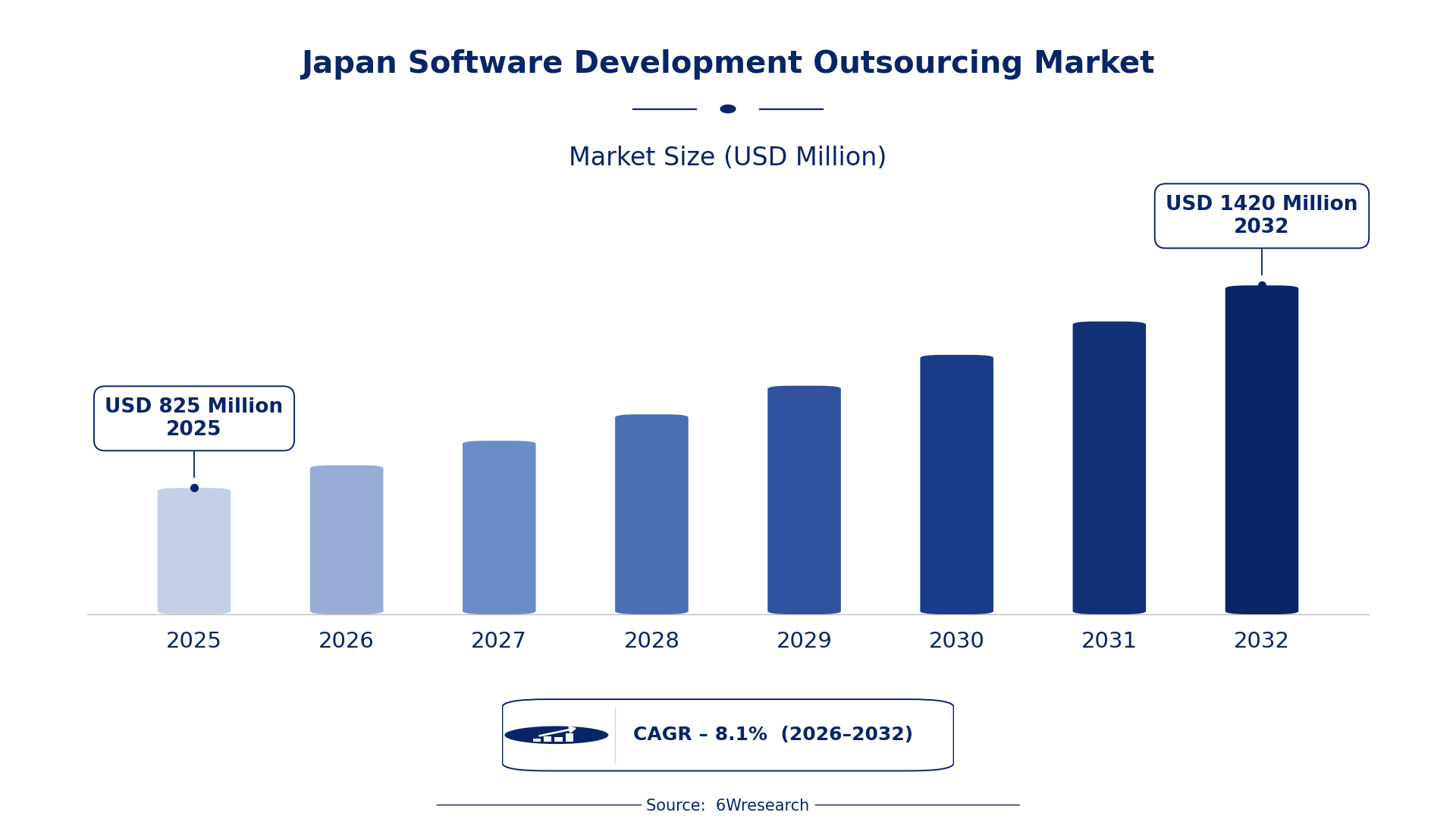
According to 6Wresearch internal database and industry insights, the Japan Software Development Outsourcing Market was valued at USD 825 Million in 2025 and is projected to reach USD 1,420 Million by 2032, growing at a CAGR of approximately 8.1% during 2026–2032.
Japan Software Development Outsourcing Market Highlights
| Report Metric | Details |
| Report Name | Japan Software Development Outsourcing Market (2026-2032) |
| Market Size 2025 | USD 825 Million |
| Market Size 2032 | USD 1,420 Million |
| Absolute Growth 2025–2032 | USD 595 Million |
| CAGR 2026–2032 | 8.1% |
| Peak Annual Growth | 8.9% in 2028 |
| Forecast Period | 2026–2032 |
| Historical Data | 2022–2025 |
| Base Year | 2025 |
| Leading Development Type, 2025 | Web/Mobile App Dev (38% share) |
| Leading Contract Model, 2025 | Fixed Price (52% share) |
| Leading Service Model, 2025 | Dedicated Team (48% share) |
| Leading End User, 2025 | Startups & SMEs (49% share) |
| Fastest-Growing Development Type | Enterprise Software (11.7% CAGR) |
| Fastest-Growing Contract Model | Time & Material (10.4% CAGR) |
| Fastest-Growing Service Model | Staff Augmentation (11.1% CAGR) |
| Fastest-Growing End User | Large Enterprises (10.3% CAGR) |
| Growing Sector | Large Enterprises |
| Key End Users | Startups & SMEs, Large Enterprises, Tech Firms, Industrial OEMs |
Japan Software Development Outsourcing Market Year-wise Growth Rate and Key Drivers (2022–2032)
This graph illustrates the annual growth rates of the market from 2022 to 2032, highlighting a steady upward trajectory and projected market expansion over the forecast period.
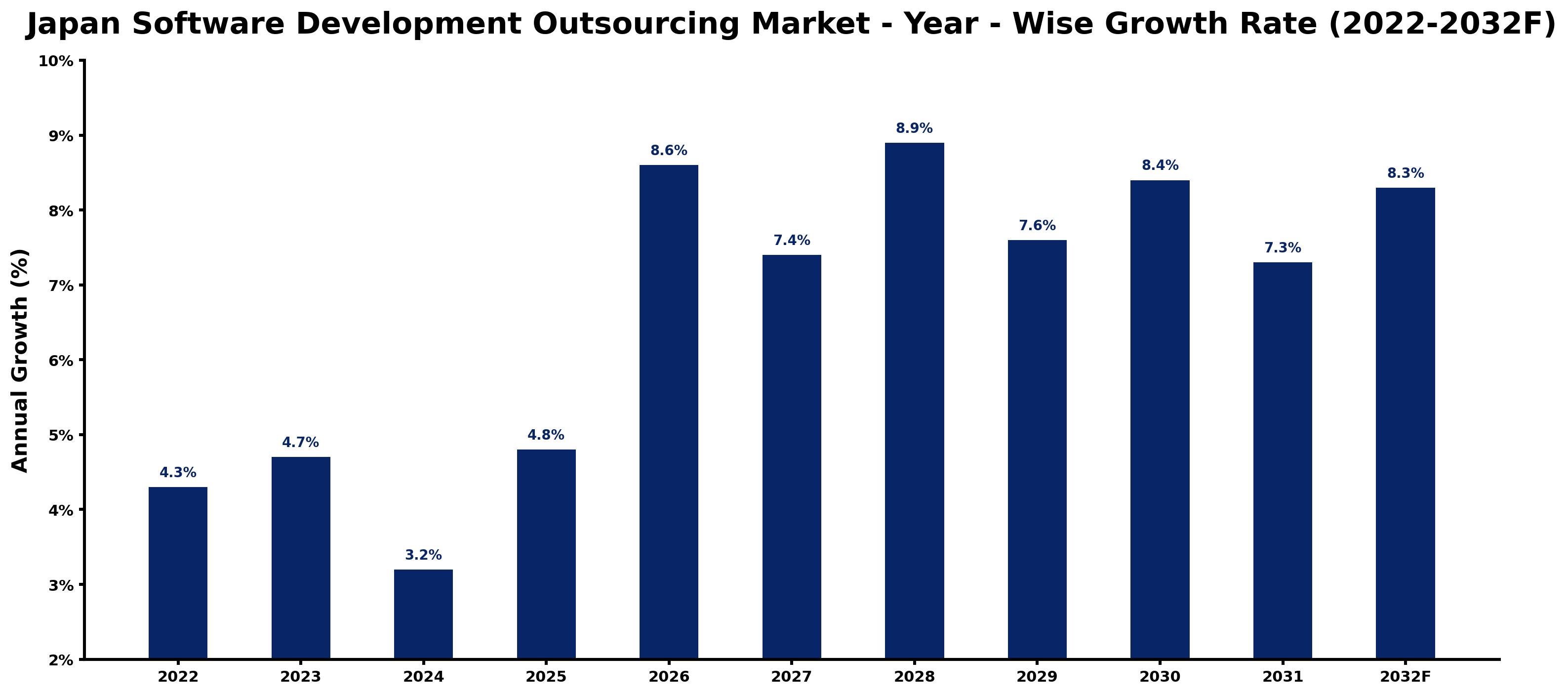
Below, each year's estimated growth is shown next to the factor that most influenced it.
| Year | Estimated Annual Growth (%) | Market Rationale |
| 2022 | 4.3 | The market showed steady growth, supported by increasing demand from domestic tech firms. |
| 2023 | 4.7 | Growth accelerated as more startups emerged, boosting the need for software services. |
| 2024 | 3.2 | Growth slowed due to market saturation and a cautious approach from larger enterprises. |
| 2025 | 4.8 | A resurgence in demand was driven by digital transformation initiatives across industries. |
| 2026 | 8.6 | Growth is expected to surge as companies invest heavily in AI and automation technologies. |
| 2027 | 7.4 | A slight slowdown is projected as businesses reassess their outsourcing strategies. |
| 2028 | 8.9 | Demand is expected to peak, driven by investments in advanced software solutions. |
| 2029 | 7.6 | Growth will decelerate as the market stabilises after the peak year. |
| 2030 | 8.4 | Demand is projected to rebound as firms prioritise digital solutions to enhance efficiency. |
| 2031 | 7.3 | Growth is expected to slow again as the market adjusts to new technological standards. |
| 2032 | 8.3 | A healthy growth rate is projected as companies continue to embrace outsourcing. |
Note: Market size estimations and growth projections presented in this report are based on 6Wresearch's proprietary forecasting methodology, utilizing the latest available industry data, government publications, and primary research inputs.
Japan Software Development Outsourcing Market Synopsis
Software Development Outsourcing involves external vendors providing services for applications, enterprise systems, and AI solutions. The market is expanding due to a surge in startups and tech firms, with the Tokyo region accounting for 40% of the market. The digital transformation programme launched by the Ministry of Economy, Trade and Industry in 2023 and the rise of AI/ML solutions projected to grow by 15% annually are key factors behind the market's growth, indicating a strong investment climate in Japan's software sector.
Market Dynamics Impact Analysis (2026–2032)
| Factor | Type | Impact | Primary Segment Affected |
| Rising number of startups in Japan | Driver | High | Startups & SMEs |
| Increased investment in AI technologies | Driver | High | AI/ML Solutions |
| Growing demand for dedicated teams for long-term projects | Opportunity | Medium | Dedicated Team |
| Increased need for flexible project scopes | Opportunity | Medium | Time & Material |
| High competition among software development firms | Restraint | High | Web/Mobile App Dev |
| Limited availability of skilled developers | Restraint | Medium | Enterprise Software |
| Challenges in maintaining quality standards | Challenge | High | AI/ML Solutions |
| Difficulty in managing offshore teams effectively | Challenge | Medium | Offshore |
Evaluation of Drivers in Japan Software Development Outsourcing Market (2026–2032)
Below are the drivers that matter most for revenue growth, with supporting evidence.
| Drivers | Primary Segment Affected | Why It Matters (Evidence) |
| Increase in the number of tech startups | Startups & SMEs | The number of startups reached 10,000 in 2023, driving demand for software services. |
| Growing investment in AI technologies | AI/ML Solutions | AI/ML solutions are projected to grow by 15% annually, prompting more software development projects. |
| Demand for dedicated teams for long-term projects | Dedicated Team | Companies prefer dedicated teams for complex projects, improving collaboration and project success. |
| Need for flexible project scopes | Time & Material | Businesses are adopting flexible contracts to adapt to changing project requirements, increasing responsiveness. |
| Increased focus on digital transformation | Enterprise Software | The digital transformation programme boosts enterprise software needs, leading to higher investment. |
Most of the extra volume comes from the rising number of tech startups, which reached 10,000 in 2023, increasing demand for software services. As firms invest in AI technologies, the projected growth of AI/ML solutions by 15% annually prompts more software development projects. The need for dedicated teams has surged as companies seek long-term collaboration on complex projects, improving success rates. Firms are increasingly adopting flexible project scopes, driven by the necessity to adapt to evolving requirements. The focus on digital transformation further fuels demand for enterprise software, creating a dynamic market environment.
Evaluation of Restraints in Japan Software Development Outsourcing Market
The main factors holding the market back are set out below.
| Market Restraint | Primary Segment Affected | Why It Matters (Evidence) |
| Intense competition among software development firms | Web/Mobile App Dev | Over 1,000 registered firms in Japan intensify competition, impacting pricing and service quality. |
| Shortage of skilled software developers | Enterprise Software | The average salary for software developers is approximately ¥6 million annually, limiting the talent pool. |
| Challenges in maintaining quality standards | AI/ML Solutions | ISO/IEC 27001 compliance is essential, but many firms struggle to meet these standards. |
| Difficulty in managing offshore teams | Offshore | Cultural and communication barriers hinder effective management of offshore projects, impacting delivery timelines. |
| Regulatory compliance costs | Dedicated Team | Compliance with local laws increases operational costs for dedicated teams, affecting project budgets. |
Japan Software Development Outsourcing Market Challenges
Producers struggle with a shortage of qualified software developers, as the average salary of ¥6 million annually limits the available talent pool, causing project delays for firms needing timely execution. Many firms do not fully adopt ISO/IEC 27001 for information security, which exposes clients to potential data breaches and undermines trust in outsourcing services. Rising minimum wages, now at JPY 1,055 per hour, increase operational costs for outsourcing firms, forcing them to raise prices for buyers seeking affordable solutions. The concentration of 40% of the market in the Tokyo region intensifies competition, resulting in price wars that can compromise service quality for end-users.
Trends in the Japan Software Development Outsourcing Market
Several trends are reshaping the Japan Software Development Outsourcing Market; the most important are set out below.
- Shift Towards AI-Driven Solutions: Tech firms are increasingly adopting AI-driven solutions, with AI/ML technologies projected to grow by 15% annually, improving operational capabilities.
- Expansion of Digital Transformation Initiatives: The Tokyo region is witnessing a surge in digital transformation initiatives, supported by the Ministry of Economy, Trade and Industry's 2023 programme, driving software development needs.
- Growing Preference for Flexible Contract Models: Since 2023, businesses have shifted towards flexible contract models, with Time & Material contracts gaining popularity due to their adaptability in project scopes.
- Rise of Embedded Systems in Automotive: The demand for embedded systems has increased in the automotive sector, reflecting the industry's push for automation and efficiency, vital for manufacturers.
Investment Opportunities in the Japan Software Development Outsourcing Market
Investors looking at the Japan Software Development Outsourcing Market should consider the following areas.
- Investment in AI/ML Development: The growing need for AI/ML solutions presents an opportunity for investment in software development, especially for tech firms focusing on automation.
- Supply of Dedicated Teams for Startups: With the rise of startups, there is a need for dedicated teams to support their software development, particularly in urban tech hubs like Tokyo.
- Focus on Digital Transformation Services: As companies prioritise digital transformation, there is an opportunity to supply enterprise software solutions to enhance operational efficiency.
- Entry into Offshore Development Services: The increasing demand for cost-effective solutions opens opportunities for firms to enter the offshore development market, partnering with local entities.
Government Initiatives in the Japan Software Development Outsourcing Market
The AI Promotion Act established in 2025 enhances the existing legal framework for software development by promoting national standards for AI research and applications. This act builds on the Digital Agency's initiatives from 2021, which focuses on digital transformation across government and industry. The integration of these measures aims to streamline processes for software developers, ensuring compliance with new AI standards and fostering innovation in the sector.
In 2023, the Japanese government allocated ¥5 billion for tech innovation grants administered by the Digital Agency. This funding supports startups and established firms in developing advanced software solutions, enabling them to invest in new technologies and improve their offerings. The grants are designed to enhance competitiveness and drive growth in the software development outsourcing market.
Future Insight of the Japan Software Development Outsourcing Market
By 2032, advancements in digital infrastructure will reshape demand, driven by the government's digital transformation programme initiated in 2023. The anticipated growth in AI solutions will require enhanced software development services to satisfy client expectations. Increased funding for tech innovation, with ¥5 billion allocated in 2023, will support the emergence of startups and improve service offerings. As the number of registered software development firms exceeds 1,000, buyers will benefit from a broader selection of services and higher quality solutions.
Market Segmentation Analysis
Japan Software Development Outsourcing Market report covers a detailed analysis of the following market segments:
By Development Type – Web/Mobile App Dev Leads, Enterprise Software Expected to Grow Fastest
According to Saurav Kr Singh, Senior Research Analyst at 6Wresearch, with 38% of development type revenue in 2025, Web/Mobile App Dev was the largest category. Web and mobile application development dominates the market because of the high demand for mobile solutions among technology firms, particularly in urban areas. This segment is crucial for businesses that aim to engage customers and streamline operations through mobile platforms. Enterprise Software is projected to grow fastest, at a CAGR of 11.7% during 2026–2032. Enterprise software is experiencing rapid growth as large enterprises invest heavily in software solutions that improve operational efficiency and manage complex processes. The increasing number of startups has created a strong ecosystem that requires advanced enterprise systems to support their growth. Suppliers should focus on developing tailored solutions for enterprise clients to capitalise on the rising demand.
By Contract Model – Fixed Price Leads, Time & Material Expected to Grow Fastest
In 2025, Fixed Price led the contract model split with a 52% share. The fixed price model dominates the market as it is preferred for well-defined projects where scope and deliverables are clear, ensuring budget predictability for clients. This approach is particularly popular among firms that require a structured payment plan for their software development needs. The quickest growth will come from Time & Material, forecast to expand at a CAGR of 10.4% between 2026 and 2032. Time and material contracts are gaining traction due to their flexibility, allowing clients to adapt project scopes as requirements evolve. This is especially relevant in a fast-paced environment where project specifications can change based on market feedback. Buyers may benefit from negotiating terms that allow for flexibility in project scope to better align with their needs.
By Service Model – Dedicated Team Leads, Staff Augmentation Expected to Grow Fastest
Dedicated Team took 48% of service model revenue in 2025, more than any other category. The dedicated team model dominates the market as it is well-suited for long-term projects that require ongoing collaboration and expertise, particularly in intricate software development tasks. This strategy allows firms to retain control over project direction while utilising external talent effectively. Staff Augmentation is set to record the highest CAGR in this split, 11.1% over 2026–2032. Staff augmentation is expanding quickly as companies aim to temporarily address skill gaps, particularly in areas where specific expertise is essential for brief periods. This trend reflects the swift pace of technological changes that necessitate specialised skills. Suppliers should explore providing adaptable staffing solutions to align with the evolving needs of clients.
By End User – Startups & SMEs Lead, Large Enterprises Expected to Grow Fastest
The largest end user category in 2025 was Startups & SMEs, at 49% of revenue. Startups and SMEs represent the largest share as they increasingly rely on outsourced solutions to scale their operations without the costs associated with in-house development. This segment reflects the vibrant entrepreneurial spirit within Japan's technology landscape. Over 2026–2032, Large Enterprises are expected to post the fastest growth, at a CAGR of 10.3%. Large enterprises are witnessing the fastest growth in software development outsourcing due to their significant investments in technology aimed at enhancing operational efficiency. This trend indicates that these firms are keen to leverage external expertise to drive innovation. Suppliers should tailor their services to meet the specific needs of large enterprises to exploit this growth opportunity.
Key Attractiveness of the Report
- 10 Years of Market Numbers
- Historical Data Starting from 2022 to 2025
- Base Year 2025
- Forecast Data until 2032
- Key Performance Indicators Impacting the Market
- Major Upcoming Developments and Projects
Key Highlights of the Report:
- Japan Software Development Outsourcing Market Outlook
- Market Size of Japan Software Development Outsourcing Market, 2025
- Forecast of Japan Software Development Outsourcing Market, 2032
- Historical Data and Forecast of Japan Software Development Outsourcing Revenues & Volume for the Period 2022-2032F
- Japan Software Development Outsourcing Market Trend Evolution
- Japan Software Development Outsourcing Market Drivers and Challenges
- Japan Software Development Outsourcing Price Trends
- Japan Software Development Outsourcing Porter's Five Forces
- Japan Software Development Outsourcing Industry Life Cycle
- Historical Data and Forecast of Japan Software Development Outsourcing Market Revenues & Volume By Development Type for the Period 2022-2032F
- Historical Data and Forecast of Japan Software Development Outsourcing Market Revenues & Volume By Web/Mobile App Dev for the Period 2022-2032F
- Historical Data and Forecast of Japan Software Development Outsourcing Market Revenues & Volume By Enterprise Software for the Period 2022-2032F
- Historical Data and Forecast of Japan Software Development Outsourcing Market Revenues & Volume By AI/ML Solutions for the Period 2022-2032F
- Historical Data and Forecast of Japan Software Development Outsourcing Market Revenues & Volume By Embedded Systems for the Period 2022-2032F
- Historical Data and Forecast of Japan Software Development Outsourcing Market Revenues & Volume By Contract Model for the Period 2022-2032F
- Historical Data and Forecast of Japan Software Development Outsourcing Market Revenues & Volume By Fixed Price for the Period 2022-2032F
- Historical Data and Forecast of Japan Software Development Outsourcing Market Revenues & Volume By Time & Material for the Period 2022-2032F
- Historical Data and Forecast of Japan Software Development Outsourcing Market Revenues & Volume By Offshore for the Period 2022-2032F
- Historical Data and Forecast of Japan Software Development Outsourcing Market Revenues & Volume By Nearshore for the Period 2022-2032F
- Historical Data and Forecast of Japan Software Development Outsourcing Market Revenues & Volume By Service Model for the Period 2022-2032F
- Historical Data and Forecast of Japan Software Development Outsourcing Market Revenues & Volume By Dedicated Team for the Period 2022-2032F
- Historical Data and Forecast of Japan Software Development Outsourcing Market Revenues & Volume By Staff Augmentation for the Period 2022-2032F
- Historical Data and Forecast of Japan Software Development Outsourcing Market Revenues & Volume By Project-Based for the Period 2022-2032F
- Historical Data and Forecast of Japan Software Development Outsourcing Market Revenues & Volume By Hybrid Delivery for the Period 2022-2032F
- Historical Data and Forecast of Japan Software Development Outsourcing Market Revenues & Volume By End User for the Period 2022-2032F
- Historical Data and Forecast of Japan Software Development Outsourcing Market Revenues & Volume By Startups & SMEs for the Period 2022-2032F
- Historical Data and Forecast of Japan Software Development Outsourcing Market Revenues & Volume By Large Enterprises for the Period 2022-2032F
- Historical Data and Forecast of Japan Software Development Outsourcing Market Revenues & Volume By Tech Firms for the Period 2022-2032F
- Historical Data and Forecast of Japan Software Development Outsourcing Market Revenues & Volume By Industrial OEMs for the Period 2022-2032F
- Japan Software Development Outsourcing Import Export Trade Statistics
- Market Opportunity Assessment By Development Type
- Market Opportunity Assessment By Contract Model
- Market Opportunity Assessment By Service Model
- Market Opportunity Assessment By End User
- Japan Software Development Outsourcing Top Companies Market Share
- Japan Software Development Outsourcing Competitive Benchmarking By Technical and Operational Parameters
- Japan Software Development Outsourcing Company Profiles
- Japan Software Development Outsourcing Key Strategic Recommendations
Market Covered
This report examines the market across the segments below.
By Development Type
- Web/Mobile App Dev
- Enterprise Software
- AI/ML Solutions
- Embedded Systems
By Contract Model
- Fixed Price
- Time & Material
- Offshore
- Nearshore
By Service Model
- Dedicated Team
- Staff Augmentation
- Project-Based
- Hybrid Delivery
By End User
- Startups & SMEs
- Large Enterprises
- Tech Firms
- Industrial OEMs































