Japan Soil Additives Market Size & Growth Rate
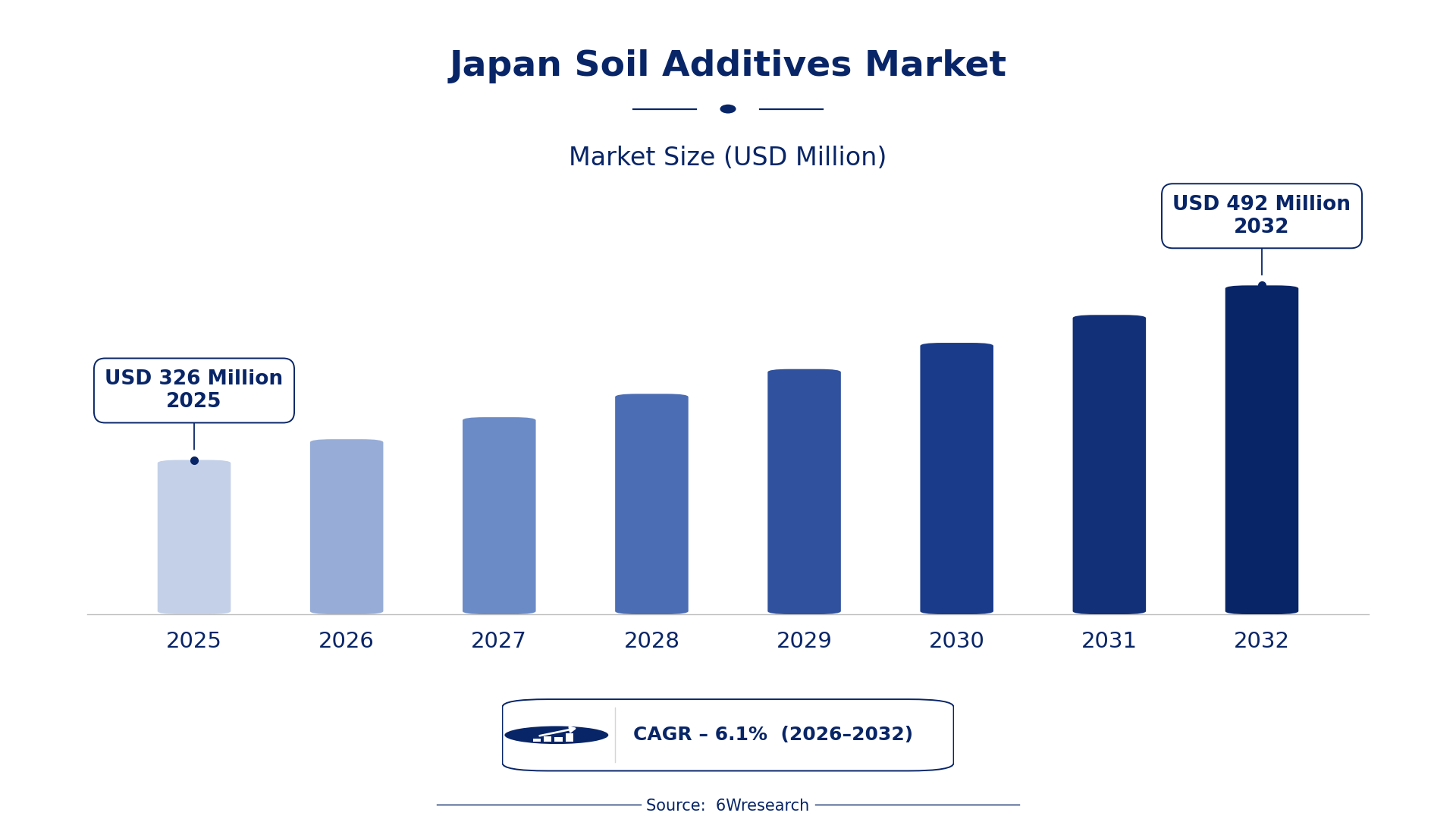
According to 6Wresearch internal database and industry insights, the Japan Soil Additives Market was valued at USD 326 Million in 2025 and is projected to reach USD 492 Million by 2032, growing at a CAGR of approximately 6.1% during 2026–2032.
Japan Soil Additives Market Highlights
| Report Metric | Details |
| Report Name | Japan Soil Additives Market (2026-2032) |
| Market Size 2025 | USD 326 Million |
| Market Size 2032 | USD 492 Million |
| Absolute Growth 2025–2032 | USD 166 Million |
| CAGR 2026–2032 | 6.1% |
| Peak Annual Growth | 6.4% in 2029 |
| Forecast Period | 2026–2032 |
| Historical Data | 2022–2025 |
| Base Year | 2025 |
| Leading Additive Type, 2025 | Organic Additives (51% share) |
| Leading Functionality, 2025 | Nutrient Enrichment (44% share) |
| Leading Crop Type, 2025 | Vegetables (37% share) |
| Leading End User, 2025 | Commercial Farms (43% share) |
| Fastest-Growing Additive Type | Biofertilizers (8.7% CAGR) |
| Fastest-Growing Functionality | Soil Rejuvenation (7.7% CAGR) |
| Fastest-Growing Crop Type | Pulses (8.4% CAGR) |
| Fastest-Growing End User | Organic Farmers (7.8% CAGR) |
| Growing Sector | Agriculture |
| Key End Users | Organic Farmers, Commercial Farms, Agribusinesses |
Japan Soil Additives Market Year-wise Growth Rate and Key Drivers (2022–2032)
This graph illustrates the annual growth rates of the market from 2022 to 2032, highlighting a steady upward trajectory and projected market expansion over the forecast period.
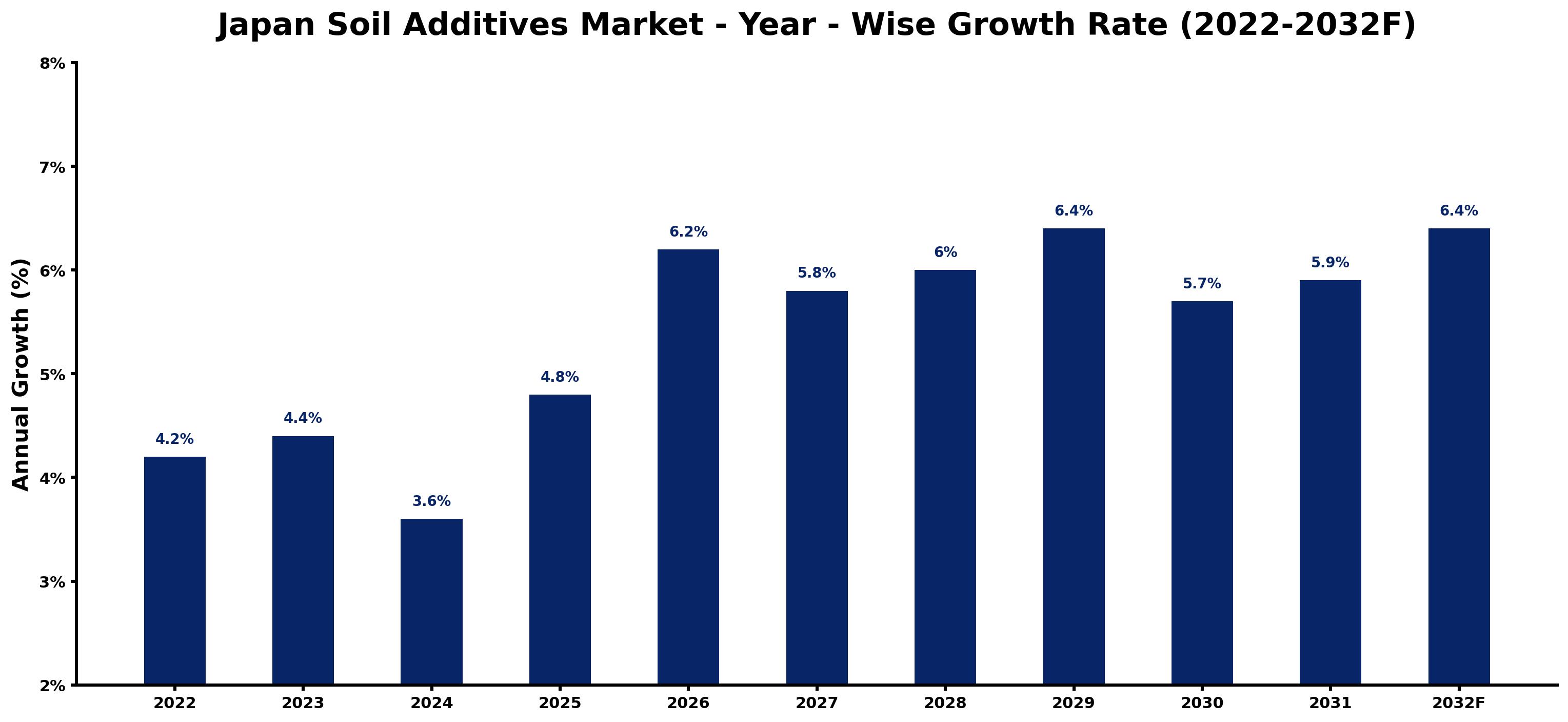
Year by year, the estimates below pair each growth rate with the development that shaped it.
| Year | Estimated Annual Growth (%) | Market Rationale |
| 2022 | 4.2 | The market showed steady growth, driven by increased awareness of soil health. |
| 2023 | 4.4 | Demand rose as organic farming practices gained popularity among producers. |
| 2024 | 3.6 | Growth slowed due to market saturation in certain regions and practices. |
| 2025 | 4.8 | The market experienced a resurgence as commercial farms expanded their operations. |
| 2026 | 6.2 | Demand is expected to surge with the introduction of new soil improvement technologies. |
| 2027 | 5.8 | Growth is projected to slow slightly as the market adjusts to new supply capabilities. |
| 2028 | 6.0 | The market is expected to rebound with renewed interest in sustainable agriculture practices. |
| 2029 | 6.4 | Peak growth will occur as investments in soil additives reach new heights. |
| 2030 | 5.7 | Growth is projected to slow as the market stabilises after rapid expansion in previous years. |
| 2031 | 5.9 | Demand will increase again as producers seek to improve crop yields. |
| 2032 | 6.4 | The market is expected to peak as sustainability initiatives gain further traction. |
Note: Market size estimations and growth projections presented in this report are based on 6Wresearch's proprietary forecasting methodology, utilizing the latest available industry data, government publications, and primary research inputs.
Japan Soil Additives Market Synopsis
Soil additives are materials that improve soil properties, such as fertility, structure, and water retention. Made from organic or synthetic materials, they play an important role in agriculture, particularly in domestic crop production. The Japan Soil Additives Market is expanding due to the increase in organic farming areas, with over 200,000 hectares dedicated to organic practices. Commercial farms, which account for 60% of usage, are driving demand as they aim to improve yields and sustainability, supported by government initiatives promoting soil health and sustainable agricultural practices.
Market Dynamics Impact Analysis (2026–2032)
| Factor | Type | Impact | Primary Segment Affected |
| Increased organic farming practices drive demand for soil additives. | Driver | High | Organic Additives |
| Technological advancements in soil improvement techniques enhance product effectiveness. | Driver | High | Biofertilizers |
| The growing area of organic farming creates a significant demand gap. | Opportunity | High | Organic Farmers |
| Investment in sustainable agriculture initiatives is rising, providing new market avenues. | Opportunity | Medium | Commercial Farms |
| Market saturation in certain regions limits growth potential for new entrants. | Restraint | High | Synthetic Additives |
| High initial costs of organic additives can deter some farmers from adoption. | Restraint | Medium | Organic Additives |
| Limited supply capacity can restrict product availability in rural areas. | Challenge | High | Biofertilizers |
| Competition from chemical fertilizers may hinder the growth of organic alternatives. | Challenge | Medium | Organic Farmers |
Evaluation of Drivers in Japan Soil Additives Market (2026–2032)
These are the developments adding the most demand over the forecast period.
| Drivers | Primary Segment Affected | Why It Matters (Evidence) |
| Rising organic farming areas increase demand for soil additives. | Organic Additives | In 2022, the organic farming area reached 200,000 hectares, prompting higher purchases of organic additives. |
| Technological advancements improve soil health and crop yields. | Biofertilizers | Biofertilizers are used in over 30% of organic farms, promoting productivity and encouraging further adoption. |
| Government initiatives support sustainable agriculture practices. | Commercial Farms | Funding for soil improvement programs has led to increased soil additive usage among commercial farms. |
| Improved yields from soil additives boost farmer incomes. | Vegetables | The average yield of vegetables has improved by 20% with soil additives, encouraging farmers to invest. |
| Growing consumer demand for organic produce drives market expansion. | Organic Farmers | As consumer preferences shift, organic farmers increasingly seek soil additives to meet quality standards. |
Volumes grow on the back of rising organic farming areas, which reached 200,000 hectares in 2022, driving demand for organic additives. Technological advancements in biofertilizers are used in over 30% of organic farms, promoting productivity and encouraging further adoption. Improved yields from soil additives have boosted vegetable production, with a 20% increase in average yields. Growing consumer demand for organic produce incentivises organic farmers to invest in soil additives to meet quality standards.
Evaluation of Restraints in Japan Soil Additives Market
The main factors holding the market back are set out below.
| Market Restraint | Primary Segment Affected | Why It Matters (Evidence) |
| Market saturation in certain regions limits growth potential. | Synthetic Additives | As the market matures, many regions have reached a saturation point, limiting new growth opportunities. |
| High initial costs deter some farmers from adopting organic additives. | Organic Additives | The cost of organic additives can be prohibitive for smaller farmers, impacting overall market penetration. |
| Limited supply capacity restricts product availability in rural areas. | Biofertilizers | Supply chain challenges can lead to shortages, particularly in remote farming regions. |
| Competition from chemical fertilizers hinders organic alternatives. | Organic Farmers | Chemical fertilizers are often cheaper and more readily available, making it difficult for organic products to compete. |
| Regulatory hurdles can slow down product approvals. | Humic Substances | Compliance with standards can delay the introduction of new soil additive products to the market. |
Japan Soil Additives Market Challenges
A lack of high-quality soil additives hampers crop production for buyers. This issue stems from limited access to specific organic materials, driving up input costs by 25% for farmers. Compliance with the JIS K 1460 standard complicates the approval process, extending time-to-market for suppliers by several months. Skills shortages in sustainable farming practices restrict effective soil management, resulting in a 20% decrease in yield for those unable to adopt advanced techniques. Additionally, fluctuating demand for organic farming inputs creates uncertainty, making it difficult for producers to maintain consistent supply chains.
Trends in the Japan Soil Additives Market
The shifts below are changing how Japan Soil Additives Market products are bought and supplied.
- Shift from Chemical to Organic Additives: Since 2020, there has been a noticeable shift towards organic additives in Japan's agricultural sector. This change is primarily driven by consumer demand for organic produce, particularly in the Tokyo region, where 37% of vegetable production now utilises organic soil additives.
- Transition to Sustainable Agricultural Practices: The adoption of sustainable practices has accelerated since 2023, with the government allocating ¥1 billion for soil improvement programs. This funding supports commercial farms in improving soil health and productivity, resulting in increased usage of soil additives.
- Emergence of Biofertilizers in Organic Farming: Biofertilizers have gained traction in organic farming since 2021, with their usage exceeding 30% on organic farms. This trend reflects a growing acceptance of natural methods to improve soil fertility and crop yields.
- Prioritisation of Soil Health in Agricultural Policies: The focus on soil health has intensified since the introduction of the GX Basic Policy in 2023. This policy aims for substantial public-private investment in decarbonisation, encouraging the use of soil additives to improve agricultural sustainability.
Investment Opportunities in the Japan Soil Additives Market
The openings below show where demand in the Japan Soil Additives Market is visible and how suppliers can enter.
- Commercial Farms Seeking Sustainable Solutions: Commercial farms, which account for 60% of soil additive usage, are increasingly looking for sustainable solutions. With a market gap of approximately ¥1 billion in soil improvement funding, suppliers can enter by partnering with local agribusinesses.
- Organic Farmers Expanding Practices: With 200,000 hectares dedicated to organic farming, the demand for organic additives is rising. Suppliers can target this market by offering certified organic products that meet the standards set by the Japan Organic Agriculture Association.
- Vegetable Producers Focusing on Yield Improvement: The average yield of vegetables has improved by 20% with soil additives, creating an opportunity for suppliers. By providing effective soil solutions, businesses can tap into the growing vegetable production sector in the Tokyo region.
- Investment in Soil Health Technologies: The government’s ¥1 billion allocation for soil improvement programs presents a unique opportunity for suppliers. Collaborating with the Ministry of Agriculture, Forestry and Fisheries can facilitate access to funding and improve market presence.
Government Initiatives in the Japan Soil Additives Market
The Waste Management and Public Cleansing Act (1970) regulates the treatment and disposal of waste, ensuring that soil additives are produced and used sustainably. This law requires producers to adhere to strict guidelines, promoting environmentally friendly practices in soil management. The act has led to improved waste treatment and a reduction in harmful substances in soil, benefiting agricultural productivity.
The Ministry of Agriculture, Forestry and Fisheries (MAFF) approves funding for soil improvement initiatives, including a recent allocation of ¥1 billion in 2023. This funding supports projects aimed at improving soil health and productivity across Japan, benefiting both producers and consumers.
Future Insight of the Japan Soil Additives Market
Emerging technologies in precision agriculture will transform demand for soil additives by 2032, allowing for more targeted applications. The government's commitment to sustainable agriculture will drive increased investment in soil improvement initiatives. Enhanced monitoring systems will enable producers to assess soil conditions in real-time, leading to better crop management. Buyers will benefit from improved yields, while suppliers will need to adapt to new standards and practices to meet the changing market requirements.
Market Segmentation Analysis
Japan Soil Additives Market report covers a detailed analysis of the following market segments:
By Additive Type – Organic Additives Lead, Biofertilizers Expected to Grow Fastest
According to Saurav Kr Singh, Senior Research Analyst at 6Wresearch, Organic Additives took 51% of additive type revenue in 2025, more than any other category. Organic additives lead the market as they are extensively utilised to enhance soil fertility and structure, particularly in the Tokyo region, a hub for vegetable production. The notable increase in organic farming area to 200,000 hectares solidifies their dominant position. The quickest growth will come from Biofertilizers, forecast to expand at a CAGR of 8.7% between 2026 and 2032. Biofertilizers are experiencing rapid growth due to their role in supporting plant growth through natural processes, with over 30% of organic farms incorporating them. This trend is expected to persist as sustainable agricultural practices gain traction. Suppliers should focus on developing organic and biofertilizer products to meet the increasing demand from farmers.
By Functionality – Nutrient Enrichment Leads, Soil Rejuvenation Expected to Grow Fastest
In 2025, Nutrient Enrichment led the functionality split with a 44% share. Nutrient enrichment stands out as the leading functionality due to its essential role in enhancing soil fertility, crucial for the productivity of Japan's agricultural land. The 20% improvement in vegetable yields underscores the importance of these additives in farming. Over 2026–2032, Soil Rejuvenation is expected to post the fastest growth, at a CAGR of 7.7%. Soil rejuvenation is the fastest-growing functionality, propelled by the urgent need to restore degraded soils, which is critical for sustainable agriculture. This trend aligns with government initiatives advocating for sustainable farming practices. Buyers should prioritise nutrient enrichment and soil rejuvenation solutions to maximise agricultural output and sustainability.
By Crop Type – Vegetables Lead, Pulses Expected to Grow Fastest
The largest crop type category in 2025 was Vegetables, at 37% of revenue. Vegetables dominate the crop type segment, significantly benefiting from soil additives, especially in regions like Tokyo where vegetable production is concentrated. The improved yields from these crops emphasise their reliance on such enhancements. Pulses are projected to grow fastest, at a CAGR of 8.4% during 2026–2032. Pulses are the fastest-growing crop type, recognised for their nitrogen fixation capabilities, which are increasingly valued in sustainable farming. The focus on crop diversity and soil health is likely to further drive this trend. Farmers should consider diversifying into pulses to leverage their benefits for soil health and align with market demands.
By End User – Commercial Farms Lead, Organic Farmers Expected to Grow Fastest
Commercial Farms accounted for 43% of the market by end user in 2025. Commercial farms account for the largest share of soil additive usage, reflecting robust demand from large-scale producers aiming to maximise yields. The scale of this segment is vital for the overall market's stability and growth. Organic Farmers are set to record the highest CAGR in this split, 7.8% over 2026–2032. Organic farmers represent the fastest-growing end user segment, driven by the increasing adoption of sustainable practices and government support for organic agriculture. Their growth indicates a significant shift towards environmentally friendly farming methods. Suppliers must cater to the specific needs of organic farmers to capitalise on this rapidly expanding segment.
Key Attractiveness of the Report
- 10 Years of Market Numbers
- Historical Data Starting from 2022 to 2025
- Base Year 2025
- Forecast Data until 2032
- Key Performance Indicators Impacting the Market
- Major Upcoming Developments and Projects
Key Highlights of the Report:
- Japan Soil Additives Market Outlook
- Market Size of Japan Soil Additives Market, 2025
- Forecast of Japan Soil Additives Market, 2032
- Historical Data and Forecast of Japan Soil Additives Revenues & Volume for the Period 2022-2032F
- Japan Soil Additives Market Trend Evolution
- Japan Soil Additives Market Drivers and Challenges
- Japan Soil Additives Price Trends
- Japan Soil Additives Porter's Five Forces
- Japan Soil Additives Industry Life Cycle
- Historical Data and Forecast of Japan Soil Additives Market Revenues & Volume By Additive Type for the Period 2022-2032F
- Historical Data and Forecast of Japan Soil Additives Market Revenues & Volume By Organic Additives for the Period 2022-2032F
- Historical Data and Forecast of Japan Soil Additives Market Revenues & Volume By Synthetic Additives for the Period 2022-2032F
- Historical Data and Forecast of Japan Soil Additives Market Revenues & Volume By Biofertilizers for the Period 2022-2032F
- Historical Data and Forecast of Japan Soil Additives Market Revenues & Volume By Humic Substances for the Period 2022-2032F
- Historical Data and Forecast of Japan Soil Additives Market Revenues & Volume By Functionality for the Period 2022-2032F
- Historical Data and Forecast of Japan Soil Additives Market Revenues & Volume By Nutrient Enrichment for the Period 2022-2032F
- Historical Data and Forecast of Japan Soil Additives Market Revenues & Volume By pH Balancing for the Period 2022-2032F
- Historical Data and Forecast of Japan Soil Additives Market Revenues & Volume By Soil Rejuvenation for the Period 2022-2032F
- Historical Data and Forecast of Japan Soil Additives Market Revenues & Volume By Microbial Activity for the Period 2022-2032F
- Historical Data and Forecast of Japan Soil Additives Market Revenues & Volume By Crop Type for the Period 2022-2032F
- Historical Data and Forecast of Japan Soil Additives Market Revenues & Volume By Vegetables for the Period 2022-2032F
- Historical Data and Forecast of Japan Soil Additives Market Revenues & Volume By Grains for the Period 2022-2032F
- Historical Data and Forecast of Japan Soil Additives Market Revenues & Volume By Pulses for the Period 2022-2032F
- Historical Data and Forecast of Japan Soil Additives Market Revenues & Volume By Oilseeds for the Period 2022-2032F
- Historical Data and Forecast of Japan Soil Additives Market Revenues & Volume By End User for the Period 2022-2032F
- Historical Data and Forecast of Japan Soil Additives Market Revenues & Volume By Organic Farmers for the Period 2022-2032F
- Historical Data and Forecast of Japan Soil Additives Market Revenues & Volume By Commercial Farms for the Period 2022-2032F
- Historical Data and Forecast of Japan Soil Additives Market Revenues & Volume By Agrochemical Companies for the Period 2022-2032F
- Historical Data and Forecast of Japan Soil Additives Market Revenues & Volume By Agribusinesses for the Period 2022-2032F
- Japan Soil Additives Import Export Trade Statistics
- Market Opportunity Assessment By Additive Type
- Market Opportunity Assessment By Functionality
- Market Opportunity Assessment By Crop Type
- Market Opportunity Assessment By End User
- Japan Soil Additives Top Companies Market Share
- Japan Soil Additives Competitive Benchmarking By Technical and Operational Parameters
- Japan Soil Additives Company Profiles
- Japan Soil Additives Key Strategic Recommendations
Market Covered
Coverage by segment is as follows.
By Additive Type
- Organic Additives
- Synthetic Additives
- Biofertilizers
- Humic Substances
By Functionality
- Nutrient Enrichment
- pH Balancing
- Soil Rejuvenation
- Microbial Activity
By Crop Type
- Vegetables
- Grains
- Pulses
- Oilseeds
By End User
- Organic Farmers
- Commercial Farms
- Agrochemical Companies
- Agribusinesses































