Japan Soil Health Enhancers Market Size & Growth Rate
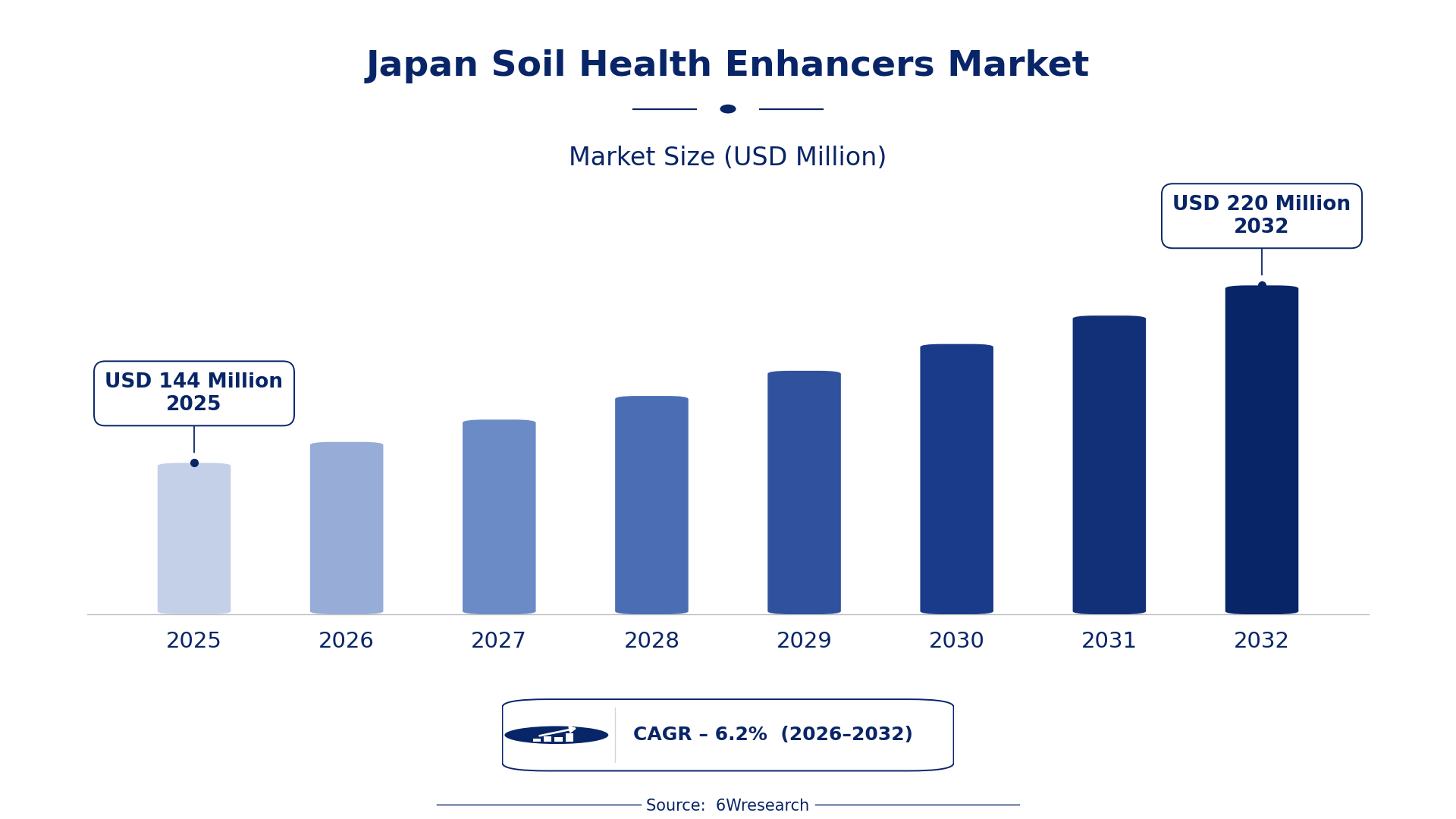
According to 6Wresearch internal database and industry insights, the Japan Soil Health Enhancers Market was valued at USD 144 Million in 2025 and is projected to reach USD 220 Million by 2032, growing at a CAGR of approximately 6.2% during 2026–2032.
Japan Soil Health Enhancers Market Highlights
| Report Metric | Details |
| Report Name | Japan Soil Health Enhancers Market (2026-2032) |
| Market Size 2025 | USD 144 Million |
| Market Size 2032 | USD 220 Million |
| Absolute Growth 2025–2032 | USD 76 Million |
| CAGR 2026–2032 | 6.2% |
| Peak Annual Growth | 7.1% in 2032 |
| Forecast Period | 2026–2032 |
| Historical Data | 2022–2025 |
| Base Year | 2025 |
| Leading Enhancer Type, 2025 | Microbial Inoculants (42% share) |
| Leading Origin, 2025 | Bio-Based (42% share) |
| Leading Application Method, 2025 | Seed Treatment (41% share) |
| Leading End User, 2025 | Precision Farmers (47% share) |
| Fastest-Growing Enhancer Type | Mycorrhizae (8.7% CAGR) |
| Fastest-Growing Origin | Fungi-Based (8.5% CAGR) |
| Fastest-Growing Application Method | Soil Incorporation (8.3% CAGR) |
| Fastest-Growing End User | Nursery Managers (8.4% CAGR) |
| Growing Sector | Organic Farming |
| Key End Users | Precision Farmers, Organic Growers, Nursery Managers, Vegetable Growers |
Japan Soil Health Enhancers Market Year-wise Growth Rate and Key Drivers (2022–2032)
This graph illustrates the annual growth rates of the market from 2022 to 2032, highlighting a steady upward trajectory and projected market expansion over the forecast period.
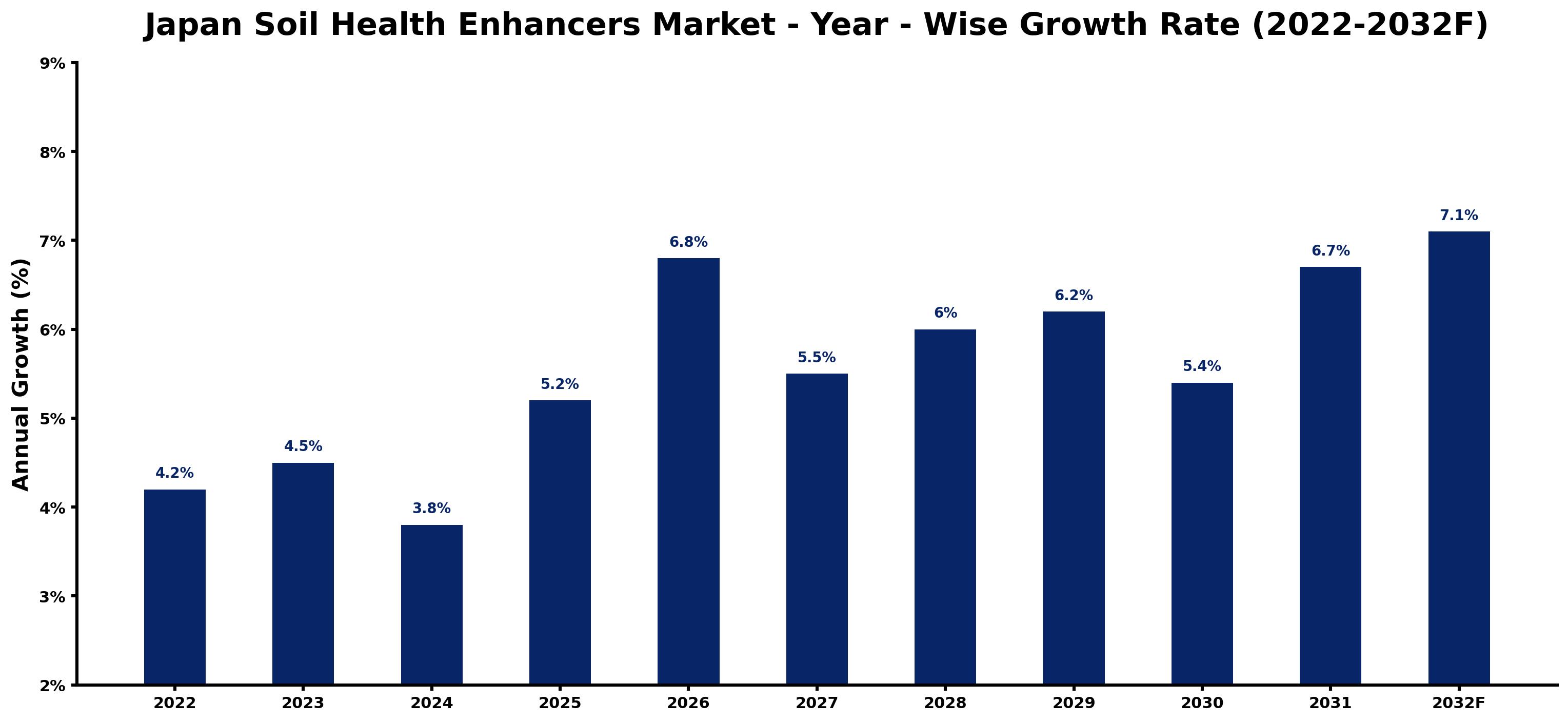
The following figures match every annual growth estimate with the main market development of that year, giving the reasoning behind each rise or slowdown.
| Year | Estimated Annual Growth (%) | Market Rationale |
| 2022 | 4.2 | The market experienced moderate growth due to increasing interest in sustainable farming practices. |
| 2023 | 4.5 | Demand rose as organic farming initiatives gained traction among domestic users. |
| 2024 | 3.8 | Growth slowed slightly as market adjustments occurred following previous rapid expansions. |
| 2025 | 5.2 | The market accelerated as more farmers adopted soil health products for improved yields. |
| 2026 | 6.8 | Demand surged with rising awareness of environmental conservation and soil health benefits. |
| 2027 | 5.5 | Growth decelerated as market saturation began to affect new customer acquisition. |
| 2028 | 6.0 | Demand increased again as new products entered the market, attracting interest. |
| 2029 | 6.2 | The market continued to expand as precision farming techniques became more widespread. |
| 2030 | 5.4 | Growth slowed as competition intensified among soil health product providers. |
| 2031 | 6.7 | Demand rose again as urban agriculture initiatives gained momentum across regions. |
| 2032 | 7.1 | The market peaked with significant investment in sustainable agricultural practices. |
Note: Market size estimations and growth projections presented in this report are based on 6Wresearch's proprietary forecasting methodology, utilizing the latest available industry data, government publications, and primary research inputs.
Japan Soil Health Enhancers Market Synopsis
Soil health products improve soil quality and fertility, often made from natural substances like microbes and organic matter. The Japan Soil Health Market is expanding, driven by approximately 1.2 million hectares of organic farmland and government support for sustainable practices. Growth is propelled by a heightened focus on environmental conservation and the adoption of advanced farming techniques, particularly in organic farming and precision agriculture.
Market Dynamics Impact Analysis (2026–2032)
| Factor | Type | Impact | Primary Segment Affected |
| Growing adoption of organic farming practices | Driver | High | Microbial Inoculants |
| Increased focus on sustainability in agriculture | Driver | High | Bio-Based |
| Rising demand for innovative soil health products | Opportunity | Medium | Mycorrhizae |
| Expansion of urban agriculture initiatives | Opportunity | Medium | Seaweed Extracts |
| Limited awareness among traditional farmers | Restraint | Medium | Humic Substance |
| High initial investment costs for advanced products | Restraint | High | Fulvic Acid |
| Aging farmer population affecting adoption rates | Challenge | High | Precision Farmers |
| Competition from synthetic alternatives in the market | Challenge | Medium | Organic Growers |
Evaluation of Drivers in Japan Soil Health Enhancers Market (2026–2032)
Below are the drivers that matter most for revenue growth, with supporting evidence.
| Drivers | Primary Segment Affected | Why It Matters (Evidence) |
| Increased organic farmland | Microbial Inoculants | Approximately 1.2 million hectares of organic farmland in Japan drives demand for microbial products. |
| Government support for sustainable practices | Bio-Based | The government promotes organic farming through initiatives, leading to higher usage of bio-based products. |
| Advancements in agricultural technology | Mycorrhizae | New mycorrhizal products enhance nutrient absorption, appealing to modern farmers seeking efficiency. |
| Growth in urban agriculture | Seaweed Extracts | Urban farming initiatives are driving demand for seaweed extracts among local growers, with a 20% increase in usage. |
| Consumer preference for organic produce | Fulvic Acid | Consumer interest in organic vegetables boosts the use of fulvic acid in production, reflecting changing agricultural practices. |
Demand is strongest in the Tokyo region, where approximately 1.2 million hectares of organic farmland drive the adoption of microbial products. Increasing support for sustainable practices is boosting the use of bio-based products as organic farming gains traction. New mycorrhizal products improve nutrient absorption, appealing to modern farmers. Rising consumer preference for organic produce is driving the use of fulvic acid in organic vegetable production, reflecting evolving agricultural practices.
Evaluation of Restraints in Japan Soil Health Enhancers Market
The main factors holding the market back are set out below.
| Market Restraint | Primary Segment Affected | Why It Matters (Evidence) |
| Limited awareness among traditional farmers | Humic Substance | Many traditional farmers lack knowledge about the benefits of humic substances, hindering adoption rates. |
| High initial investment costs for advanced products | Fulvic Acid | The cost of advanced fulvic acid products can deter small-scale farmers from purchasing, with prices often exceeding JPY 1 million. |
| Aging farmer population affecting adoption rates | Precision Farmers | With an average age of 67, many farmers are reluctant to adopt new practices, impacting overall market growth. |
| Competition from synthetic alternatives in the market | Organic Growers | Synthetic products often offer lower prices, making it hard for organic options to compete effectively. |
| Regulatory hurdles for new product approvals | Mycorrhizae | New mycorrhizal products face lengthy approval processes, delaying market entry and increasing costs. |
Japan Soil Health Enhancers Market Challenges
In rural areas, many farmers face high costs due to limited access to soil health enhancers, inflating production expenses by up to 20% for small-scale producers. A shortage of skilled agricultural workers exacerbates this issue, causing delays in effective soil management practices that can lead to reduced crop yields for buyers. Buyers also encounter challenges from changing regulations around organic certifications, resulting in compliance costs that can reach JPY 5 million annually for some farms. The aging farmer population, with an average age of 67, restricts the adoption of new technologies, hindering overall market growth for suppliers.
Trends in the Japan Soil Health Enhancers Market
The shifts below are changing how Japan Soil Health Enhancers Market products are bought and supplied.
- Precision Farmers Adopting Advanced Techniques: Precision farmers are increasingly using advanced soil health products, with a reported 47% market share in 2025, reflecting a shift towards technology-driven agriculture.
- Urban Agriculture Initiatives Gaining Popularity: Since 2023, urban agriculture initiatives have expanded significantly, with a notable increase in local farms adopting soil health products to improve yield and sustainability.
- Growing Demand for Bio-Based Products: The bio-based segment has seen a surge in demand, with 42% market share in 2025, as consumers and farmers alike prioritise sustainable farming practices.
- Rising Use of Mycorrhizae in Nursery Management: Mycorrhizae are increasingly employed in nursery management, particularly in urban areas, with an 8.7% CAGR projected from 2026 to 2032.
Investment Opportunities in the Japan Soil Health Enhancers Market
Several openings in the Japan Soil Health Enhancers Market merit attention from investors.
- Investment in Urban Agriculture Facilities: With urban agriculture expanding, there is an opportunity to supply soil health products to local farms, especially in metropolitan areas like Tokyo, where demand is rising.
- Focus on Sustainable Farming Practices: The Japanese government allocated JPY 5 billion for sustainable farming practices, creating a gap for suppliers of organic products to meet this growing demand.
- Development of Advanced Soil Health Products: The market for advanced soil health products is expanding, with a projected growth rate of 8.5% for fungi-based products, appealing to forward-thinking farmers.
- Support for Research on Soil Health Technologies: In 2023, the government funded research on soil health technologies, providing opportunities for companies to develop and supply new solutions.
Government Initiatives in the Japan Soil Health Enhancers Market
The Waste Management and Public Cleansing Act of 1970 regulates the treatment of waste, adding to the framework for sustainable agriculture by ensuring that soil health products are produced responsibly. This law complements newer initiatives aimed at promoting organic farming and improving soil quality, ensuring compliance with environmental standards and improving market access for producers.
In 2023, the government allocated JPY 5 billion for sustainable farming practices, administered by the Ministry of Agriculture, Forestry and Fisheries (MAFF), which supports the development and adoption of soil health technologies, enabling buyers to access innovative solutions.
Future Insight of the Japan Soil Health Enhancers Market
The introduction of updated standards for soil enhancers will streamline compliance processes, benefiting suppliers and buyers alike. By 2032, the government’s funding for research on soil health technologies will lead to more effective products, improving user adoption rates. Urban areas will increasingly implement advanced practices in nursery management, improving soil quality and supporting the growth of organic farming. The expansion of organic farmland, which reached approximately 1.2 million hectares in 2022, will further drive demand for these enhancers.
Market Segmentation Analysis
Japan Soil Health Enhancers Market report covers a detailed analysis of the following market segments:
By Enhancer Type – Microbial Inoculants Lead, Mycorrhizae Expected to Grow Fastest
According to Saurav Kr Singh, Senior Research Analyst at 6Wresearch, Microbial Inoculants held 42% of the Japan Soil Health Enhancers Market by enhancer type in 2025. Microbial inoculants hold the largest share due to their extensive use in approximately 30% of organic farms in Japan, where they are essential for enhancing nutrient uptake. This widespread adoption is influenced by the increasing focus on sustainable farming practices. Over 2026–2032, Mycorrhizae is expected to post the fastest growth, at a CAGR of 8.7%. The mycorrhizae segment is experiencing rapid growth as they promote beneficial relationships between fungi and plant roots, significantly improving water and nutrient absorption. Their rising popularity is evident in urban nursery management, where efficient resource use is critical. This trend indicates that suppliers should focus on developing and promoting mycorrhizae products to meet growing demand.
By Origin – Bio-Based Leads, Fungi-Based Expected to Grow Fastest
In 2025, Bio-Based led the origin split with a 42% share. Bio-based enhancers dominate the market as they are derived from natural sources, appealing to organic farming practices. Their appeal is further strengthened by government initiatives supporting sustainable agricultural practices. The quickest growth will come from Fungi-Based, forecast to expand at a CAGR of 8.5% between 2026 and 2032. Fungi-based enhancers are gaining traction as they effectively utilise fungi to boost soil health and crop productivity. This growth is particularly noticeable in urban farming settings, where innovative practices are being adopted. Suppliers should consider investing in fungi-based products to capitalise on this emerging trend.
By Application Method – Seed Treatment Leads, Soil Incorporation Expected to Grow Fastest
With 41% of application method revenue in 2025, Seed Treatment was the largest category. Seed treatment methods lead the market as they are specifically designed to enhance germination and early growth, which is vital for successful crop establishment. Their effectiveness in improving yields makes them a preferred choice among farmers. Soil Incorporation is set to record the highest CAGR in this split, 8.3% over 2026–2032. Soil incorporation techniques are rapidly gaining popularity as they directly improve soil health and nutrient content, crucial for sustainable farming. This method's effectiveness is increasingly recognised in rural agricultural extension services. This shift suggests that suppliers should enhance their offerings around soil incorporation methods to attract more users.
By End User – Precision Farmers Lead, Nursery Managers Expected to Grow Fastest
Precision Farmers accounted for 47% of the market by end user in 2025. Precision farmers represent the largest segment as they employ advanced techniques and products to maximise crop yields, reflecting their need for high-performance enhancers. Their focus on efficiency and productivity drives substantial demand in the market. Nursery Managers are projected to grow fastest, at a CAGR of 8.4% during 2026–2032. Nursery managers are experiencing the fastest growth as they increasingly use soil health enhancers to ensure healthy plant growth in nurseries. This trend is particularly important as urban gardening continues to rise. Suppliers should tailor their strategies to meet the specific needs of nursery managers, who are becoming key customers.
Key Attractiveness of the Report
- 10 Years of Market Numbers
- Historical Data Starting from 2022 to 2025
- Base Year 2025
- Forecast Data until 2032
- Key Performance Indicators Impacting the Market
- Major Upcoming Developments and Projects
Key Highlights of the Report:
- Japan Soil Health Enhancers Market Outlook
- Market Size of Japan Soil Health Enhancers Market, 2025
- Forecast of Japan Soil Health Enhancers Market, 2032
- Historical Data and Forecast of Japan Soil Health Enhancers Revenues & Volume for the Period 2022-2032F
- Japan Soil Health Enhancers Market Trend Evolution
- Japan Soil Health Enhancers Market Drivers and Challenges
- Japan Soil Health Enhancers Price Trends
- Japan Soil Health Enhancers Porter's Five Forces
- Japan Soil Health Enhancers Industry Life Cycle
- Historical Data and Forecast of Japan Soil Health Enhancers Market Revenues & Volume By Enhancer Type for the Period 2022-2032F
- Historical Data and Forecast of Japan Soil Health Enhancers Market Revenues & Volume By Microbial Inoculants for the Period 2022-2032F
- Historical Data and Forecast of Japan Soil Health Enhancers Market Revenues & Volume By Mycorrhizae for the Period 2022-2032F
- Historical Data and Forecast of Japan Soil Health Enhancers Market Revenues & Volume By Fulvic Acid for the Period 2022-2032F
- Historical Data and Forecast of Japan Soil Health Enhancers Market Revenues & Volume By Seaweed Extracts for the Period 2022-2032F
- Historical Data and Forecast of Japan Soil Health Enhancers Market Revenues & Volume By Origin for the Period 2022-2032F
- Historical Data and Forecast of Japan Soil Health Enhancers Market Revenues & Volume By Bio-Based for the Period 2022-2032F
- Historical Data and Forecast of Japan Soil Health Enhancers Market Revenues & Volume By Fungi-Based for the Period 2022-2032F
- Historical Data and Forecast of Japan Soil Health Enhancers Market Revenues & Volume By Humic Substance for the Period 2022-2032F
- Historical Data and Forecast of Japan Soil Health Enhancers Market Revenues & Volume By Marine Bio for the Period 2022-2032F
- Historical Data and Forecast of Japan Soil Health Enhancers Market Revenues & Volume By Application Method for the Period 2022-2032F
- Historical Data and Forecast of Japan Soil Health Enhancers Market Revenues & Volume By Seed Treatment for the Period 2022-2032F
- Historical Data and Forecast of Japan Soil Health Enhancers Market Revenues & Volume By Soil Incorporation for the Period 2022-2032F
- Historical Data and Forecast of Japan Soil Health Enhancers Market Revenues & Volume By Drip Systems for the Period 2022-2032F
- Historical Data and Forecast of Japan Soil Health Enhancers Market Revenues & Volume By Spray Application for the Period 2022-2032F
- Historical Data and Forecast of Japan Soil Health Enhancers Market Revenues & Volume By End User for the Period 2022-2032F
- Historical Data and Forecast of Japan Soil Health Enhancers Market Revenues & Volume By Precision Farmers for the Period 2022-2032F
- Historical Data and Forecast of Japan Soil Health Enhancers Market Revenues & Volume By Nursery Managers for the Period 2022-2032F
- Historical Data and Forecast of Japan Soil Health Enhancers Market Revenues & Volume By Organic Growers for the Period 2022-2032F
- Historical Data and Forecast of Japan Soil Health Enhancers Market Revenues & Volume By Vegetable Growers for the Period 2022-2032F
- Japan Soil Health Enhancers Import Export Trade Statistics
- Market Opportunity Assessment By Enhancer Type
- Market Opportunity Assessment By Origin
- Market Opportunity Assessment By Application Method
- Market Opportunity Assessment By End User
- Japan Soil Health Enhancers Top Companies Market Share
- Japan Soil Health Enhancers Competitive Benchmarking By Technical and Operational Parameters
- Japan Soil Health Enhancers Company Profiles
- Japan Soil Health Enhancers Key Strategic Recommendations
Market Covered
The study includes the following segmentation.
By Enhancer Type
- Microbial Inoculants
- Mycorrhizae
- Fulvic Acid
- Seaweed Extracts
By Origin
- Bio-Based
- Fungi-Based
- Humic Substance
- Marine Bio
By Application Method
- Seed Treatment
- Soil Incorporation
- Drip Systems
- Spray Application
By End User
- Precision Farmers
- Nursery Managers
- Organic Growers
- Vegetable Growers































