Japan Soil Health Market Size & Growth Rate
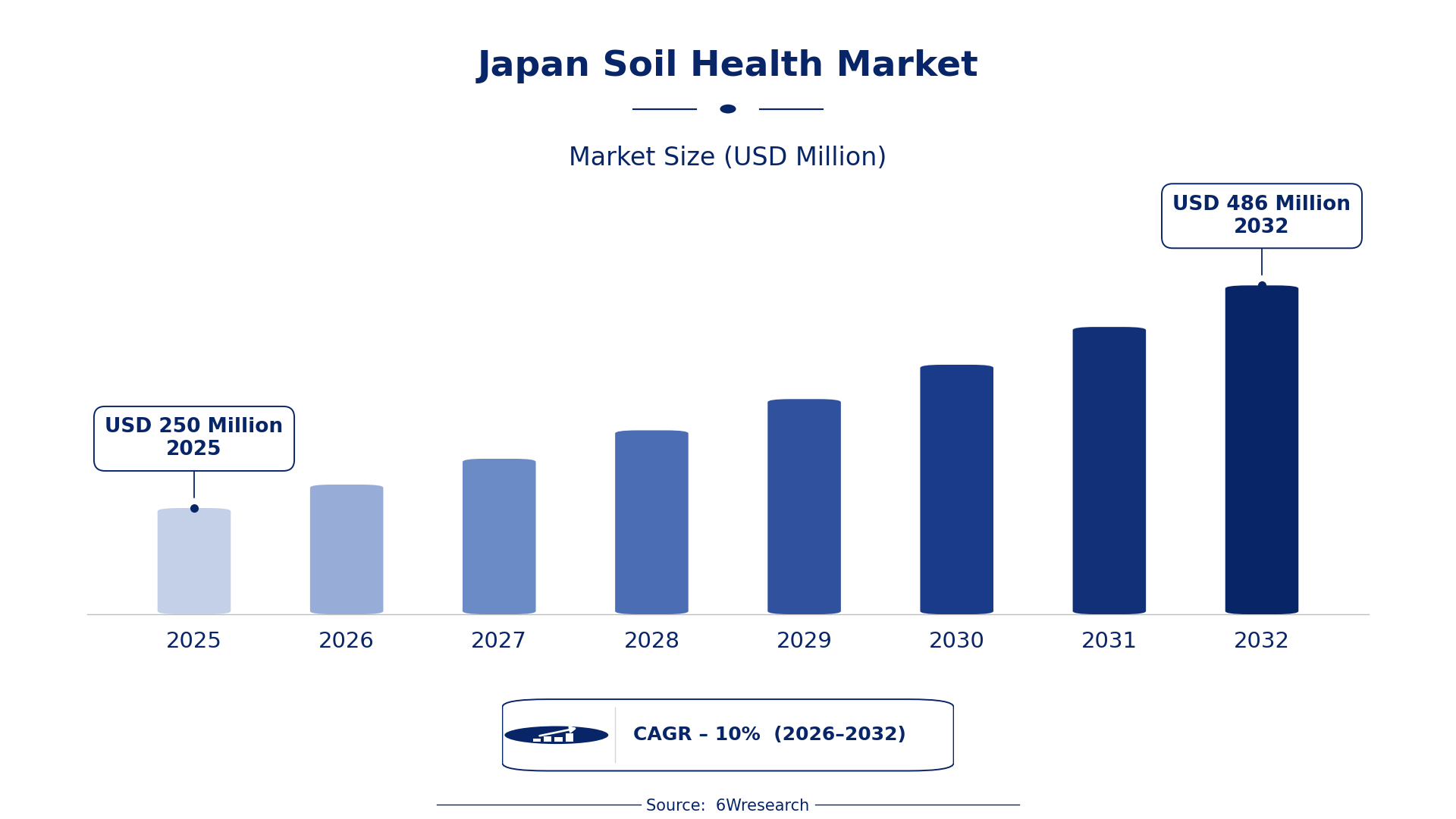
According to 6Wresearch internal database and industry insights, the Japan Soil Health Market was valued at USD 250 Million in 2025 and is projected to reach USD 486 Million by 2032, growing at a CAGR of approximately 10% during 2026–2032.
Japan Soil Health Market Highlights
| Report Metric | Details |
| Report Name | Japan Soil Health Market (2026-2032) |
| Market Size 2025 | USD 250 Million |
| Market Size 2032 | USD 486 Million |
| Absolute Growth 2025–2032 | USD 236 Million |
| CAGR 2026–2032 | 10% |
| Peak Annual Growth | 10.9% in 2026 |
| Forecast Period | 2026–2032 |
| Historical Data | 2022–2025 |
| Base Year | 2025 |
| Leading Product Type, 2025 | Organic Fertilizer (36% share) |
| Leading Improvement Method, 2025 | Nutrient Enrichment (39% share) |
| Leading Application Area, 2025 | Farmland (49% share) |
| Leading End User, 2025 | Organic Farmers (38% share) |
| Fastest-Growing Product Type | Biochar (13.9% CAGR) |
| Fastest-Growing Improvement Method | Carbon Sequestration (13.6% CAGR) |
| Fastest-Growing Application Area | Soil Conditioning (12.3% CAGR) |
| Fastest-Growing End User | Agri-Researchers (12.7% CAGR) |
| Growing Sector | sustainable agriculture |
| Key End Users | organic farmers, agri-cooperatives, agricultural researchers |
Japan Soil Health Market Year-wise Growth Rate and Key Drivers (2022–2032)
This graph illustrates the annual growth rates of the market from 2022 to 2032, highlighting a steady upward trajectory and projected market expansion over the forecast period.
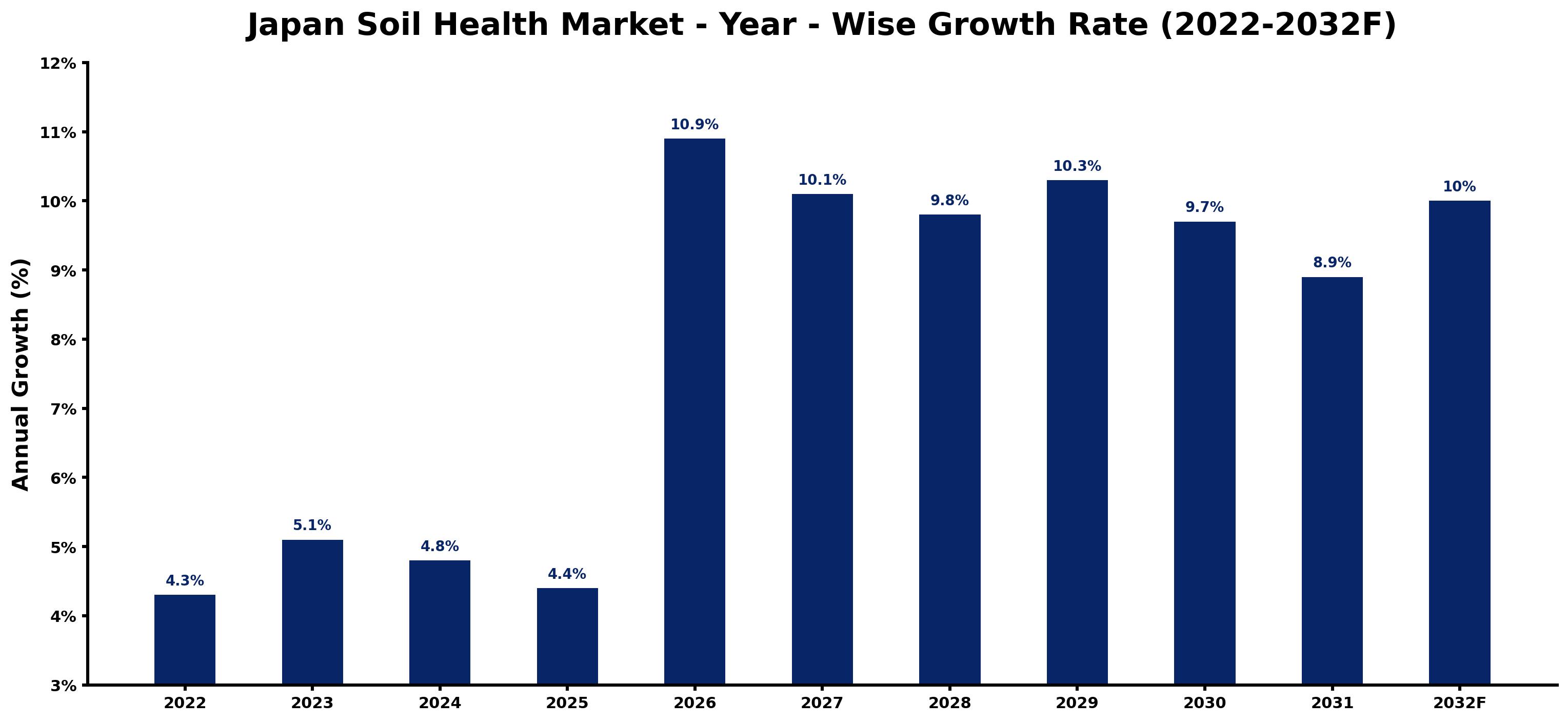
Year by year, the estimates below pair each growth rate with the development that shaped it.
| Year | Estimated Annual Growth (%) | Market Rationale |
| 2022 | 4.3 | The market showed steady growth as organic farming practices gained traction. |
| 2023 | 5.1 | Growth accelerated due to increased awareness of sustainable agriculture among farmers. |
| 2024 | 4.8 | A slight slowdown occurred as some farmers hesitated to switch to new products. |
| 2025 | 4.4 | Continued interest in soil health products maintained positive growth, albeit at a slower pace. |
| 2026 | 10.9 | A surge in demand is anticipated as government initiatives gain momentum nationwide. |
| 2027 | 10.1 | Growth will moderate slightly as the market adjusts to the previous year's rapid expansion. |
| 2028 | 9.8 | Demand is projected to remain strong but slow as market saturation begins to take effect. |
| 2029 | 10.3 | A rebound in growth is anticipated as new soil health products enter the market. |
| 2030 | 9.7 | Growth is expected to decelerate as farmers focus on optimising existing product usage. |
| 2031 | 8.9 | The market will continue to expand, driven by rising awareness of environmental sustainability. |
| 2032 | 10.0 | A renewed interest in soil health products is expected as new technologies emerge. |
Note: Market size estimations and growth projections presented in this report are based on 6Wresearch's proprietary forecasting methodology, utilizing the latest available industry data, government publications, and primary research inputs.
Japan Soil Health Market Synopsis
Soil health products in Japan, including organic fertilizers, biochar, and soil amendments, improve soil fertility and structure, supporting sustainable agricultural practices. The Japan Soil Health Market is expanding due to rising demand from organic farmers and the agricultural sector's focus on sustainability. Government initiatives promoting organic farming practices are driving this growth, with a target to increase organic farmland to 3% of total agricultural land by 2030.
Market Dynamics Impact Analysis (2026–2032)
| Factor | Type | Impact | Primary Segment Affected |
| Rising adoption of organic farming practices | Driver | High | Organic Fertilizer |
| Increased government support for sustainable agriculture | Driver | High | Soil Amendments |
| Growing demand for carbon sequestration solutions | Opportunity | Medium | Biochar |
| Expanding organic farmland initiatives | Opportunity | High | Nutrient Enrichment |
| Limited awareness of soil health benefits among some farmers | Restraint | Medium | Soil Amendments |
| Competition from synthetic fertilizers | Restraint | High | Organic Fertilizer |
| High initial costs of organic products | Challenge | Medium | Biochar |
| Slow adoption of new technologies in rural areas | Challenge | High | Soil Conditioning |
Evaluation of Drivers in Japan Soil Health Market (2026–2032)
The table below links each growth driver to the segment it affects and the evidence for it.
| Drivers | Primary Segment Affected | Why It Matters (Evidence) |
| Increased organic farming practices | Organic Fertilizer | In 2023, Japan had over 200,000 organic farmers, boosting demand for organic fertilizers. |
| Support for sustainable agriculture | Soil Amendments | The Ministry of Agriculture, Forestry and Fisheries promotes sustainable practices, increasing demand for soil health products. |
| Growing interest in carbon sequestration | Biochar | Biochar usage is recognised under the JIS A 6201 standard, increasing its appeal for environmental benefits. |
| Rising awareness of soil health importance | Nutrient Enrichment | Japan aims to increase organic farmland to 3% of total agricultural land by 2030. |
| Demand for improved crop yields | Soil Conditioning | With over 1 million hectares of organic farmland, farmers seek effective soil conditioning solutions. |
Orders keep climbing as the Tohoku region embraces organic farming, with over 1 million hectares dedicated to organic agriculture. Support for sustainable practices leads to increased demand for soil health products. The recognition of biochar under the JIS A 6201 standard drives interest in carbon sequestration solutions. Japan's target to increase organic farmland to 3% by 2030 supports the need for nutrient enrichment products. Farmers are increasingly looking for effective ways to improve soil quality, particularly in regions with expanding organic farmland.
Evaluation of Restraints in Japan Soil Health Market
The following restraints limit how fast demand can grow.
| Market Restraint | Primary Segment Affected | Why It Matters (Evidence) |
| Limited awareness of soil health benefits among some farmers | Soil Amendments | Many farmers remain uninformed about the advantages of soil amendments, hindering adoption. |
| Competition from synthetic fertilizers | Organic Fertilizer | Synthetic fertilizers remain cheaper, making them more attractive to cost-sensitive farmers. |
| High initial costs of organic products | Biochar | The upfront investment for biochar can deter farmers from switching from conventional methods. |
| Slow adoption of new technologies in rural areas | Soil Conditioning | Many rural farmers lack access to the latest soil conditioning technologies, limiting growth. |
| Regulatory hurdles for new product approvals | Nutrient Enrichment | Stringent regulations can delay the introduction of new nutrient enrichment products. |
Japan Soil Health Market Challenges
Intense competition among producers drives prices down, compelling suppliers to compromise on quality, which ultimately impacts buyer satisfaction. This situation arises from the high number of market participants, leading to a 15% decline in average profit margins for suppliers. Frequent natural disasters disrupt supply chains, especially in the Tohoku region, a key area for organic farming, causing delivery delays for farmers. A shortage of skilled workers in sustainable farming practices limits effective product application, costing producers around 20% in operational efficiency due to inadequate training.
Trends in the Japan Soil Health Market
Below are the shifts with the largest effect on the Japan Soil Health Market.
- Shift from Conventional to Organic Farming: Since 2022, Japan has seen a shift towards organic farming practices, particularly in the Tohoku region, where over 1 million hectares are now dedicated to organic agriculture. This trend is driving demand for organic fertilizers, which are essential for improving soil quality.
- Increased Focus on Carbon Sequestration: The emphasis on carbon sequestration has grown since 2022, with biochar becoming a popular choice among farmers. The recognition of biochar under the JIS A 6201 standard has encouraged its adoption, with applications in various agricultural sectors.
- Expansion of Organic Farmland Initiatives: The Japanese government has set a target to increase organic farmland to 3% of total agricultural land by 2030. This initiative is driving investments in organic fertilizers and soil amendments, creating opportunities for suppliers in the market.
- Growing Demand for Sustainable Practices: As environmental concerns grow, farmers are increasingly adopting sustainable practices. Government initiatives launched in 2022 have played a role in promoting soil health products across Japan, leading to a surge in demand.
Investment Opportunities in the Japan Soil Health Market
Where to invest in the Japan Soil Health Market: the main openings are set out below.
- Partner with Local Agri-Cooperatives: Now is an ideal time to collaborate with local agri-cooperatives, which are instrumental in distributing soil health products to farmers. With approximately 200,000 organic farmers in Japan, this partnership can broaden market reach.
- Invest in New Soil Health Products: The current emphasis on sustainability presents an opportunity to invest in new soil health products. Government initiatives have fostered a favourable environment for solutions, attracting organic farmers seeking effective products.
- Supply Biochar for Carbon Sequestration: With the rising interest in carbon sequestration, supplying biochar can satisfy the growing demand. Its recognition under the JIS A 6201 standard enhances its marketability among environmentally conscious farmers.
- Explore Nutrient Enrichment Solutions: The push for organic farming creates opportunities to provide nutrient enrichment solutions. Farmers are increasingly searching for effective methods to enhance soil fertility, particularly in regions with expanding organic farmland.
Government Initiatives in the Japan Soil Health Market
The Waste Management and Public Cleansing Act of 1970 regulates the treatment and disposal of waste, impacting producers by ensuring environmentally safe practices. This law lays the groundwork for sustainable agriculture in Japan, promoting the use of organic fertilizers and soil amendments. The government aims to increase organic farmland to 3% of total agricultural land by 2030, supporting the growth of soil health products.
In 2023, the Soil Health Initiative, funded by the Ministry of Agriculture, Forestry and Fisheries, seeks to improve soil quality nationwide. The initiative provides farmers with resources and guidance, assisting them in transitioning to sustainable practices.
Future Insight of the Japan Soil Health Market
Advancements in precision agriculture technology will reshape the demand for soil health products by 2032, enabling farmers to apply inputs more effectively. The government's objective to expand organic farmland to 3% by 2030 will compel suppliers to enhance their production capabilities. By 2025, efforts to reduce soil erosion by 30% will drive demand for effective soil amendments. Improved standards for organic fertilizers will elevate product quality, delivering greater value for both buyers and suppliers.
Market Segmentation Analysis
Japan Soil Health Market report covers a detailed analysis of the following market segments:
By Product Type – Organic Fertilizer Leads, Biochar Expected to Grow Fastest
According to Ayushi Shukla, Senior Research Analyst at 6Wresearch, with 36% of product type revenue in 2025, Organic Fertilizer was the largest category. Organic fertilizers hold the largest market share due to their critical function in enhancing soil fertility for Japan's agricultural sector. The strong demand from farmers, particularly in the Tohoku region known for organic farming, reinforces their leading position. Biochar is set to record the highest CAGR in this split, 13.9% over 2026–2032. Biochar is experiencing rapid growth as its benefits for carbon sequestration and soil improvement become more recognised. Initiatives promoting sustainable practices are accelerating its adoption, indicating a widening lead for organic fertilizers as they also incorporate biochar. Suppliers should focus on developing organic fertilizers that integrate biochar to meet the growing demand for sustainable soil health solutions.
By Improvement Method – Nutrient Enrichment Leads, Carbon Sequestration Expected to Grow Fastest
Nutrient Enrichment held 39% of the Japan Soil Health Market by improvement method in 2025. Nutrient enrichment is the leading method as it is vital for improving soil nutrients, directly impacting agricultural productivity. This method is widely adopted across Japan, particularly in regions with intensive farming practices. Carbon Sequestration is projected to grow fastest, at a CAGR of 13.6% during 2026–2032. Carbon sequestration is the fastest-growing method, with its environmental benefits aligning with Japan's targets to cut greenhouse gas emissions by 46% by 2030. This focus on sustainability will likely enhance the prominence of nutrient enrichment as well. Buyers should adopt nutrient enrichment alongside carbon sequestration techniques to align with environmental goals and improve soil health.
By Application Area – Farmland Leads, Soil Conditioning Expected to Grow Fastest
Farmland took 49% of application area revenue in 2025, more than any other category. Farmland is the primary application area for soil health products, encompassing most agricultural activities in Japan. With over 1 million hectares dedicated to organic farming, this segment is crucial for maintaining soil health among farmers. Over 2026–2032, Soil Conditioning is expected to post the fastest growth, at a CAGR of 12.3%. Soil conditioning is the fastest-growing application area, as it plays a key role in improving soil structure essential for crop productivity. The increasing emphasis on sustainable agricultural practices is driving demand for effective soil conditioning solutions. Suppliers must prioritise soil conditioning products to cater to the rising demand for improved soil structure in agriculture.
By End User – Organic Farmers Lead, Agri-Researchers Expected to Grow Fastest
The largest end user category in 2025 was Organic Farmers, at 38% of revenue. Organic farmers are the largest user group of soil health products, relying on these solutions to maintain soil fertility and promote sustainable farming. With approximately 200,000 organic farmers in Japan, this segment is well-established and continues to expand. The quickest growth will come from Agri-Researchers, forecast to expand at a CAGR of 12.7% between 2026 and 2032. Agri-researchers are the fastest-growing user group, as their involvement in studying and developing new soil health practices becomes increasingly vital. Their engagement in research initiatives is driving demand for innovative soil health products. Suppliers should collaborate with agri-researchers to support the development of new soil health solutions and address emerging market needs.
Key Attractiveness of the Report
- 10 Years of Market Numbers
- Historical Data Starting from 2022 to 2025
- Base Year 2025
- Forecast Data until 2032
- Key Performance Indicators Impacting the Market
- Major Upcoming Developments and Projects
Key Highlights of the Report:
- Japan Soil Health Market Outlook
- Market Size of Japan Soil Health Market, 2025
- Forecast of Japan Soil Health Market, 2032
- Historical Data and Forecast of Japan Soil Health Revenues & Volume for the Period 2022-2032F
- Japan Soil Health Market Trend Evolution
- Japan Soil Health Market Drivers and Challenges
- Japan Soil Health Price Trends
- Japan Soil Health Porter's Five Forces
- Japan Soil Health Industry Life Cycle
- Historical Data and Forecast of Japan Soil Health Market Revenues & Volume By Product Type for the Period 2022-2032F
- Historical Data and Forecast of Japan Soil Health Market Revenues & Volume By Organic Fertilizer for the Period 2022-2032F
- Historical Data and Forecast of Japan Soil Health Market Revenues & Volume By Biochar for the Period 2022-2032F
- Historical Data and Forecast of Japan Soil Health Market Revenues & Volume By Soil Amendments for the Period 2022-2032F
- Historical Data and Forecast of Japan Soil Health Market Revenues & Volume By Cover Cropping for the Period 2022-2032F
- Historical Data and Forecast of Japan Soil Health Market Revenues & Volume By Improvement Method for the Period 2022-2032F
- Historical Data and Forecast of Japan Soil Health Market Revenues & Volume By Nutrient Enrichment for the Period 2022-2032F
- Historical Data and Forecast of Japan Soil Health Market Revenues & Volume By Carbon Sequestration for the Period 2022-2032F
- Historical Data and Forecast of Japan Soil Health Market Revenues & Volume By pH Balancing for the Period 2022-2032F
- Historical Data and Forecast of Japan Soil Health Market Revenues & Volume By Erosion Control for the Period 2022-2032F
- Historical Data and Forecast of Japan Soil Health Market Revenues & Volume By Application Area for the Period 2022-2032F
- Historical Data and Forecast of Japan Soil Health Market Revenues & Volume By Farmland for the Period 2022-2032F
- Historical Data and Forecast of Japan Soil Health Market Revenues & Volume By Soil Conditioning for the Period 2022-2032F
- Historical Data and Forecast of Japan Soil Health Market Revenues & Volume By Crop Fields for the Period 2022-2032F
- Historical Data and Forecast of Japan Soil Health Market Revenues & Volume By Sustainable Farming for the Period 2022-2032F
- Historical Data and Forecast of Japan Soil Health Market Revenues & Volume By End User for the Period 2022-2032F
- Historical Data and Forecast of Japan Soil Health Market Revenues & Volume By Organic Farmers for the Period 2022-2032F
- Historical Data and Forecast of Japan Soil Health Market Revenues & Volume By Agri-Researchers for the Period 2022-2032F
- Historical Data and Forecast of Japan Soil Health Market Revenues & Volume By Agri-Cooperatives for the Period 2022-2032F
- Historical Data and Forecast of Japan Soil Health Market Revenues & Volume By Rural Development Orgs for the Period 2022-2032F
- Japan Soil Health Import Export Trade Statistics
- Market Opportunity Assessment By Product Type
- Market Opportunity Assessment By Improvement Method
- Market Opportunity Assessment By Application Area
- Market Opportunity Assessment By End User
- Japan Soil Health Top Companies Market Share
- Japan Soil Health Competitive Benchmarking By Technical and Operational Parameters
- Japan Soil Health Company Profiles
- Japan Soil Health Key Strategic Recommendations
Market Covered
The report covers the following segments.
By Product Type
- Organic Fertilizer
- Biochar
- Soil Amendments
- Cover Cropping
By Improvement Method
- Nutrient Enrichment
- Carbon Sequestration
- pH Balancing
- Erosion Control
By Application Area
- Farmland
- Soil Conditioning
- Crop Fields
- Sustainable Farming
By End User
- Organic Farmers
- Agri-Researchers
- Agri-Cooperatives
- Rural Development Orgs































