Japan Soil Health & Treatment Market Size & Growth Rate
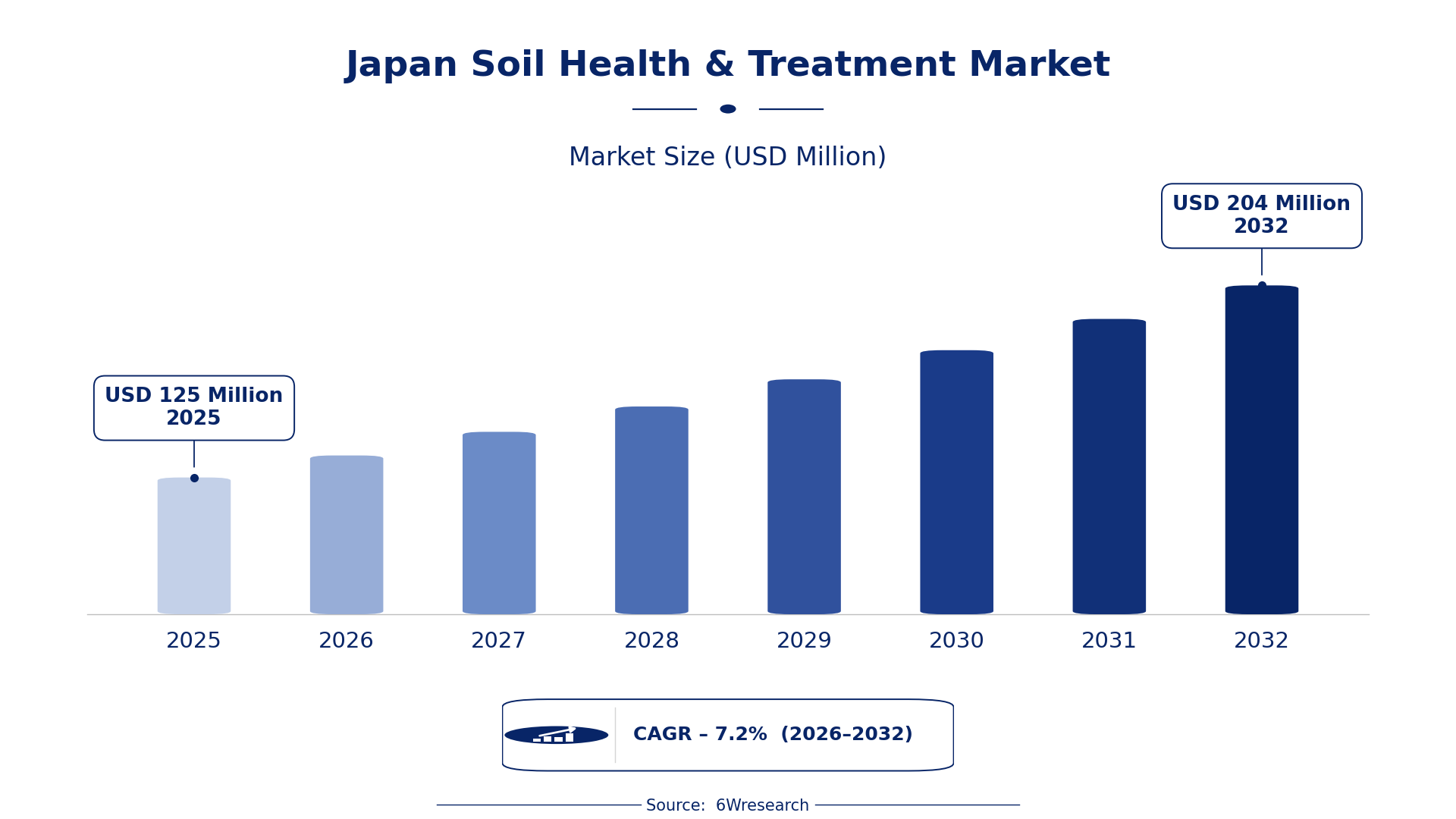
According to 6Wresearch internal database and industry insights, the Japan Soil Health & Treatment Market was valued at USD 125 Million in 2025 and is projected to reach USD 204 Million by 2032, growing at a CAGR of approximately 7.2% during 2026–2032.
Japan Soil Health & Treatment Market Highlights
| Report Metric | Details |
| Report Name | Japan Soil Health & Treatment Market (2026-2032) |
| Market Size 2025 | USD 125 Million |
| Market Size 2032 | USD 204 Million |
| Absolute Growth 2025–2032 | USD 79 Million |
| CAGR 2026–2032 | 7.2% |
| Peak Annual Growth | 9.2% in 2032 |
| Forecast Period | 2026–2032 |
| Historical Data | 2022–2025 |
| Base Year | 2025 |
| Leading Treatment Type, 2025 | Fertilizer Blends (37% share) |
| Leading Mode of Application, 2025 | Drip Irrigation (46% share) |
| Leading Crop Segment, 2025 | Row Crops (46% share) |
| Leading End User, 2025 | Agro Distributors (41% share) |
| Fastest-Growing Treatment Type | Soil Fumigants (10.7% CAGR) |
| Fastest-Growing Mode of Application | Spraying (9.2% CAGR) |
| Fastest-Growing Crop Segment | High-Value Crops (9.6% CAGR) |
| Fastest-Growing End User | Export-Oriented Farms (9.8% CAGR) |
| Growing Sector | Agriculture |
| Key End Users | Farmers, Agro Distributors, Greenhouse Growers, Export-Oriented Farms |
Japan Soil Health & Treatment Market Year-wise Growth Rate and Key Drivers (2022–2032)
This graph illustrates the annual growth rates of the market from 2022 to 2032, highlighting a steady upward trajectory and projected market expansion over the forecast period.
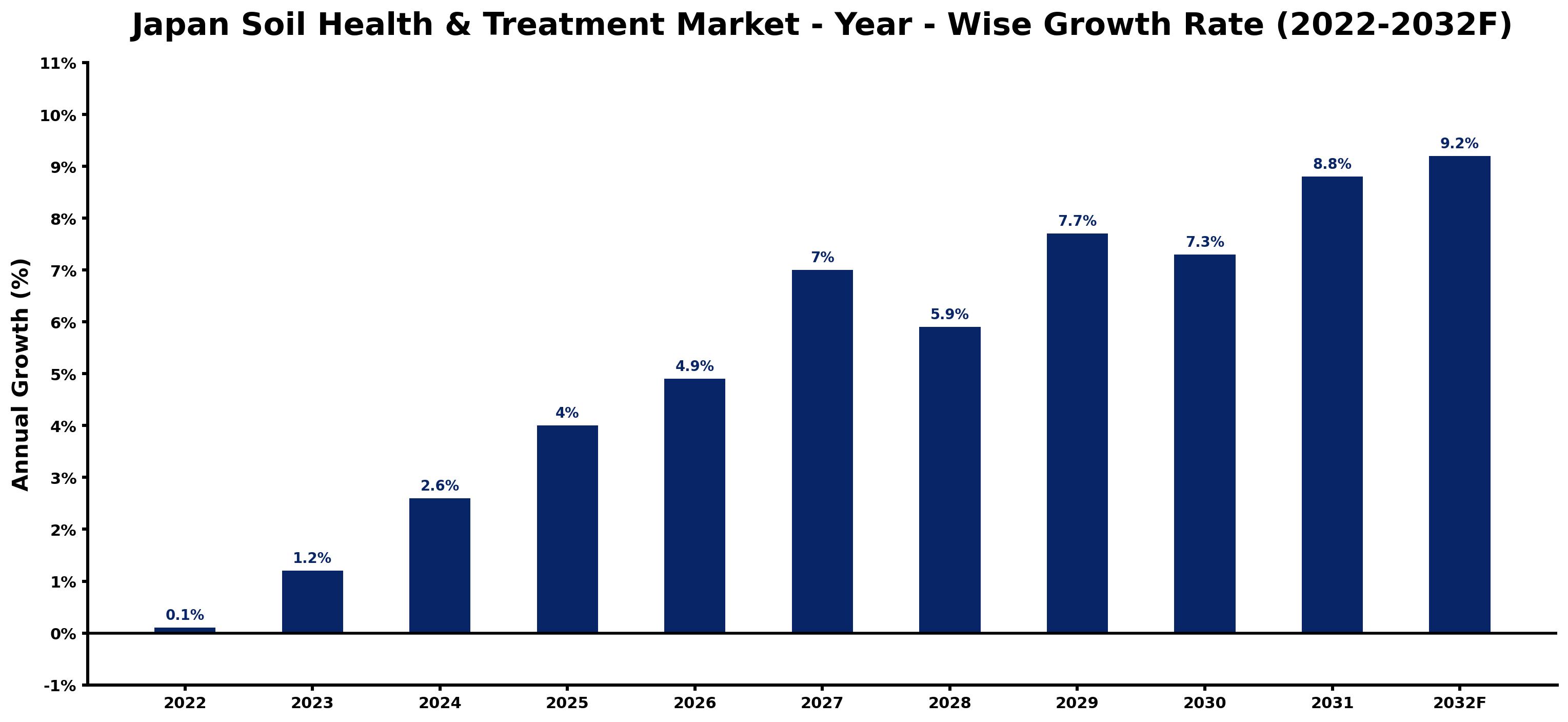
Year by year, the estimates below pair each growth rate with the development that shaped it.
| Year | Estimated Annual Growth (%) | Market Rationale |
| 2022 | 0.1 | The market showed minimal growth due to ongoing adjustments in agricultural practices. |
| 2023 | 1.2 | Increased awareness of soil treatment options drove demand for products among farmers. |
| 2024 | 2.6 | The adoption of organic fertilizers gained traction, boosting market activity significantly. |
| 2025 | 4.0 | The introduction of new soil treatment technologies improved product effectiveness and appeal. |
| 2026 | 4.9 | Growing interest in sustainable farming practices will influence purchasing decisions. |
| 2027 | 7.0 | The rise of high-value crops will lead to increased investments in soil health solutions. |
| 2028 | 5.9 | A slight slowdown is expected as market saturation begins to take effect. |
| 2029 | 7.7 | The introduction of new biostimulants is projected to stimulate renewed interest in soil treatments. |
| 2030 | 7.3 | Demand is expected to stabilise as farmers adjust to new product offerings and techniques. |
| 2031 | 8.8 | The market will expand rapidly due to heightened focus on agricultural sustainability. |
| 2032 | 9.2 | The peak growth is projected to be driven by substantial investments in soil health initiatives. |
Note: Market size estimations and growth projections presented in this report are based on 6Wresearch's proprietary forecasting methodology, utilizing the latest available industry data, government publications, and primary research inputs.
Japan Soil Health & Treatment Market Synopsis
Soil health and treatment products include fertilizers, soil fumigants, organic conditioners, and biostimulants, all aimed at improving soil fertility and crop yield. The Japan Soil Health & Treatment Market is growing due to rising domestic demand from traditional and modern agricultural practices. The increasing adoption of organic fertilizers, alongside government initiatives promoting sustainable agriculture, drives investments in soil health solutions, with the agricultural sector contributing approximately 1.1% to GDP and strong prospects for future expansion.
Market Dynamics Impact Analysis (2026–2032)
| Factor | Type | Impact | Primary Segment Affected |
| Rising adoption of organic fertilizers | Driver | High | Organic Conditioners |
| Increased focus on sustainable farming practices | Driver | High | Soil Biostimulants |
| Growing demand for high-value crops | Opportunity | High | High-Value Crops |
| Expansion of agro distributors | Opportunity | Medium | Agro Distributors |
| Regulatory challenges in fertilizer use | Restraint | High | Fertilizer Blends |
| Market saturation in traditional farming methods | Restraint | Medium | Row Crops |
| High costs associated with organic certification | Challenge | High | Organic Conditioners |
| Limited access to advanced soil treatment technologies | Challenge | Medium | Soil Fumigants |
Evaluation of Drivers in Japan Soil Health & Treatment Market (2026–2032)
Demand rests on the following drivers, each shown with the segment it touches most.
| Drivers | Primary Segment Affected | Why It Matters (Evidence) |
| Increased use of organic fertilizers | Organic Conditioners | Organic fertilizers have seen a 20% rise in usage among farmers, improving soil fertility and attracting more buyers. |
| Growing interest in sustainable practices | Soil Biostimulants | The market share of soil biostimulants increased by 15% in 2023, reflecting demand from eco-conscious farmers seeking sustainable solutions. |
| Rising production of high-value crops | High-Value Crops | The focus on high-value crops drives demand for advanced soil treatments, as farmers seek to maximise yield and quality. |
| Expansion of agro distributors | Agro Distributors | With over 2,000 registered agro distributors in Japan, access to soil health products has improved significantly, facilitating market growth. |
| Technological advancements in soil treatment | Soil Fumigants | Advancements in fumigant formulations improve effectiveness, leading to increased purchases by farmers looking for reliable solutions. |
A wider customer base explains much of the growth, as the agricultural sector increasingly adopts organic fertilizers, with a reported 20% rise in usage among farmers. The demand for soil biostimulants surged by 15% in 2023, driven by eco-conscious practices among producers. The presence of over 2,000 agro distributors facilitates access to these products, while ongoing technological advancements in soil fumigants improve their effectiveness, encouraging further purchases. The focus on high-value crops has prompted farmers to invest in advanced soil treatments, reflecting a shift towards sustainable agricultural practices and boosting productivity.
Evaluation of Restraints in Japan Soil Health & Treatment Market
The key brakes on demand, and where they bite hardest, are shown below.
| Market Restraint | Primary Segment Affected | Why It Matters (Evidence) |
| Strict regulations on fertilizer use | Fertilizer Blends | Regulations limit the types of fertilizers that can be used, affecting availability and compliance costs. |
| Market saturation in traditional farming | Row Crops | As traditional farming methods become saturated, growth opportunities in this segment are constrained, limiting innovation. |
| High costs of organic certification | Organic Conditioners | Obtaining organic certification incurs costs, deterring some farmers from adopting organic treatments and impacting market growth. |
| Limited availability of advanced technologies | Soil Fumigants | Access to advanced soil treatment technologies remains limited, hindering market expansion and adoption of best practices. |
| Dependence on conventional farming practices | High-Value Crops | Many farmers still rely on conventional practices, slowing the shift to modern soil health solutions and limiting product uptake. |
Japan Soil Health & Treatment Market Challenges
A primary obstacle for buyers is the inconsistent supply of soil health products, stemming from production concentration in specific regions, which can delay deliveries and lead to potential yield losses of up to 15% for farmers. Suppliers contend with fierce competition from lower-priced imported alternatives, forcing local producers to reduce output and destabilising their market presence. Regulatory frameworks impose additional costs on producers, resulting in delayed product launches and increased prices for buyers. Rising raw material costs, influenced by global market trends, can drive up prices by 10-20% for soil treatment products, straining farmers' budgets.
Trends in the Japan Soil Health & Treatment Market
The following changes are redrawing the Japan Soil Health & Treatment Market.
- Shift towards Organic Fertilizers: Farmers are increasingly adopting organic fertilizers, reflecting a growing trend towards sustainable agriculture. In 2023, organic fertilizer usage rose by 20%, driven by consumer demand for healthier produce and environmental responsibility.
- Focus on High-Value Crop Production: The Hokkaido region is prioritising high-value crop production, with a notable increase in soil treatment investments. This shift is clear as farmers seek to maximise yield and quality, enhancing their market competitiveness.
- Emergence of Soil Biostimulants: Soil biostimulants are gaining traction among farmers, with a 15% market share increase in 2023. This trend indicates a shift towards improving plant resilience and growth, aligning with sustainable farming practices.
- Expansion of Agro Distributors: The number of registered agro distributors in Japan surpassed 2,000 in 2023, facilitating better access to soil health products for farmers across the country, thereby supporting market growth.
Investment Opportunities in the Japan Soil Health & Treatment Market
The following areas offer the clearest openings for investors and suppliers in the Japan Soil Health & Treatment Market.
- Gap in Organic Fertilizer Supply: With a 20% rise in organic fertilizer usage, there is a clear opportunity for suppliers to meet this growing demand among farmers in Japan, particularly in regions with high agricultural activity.
- Investment in High-Value Crop Facilities: The focus on high-value crops in regions like Hokkaido presents opportunities for investment in advanced soil treatment facilities to support local farmers and enhance productivity.
- Timing for Sustainable Practices: As Japan aims for 25% organic farming by 2030, suppliers can invest in organic soil treatments to align with this target and attract eco-conscious buyers looking for sustainable solutions.
- Support for Agro Distributors: The expanding network of over 2,000 agro distributors offers opportunities for partnerships to improve distribution channels for soil health products, enhancing market reach.
Government Initiatives in the Japan Soil Health & Treatment Market
The Waste Management and Public Cleansing Act, enacted in 1970, mandates proper treatment and disposal of agricultural waste, which directly impacts soil health product producers by ensuring compliance with environmental standards. This law complements the Fertilizer Control Law, which regulates fertilizer use, enhancing product safety and quality assurance for buyers. Together, these regulations promote sustainable practices in soil treatment, supporting a responsible agricultural sector.
In 2023, the annual budget for agricultural subsidies was approximately ¥1 trillion, administered by the Ministry of Agriculture, Forestry and Fisheries. This funding supports various initiatives aimed at enhancing soil health, including research and development for organic fertilizers and soil conditioners. The ministry's efforts ensure that farmers have access to innovative solutions that improve soil fertility and crop productivity.
Future Insight of the Japan Soil Health & Treatment Market
Farmers will increasingly adopt organic fertilizers, with usage projected to rise by 25% by 2030 due to government initiatives promoting sustainable practices. Technological advancements in soil health will enhance product effectiveness, allowing suppliers to provide superior solutions. The Tokyo region is expected to emerge as a centre for agricultural innovation, fostering collaborations between researchers and producers. By 2032, smart farming techniques will enable real-time soil monitoring, empowering farmers to make informed decisions and optimise resource use, ultimately improving crop yields.
Market Segmentation Analysis
Japan Soil Health & Treatment Market report covers a detailed analysis of the following market segments:
By Treatment Type – Fertilizer Blends Lead, Soil Fumigants Expected to Grow Fastest
According to Saurav Kr Singh, Senior Research Analyst at 6Wresearch, with 37% of treatment type revenue in 2025, Fertilizer Blends was the largest category. Fertilizer Blends command the largest share due to their widespread use among farmers to enhance nutrient availability in soil, particularly for staple crops like rice. The strong distribution networks and robust agricultural subsidies in Japan further reinforce this segment's significance. Soil Fumigants are projected to grow fastest, at a CAGR of 10.7% during 2026–2032. Soil Fumigants are experiencing rapid growth as they play a crucial role in controlling nematodes and soil-borne diseases, which pose challenges in intensive farming systems. The increasing need for effective pest control solutions is propelling this segment's expansion. Suppliers must focus on developing advanced soil fumigants to meet the rising demands of farmers.
By Mode of Application – Drip Irrigation Leads, Spraying Expected to Grow Fastest
Drip Irrigation accounted for 46% of the market by mode of application in 2025. Drip Irrigation holds the largest share as it supports efficient water use in agriculture, particularly in regions with limited water resources. This method is increasingly adopted in areas like Hokkaido, known for high-value crop production. The quickest growth will come from Spraying, forecast to expand at a CAGR of 9.2% between 2026 and 2032. Spraying is the fastest-growing application method due to its direct efficiency in applying treatments to crops, especially in high-density farming systems. The convenience and speed of this method are attracting more farmers. Buyers may benefit from investing in advanced spraying technologies to optimise treatment application and improve crop yields.
By Crop Segment – Row Crops Lead, High-Value Crops Expected to Grow Fastest
In 2025, Row Crops led the crop segment split with a 46% share. Row Crops lead the market as they include essential staples like rice and wheat that rely heavily on soil treatments for optimal growth. The significant area dedicated to these crops in Japan ensures a steady demand for soil health products. High-Value Crops are set to record the highest CAGR in this split, 9.6% over 2026–2032. High-Value Crops are witnessing swift growth as they require improved soil health to meet the standards of premium markets, encouraging farmers to invest more in soil treatments. This trend towards specialty crops is reshaping agricultural practices. Suppliers should tailor their products to address the specific needs of high-value crop producers.
By End User – Agro Distributors Lead, Export-Oriented Farms Expected to Grow Fastest
Agro Distributors took 41% of end user revenue in 2025, more than any other category. Agro Distributors are crucial in the market, acting as the primary link for soil health products to local farmers across Japan. Their established networks and strong relationships with farmers ensure a consistent demand for various soil treatments. Over 2026–2032, Export-Oriented Farms are expected to post the fastest growth, at a CAGR of 9.8%. Export-Oriented Farms are growing rapidly as they focus on producing high-quality goods for international markets, necessitating superior soil health solutions. This trend is likely to continue as global demand for quality food increases. Suppliers should strengthen partnerships with export-oriented farms to enhance their market reach.
Key Attractiveness of the Report
- 10 Years of Market Numbers
- Historical Data Starting from 2022 to 2025
- Base Year 2025
- Forecast Data until 2032
- Key Performance Indicators Impacting the Market
- Major Upcoming Developments and Projects
Key Highlights of the Report:
- Japan Soil Health & Treatment Market Outlook
- Market Size of Japan Soil Health & Treatment Market, 2025
- Forecast of Japan Soil Health & Treatment Market, 2032
- Historical Data and Forecast of Japan Soil Health & Treatment Revenues & Volume for the Period 2022-2032F
- Japan Soil Health & Treatment Market Trend Evolution
- Japan Soil Health & Treatment Market Drivers and Challenges
- Japan Soil Health & Treatment Price Trends
- Japan Soil Health & Treatment Porter's Five Forces
- Japan Soil Health & Treatment Industry Life Cycle
- Historical Data and Forecast of Japan Soil Health & Treatment Market Revenues & Volume By Treatment Type for the Period 2022-2032F
- Historical Data and Forecast of Japan Soil Health & Treatment Market Revenues & Volume By Fertilizer Blends for the Period 2022-2032F
- Historical Data and Forecast of Japan Soil Health & Treatment Market Revenues & Volume By Soil Fumigants for the Period 2022-2032F
- Historical Data and Forecast of Japan Soil Health & Treatment Market Revenues & Volume By Organic Conditioners for the Period 2022-2032F
- Historical Data and Forecast of Japan Soil Health & Treatment Market Revenues & Volume By Soil Biostimulants for the Period 2022-2032F
- Historical Data and Forecast of Japan Soil Health & Treatment Market Revenues & Volume By Mode of Application for the Period 2022-2032F
- Historical Data and Forecast of Japan Soil Health & Treatment Market Revenues & Volume By Drip Irrigation for the Period 2022-2032F
- Historical Data and Forecast of Japan Soil Health & Treatment Market Revenues & Volume By Spraying for the Period 2022-2032F
- Historical Data and Forecast of Japan Soil Health & Treatment Market Revenues & Volume By Manual Mixing for the Period 2022-2032F
- Historical Data and Forecast of Japan Soil Health & Treatment Market Revenues & Volume By Foliar Spray for the Period 2022-2032F
- Historical Data and Forecast of Japan Soil Health & Treatment Market Revenues & Volume By Crop Segment for the Period 2022-2032F
- Historical Data and Forecast of Japan Soil Health & Treatment Market Revenues & Volume By Row Crops for the Period 2022-2032F
- Historical Data and Forecast of Japan Soil Health & Treatment Market Revenues & Volume By High-Value Crops for the Period 2022-2032F
- Historical Data and Forecast of Japan Soil Health & Treatment Market Revenues & Volume By Fruit & Veg for the Period 2022-2032F
- Historical Data and Forecast of Japan Soil Health & Treatment Market Revenues & Volume By Cash Crops for the Period 2022-2032F
- Historical Data and Forecast of Japan Soil Health & Treatment Market Revenues & Volume By End User for the Period 2022-2032F
- Historical Data and Forecast of Japan Soil Health & Treatment Market Revenues & Volume By Agro Distributors for the Period 2022-2032F
- Historical Data and Forecast of Japan Soil Health & Treatment Market Revenues & Volume By Export-Oriented Farms for the Period 2022-2032F
- Historical Data and Forecast of Japan Soil Health & Treatment Market Revenues & Volume By Greenhouse Growers for the Period 2022-2032F
- Historical Data and Forecast of Japan Soil Health & Treatment Market Revenues & Volume By Agri Co-ops for the Period 2022-2032F
- Japan Soil Health & Treatment Import Export Trade Statistics
- Market Opportunity Assessment By Treatment Type
- Market Opportunity Assessment By Mode of Application
- Market Opportunity Assessment By Crop Segment
- Market Opportunity Assessment By End User
- Japan Soil Health & Treatment Top Companies Market Share
- Japan Soil Health & Treatment Competitive Benchmarking By Technical and Operational Parameters
- Japan Soil Health & Treatment Company Profiles
- Japan Soil Health & Treatment Key Strategic Recommendations
Market Covered
Coverage by segment is as follows.
By Treatment Type
- Fertilizer Blends
- Soil Fumigants
- Organic Conditioners
- Soil Biostimulants
By Mode of Application
- Drip Irrigation
- Spraying
- Manual Mixing
- Foliar Spray
By Crop Segment
- Row Crops
- High-Value Crops
- Fruit & Veg
- Cash Crops
By End User
- Agro Distributors
- Export-Oriented Farms
- Greenhouse Growers
- Agri Co-ops































