Japan Soil Microbial Enhancers Market Size & Growth Rate
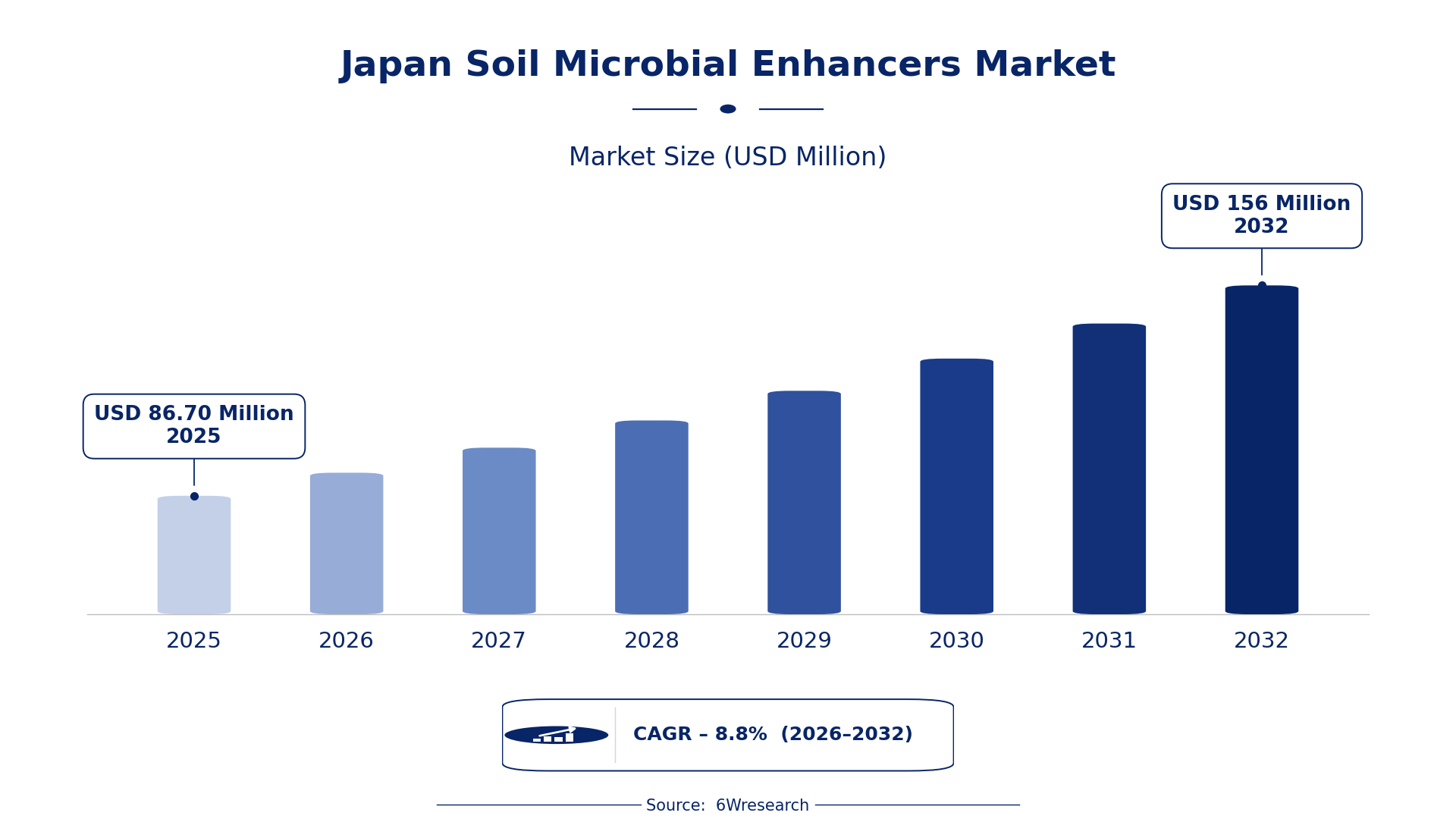
According to 6Wresearch internal database and industry insights, the Japan Soil Microbial Enhancers Market was valued at USD 86.70 Million in 2025 and is projected to reach USD 156 Million by 2032, growing at a CAGR of approximately 8.8% during 2026–2032.
Japan Soil Microbial Enhancers Market Highlights
| Report Metric | Details |
| Report Name | Japan Soil Microbial Enhancers Market (2026-2032) |
| Market Size 2025 | USD 86.70 Million |
| Market Size 2032 | USD 156 Million |
| Absolute Growth 2025–2032 | USD 69.30 Million |
| CAGR 2026–2032 | 8.8% |
| Peak Annual Growth | 10.1% in 2032 |
| Forecast Period | 2026–2032 |
| Historical Data | 2022–2025 |
| Base Year | 2025 |
| Leading Enhancer Type, 2025 | Plant Growth Promoters (42% share) |
| Leading Microbe Type, 2025 | Rhizobium (50% share) |
| Leading Delivery Method, 2025 | Soil Amendment (41% share) |
| Leading End User, 2025 | Legume Farmers (42% share) |
| Fastest-Growing Enhancer Type | Nitrogen Fixers (12.4% CAGR) |
| Fastest-Growing Microbe Type | Bacillus spp. (12.9% CAGR) |
| Fastest-Growing Delivery Method | Liquid Application (12.6% CAGR) |
| Growing Sector | Agriculture |
| Key End Users | Farmers, Agricultural Cooperatives, High-Input Farms, Fertilizer Companies |
Japan Soil Microbial Enhancers Market Year-wise Growth Rate and Key Drivers (2022–2032)
This graph illustrates the annual growth rates of the market from 2022 to 2032, highlighting a steady upward trajectory and projected market expansion over the forecast period.
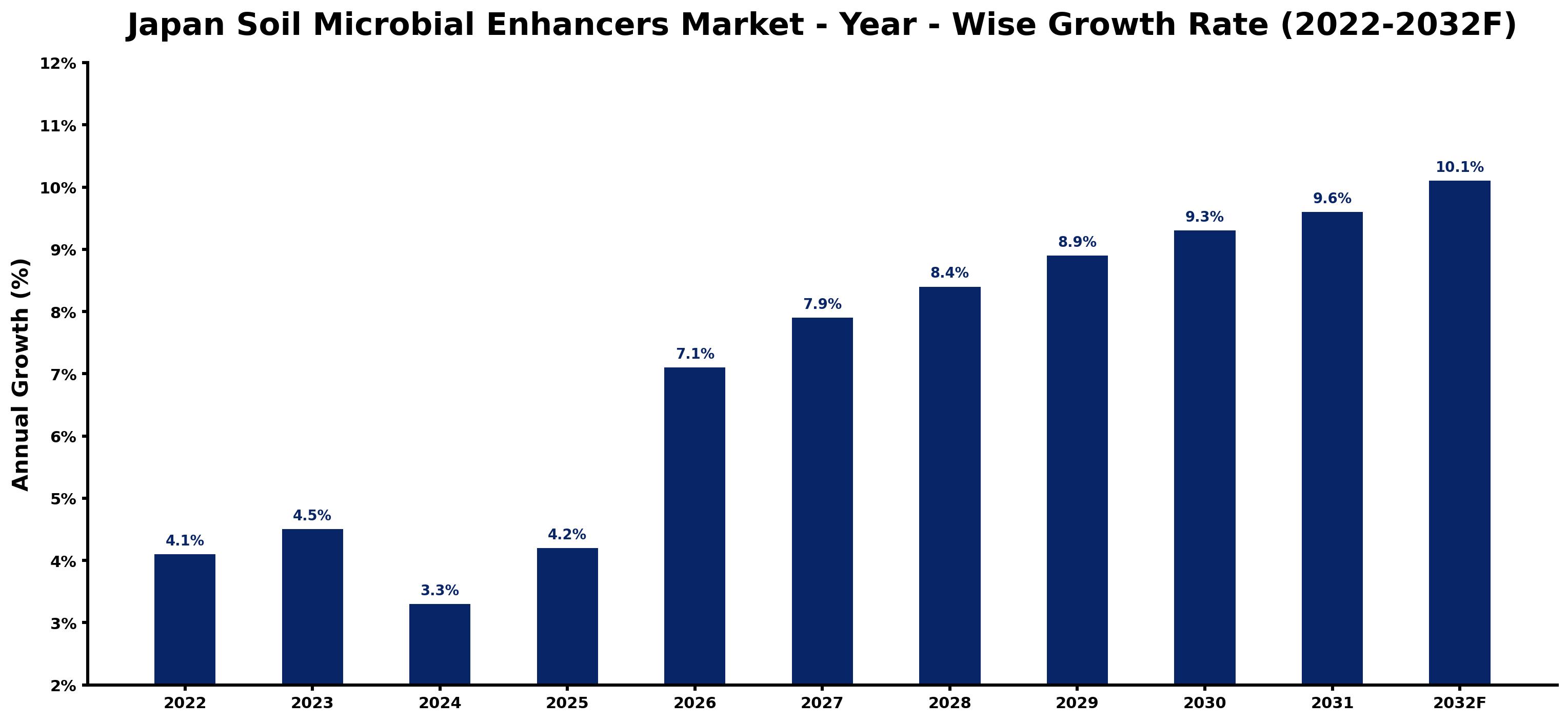
The table below sets out the estimated growth rate for each year and the main factor behind it.
| Year | Estimated Annual Growth (%) | Market Rationale |
| 2022 | 4.1 | The agricultural sector showed steady demand for microbial products in this year. |
| 2023 | 4.5 | Demand for soil microbial products grew faster as farmers sought sustainable practices. |
| 2024 | 3.3 | Growth slowed as market adjustments occurred amid changing agricultural trends. |
| 2025 | 4.2 | Demand increased again as farmers adopted more biological solutions for crop health. |
| 2026 | 7.1 | Interest in microbial products is expected to surge with rising organic farming practices. |
| 2027 | 7.9 | The market will continue to expand as research on microbial efficacy gains traction. |
| 2028 | 8.4 | Growth will remain strong as farmers increasingly recognise the benefits of these products. |
| 2029 | 8.9 | Demand will rise further as agricultural cooperatives promote microbial products actively. |
| 2030 | 9.3 | The market will see increased purchases driven by sustainability initiatives in agriculture. |
| 2031 | 9.6 | Continued growth will be supported by rising awareness of soil health benefits. |
| 2032 | 10.1 | Demand will peak as farmers aim for higher yields through advanced microbial solutions. |
Note: Market size estimations and growth projections presented in this report are based on 6Wresearch's proprietary forecasting methodology, utilizing the latest available industry data, government publications, and primary research inputs.
Japan Soil Microbial Enhancers Market Synopsis
Soil microbial enhancers are biological products that improve soil health by boosting microbial activity and are produced through fermentation processes that cultivate beneficial microbes. The Japan Soil Microbial Enhancers Market is expanding, driven by over 1 million farms focusing on sustainable practices and increasing organic farming. Government initiatives, including a 30% adoption target for biological products by 2030, along with the rising adoption of these enhancers, are key factors behind this growth.
Market Dynamics Impact Analysis (2026–2032)
| Factor | Type | Impact | Primary Segment Affected |
| Growing organic farming practices are increasing demand for biological products. | Driver | High | Plant Growth Promoters |
| The need for sustainable agriculture solutions drives investments in microbial enhancers. | Driver | High | Nitrogen Fixers |
| The Kanto region's agricultural focus presents opportunities for enhanced product supply. | Opportunity | High | Soil Amendment |
| Research institutions are actively studying microbial efficacy, creating demand for innovative products. | Opportunity | Medium | Bacillus spp. |
| Market fluctuations may affect the pricing of microbial enhancers for farmers. | Restraint | Medium | Rhizobium |
| Limited awareness among farmers about the benefits of microbial enhancers can hinder growth. | Restraint | High | Plant Growth Promoters |
| Supply chain disruptions can delay product availability for farmers. | Challenge | High | Liquid Application |
| Competition among suppliers may lead to price wars, impacting profitability. | Challenge | Medium | Root Dip |
Evaluation of Drivers in Japan Soil Microbial Enhancers Market (2026–2032)
These are the developments adding the most demand over the forecast period.
| Drivers | Primary Segment Affected | Why It Matters (Evidence) |
| Increasing adoption of organic farming practices drives demand for microbial products. | Plant Growth Promoters | In 2023, the government launched a program promoting sustainable agriculture, increasing purchases by farmers. |
| Growing interest in nitrogen-fixing solutions boosts demand for specific microbial products. | Nitrogen Fixers | In Hokkaido, legume cultivation leads to higher purchases of Rhizobium, enhancing crop yields. |
| Research on microbial efficacy is driving demand for these products. | Bacillus spp. | Studies have shown that these microbes can improve plant health, encouraging farmers to invest in them. |
| The expansion of agricultural cooperatives boosts demand for microbial products among farmers. | Soil Amendment | Over 1 million farms in Japan are increasingly adopting biological products for soil health. |
| The focus on disease management in high-input farms increases the need for antagonistic microbes. | Antagonistic Microbes | Trichoderma spp. are recognised for their role in disease suppression, prompting higher purchases. |
Purchasing is increasing as farmers adopt organic farming practices, which is expected to lead to a 30% rise in the use of biological products by 2030. The Kanto region is seeing a surge in demand for soil microbial products, with over 1 million farms committed to sustainable agriculture. Research institutions are actively studying microbial efficacy, demonstrating yield improvements that encourage investment in these products. The need for nitrogen-fixing solutions is driving demand, particularly among legume farmers, boosting overall purchasing activity.
Evaluation of Restraints in Japan Soil Microbial Enhancers Market
The key brakes on demand, and where they bite hardest, are shown below.
| Market Restraint | Primary Segment Affected | Why It Matters (Evidence) |
| Market fluctuations can impact pricing, affecting farmer budgets. | Rhizobium | Prices may vary due to supply chain issues, making it challenging for farmers to plan expenditures. |
| Limited awareness among farmers about microbial benefits can slow adoption rates. | Plant Growth Promoters | Many farmers still rely on traditional methods, hindering the transition to biological solutions. |
| Supply chain disruptions can delay the availability of microbial products. | Liquid Application | Logistical challenges can lead to shortages, affecting farmers' ability to access products. |
| Competition among suppliers may lead to aggressive pricing strategies. | Root Dip | Price wars can reduce profit margins for suppliers, impacting product quality and availability. |
| Regulatory hurdles can slow the introduction of new microbial products. | Soil Amendment | Producers must navigate complex approval processes, delaying market entry. |
Japan Soil Microbial Enhancers Market Challenges
Buyers in Japan face rising input costs due to the increasing adoption of organic farming practices, with reports indicating a 15% hike in expenses for farmers. Producers struggle with a shortage of skilled labour, delaying the application of microbial enhancers during critical planting periods, which can lead to reduced crop yields. Distributors encounter supply chain disruptions that hinder the availability of raw materials, extending lead times by up to two months. Competition from synthetic alternatives pressures producers to lower prices, squeezing profit margins and limiting their capacity to invest in product quality.
Trends in the Japan Soil Microbial Enhancers Market
These developments are changing demand patterns in the Japan Soil Microbial Enhancers Market.
- Legume Farmers Prioritising Nitrogen Fixers: Legume farmers are increasingly adopting nitrogen-fixing microbial products, particularly Rhizobium, to improve crop yields. In Hokkaido, where legume cultivation is concentrated, demand has risen significantly.
- Transition from Traditional to Biological Solutions: Farmers are shifting from conventional practices to biological solutions for soil health. The 2023 government program promoting sustainable agriculture has led to a 30% increase in the adoption of microbial products.
- Growing Interest in Bacillus spp. Efficacy: Research institutions are focusing on the efficacy of Bacillus spp. in enhancing crop yields. Studies have shown that these microbes can improve plant health, driving demand among farmers.
- Shift Towards Sustainable Agriculture Practices: The Japanese agricultural sector is increasingly embracing sustainable practices, supported by the Ministry of Agriculture's initiatives. In 2023, Japan's agricultural exports reached approximately 1 trillion yen, reflecting this growing interest.
Investment Opportunities in the Japan Soil Microbial Enhancers Market
The following areas offer the clearest openings for investors and suppliers in the Japan Soil Microbial Enhancers Market.
- Kanto Region as a Hub for Microbial Products: The Kanto region's agricultural focus presents a significant opportunity for microbial products, with over 1 million farms. Entering this market through local partnerships can facilitate product distribution.
- Investment in Research on Microbial Technologies: There is a growing need for microbial products, particularly Bacillus spp. Research institutions are actively seeking partnerships to develop new solutions, presenting an entry point for suppliers.
- High-Input Farms Seeking Disease Management Solutions: High-input farms are increasingly looking for solutions to manage soil-borne diseases. The market gap for effective antagonistic microbes presents an opportunity for suppliers to meet this demand.
- Expansion of Agricultural Cooperatives: Agricultural cooperatives are expanding their offerings of microbial products. Suppliers can enter this market by forming joint ventures with these cooperatives to enhance product availability.
Government Initiatives in the Japan Soil Microbial Enhancers Market
The GX Basic Policy adopted in 2023 aims for about JPY 150 trillion in public-private decarbonisation investment over 10 years. This measure encourages the adoption of biological products, boosting the market for soil microbial enhancers.
The Ministry of Agriculture, Forestry and Fisheries (MAFF) promotes sustainable agriculture practices and funds initiatives aimed at increasing the adoption of biological products by 30% by 2030. This support is vital for expanding the market for microbial enhancers.
Future Insight of the Japan Soil Microbial Enhancers Market
Emerging fermentation technologies will reshape the production of microbial enhancers, allowing suppliers to meet rising demand with greater efficiency. By 2032, government initiatives will drive a notable increase in the adoption of biological products, promoting sustainable agricultural practices. Research on microbial strains will yield more targeted applications, improving crop yields. As a result, buyers will benefit from enhanced product availability and competitive pricing, while suppliers will access a broader market aligned with sustainability objectives.
Market Segmentation Analysis
Japan Soil Microbial Enhancers Market report covers a detailed analysis of the following market segments:
By Enhancer Type – Plant Growth Promoters Lead, Nitrogen Fixers Expected to Grow Fastest
According to Saurav Kr Singh, Senior Research Analyst at 6Wresearch, Plant Growth Promoters held 42% of the Japan Soil Microbial Enhancers Market by enhancer type in 2025. Plant growth promoters hold the largest share due to their widespread application among farmers aiming to enhance crop yields, particularly in the Kanto region. Their effectiveness in stimulating plant growth aligns with Japan's focus on rice and vegetable production, ensuring consistent demand. Nitrogen Fixers are set to record the highest CAGR in this split, 12.4% over 2026–2032. Nitrogen fixers are experiencing rapid growth as they directly enhance nitrogen availability for plants, which is vital for sustainable agriculture. The government's 2023 initiative promoting sustainable practices is expected to further boost their adoption among farmers. Suppliers should prioritise the development of nitrogen fixers to align with the increasing demand from farmers.
By Microbe Type – Rhizobium Leads, Bacillus spp. Expected to Grow Fastest
Rhizobium accounted for 50% of the market by microbe type in 2025. Rhizobium dominates the market as it directly fixes atmospheric nitrogen in legumes, which is essential for the cultivation of crops in regions like Hokkaido and Tohoku. This microbe's critical role in legume farming makes it a preferred choice among farmers. Bacillus spp. is projected to grow fastest, at a CAGR of 12.9% during 2026–2032. Bacillus spp. is growing quickly due to its direct promotion of plant health and nutrient uptake, which aligns with the increasing interest in sustainable practices. Research institutions are actively studying its efficacy, further driving adoption. Buyers should consider incorporating Bacillus spp. into their farming practices to improve crop yields.
By Delivery Method – Soil Amendment Leads, Liquid Application Expected to Grow Fastest
With 41% of delivery method revenue in 2025, Soil Amendment was the largest category. Soil amendment is the leading delivery method as it directly improves soil health and microbial activity, which are essential for effective farming in Japan's intensive agricultural landscape. This method is preferred by farmers looking to enhance soil quality and productivity. Over 2026–2032, Liquid Application is expected to post the fastest growth, at a CAGR of 12.6%. Liquid application is gaining traction as it directly delivers microbial enhancers to the soil, allowing for more efficient utilisation of these products. The growing emphasis on precision agriculture is a key factor driving this trend. Suppliers must focus on liquid application technologies to meet the changing preferences of farmers.
By End User – Legume Farmers Lead and Record the Fastest Growth
In 2025, Legume Farmers led the end user split with a 42% share. Legume farmers represent the largest end user group, benefiting directly from nitrogen fixation, which is crucial for their crop yields. The concentration of legume cultivation in regions like Hokkaido ensures a steady demand for microbial enhancers. Legume Farmers are also forecast to expand faster than any other category, at a CAGR of 11.5% over 2026–2032. Legume farmers are also the fastest-growing group as their need for effective nitrogen fixation intensifies with the shift towards organic farming practices. This dual role reinforces their strong market position and demand for microbial enhancers. Suppliers should concentrate on legume farmers in their marketing strategies to leverage this expanding segment.
Key Attractiveness of the Report
- 10 Years of Market Numbers
- Historical Data Starting from 2022 to 2025
- Base Year 2025
- Forecast Data until 2032
- Key Performance Indicators Impacting the Market
- Major Upcoming Developments and Projects
Key Highlights of the Report:
- Japan Soil Microbial Enhancers Market Outlook
- Market Size of Japan Soil Microbial Enhancers Market, 2025
- Forecast of Japan Soil Microbial Enhancers Market, 2032
- Historical Data and Forecast of Japan Soil Microbial Enhancers Revenues & Volume for the Period 2022-2032F
- Japan Soil Microbial Enhancers Market Trend Evolution
- Japan Soil Microbial Enhancers Market Drivers and Challenges
- Japan Soil Microbial Enhancers Price Trends
- Japan Soil Microbial Enhancers Porter's Five Forces
- Japan Soil Microbial Enhancers Industry Life Cycle
- Historical Data and Forecast of Japan Soil Microbial Enhancers Market Revenues & Volume By Enhancer Type for the Period 2022-2032F
- Historical Data and Forecast of Japan Soil Microbial Enhancers Market Revenues & Volume By Nitrogen Fixers for the Period 2022-2032F
- Historical Data and Forecast of Japan Soil Microbial Enhancers Market Revenues & Volume By Phosphate Solubilizers for the Period 2022-2032F
- Historical Data and Forecast of Japan Soil Microbial Enhancers Market Revenues & Volume By Plant Growth Promoters for the Period 2022-2032F
- Historical Data and Forecast of Japan Soil Microbial Enhancers Market Revenues & Volume By Antagonistic Microbes for the Period 2022-2032F
- Historical Data and Forecast of Japan Soil Microbial Enhancers Market Revenues & Volume By Microbe Type for the Period 2022-2032F
- Historical Data and Forecast of Japan Soil Microbial Enhancers Market Revenues & Volume By Rhizobium for the Period 2022-2032F
- Historical Data and Forecast of Japan Soil Microbial Enhancers Market Revenues & Volume By Bacillus spp. for the Period 2022-2032F
- Historical Data and Forecast of Japan Soil Microbial Enhancers Market Revenues & Volume By Trichoderma spp. for the Period 2022-2032F
- Historical Data and Forecast of Japan Soil Microbial Enhancers Market Revenues & Volume By Pseudomonas for the Period 2022-2032F
- Historical Data and Forecast of Japan Soil Microbial Enhancers Market Revenues & Volume By Delivery Method for the Period 2022-2032F
- Historical Data and Forecast of Japan Soil Microbial Enhancers Market Revenues & Volume By Seed Coating for the Period 2022-2032F
- Historical Data and Forecast of Japan Soil Microbial Enhancers Market Revenues & Volume By Soil Amendment for the Period 2022-2032F
- Historical Data and Forecast of Japan Soil Microbial Enhancers Market Revenues & Volume By Liquid Application for the Period 2022-2032F
- Historical Data and Forecast of Japan Soil Microbial Enhancers Market Revenues & Volume By Root Dip for the Period 2022-2032F
- Historical Data and Forecast of Japan Soil Microbial Enhancers Market Revenues & Volume By End User for the Period 2022-2032F
- Historical Data and Forecast of Japan Soil Microbial Enhancers Market Revenues & Volume By Legume Farmers for the Period 2022-2032F
- Historical Data and Forecast of Japan Soil Microbial Enhancers Market Revenues & Volume By Fertilizer Companies for the Period 2022-2032F
- Historical Data and Forecast of Japan Soil Microbial Enhancers Market Revenues & Volume By High-Input Farms for the Period 2022-2032F
- Historical Data and Forecast of Japan Soil Microbial Enhancers Market Revenues & Volume By Disease-Prone Regions for the Period 2022-2032F
- Japan Soil Microbial Enhancers Import Export Trade Statistics
- Market Opportunity Assessment By Enhancer Type
- Market Opportunity Assessment By Microbe Type
- Market Opportunity Assessment By Delivery Method
- Market Opportunity Assessment By End User
- Japan Soil Microbial Enhancers Top Companies Market Share
- Japan Soil Microbial Enhancers Competitive Benchmarking By Technical and Operational Parameters
- Japan Soil Microbial Enhancers Company Profiles
- Japan Soil Microbial Enhancers Key Strategic Recommendations
Market Covered
This report examines the market across the segments below.
By Enhancer Type
- Nitrogen Fixers
- Phosphate Solubilizers
- Plant Growth Promoters
- Antagonistic Microbes
By Microbe Type
- Rhizobium
- Bacillus spp.
- Trichoderma spp.
- Pseudomonas
By Delivery Method
- Seed Coating
- Soil Amendment
- Liquid Application
- Root Dip
By End User
- Legume Farmers
- Fertilizer Companies
- High-Input Farms
- Disease-Prone Regions































