Japan Soil Microbial Testing Market Size & Growth Rate
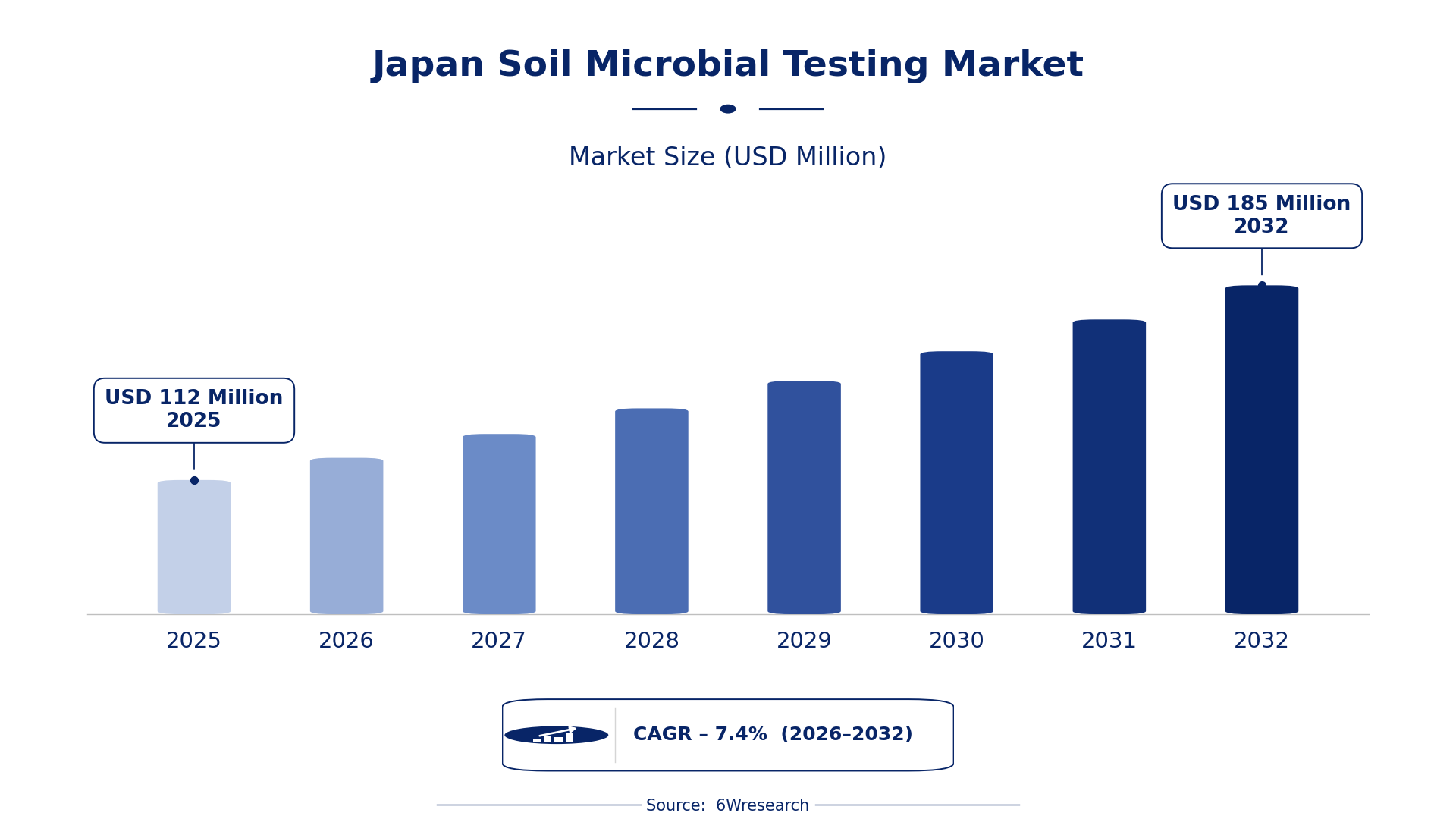
According to 6Wresearch internal database and industry insights, the Japan Soil Microbial Testing Market was valued at USD 112 Million in 2025 and is projected to reach USD 185 Million by 2032, growing at a CAGR of approximately 7.4% during 2026–2032.
Japan Soil Microbial Testing Market Highlights
| Report Metric | Details |
| Report Name | Japan Soil Microbial Testing Market (2026-2032) |
| Market Size 2025 | USD 112 Million |
| Market Size 2032 | USD 185 Million |
| Absolute Growth 2025–2032 | USD 73 Million |
| CAGR 2026–2032 | 7.4% |
| Peak Annual Growth | 8.8% in 2032 |
| Forecast Period | 2026–2032 |
| Historical Data | 2022–2025 |
| Base Year | 2025 |
| Leading Testing Type, 2025 | Culture-Based (52% share) |
| Leading Detection Method, 2025 | Plate Count (42% share) |
| Leading Lab Type, 2025 | Soil Testing Labs (45% share) |
| Leading End User, 2025 | Agri Universities (36% share) |
| Fastest-Growing Testing Type | DNA Sequencing (10.5% CAGR) |
| Fastest-Growing Detection Method | NGS (10.8% CAGR) |
| Fastest-Growing Lab Type | Genomic Labs (10.6% CAGR) |
| Fastest-Growing End User | Microbial Researchers (9.8% CAGR) |
| Growing Sector | Agricultural Research |
| Key End Users | Agri Universities, Soil Health Agencies, Microbial Researchers, Fertilizer R&D Teams |
Japan Soil Microbial Testing Market Year-wise Growth Rate and Key Drivers (2022–2032)
This graph illustrates the annual growth rates of the market from 2022 to 2032, highlighting a steady upward trajectory and projected market expansion over the forecast period.
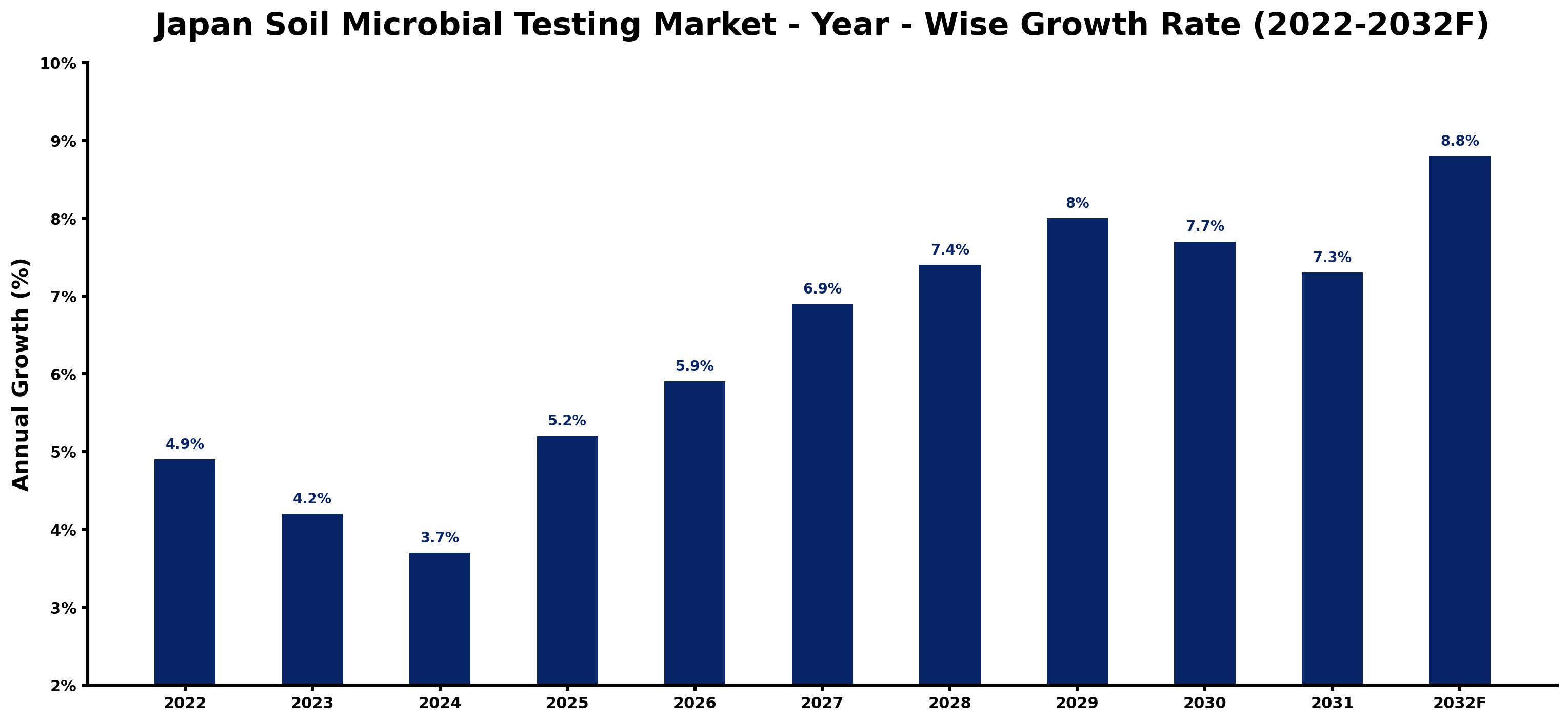
Annual growth estimates for each year appear below with the principal reason behind them, explaining the shifts that set the pace of the market.
| Year | Estimated Annual Growth (%) | Market Rationale |
| 2022 | 4.9 | The market showed steady growth due to increased awareness of soil health practices. |
| 2023 | 4.2 | Growth slowed as agricultural sectors adjusted to evolving environmental policies and practices. |
| 2024 | 3.7 | Market expansion continued but at a slower pace amid rising operational costs and challenges. |
| 2025 | 5.2 | Growth accelerated as investments in soil health initiatives gained significant momentum. |
| 2026 | 5.9 | Demand is expected to increase with a focus on sustainable agricultural practices and research advancements. |
| 2027 | 6.9 | Market growth will continue as agricultural universities expand their research capabilities and outreach. |
| 2028 | 7.4 | The rise in DNA sequencing adoption will further boost market demand and research capabilities. |
| 2029 | 8.0 | Demand will surge as microbial testing becomes essential for compliance with increasing regulations. |
| 2030 | 7.7 | Growth is projected to slow as the market reaches a more mature phase of development and competition increases. |
| 2031 | 7.3 | The market will continue to grow, albeit at a reduced rate due to market saturation and competitive pressures. |
| 2032 | 8.8 | Demand is expected to peak as new testing methods gain widespread acceptance and application. |
Note: Market size estimations and growth projections presented in this report are based on 6Wresearch's proprietary forecasting methodology, utilizing the latest available industry data, government publications, and primary research inputs.
Japan Soil Microbial Testing Market Synopsis
Soil microbial testing assesses microbial populations and activities in soil samples, using methods like culture-based techniques and DNA sequencing. This testing is essential for evaluating soil health, guiding agricultural practices, and supporting environmental research. The Japan Soil Microbial Testing Market is expanding due to rising demand from agricultural sectors and universities, driven by increased investment in soil health initiatives. In 2023, Japan allocated ¥3 billion for soil health research, underscoring the growing importance of this sector in sustainable agriculture and environmental management.
Market Dynamics Impact Analysis (2026–2032)
| Factor | Type | Impact | Primary Segment Affected |
| Rising focus on sustainable agriculture practices | Driver | High | Soil Testing Labs |
| Increased investment in agricultural research and development | Driver | High | Agri Universities |
| Growing demand for compliance with environmental regulations | Opportunity | High | Microbial Researchers |
| Emerging technologies in soil testing methods | Opportunity | Medium | Genomic Labs |
| High operational costs for testing facilities | Restraint | High | Soil Testing Labs |
| Limited awareness among farmers about soil health benefits | Restraint | Medium | Agri Universities |
| Compliance with stringent environmental regulations | Challenge | High | Soil Health Agencies |
| Capacity constraints in testing laboratories | Challenge | Medium | Contract Research |
Evaluation of Drivers in Japan Soil Microbial Testing Market (2026–2032)
Key forces behind demand, with the segment each one moves most, are listed below.
| Drivers | Primary Segment Affected | Why It Matters (Evidence) |
| Increased adoption of DNA sequencing | DNA Sequencing | This method provides detailed genetic information about soil microbes, leading to a 30% rise in usage since 2020. |
| Growing agricultural investments | Agri Universities | With Japan's agricultural land area of approximately 4.5 million hectares, universities are expanding research to improve soil health outcomes. |
| Rising public interest in organic farming | Microbial Researchers | Soil microbial testing supports organic practices, which have seen a notable increase in demand among farmers seeking sustainable solutions. |
| Government funding for soil health initiatives | Soil Testing Labs | Japan allocated ¥3 billion for soil health research in 2023, boosting laboratory capabilities and expanding testing services. |
| Focus on sustainable agricultural practices | Soil Health Agencies | Regular assessments by agencies ensure compliance with environmental regulations, increasing demand for testing services among farmers. |
Behind the steady rise in orders sits the increased adoption of DNA sequencing in soil testing, which has grown significantly since 2020. The public's interest in organic farming is pushing researchers to seek better practices for soil management. Funding for soil health research, highlighted by the ¥3 billion allocated in 2023, improves laboratory capabilities and expands testing services.
Evaluation of Restraints in Japan Soil Microbial Testing Market
Several factors work against faster growth; the main ones are summarised below.
| Market Restraint | Primary Segment Affected | Why It Matters (Evidence) |
| High operational costs for testing facilities | Soil Testing Labs | Testing facilities face rising operational costs, limiting their ability to expand services and invest in new technologies. |
| Limited awareness among farmers about soil health benefits | Agri Universities | Many farmers lack knowledge about the advantages of soil microbial testing, impacting overall market demand and adoption. |
| Compliance with stringent environmental regulations | Soil Health Agencies | Meeting regulatory requirements increases operational complexity and costs for agencies, affecting service delivery and efficiency. |
| Capacity constraints in testing laboratories | Contract Research | Laboratories struggle to meet growing demand due to limited testing capacity, leading to delays in service provision. |
| Dependence on traditional testing methods | Genomic Labs | Many facilities still rely on outdated methods, hindering innovation and efficiency in soil microbial analysis. |
Japan Soil Microbial Testing Market Challenges
Soil microbial testing costs Japanese farmers approximately ¥3 billion annually due to the need for precise assessments to maintain crop yields. Buyers experience delays of up to two weeks for results because of the over 1,000 soil testing laboratories, which limits timely agricultural decisions. Regulatory requirements necessitate frequent testing, imposing additional costs on producers who must comply with the Fertilizer Control Law. Supply chain issues arise as the average annual rainfall affects microbial activity, leading to inconsistent testing outcomes that complicate planning for farmers.
Trends in the Japan Soil Microbial Testing Market
Buyers and suppliers in the Japan Soil Microbial Testing Market are adjusting to the following trends.
- Shift Towards DNA Sequencing: Microbial researchers are increasingly adopting DNA sequencing methods for soil analysis, with usage rising by 30% since 2020. This trend is reshaping testing practices, allowing for more detailed insights into microbial communities.
- Growing Emphasis on Organic Farming: Agri universities are prioritising research on organic farming practices, reflecting a broader societal shift. This focus is essential for sustainable agriculture, with increasing public interest in organic produce and farming methods.
- Surge in Soil Testing Laboratories: The Tokyo region is experiencing a surge in new soil testing laboratories, responding to the growing demand for microbial testing. With over 1,000 labs nationwide, this expansion supports agricultural innovation and research.
- Increased Government Funding for Soil Health: Japan allocated ¥3 billion in 2023 for soil health research initiatives, demonstrating a commitment to sustainable agriculture. This funding is vital for advancing testing technologies and practices across the sector.
Investment Opportunities in the Japan Soil Microbial Testing Market
The openings below show where demand in the Japan Soil Microbial Testing Market is visible and how suppliers can enter.
- Investment in Advanced Testing Technologies: With a projected growth in demand for DNA sequencing, investing in advanced testing technologies is timely. Microbial researchers are seeking new solutions to improve soil analysis and testing accuracy.
- Partnerships with Agricultural Universities: Now is the ideal time to form partnerships with agricultural universities for research collaborations. These institutions are actively expanding their soil health programs, creating opportunities for joint ventures and knowledge sharing.
- Development of On-Field Testing Solutions: The need for on-field testing solutions is growing, with farmers seeking immediate results. Collaborating with soil health agencies can facilitate the introduction of portable testing technologies that meet farmers' needs.
- Focus on Environmental Compliance Solutions: As compliance with environmental regulations becomes more critical, developing solutions that streamline testing processes is essential. Soil health agencies are looking for efficient methods to meet regulatory standards and enhance service delivery.
Government Initiatives in the Japan Soil Microbial Testing Market
The GX Basic Policy, adopted in 2023, aims for substantial public-private decarbonisation investment, strengthening existing frameworks like the Soil Conservation Law of 2009. This new policy improves support for soil health initiatives, ensuring better compliance and research funding for soil microbial testing practices.
Soil health agencies utilise the Soil Conservation Law to conduct regular assessments, ensuring sustainable agricultural practices. These assessments help farmers comply with environmental regulations, promoting the importance of microbial testing in maintaining soil health.
Future Insight of the Japan Soil Microbial Testing Market
New agricultural research facilities will emerge by 2032, focusing on microbial diversity and advanced testing methods. Japan's commitment to a 46% cut in greenhouse-gas emissions by 2030 will drive innovations in sustainable farming practices. The adoption of DNA sequencing in soil assessments is expected to rise, improving accuracy and efficiency. With ¥3 billion allocated for soil health research initiatives, suppliers will access enhanced resources for developing effective testing solutions.
Market Segmentation Analysis
Japan Soil Microbial Testing Market report covers a detailed analysis of the following market segments:
By Testing Type – Culture-Based Leads, DNA Sequencing Expected to Grow Fastest
According to Saurav Kr Singh, Senior Research Analyst at 6Wresearch, in 2025, Culture-Based led the testing type split with a 52% share. Culture-based testing holds the largest share due to its essential role in isolating and identifying microbial species, which is critical for agricultural practices. This method is particularly prevalent in Japan's extensive network of over 1,000 soil testing laboratories, ensuring widespread adoption. DNA Sequencing is projected to grow fastest, at a CAGR of 10.5% during 2026–2032. The rapid growth of DNA sequencing is driven by its capability to provide detailed genetic information about soil microbes, with usage increasing by 30% since 2020. As culture-based testing continues to dominate, advancements in DNA sequencing will further enhance its appeal and broaden its application. Suppliers should focus on integrating DNA sequencing technologies to meet the growing demand for detailed microbial analysis.
By Detection Method – Plate Count Leads, NGS Expected to Grow Fastest
Plate Count accounted for 42% of the market by detection method in 2025. Plate count is the leading detection method as it effectively measures viable microbial populations in soil, which is crucial for assessing soil health. Its reliability and established use make it a standard practice in many soil testing laboratories across Japan. The quickest growth will come from NGS, forecast to expand at a CAGR of 10.8% between 2026 and 2032. Next-generation sequencing (NGS) is experiencing rapid growth because it offers high-throughput sequencing capabilities, enabling comprehensive microbial analysis. As plate count remains prevalent, NGS will likely complement it, driving further advancements in soil testing methodologies. Buyers should consider investing in NGS capabilities to enhance their microbial analysis and maintain competitiveness in the market.
By Lab Type – Soil Testing Labs Lead, Genomic Labs Expected to Grow Fastest
Soil Testing Labs took 45% of lab type revenue in 2025, more than any other category. Soil testing labs dominate the market as specialized facilities dedicated to conducting thorough soil analyses, which are crucial for agricultural sustainability. Their established presence across Japan supports a robust infrastructure for regular soil health assessments. Over 2026–2032, Genomic Labs are expected to post the fastest growth, at a CAGR of 10.6%. Genomic labs are growing rapidly due to their focus on the genetic analysis of soil microorganisms, which is increasingly important for understanding soil health. As soil testing labs continue to provide foundational services, genomic labs will enhance the depth of analysis available to researchers. Suppliers should explore partnerships with genomic labs to expand their service offerings and meet evolving research needs.
By End User – Agri Universities Lead, Microbial Researchers Expected to Grow Fastest
Agri Universities held 36% of the Japan Soil Microbial Testing Market by end user in 2025. Agri universities represent the largest end user group as they educate students and conduct vital research on soil health, significantly influencing agricultural practices. Their integral role in Japan's agricultural education system ensures a steady demand for soil microbial testing services. Microbial Researchers are set to record the highest CAGR in this split, 9.8% over 2026–2032. Microbial researchers are the fastest-growing end user segment, driven by their need to investigate soil microbial dynamics and functions for sustainable agricultural practices. As agri universities maintain their leadership, the increasing focus on microbial research will further drive demand for testing services. Suppliers should tailor their offerings to meet the specific needs of microbial researchers to capture this growing market segment.
Key Attractiveness of the Report
- 10 Years of Market Numbers
- Historical Data Starting from 2022 to 2025
- Base Year 2025
- Forecast Data until 2032
- Key Performance Indicators Impacting the Market
- Major Upcoming Developments and Projects
Key Highlights of the Report:
- Japan Soil Microbial Testing Market Outlook
- Market Size of Japan Soil Microbial Testing Market, 2025
- Forecast of Japan Soil Microbial Testing Market, 2032
- Historical Data and Forecast of Japan Soil Microbial Testing Revenues & Volume for the Period 2022-2032F
- Japan Soil Microbial Testing Market Trend Evolution
- Japan Soil Microbial Testing Market Drivers and Challenges
- Japan Soil Microbial Testing Price Trends
- Japan Soil Microbial Testing Porter's Five Forces
- Japan Soil Microbial Testing Industry Life Cycle
- Historical Data and Forecast of Japan Soil Microbial Testing Market Revenues & Volume By Testing Type for the Period 2022-2032F
- Historical Data and Forecast of Japan Soil Microbial Testing Market Revenues & Volume By Culture-Based for the Period 2022-2032F
- Historical Data and Forecast of Japan Soil Microbial Testing Market Revenues & Volume By DNA Sequencing for the Period 2022-2032F
- Historical Data and Forecast of Japan Soil Microbial Testing Market Revenues & Volume By Metagenomics for the Period 2022-2032F
- Historical Data and Forecast of Japan Soil Microbial Testing Market Revenues & Volume By Enzymatic Tests for the Period 2022-2032F
- Historical Data and Forecast of Japan Soil Microbial Testing Market Revenues & Volume By Detection Method for the Period 2022-2032F
- Historical Data and Forecast of Japan Soil Microbial Testing Market Revenues & Volume By Plate Count for the Period 2022-2032F
- Historical Data and Forecast of Japan Soil Microbial Testing Market Revenues & Volume By NGS for the Period 2022-2032F
- Historical Data and Forecast of Japan Soil Microbial Testing Market Revenues & Volume By qPCR for the Period 2022-2032F
- Historical Data and Forecast of Japan Soil Microbial Testing Market Revenues & Volume By Colorimetric for the Period 2022-2032F
- Historical Data and Forecast of Japan Soil Microbial Testing Market Revenues & Volume By Lab Type for the Period 2022-2032F
- Historical Data and Forecast of Japan Soil Microbial Testing Market Revenues & Volume By Soil Testing Labs for the Period 2022-2032F
- Historical Data and Forecast of Japan Soil Microbial Testing Market Revenues & Volume By Genomic Labs for the Period 2022-2032F
- Historical Data and Forecast of Japan Soil Microbial Testing Market Revenues & Volume By Contract Research for the Period 2022-2032F
- Historical Data and Forecast of Japan Soil Microbial Testing Market Revenues & Volume By On-Field Labs for the Period 2022-2032F
- Historical Data and Forecast of Japan Soil Microbial Testing Market Revenues & Volume By End User for the Period 2022-2032F
- Historical Data and Forecast of Japan Soil Microbial Testing Market Revenues & Volume By Agri Universities for the Period 2022-2032F
- Historical Data and Forecast of Japan Soil Microbial Testing Market Revenues & Volume By Microbial Researchers for the Period 2022-2032F
- Historical Data and Forecast of Japan Soil Microbial Testing Market Revenues & Volume By Fertilizer R&D Teams for the Period 2022-2032F
- Historical Data and Forecast of Japan Soil Microbial Testing Market Revenues & Volume By Soil Health Agencies for the Period 2022-2032F
- Japan Soil Microbial Testing Import Export Trade Statistics
- Market Opportunity Assessment By Testing Type
- Market Opportunity Assessment By Detection Method
- Market Opportunity Assessment By Lab Type
- Market Opportunity Assessment By End User
- Japan Soil Microbial Testing Top Companies Market Share
- Japan Soil Microbial Testing Competitive Benchmarking By Technical and Operational Parameters
- Japan Soil Microbial Testing Company Profiles
- Japan Soil Microbial Testing Key Strategic Recommendations
Market Covered
The following segment groups are covered in the report.
By Testing Type
- Culture-Based
- DNA Sequencing
- Metagenomics
- Enzymatic Tests
By Detection Method
- Plate Count
- NGS
- qPCR
- Colorimetric
By Lab Type
- Soil Testing Labs
- Genomic Labs
- Contract Research
- On-Field Labs
By End User
- Agri Universities
- Microbial Researchers
- Fertilizer R&D Teams
- Soil Health Agencies































