Japan Soil Microbiome Market Size & Growth Rate
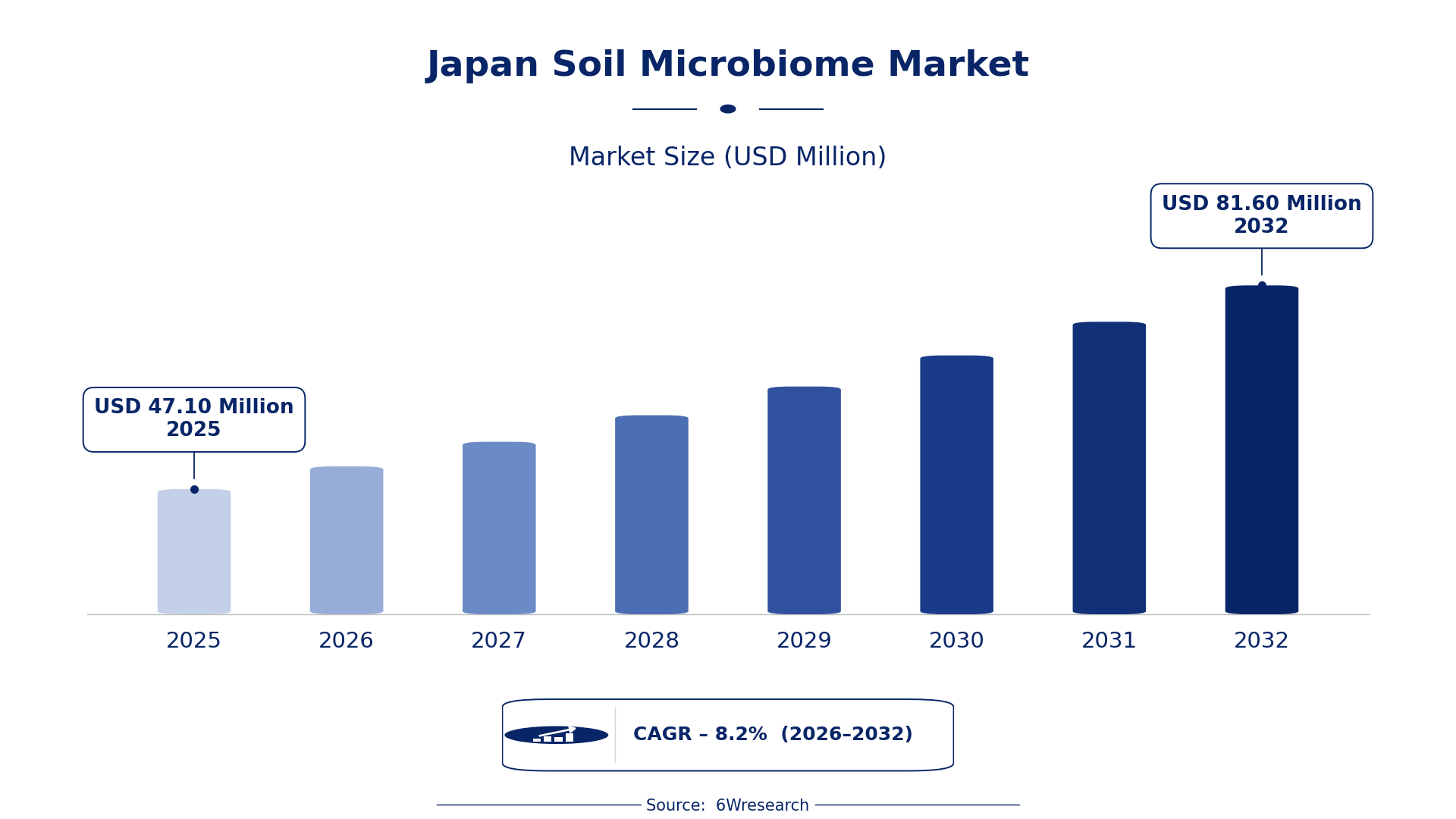
According to 6Wresearch internal database and industry insights, the Japan Soil Microbiome Market was valued at USD 47.10 Million in 2025 and is projected to reach USD 81.60 Million by 2032, growing at a CAGR of approximately 8.2% during 2026–2032.
Japan Soil Microbiome Market Highlights
| Report Metric | Details |
| Report Name | Japan Soil Microbiome Market (2026-2032) |
| Market Size 2025 | USD 47.10 Million |
| Market Size 2032 | USD 81.60 Million |
| Absolute Growth 2025–2032 | USD 34.50 Million |
| CAGR 2026–2032 | 8.2% |
| Peak Annual Growth | 11.0% in 2026 |
| Forecast Period | 2026–2032 |
| Historical Data | 2022–2025 |
| Base Year | 2025 |
| Leading Microbiome Element, 2025 | Rhizospheric Microbiome (39% share) |
| Leading Study Focus, 2025 | Crop Productivity (46% share) |
| Leading Research Tool, 2025 | Genomic Sequencing (46% share) |
| Leading End User, 2025 | Soil Scientists (39% share) |
| Fastest-Growing Microbiome Element | Mycorrhiza (10.6% CAGR) |
| Fastest-Growing Study Focus | Nitrogen Fixation (10.2% CAGR) |
| Fastest-Growing End User | Ag-Biotech Companies (10.7% CAGR) |
| Growing Sector | Agriculture |
| Key End Users | Soil Scientists, Crop Breeders, Ag-Biotech Companies, Environmental NGOs |
Japan Soil Microbiome Market Year-wise Growth Rate and Key Drivers (2022–2032)
This graph illustrates the annual growth rates of the market from 2022 to 2032, highlighting a steady upward trajectory and projected market expansion over the forecast period.
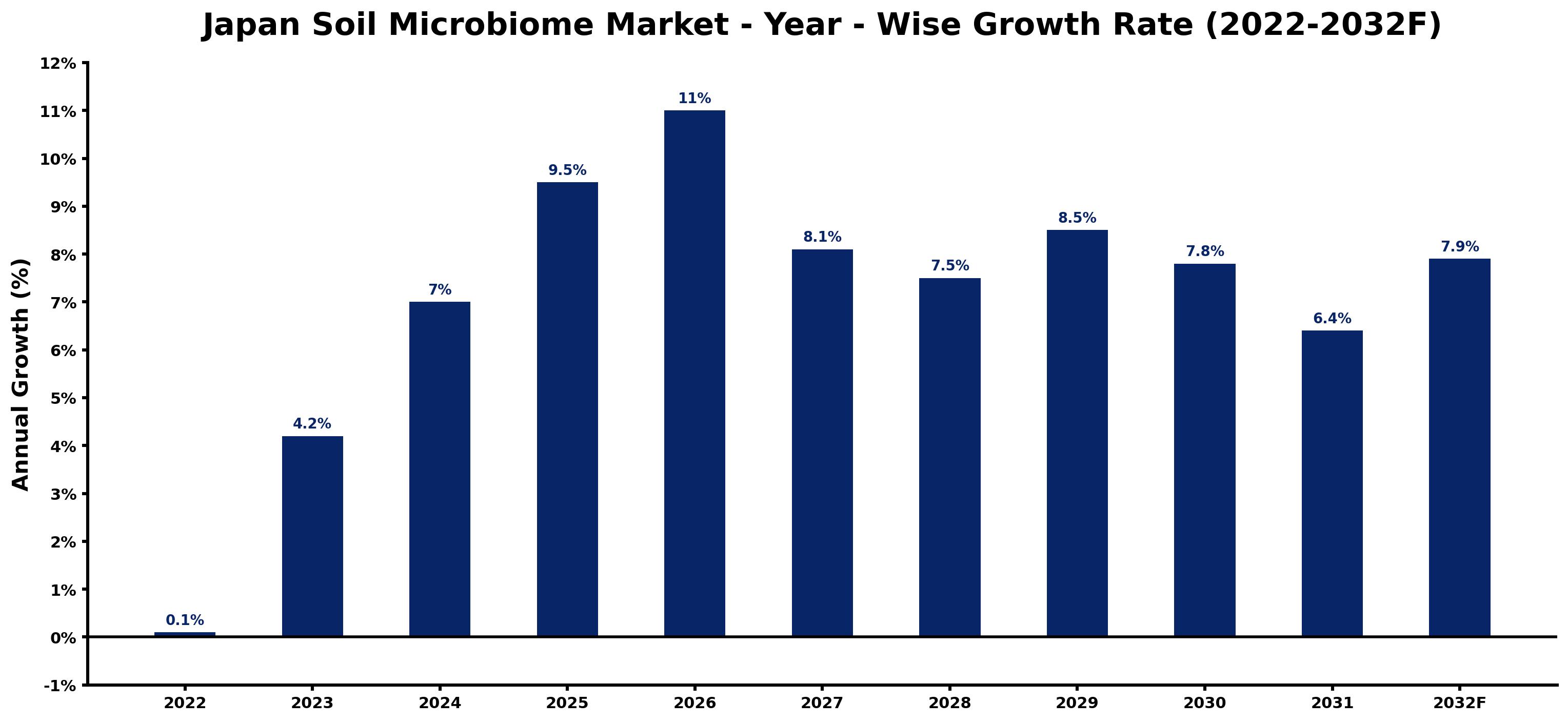
Each row of the following table gives one year's estimated growth and the event or demand shift that explains it.
| Year | Estimated Annual Growth (%) | Market Rationale |
| 2022 | 0.1 | The market showed minimal growth due to initial adoption rates. |
| 2023 | 4.2 | Demand increased as awareness of soil health benefits grew among farmers. |
| 2024 | 7.0 | The introduction of new agricultural practices accelerated market expansion. |
| 2025 | 9.5 | Higher adoption of microbiome techniques drove growth. |
| 2026 | 11.0 | The peak growth year saw widespread investment in sustainable agriculture. |
| 2027 | 8.1 | A slowdown occurred as the market began to stabilise after rapid growth. |
| 2028 | 7.5 | Growth continued but at a reduced rate as market maturity approached. |
| 2029 | 8.5 | Renewed interest in soil health led to a rebound in growth rates. |
| 2030 | 7.8 | Growth slowed again as the market adjusted to new standards. |
| 2031 | 6.4 | A further slowdown reflected the stabilisation of demand patterns. |
| 2032 | 7.9 | Increased focus on sustainable practices revitalised market growth. |
Note: Market size estimations and growth projections presented in this report are based on 6Wresearch's proprietary forecasting methodology, utilizing the latest available industry data, government publications, and primary research inputs.
Japan Soil Microbiome Market Synopsis
Soil microbiomes consist of diverse microorganisms that improve soil health, increase nutrient availability, and promote plant growth. The Japan Soil Microbiome Market benefits from a robust agricultural sector, with over 1.2 million hectares of arable land dedicated to microbiome studies. The growing adoption of sustainable agricultural practices and ongoing research initiatives contribute to the market's expansion, projected to reach USD 81.60 Million by 2032.
Market Dynamics Impact Analysis (2026–2032)
| Factor | Type | Impact | Primary Segment Affected |
| Growing adoption of sustainable farming practices | Driver | High | Rhizospheric Microbiome |
| Increased research funding for soil health | Driver | High | Crop Productivity |
| Expansion of agricultural biotechnology research | Opportunity | High | Ag-Biotech Companies |
| Rising interest in mycorrhizal fungi applications | Opportunity | Medium | Mycorrhiza |
| Limited awareness among traditional farmers | Restraint | Medium | Endophytes |
| Slow adoption of genomic sequencing technologies | Restraint | Medium | Genomic Sequencing |
| High costs associated with microbiome research | Challenge | High | Soil Scientists |
| Competition from alternative soil enhancement methods | Challenge | Medium | Ag-Biotech Companies |
Evaluation of Drivers in Japan Soil Microbiome Market (2026–2032)
The factors lifting demand, and the evidence behind each, are summarised below.
| Drivers | Primary Segment Affected | Why It Matters (Evidence) |
| Increased awareness of soil health benefits | Rhizospheric Microbiome | This awareness has led to more farmers adopting practices that improve soil microbiomes, with over 500 active soil scientists in Japan. |
| Government funding for agricultural research | Crop Productivity | Research initiatives by agricultural institutions support sustainable practices, boosting demand for microbiome solutions. |
| Growing interest in sustainable agriculture | Mycorrhiza | The average Japanese farmer is increasingly adopting sustainable practices, driving demand for mycorrhizal fungi applications. |
| Technological advancements in genomic sequencing | Genomic Sequencing | Universities widely use genomic sequencing for soil microbiome analysis, driving demand for advanced research tools. |
| Rising need for nitrogen-fixing bacteria | Nitrogen Fixation | Research on nitrogen-fixing bacteria is supported by various agricultural institutions, increasing its importance in sustainable agriculture. |
Spending rises because the Tokyo region shows increased awareness of soil health benefits among farmers, leading to more sustainable practices. Approximately 1.2 million hectares of arable land are dedicated to microbiome studies, stimulating growth in this sector. The average Japanese farmer is adopting sustainable practices, increasing the need for mycorrhizal fungi applications. Advancements in genomic sequencing are widely used in universities, boosting research capabilities and demand for soil microbiome solutions.
Evaluation of Restraints in Japan Soil Microbiome Market
Below are the constraints most often cited by buyers and suppliers, with the segment each affects.
| Market Restraint | Primary Segment Affected | Why It Matters (Evidence) |
| Limited awareness among traditional farmers | Endophytes | Many traditional farmers lack knowledge about soil microbiomes, which restricts adoption rates and overall market growth. |
| Slow adoption of genomic sequencing technologies | Genomic Sequencing | The high costs and complexity of genomic sequencing technologies deter some researchers from fully utilising these tools. |
| High costs associated with microbiome research | Soil Scientists | Funding limitations restrict the ability of soil scientists to conduct extensive microbiome studies, impacting innovation. |
| Competition from alternative soil improvement methods | Ag-Biotech Companies | Alternative methods for soil improvement can divert attention and funding away from microbiome-focused solutions. |
| Regulatory hurdles in agricultural practices | Mycorrhiza | Strict regulations can delay the introduction of new microbiome products into the market. |
Japan Soil Microbiome Market Challenges
In 2023, Japan's agriculture sector faced rising costs due to stringent regulations on soil health practices, which can delay project approvals for farmers by up to six months. Increasing expenses associated with sustainable farming methods, such as composting, have pushed operational costs for producers up by 15%, impacting their profit margins. Competition from imported agricultural products has intensified, forcing local farmers to lower prices, which can reduce their income by approximately 10%. Buyers are increasingly concerned about the quality of soil microbiomes, complicating sourcing for suppliers and leading to heightened scrutiny of product certifications.
Trends in the Japan Soil Microbiome Market
Four trends stand out in the Japan Soil Microbiome Market.
- Shift towards Sustainable Agricultural Practices: In 2023, a programme was launched promoting sustainable practices, with 1.2 million hectares of arable land involved. This shift encourages farmers to adopt microbiome-focused techniques.
- Transition from Traditional to Advanced Research Tools: The use of genomic sequencing has become prevalent in Japanese universities since 2023, with a 46% share in the research tool segment. This transition enables more precise studies of soil microbiomes.
- Emergence of Mycorrhizal Fungi Applications: Since 2023, there has been a notable increase in the use of mycorrhizal fungi in agriculture, with initiatives promoting their benefits. This trend is expected to improve soil health across various regions.
- Growing Focus on Nitrogen-Fixing Bacteria: Research on nitrogen-fixing bacteria has gained momentum, supported by agricultural institutions. This focus is critical for sustainable agriculture, with increasing studies conducted annually.
Investment Opportunities in the Japan Soil Microbiome Market
Below are the investment opportunities with the strongest case in the Japan Soil Microbiome Market.
- Investment in Agricultural Biotechnology Research: With over 500 soil scientists in Japan, there is a growing need for advanced research tools. Investing in biotechnology research can improve soil microbiome applications and drive market growth.
- Supply of Mycorrhizal Fungi Products: The prefecture of Hokkaido is known for innovative approaches to integrating mycorrhizal fungi in crop production. Suppliers can enter this market through local partnerships and certifications.
- Development of Genomic Sequencing Services: As genomic sequencing is widely adopted in universities, there is a demand for advanced sequencing services. Collaborating with educational institutions can facilitate market entry.
- Enhancement of Soil Health Initiatives: The Japanese Society of Soil Microbiology promotes research and education, creating opportunities for companies to supply educational materials and tools for soil health initiatives.
Government Initiatives in the Japan Soil Microbiome Market
The Waste Management and Public Cleansing Act (1970) regulates waste treatment, ensuring that producers of soil microbiomes adhere to strict environmental standards. This law complements other regulations by promoting sustainable practices in agriculture, improving soil health and microbiome research. In 2023, the Ministry of Agriculture, Forestry and Fisheries initiated a programme to enhance soil health through microbiome research, providing funding for various projects.
The Japan Agricultural Research Institute funds various projects aimed at improving soil health through microbiome studies. This funding allows soil scientists to conduct extensive research, ensuring that agricultural practices align with national sustainability goals. In 2023, the institute approved multiple initiatives focusing on the application of mycorrhizal fungi, thus directly benefiting agricultural producers.
Future Insight of the Japan Soil Microbiome Market
Advanced genomic sequencing technology will transform soil microbiome analysis by 2032, enabling precise identification of beneficial microorganisms. The programme to promote mycorrhizal fungi will improve crop yields and soil health. Research initiatives in Hokkaido will lead to innovative practices that integrate microbiomes into sustainable agriculture. By 2032, the adoption of ISO 22000 standards will ensure that 80% of agricultural outputs meet stringent food safety requirements, benefiting both buyers and suppliers.
Market Segmentation Analysis
Japan Soil Microbiome Market report covers a detailed analysis of the following market segments:
By Microbiome Element – Rhizospheric Microbiome Leads, Mycorrhiza Expected to Grow Fastest
According to Saurav Kr Singh, Senior Research Analyst at 6Wresearch, Rhizospheric Microbiome took 39% of microbiome element revenue in 2025, more than any other category. The Rhizospheric Microbiome holds the largest share due to its essential role in nutrient uptake for plants, which is critical for agricultural productivity. Research conducted across over 1.2 million hectares of arable land in Japan underscores its significance in enhancing crop yields. The quickest growth will come from Mycorrhiza, forecast to expand at a CAGR of 10.6% between 2026 and 2032. The Mycorrhiza segment is experiencing rapid growth as it significantly improves water and nutrient absorption in plants, which is vital for sustainable farming practices. Recent initiatives promoting the use of mycorrhizal fungi in agriculture are expected to further drive this growth. Suppliers should focus on developing products that incorporate mycorrhizal fungi to meet the rising demand in the market.
By Study Focus – Crop Productivity Leads, Nitrogen Fixation Expected to Grow Fastest
The largest study focus category in 2025 was Crop Productivity, at 46% of revenue. Crop Productivity is the leading focus area as it directly influences agricultural yields, which are crucial for food security in Japan. Government-backed research initiatives highlight the importance of this focus in enhancing overall agricultural performance. Nitrogen Fixation is projected to grow fastest, at a CAGR of 10.2% during 2026–2032. Nitrogen Fixation is the fastest growing area of study due to its critical importance in sustainable agriculture, particularly in light of Japan's environmental targets. The support from the Japan Agricultural Research Institute for research in this field is a key factor in its growth. Buyers should prioritise solutions that improve nitrogen fixation to align with sustainable agricultural practices.
By Research Tool – Genomic Sequencing Leads and Records the Fastest Growth
Genomic Sequencing accounted for 46% of the market by research tool in 2025. Genomic Sequencing is the primary research tool as it is widely used for analysing microbial communities, providing essential insights into soil health. Its extensive application in Japanese universities for soil microbiome studies highlights its importance in research. Genomic Sequencing is also forecast to expand faster than any other category, at a CAGR of 10.5% over 2026–2032. Genomic Sequencing remains the fastest growing tool due to ongoing advancements and its increasing application in various research projects. The growing adoption of this technology in studies will continue to elevate its relevance in the field. Suppliers of genomic sequencing technologies should prepare for increased demand from research institutions focusing on soil microbiomes.
By End User – Soil Scientists Lead, Ag-Biotech Companies Expected to Grow Fastest
In 2025, Soil Scientists led the end user split with a 39% share. Soil Scientists represent the largest user group as they conduct crucial research on soil health, which directly influences agricultural practices. The presence of over 500 soil scientists in Japan indicates a strong demand for their expertise in this sector. Ag-Biotech Companies are set to record the highest CAGR in this split, 10.7% over 2026–2032. Ag-Biotech Companies are the fastest growing user group, as they develop solutions that leverage soil microbiomes to enhance crop production. Their expanding role in agricultural biotechnology research reflects a notable trend in the market. Suppliers should tailor their offerings to Ag-Biotech Companies, integrating soil microbiome research into their product strategies.
Key Attractiveness of the Report
- 10 Years of Market Numbers
- Historical Data Starting from 2022 to 2025
- Base Year 2025
- Forecast Data until 2032
- Key Performance Indicators Impacting the Market
- Major Upcoming Developments and Projects
Key Highlights of the Report:
- Japan Soil Microbiome Market Outlook
- Market Size of Japan Soil Microbiome Market, 2025
- Forecast of Japan Soil Microbiome Market, 2032
- Historical Data and Forecast of Japan Soil Microbiome Revenues & Volume for the Period 2022-2032F
- Japan Soil Microbiome Market Trend Evolution
- Japan Soil Microbiome Market Drivers and Challenges
- Japan Soil Microbiome Price Trends
- Japan Soil Microbiome Porter's Five Forces
- Japan Soil Microbiome Industry Life Cycle
- Historical Data and Forecast of Japan Soil Microbiome Market Revenues & Volume By Microbiome Element for the Period 2022-2032F
- Historical Data and Forecast of Japan Soil Microbiome Market Revenues & Volume By Rhizospheric Microbiome for the Period 2022-2032F
- Historical Data and Forecast of Japan Soil Microbiome Market Revenues & Volume By Endophytes for the Period 2022-2032F
- Historical Data and Forecast of Japan Soil Microbiome Market Revenues & Volume By Symbiotic Bacteria for the Period 2022-2032F
- Historical Data and Forecast of Japan Soil Microbiome Market Revenues & Volume By Mycorrhiza for the Period 2022-2032F
- Historical Data and Forecast of Japan Soil Microbiome Market Revenues & Volume By Study Focus for the Period 2022-2032F
- Historical Data and Forecast of Japan Soil Microbiome Market Revenues & Volume By Plant-Microbe Interactions for the Period 2022-2032F
- Historical Data and Forecast of Japan Soil Microbiome Market Revenues & Volume By Crop Productivity for the Period 2022-2032F
- Historical Data and Forecast of Japan Soil Microbiome Market Revenues & Volume By Nitrogen Fixation for the Period 2022-2032F
- Historical Data and Forecast of Japan Soil Microbiome Market Revenues & Volume By Root Health for the Period 2022-2032F
- Historical Data and Forecast of Japan Soil Microbiome Market Revenues & Volume By Research Tool for the Period 2022-2032F
- Historical Data and Forecast of Japan Soil Microbiome Market Revenues & Volume By Genomic Sequencing for the Period 2022-2032F
- Historical Data and Forecast of Japan Soil Microbiome Market Revenues & Volume By Bioinformatics for the Period 2022-2032F
- Historical Data and Forecast of Japan Soil Microbiome Market Revenues & Volume By Culturing + qPCR for the Period 2022-2032F
- Historical Data and Forecast of Japan Soil Microbiome Market Revenues & Volume By Imaging + Profiling for the Period 2022-2032F
- Historical Data and Forecast of Japan Soil Microbiome Market Revenues & Volume By End User for the Period 2022-2032F
- Historical Data and Forecast of Japan Soil Microbiome Market Revenues & Volume By Soil Scientists for the Period 2022-2032F
- Historical Data and Forecast of Japan Soil Microbiome Market Revenues & Volume By Crop Breeders for the Period 2022-2032F
- Historical Data and Forecast of Japan Soil Microbiome Market Revenues & Volume By Ag-Biotech Companies for the Period 2022-2032F
- Historical Data and Forecast of Japan Soil Microbiome Market Revenues & Volume By Environmental NGOs for the Period 2022-2032F
- Japan Soil Microbiome Import Export Trade Statistics
- Market Opportunity Assessment By Microbiome Element
- Market Opportunity Assessment By Study Focus
- Market Opportunity Assessment By Research Tool
- Market Opportunity Assessment By End User
- Japan Soil Microbiome Top Companies Market Share
- Japan Soil Microbiome Competitive Benchmarking By Technical and Operational Parameters
- Japan Soil Microbiome Company Profiles
- Japan Soil Microbiome Key Strategic Recommendations
Market Covered
The report covers the following segments.
By Microbiome Element
- Rhizospheric Microbiome
- Endophytes
- Symbiotic Bacteria
- Mycorrhiza
By Study Focus
- Plant-Microbe Interactions
- Crop Productivity
- Nitrogen Fixation
- Root Health
By Research Tool
- Genomic Sequencing
- Bioinformatics
- Culturing + qPCR
- Imaging + Profiling
By End User
- Soil Scientists
- Crop Breeders
- Ag-Biotech Companies
- Environmental NGOs































