Japan Soil Pest Control Market Size & Growth Rate
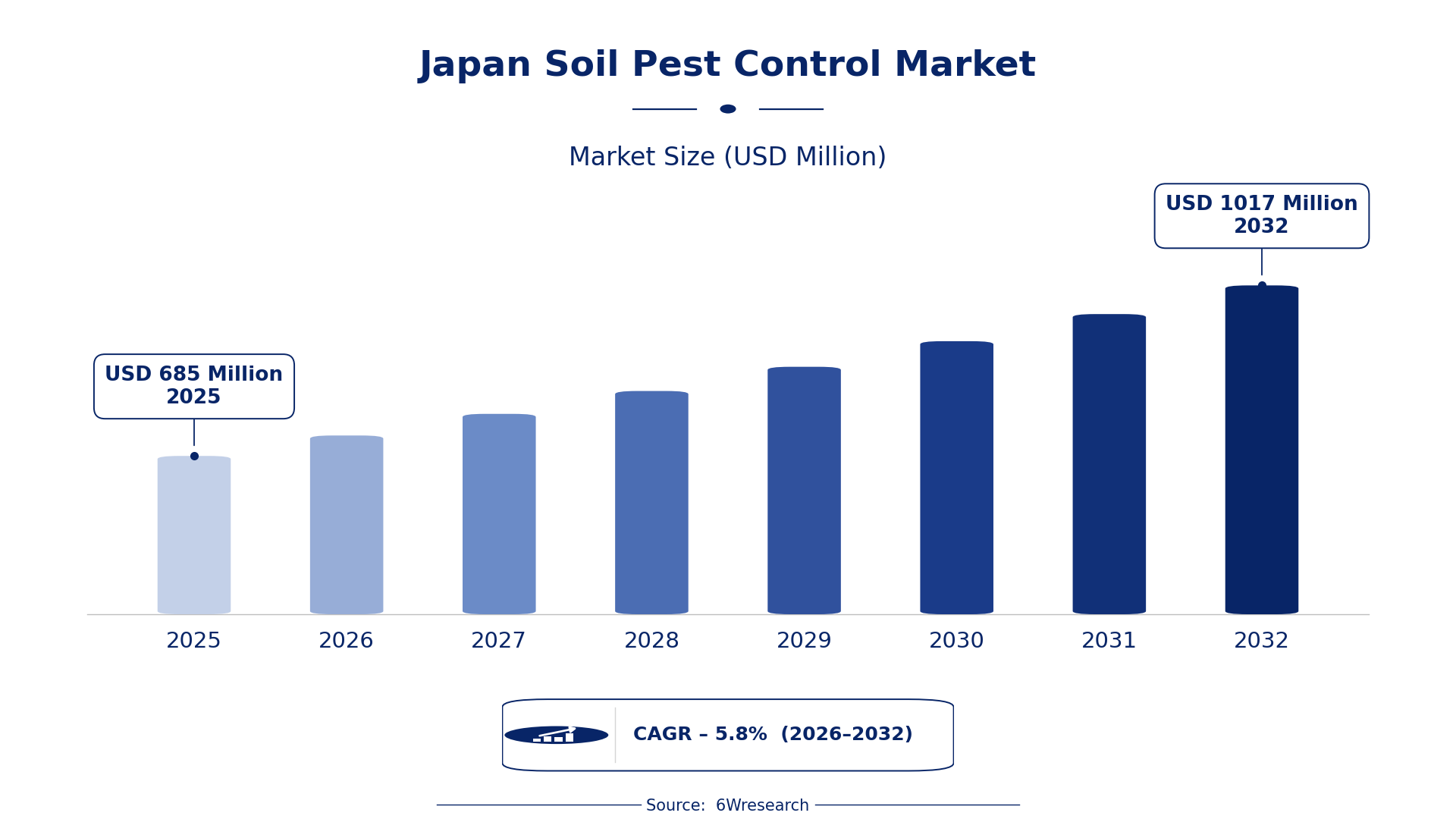
According to 6Wresearch internal database and industry insights, the Japan Soil Pest Control Market was valued at USD 685 Million in 2025 and is projected to reach USD 1,017 Million by 2032, growing at a CAGR of approximately 5.8% during 2026–2032.
Japan Soil Pest Control Market Highlights
| Report Metric | Details |
| Report Name | Japan Soil Pest Control Market (2026-2032) |
| Market Size 2025 | USD 685 Million |
| Market Size 2032 | USD 1,017 Million |
| Absolute Growth 2025–2032 | USD 332 Million |
| CAGR 2026–2032 | 5.8% |
| Peak Annual Growth | 6.6% in 2030 |
| Forecast Period | 2026–2032 |
| Historical Data | 2022–2025 |
| Base Year | 2025 |
| Leading Control Type, 2025 | Insecticides (49% share) |
| Leading Active Ingredient, 2025 | Organophosphates (41% share) |
| Leading Target Pest, 2025 | Soil-Borne Insects (46% share) |
| Leading End User, 2025 | Sugarcane Growers (49% share) |
| Fastest-Growing Control Type | Biocontrol Agents (8.4% CAGR) |
| Fastest-Growing Active Ingredient | Bacillus Thuringiensis (7.6% CAGR) |
| Fastest-Growing Target Pest | Root Rot Pathogens (8.0% CAGR) |
| Fastest-Growing End User | Floriculture Farms (7.7% CAGR) |
| Growing Sector | agriculture |
| Key End Users | Sugarcane Growers, Cotton Growers, Organic Producers, Floriculture Farms |
Japan Soil Pest Control Market Year-wise Growth Rate and Key Drivers (2022–2032)
This graph illustrates the annual growth rates of the market from 2022 to 2032, highlighting a steady upward trajectory and projected market expansion over the forecast period.
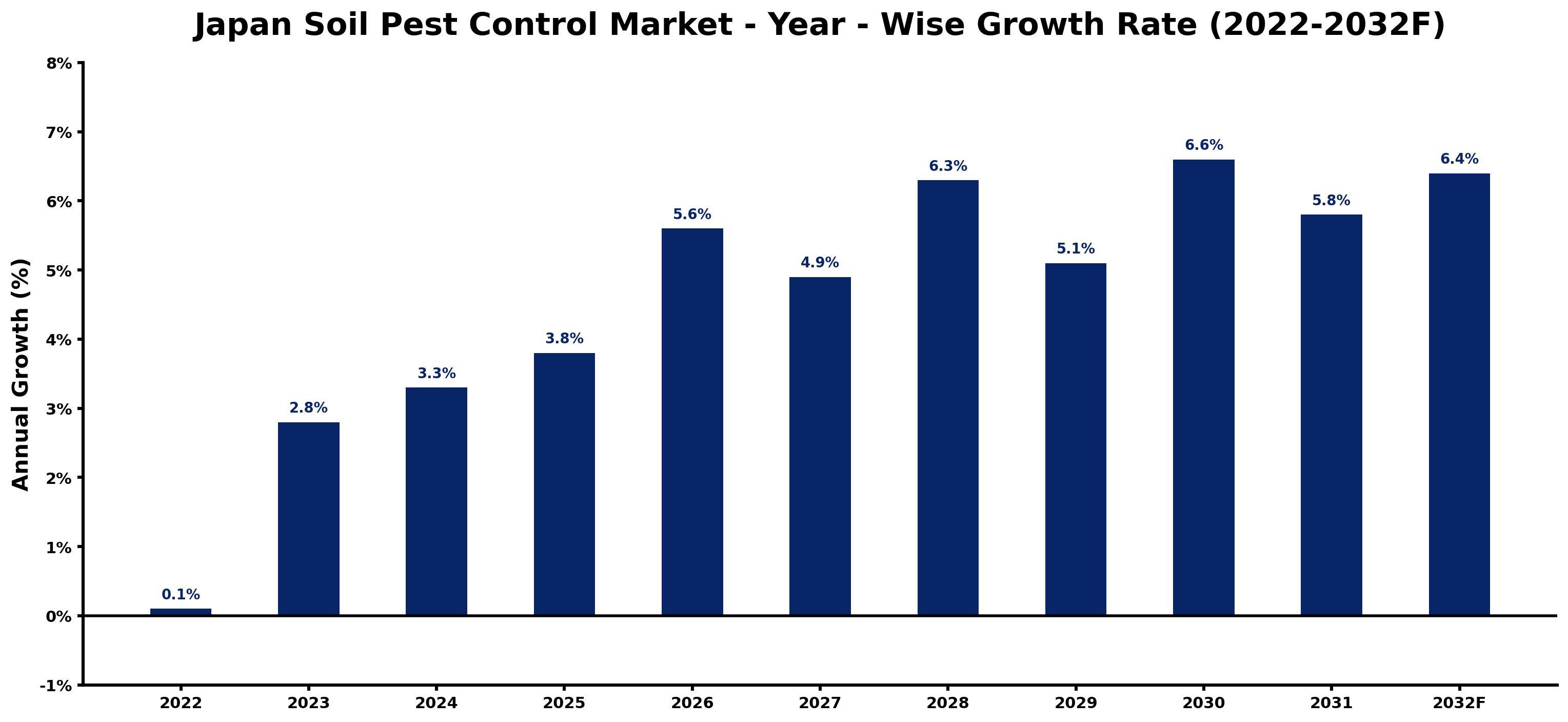
Annual growth estimates for each year appear below with the principal reason behind them, explaining the shifts that set the pace of the market.
| Year | Estimated Annual Growth (%) | Market Rationale |
| 2022 | 0.1 | The market showed minimal growth due to limited pest management activities. |
| 2023 | 2.8 | Increased awareness of soil pest issues led to faster growth compared to the previous year. |
| 2024 | 3.3 | The introduction of new pest control products further accelerated market expansion. |
| 2025 | 3.8 | Demand rose as agricultural practices improved, contributing to higher growth rates. |
| 2026 | 5.6 | Investment in pest management technologies is expected to drive demand. |
| 2027 | 4.9 | Growth slows slightly as market stabilises after previous rapid expansion. |
| 2028 | 6.3 | The introduction of innovative biocontrol methods is expected to boost growth again. |
| 2029 | 5.1 | A slowdown occurs as the market adjusts to new product integrations. |
| 2030 | 6.6 | Peak growth is driven by heightened investments in sustainable pest control solutions. |
| 2031 | 5.8 | Market growth slows as saturation in certain segments begins to take effect. |
| 2032 | 6.4 | Continued demand for advanced pest control methods supports a strong growth outlook. |
Note: Market size estimations and growth projections presented in this report are based on 6Wresearch's proprietary forecasting methodology, utilizing the latest available industry data, government publications, and primary research inputs.
Japan Soil Pest Control Market Synopsis
Soil pest control products are essential for managing pests like nematodes and insects in agricultural soils. These products protect crops such as sugarcane and cotton. The Japan Soil Pest Control Market is expanding, driven by increasing domestic agricultural activities and a shift towards sustainable pest management practices. The government’s initiatives, including a ¥5 billion allocation for pest management programs, are further stimulating demand for effective pest control solutions.
Market Dynamics Impact Analysis (2026–2032)
| Factor | Type | Impact | Primary Segment Affected |
| Rising focus on sustainable agriculture practices | Driver | High | Insecticides |
| Increased investment in agricultural technology | Driver | High | Nematicides |
| Growing demand for organic pest control solutions | Opportunity | High | Biocontrol Agents |
| Expansion of agricultural areas for sugarcane and cotton | Opportunity | High | Sugarcane Growers |
| High costs associated with advanced pest control technologies | Restraint | Medium | Fungal Control |
| Regulatory compliance for pest control products | Restraint | Medium | Insecticides |
| Aging farmer population affecting adoption of new methods | Challenge | High | Sugarcane Growers |
| Limited availability of skilled labour in agriculture | Challenge | Medium | Cotton Growers |
Evaluation of Drivers in Japan Soil Pest Control Market (2026–2032)
Demand rests on the following drivers, each shown with the segment it touches most.
| Drivers | Primary Segment Affected | Why It Matters (Evidence) |
| Increased agricultural productivity demands | Insecticides | Higher yields in sugarcane and cotton require effective pest control, with Japan producing 1.5 million tons of sugarcane in 2022. |
| Investment in pest management technologies | Nematicides | Growers are adopting new technologies, leading to increased purchases of nematicides for effective pest management. |
| Shift towards organic farming practices | Biocontrol Agents | The rise of organic farming, with around 120,000 registered organic farms in 2022, boosts demand for biocontrol agents. |
| Expansion of agricultural land for key crops | Fungal Control | The total area cultivated for cotton is approximately 1,000 hectares, increasing the need for effective fungal control products. |
| Government support for pest management initiatives | Fumigant/Non-Fumigant | The government allocated ¥5 billion in 2023 for agricultural pest management programs, supporting market growth. |
Several shifts outside the market lift sales. The push for increased agricultural productivity, particularly in sugarcane and cotton, has led to a demand for insecticides. Investment in advanced pest management technologies drives purchases of nematicides, as growers seek effective solutions. The rise of organic farming is boosting demand for biocontrol agents, supported by the increase in registered organic farms.
Evaluation of Restraints in Japan Soil Pest Control Market
Below are the constraints most often cited by buyers and suppliers, with the segment each affects.
| Market Restraint | Primary Segment Affected | Why It Matters (Evidence) |
| High costs of advanced pest control technologies | Fungal Control | The financial burden of implementing advanced technologies limits adoption among smaller growers, affecting overall market growth. |
| Regulatory compliance challenges for pest control products | Insecticides | Stringent regulations require extensive testing and certification, delaying product availability and increasing costs for producers. |
| Limited awareness of pest management solutions among farmers | Nematicides | Many farmers lack knowledge about effective pest control methods, resulting in lower product uptake in the market. |
| Market saturation in certain pest control segments | Biocontrol Agents | As more products enter the market, competition increases, making it difficult for new entrants to gain market share. |
| Dependence on traditional farming practices | Sugarcane Growers | Older farmers may resist adopting new technologies, slowing the transition to more effective pest management solutions. |
Japan Soil Pest Control Market Challenges
High production costs stem from an average minimum wage of JPY 1,055 per hour, making soil pest control products unaffordable for many farmers. Limited access to biocontrol agents disrupts supply chains, causing delays in pest management for growers and risking crop losses estimated at 1.5 million tons of sugarcane. Complex regulations, such as compliance with the JIS K 1495 standard, impose additional costs on producers, extending product development timelines by several months. An ageing farming workforce, with an average age of 67 years, creates a skills gap that impedes the adoption of modern pest control methods among younger farmers.
Trends in the Japan Soil Pest Control Market
The following changes are redrawing the Japan Soil Pest Control Market.
- Shift towards Biocontrol Methods: The agricultural sector is increasingly adopting biocontrol agents as a sustainable alternative. In 2023, the Japanese government launched a new initiative to promote these agents, reflecting a growing emphasis on environmentally friendly practices.
- Transition from Chemical to Organic Solutions: In Japan, there is a noticeable shift from chemical pest control to organic solutions. The number of organic farms has reached approximately 120,000, indicating a strong market trend towards sustainable practices.
- Emergence of Integrated Pest Management: Integrated pest management practices are gaining traction among growers. The Kanto region, a major agricultural hub, is seeing increased adoption of these methods to improve crop protection.
- Focus on Precision Agriculture: Precision agriculture techniques are being prioritised to improve pest control efficiency. The average annual rainfall of 1,500 mm in agricultural regions is driving the need for tailored pest management solutions.
Investment Opportunities in the Japan Soil Pest Control Market
Investors looking at the Japan Soil Pest Control Market should consider the following areas.
- Sugarcane Growers seeking effective pest solutions: Sugarcane growers are increasingly in search of advanced pest control products. The market gap is evident with 1.5 million tons of sugarcane produced in 2022, indicating a demand for effective solutions.
- Collaborative Development of Biocontrol Agents: There is potential for joint ventures focused on biocontrol agents. The recent initiative by the government to promote these agents offers a pathway for collaboration.
- Investment in Sustainable Pest Management: With the government allocating ¥5 billion for pest management in 2023, there is a notable opportunity to invest in sustainable pest control solutions.
- Expansion in Cotton Growing Regions: Cotton growers are broadening their operations, creating demand for effective pest control. The total area cultivated for cotton is approximately 1,000 hectares, presenting a timely investment opportunity.
Government Initiatives in the Japan Soil Pest Control Market
The Waste Management and Public Cleansing Act of 1970 regulates the treatment and disposal of waste related to pest control products. This law ensures that producers adhere to environmental standards, impacting their operational practices. Additionally, the Electrical Appliance and Material Safety Act of 1961 mandates safety regulations for materials used in pest control, affecting product development and compliance.
In 2023, the Japanese government allocated ¥5 billion for agricultural pest management programmes, overseen by the Ministry of Agriculture, Forestry and Fisheries. This funding supports initiatives aimed at improving pest control measures, ensuring that producers meet safety and efficacy standards.
Future Insight of the Japan Soil Pest Control Market
By 2032, Japan's commitment to reducing greenhouse gas emissions will drive a shift towards environmentally friendly pest control solutions. The government's ¥5 billion investment in agricultural pest management programmes will improve the availability of advanced soil pest control products for domestic growers. Adoption of ISO 9001 standards will enhance product quality, ensuring reliability for buyers. The rise of precision farming technologies will enable more efficient and targeted applications, transforming pest management strategies in agriculture.
Market Segmentation Analysis
Japan Soil Pest Control Market report covers a detailed analysis of the following market segments:
By Control Type – Insecticides Lead, Biocontrol Agents Expected to Grow Fastest
According to Saurav Kr Singh, Senior Research Analyst at 6Wresearch, Insecticides accounted for 49% of the market by control type in 2025. Insecticides maintain the largest market share as they are extensively used for managing soil-borne insects, particularly among sugarcane growers in the Kanto region. Their established application and effectiveness make them a preferred choice for many agricultural practices. Over 2026–2032, Biocontrol Agents are expected to post the fastest growth, at a CAGR of 8.4%. The rapid growth of biocontrol agents is fuelled by the Japanese government's 2023 initiative promoting sustainable agricultural methods, which allocated ¥5 billion for pest management programs. This governmental support is likely to accelerate the adoption of environmentally friendly pest control solutions. Suppliers should focus on expanding their biocontrol product lines to align with government initiatives and farmer preferences for sustainable practices.
By Active Ingredient – Organophosphates Lead, Bacillus Thuringiensis Expected to Grow Fastest
In 2025, Organophosphates led the active ingredient split with a 41% share. Organophosphates dominate the market due to their widespread application as effective insecticides for various soil-borne pests, crucial for many agricultural practices. Their established use in regions like Kanto, known for sugarcane and cotton production, reinforces their leading position. Bacillus Thuringiensis is set to record the highest CAGR in this split, 7.6% over 2026–2032. Bacillus Thuringiensis is experiencing rapid growth as the rise of organic farms, which numbered around 120,000 in 2022, fuels the demand for eco-friendly pest control methods. This shift towards organic agriculture will likely accelerate the uptake of this active ingredient. Suppliers should consider expanding their product lines to include more organic-compatible solutions to meet the increasing demand from organic farmers.
By Target Pest – Soil-Borne Insects Lead, Root Rot Pathogens Expected to Grow Fastest
Soil-Borne Insects took 46% of target pest revenue in 2025, more than any other category. Soil-borne insects are the primary target for pest control products, particularly among sugarcane growers who rely heavily on insecticides for effective management. The direct impact of these pests on crop yield solidifies their leading position in the market. Root Rot Pathogens are projected to grow fastest, at a CAGR of 8.0% during 2026–2032. Root rot pathogens are gaining attention as floriculture farms increasingly recognise the importance of controlling these pathogens to ensure healthy flower production. The focus on quality in floriculture is likely to accelerate the demand for solutions targeting these pests. Buyers should prioritise pest control solutions that address root rot pathogens to maintain high standards in flower production.
By End User – Sugarcane Growers Lead, Floriculture Farms Expected to Grow Fastest
Sugarcane Growers held 49% of the Japan Soil Pest Control Market by end user in 2025. Sugarcane growers constitute the largest user group of soil pest control products, driven by high production levels in the Kanto region. Their dependence on effective pest management strategies ensures consistent demand for these products. The quickest growth will come from Floriculture Farms, forecast to expand at a CAGR of 7.7% between 2026 and 2032. Floriculture farms are increasingly adopting soil pest control products to optimise flower production and address emerging pest challenges. The growing popularity of floriculture is anticipated to further stimulate this segment's expansion. Suppliers should develop targeted solutions for floriculture farms to take advantage of the growth in this market segment.
Key Attractiveness of the Report
- 10 Years of Market Numbers
- Historical Data Starting from 2022 to 2025
- Base Year 2025
- Forecast Data until 2032
- Key Performance Indicators Impacting the Market
- Major Upcoming Developments and Projects
Key Highlights of the Report:
- Japan Soil Pest Control Market Outlook
- Market Size of Japan Soil Pest Control Market, 2025
- Forecast of Japan Soil Pest Control Market, 2032
- Historical Data and Forecast of Japan Soil Pest Control Revenues & Volume for the Period 2022-2032F
- Japan Soil Pest Control Market Trend Evolution
- Japan Soil Pest Control Market Drivers and Challenges
- Japan Soil Pest Control Price Trends
- Japan Soil Pest Control Porter's Five Forces
- Japan Soil Pest Control Industry Life Cycle
- Historical Data and Forecast of Japan Soil Pest Control Market Revenues & Volume By Control Type for the Period 2022-2032F
- Historical Data and Forecast of Japan Soil Pest Control Market Revenues & Volume By Nematicides for the Period 2022-2032F
- Historical Data and Forecast of Japan Soil Pest Control Market Revenues & Volume By Insecticides for the Period 2022-2032F
- Historical Data and Forecast of Japan Soil Pest Control Market Revenues & Volume By Biocontrol Agents for the Period 2022-2032F
- Historical Data and Forecast of Japan Soil Pest Control Market Revenues & Volume By Fungal Control for the Period 2022-2032F
- Historical Data and Forecast of Japan Soil Pest Control Market Revenues & Volume By Active Ingredient for the Period 2022-2032F
- Historical Data and Forecast of Japan Soil Pest Control Market Revenues & Volume By Fumigant/Non-Fumigant for the Period 2022-2032F
- Historical Data and Forecast of Japan Soil Pest Control Market Revenues & Volume By Organophosphates for the Period 2022-2032F
- Historical Data and Forecast of Japan Soil Pest Control Market Revenues & Volume By Bacillus Thuringiensis for the Period 2022-2032F
- Historical Data and Forecast of Japan Soil Pest Control Market Revenues & Volume By Trichoderma Formulas for the Period 2022-2032F
- Historical Data and Forecast of Japan Soil Pest Control Market Revenues & Volume By Target Pest for the Period 2022-2032F
- Historical Data and Forecast of Japan Soil Pest Control Market Revenues & Volume By Nematodes for the Period 2022-2032F
- Historical Data and Forecast of Japan Soil Pest Control Market Revenues & Volume By Soil-Borne Insects for the Period 2022-2032F
- Historical Data and Forecast of Japan Soil Pest Control Market Revenues & Volume By Grubs/Beetles for the Period 2022-2032F
- Historical Data and Forecast of Japan Soil Pest Control Market Revenues & Volume By Root Rot Pathogens for the Period 2022-2032F
- Historical Data and Forecast of Japan Soil Pest Control Market Revenues & Volume By End User for the Period 2022-2032F
- Historical Data and Forecast of Japan Soil Pest Control Market Revenues & Volume By Sugarcane Growers for the Period 2022-2032F
- Historical Data and Forecast of Japan Soil Pest Control Market Revenues & Volume By Cotton Growers for the Period 2022-2032F
- Historical Data and Forecast of Japan Soil Pest Control Market Revenues & Volume By Organic Producers for the Period 2022-2032F
- Historical Data and Forecast of Japan Soil Pest Control Market Revenues & Volume By Floriculture Farms for the Period 2022-2032F
- Japan Soil Pest Control Import Export Trade Statistics
- Market Opportunity Assessment By Control Type
- Market Opportunity Assessment By Active Ingredient
- Market Opportunity Assessment By Target Pest
- Market Opportunity Assessment By End User
- Japan Soil Pest Control Top Companies Market Share
- Japan Soil Pest Control Competitive Benchmarking By Technical and Operational Parameters
- Japan Soil Pest Control Company Profiles
- Japan Soil Pest Control Key Strategic Recommendations
Market Covered
The following segment groups are covered in the report.
By Control Type
- Nematicides
- Insecticides
- Biocontrol Agents
- Fungal Control
By Active Ingredient
- Fumigant/Non-Fumigant
- Organophosphates
- Bacillus Thuringiensis
- Trichoderma Formulas
By Target Pest
- Nematodes
- Soil-Borne Insects
- Grubs/Beetles
- Root Rot Pathogens
By End User
- Sugarcane Growers
- Cotton Growers
- Organic Producers
- Floriculture Farms































