Japan Soil & Water Testing Services Market Size & Growth Rate
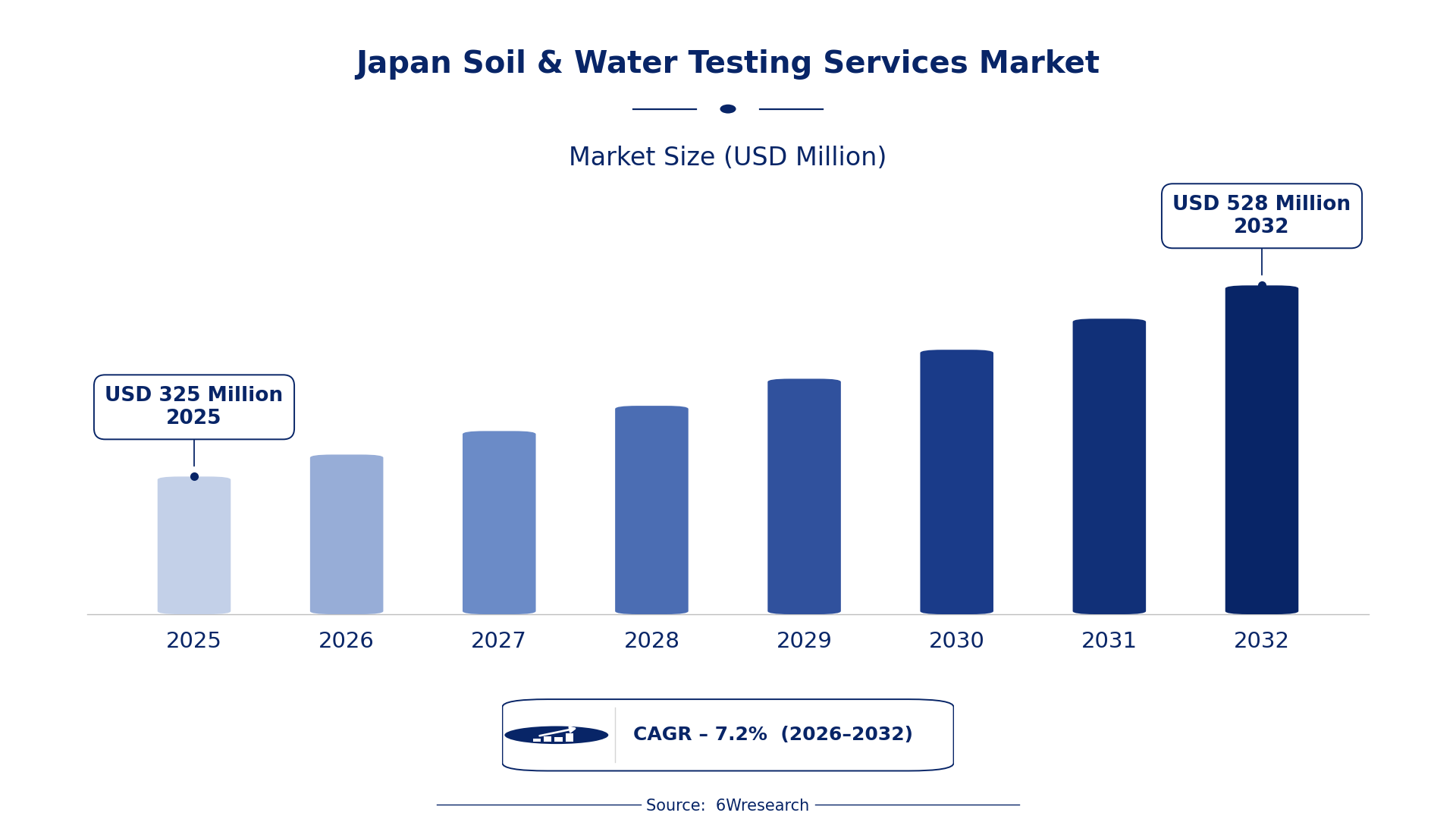
According to 6Wresearch internal database and industry insights, the Japan Soil & Water Testing Services Market was valued at USD 325 Million in 2025 and is projected to reach USD 528 Million by 2032, growing at a CAGR of approximately 7.2% during 2026–2032.
Japan Soil & Water Testing Services Market Highlights
| Report Metric | Details |
| Report Name | Japan Soil & Water Testing Services Market (2026-2032) |
| Market Size 2025 | USD 325 Million |
| Market Size 2032 | USD 528 Million |
| Absolute Growth 2025–2032 | USD 203 Million |
| CAGR 2026–2032 | 7.2% |
| Peak Annual Growth | 8.6% in 2028 |
| Forecast Period | 2026–2032 |
| Historical Data | 2022–2025 |
| Base Year | 2025 |
| Leading Test Type, 2025 | Soil Nutrient Test (43% share) |
| Leading Sample Type, 2025 | Topsoil/Subsoil (40% share) |
| Leading Lab Type, 2025 | Government Agri Labs (49% share) |
| Leading End User, 2025 | Farmers (39% share) |
| Fastest-Growing Test Type | Water Hardness Test (10.1% CAGR) |
| Fastest-Growing Sample Type | Ground/Surface Water (10.2% CAGR) |
| Fastest-Growing Lab Type | Environmental Agencies (9.9% CAGR) |
| Fastest-Growing End User | Housing Authorities (9.3% CAGR) |
| Growing Sector | Agricultural sector |
| Key End Users | Farmers, Environmental Agencies, Agrochemical Companies, Housing Authorities |
Japan Soil & Water Testing Services Market Year-wise Growth Rate and Key Drivers (2022–2032)
This graph illustrates the annual growth rates of the market from 2022 to 2032, highlighting a steady upward trajectory and projected market expansion over the forecast period.
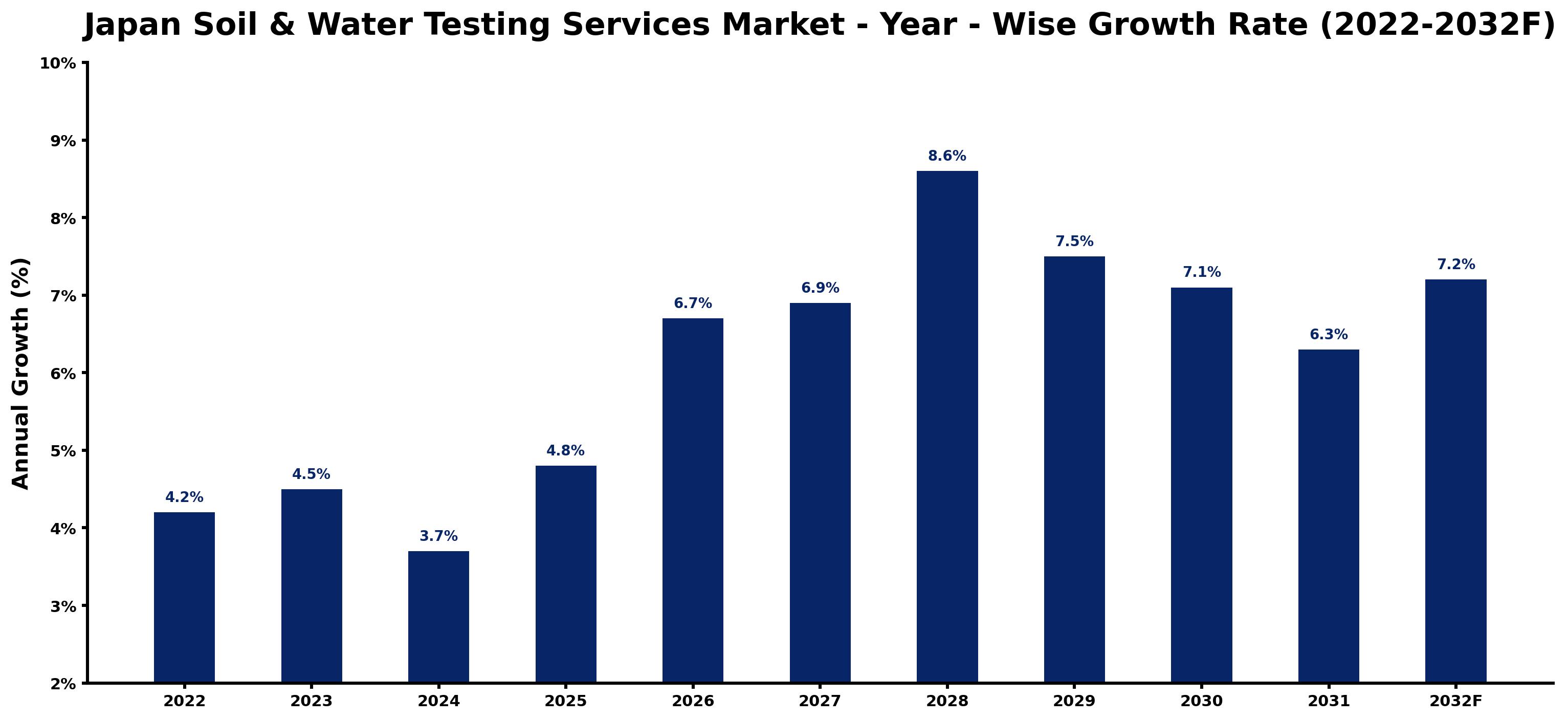
Each row of the following table gives one year's estimated growth and the event or demand shift that explains it.
| Year | Estimated Annual Growth (%) | Market Rationale |
| 2022 | 4.2 | The market showed steady growth due to increased awareness of soil health. |
| 2023 | 4.5 | Demand rose as more farmers adopted soil testing services for better crop yields. |
| 2024 | 3.7 | Growth slowed as some farmers faced budget constraints amid rising costs. |
| 2025 | 4.8 | The market accelerated as more agricultural land underwent testing for compliance. |
| 2026 | 6.7 | Growth is expected to rise with increased investments in sustainable agricultural practices. |
| 2027 | 6.9 | Demand will continue to rise as environmental agencies expand their testing initiatives. |
| 2028 | 8.6 | The market is projected to peak, driven by heightened regulatory requirements for water quality. |
| 2029 | 7.5 | Growth is expected to slow as the market begins to stabilise after rapid expansion. |
| 2030 | 7.1 | Demand will continue to grow, supported by ongoing environmental monitoring efforts. |
| 2031 | 6.3 | Growth is projected to decelerate as the market adjusts to new testing standards. |
| 2032 | 7.2 | The market is expected to rebound with renewed investments in agricultural technologies. |
Note: Market size estimations and growth projections presented in this report are based on 6Wresearch's proprietary forecasting methodology, utilizing the latest available industry data, government publications, and primary research inputs.
Japan Soil & Water Testing Services Market Synopsis
Soil and water testing services involve analysing samples to determine their chemical and physical properties, which are essential for agricultural health and environmental monitoring. The Japan Soil & Water Testing Services Market is experiencing growth, with 70% of farmers utilising these services. Factors such as regulatory compliance and environmental awareness are driving demand, particularly in regions like Kanto, where soil testing is vital for sustainable agriculture and productivity.
Market Dynamics Impact Analysis (2026–2032)
| Factor | Type | Impact | Primary Segment Affected |
| Increased regulatory compliance for agricultural practices | Driver | High | Soil Nutrient Test |
| Growing environmental awareness among farmers | Driver | High | Water Hardness Test |
| Rising demand for sustainable agricultural practices | Opportunity | High | Topsoil/Subsoil |
| Expansion of environmental monitoring initiatives | Opportunity | Medium | Ground/Surface Water |
| High costs associated with testing services | Restraint | High | Heavy Metal Analysis |
| Limited access to testing facilities in rural areas | Restraint | Medium | Field Testing Centers |
| Compliance with stringent environmental regulations | Challenge | High | Environmental Agencies |
| Capacity constraints in testing laboratories | Challenge | Medium | Private Labs |
Evaluation of Drivers in Japan Soil & Water Testing Services Market (2026–2032)
The factors lifting demand, and the evidence behind each, are summarised below.
| Drivers | Primary Segment Affected | Why It Matters (Evidence) |
| Increased funding for sustainable agriculture | Soil Nutrient Test | This funding allows farmers to invest in soil testing, leading to improved crop yields, with 70% of farmers now using these services. |
| Rising awareness of soil health | Water Hardness Test | Farmers are increasingly aware of how soil quality affects productivity, resulting in a 10% rise in testing services. |
| Regulatory requirements for heavy metal testing | Heavy Metal Analysis | Mandatory testing for agricultural land use changes has led to a 50% increase in demand for these services. |
| Technological advancements in testing methods | pH & Salinity Test | New techniques have reduced testing times to an average of 5 days, encouraging more farmers to conduct tests. |
| Environmental monitoring initiatives by agencies | Ground/Surface Water | Environmental agencies conduct over 50,000 water quality tests annually, increasing demand for testing services. |
A wider customer base explains much of the growth, as increased funding for sustainable agriculture enables farmers to invest in soil testing. Approximately 70% of farmers are now utilising these services, reflecting a rising awareness of soil health and its impact on productivity. Mandatory testing for heavy metal analysis has led to a notable increase in demand for these services. Technological advancements have improved testing efficiency, reducing turnaround times to an average of five days.
Evaluation of Restraints in Japan Soil & Water Testing Services Market
Below are the constraints most often cited by buyers and suppliers, with the segment each affects.
| Market Restraint | Primary Segment Affected | Why It Matters (Evidence) |
| High costs associated with testing services | Heavy Metal Analysis | The average cost of a soil nutrient test is approximately 10,000 JPY, which can deter some farmers. |
| Limited access to testing facilities in rural areas | Field Testing Centers | Many rural areas lack adequate testing facilities, restricting farmers' ability to conduct necessary tests. |
| Compliance with stringent environmental regulations | Environmental Agencies | Extensive testing for compliance burdens smaller operators, complicating their operational capacity. |
| Capacity constraints in testing laboratories | Private Labs | With over 1,200 registered agricultural laboratories, some are overwhelmed, causing delays in test results. |
| Inconsistent quality of testing across facilities | Government Agri Labs | Variability in testing standards can affect trust in results, impacting farmer engagement. |
Japan Soil & Water Testing Services Market Challenges
Environmental agencies conduct over 50,000 water quality tests annually, yet skills shortages in agricultural laboratories create delays, hindering compliance for producers. More than 1,200 registered agricultural laboratories exist, but inconsistent availability of testing equipment prolongs wait times for buyers needing timely soil assessments. Heavy metal analysis is required for all agricultural land use changes, complicating compliance for producers and risking fines that can exceed 100,000 JPY. Competition among testing facilities drives prices down, squeezing profit margins for suppliers and ultimately affecting service quality for buyers.
Trends in the Japan Soil & Water Testing Services Market
The shifts below are changing how Japan Soil & Water Testing Services Market products are bought and supplied.
- Farmers Increasing Focus on Soil Health Assessments: Farmers are prioritising soil health assessments to improve crop yields, with 70% now using testing services. This shift began in 2023, driven by rising awareness of sustainable practices.
- Environmental Agencies Expanding Water Quality Testing: Environmental agencies are expanding their water quality testing initiatives, conducting over 60,000 tests annually. This change started in 2022, reflecting a growing commitment to environmental monitoring.
- Shift Towards Advanced Testing Technologies: The adoption of advanced testing technologies is transforming soil and water analysis. This trend began in 2023, with new methods reducing average testing times to five days.
- Regulatory Compliance Driving Testing Demand: Regulatory compliance is increasingly driving demand for soil and water testing services. This trend has been apparent since 2023, as mandatory testing for heavy metals becomes more common.
Investment Opportunities in the Japan Soil & Water Testing Services Market
Below are the investment opportunities with the strongest case in the Japan Soil & Water Testing Services Market.
- Gap in Affordable Testing Services: With 70% of farmers using testing services, there remains a gap for affordable options. Farmers in rural areas need accessible testing, creating opportunities for local partnerships.
- Rising Demand for Sustainable Practices: Farmers are increasingly seeking sustainable agricultural practices, with a clear opportunity for testing services. Collaborating with agricultural cooperatives can facilitate market entry.
- Investment in Field Testing Centers: Investment in field testing centers is essential, particularly in rural areas where access is limited. The growing number of farmers needing these services presents a clear opportunity.
- Timing with National Soil Health Programme: The national programme for improving soil health by 2025 offers a timely opportunity for investment. Engaging with government initiatives can enhance market presence.
Government Initiatives in the Japan Soil & Water Testing Services Market
The Waste Management and Public Cleansing Act regulates the treatment and disposal of waste, impacting soil and water testing services. This law ensures that testing facilities adhere to strict standards, which helps maintain environmental integrity and promotes public health. The Water Supply Act sets standards for drinking-water quality and supply, which influences testing protocols for water quality assessments, ensuring compliance with health regulations.
The GX Basic Policy aims for about JPY 150 trillion in public-private decarbonisation investment over ten years, managed by the Government of Japan. This investment supports initiatives that improve soil and water testing capabilities, ultimately benefiting agricultural producers.
Future Insight of the Japan Soil & Water Testing Services Market
Advancements in laboratory technology, such as automated analysis systems, will reshape soil and water testing services by 2032, improving efficiency and reducing turnaround times. The national program for improving soil health by 2025 will increase demand for assessments, with the average cost of a soil nutrient test at approximately 10,000 JPY expected to rise. Enhanced data analytics will provide buyers with tailored assessments, while the widespread adoption of ISO 17025 standards will ensure consistent quality across testing facilities, building trust between suppliers and buyers.
Market Segmentation Analysis
Japan Soil & Water Testing Services Market report covers a detailed analysis of the following market segments:
By Test Type – Soil Nutrient Test Leads, Water Hardness Test Expected to Grow Fastest
According to Saurav Kr Singh, Senior Research Analyst at 6Wresearch, Soil Nutrient Test held 43% of the Japan Soil & Water Testing Services Market by test type in 2025. The Soil Nutrient Test holds the largest share as it is vital for evaluating soil fertility, which is essential for agricultural productivity in Japan. With 70% of farmers using soil testing services, this test is integral to their farming practices. Water Hardness Test is projected to grow fastest, at a CAGR of 10.1% during 2026–2032. The Water Hardness Test is witnessing rapid growth due to increasing awareness about irrigation water quality and its impact on crop yields. This surge is propelled by the need for farmers to optimise water use in their agricultural activities. Suppliers should focus on expanding their water hardness testing services to meet the growing needs of agricultural users.
By Sample Type – Topsoil/Subsoil Leads, Ground/Surface Water Expected to Grow Fastest
In 2025, Topsoil/Subsoil led the sample type split with a 40% share. Topsoil/Subsoil testing dominates the market as it provides essential insights for agricultural assessments, directly influencing soil health evaluations. Given Japan's vast agricultural areas, farmers consistently depend on this sample type for effective cultivation. The quickest growth will come from Ground/Surface Water, forecast to expand at a CAGR of 10.2% between 2026 and 2032. Ground/Surface Water testing is growing quickly due to heightened concerns regarding water quality in agricultural zones. The rising regulatory focus on groundwater safety is boosting demand for this testing category. Buyers need to prioritise ground and surface water testing to comply with strict environmental regulations.
By Lab Type – Government Agri Labs Lead, Environmental Agencies Expected to Grow Fastest
Government Agri Labs took 49% of lab type revenue in 2025, more than any other category. Government Agri Labs dominate the market as they serve as the primary testing facilities, ensuring compliance with national standards for soil and water testing. With over 1,200 registered agricultural laboratories, they are integral to maintaining testing quality. Environmental Agencies are set to record the highest CAGR in this split, 9.9% over 2026–2032. Environmental Agencies are the fastest-growing segment, driven by their mandate to monitor and regulate water quality effectively. The rising number of assessments they conduct reflects an increasing focus on environmental protection and compliance. Suppliers need to align their services with the requirements set by environmental agencies to capitalise on this growth opportunity.
By End User – Farmers Lead, Housing Authorities Expected to Grow Fastest
With 39% of end user revenue in 2025, Farmers was the largest category. Farmers account for the largest share of the market as they are the primary users of testing services, which are vital for maintaining soil health and agricultural productivity. Their reliance on accurate testing is highlighted by the national programme aimed at improving soil health by 2025. Over 2026–2032, Housing Authorities are expected to post the fastest growth, at a CAGR of 9.3%. Housing Authorities are experiencing the fastest growth as they increasingly monitor the impacts of land use on soil and water quality. This trend is driven by urban development and the necessity for sustainable land management practices. Suppliers should target housing authorities to expand their market presence in response to urbanisation trends.
Key Attractiveness of the Report
- 10 Years of Market Numbers
- Historical Data Starting from 2022 to 2025
- Base Year 2025
- Forecast Data until 2032
- Key Performance Indicators Impacting the Market
- Major Upcoming Developments and Projects
Key Highlights of the Report:
- Japan Soil & Water Testing Services Market Outlook
- Market Size of Japan Soil & Water Testing Services Market, 2025
- Forecast of Japan Soil & Water Testing Services Market, 2032
- Historical Data and Forecast of Japan Soil & Water Testing Services Revenues & Volume for the Period 2022-2032F
- Japan Soil & Water Testing Services Market Trend Evolution
- Japan Soil & Water Testing Services Market Drivers and Challenges
- Japan Soil & Water Testing Services Price Trends
- Japan Soil & Water Testing Services Porter's Five Forces
- Japan Soil & Water Testing Services Industry Life Cycle
- Historical Data and Forecast of Japan Soil & Water Testing Services Market Revenues & Volume By Test Type for the Period 2022-2032F
- Historical Data and Forecast of Japan Soil & Water Testing Services Market Revenues & Volume By Soil Nutrient Test for the Period 2022-2032F
- Historical Data and Forecast of Japan Soil & Water Testing Services Market Revenues & Volume By Water Hardness Test for the Period 2022-2032F
- Historical Data and Forecast of Japan Soil & Water Testing Services Market Revenues & Volume By pH & Salinity Test for the Period 2022-2032F
- Historical Data and Forecast of Japan Soil & Water Testing Services Market Revenues & Volume By Heavy Metal Analysis for the Period 2022-2032F
- Historical Data and Forecast of Japan Soil & Water Testing Services Market Revenues & Volume By Sample Type for the Period 2022-2032F
- Historical Data and Forecast of Japan Soil & Water Testing Services Market Revenues & Volume By Topsoil/Subsoil for the Period 2022-2032F
- Historical Data and Forecast of Japan Soil & Water Testing Services Market Revenues & Volume By Ground/Surface Water for the Period 2022-2032F
- Historical Data and Forecast of Japan Soil & Water Testing Services Market Revenues & Volume By Irrigation Water for the Period 2022-2032F
- Historical Data and Forecast of Japan Soil & Water Testing Services Market Revenues & Volume By Soil Runoff for the Period 2022-2032F
- Historical Data and Forecast of Japan Soil & Water Testing Services Market Revenues & Volume By Lab Type for the Period 2022-2032F
- Historical Data and Forecast of Japan Soil & Water Testing Services Market Revenues & Volume By Government Agri Labs for the Period 2022-2032F
- Historical Data and Forecast of Japan Soil & Water Testing Services Market Revenues & Volume By Environmental Agencies for the Period 2022-2032F
- Historical Data and Forecast of Japan Soil & Water Testing Services Market Revenues & Volume By Private Labs for the Period 2022-2032F
- Historical Data and Forecast of Japan Soil & Water Testing Services Market Revenues & Volume By Field Testing Centers for the Period 2022-2032F
- Historical Data and Forecast of Japan Soil & Water Testing Services Market Revenues & Volume By End User for the Period 2022-2032F
- Historical Data and Forecast of Japan Soil & Water Testing Services Market Revenues & Volume By Farmers for the Period 2022-2032F
- Historical Data and Forecast of Japan Soil & Water Testing Services Market Revenues & Volume By Housing Authorities for the Period 2022-2032F
- Historical Data and Forecast of Japan Soil & Water Testing Services Market Revenues & Volume By Agrochemical Companies for the Period 2022-2032F
- Historical Data and Forecast of Japan Soil & Water Testing Services Market Revenues & Volume By Construction & Mining for the Period 2022-2032F
- Japan Soil & Water Testing Services Import Export Trade Statistics
- Market Opportunity Assessment By Test Type
- Market Opportunity Assessment By Sample Type
- Market Opportunity Assessment By Lab Type
- Market Opportunity Assessment By End User
- Japan Soil & Water Testing Services Top Companies Market Share
- Japan Soil & Water Testing Services Competitive Benchmarking By Technical and Operational Parameters
- Japan Soil & Water Testing Services Company Profiles
- Japan Soil & Water Testing Services Key Strategic Recommendations
Market Covered
Coverage by segment is as follows.
By Test Type
- Soil Nutrient Test
- Water Hardness Test
- pH & Salinity Test
- Heavy Metal Analysis
By Sample Type
- Topsoil/Subsoil
- Ground/Surface Water
- Irrigation Water
- Soil Runoff
By Lab Type
- Government Agri Labs
- Environmental Agencies
- Private Labs
- Field Testing Centers
By End User
- Farmers
- Housing Authorities
- Agrochemical Companies
- Construction & Mining































