Japan Solar EPC Market Size & Growth Rate
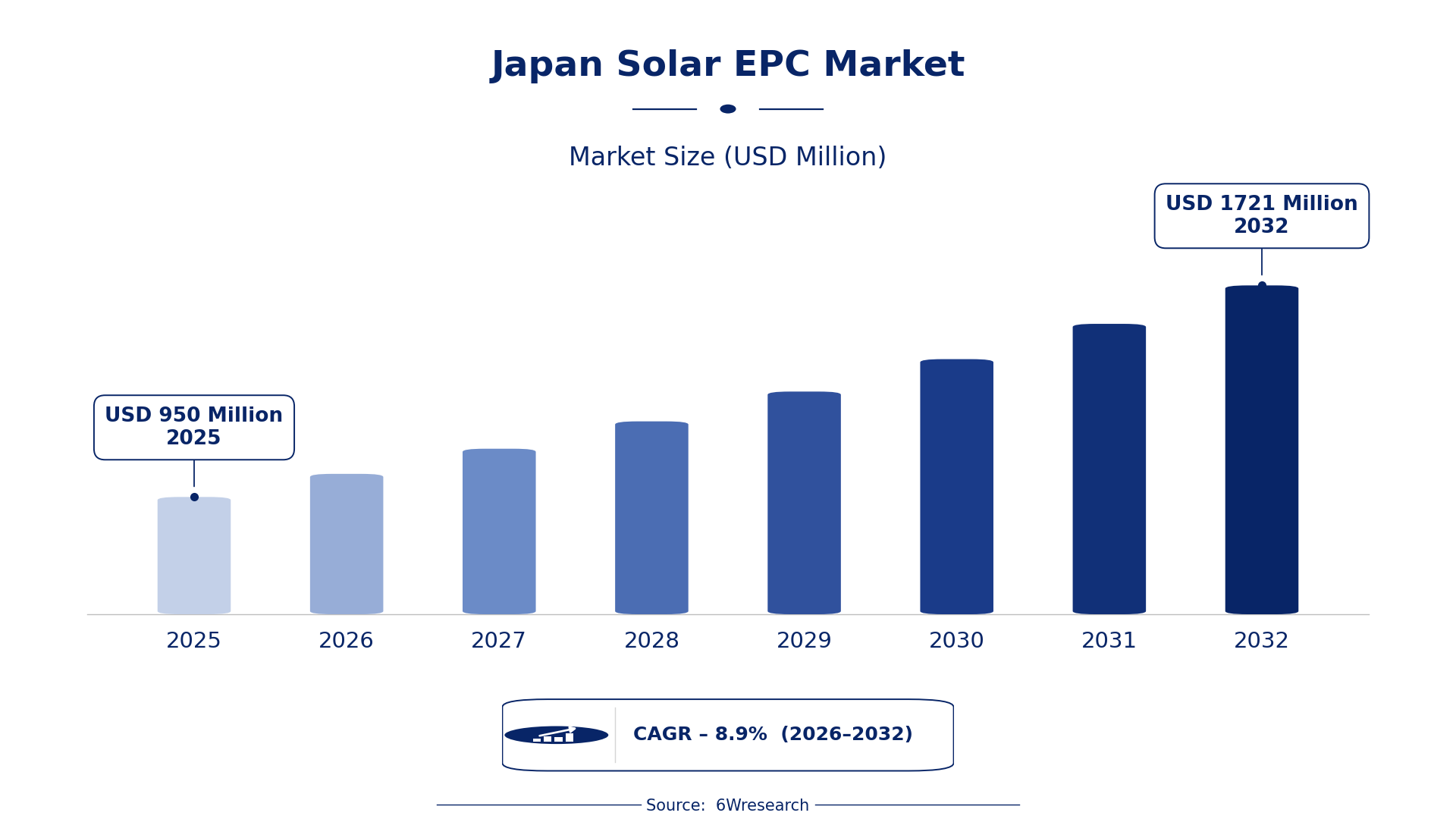
According to 6Wresearch internal database and industry insights, the Japan Solar EPC Market was valued at USD 950 Million in 2025 and is projected to reach USD 1,721 Million by 2032, growing at a CAGR of approximately 8.9% during 2026–2032.
Japan Solar EPC Market Highlights
| Report Metric | Details |
| Report Name | Japan Solar EPC Market (2026-2032) |
| Market Size 2025 | USD 950 Million |
| Market Size 2032 | USD 1,721 Million |
| Absolute Growth 2025–2032 | USD 771 Million |
| CAGR 2026–2032 | 8.9% |
| Peak Annual Growth | 9.6% in 2026 |
| Forecast Period | 2026–2032 |
| Historical Data | 2022–2025 |
| Base Year | 2025 |
| Leading Mounting Type, 2025 | Ground (52% share) |
| Leading Technology, 2025 | Concentrated Solar Power (63% share) |
| Leading End-User, 2025 | Residential (46% share) |
| Fastest-Growing Mounting Type | Rooftop (12.1% CAGR) |
| Fastest-Growing Technology | Photovoltaic (12.3% CAGR) |
| Fastest-Growing End-User | Commercial (11.1% CAGR) |
| Growing Sector | Commercial |
| Key End Users | Residential, Commercial, Industrial |
Japan Solar EPC Market Year-wise Growth Rate and Key Drivers (2022–2032)
This graph illustrates the annual growth rates of the market from 2022 to 2032, highlighting a steady upward trajectory and projected market expansion over the forecast period.
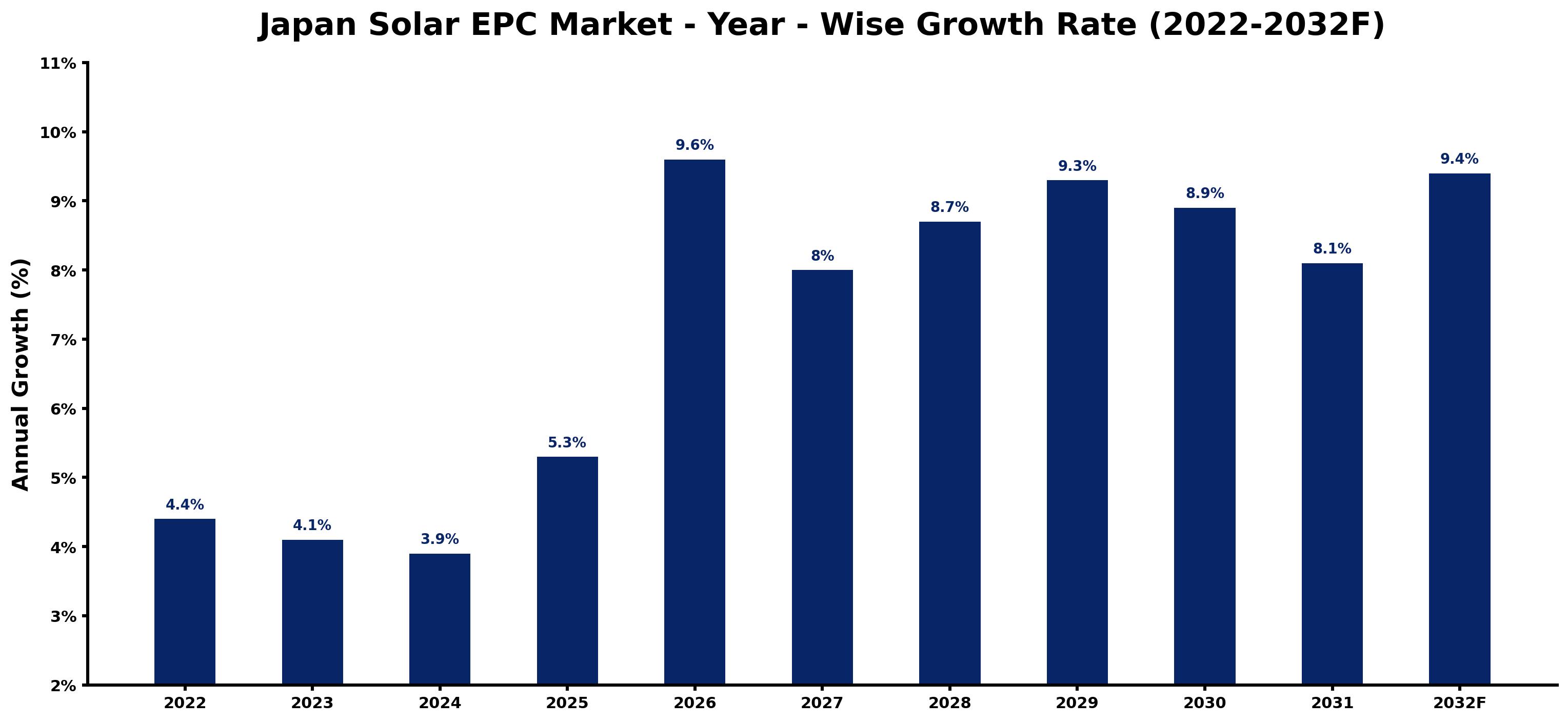
The following figures match every annual growth estimate with the main market development of that year, giving the reasoning behind each rise or slowdown.
| Year | Estimated Annual Growth (%) | Market Rationale |
| 2022 | 4.4 | The market experienced moderate growth, reflecting ongoing investments in solar infrastructure. |
| 2023 | 4.1 | Growth slowed slightly as market adjustments took place amid evolving energy policies. |
| 2024 | 3.9 | Continued adjustments in the market led to a further slowdown in growth rates. |
| 2025 | 5.3 | A surge in installations boosted growth as demand for renewable energy increased. |
| 2026 | 9.6 | Rapid expansion is expected to occur due to investments and technological advancements. |
| 2027 | 8.0 | Growth is projected to slow as the market begins to stabilise after the previous peak. |
| 2028 | 8.7 | Increased adoption of solar technologies is expected to lead to a rise in growth rates. |
| 2029 | 9.3 | Demand will continue to rise, driven by sustainability goals across sectors. |
| 2030 | 8.9 | Growth is anticipated to slow as the market matures, balancing supply and demand. |
| 2031 | 8.1 | A slight slowdown in growth is expected as the market adjusts to new standards. |
| 2032 | 9.4 | Growth will accelerate again as technological innovations and investments surge. |
Note: Market size estimations and growth projections presented in this report are based on 6Wresearch's proprietary forecasting methodology, utilizing the latest available industry data, government publications, and primary research inputs.
Japan Solar EPC Market Synopsis
Solar EPC services encompass the design, procurement, and construction of solar systems, facilitating the installation of photovoltaic and concentrated solar technologies. The Japan Solar EPC Market is expanding due to strong demand from residential, commercial, and industrial sectors, driven by sustainability initiatives and government support. With over 75 GW of installed capacity and a target of 10 million households equipped with solar power by 2030, the market is set for notable growth as investments in solar infrastructure increase.
Market Dynamics Impact Analysis (2026–2032)
| Factor | Type | Impact | Primary Segment Affected |
| Increasing investments in solar infrastructure | Driver | High | Photovoltaic |
| Growing residential installations driven by energy independence | Driver | High | Residential |
| Emerging floating solar technology presents new opportunities | Opportunity | Medium | Floating |
| Government initiatives to promote solar adoption create demand | Opportunity | High | Commercial |
| High initial installation costs can deter investment | Restraint | High | Residential |
| Limited availability of suitable sites for floating solar | Restraint | Medium | Floating |
| Competition from alternative energy sources may impact market share | Challenge | High | Commercial |
| Supply chain disruptions can delay project timelines | Challenge | Medium | Photovoltaic |
Evaluation of Drivers in Japan Solar EPC Market (2026–2032)
Key forces behind demand, with the segment each one moves most, are listed below.
| Drivers | Primary Segment Affected | Why It Matters (Evidence) |
| Strong government support for renewable energy initiatives | Residential | The government aims for 36-38% of electricity from renewables by 2030, encouraging more residential installations. |
| Increased energy costs prompting businesses to adopt solar solutions | Commercial | Rising energy prices are pushing businesses to invest in solar to reduce operational costs, increasing installations. |
| Technological advancements in solar efficiency | Photovoltaic | Innovations in solar technology are improving efficiency, resulting in higher demand for photovoltaic systems. |
| Growing awareness of sustainability among consumers | Residential | As consumers focus on sustainability, more households are opting for solar installations to reduce their carbon footprint. |
| Expansion of financing options for solar projects | Commercial | New financing models are making solar projects more accessible for businesses, driving demand for solar EPC services. |
A wider customer base explains much of the growth, as residential installations surged with over 2 million systems in place, reflecting a strong push for energy independence. The commercial sector is increasingly adopting solar solutions, driven by rising energy costs, with many businesses investing in renewable energy to lower operational expenses. The photovoltaic sector, with over 75 GW of installed capacity, is seeing improved efficiency, resulting in more installations. Increased awareness of sustainability is prompting households to invest in solar, while expanded financing options are making solar projects more accessible for businesses.
Evaluation of Restraints in Japan Solar EPC Market
These are the pressures that could keep growth below its potential.
| Market Restraint | Primary Segment Affected | Why It Matters (Evidence) |
| High initial costs of solar installations | Residential | The average payback period for residential solar installations is around 7-10 years, which can deter potential buyers. |
| Limited availability of suitable sites for floating solar | Floating | Floating solar technology is constrained by water surface availability, limiting its deployment in various regions. |
| Competition from alternative energy sources | Commercial | As alternative energy sources gain traction, the commercial sector may divert investments away from solar. |
| Supply chain disruptions affecting project timelines | Photovoltaic | Delays in obtaining materials can hinder project completion, impacting overall market growth. |
| Regulatory complexities in solar project approvals | Residential | Navigating regulatory requirements can slow down the approval process for residential solar installations. |
Japan Solar EPC Market Challenges
Producers face supply chain disruptions due to reliance on imported components, causing project delays of up to six months and increasing costs for buyers. Technology adoption lags as producers struggle to integrate advanced solar systems, leading to inefficiencies that can reduce output by 15%. A shortage of skilled technicians hampers project timelines, resulting in installation delays that can extend by 20%. Rising raw material costs, driven by global market fluctuations, inflate project budgets by 10%, making it difficult for buyers to maintain project feasibility.
Trends in the Japan Solar EPC Market
Four trends stand out in the Japan Solar EPC Market.
- Shift from Ground to Rooftop Installations: The trend is moving towards rooftop solar installations as homeowners seek to utilise available space. In 2023, rooftop systems accounted for a notable share of new installations, reflecting a growing preference for space-efficient solutions.
- Emergence of Floating Solar Technology: Floating solar technology is gaining traction, especially in regions with limited land availability. In 2023, Japan's solar EPC market saw increased interest in floating systems, supported by a projected ¥1 trillion investment in renewable energy initiatives.
- Increase in Government Support for Renewable Energy: The Japanese government has intensified its support for renewable energy through various initiatives. The GX Basic Policy aims for about JPY 150 trillion of public-private decarbonisation investment over 10 years.
- Adoption of Advanced Battery Storage Solutions: There is a growing focus on integrating battery storage with solar systems to improve energy reliability. In 2023, advancements in battery technology are expected to complement solar installations, enhancing energy management.
Investment Opportunities in the Japan Solar EPC Market
Below are the investment opportunities with the strongest case in the Japan Solar EPC Market.
- Partnerships with Local Governments: Now is the time to collaborate with local governments to supply solar EPC services, as they seek to meet renewable energy targets. Urban areas are focusing on solar solutions to achieve sustainability goals, supported by significant investments.
- Expansion into Floating Solar Solutions: With a projected ¥1 trillion investment in renewable energy initiatives, there is a gap in floating solar technology supply. Engaging with regional authorities can facilitate entry into this emerging market, providing new opportunities for growth.
- Investment in Residential Solar Solutions: The residential sector is expanding, with over 2 million installations. Targeting homeowners through financing options can capture this growing market segment, as more individuals seek to reduce energy costs.
- Development of Advanced Battery Storage Systems: With increasing demand for energy reliability, investing in battery storage technology is essential. Collaborating with energy firms can strengthen market presence and service offerings, meeting the needs of consumers.
Government Initiatives in the Japan Solar EPC Market
The Industrial Safety and Health Act (1972; MHLW) sets employer duties for hazardous substances and machinery, impacting solar EPC producers by ensuring safety standards in installations. The Act on the Rational Use of Energy (1979; METI) obliges large energy users to improve energy efficiency and report energy use, influencing solar buyers to adopt more efficient systems in their operations.
The GX Promotion Act (2023) is the legal basis for the GX strategy, aiming for substantial investments in renewable energy. The Agency for Natural Resources and Energy oversees the implementation of various renewable energy schemes, including funding for solar projects that support buyers in achieving sustainability targets.
Future Insight of the Japan Solar EPC Market
By 2032, buyers will benefit from advancements in battery storage technologies that enhance system efficiency. The government’s initiative to equip 10 million households with solar power will drive demand for solar solutions. Progress in smart grid technology will facilitate improved energy management, lowering operational costs for suppliers. The 'Solar Power Generation Promotion Program' will encourage local governments to adopt solar solutions, creating new opportunities for communities.
Market Segmentation Analysis
Japan Solar EPC Market report covers a detailed analysis of the following market segments:
By Mounting Type – Ground Leads, Rooftop Expected to Grow Fastest
According to Summon Dutta, Assistant Manager at 6Wresearch, the largest mounting type category in 2025 was Ground, at 52% of revenue. Ground mounting holds the largest share due to its suitability for large-scale solar farms, which are essential for meeting Japan's renewable energy targets. For instance, the high energy demand in regions like Tokyo and Osaka drives the adoption of ground-mounted solar solutions. The quickest growth will come from Rooftop, forecast to expand at a CAGR of 12.1% between 2026 and 2032. Rooftop mounting is experiencing rapid growth as homeowners and businesses seek to utilise available space for solar installations, supported by government initiatives like the 'Smart Energy City'. The increasing number of residential installations, now over 2 million, indicates a strong trend towards rooftop solutions. Suppliers should focus on developing rooftop solutions to meet the growing demand from residential and commercial sectors.
By Technology – Concentrated Solar Power Leads, Photovoltaic Expected to Grow Fastest
With 63% of technology revenue in 2025, Concentrated Solar Power was the largest category. Concentrated Solar Power holds a substantial share due to its capability for large-scale energy generation, appealing to utility providers. This technology is particularly relevant in regions like Kyushu, where solar potential is maximised for extensive projects. Photovoltaic is projected to grow fastest, at a CAGR of 12.3% during 2026–2032. Photovoltaic technology experiences the highest growth rate, largely because of its prevalence in residential settings, which supports the government's aim for 10 million solar-equipped households by 2030. The established infrastructure for photovoltaic systems ensures that its lead will continue to expand. Suppliers should focus on photovoltaic solutions to align with market demand and government targets.
By End-User – Residential Leads, Commercial Expected to Grow Fastest
Residential accounted for 46% of the market by end-user in 2025. The residential segment commands the largest share as over 2 million homes have adopted solar installations, driven by a desire for energy independence and cost savings. Government initiatives, such as the Feed-in Tariff program, further encourage homeowners to invest in solar solutions. Commercial is set to record the highest CAGR in this split, 11.1% over 2026–2032. The commercial segment is experiencing rapid growth as businesses increasingly adopt solar energy to lower operational costs and meet sustainability goals. This shift is supported by the government's target for 36-38% of electricity to come from renewable sources by 2030, prompting further investments in solar. Suppliers should focus on developing solutions that cater specifically to the commercial sector to capitalise on this growing demand for solar energy.
Key Attractiveness of the Report
- 10 Years of Market Numbers
- Historical Data Starting from 2022 to 2025
- Base Year 2025
- Forecast Data until 2032
- Key Performance Indicators Impacting the Market
- Major Upcoming Developments and Projects
Key Highlights of the Report:
- Japan Solar EPC Market Outlook
- Market Size of Japan Solar EPC Market, 2025
- Forecast of Japan Solar EPC Market, 2032
- Historical Data and Forecast of Japan Solar EPC Revenues & Volume for the Period 2022-2032
- Japan Solar EPC Market Trend Evolution
- Japan Solar EPC Market Drivers and Challenges
- Japan Solar EPC Price Trends
- Japan Solar EPC Porter's Five Forces
- Japan Solar EPC Industry Life Cycle
- Historical Data and Forecast of Japan Solar EPC Market Revenues & Volume By Mounting Type for the Period 2022-2032
- Historical Data and Forecast of Japan Solar EPC Market Revenues & Volume By Ground for the Period 2022-2032
- Historical Data and Forecast of Japan Solar EPC Market Revenues & Volume By Rooftop for the Period 2022-2032
- Historical Data and Forecast of Japan Solar EPC Market Revenues & Volume By Floating for the Period 2022-2032
- Historical Data and Forecast of Japan Solar EPC Market Revenues & Volume By Technology for the Period 2022-2032
- Historical Data and Forecast of Japan Solar EPC Market Revenues & Volume By Concentrated Solar Power for the Period 2022-2032
- Historical Data and Forecast of Japan Solar EPC Market Revenues & Volume By Photovoltaic for the Period 2022-2032
- Historical Data and Forecast of Japan Solar EPC Market Revenues & Volume By End-User for the Period 2022-2032
- Historical Data and Forecast of Japan Solar EPC Market Revenues & Volume By Residential for the Period 2022-2032
- Historical Data and Forecast of Japan Solar EPC Market Revenues & Volume By Commercial for the Period 2022-2032
- Historical Data and Forecast of Japan Solar EPC Market Revenues & Volume By Industrial for the Period 2022-2032
- Japan Solar EPC Import Export Trade Statistics
- Market Opportunity Assessment By Mounting Type
- Market Opportunity Assessment By Technology
- Market Opportunity Assessment By End-User
- Japan Solar EPC Top Companies Market Share
- Japan Solar EPC Competitive Benchmarking By Technical and Operational Parameters
- Japan Solar EPC Company Profiles
- Japan Solar EPC Key Strategic Recommendations
Market Covered
The following segment groups are covered in the report.
By Mounting Type
- Ground
- Rooftop
- Floating
By Technology
- Concentrated Solar Power
- Photovoltaic
By End-User
- Residential
- Commercial
- Industrial































