Japan Solar Water Heater Market Size & Growth Rate
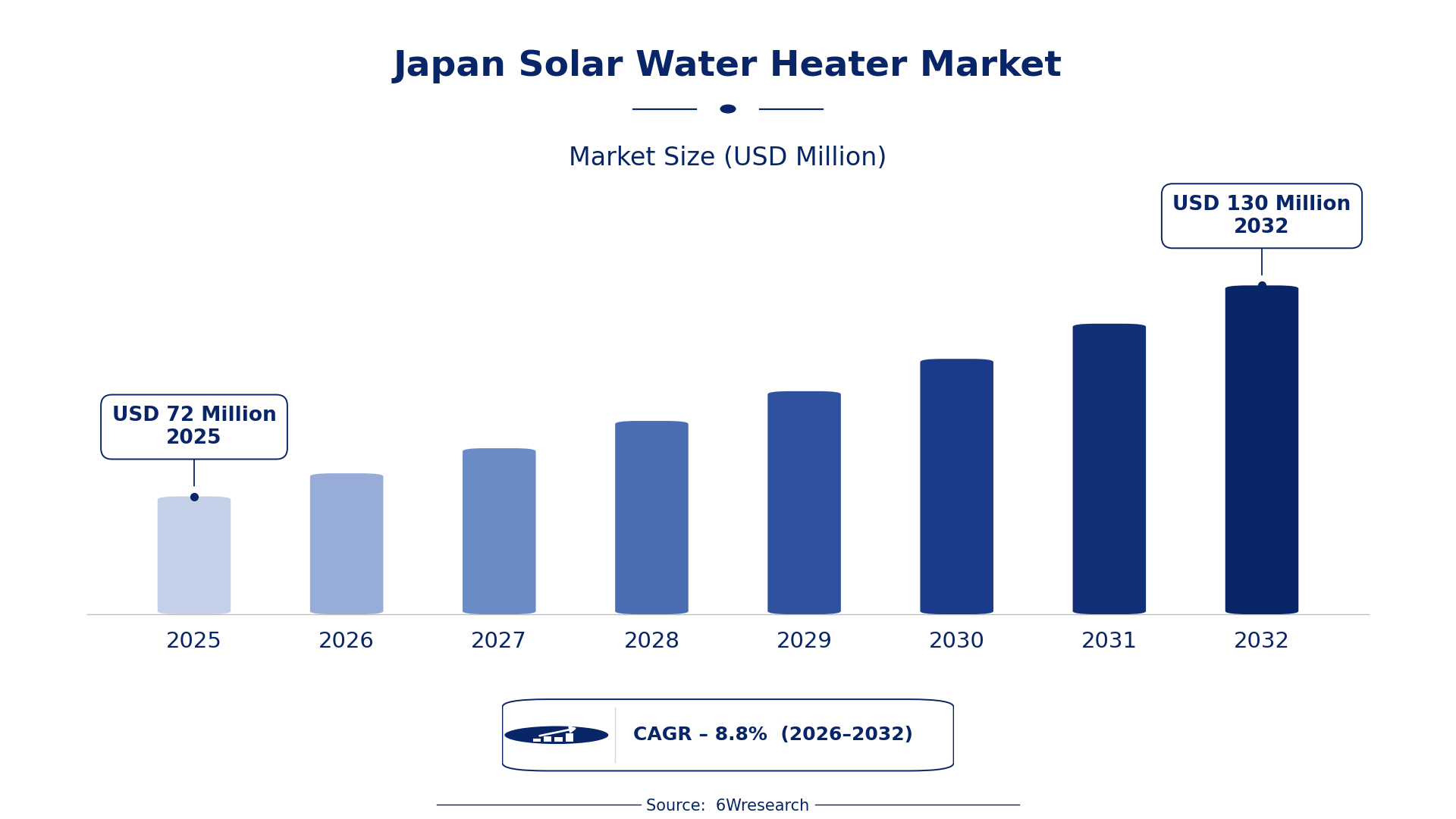
According to 6Wresearch internal database and industry insights, the Japan Solar Water Heater Market was valued at USD 72 Million in 2025 and is projected to reach USD 130 Million by 2032, growing at a CAGR of approximately 8.8% during 2026–2032.
Japan Solar Water Heater Market Highlights
| Report Metric | Details |
| Report Name | Japan Solar Water Heater Market (2026-2032) |
| Market Size 2025 | USD 72 Million |
| Market Size 2032 | USD 130 Million |
| Absolute Growth 2025–2032 | USD 58 Million |
| CAGR 2026–2032 | 8.8% |
| Peak Annual Growth | 10.4% in 2032 |
| Forecast Period | 2026–2032 |
| Historical Data | 2022–2025 |
| Base Year | 2025 |
| Leading Technology, 2025 | Evacuated Tube Collector (54% share) |
| Leading Application, 2025 | Residential (40% share) |
| Leading System, 2025 | Thermosyphon (59% share) |
| Fastest-Growing Technology | Flat Plate Collector (12.2% CAGR) |
| Fastest-Growing Application | Commercial (11.7% CAGR) |
| Fastest-Growing System | Pumped (12.0% CAGR) |
| Growing Sector | Residential applications |
| Key End Users | Homeowners, commercial businesses, industrial facilities |
Japan Solar Water Heater Market Year-wise Growth Rate and Key Drivers (2022–2032)
This graph illustrates the annual growth rates of the market from 2022 to 2032, highlighting a steady upward trajectory and projected market expansion over the forecast period.
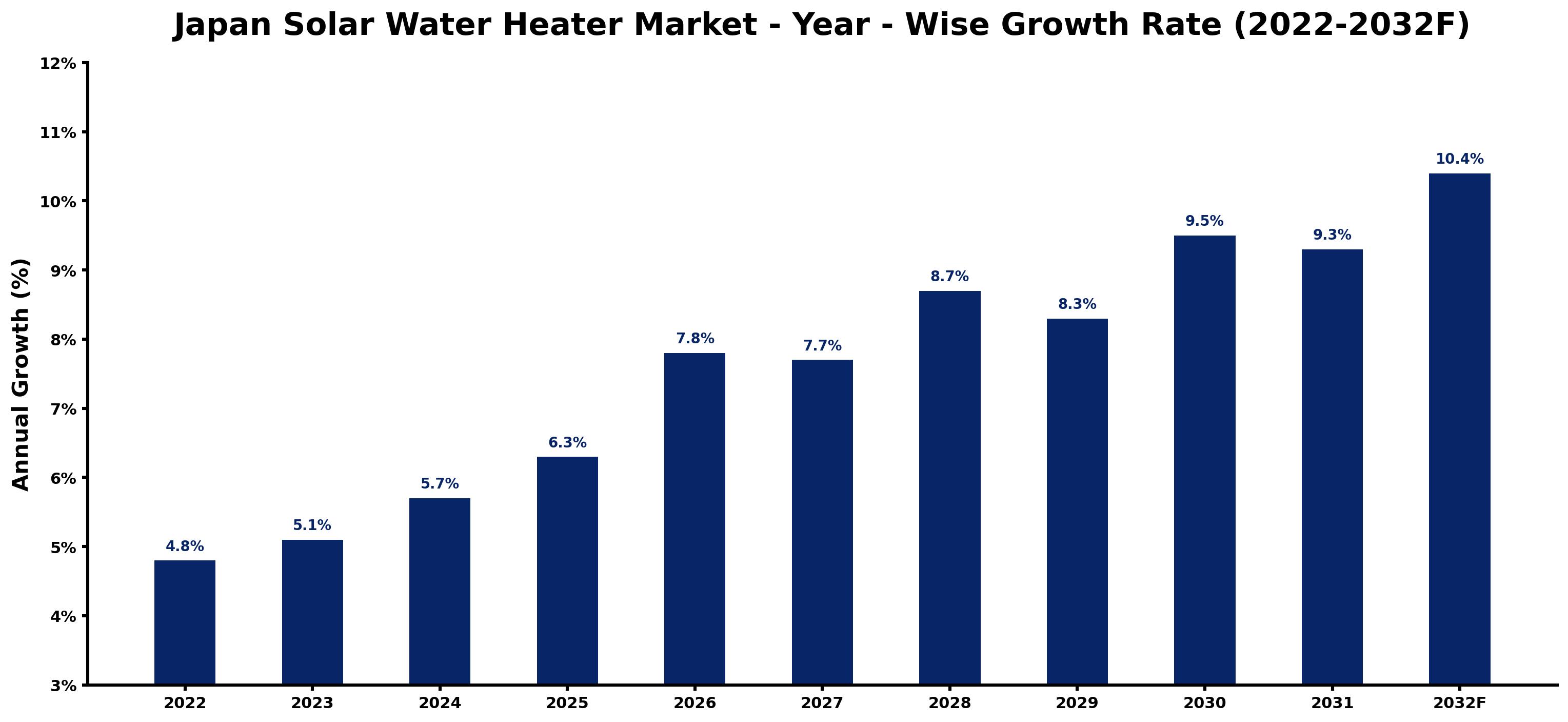
The following figures match every annual growth estimate with the main market development of that year, giving the reasoning behind each rise or slowdown.
| Year | Estimated Annual Growth (%) | Market Rationale |
| 2022 | 4.8 | The market showed steady growth due to increasing awareness of renewable energy. |
| 2023 | 5.1 | Demand rose as more residential users adopted solar water heating solutions. |
| 2024 | 5.7 | The expansion of subsidy programs encouraged further installations across the country. |
| 2025 | 6.3 | Growth accelerated as energy-saving regulations gained traction in commercial sectors. |
| 2026 | 7.8 | Investment in renewable energy technologies is expected to rise across various applications. |
| 2027 | 7.7 | The growth rate is projected to slow slightly as market saturation begins in some regions. |
| 2028 | 8.7 | Renewed interest in sustainability is expected to lead to increased installations in residential areas. |
| 2029 | 8.3 | A slight slowdown is anticipated as competition intensifies among suppliers. |
| 2030 | 9.5 | Demand is expected to surge with the government's commitment to renewable energy targets. |
| 2031 | 9.3 | Growth is projected to moderate as the market approaches maturity with established players dominating. |
| 2032 | 10.4 | The peak growth rate reflects increasing investments and consumer adoption of solar technology. |
Note: Market size estimations and growth projections presented in this report are based on 6Wresearch's proprietary forecasting methodology, utilizing the latest available industry data, government publications, and primary research inputs.
Japan Solar Water Heater Market Synopsis
Solar water heaters are devices that harness solar energy to heat water for various applications, including residential and commercial uses. In Japan, the market is valued at approximately 80 billion yen as of 2023, with over 1 million systems installed. Rising utility costs, government incentives for renewable energy, and increasing consumer awareness of sustainability drive the growth of the Japan Solar Water Heater Market. The government aims to increase renewable energy usage to 24% by 2030, further propelling market expansion.
Market Dynamics Impact Analysis (2026–2032)
| Factor | Type | Impact | Primary Segment Affected |
| Rising energy costs drive homeowners to seek cost-effective solutions. | Driver | High | Residential |
| Government subsidies incentivise the adoption of solar water heaters. | Driver | High | Residential |
| Increasing demand for energy-efficient solutions in commercial buildings. | Opportunity | High | Commercial |
| Potential for growth in rural areas with limited access to traditional energy sources. | Opportunity | Medium | Residential |
| Market saturation in urban areas limits new installations. | Restraint | High | Residential |
| High initial investment costs deter some potential buyers. | Restraint | Medium | Residential |
| Competition from alternative energy solutions pressures pricing. | Challenge | High | Residential |
| Technological advancements require constant updates in product offerings. | Challenge | Medium | Residential |
Evaluation of Drivers in Japan Solar Water Heater Market (2026–2032)
The factors lifting demand, and the evidence behind each, are summarised below.
| Drivers | Primary Segment Affected | Why It Matters (Evidence) |
| Increasing energy costs encourage investment in solar water heaters. | Residential | As energy prices rise by 5% in 2023, homeowners are motivated to invest in solar solutions to reduce utility bills. |
| Government subsidies improve affordability for residential installations. | Residential | Subsidy programs make solar water heaters more accessible, leading to higher adoption rates. |
| Growing consumer preference for eco-friendly solutions boosts demand. | Residential | Awareness of environmental sustainability drives purchases of solar water heaters as consumers seek greener options. |
| Legislation encourages businesses to invest in renewable energy technologies. | Commercial | Energy-saving regulations promote solar adoption among companies looking to comply with new standards. |
| Technological advancements improve efficiency and reduce costs. | Residential | Innovations in solar technology lower production costs, making systems more appealing to buyers. |
Much of the new demand traces back to rising energy costs, prompting homeowners to seek cost-effective solutions. In 2023, the average energy price rose by 5%, leading to heightened interest in solar water heaters as a means to cut utility bills. Increased consumer preference for eco-friendly solutions drives purchases as individuals seek greener options. Legislation promoting energy efficiency in commercial buildings encourages businesses to adopt solar water heaters to comply with new standards and reduce operational costs.
Evaluation of Restraints in Japan Solar Water Heater Market
The table below lists the restraints and the evidence behind each.
| Market Restraint | Primary Segment Affected | Why It Matters (Evidence) |
| Market saturation limits growth potential in urban areas. | Residential | With over 1 million homes already equipped with solar systems, new installations are declining in densely populated regions. |
| High initial investment costs deter potential buyers. | Residential | The upfront costs of solar water heaters can be prohibitive for some homeowners, limiting market expansion. |
| Competition from alternative energy solutions pressures pricing. | Residential | Emerging renewable technologies create pricing pressures that can affect sales of solar water heaters. |
| Technological advancements require constant updates in product offerings. | Residential | Manufacturers must continually innovate to stay competitive, which can strain resources and impact pricing. |
| Limited awareness in rural areas hinders adoption rates. | Residential | In regions with less information about solar technologies, potential buyers may hesitate to invest. |
Japan Solar Water Heater Market Challenges
High levels of competition from imported solar water heaters challenge local producers, compelling them to reduce prices and shrink profit margins. Stricter regulations, such as adherence to JIS standards, impose extra costs on manufacturers, which can delay product launches and increase operational expenses for local firms. Escalating material costs, driven by global supply chain issues, can inflate production costs by up to 15%, impacting profitability for domestic producers. Rapid technological advancements necessitate ongoing investment, straining financial resources for smaller manufacturers and limiting their ability to innovate and compete effectively in the market.
Trends in the Japan Solar Water Heater Market
Buyers and suppliers in the Japan Solar Water Heater Market are adjusting to the following trends.
- Shift from Traditional Heating to Solar Solutions: Japan is experiencing a transition from conventional heating methods to solar water heaters, particularly in residential applications. In 2023, the number of installations increased by 15%, reflecting rising utility costs.
- Transition from Flat Plate to Evacuated Tube Collectors: Evacuated tube collectors are becoming more popular due to their efficiency in low temperatures. This shift is evident in the Kyushu region, where installations rose by 20% in 2023.
- Emergence of Smart Solar Water Heating Systems: Smart solar water heating systems are gaining traction, integrating IoT technology for efficiency. In 2023, 10% of new installations featured smart technology, reflecting changing consumer preferences.
- Increased Focus on Energy Efficiency Standards: The implementation of stricter energy efficiency standards is reshaping the market. The introduction of new JIS standards in 2023 has led to improved product performance and consumer confidence.
Investment Opportunities in the Japan Solar Water Heater Market
Investors looking at the Japan Solar Water Heater Market should consider the following areas.
- Ideal Timing for Investment in Residential Solar Water Heaters: With the government aiming for 24% renewable energy usage by 2030, now is an ideal time to invest in residential solar water heaters. This creates opportunities for suppliers in urban areas.
- Supply Advanced Solar Water Heating Systems: Investing in high-efficiency evacuated tube collectors can meet growing demand. Residential buyers are increasingly seeking efficient solutions to reduce energy costs.
- Commercial Sector Demand for Energy-Efficient Solutions: Businesses are looking to adopt solar water heaters to comply with energy-saving regulations. This presents opportunities for suppliers to target commercial installations.
- Focus on Rural Installations to Expand Market Reach: Rural areas present opportunities for solar water heater suppliers, especially with limited access to traditional energy sources. Collaborating with local partners can facilitate market entry.
Government Initiatives in the Japan Solar Water Heater Market
The Water Supply Act (1957) establishes standards for drinking-water quality, which indirectly influences the solar water heater market by ensuring that systems meet safety and quality requirements. Compliance with the Act is essential for producers, as it affects consumer trust and market acceptance. Additionally, the Industrial Standardization Act (1949), recently amended, governs the Japanese Industrial Standards (JIS) for solar water heaters, ensuring that products adhere to quality benchmarks, which is crucial for maintaining competitiveness in the market.
In 2023, the government allocated 5 billion yen for renewable energy initiatives, including solar water heaters, to promote sustainable energy solutions. The Ministry of the Environment oversees these initiatives, which aim to increase the adoption of solar technologies among residential users. This funding supports various subsidy programs that make solar water heaters more accessible, encouraging greater investment in renewable energy infrastructure across Japan.
Future Insight of the Japan Solar Water Heater Market
The investment pipeline for renewable energy infrastructure will expand, creating robust demand for solar water heaters. By 2030, the government's commitment to a 46% reduction in greenhouse gas emissions will lead to increased installations across the country. Standards like ISO 9806 will enhance efficiency and performance, benefiting both buyers and suppliers. The government’s allocation of 5 billion yen for renewable energy initiatives will stimulate the growth of solar technologies, fostering a more competitive market environment.
Market Segmentation Analysis
Japan Solar Water Heater Market report covers a detailed analysis of the following market segments:
By Technology – Evacuated Tube Collector Leads, Flat Plate Collector Expected to Grow Fastest
According to Dhaval Chaurasia, Assistant Manager at 6Wresearch, the largest technology category in 2025 was Evacuated Tube Collector, at 54% of revenue. Evacuated tube collectors lead the market due to their efficiency in low temperatures, making them ideal for Japan's varied climate. This technology is prevalent, with over 1 million solar water heating systems installed across the country, catering to both residential and commercial needs. Flat Plate Collector is set to record the highest CAGR in this split, 12.2% over 2026–2032. Flat plate collectors are gaining traction as they are increasingly preferred for residential use, attributed to their cost-effectiveness. The government's commitment to increasing renewable energy usage to 24% by 2030 further supports this segment's growth. Suppliers should prioritise the distribution of flat plate collectors to align with the rising demand in residential applications.
By Application – Residential Leads, Commercial Expected to Grow Fastest
Residential accounted for 40% of the market by application in 2025. Residential applications dominate the market, accounting for around 70% of the total share, driven by the necessity for hot water in households. The substantial number of installations indicates a strong consumer inclination towards solar water heating solutions for home use. The quickest growth will come from Commercial, forecast to expand at a CAGR of 11.7% between 2026 and 2032. The commercial sector is experiencing the fastest growth, propelled by the increasing need for energy-efficient solutions in businesses, especially in urban centres like Tokyo. This growth is encouraged by energy-saving regulations that prompt businesses to adopt renewable technologies. Buyers in the commercial sector should invest in solar water heating systems to meet energy regulations and lower their operational expenses.
By System – Thermosyphon Leads, Pumped Expected to Grow Fastest
Thermosyphon held 59% of the Japan Solar Water Heater Market by system in 2025. Thermosyphon systems are preferred for residential use due to their simple design and reliability, making them easy to install and maintain. Their popularity is evidenced by the substantial number of residential installations across Japan. Pumped is projected to grow fastest, at a CAGR of 12.0% during 2026–2032. Pumped systems are growing quickly as they offer greater efficiency for larger installations, particularly in commercial applications. This trend is driven by the increasing need for scalable solutions in energy-intensive businesses. Suppliers must ensure that pumped systems are readily available to cater to the expanding commercial market.
Key Attractiveness of the Report
- 10 Years of Market Numbers
- Historical Data Starting from 2022 to 2025
- Base Year 2025
- Forecast Data until 2032
- Key Performance Indicators Impacting the Market
- Major Upcoming Developments and Projects
Key Highlights of the Report:
- Japan Solar Water Heater Market Outlook
- Market Size of Japan Solar Water Heater Market, 2025
- Forecast of Japan Solar Water Heater Market, 2032
- Historical Data and Forecast of Japan Solar Water Heater Revenues & Volume for the Period 2022-2032
- Japan Solar Water Heater Market Trend Evolution
- Japan Solar Water Heater Market Drivers and Challenges
- Japan Solar Water Heater Price Trends
- Japan Solar Water Heater Porter's Five Forces
- Japan Solar Water Heater Industry Life Cycle
- Historical Data and Forecast of Japan Solar Water Heater Market Revenues & Volume By Technology for the Period 2022-2032
- Historical Data and Forecast of Japan Solar Water Heater Market Revenues & Volume By Evacuated Tube Collector for the Period 2022-2032
- Historical Data and Forecast of Japan Solar Water Heater Market Revenues & Volume By Flat Plate Collector for the Period 2022-2032
- Historical Data and Forecast of Japan Solar Water Heater Market Revenues & Volume By Unglazed Water Collector for the Period 2022-2032
- Historical Data and Forecast of Japan Solar Water Heater Market Revenues & Volume By Application for the Period 2022-2032
- Historical Data and Forecast of Japan Solar Water Heater Market Revenues & Volume By Residential for the Period 2022-2032
- Historical Data and Forecast of Japan Solar Water Heater Market Revenues & Volume By Commercial for the Period 2022-2032
- Historical Data and Forecast of Japan Solar Water Heater Market Revenues & Volume By Industrial for the Period 2022-2032
- Historical Data and Forecast of Japan Solar Water Heater Market Revenues & Volume By System for the Period 2022-2032
- Historical Data and Forecast of Japan Solar Water Heater Market Revenues & Volume By Thermosyphon for the Period 2022-2032
- Historical Data and Forecast of Japan Solar Water Heater Market Revenues & Volume By Pumped for the Period 2022-2032
- Japan Solar Water Heater Import Export Trade Statistics
- Market Opportunity Assessment By Technology
- Market Opportunity Assessment By Application
- Market Opportunity Assessment By System
- Japan Solar Water Heater Top Companies Market Share
- Japan Solar Water Heater Competitive Benchmarking By Technical and Operational Parameters
- Japan Solar Water Heater Company Profiles
- Japan Solar Water Heater Key Strategic Recommendations
Market Covered
Segments analysed in this report are listed below.
By Technology
- Evacuated Tube Collector
- Flat Plate Collector
- Unglazed Water Collector
By Application
- Residential
- Commercial
- Industrial
By System
- Thermosyphon
- Pumped































