Japan Soy Market Size & Growth Rate
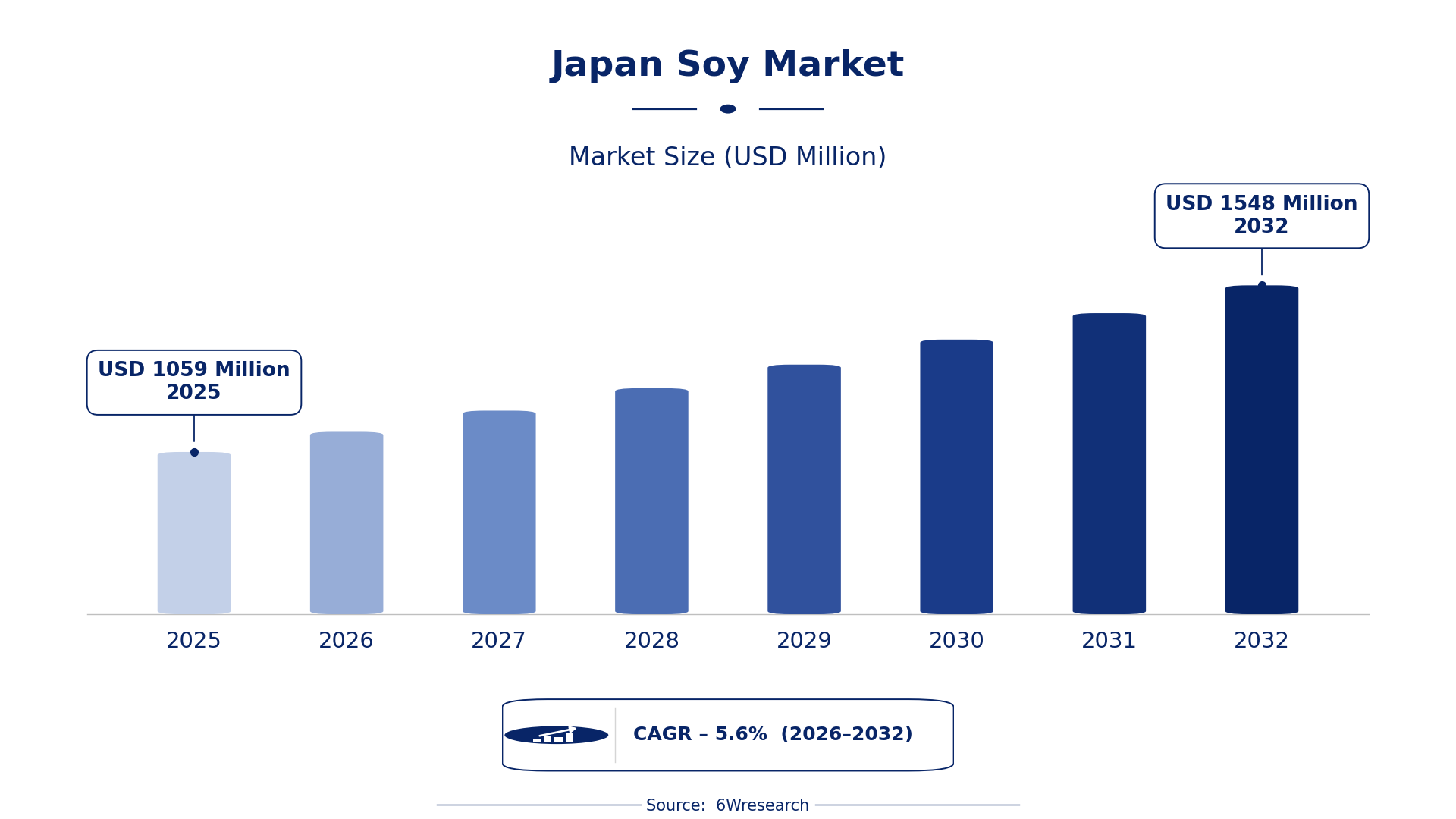
According to 6Wresearch internal database and industry insights, the Japan Soy Market was valued at USD 1,059 Million in 2025 and is projected to reach USD 1,548 Million by 2032, growing at a CAGR of approximately 5.6% during 2026–2032.
Japan Soy Market Highlights
| Report Metric | Details |
| Report Name | Japan Soy Market (2026-2032) |
| Market Size 2025 | USD 1,059 Million |
| Market Size 2032 | USD 1,548 Million |
| Absolute Growth 2025–2032 | USD 489 Million |
| CAGR 2026–2032 | 5.6% |
| Peak Annual Growth | 6.9% in 2028 |
| Forecast Period | 2026–2032 |
| Historical Data | 2022–2025 |
| Base Year | 2025 |
| Leading Product Type, 2025 | Soybean (45% share) |
| Leading Processing Type, 2025 | Raw (45% share) |
| Leading Application Area, 2025 | Oil & Meal Production (36% share) |
| Leading End User, 2025 | Food Manufacturers (44% share) |
| Fastest-Growing Product Type | Soy Protein (7.7% CAGR) |
| Fastest-Growing Processing Type | Isolated/Concentrated (7.9% CAGR) |
| Fastest-Growing Application Area | Functional Foods (6.9% CAGR) |
| Growing Sector | Food Manufacturing |
| Key End Users | Food Manufacturers, Agri Processors, Foodservice Industry, Household Consumers |
Japan Soy Market Year-wise Growth Rate and Key Drivers (2022–2032)
This graph illustrates the annual growth rates of the market from 2022 to 2032, highlighting a steady upward trajectory and projected market expansion over the forecast period.
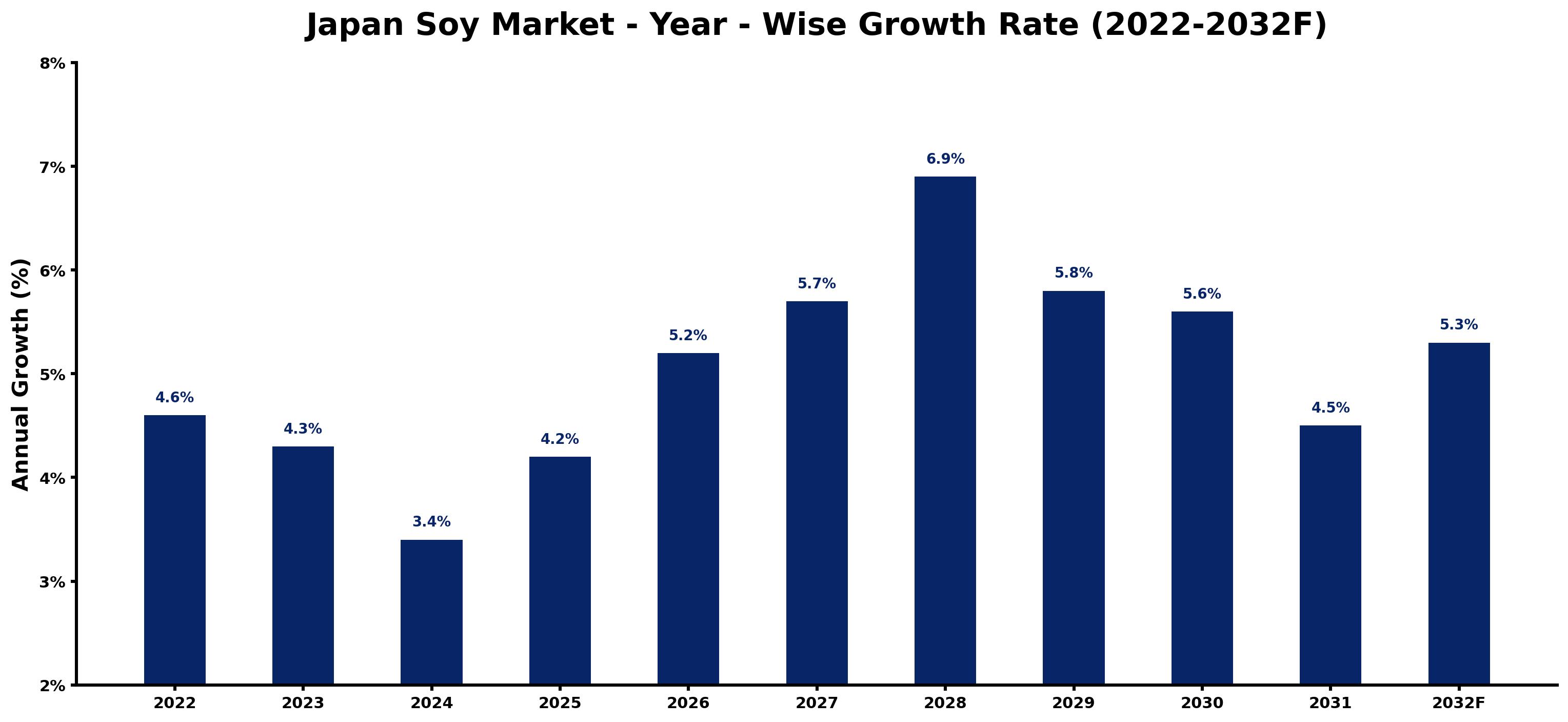
For each year, the table pairs the estimated growth rate with the leading influence on demand, showing how the drivers changed across the period.
| Year | Estimated Annual Growth (%) | Market Rationale |
| 2022 | 4.6 | The market experienced solid growth due to increased health awareness among consumers. |
| 2023 | 4.3 | Market saturation and intense competition among suppliers impacted sales, leading to slower growth. |
| 2024 | 3.4 | Demand continued to slow as consumers became more price-sensitive amid economic pressures. |
| 2025 | 4.2 | Food manufacturers sought healthier ingredients for product innovation, accelerating growth. |
| 2026 | 5.2 | Consumer interest in plant-based diets is expected to drive demand for soy products. |
| 2027 | 5.7 | Food manufacturers are projected to expand their product lines, contributing to market growth. |
| 2028 | 6.9 | A peak in growth is anticipated as health trends influence purchasing decisions. |
| 2029 | 5.8 | Market competition intensifies, leading to a slowdown in growth rates. |
| 2030 | 5.6 | Consumer preferences shift towards alternative proteins, causing a further slowdown. |
| 2031 | 4.5 | Market growth is expected to moderate as competition remains fierce. |
| 2032 | 5.3 | An increase in health-focused product offerings is likely to boost demand for soy. |
Note: Market size estimations and growth projections presented in this report are based on 6Wresearch's proprietary forecasting methodology, utilizing the latest available industry data, government publications, and primary research inputs.
Japan Soy Market Synopsis
Soy serves as a versatile ingredient utilized in various forms, including soybean, soy protein, soy oil, and soy flour, primarily for food manufacturing and oil production. The Japan Soy Market is experiencing growth driven by rising consumer interest in plant-based diets and health-conscious eating habits. Food manufacturers are increasingly incorporating soy products into their offerings, reflecting a strong demand for healthier food options.
Market Dynamics Impact Analysis (2026–2032)
| Factor | Type | Impact | Primary Segment Affected |
| Increased health consciousness among consumers | Driver | High | Soy Protein |
| Growing adoption of plant-based diets | Driver | High | Soy Oil |
| Expansion of functional food products | Opportunity | High | Functional Foods |
| Rising demand for sustainable food sources | Opportunity | High | Oil & Meal Production |
| Market saturation leading to intense competition | Restraint | High | Soybean |
| Price sensitivity among consumers affecting purchasing decisions | Restraint | Medium | Soy Flour |
| Supply chain disruptions impacting availability | Challenge | High | Soy Protein |
| Technological advancements in processing methods | Challenge | Medium | Soy Oil |
Evaluation of Drivers in Japan Soy Market (2026–2032)
Below are the drivers that matter most for revenue growth, with supporting evidence.
| Drivers | Primary Segment Affected | Why It Matters (Evidence) |
| Health-conscious consumer trends | Soy Protein | Increased awareness of health benefits drives food manufacturers to incorporate soy protein into products, with sales rising in health-focused sectors. |
| Expansion of plant-based food products | Soy Oil | Popularity of plant-based diets has led to increased soy oil usage in food manufacturing, with a notable rise in demand. |
| Innovation in functional food applications | Functional Foods | The demand for functional foods is rising, with a significant increase in soy-based functional products launched in the market. |
| Sustainability initiatives among food manufacturers | Oil & Meal Production | Sustainability efforts have led to increased use of soy in oil and meal production processes, enhancing market demand. |
| Rising disposable incomes among consumers | Soy Flour | Increased disposable incomes have resulted in growth in demand for premium soy flour products, particularly among health-conscious buyers. |
Several shifts outside the market lift sales. Health consciousness among consumers has led to a rise in soy protein incorporation into food products, particularly among health-focused brands. The expansion of plant-based diets has resulted in increased soy oil usage in food manufacturing, with a notable rise in demand. Developments in functional foods have spurred a rise in soy-based product launches, while sustainability efforts have strengthened soy's role in oil and meal production. Increased disposable incomes have also contributed to growth in demand for premium soy flour products, particularly among consumers seeking healthier options.
Evaluation of Restraints in Japan Soy Market
The following restraints limit how fast demand can grow.
| Market Restraint | Primary Segment Affected | Why It Matters (Evidence) |
| Intense competition among suppliers | Soybean | Increased competition has led to a decrease in profit margins for suppliers, affecting their ability to invest in innovation. |
| Consumer price sensitivity | Soy Flour | Price sensitivity has caused a decline in sales of premium soy flour products as consumers opt for cheaper alternatives. |
| Supply chain disruptions | Soy Protein | Recent disruptions have led to a reduction in availability, impacting production schedules for food manufacturers. |
| Regulatory compliance costs | Soy Oil | Compliance with food safety regulations has resulted in increased operational costs for soy oil producers. |
| Limited awareness of soy benefits | Functional Foods | A lack of consumer awareness about the benefits of soy has led to stagnation in the growth of functional soy products. |
Japan Soy Market Challenges
High labour costs in Japan create a shortage of skilled workers in the soy processing sector, leading to delays that can extend lead times by 30% for suppliers. Intense competition among local producers drives down prices, which limits profit margins and hinders their ability to invest in quality improvements. Frequent supply chain disruptions, often caused by natural disasters, can delay deliveries and increase logistics expenses for buyers, forcing them to seek alternative sources. Rising input costs for raw materials inflate prices, making it challenging for buyers to maintain competitive pricing in the market.
Trends in the Japan Soy Market
The shifts below are changing how Japan Soy Market products are bought and supplied.
- Shift towards Plant-Based Ingredients: Food manufacturers are increasingly incorporating soy into their products, with a rise in plant-based offerings since 2020, reflecting a 20% increase in demand.
- Emergence of Functional Soy Products: Functional soy products are gaining traction, with a notable increase in health-focused offerings since 2021, contributing to a 15% growth in this segment.
- Transition from Traditional to Innovative Processing: Innovative processing methods are being adopted, with an increase in the use of isolated soy protein, enhancing product versatility and market appeal.
- Growing Demand for Sustainable Sourcing: Sustainable sourcing practices are becoming a priority, with an increase in soy sourced from certified sustainable farms since 2021, reflecting a 25% rise in consumer preference.
Investment Opportunities in the Japan Soy Market
The following opportunities in the Japan Soy Market pair current demand with a clear way in.
- Food Manufacturers Seeking Healthier Ingredients: Food manufacturers are increasingly looking for healthier ingredients, with a notable rise in demand for soy protein products as consumers shift towards health-focused diets.
- Investment in Functional Soy Products: There is a growing opportunity to invest in functional soy products, as demand is expected to rise significantly due to health trends among consumers.
- Timing for Sustainable Soy Sourcing: Now is an ideal time to invest in sustainable soy sourcing, with a marked increase in consumer preference for sustainably sourced products.
- Entry into the Functional Foods Market: Entering the functional foods market through partnerships with health-focused brands can yield strong returns, as this segment is projected to expand.
Government Initiatives in the Japan Soy Market
The Waste Management and Public Cleansing Act ensures that soy producers adhere to environmental standards regarding waste disposal. The Food Recycling Law mandates food businesses to recycle waste into feed, fertiliser, and energy, promoting sustainability in the soy industry. These regulations impact soy producers by requiring compliance with waste management practices and encouraging a more sustainable production process. In 2020, over 50% of food businesses reported compliance with these regulations, reflecting a commitment to sustainability.
The Ministry of Health, Labour and Welfare oversees the Food Sanitation Act, which requires food businesses to implement HACCP-based hygiene management. This regulation ensures that soy products meet safety standards, building consumer confidence in food safety. Compliance with these standards is essential for food manufacturers to maintain market access and consumer trust, with over 70% of manufacturers achieving certification by 2021.
Future Insight of the Japan Soy Market
Producers in the food manufacturing sector will see changes by 2032 due to the introduction of advanced processing technologies that improve efficiency. New traceability standards will allow buyers to verify product quality and sourcing practices, building trust in the market. The establishment of modern processing facilities will enhance production capacity and reduce lead times. By 2032, the market will shift towards plant-based protein alternatives, with an expected increase of 25% in product offerings, creating new opportunities for suppliers.
Market Segmentation Analysis
Japan Soy Market report covers a detailed analysis of the following market segments:
By Product Type – Soybean Leads, Soy Protein Expected to Grow Fastest
According to Ayushi Shukla, Senior Research Analyst at 6Wresearch, Soybean took 45% of product type revenue in 2025, more than any other category. Soybean holds the largest share due to its critical role in both food products and animal feed, which are vital for the agricultural industry. The extensive use of soybeans in livestock feed significantly supports its dominant position in Japan. Soy Protein is projected to grow fastest, at a CAGR of 7.7% during 2026–2032. Soy Protein is experiencing rapid growth as more consumers shift towards plant-based diets, with a noticeable increase in demand for protein-rich snacks and supplements. This trend is indicative of a broader health-conscious movement among Japanese consumers. Suppliers should focus on expanding their soy protein product lines to align with the rising health-focused consumer trends.
By Processing Type – Raw Leads, Isolated/Concentrated Expected to Grow Fastest
Raw held 45% of the Japan Soy Market by processing type in 2025. Raw processing leads the market as it is essential for producing unrefined soy products, which are widely preferred for their natural qualities. The demand for minimally processed foods in Japan supports the dominance of raw processing methods. Isolated/Concentrated is set to record the highest CAGR in this split, 7.9% over 2026–2032. Isolated/Concentrated processing is growing quickly due to the increasing popularity of high-protein dietary supplements and functional foods. This segment's expansion is driven by consumer trends favouring protein isolation for health benefits. Suppliers must invest in isolated and concentrated processing technologies to meet the rising demand for specialised soy products.
By Application Area – Oil & Meal Production Leads, Functional Foods Expected to Grow Fastest
With 36% of application area revenue in 2025, Oil & Meal Production was the largest category. Oil & Meal Production leads the market as it effectively utilises the entire soybean, serving both food and feed sectors. The high volume of soybeans processed for oil extraction in Japan reinforces this segment's dominant position. Over 2026–2032, Functional Foods are expected to post the fastest growth, at a CAGR of 6.9%. Functional Foods are experiencing the fastest growth due to heightened consumer awareness regarding health and nutrition, resulting in greater demand for fortified products. The trend towards healthier eating habits is spurring innovation in this segment. Suppliers should explore the development of functional food products to align with health trends shaping consumer preferences.
By End User – Food Manufacturers Lead and Record the Fastest Growth
In 2025, Food Manufacturers led the end user split with a 44% share. Food Manufacturers dominate the market as they utilise soy products in a wide array of processed foods, ensuring consistent demand. The integration of soy ingredients across various food applications solidifies this segment's leading position. The same category are also set to grow fastest, at a CAGR of 7.1% during 2026–2032. Food Manufacturers are also the fastest-growing segment, adapting to consumer preferences for healthier and plant-based options. Their dual role as both leader and fastest highlights a strong market for soy products among food producers. Suppliers should strengthen partnerships with food manufacturers to leverage the increasing demand for soy-based ingredients in innovative product developments.
Key Attractiveness of the Report
- 10 Years of Market Numbers
- Historical Data Starting from 2022 to 2025
- Base Year 2025
- Forecast Data until 2032
- Key Performance Indicators Impacting the Market
- Major Upcoming Developments and Projects
Key Highlights of the Report:
- Japan Soy Market Outlook
- Market Size of Japan Soy Market, 2025
- Forecast of Japan Soy Market, 2032
- Historical Data and Forecast of Japan Soy Revenues & Volume for the Period 2022-2032F
- Japan Soy Market Trend Evolution
- Japan Soy Market Drivers and Challenges
- Japan Soy Price Trends
- Japan Soy Porter's Five Forces
- Japan Soy Industry Life Cycle
- Historical Data and Forecast of Japan Soy Market Revenues & Volume By Product Type for the Period 2022-2032F
- Historical Data and Forecast of Japan Soy Market Revenues & Volume By Soybean for the Period 2022-2032F
- Historical Data and Forecast of Japan Soy Market Revenues & Volume By Soy Protein for the Period 2022-2032F
- Historical Data and Forecast of Japan Soy Market Revenues & Volume By Soy Oil for the Period 2022-2032F
- Historical Data and Forecast of Japan Soy Market Revenues & Volume By Soy Flour for the Period 2022-2032F
- Historical Data and Forecast of Japan Soy Market Revenues & Volume By Processing Type for the Period 2022-2032F
- Historical Data and Forecast of Japan Soy Market Revenues & Volume By Raw for the Period 2022-2032F
- Historical Data and Forecast of Japan Soy Market Revenues & Volume By Isolated/Concentrated for the Period 2022-2032F
- Historical Data and Forecast of Japan Soy Market Revenues & Volume By Refined for the Period 2022-2032F
- Historical Data and Forecast of Japan Soy Market Revenues & Volume By Toasted/Untoasted for the Period 2022-2032F
- Historical Data and Forecast of Japan Soy Market Revenues & Volume By Application Area for the Period 2022-2032F
- Historical Data and Forecast of Japan Soy Market Revenues & Volume By Oil & Meal Production for the Period 2022-2032F
- Historical Data and Forecast of Japan Soy Market Revenues & Volume By Functional Foods for the Period 2022-2032F
- Historical Data and Forecast of Japan Soy Market Revenues & Volume By Cooking & Industrial Use for the Period 2022-2032F
- Historical Data and Forecast of Japan Soy Market Revenues & Volume By Bakery & Confectionery for the Period 2022-2032F
- Historical Data and Forecast of Japan Soy Market Revenues & Volume By End User for the Period 2022-2032F
- Historical Data and Forecast of Japan Soy Market Revenues & Volume By Agri Processors for the Period 2022-2032F
- Historical Data and Forecast of Japan Soy Market Revenues & Volume By Food Manufacturers for the Period 2022-2032F
- Historical Data and Forecast of Japan Soy Market Revenues & Volume By Household Consumers for the Period 2022-2032F
- Historical Data and Forecast of Japan Soy Market Revenues & Volume By Foodservice Industry for the Period 2022-2032F
- Japan Soy Import Export Trade Statistics
- Market Opportunity Assessment By Product Type
- Market Opportunity Assessment By Processing Type
- Market Opportunity Assessment By Application Area
- Market Opportunity Assessment By End User
- Japan Soy Top Companies Market Share
- Japan Soy Competitive Benchmarking By Technical and Operational Parameters
- Japan Soy Company Profiles
- Japan Soy Key Strategic Recommendations
Market Covered
This report examines the market across the segments below.
By Product Type
- Soybean
- Soy Protein
- Soy Oil
- Soy Flour
By Processing Type
- Raw
- Isolated/Concentrated
- Refined
- Toasted/Untoasted
By Application Area
- Oil & Meal Production
- Functional Foods
- Cooking & Industrial Use
- Bakery & Confectionery
By End User
- Agri Processors
- Food Manufacturers
- Household Consumers
- Foodservice Industry































