Japan Space Systems Market Size & Growth Rate
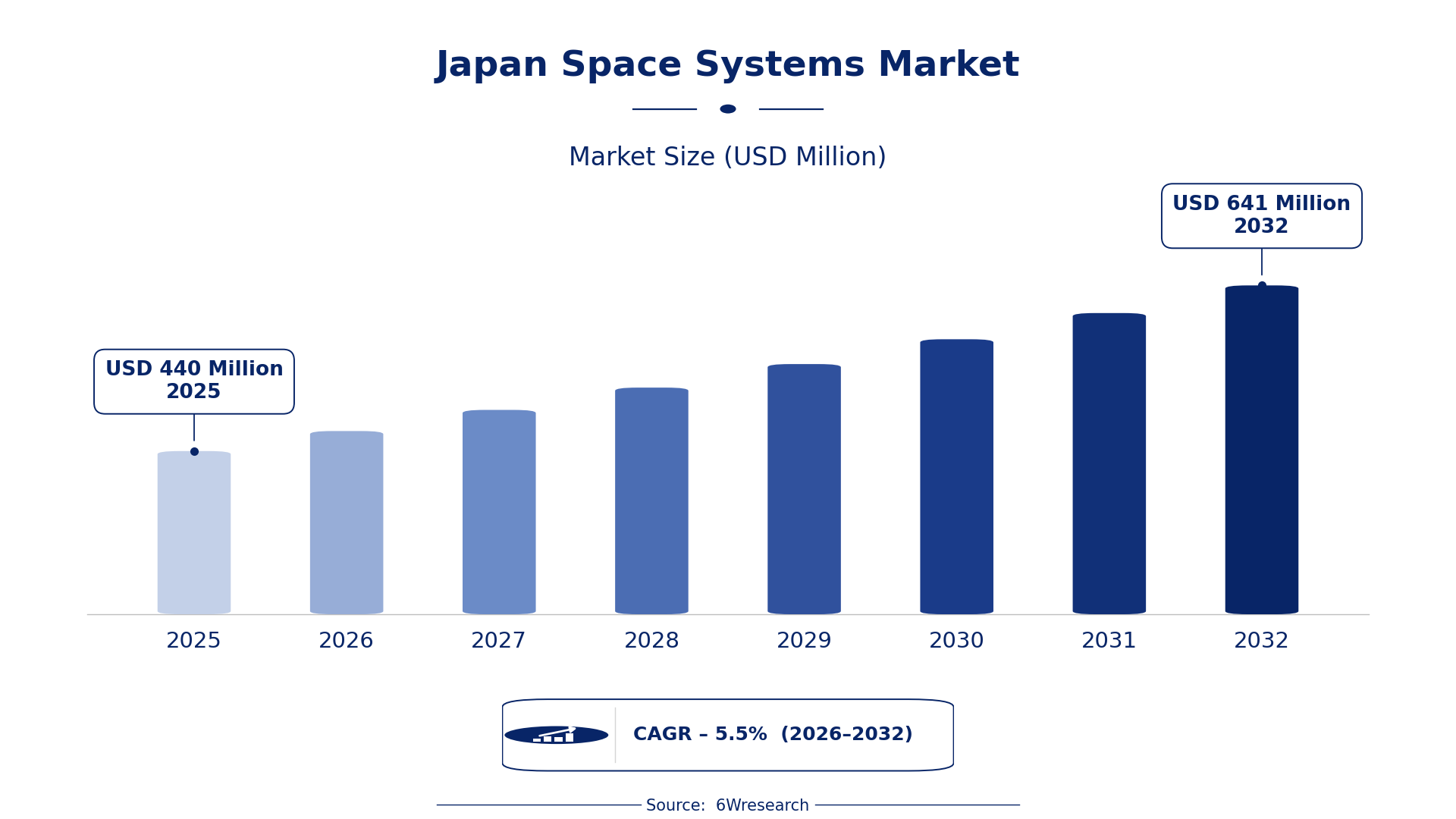
According to 6Wresearch internal database and industry insights, the Japan Space Systems Market was valued at USD 440 Million in 2025 and is projected to reach USD 641 Million by 2032, growing at a CAGR of approximately 5.5% during 2026–2032.
Japan Space Systems Market Highlights
| Report Metric | Details |
| Report Name | Japan Space Systems Market (2026-2032) |
| Market Size 2025 | USD 440 Million |
| Market Size 2032 | USD 641 Million |
| Absolute Growth 2025–2032 | USD 201 Million |
| CAGR 2026–2032 | 5.5% |
| Peak Annual Growth | 6.8% in 2032 |
| Forecast Period | 2026–2032 |
| Historical Data | 2022–2025 |
| Base Year | 2025 |
| Leading System Type, 2025 | Satellite Systems (49% share) |
| Leading Operational Domain, 2025 | Orbital (37% share) |
| Leading Functionality, 2025 | Communication/Navigation (37% share) |
| Leading End User, 2025 | Commercial Operators (53% share) |
| Fastest-Growing System Type | Propulsion Systems (7.8% CAGR) |
| Fastest-Growing Operational Domain | Deep Space (7.2% CAGR) |
| Fastest-Growing Functionality | Movement/Control (7.6% CAGR) |
| Fastest-Growing End User | Spacecraft OEMs (7.3% CAGR) |
| Growing Sector | Satellite Services |
| Key End Users | Government agencies, commercial operators, aerospace manufacturers, launch service providers |
Japan Space Systems Market Year-wise Growth Rate and Key Drivers (2022–2032)
This graph illustrates the annual growth rates of the market from 2022 to 2032, highlighting a steady upward trajectory and projected market expansion over the forecast period.
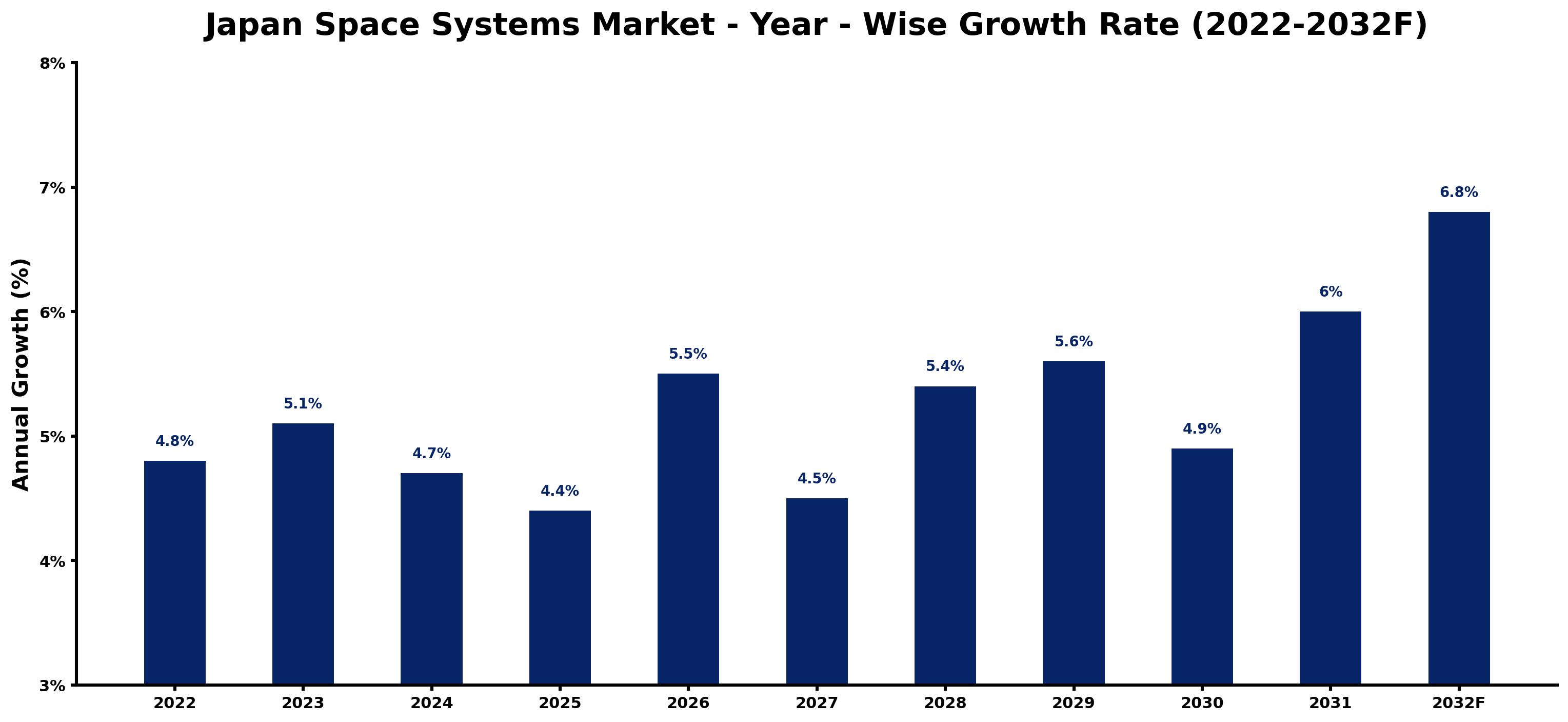
Below, each year's estimated growth is shown next to the factor that most influenced it.
| Year | Estimated Annual Growth (%) | Market Rationale |
| 2022 | 4.8 | The market experienced steady demand from government agencies and commercial operators. |
| 2023 | 5.1 | Growth accelerated due to increased satellite launches and international collaborations. |
| 2024 | 4.7 | Demand slowed as market adjustments followed the previous year's growth surge. |
| 2025 | 4.4 | Growth continued to decelerate as the market stabilised after rapid expansion. |
| 2026 | 5.5 | Demand is expected to rise with new investments in satellite technology. |
| 2027 | 4.5 | Growth is projected to slow as the market matures and competition increases. |
| 2028 | 5.4 | Demand is anticipated to rise again with advancements in propulsion systems. |
| 2029 | 5.6 | Growth is expected to continue as new projects come online. |
| 2030 | 4.9 | Market growth is likely to moderate as demand stabilises. |
| 2031 | 6.0 | Growth is anticipated to rise with increased focus on deep space missions. |
| 2032 | 6.8 | The market is expected to peak with investments in space exploration. |
Note: Market size estimations and growth projections presented in this report are based on 6Wresearch's proprietary forecasting methodology, utilizing the latest available industry data, government publications, and primary research inputs.
Japan Space Systems Market Synopsis
Space systems encompass a range of technologies including satellites, propulsion, avionics, and environmental systems, primarily used for communication, navigation, and scientific research. The Japan Space Systems Market is expanding due to rising demand from government agencies and commercial operators, alongside international partnerships. In 2023, the allocation of ¥100 billion for space exploration initiatives and the ongoing development of the H-IIA rocket highlight the increasing investment in satellite launches and technology advancements, fuelling market expansion.
Market Dynamics Impact Analysis (2026–2032)
| Factor | Type | Impact | Primary Segment Affected |
| Increased satellite launches driven by government and commercial demand | Driver | High | Satellite Systems |
| Investment in advanced propulsion technologies for space missions | Driver | High | Propulsion Systems |
| Growing international collaborations in space exploration | Opportunity | High | Orbital |
| Emerging demand for advanced communication systems in commercial sectors | Opportunity | High | Communication/Navigation |
| High development costs for new space technologies | Restraint | Medium | Avionics Systems |
| Limited availability of skilled workforce in aerospace engineering | Restraint | Medium | Satellite Systems |
| Competition from international space agencies and private firms | Challenge | High | Launch Service Providers |
| Regulatory hurdles in commercial space activities | Challenge | Medium | Spacecraft OEMs |
Evaluation of Drivers in Japan Space Systems Market (2026–2032)
The factors lifting demand, and the evidence behind each, are summarised below.
| Drivers | Primary Segment Affected | Why It Matters (Evidence) |
| Increased government funding for space initiatives | Satellite Systems | Japan allocated ¥100 billion for space exploration in 2023, boosting satellite launches. |
| Growing demand for Earth observation capabilities | Propulsion Systems | Japan launched 7 satellites in 2022, enhancing its observation capabilities. |
| Advancements in satellite technology | Avionics Systems | ISO 9001 standards are widely adopted, improving manufacturing quality and reliability. |
| Expansion of commercial space operations | Communication/Navigation | Commercial operators are increasingly utilising satellite services for communication needs. |
| International partnerships for collaborative missions | Orbital | JAXA's Hayabusa2 mission illustrates successful international collaboration in space exploration. |
Spending rises because demand for satellite services has surged, with Japan launching 7 satellites in 2022 to improve communication and observation capabilities. The adoption of ISO 9001 standards in aerospace manufacturing ensures high-quality production, attracting operators seeking reliable services. Collaborations in missions, such as those seen in recent projects, further stimulate demand for advanced technologies.
Evaluation of Restraints in Japan Space Systems Market
Below are the constraints most often cited by buyers and suppliers, with the segment each affects.
| Market Restraint | Primary Segment Affected | Why It Matters (Evidence) |
| High costs associated with developing new satellite technologies | Satellite Systems | Development costs can exceed billions, limiting investment from smaller firms. |
| Shortage of skilled aerospace engineers in the workforce | Propulsion Systems | The limited talent pool hampers the ability to meet project demands. |
| Regulatory challenges in commercial space activities | Avionics Systems | Compliance with the Electrical Appliance and Material Safety Act can delay project timelines. |
| Intense competition from international space agencies | Launch Service Providers | Competitive pressure can lead to price wars, affecting profitability. |
| Limited funding for smaller space startups | Communication/Navigation | Access to capital is often restricted, hindering innovation and growth. |
Japan Space Systems Market Challenges
Japan's space systems market faces high development costs, with project budgets inflating by up to 30% for producers due to advanced engineering and strict quality standards. Supply chain disruptions arise from reliance on specific materials, leading to production delays of several months for manufacturers. Competition intensifies as international entities enter the sector, forcing local producers to reduce prices, which can cut profit margins by 15% for suppliers. Technological advancements lag due to limited funding for research and development, resulting in buyers receiving outdated systems that do not meet current demands.
Trends in the Japan Space Systems Market
Below are the shifts with the largest effect on the Japan Space Systems Market.
- Shift towards Enhanced Earth Observation Capabilities: Japan is increasingly focusing on Earth observation technologies, as evidenced by the launch of 7 satellites in 2022. This shift is expected to improve data collection for environmental monitoring and disaster management.
- Transition from Traditional to Advanced Propulsion Systems: The development of new propulsion technologies is gaining momentum, with investments aimed at improving satellite mobility. This change is essential for enhancing Japan's capabilities in deep space exploration.
- Emerging Focus on International Collaborations: International partnerships are becoming more prominent, as seen in recent missions. Such collaborations are important for sharing expertise and resources in space exploration.
- Growing Demand for Commercial Satellite Services: The commercial sector is increasingly prioritising satellite services, with operators seeking reliable communication solutions. This trend is underscored by the rising number of satellite launches in recent years.
Investment Opportunities in the Japan Space Systems Market
Where to invest in the Japan Space Systems Market: the main openings are set out below.
- Invest in Advanced Propulsion Technologies: Now is the time to invest in propulsion systems, as Japan's space exploration initiatives are expanding. Collaborating with JAXA can provide valuable insights and access to funding.
- Partner with Commercial Operators: Tokyo is a major hub for space technology, offering opportunities to collaborate with commercial operators. Establishing joint ventures can improve market presence and service offerings.
- Supply Communication Systems for Satellite Services: The increasing need for satellite communication services presents an opportunity to supply advanced systems. Engaging with commercial operators can lead to valuable contracts.
- Advance Robotic Technologies: With the Space Robotics Program aiming for advancements by 2025, there is an opportunity to invest in robotic technologies. Collaborating with research institutions can facilitate entry into this market.
Government Initiatives in the Japan Space Systems Market
The GX Basic Policy, adopted in 2023, aims to mobilise about JPY 150 trillion for public-private decarbonisation investment over the next decade. This policy builds on the existing framework established by the Industrial Standardization Act of 1949, which governs product and test standards in the space sector, ensuring compliance with safety regulations for space systems.
The Japan Aerospace Exploration Agency (JAXA) oversees the approval of projects that align with national objectives. JAXA also provides funding for advanced space technologies and collaborates with private sector stakeholders to improve Japan's space capabilities.
Future Insight of the Japan Space Systems Market
New satellite launch facilities will emerge by 2032, enhancing access to space for domestic users. Increased funding of ¥100 billion for space exploration initiatives will drive advancements in satellite technology, allowing buyers to access improved services. The Space Robotics Program aims to enhance robotic technologies for space applications by 2025, encouraging innovation among suppliers. Collaboration through the Japan Space Forum will strengthen partnerships, ensuring a more integrated approach to space development.
Market Segmentation Analysis
Japan Space Systems Market report covers a detailed analysis of the following market segments:
By System Type – Satellite Systems Lead, Propulsion Systems Expected to Grow Fastest
According to Saurav Kr Singh, Senior Research Analyst at 6Wresearch, with 49% of system type revenue in 2025, Satellite Systems was the largest category. Satellite systems dominate the market due to their essential role in communication and Earth observation, catering to both government and commercial users. The launch of 7 satellites in 2022 illustrates the robust demand for these technologies in Japan. Over 2026–2032, Propulsion Systems are expected to post the fastest growth, at a CAGR of 7.8%. Propulsion systems are witnessing rapid growth, primarily due to advancements in rocket technology that are crucial for satellite and spacecraft movement. The prominence of the H-IIA rocket highlights the increasing investments in propulsion capabilities, ensuring continued expansion. Suppliers must focus on developing advanced propulsion technologies to meet the rising demand from satellite manufacturers.
By Operational Domain – Orbital Leads, Deep Space Expected to Grow Fastest
The largest operational domain category in 2025 was Orbital, at 37% of revenue. The orbital domain captures the largest share as it includes the majority of active missions, mainly centred on satellite deployment for various applications. The Japan Aerospace Exploration Agency's ongoing commitment to orbital missions further underscores this segment's significance. The quickest growth will come from Deep Space, forecast to expand at a CAGR of 7.2% between 2026 and 2032. Deep space operations are set for growth, driven by a surge in interest for exploration missions, despite being less frequent. The success of JAXA's Hayabusa2 mission showcases the potential for expansion in this domain, indicating future opportunities. Buyers should consider investments in deep space technologies as opportunities for future exploration continue to expand.
By Functionality – Communication/Navigation Leads, Movement/Control Expected to Grow Fastest
Communication/Navigation accounted for 37% of the market by functionality in 2025. Communication and navigation functionalities lead the market, being vital for the operational success of numerous missions. Their extensive integration across satellite systems underscores their critical importance in the space systems sector. Movement/Control is set to record the highest CAGR in this split, 7.6% over 2026–2032. Movement and control functionalities are advancing rapidly, driven by the need for improved spacecraft manoeuvrability. This demand is crucial for missions that require precise positioning and adjustments in space, indicating a growing focus on these capabilities. Suppliers should prioritise innovations in movement and control technologies to address the evolving requirements of spacecraft operations.
By End User – Commercial Operators Lead, Spacecraft OEMs Expected to Grow Fastest
In 2025, Commercial Operators led the end user split with a 53% share. Commercial operators represent the largest segment as they are the primary users of satellite services, driving demand for various space systems. Their reliance on satellite communication for business operations underscores their importance in the market. Spacecraft OEMs are projected to grow fastest, at a CAGR of 7.3% during 2026–2032. Spacecraft OEMs are experiencing the fastest growth as they seek to meet the increasing demand for new space vehicles. The expansion of satellite launches necessitates a corresponding rise in manufacturing capabilities for spacecraft. Manufacturers must align their production strategies with the growing needs of spacecraft OEMs to capitalise on market opportunities.
Key Attractiveness of the Report
- 10 Years of Market Numbers
- Historical Data Starting from 2022 to 2025
- Base Year 2025
- Forecast Data until 2032
- Key Performance Indicators Impacting the Market
- Major Upcoming Developments and Projects
Key Highlights of the Report:
- Japan Space Systems Market Outlook
- Market Size of Japan Space Systems Market, 2025
- Forecast of Japan Space Systems Market, 2032
- Historical Data and Forecast of Japan Space Systems Revenues & Volume for the Period 2022-2032F
- Japan Space Systems Market Trend Evolution
- Japan Space Systems Market Drivers and Challenges
- Japan Space Systems Price Trends
- Japan Space Systems Porter's Five Forces
- Japan Space Systems Industry Life Cycle
- Historical Data and Forecast of Japan Space Systems Market Revenues & Volume By System Type for the Period 2022-2032F
- Historical Data and Forecast of Japan Space Systems Market Revenues & Volume By Satellite Systems for the Period 2022-2032F
- Historical Data and Forecast of Japan Space Systems Market Revenues & Volume By Propulsion Systems for the Period 2022-2032F
- Historical Data and Forecast of Japan Space Systems Market Revenues & Volume By Avionics Systems for the Period 2022-2032F
- Historical Data and Forecast of Japan Space Systems Market Revenues & Volume By Environmental Systems for the Period 2022-2032F
- Historical Data and Forecast of Japan Space Systems Market Revenues & Volume By Operational Domain for the Period 2022-2032F
- Historical Data and Forecast of Japan Space Systems Market Revenues & Volume By Orbital for the Period 2022-2032F
- Historical Data and Forecast of Japan Space Systems Market Revenues & Volume By Deep Space for the Period 2022-2032F
- Historical Data and Forecast of Japan Space Systems Market Revenues & Volume By In-Mission for the Period 2022-2032F
- Historical Data and Forecast of Japan Space Systems Market Revenues & Volume By Habitats for the Period 2022-2032F
- Historical Data and Forecast of Japan Space Systems Market Revenues & Volume By Functionality for the Period 2022-2032F
- Historical Data and Forecast of Japan Space Systems Market Revenues & Volume By Communication/Navigation for the Period 2022-2032F
- Historical Data and Forecast of Japan Space Systems Market Revenues & Volume By Movement/Control for the Period 2022-2032F
- Historical Data and Forecast of Japan Space Systems Market Revenues & Volume By Control/Navigation for the Period 2022-2032F
- Historical Data and Forecast of Japan Space Systems Market Revenues & Volume By Life Support for the Period 2022-2032F
- Historical Data and Forecast of Japan Space Systems Market Revenues & Volume By End User for the Period 2022-2032F
- Historical Data and Forecast of Japan Space Systems Market Revenues & Volume By Commercial Operators for the Period 2022-2032F
- Historical Data and Forecast of Japan Space Systems Market Revenues & Volume By Spacecraft OEMs for the Period 2022-2032F
- Historical Data and Forecast of Japan Space Systems Market Revenues & Volume By Launch Service Providers for the Period 2022-2032F
- Historical Data and Forecast of Japan Space Systems Market Revenues & Volume By Space Station Partners for the Period 2022-2032F
- Japan Space Systems Import Export Trade Statistics
- Market Opportunity Assessment By System Type
- Market Opportunity Assessment By Operational Domain
- Market Opportunity Assessment By Functionality
- Market Opportunity Assessment By End User
- Japan Space Systems Top Companies Market Share
- Japan Space Systems Competitive Benchmarking By Technical and Operational Parameters
- Japan Space Systems Company Profiles
- Japan Space Systems Key Strategic Recommendations
Market Covered
Coverage by segment is as follows.
By System Type
- Satellite Systems
- Propulsion Systems
- Avionics Systems
- Environmental Systems
By Operational Domain
- Orbital
- Deep Space
- In-Mission
- Habitats
By Functionality
- Communication/Navigation
- Movement/Control
- Control/Navigation
- Life Support
By End User
- Commercial Operators
- Spacecraft OEMs
- Launch Service Providers
- Space Station Partners































