Japan Spas and Beauty Salons Market Size & Growth Rate
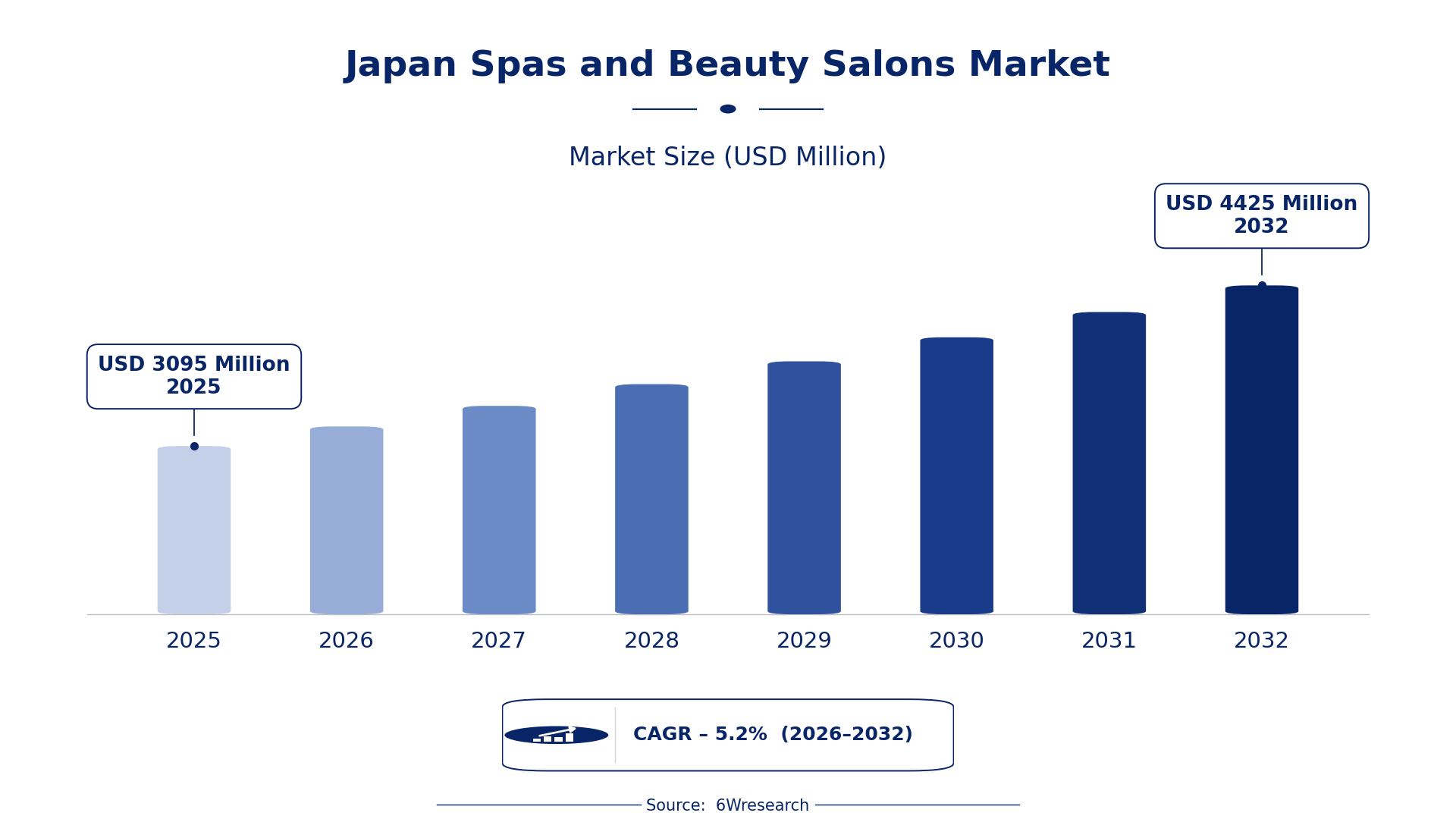
According to 6Wresearch internal database and industry insights, the Japan Spas and Beauty Salons Market was valued at USD 3,095 Million in 2025 and is projected to reach USD 4,425 Million by 2032, growing at a CAGR of approximately 5.2% during 2026–2032.
Japan Spas and Beauty Salons Market Highlights
| Report Metric | Details |
| Report Name | Japan Spas and Beauty Salons Market (2026-2032) |
| Market Size 2025 | USD 3,095 Million |
| Market Size 2032 | USD 4,425 Million |
| Absolute Growth 2025–2032 | USD 1,330 Million |
| CAGR 2026–2032 | 5.2% |
| Peak Annual Growth | 6.4% in 2028 |
| Forecast Period | 2026–2032 |
| Historical Data | 2022–2025 |
| Base Year | 2025 |
| Leading Type, 2025 | Spa (67% share) |
| Leading End-user, 2025 | Men (66% share) |
| Fastest-Growing Type | Beauty Salon (6.7% CAGR) |
| Fastest-Growing End-user | Women (6.2% CAGR) |
| Growing Sector | personal care services |
| Key End Users | women, men, wellness tourists |
Japan Spas and Beauty Salons Market Year-wise Growth Rate and Key Drivers (2022–2032)
This graph illustrates the annual growth rates of the market from 2022 to 2032, highlighting a steady upward trajectory and projected market expansion over the forecast period.
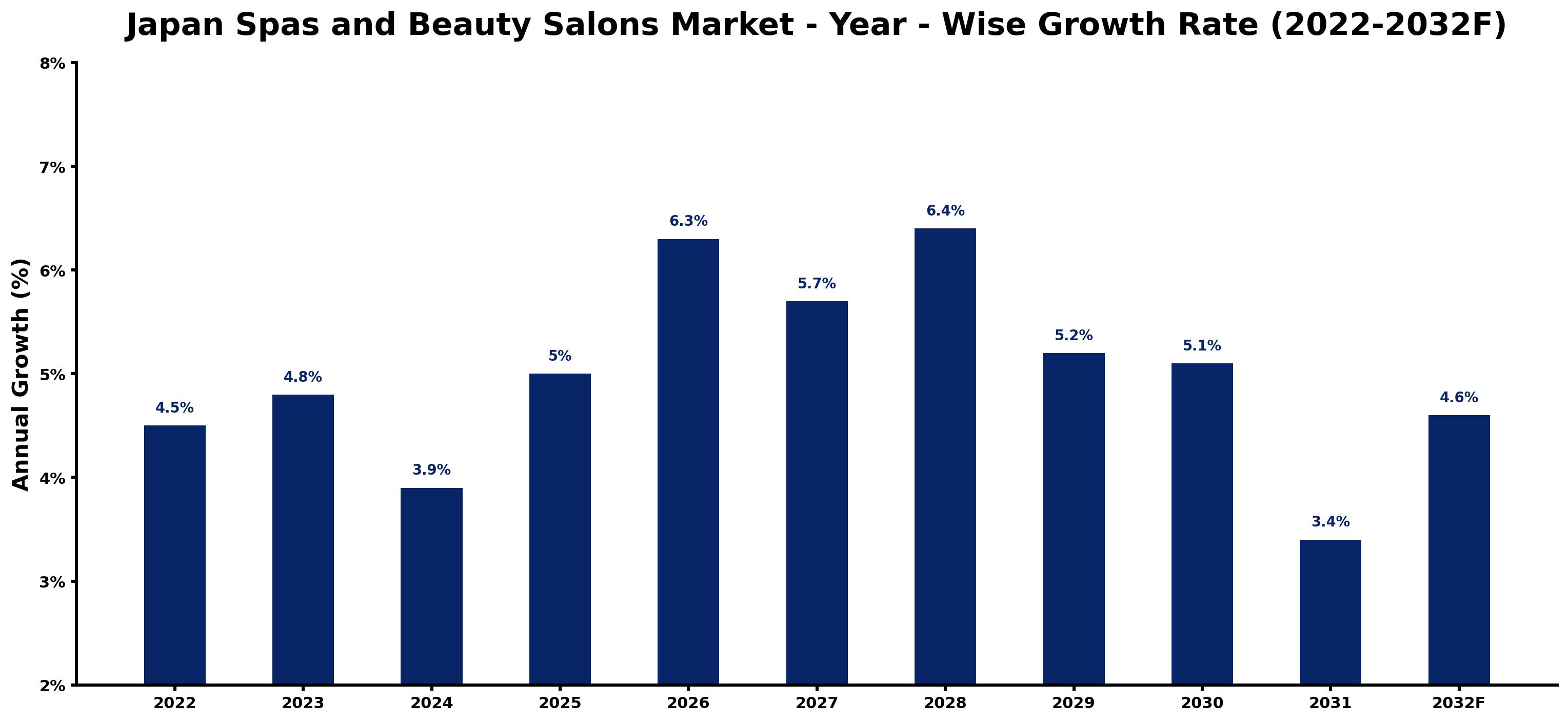
Annual growth estimates for each year appear below with the principal reason behind them, explaining the shifts that set the pace of the market.
| Year | Estimated Annual Growth (%) | Market Rationale |
| 2022 | 4.5 | The market showed strong engagement with personal care services, reflecting ongoing consumer interest. |
| 2023 | 4.8 | Demand continued to rise as consumers increasingly prioritised beauty and wellness services. |
| 2024 | 3.9 | Growth slowed as market saturation began to affect new service uptake. |
| 2025 | 5.0 | The market experienced a resurgence as consumer spending on beauty services increased. |
| 2026 | 6.3 | Demand is expected to surge as beauty salons expand their offerings to attract more clients. |
| 2027 | 5.7 | Growth is projected to slow due to increased competition among beauty establishments in urban areas. |
| 2028 | 6.4 | The market is expected to peak as wellness treatments gain popularity among consumers. |
| 2029 | 5.2 | Growth is anticipated to slow as economic factors begin to impact discretionary spending on beauty services. |
| 2030 | 5.1 | Demand will continue to moderate as consumers become more selective in their service choices. |
| 2031 | 3.4 | Growth will slow further as the market approaches saturation with numerous service providers. |
| 2032 | 4.6 | Demand is projected to increase again as new eco-friendly practices attract environmentally conscious consumers. |
Note: Market size estimations and growth projections presented in this report are based on 6Wresearch's proprietary forecasting methodology, utilizing the latest available industry data, government publications, and primary research inputs.
Japan Spas and Beauty Salons Market Synopsis
Spas and beauty salons in Japan provide personal care services, including skincare and relaxation treatments, catering to a diverse clientele. The average spending on beauty services is around 30,000 JPY annually, reflecting a strong consumer focus on wellness. Key factors driving growth include the promotion of wellness tourism by the Japan Spa Association and the increasing number of establishments in urban areas, particularly in Tokyo, which has over 1,200 spas.
Market Dynamics Impact Analysis (2026–2032)
| Factor | Type | Impact | Primary Segment Affected |
| Growing interest in wellness tourism | Driver | High | Spa |
| Increased consumer spending on beauty services | Driver | High | Beauty Salon |
| Expansion of eco-friendly beauty practices | Opportunity | Medium | Beauty Salon |
| Rising demand for specialised skincare treatments | Opportunity | High | Spa |
| Market saturation in urban areas | Restraint | High | Beauty Salon |
| High competition among service providers | Restraint | Medium | Spa |
| Limited access to advanced training for professionals | Challenge | High | Beauty Salon |
| Rising operational costs for beauty establishments | Challenge | Medium | Spa |
Evaluation of Drivers in Japan Spas and Beauty Salons Market (2026–2032)
The factors lifting demand, and the evidence behind each, are summarised below.
| Drivers | Primary Segment Affected | Why It Matters (Evidence) |
| Increasing consumer focus on personal appearance | Beauty Salon | This trend has led to higher spending on hair and beauty treatments, averaging 30,000 JPY per person annually. |
| Growth in wellness tourism | Spa | Tokyo hosts over 1,200 spas, attracting both domestic and international tourists seeking relaxation and wellness services. |
| Adoption of eco-friendly practices | Beauty Salon | The beauty industry is set to adopt more eco-friendly practices by 2025, appealing to environmentally conscious consumers. |
| Expansion of service offerings | Spa | Spas are diversifying their services to include wellness treatments, attracting a broader clientele. |
| Support from industry associations | Beauty Salon | The Japan Hairdressing and Beauty Association promotes training and education, improving service quality. |
Buyers are adding capacity as consumer interest in personal care services rises. Over the past five years, spending on beauty services has reached an average of 30,000 JPY annually, reflecting a strong focus on personal appearance. The beauty industry is moving towards eco-friendly practices, expected to be adopted by 2025, which will attract environmentally conscious clients. As spas diversify their offerings, they are appealing to a broader clientele, thereby increasing demand for relaxation and wellness services. Wellness tourism is becoming a key driver, with Tokyo hosting a growing number of spas catering to both domestic and international visitors.
Evaluation of Restraints in Japan Spas and Beauty Salons Market
These restraints slow adoption and weigh on supplier margins.
| Market Restraint | Primary Segment Affected | Why It Matters (Evidence) |
| Market saturation in urban areas | Beauty Salon | With over 25,000 beauty salons in Japan, competition has intensified, limiting growth opportunities for new entrants. |
| High operational costs for beauty establishments | Spa | Rising costs associated with supplies and staffing are impacting profit margins for spa operators. |
| Limited access to advanced training for professionals | Beauty Salon | A lack of training programmes restricts the skill development of beauty professionals, affecting service quality. |
| Consumer price sensitivity | Spa | Economic fluctuations have made consumers more cautious about spending on luxury wellness services. |
| Regulatory compliance costs | Beauty Salon | Compliance with standards such as ISO 22716 increases operational costs for beauty salons. |
Japan Spas and Beauty Salons Market Challenges
Japan has over 25,000 beauty salons, but strict regulations from the Ministry of Health, Labour and Welfare complicate operations, causing delays in service delivery for consumers. Compliance with ISO 22716 standards raises operational costs, forcing salons to increase prices, which can deter potential clients. Many establishments struggle to integrate new technology, resulting in outdated service offerings that fail to attract younger demographics, costing them market share. Intense competition in urban areas like Tokyo, where over 1,200 spas exist, drives down prices, squeezing margins for salon owners and limiting their ability to invest in quality improvements.
Trends in the Japan Spas and Beauty Salons Market
The following changes are redrawing the Japan Spas and Beauty Salons Market.
- Increase in Eco-Friendly Practices: The beauty industry is increasingly adopting eco-friendly practices, with a shift expected by 2025. This change is driven by consumer demand for sustainable products, as seen in initiatives promoted by the Japan Spa Association.
- Rise in Popularity of Wellness Treatments: Tokyo's spa sector is experiencing a surge in demand for wellness treatments, with over 1,200 establishments catering to this trend. This focus on holistic health reflects a broader cultural shift towards well-being.
- Investment in Beauty Education: There is a notable increase in investment in beauty education, supported by the Japan Hairdressing and Beauty Association. This trend aims to improve service quality and professional standards across the industry.
- Expansion of Spa Services: Spas are broadening their service offerings, incorporating wellness treatments to attract a wider clientele. This trend is particularly visible in Tokyo, where the average age of spa visitors ranges from 35 to 45 years.
Investment Opportunities in the Japan Spas and Beauty Salons Market
The following areas offer the clearest openings for investors and suppliers in the Japan Spas and Beauty Salons Market.
- Sustainable Beauty Products: With the beauty industry expected to adopt eco-friendly practices by 2025, there is an opportunity for suppliers of sustainable beauty products. This shift aligns with consumer preferences for environmentally conscious options.
- Specialised Skincare Treatments: The rising demand for specialised skincare treatments presents an opportunity for beauty salons to expand their service offerings. Women, who represent about 70% of the clientele, are particularly interested in these services.
- Wellness Tourism Services: As wellness tourism continues to grow, spas can capitalise on this trend by enhancing their service offerings. Tokyo's status as a major hub for spas provides an ideal entry point for new service providers.
- Investment in Training Programmes: Investing in training programmes for beauty professionals is important as the industry evolves. Partnering with the Japan Hairdressing and Beauty Association can facilitate access to quality training resources.
Government Initiatives in the Japan Spas and Beauty Salons Market
The GX Basic Policy, adopted in 2023, aims for JPY 150 trillion in public-private decarbonisation investment over the next decade. This initiative encourages beauty establishments to adopt sustainable practices, aligning with global environmental standards and improving their market appeal.
The Japan Cosmetic Standards set ingredient restrictions for products sold in Japan, ensuring that beauty establishments maintain high safety and quality levels. Compliance with these standards benefits both producers and consumers, as it enhances trust in the industry.
Future Insight of the Japan Spas and Beauty Salons Market
Emerging digital booking systems will simplify appointment scheduling, improving customer experience and attracting more clients. By 2032, eco-friendly practices will become common, appealing to environmentally conscious consumers and setting suppliers apart. The annual Beauty World Japan event will highlight new innovations, prompting salons to adopt advanced techniques and products. Average spending on beauty services is expected to rise to 30,000 JPY annually, compelling suppliers to adjust their offerings to meet changing consumer demands.
Market Segmentation Analysis
Japan Spas and Beauty Salons Market report covers a detailed analysis of the following market segments:
By Type – Spa Leads, Beauty Salon Expected to Grow Fastest
According to Summon Dutta, Assistant Manager at 6Wresearch, Spa held 67% of the Japan Spas and Beauty Salons Market by type in 2025. Spas lead the market due to their concentration in urban areas such as Tokyo, where over 1,200 establishments provide relaxation and wellness services. This strong presence is complemented by a cultural focus on personal care and wellness, driving their substantial market share. Over 2026–2032, Beauty Salon is expected to post the fastest growth, at a CAGR of 6.7%. Beauty salons are experiencing rapid growth as they cater to a broader audience, with many clients increasingly seeking hair and beauty treatments. The average annual spending of approximately 30,000 JPY per person on these services indicates a rising interest in this segment. Suppliers should focus on enhancing service offerings in beauty salons to align with the growing consumer demand.
By End-user – Men Leads, Women Expected to Grow Fastest
With 66% of end-user revenue in 2025, Men was the largest category. Men represent a significant portion of spa clientele, although they visit less frequently than women, which shapes market trends. Marketing efforts by beauty salons effectively attract male customers seeking grooming services, thus maintaining their market share. Women is projected to grow fastest, at a CAGR of 6.2% during 2026–2032. Women constitute the fastest-growing segment, accounting for about 70% of spa and beauty salon clientele, reflecting their high demand for beauty services. This trend is expected to continue as more women prioritise personal care and wellness. Buyers should consider tailored services that specifically address the needs of women to capitalise on this growth opportunity.
Key Attractiveness of the Report
- 10 Years of Market Numbers
- Historical Data Starting from 2022 to 2025
- Base Year 2025
- Forecast Data until 2032
- Key Performance Indicators Impacting the Market
- Major Upcoming Developments and Projects
Key Highlights of the Report:
- Japan Spas and Beauty Salons Market Outlook
- Market Size of Japan Spas and Beauty Salons Market, 2025
- Forecast of Japan Spas and Beauty Salons Market, 2032
- Historical Data and Forecast of Japan Spas and Beauty Salons Revenues & Volume for the Period 2022-2032
- Japan Spas and Beauty Salons Market Trend Evolution
- Japan Spas and Beauty Salons Market Drivers and Challenges
- Japan Spas and Beauty Salons Price Trends
- Japan Spas and Beauty Salons Porter's Five Forces
- Japan Spas and Beauty Salons Industry Life Cycle
- Historical Data and Forecast of Japan Spas and Beauty Salons Market Revenues & Volume By Type for the Period 2022-2032
- Historical Data and Forecast of Japan Spas and Beauty Salons Market Revenues & Volume By Spa for the Period 2022-2032
- Historical Data and Forecast of Japan Spas and Beauty Salons Market Revenues & Volume By Beauty Salon for the Period 2022-2032
- Historical Data and Forecast of Japan Spas and Beauty Salons Market Revenues & Volume By End-user for the Period 2022-2032
- Historical Data and Forecast of Japan Spas and Beauty Salons Market Revenues & Volume By Men for the Period 2022-2032
- Historical Data and Forecast of Japan Spas and Beauty Salons Market Revenues & Volume By Women for the Period 2022-2032
- Japan Spas and Beauty Salons Import Export Trade Statistics
- Market Opportunity Assessment By Type
- Market Opportunity Assessment By End-user
- Japan Spas and Beauty Salons Top Companies Market Share
- Japan Spas and Beauty Salons Competitive Benchmarking By Technical and Operational Parameters
- Japan Spas and Beauty Salons Company Profiles
- Japan Spas and Beauty Salons Key Strategic Recommendations
Market Covered
The report covers the following segments.
By Type
- Spa
- Beauty Salon
By End-user
- Men
- Women































