Japan Specialty Alloys Market Size & Growth Rate
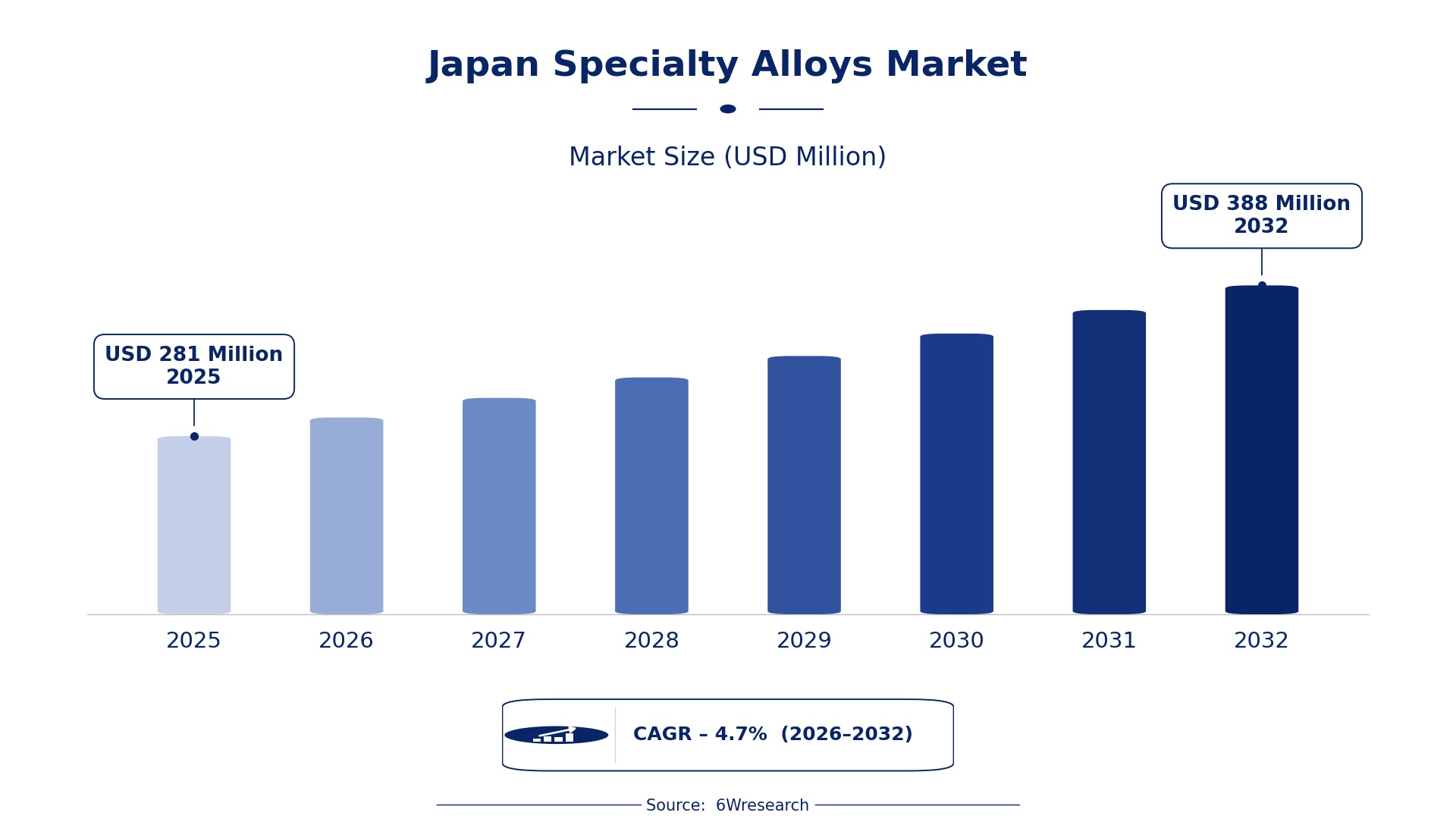
According to 6Wresearch internal database and industry insights, the Japan Specialty Alloys Market was valued at USD 281 Million in 2025 and is projected to reach USD 388 Million by 2032, growing at a CAGR of approximately 4.7% during 2026–2032.
Japan Specialty Alloys Market Highlights
| Report Metric | Details |
| Report Name | Japan Specialty Alloys Market (2026-2032) |
| Market Size 2025 | USD 281 Million |
| Market Size 2032 | USD 388 Million |
| Absolute Growth 2025–2032 | USD 107 Million |
| CAGR 2026–2032 | 4.7% |
| Peak Annual Growth | 5.5% in 2032 |
| Forecast Period | 2026–2032 |
| Historical Data | 2022–2025 |
| Base Year | 2025 |
| Leading Alloy Type, 2025 | Titanium Alloys (44% share) |
| Leading Base Material, 2025 | Titanium/Al-V (36% share) |
| Leading Application Industry, 2025 | Aerospace (41% share) |
| Leading End User, 2025 | Aircraft Manufacturers (47% share) |
| Fastest-Growing Alloy Type | Nickel Alloys (6.6% CAGR) |
| Fastest-Growing Base Material | Nickel-Chromium (6.7% CAGR) |
| Fastest-Growing Application Industry | Medical Implants (6.2% CAGR) |
| Fastest-Growing End User | Healthcare OEMs (6.1% CAGR) |
| Growing Sector | Aerospace |
| Key End Users | Aerospace Manufacturers, Healthcare OEMs, Automotive Manufacturers |
Japan Specialty Alloys Market Year-wise Growth Rate and Key Drivers (2022–2032)
This graph illustrates the annual growth rates of the market from 2022 to 2032, highlighting a steady upward trajectory and projected market expansion over the forecast period.
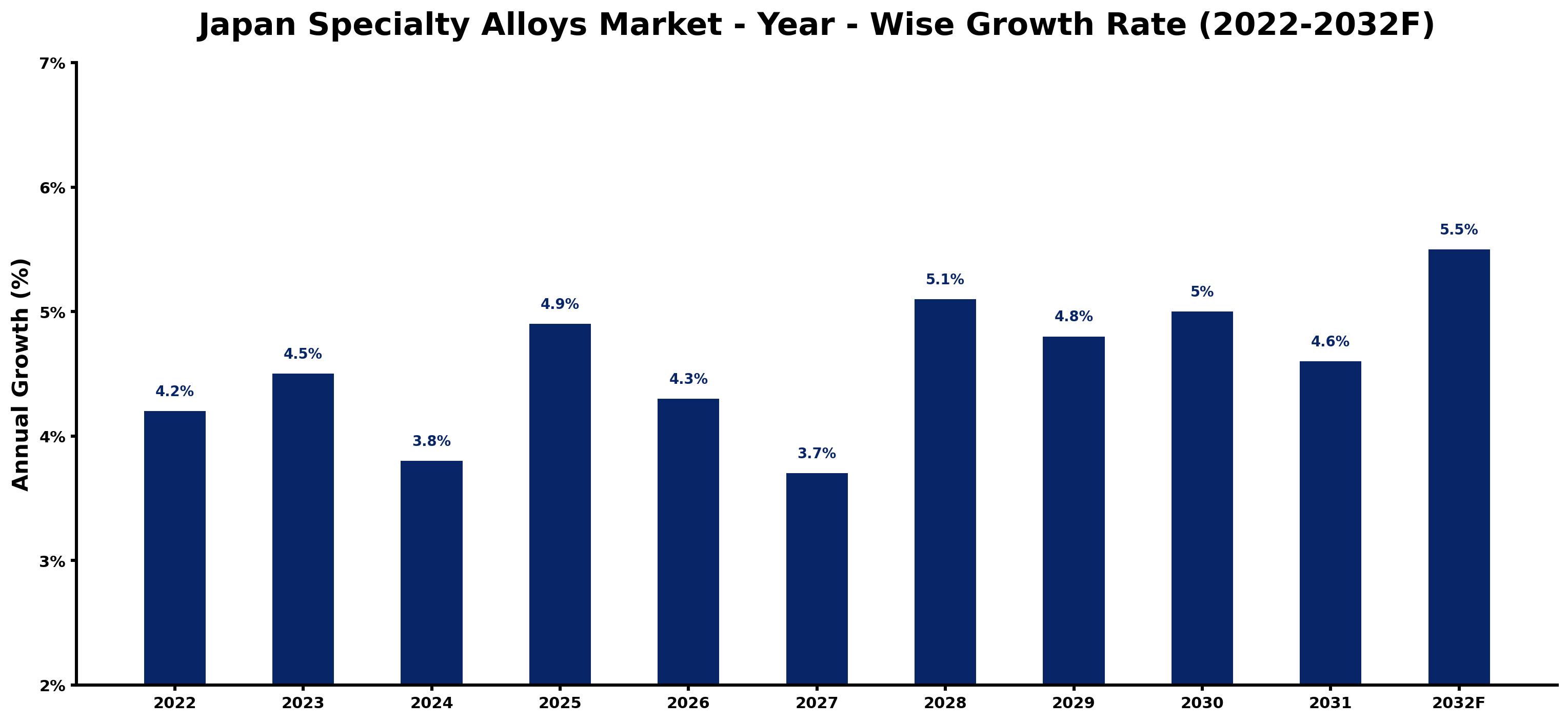
Annual growth estimates for each year appear below with the principal reason behind them, explaining the shifts that set the pace of the market.
| Year | Estimated Annual Growth (%) | Market Rationale |
| 2022 | 4.2 | The aerospace sector maintained steady demand for specialty alloys due to ongoing projects. |
| 2023 | 4.5 | The automotive industry increased its use of aluminum alloys for weight reduction and efficiency. |
| 2024 | 3.8 | Demand growth slowed as manufacturers adjusted to supply chain challenges and market conditions. |
| 2025 | 4.9 | Aerospace projects drove demand for titanium alloys, leading to increased production rates. |
| 2026 | 4.3 | Growth is expected to slow as the market stabilises after a peak in aerospace activity. |
| 2027 | 3.7 | Demand will continue to slow due to market saturation and increased competition among suppliers. |
| 2028 | 5.1 | A resurgence in aerospace projects is expected to boost demand for specialty alloys. |
| 2029 | 4.8 | Growth is projected to slow as manufacturers focus on optimising existing production capabilities. |
| 2030 | 5.0 | Increased investment in aerospace technology is expected to raise demand for specialty alloys. |
| 2031 | 4.6 | Demand growth is projected to slow as the market reaches a more mature phase. |
| 2032 | 5.5 | A rise in aerospace projects will lead to heightened demand for specialty alloys. |
Note: Market size estimations and growth projections presented in this report are based on 6Wresearch's proprietary forecasting methodology, utilizing the latest available industry data, government publications, and primary research inputs.
Japan Specialty Alloys Market Synopsis
Specialty alloys are high-performance materials designed for specific applications, primarily in aerospace, medical implants, and oil & gas industries due to their superior strength and corrosion resistance. The Japan Specialty Alloys Market is experiencing growth, with the aerospace sector employing over 80,000 people and projected to increase its use of titanium alloys, which reached approximately 10,000 tons in 2022. The automotive sector's demand for aluminum alloys is set to reach 300,000 tons annually by 2025, propelling market expansion.
Market Dynamics Impact Analysis (2026–2032)
| Factor | Type | Impact | Primary Segment Affected |
| Strong demand from the aerospace sector drives the need for titanium alloys. | Driver | High | Titanium Alloys |
| Increasing automotive production requires lightweight aluminum alloys. | Driver | High | Aluminum Alloys |
| Growing medical device market necessitates specialty alloys for implants. | Opportunity | High | Medical Implants |
| Investment in aerospace technology development opens new market avenues. | Opportunity | High | Aerospace |
| Supply chain disruptions affect the availability of raw materials. | Restraint | Medium | Nickel Alloys |
| High production costs limit the competitiveness of specialty alloys. | Restraint | Medium | Cobalt Alloys |
| Competition from alternative materials pressures pricing strategies. | Challenge | High | Aluminum Alloys |
| Technological advancements require continuous investment from suppliers. | Challenge | Medium | Titanium Alloys |
Evaluation of Drivers in Japan Specialty Alloys Market (2026–2032)
The table below links each growth driver to the segment it affects and the evidence for it.
| Drivers | Primary Segment Affected | Why It Matters (Evidence) |
| Investment in aerospace projects increases demand for titanium alloys. | Titanium Alloys | Japan's aerospace industry produced approximately 10,000 tons of titanium alloys in 2022. |
| Automotive sector's shift towards lightweight materials boosts aluminum alloy use. | Aluminum Alloys | The automotive sector is set to use 300,000 tons of aluminum alloys annually by 2025. |
| Rising healthcare needs drive demand for medical implants made from specialty alloys. | Medical Implants | The Medical Device Industry in Japan is valued at ¥1.5 trillion as of 2023. |
| Oil & gas sector investments in corrosion-resistant materials increase nickel alloy demand. | Nickel Alloys | The Oil & Gas sector is investing heavily in materials that withstand harsh environments. |
| Technological advancements in aerospace applications promote the use of advanced materials. | Aerospace | The Japan Aerospace Exploration Agency promotes the use of advanced materials in aerospace applications. |
Buyers are adding capacity as the aerospace sector expands, with production of titanium alloys reaching approximately 10,000 tons in 2022. The automotive industry is set to consume 300,000 tons of aluminum alloys annually by 2025, driven by the need for lightweight vehicles. Rising healthcare demands are increasing the need for medical implants, with the medical device industry valued at ¥1.5 trillion in 2023. Investments in the oil & gas sector for corrosion-resistant materials are boosting demand for nickel alloys. Technological advancements in aerospace applications further support the market for specialty alloys.
Evaluation of Restraints in Japan Specialty Alloys Market
Below are the constraints most often cited by buyers and suppliers, with the segment each affects.
| Market Restraint | Primary Segment Affected | Why It Matters (Evidence) |
| Supply chain disruptions hinder the availability of raw materials for production. | Nickel Alloys | Manufacturers face challenges in sourcing materials due to global supply chain issues. |
| High production costs limit the competitiveness of specialty alloys in the market. | Cobalt Alloys | Rising costs of raw materials affect pricing strategies for cobalt alloys. |
| Market saturation in certain alloy types leads to intensified competition among suppliers. | Aluminum Alloys | Increased competition pressures pricing and profit margins for aluminum alloy producers. |
| Technological advancements require ongoing investment, straining supplier resources. | Titanium Alloys | Suppliers must invest in R&D to keep up with industry standards. |
| Regulatory compliance adds complexity and cost to the production process. | Medical Implants | Manufacturers must adhere to strict regulations, increasing operational costs. |
Japan Specialty Alloys Market Challenges
High production costs for specialty alloy manufacturers arise from the need for advanced melting technologies, increasing expenses by 15%. A shortage of skilled technicians delays production schedules, costing manufacturers up to ¥200 million annually. Compliance with standards such as JIS H 4650 adds testing expenses, which can postpone projects by several months for suppliers. Disruptions in sourcing raw materials extend lead times, impacting buyers reliant on timely deliveries and potentially increasing their operational costs by 10%.
Trends in the Japan Specialty Alloys Market
Buyers and suppliers in the Japan Specialty Alloys Market are adjusting to the following trends.
- Shift towards Lightweight Materials in Aerospace: The aerospace industry is increasingly adopting lightweight materials to improve fuel efficiency. In 2023, the Japan Aerospace Exploration Agency reported a rise in the use of titanium alloys, essential for reducing aircraft weight.
- Emergence of Advanced Medical Devices: The demand for specialty alloys in medical devices is growing, driven by innovations in biocompatibility. The Medical Device Industry in Japan is valued at ¥1.5 trillion as of 2023, highlighting the need for high-performance materials.
- Transition from Traditional to Advanced Alloys: The shift from traditional materials to advanced alloys is clear in the oil & gas sector. Investments in corrosion-resistant nickel alloys are increasing, with significant projects underway to improve operational efficiency.
- Focus on Sustainable Manufacturing Practices: Manufacturers are prioritising sustainability in production processes. The Economic Security Promotion Act supports supply-chain resilience, encouraging the use of eco-friendly materials and practices.
Investment Opportunities in the Japan Specialty Alloys Market
The following opportunities in the Japan Specialty Alloys Market pair current demand with a clear way in.
- Aerospace Manufacturers Seeking Lightweight Solutions: Aerospace manufacturers are increasingly looking for lightweight specialty alloys. With the projected demand for titanium alloys rising, partnerships with local suppliers can facilitate entry into this market.
- Healthcare OEMs Requiring Biocompatible Materials: Healthcare OEMs are in need of biocompatible specialty alloys for medical devices. The growing medical device market, valued at ¥1.5 trillion, presents opportunities for suppliers to meet this demand.
- Automotive Sector's Shift to Lightweight Alloys: The automotive sector's transition to lightweight materials opens avenues for suppliers of aluminum alloys. With a projected use of 300,000 tons annually by 2025, entering this market through joint ventures can be beneficial.
- Investment in Corrosion-Resistant Materials for Oil & Gas: The oil & gas sector is investing heavily in corrosion-resistant materials. Suppliers can tap into this market by providing nickel alloys, focusing on the sector's emphasis on durability.
Government Initiatives in the Japan Specialty Alloys Market
The Economic Security Promotion Act, enacted in 2022, impacts buyers of specialty alloys by ensuring supply-chain resilience for critical materials. This measure encourages domestic production and reduces reliance on imports, allowing manufacturers to secure a stable supply of essential materials for aerospace and medical applications. Compliance with standards such as JIS H 4650 ensures that titanium alloys meet industry requirements, further supporting market stability.
In 2023, ¥50 billion was allocated for aerospace technology development, administered by the Japan Aerospace Exploration Agency. This funding supports research and development initiatives aimed at advancing the use of specialty alloys in aerospace applications, boosting the competitiveness of domestic manufacturers and ensuring they meet evolving industry standards.
Future Insight of the Japan Specialty Alloys Market
The government's investment pipeline of ¥50 billion in aerospace technology will stimulate demand for specialty alloys, creating opportunities for suppliers. By 2025, the automotive sector is expected to utilise 300,000 tons of aluminum alloys annually, prompting advancements in alloy formulations. Research supported by the Japan Society of Mechanical Engineers will lead to the development of new materials for medical applications. As the oil and gas sector prioritises corrosion-resistant materials, suppliers will need to adapt their offerings to meet evolving industry standards.
Market Segmentation Analysis
Japan Specialty Alloys Market report covers a detailed analysis of the following market segments:
By Alloy Type – Titanium Alloys Lead, Nickel Alloys Expected to Grow Fastest
According to Saurav Kr Singh, Senior Research Analyst at 6Wresearch, Titanium Alloys took 44% of alloy type revenue in 2025, more than any other category. Titanium alloys play a vital role in aerospace and medical applications due to their high strength-to-weight ratio, making them essential for these industries. The production of approximately 10,000 tons in 2022 illustrates their significance within Japan's manufacturing landscape. Nickel Alloys are set to record the highest CAGR in this split, 6.6% over 2026–2032. Nickel alloys are experiencing rapid growth as they are increasingly utilised in oil and gas applications, where corrosion resistance is critical. This trend is expected to persist as the sector continues to seek durable materials for challenging environments. Suppliers should consider expanding their offerings in nickel alloys to meet the rising demand from the oil and gas sector.
By Base Material – Titanium/Al-V Leads, Nickel-Chromium Expected to Grow Fastest
The largest base material category in 2025 was Titanium/Al-V, at 36% of revenue. Titanium/Al-V is the leading base material due to its excellent mechanical properties, particularly in aerospace applications where performance is paramount. Its widespread use among aircraft manufacturers underscores its importance in the sector. The quickest growth will come from Nickel-Chromium, forecast to expand at a CAGR of 6.7% between 2026 and 2032. Nickel-chromium is the fastest-growing base material, driven by its significance in high-temperature applications within the oil and gas industry. As investments in this sector increase, demand for nickel-chromium is likely to rise accordingly. Buyers in the aerospace and oil and gas sectors should consider securing long-term contracts for nickel-chromium to ensure supply stability.
By Application Industry – Aerospace Leads, Medical Implants Expected to Grow Fastest
With 41% of application industry revenue in 2025, Aerospace was the largest category. The aerospace sector is the largest consumer of specialty alloys, primarily for aircraft manufacturing where performance and safety are crucial. The employment of over 80,000 individuals in this industry in 2023 reflects its reliance on these high-performance materials. Over 2026–2032, Medical Implants are expected to post the fastest growth, at a CAGR of 6.2%. Medical implants are witnessing the fastest growth due to the increasing demand for biocompatible materials, particularly as the population ages. The medical device industry's valuation of ¥1.5 trillion as of 2023 presents a substantial market opportunity. Suppliers should prioritise the development of specialty alloys tailored for medical applications to capitalise on this expanding market.
By End User – Aircraft Manufacturers Lead, Healthcare OEMs Expected to Grow Fastest
In 2025, Aircraft Manufacturers led the end user split with a 47% share. Aircraft manufacturers are the primary users of titanium and aluminum alloys, which are essential for constructing lightweight and durable aircraft structures. Their critical role in the aerospace industry ensures a steady demand for these materials. Healthcare OEMs are projected to grow fastest, at a CAGR of 6.1% during 2026–2032. Healthcare OEMs are rapidly increasing their utilisation of specialty alloys for medical devices and implants, driven by advancements in healthcare technology. This growth is likely to continue as the healthcare sector progresses. Manufacturers should adjust their production strategies to align with the specific requirements of healthcare OEMs to leverage this growth opportunity.
Key Attractiveness of the Report
- 10 Years of Market Numbers
- Historical Data Starting from 2022 to 2025
- Base Year 2025
- Forecast Data until 2032
- Key Performance Indicators Impacting the Market
- Major Upcoming Developments and Projects
Key Highlights of the Report:
- Japan Specialty Alloys Market Outlook
- Market Size of Japan Specialty Alloys Market, 2025
- Forecast of Japan Specialty Alloys Market, 2032
- Historical Data and Forecast of Japan Specialty Alloys Revenues & Volume for the Period 2022-2032F
- Japan Specialty Alloys Market Trend Evolution
- Japan Specialty Alloys Market Drivers and Challenges
- Japan Specialty Alloys Price Trends
- Japan Specialty Alloys Porter's Five Forces
- Japan Specialty Alloys Industry Life Cycle
- Historical Data and Forecast of Japan Specialty Alloys Market Revenues & Volume By Alloy Type for the Period 2022-2032F
- Historical Data and Forecast of Japan Specialty Alloys Market Revenues & Volume By Titanium Alloys for the Period 2022-2032F
- Historical Data and Forecast of Japan Specialty Alloys Market Revenues & Volume By Nickel Alloys for the Period 2022-2032F
- Historical Data and Forecast of Japan Specialty Alloys Market Revenues & Volume By Cobalt Alloys for the Period 2022-2032F
- Historical Data and Forecast of Japan Specialty Alloys Market Revenues & Volume By Aluminum Alloys for the Period 2022-2032F
- Historical Data and Forecast of Japan Specialty Alloys Market Revenues & Volume By Base Material for the Period 2022-2032F
- Historical Data and Forecast of Japan Specialty Alloys Market Revenues & Volume By Titanium/Al-V for the Period 2022-2032F
- Historical Data and Forecast of Japan Specialty Alloys Market Revenues & Volume By Nickel-Chromium for the Period 2022-2032F
- Historical Data and Forecast of Japan Specialty Alloys Market Revenues & Volume By Cobalt-Chrome for the Period 2022-2032F
- Historical Data and Forecast of Japan Specialty Alloys Market Revenues & Volume By Al-Zn-Mg-Cu for the Period 2022-2032F
- Historical Data and Forecast of Japan Specialty Alloys Market Revenues & Volume By Application Industry for the Period 2022-2032F
- Historical Data and Forecast of Japan Specialty Alloys Market Revenues & Volume By Aerospace for the Period 2022-2032F
- Historical Data and Forecast of Japan Specialty Alloys Market Revenues & Volume By Oil & Gas for the Period 2022-2032F
- Historical Data and Forecast of Japan Specialty Alloys Market Revenues & Volume By Medical Implants for the Period 2022-2032F
- Historical Data and Forecast of Japan Specialty Alloys Market Revenues & Volume By Automotive for the Period 2022-2032F
- Historical Data and Forecast of Japan Specialty Alloys Market Revenues & Volume By End User for the Period 2022-2032F
- Historical Data and Forecast of Japan Specialty Alloys Market Revenues & Volume By Aircraft Manufacturers for the Period 2022-2032F
- Historical Data and Forecast of Japan Specialty Alloys Market Revenues & Volume By Turbine Manufacturers for the Period 2022-2032F
- Historical Data and Forecast of Japan Specialty Alloys Market Revenues & Volume By Healthcare OEMs for the Period 2022-2032F
- Historical Data and Forecast of Japan Specialty Alloys Market Revenues & Volume By Vehicle Component Makers for the Period 2022-2032F
- Japan Specialty Alloys Import Export Trade Statistics
- Market Opportunity Assessment By Alloy Type
- Market Opportunity Assessment By Base Material
- Market Opportunity Assessment By Application Industry
- Market Opportunity Assessment By End User
- Japan Specialty Alloys Top Companies Market Share
- Japan Specialty Alloys Competitive Benchmarking By Technical and Operational Parameters
- Japan Specialty Alloys Company Profiles
- Japan Specialty Alloys Key Strategic Recommendations
Market Covered
Coverage by segment is as follows.
By Alloy Type
- Titanium Alloys
- Nickel Alloys
- Cobalt Alloys
- Aluminum Alloys
By Base Material
- Titanium/Al-V
- Nickel-Chromium
- Cobalt-Chrome
- Al-Zn-Mg-Cu
By Application Industry
- Aerospace
- Oil & Gas
- Medical Implants
- Automotive
By End User
- Aircraft Manufacturers
- Turbine Manufacturers
- Healthcare OEMs
- Vehicle Component Makers































