Japan Specialty Aromatics Market Size & Growth Rate
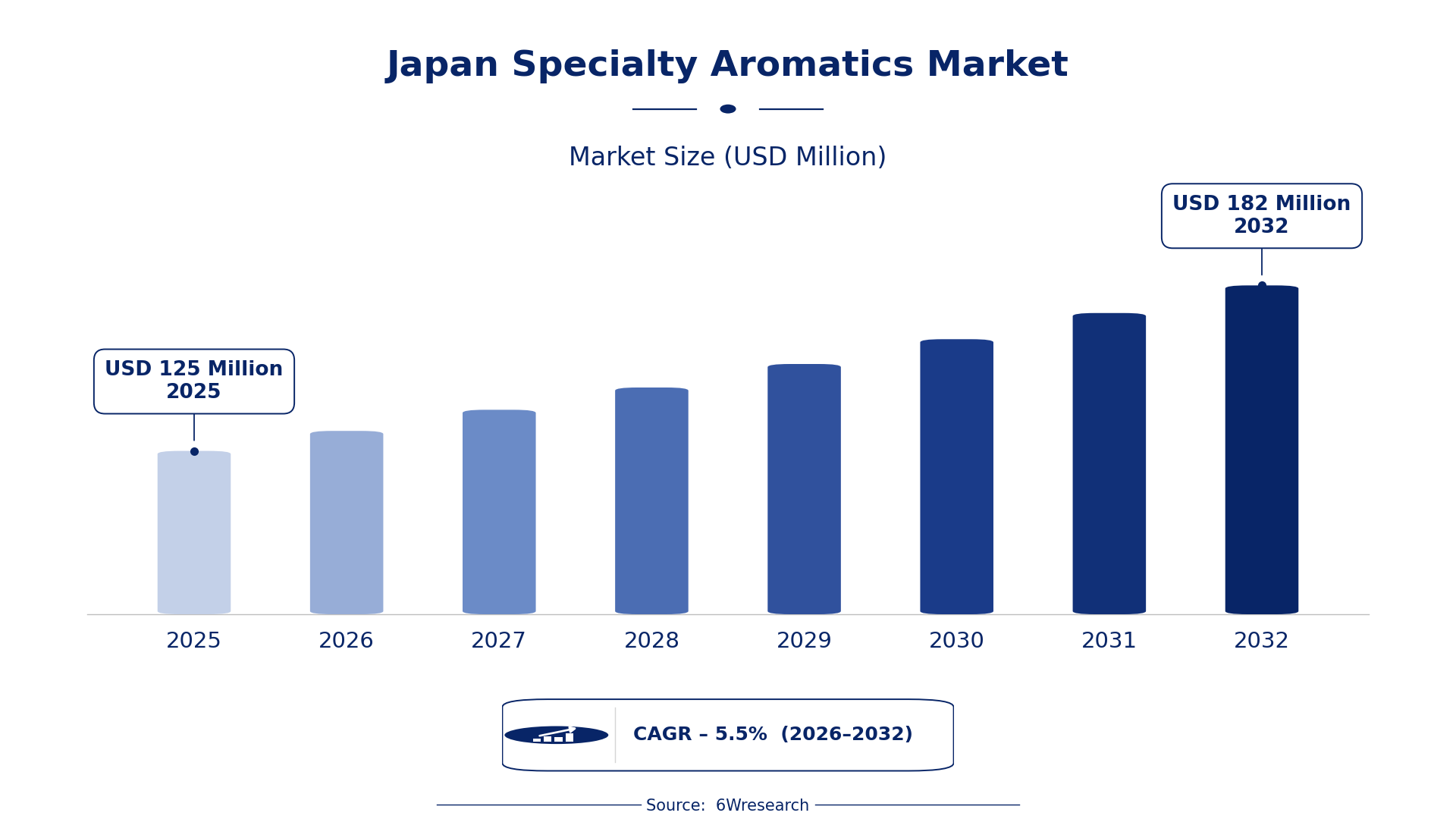
According to 6Wresearch internal database and industry insights, the Japan Specialty Aromatics Market was valued at USD 125 Million in 2025 and is projected to reach USD 182 Million by 2032, growing at a CAGR of approximately 5.5% during 2026–2032.
Japan Specialty Aromatics Market Highlights
| Report Metric | Details |
| Report Name | Japan Specialty Aromatics Market (2026-2032) |
| Market Size 2025 | USD 125 Million |
| Market Size 2032 | USD 182 Million |
| Absolute Growth 2025–2032 | USD 57 Million |
| CAGR 2026–2032 | 5.5% |
| Peak Annual Growth | 6.3% in 2027 |
| Forecast Period | 2026–2032 |
| Historical Data | 2022–2025 |
| Base Year | 2025 |
| Leading Compound Type, 2025 | Benzyl Derivatives (36% share) |
| Leading Aroma Profile, 2025 | Floral/Fruity (39% share) |
| Leading Usage Area, 2025 | Fragrances (43% share) |
| Leading End User, 2025 | Perfume Manufacturers (47% share) |
| Fastest-Growing Aroma Profile | Synthetic Scent (7.5% CAGR) |
| Fastest-Growing Usage Area | Flavors & Pharmaceuticals (6.7% CAGR) |
| Fastest-Growing End User | Food & Pharma Companies (7.2% CAGR) |
| Growing Sector | Fragrance and Personal Care |
| Key End Users | Perfume Manufacturers, Food & Pharma Companies, Personal Care Companies |
Japan Specialty Aromatics Market Year-wise Growth Rate and Key Drivers (2022–2032)
This graph illustrates the annual growth rates of the market from 2022 to 2032, highlighting a steady upward trajectory and projected market expansion over the forecast period.
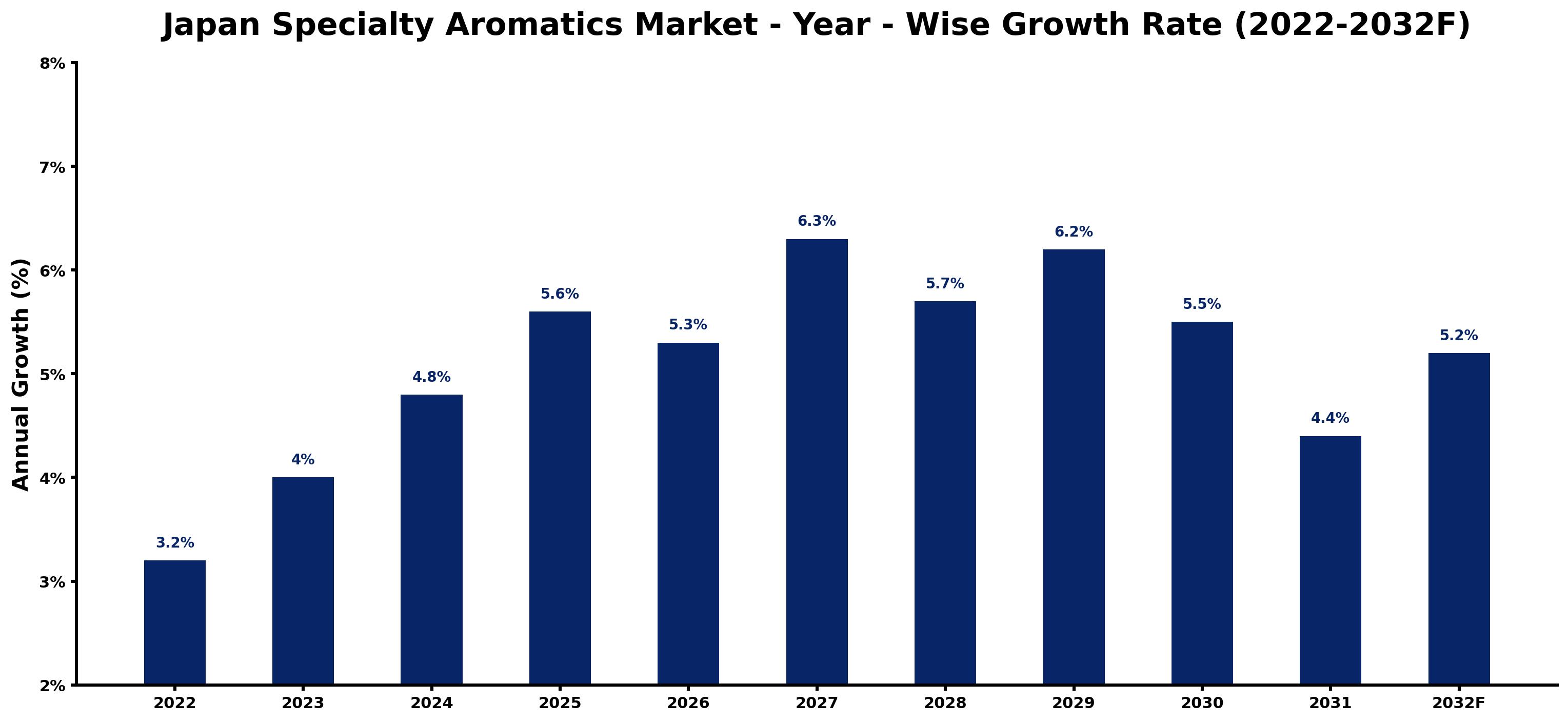
Each row of the following table gives one year's estimated growth and the event or demand shift that explains it.
| Year | Estimated Annual Growth (%) | Market Rationale |
| 2022 | 3.2 | The market was stable, reflecting consistent demand in the fragrance sector. |
| 2023 | 4.0 | Growth accelerated due to increased consumer interest in personal care products. |
| 2024 | 4.8 | Demand continued to rise as new fragrance trends emerged in the market. |
| 2025 | 5.6 | The peak year saw heightened production driven by innovation in fragrance formulations. |
| 2026 | 5.3 | Growth slowed slightly as the market adjusted to previous peaks in demand. |
| 2027 | 6.3 | A surge in demand occurred, driven by new eco-friendly fragrance initiatives. |
| 2028 | 5.7 | Growth decelerated as the market stabilised after the previous year's peak. |
| 2029 | 6.2 | Demand increased again, supported by rising exports of Japanese perfumes. |
| 2030 | 5.5 | Growth slowed as market saturation began to affect new product introductions. |
| 2031 | 4.4 | A further slowdown occurred as consumer preferences shifted towards sustainability. |
| 2032 | 5.2 | Demand is expected to rise again, driven by innovations in fragrance technology. |
Note: Market size estimations and growth projections presented in this report are based on 6Wresearch's proprietary forecasting methodology, utilizing the latest available industry data, government publications, and primary research inputs.
Japan Specialty Aromatics Market Synopsis
Specialty aromatics are chemical compounds derived from petroleum or natural sources, primarily used for their fragrance and flavour properties. The Japan Specialty Aromatics Market is expanding due to rising demand from the fragrance and personal care sectors, driven by a projected personal care industry value of 1 trillion yen by 2025. Developments in sustainable fragrance production, backed by government initiatives, attract new buyers and reshape market conditions.
Market Dynamics Impact Analysis (2026–2032)
| Factor | Type | Impact | Primary Segment Affected |
| Growing consumer interest in personal care products | Driver | High | Fragrances |
| Innovations in sustainable fragrance production | Driver | High | Floral/Fruity |
| Expansion of the fragrance market in Asia | Opportunity | Medium | Perfume Manufacturers |
| Increasing exports of Japanese perfumes | Opportunity | Medium | Food & Pharma Companies |
| Regulatory compliance costs for fragrance production | Restraint | High | Synthetic Scent |
| Market saturation affecting new product launches | Restraint | Medium | Woody/Spicy |
| High production costs for eco-friendly materials | Challenge | High | Benzyl Derivatives |
| Limited capacity for scaling up production | Challenge | Medium | Phenyl Ethers |
Evaluation of Drivers in Japan Specialty Aromatics Market (2026–2032)
Below are the drivers that matter most for revenue growth, with supporting evidence.
| Drivers | Primary Segment Affected | Why It Matters (Evidence) |
| Increased consumer spending on personal care products | Fragrances | The personal care industry is projected to reach 1 trillion yen by 2025, driving higher purchases of fragrances. |
| Rising demand for sustainable products | Floral/Fruity | The 2023 government program promoting sustainable fragrance production encourages manufacturers to innovate. |
| Growth in the Japanese perfume export market | Perfume Manufacturers | Perfume exports were valued at 15 billion yen in 2022, prompting increased production. |
| Expansion of fragrance applications in food and pharmaceuticals | Flavors & Pharmaceuticals | The Japanese pharmaceutical market, valued at over 10 trillion yen, boosts demand for aromatic compounds. |
| Technological advancements in fragrance production | Synthetic Scent | ISO 9235 defines terminology for aromatic raw materials, facilitating better production processes. |
Several shifts outside the market boost sales. The personal care industry, expected to reach 1 trillion yen by 2025, propels increased spending on fragrances, heightening demand for aromatic compounds. In addition, the perfume export market, valued at 15 billion yen in 2022, stimulates local production to satisfy international demand. Growth in the pharmaceutical sector, valued at over 10 trillion yen, further fuels the need for flavouring agents, driving purchases across various applications.
Evaluation of Restraints in Japan Specialty Aromatics Market
The key brakes on demand, and where they bite hardest, are shown below.
| Market Restraint | Primary Segment Affected | Why It Matters (Evidence) |
| High compliance costs associated with fragrance production | Synthetic Scent | The Food Sanitation Act regulates flavoring agents, increasing operational costs for manufacturers. |
| Market saturation limiting new product introductions | Woody/Spicy | Shifting consumer preferences make it challenging for new fragrances to gain traction. |
| Rising costs for eco-friendly materials | Benzyl Derivatives | Sustainable production methods require substantial investment, impacting profit margins. |
| Limited production capacity for scaling up | Phenyl Ethers | Manufacturers face challenges in meeting growing demand without expanding facilities. |
| Regulatory hurdles affecting production timelines | Flavors & Pharmaceuticals | Compliance with multiple regulations can delay product launches. |
Japan Specialty Aromatics Market Challenges
Quality inconsistencies hinder buyers in Japan's specialty aromatics market, risking brand loyalty and leading to potential revenue losses. Suppliers struggle with outdated production technology, which raises operational costs and can increase prices for buyers by 15%. A lack of skilled workers in chemical processing limits suppliers' ability to fulfil orders, causing delays that can extend delivery timelines by up to six months. Fierce competition from international markets forces local producers to reduce prices, which can diminish profit margins and restrict investment in necessary advancements for suppliers.
Trends in the Japan Specialty Aromatics Market
The shifts below are changing how Japan Specialty Aromatics Market products are bought and supplied.
- Shift towards Eco-Friendly Fragrance Production: In 2023, a government program to promote sustainable fragrance production aims to reduce environmental impact. This initiative is expected to increase market participation by eco-conscious brands, contributing to overall market growth.
- Rise of Synthetic Scents in Fragrance Products: The market for synthetic scents is expanding due to increasing consumer preferences for long-lasting fragrances. This shift is supported by the JIS K 0051 standard, which ensures quality in fragrance production.
- Increased Demand for Fragrances in Personal Care: The personal care sector is prioritising fragrances, with an estimated market value of 1 trillion yen by 2025. This trend prompts suppliers to innovate and expand their fragrance offerings.
- Expansion of Fragrance Applications in Pharmaceuticals: Fragrances are increasingly being used in pharmaceutical products, driven by the need for consumer-friendly formulations. The Japanese pharmaceutical market, valued at over 10 trillion yen, supports this trend.
Investment Opportunities in the Japan Specialty Aromatics Market
The opportunities below stand out in the Japan Specialty Aromatics Market for new entrants and existing suppliers.
- Investment in Sustainable Fragrance Production: With the government promoting eco-friendly practices, there is an opportunity for suppliers to invest in sustainable fragrance production technologies, particularly in Tokyo and Osaka, where demand is high.
- Supply of Synthetic Aromatics: The growing market for synthetic scents presents an opportunity for suppliers to focus on this segment, especially as consumer preferences shift. The Tokyo Metropolitan Government supports innovation in this area.
- Expansion into Food and Pharmaceutical Fragrances: The increasing demand for flavours in food and pharmaceuticals creates opportunities for suppliers to develop aromatic compounds tailored for these industries, particularly in regions with high pharmaceutical activity.
- Development of New Fragrance Profiles: The market gap for unique fragrance profiles is notable, with an estimated 50,000 tons of annual fragrance consumption. Suppliers can explore innovative blends to meet changing consumer preferences.
Government Initiatives in the Japan Specialty Aromatics Market
The Food Sanitation Act, amended in 2018, regulates flavoring agents in food products, ensuring safety and quality standards for consumers. This law mandates HACCP-based hygiene management for food businesses, impacting how flavoring agents are produced and used in the industry. The Food Recycling Law requires food businesses to reduce waste and recycle it into feed, fertiliser, and energy, further influencing production practices in the specialty aromatics sector.
The Japan Chemical Industry Association oversees regulations for flavoring substances, ensuring compliance with safety standards. This agency funds initiatives aimed at improving production practices, which enhances the overall quality of specialty aromatics in Japan. The Japan Cosmetic Industry Association provides guidelines for aromatic compounds, facilitating adherence to industry standards.
Future Insight of the Japan Specialty Aromatics Market
The investment pipeline for sustainable production methods will expand as government initiatives promote eco-friendly practices, generating demand for new technologies. By 2032, the personal care industry will reach 1 trillion yen, driving significant opportunities for suppliers. The adoption of the JIS K 0051 standard will enhance product quality, ensuring buyers receive reliable materials. Increased collaboration through events like the Japan Aroma and Fragrance Expo will facilitate innovation and strengthen industry connections.
Market Segmentation Analysis
Japan Specialty Aromatics Market report covers a detailed analysis of the following market segments:
By Compound Type – Benzyl Derivatives Lead and Record the Fastest Growth
According to Saurav Kr Singh, Senior Research Analyst at 6Wresearch, in 2025, Benzyl Derivatives led the compound type split with a 36% share. Benzyl derivatives are predominant in the market due to their extensive applications in fragrances and flavours, appealing to diverse consumer preferences. Their established role in Japan's fragrance industry, aligned with the JIS K 0051 standard, solidifies their leading market position. Benzyl Derivatives are also forecast to expand faster than any other category, at a CAGR of 7.7% over 2026–2032. The increasing popularity of benzyl derivatives is fuelled by their versatility and the rising consumer inclination towards natural and sustainable products. The government's initiative in 2023 to promote eco-friendly fragrance production is expected to further boost demand for these compounds. Suppliers should prioritise sustainable production methods to align with the growing demand for benzyl derivatives.
By Aroma Profile – Floral/Fruity Leads, Synthetic Scent Expected to Grow Fastest
With 39% of aroma profile revenue in 2025, Floral/Fruity was the largest category. The floral/fruity aroma profile holds the largest share due to its widespread use in perfumes, appealing to a broad consumer base in Japan. This preference is underscored by the annual fragrance consumption, estimated at 50,000 tons, indicating its importance in the market. Synthetic Scent is set to record the highest CAGR in this split, 7.5% over 2026–2032. Synthetic scents are experiencing rapid growth as they are increasingly favoured for their versatility in various fragrance products. This trend is likely to continue as consumer preferences shift towards more synthetic alternatives, widening the lead of floral/fruity aromas. Suppliers should consider diversifying their offerings to include synthetic scents alongside traditional floral/fruity profiles.
By Usage Area – Fragrances Lead, Flavors & Pharmaceuticals Expected to Grow Fastest
Fragrances accounted for 43% of the market by usage area in 2025. Fragrances are the primary application for specialty aromatics, establishing them as the leading usage area in Japan. The market's valuation of approximately 300 billion yen for fragrances highlights their essential role in the specialty chemicals sector. Over 2026–2032, Flavors & Pharmaceuticals are expected to post the fastest growth, at a CAGR of 6.7%. The flavours and pharmaceuticals segment is witnessing swift growth, driven by their critical role in food and drug formulations, reflecting increasing health awareness among consumers. This expansion is further supported by Japan's substantial pharmaceutical market, valued at over 10 trillion yen. Suppliers should focus on the flavours and pharmaceuticals sector to take advantage of its rapid growth opportunities.
By End User – Perfume Manufacturers Lead, Food & Pharma Companies Expected to Grow Fastest
The largest end user category in 2025 was Perfume Manufacturers, at 47% of revenue. Perfume manufacturers are the main end users of specialty aromatics, significantly shaping demand within the fragrance market. Their influence is evident through events like the annual Japan Aroma and Fragrance Expo, which highlights industry innovations. The quickest growth will come from Food & Pharma Companies, forecast to expand at a CAGR of 7.2% between 2026 and 2032. Food and pharma companies are increasingly adopting specialty aromatics, motivated by the demand for flavouring agents in food and pharmaceuticals. This trend is expected to persist as the personal care industry approaches a valuation of 1 trillion yen by 2025. Suppliers should enhance partnerships with food and pharma companies to capitalise on the growing demand in these sectors.
Key Attractiveness of the Report
- 10 Years of Market Numbers
- Historical Data Starting from 2022 to 2025
- Base Year 2025
- Forecast Data until 2032
- Key Performance Indicators Impacting the Market
- Major Upcoming Developments and Projects
Key Highlights of the Report:
- Japan Specialty Aromatics Market Outlook
- Market Size of Japan Specialty Aromatics Market, 2025
- Forecast of Japan Specialty Aromatics Market, 2032
- Historical Data and Forecast of Japan Specialty Aromatics Revenues & Volume for the Period 2022-2032F
- Japan Specialty Aromatics Market Trend Evolution
- Japan Specialty Aromatics Market Drivers and Challenges
- Japan Specialty Aromatics Price Trends
- Japan Specialty Aromatics Porter's Five Forces
- Japan Specialty Aromatics Industry Life Cycle
- Historical Data and Forecast of Japan Specialty Aromatics Market Revenues & Volume By Compound Type for the Period 2022-2032F
- Historical Data and Forecast of Japan Specialty Aromatics Market Revenues & Volume By Benzyl Derivatives for the Period 2022-2032F
- Historical Data and Forecast of Japan Specialty Aromatics Market Revenues & Volume By Styrene Derivatives for the Period 2022-2032F
- Historical Data and Forecast of Japan Specialty Aromatics Market Revenues & Volume By Phenyl Ethers for the Period 2022-2032F
- Historical Data and Forecast of Japan Specialty Aromatics Market Revenues & Volume By Cumene-Based Aromatics for the Period 2022-2032F
- Historical Data and Forecast of Japan Specialty Aromatics Market Revenues & Volume By Aroma Profile for the Period 2022-2032F
- Historical Data and Forecast of Japan Specialty Aromatics Market Revenues & Volume By Floral/Fruity for the Period 2022-2032F
- Historical Data and Forecast of Japan Specialty Aromatics Market Revenues & Volume By Synthetic Scent for the Period 2022-2032F
- Historical Data and Forecast of Japan Specialty Aromatics Market Revenues & Volume By Woody/Spicy for the Period 2022-2032F
- Historical Data and Forecast of Japan Specialty Aromatics Market Revenues & Volume By Sweet/Alkyl Notes for the Period 2022-2032F
- Historical Data and Forecast of Japan Specialty Aromatics Market Revenues & Volume By Usage Area for the Period 2022-2032F
- Historical Data and Forecast of Japan Specialty Aromatics Market Revenues & Volume By Fragrances for the Period 2022-2032F
- Historical Data and Forecast of Japan Specialty Aromatics Market Revenues & Volume By Polymer Additives for the Period 2022-2032F
- Historical Data and Forecast of Japan Specialty Aromatics Market Revenues & Volume By Flavors & Pharmaceuticals for the Period 2022-2032F
- Historical Data and Forecast of Japan Specialty Aromatics Market Revenues & Volume By Detergents for the Period 2022-2032F
- Historical Data and Forecast of Japan Specialty Aromatics Market Revenues & Volume By End User for the Period 2022-2032F
- Historical Data and Forecast of Japan Specialty Aromatics Market Revenues & Volume By Perfume Manufacturers for the Period 2022-2032F
- Historical Data and Forecast of Japan Specialty Aromatics Market Revenues & Volume By Resin Producers for the Period 2022-2032F
- Historical Data and Forecast of Japan Specialty Aromatics Market Revenues & Volume By Food & Pharma Companies for the Period 2022-2032F
- Historical Data and Forecast of Japan Specialty Aromatics Market Revenues & Volume By Personal Care Companies for the Period 2022-2032F
- Japan Specialty Aromatics Import Export Trade Statistics
- Market Opportunity Assessment By Compound Type
- Market Opportunity Assessment By Aroma Profile
- Market Opportunity Assessment By Usage Area
- Market Opportunity Assessment By End User
- Japan Specialty Aromatics Top Companies Market Share
- Japan Specialty Aromatics Competitive Benchmarking By Technical and Operational Parameters
- Japan Specialty Aromatics Company Profiles
- Japan Specialty Aromatics Key Strategic Recommendations
Market Covered
The report covers the following segments.
By Compound Type
- Benzyl Derivatives
- Styrene Derivatives
- Phenyl Ethers
- Cumene-Based Aromatics
By Aroma Profile
- Floral/Fruity
- Synthetic Scent
- Woody/Spicy
- Sweet/Alkyl Notes
By Usage Area
- Fragrances
- Polymer Additives
- Flavors & Pharmaceuticals
- Detergents
By End User
- Perfume Manufacturers
- Resin Producers
- Food & Pharma Companies
- Personal Care Companies































