Japan Specialty Automotive Lubricants Market Size & Growth Rate
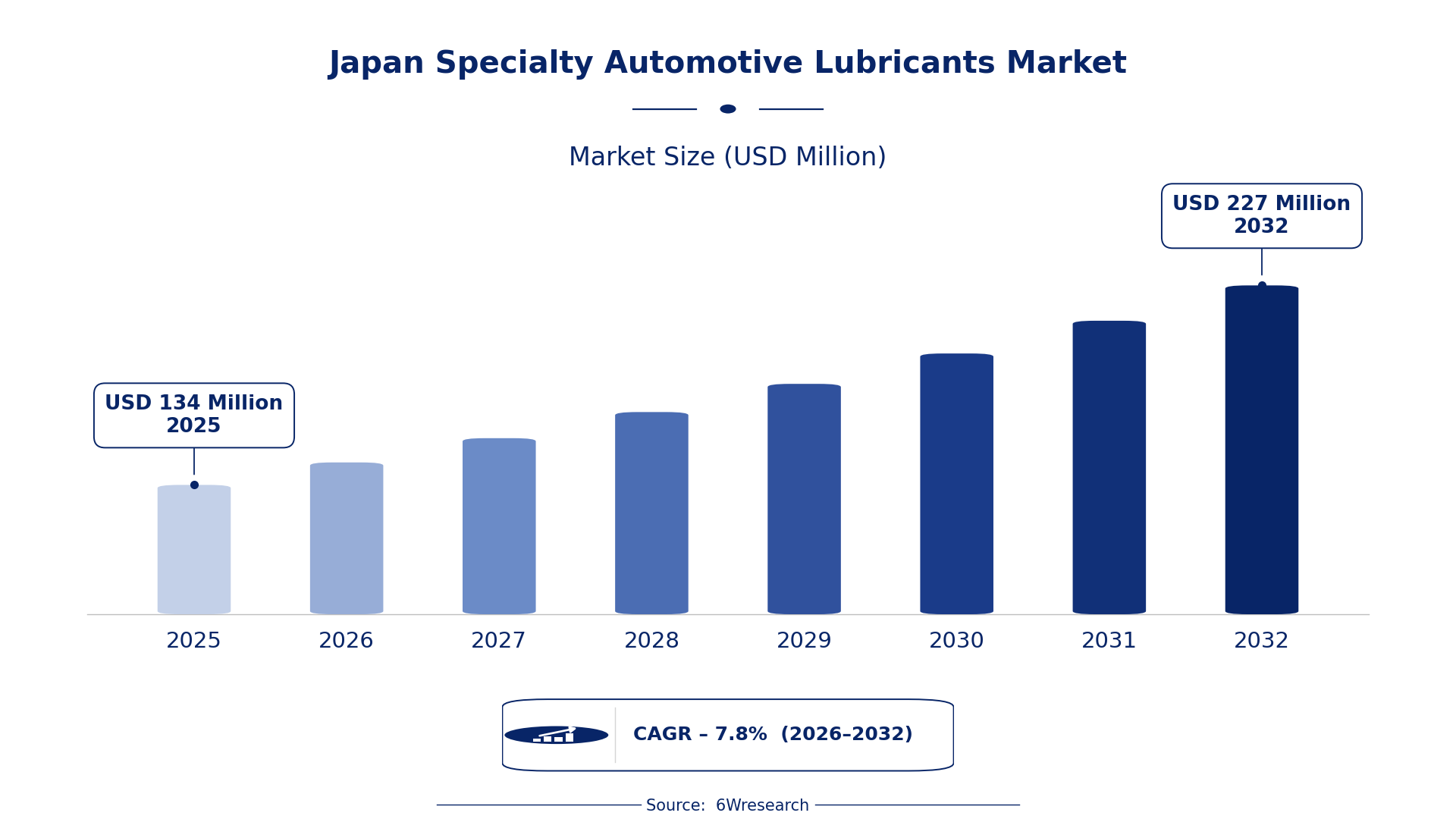
According to 6Wresearch internal database and industry insights, the Japan Specialty Automotive Lubricants Market was valued at USD 134 Million in 2025 and is projected to reach USD 227 Million by 2032, growing at a CAGR of approximately 7.8% during 2026–2032.
Japan Specialty Automotive Lubricants Market Highlights
| Report Metric | Details |
| Report Name | Japan Specialty Automotive Lubricants Market (2026-2032) |
| Market Size 2025 | USD 134 Million |
| Market Size 2032 | USD 227 Million |
| Absolute Growth 2025–2032 | USD 93 Million |
| CAGR 2026–2032 | 7.8% |
| Peak Annual Growth | 8.7% in 2029 |
| Forecast Period | 2026–2032 |
| Historical Data | 2022–2025 |
| Base Year | 2025 |
| Leading Lubricant Type, 2025 | Synthetic Gear Oils (48% share) |
| Leading Vehicle Segment, 2025 | Commercial Trucks (46% share) |
| Leading Application Area, 2025 | Transmission (42% share) |
| Leading End User, 2025 | Fleet Operators (45% share) |
| Fastest-Growing Lubricant Type | Racing Oils (11.5% CAGR) |
| Fastest-Growing Vehicle Segment | Sports Cars (10.1% CAGR) |
| Fastest-Growing Application Area | Engine (9.5% CAGR) |
| Fastest-Growing End User | Performance Brands (10.6% CAGR) |
| Growing Sector | Electric Vehicles |
| Key End Users | Fleet Operators, Performance Brands, Aftermarket Retailers, EV OEMs |
Japan Specialty Automotive Lubricants Market Year-wise Growth Rate and Key Drivers (2022–2032)
This graph illustrates the annual growth rates of the market from 2022 to 2032, highlighting a steady upward trajectory and projected market expansion over the forecast period.
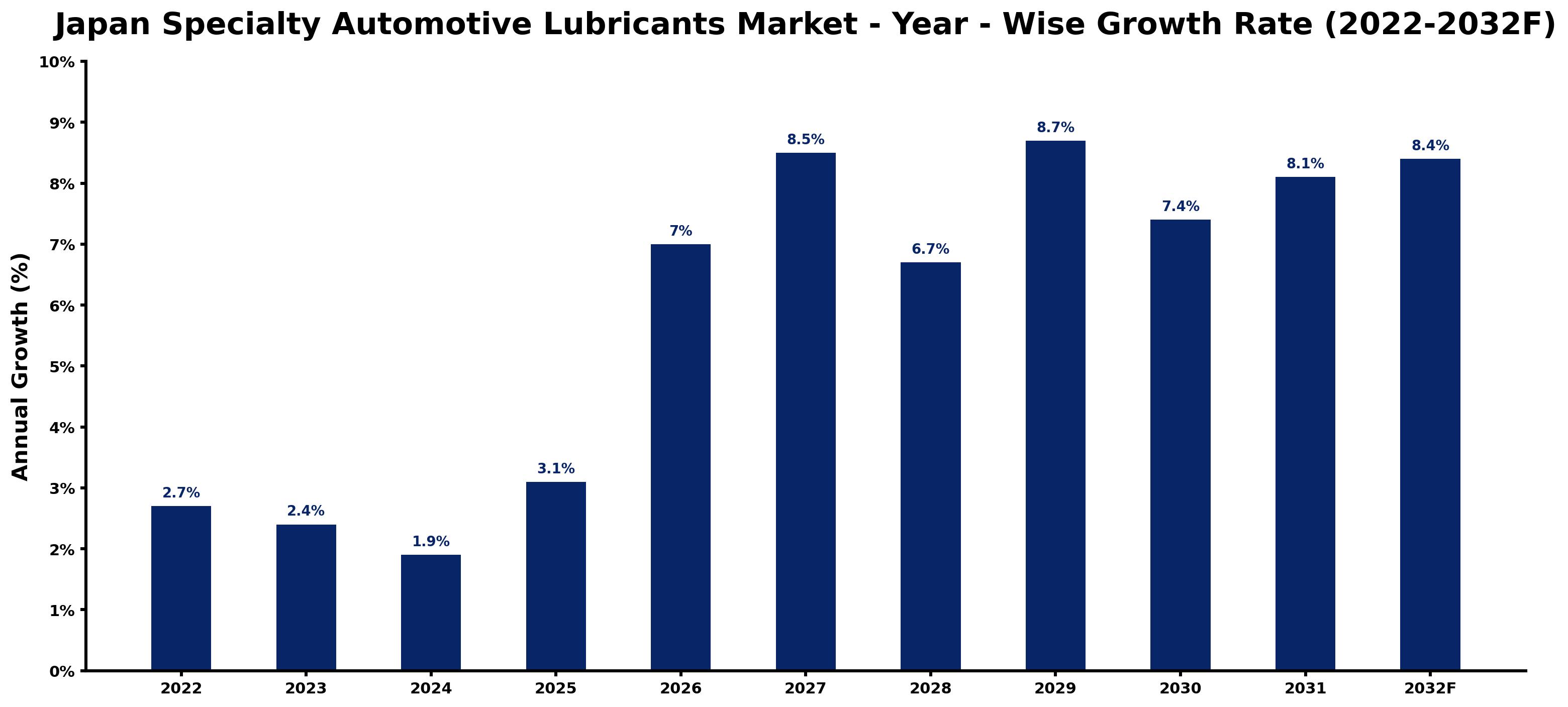
The yearly estimates that follow link every growth rate to its principal driver, so readers can see why the pace changed in each period.
| Year | Estimated Annual Growth (%) | Market Rationale |
| 2022 | 2.7 | The market experienced steady growth, reflecting ongoing demand from automotive sectors. |
| 2023 | 2.4 | Growth slowed due to market saturation in certain lubricant categories. |
| 2024 | 1.9 | The market continued to grow, albeit at a reduced pace compared to previous years. |
| 2025 | 3.1 | Demand surged as fleet operators increased their lubricant purchases for efficiency. |
| 2026 | 7.0 | Growth is projected to accelerate as electric vehicle adoption influences lubricant choices. |
| 2027 | 8.5 | Demand is expected to rise strongly, driven by increased performance lubricant usage. |
| 2028 | 6.7 | Growth is anticipated to slow slightly as the market stabilises after rapid expansion. |
| 2029 | 8.7 | Demand is expected to peak as high-performance lubricants become essential in motorsports. |
| 2030 | 7.4 | Growth will moderate as the market adjusts to evolving consumer preferences. |
| 2031 | 8.1 | Demand is projected to rise again as fleet operators seek advanced lubricant solutions. |
| 2032 | 8.4 | The market will continue to expand due to rising electric vehicle sales. |
Note: Market size estimations and growth projections presented in this report are based on 6Wresearch's proprietary forecasting methodology, utilizing the latest available industry data, government publications, and primary research inputs.
Japan Specialty Automotive Lubricants Market Synopsis
Specialty automotive lubricants are high-performance fluids designed for specific applications in vehicles, formulated with advanced synthetic base oils and additives for optimal protection. The Japan Specialty Automotive Lubricants Market is valued at over 1 trillion JPY annually, driven by fleet operators and the growing electric vehicle segment. Factors such as increasing electric vehicle adoption, a focus on high-performance lubricants, and support from industry associations are propelling market growth.
Market Dynamics Impact Analysis (2026–2032)
| Factor | Type | Impact | Primary Segment Affected |
| Increasing adoption of electric vehicles drives demand for specialized lubricants. | Driver | High | Electric Drivetrain Lubes |
| Rising performance standards in motorsports create a need for high-temp brake oils. | Driver | High | Racing Oils |
| The shift towards eco-friendly lubricants presents opportunities for innovation. | Opportunity | Medium | Synthetic Gear Oils |
| Growing demand for electric vehicles opens new markets for specialized lubricants. | Opportunity | High | Electric Drivetrain Lubes |
| Market saturation in certain lubricant categories may limit growth potential. | Restraint | Medium | Transmission |
| High costs associated with developing advanced lubricants can hinder smaller producers. | Restraint | High | Racing Oils |
| Competition from international manufacturers pressures local producers on pricing. | Challenge | High | Commercial Trucks |
| Technological advancements in lubricant formulations require continuous investment. | Challenge | Medium | Performance Brands |
Evaluation of Drivers in Japan Specialty Automotive Lubricants Market (2026–2032)
Below are the drivers that matter most for revenue growth, with supporting evidence.
| Drivers | Primary Segment Affected | Why It Matters (Evidence) |
| Fleet operators are increasing their lubricant purchases for efficiency. | Fleet Operators | Fleet operators account for 40% of total lubricant sales in Japan, driving demand for specialized products. |
| Electric vehicle adoption is influencing lubricant choices. | Electric Drivetrain Lubes | With over 500,000 registered EVs in Japan, demand for electric drivetrain lubricants is rising. |
| High-performance lubricants are essential in motorsports. | Racing Oils | High-temp brake oils are critical for motorsport applications, reflecting the performance needs of the industry. |
| The Tokyo region is a major consumer of automotive lubricants. | Transmission | The Tokyo region accounts for 30% of Japan's automotive lubricant consumption, boosting demand. |
| Investment in lubricant innovation is increasing. | Synthetic Gear Oils | The Japan Automobile Manufacturers Association supports lubricant innovation, promoting product offerings. |
The strongest pull on demand comes from fleet operators, who accounted for 40% of total lubricant sales in Japan, increasing their purchases of specialized products. Electric vehicle adoption is influencing lubricant choices, with over 500,000 registered EVs in Japan driving demand for electric drivetrain lubricants. High-performance lubricants are essential in motorsports, as high-temp brake oils are critical for racing applications. The Tokyo region, accounting for 30% of lubricant consumption, boosts demand for transmission lubricants. Investment in lubricant innovation is rising, supported by the Japan Automobile Manufacturers Association, driving market growth.
Evaluation of Restraints in Japan Specialty Automotive Lubricants Market
The following restraints limit how fast demand can grow.
| Market Restraint | Primary Segment Affected | Why It Matters (Evidence) |
| Market saturation in certain lubricant categories may limit growth potential. | Transmission | As the market matures, demand for conventional lubricants stabilises, restricting growth opportunities. |
| High costs associated with developing advanced lubricants can hinder smaller producers. | Racing Oils | Developing high-performance lubricants requires substantial investment, which may be challenging for smaller firms. |
| Competition from international manufacturers pressures local producers on pricing. | Commercial Trucks | Local producers face pricing pressures from international competitors, affecting their market share. |
| Technological advancements in lubricant formulations require continuous investment. | Performance Brands | Staying competitive necessitates ongoing investment in R&D, which can strain resources. |
| Regulatory compliance can increase operational costs for manufacturers. | Electric Drivetrain Lubes | Manufacturers must adhere to strict environmental regulations, raising production costs. |
Japan Specialty Automotive Lubricants Market Challenges
Buyers face inflated costs due to regulations requiring eco-friendly lubricants, which can increase production expenses by 20% for manufacturers. Fleet operators, responsible for 40% of total lubricant sales, struggle with limited access to high-performance options, causing delays in maintenance schedules. Skills shortages in advanced lubricant formulation hinder innovation, extending product development timelines by six months for suppliers. Compliance with ISO 9001 standards can raise prices for consumers, complicating purchasing decisions for buyers and leading to potential supply chain disruptions.
Trends in the Japan Specialty Automotive Lubricants Market
The following changes are redrawing the Japan Specialty Automotive Lubricants Market.
- Fleet Operators Increasing Demand for High-Performance Lubricants: Fleet operators are increasingly seeking high-performance lubricants to improve vehicle efficiency. In 2023, fleet operators accounted for 40% of total lubricant sales in Japan, driving innovation in product formulations.
- Shift Towards Eco-Friendly Lubricants: A growing trend towards eco-friendly lubricants is emerging in the automotive sector. The Ministry of Land, Infrastructure, Transport and Tourism promotes eco-friendly lubricants, aligning with Japan's decarbonisation goals.
- Rising Popularity of Electric Drivetrain Lubes: The demand for electric drivetrain lubricants is increasing as electric vehicles gain traction. Electric vehicles are projected to account for 20% of new car sales by 2025, increasing lubricant needs.
- Expansion of Aftermarket Retailers: Aftermarket retailers are broadening their offerings to include high-performance lubricants. This sector is expected to grow by 15% in the next five years, reflecting changing consumer preferences.
Investment Opportunities in the Japan Specialty Automotive Lubricants Market
Below are the investment opportunities with the strongest case in the Japan Specialty Automotive Lubricants Market.
- Investment Potential in Electric Drivetrain Lubes: With electric vehicles projected to account for 20% of new car sales by 2025, there is an opportunity to invest in electric drivetrain lubricants. Fleet operators are increasingly adopting these products.
- Market Gap for High-Performance Lubricants: The market gap for high-performance lubricants is substantial, with performance brands expected to grow by 15% in the next five years. Investing in this segment can yield significant returns.
- Demand for Eco-Friendly Lubricants: The focus on eco-friendly lubricants presents an opportunity to supply innovative products. Collaborating with the Ministry of Land, Infrastructure, Transport and Tourism can facilitate market entry.
- Strategic Local Partnerships: Establishing partnerships with local manufacturers can ease market entry. The Kansai region, known for automotive manufacturing, offers a strategic location for collaboration.
Government Initiatives in the Japan Specialty Automotive Lubricants Market
The Fire Service Act, enacted in 1948, regulates the handling and storage of hazardous materials, including petroleum products used in specialty automotive lubricants. This law ensures that manufacturers meet safety standards, impacting their production processes. The GX Promotion Act, introduced in 2023, supports the transition to eco-friendly lubricants, aligning with Japan's decarbonisation goals and encouraging innovation in the sector.
The Fire and Disaster Management Agency oversees compliance with safety standards for hazardous materials. This agency funds initiatives aimed at promoting sustainable practices within the automotive lubricant industry, ensuring compliance with environmental regulations.
Future Insight of the Japan Specialty Automotive Lubricants Market
The Electric Vehicle Promotion Program aims to boost EV adoption, creating demand for specialty automotive lubricants. By 2032, electric vehicles are projected to account for 20% of new car sales, influencing lubricant formulations. The government's commitment to a 46% reduction in greenhouse-gas emissions will drive advancements in eco-friendly lubricant technology. As the number of registered EVs surpasses 1 million, suppliers will need to develop tailored lubricant solutions to meet evolving market demands.
Market Segmentation Analysis
Japan Specialty Automotive Lubricants Market report covers a detailed analysis of the following market segments:
By Lubricant Type – Synthetic Gear Oils Lead, Racing Oils Expected to Grow Fastest
According to Saurav Kr Singh, Senior Research Analyst at 6Wresearch, Synthetic Gear Oils accounted for 48% of the market by lubricant type in 2025. Synthetic gear oils dominate the market due to their critical role in high-performance gear systems, particularly in commercial trucks that operate under demanding conditions. Their extensive use in logistics and transportation sectors further solidifies their leading position. Over 2026–2032, Racing Oils are expected to post the fastest growth, at a CAGR of 11.5%. Racing oils are experiencing rapid growth, driven by the increasing popularity of motorsport activities, with performance brands projected to expand by 15% in the next five years. This trend is fuelled by the demand for lubricants that can withstand extreme conditions during competitive racing. Suppliers should focus on developing high-performance lubricants to meet the growing needs of the motorsport sector.
By Vehicle Segment – Commercial Trucks Lead, Sports Cars Expected to Grow Fastest
Commercial Trucks held 46% of the Japan Specialty Automotive Lubricants Market by vehicle segment in 2025. Commercial trucks hold the largest share as they are vital for fleet operations, accounting for 40% of total lubricant sales in Japan. Their extensive deployment in logistics and transportation creates a strong demand for specialty lubricants tailored for heavy-duty use. Sports Cars are projected to grow fastest, at a CAGR of 10.1% during 2026–2032. Sports cars represent the fastest-growing segment, reflecting a shift towards high-performance vehicles that require advanced lubricants for optimal functionality. The rising consumer interest in sports cars is expected to further boost lubricant sales in this category. Buyers in the sports car segment will increasingly seek premium lubricants to ensure optimal performance and protection.
By Application Area – Transmission Leads, Engine Expected to Grow Fastest
Transmission took 42% of application area revenue in 2025, more than any other category. Transmission lubricants are essential for vehicle operation, facilitating smooth gear shifts and enhancing overall performance across various vehicle types. Their widespread application in both commercial and passenger vehicles reinforces their leading position in the market. The quickest growth will come from Engine, forecast to expand at a CAGR of 9.5% between 2026 and 2032. Engine lubricants are witnessing rapid growth as they are fundamental for engine lubrication, especially in high-performance and racing applications. The emphasis on improving engine efficiency and longevity is driving this segment forward. Suppliers must prioritise the development of advanced engine lubricants to cater to the demands of performance-oriented consumers.
By End User – Fleet Operators Lead, Performance Brands Expected to Grow Fastest
The largest end user category in 2025 was Fleet Operators, at 45% of revenue. Fleet operators are the primary end users, representing a significant portion of specialized lubricant consumption due to their large vehicle fleets. Their continuous need for reliable lubricants ensures a stable market environment for suppliers. Performance Brands are set to record the highest CAGR in this split, 10.6% over 2026–2032. Performance brands are quickly increasing their market share as they focus on high-quality lubricants that enhance vehicle performance. This growth aligns with the rising consumer preference for premium automotive products. Suppliers should tailor their offerings to meet the specific requirements of performance brands to capitalise on this expanding market.
Key Attractiveness of the Report
- 10 Years of Market Numbers
- Historical Data Starting from 2022 to 2025
- Base Year 2025
- Forecast Data until 2032
- Key Performance Indicators Impacting the Market
- Major Upcoming Developments and Projects
Key Highlights of the Report:
- Japan Specialty Automotive Lubricants Market Outlook
- Market Size of Japan Specialty Automotive Lubricants Market, 2025
- Forecast of Japan Specialty Automotive Lubricants Market, 2032
- Historical Data and Forecast of Japan Specialty Automotive Lubricants Revenues & Volume for the Period 2022-2032F
- Japan Specialty Automotive Lubricants Market Trend Evolution
- Japan Specialty Automotive Lubricants Market Drivers and Challenges
- Japan Specialty Automotive Lubricants Price Trends
- Japan Specialty Automotive Lubricants Porter's Five Forces
- Japan Specialty Automotive Lubricants Industry Life Cycle
- Historical Data and Forecast of Japan Specialty Automotive Lubricants Market Revenues & Volume By Lubricant Type for the Period 2022-2032F
- Historical Data and Forecast of Japan Specialty Automotive Lubricants Market Revenues & Volume By Synthetic Gear Oils for the Period 2022-2032F
- Historical Data and Forecast of Japan Specialty Automotive Lubricants Market Revenues & Volume By Racing Oils for the Period 2022-2032F
- Historical Data and Forecast of Japan Specialty Automotive Lubricants Market Revenues & Volume By High-Temp Brake Oils for the Period 2022-2032F
- Historical Data and Forecast of Japan Specialty Automotive Lubricants Market Revenues & Volume By Electric Drivetrain Lubes for the Period 2022-2032F
- Historical Data and Forecast of Japan Specialty Automotive Lubricants Market Revenues & Volume By Vehicle Segment for the Period 2022-2032F
- Historical Data and Forecast of Japan Specialty Automotive Lubricants Market Revenues & Volume By Commercial Trucks for the Period 2022-2032F
- Historical Data and Forecast of Japan Specialty Automotive Lubricants Market Revenues & Volume By Sports Cars for the Period 2022-2032F
- Historical Data and Forecast of Japan Specialty Automotive Lubricants Market Revenues & Volume By Off-Road Vehicles for the Period 2022-2032F
- Historical Data and Forecast of Japan Specialty Automotive Lubricants Market Revenues & Volume By EVs for the Period 2022-2032F
- Historical Data and Forecast of Japan Specialty Automotive Lubricants Market Revenues & Volume By Application Area for the Period 2022-2032F
- Historical Data and Forecast of Japan Specialty Automotive Lubricants Market Revenues & Volume By Transmission for the Period 2022-2032F
- Historical Data and Forecast of Japan Specialty Automotive Lubricants Market Revenues & Volume By Engine for the Period 2022-2032F
- Historical Data and Forecast of Japan Specialty Automotive Lubricants Market Revenues & Volume By Braking Systems for the Period 2022-2032F
- Historical Data and Forecast of Japan Specialty Automotive Lubricants Market Revenues & Volume By Motor & Gears for the Period 2022-2032F
- Historical Data and Forecast of Japan Specialty Automotive Lubricants Market Revenues & Volume By End User for the Period 2022-2032F
- Historical Data and Forecast of Japan Specialty Automotive Lubricants Market Revenues & Volume By Fleet Operators for the Period 2022-2032F
- Historical Data and Forecast of Japan Specialty Automotive Lubricants Market Revenues & Volume By Performance Brands for the Period 2022-2032F
- Historical Data and Forecast of Japan Specialty Automotive Lubricants Market Revenues & Volume By Aftermarket Retailers for the Period 2022-2032F
- Historical Data and Forecast of Japan Specialty Automotive Lubricants Market Revenues & Volume By EV OEMs for the Period 2022-2032F
- Japan Specialty Automotive Lubricants Import Export Trade Statistics
- Market Opportunity Assessment By Lubricant Type
- Market Opportunity Assessment By Vehicle Segment
- Market Opportunity Assessment By Application Area
- Market Opportunity Assessment By End User
- Japan Specialty Automotive Lubricants Top Companies Market Share
- Japan Specialty Automotive Lubricants Competitive Benchmarking By Technical and Operational Parameters
- Japan Specialty Automotive Lubricants Company Profiles
- Japan Specialty Automotive Lubricants Key Strategic Recommendations
Market Covered
This report examines the market across the segments below.
By Lubricant Type
- Synthetic Gear Oils
- Racing Oils
- High-Temp Brake Oils
- Electric Drivetrain Lubes
By Vehicle Segment
- Commercial Trucks
- Sports Cars
- Off-Road Vehicles
- EVs
By Application Area
- Transmission
- Engine
- Braking Systems
- Motor & Gears
By End User
- Fleet Operators
- Performance Brands
- Aftermarket Retailers
- EV OEMs































