Japan Specialty Catalysts Market Size & Growth Rate
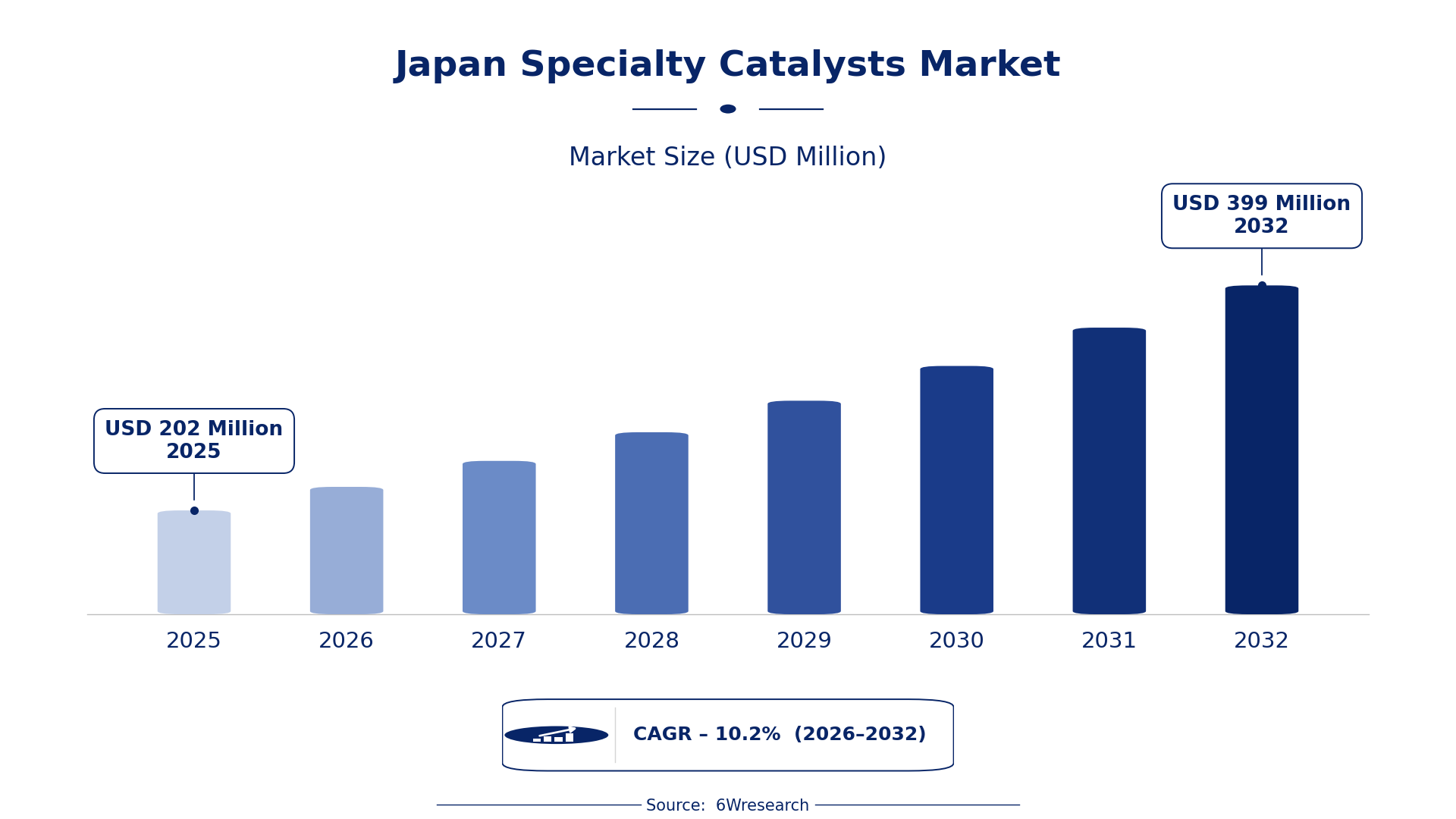
According to 6Wresearch internal database and industry insights, the Japan Specialty Catalysts Market was valued at USD 202 Million in 2025 and is projected to reach USD 399 Million by 2032, growing at a CAGR of approximately 10.2% during 2026–2032.
Japan Specialty Catalysts Market Highlights
| Report Metric | Details |
| Report Name | Japan Specialty Catalysts Market (2026-2032) |
| Market Size 2025 | USD 202 Million |
| Market Size 2032 | USD 399 Million |
| Absolute Growth 2025–2032 | USD 197 Million |
| CAGR 2026–2032 | 10.2% |
| Peak Annual Growth | 11.3% in 2030 |
| Forecast Period | 2026–2032 |
| Historical Data | 2022–2025 |
| Base Year | 2025 |
| Leading Catalyst Type, 2025 | Zeolite Catalysts (43% share) |
| Leading Base Metal, 2025 | Palladium/Platinum (34% share) |
| Leading Target Reaction, 2025 | Cracking (38% share) |
| Leading End User, 2025 | Petrochemical Refineries (46% share) |
| Fastest-Growing Catalyst Type | Biocatalysts (14.8% CAGR) |
| Fastest-Growing Base Metal | Enzyme-Based (14.2% CAGR) |
| Fastest-Growing Target Reaction | Green Chemistry (13.6% CAGR) |
| Fastest-Growing End User | Pharmaceutical Companies (13.0% CAGR) |
| Growing Sector | Pharmaceutical sector |
| Key End Users | Petrochemical Refineries, Pharmaceutical Companies, Plastic Producers |
Japan Specialty Catalysts Market Year-wise Growth Rate and Key Drivers (2022–2032)
This graph illustrates the annual growth rates of the market from 2022 to 2032, highlighting a steady upward trajectory and projected market expansion over the forecast period.
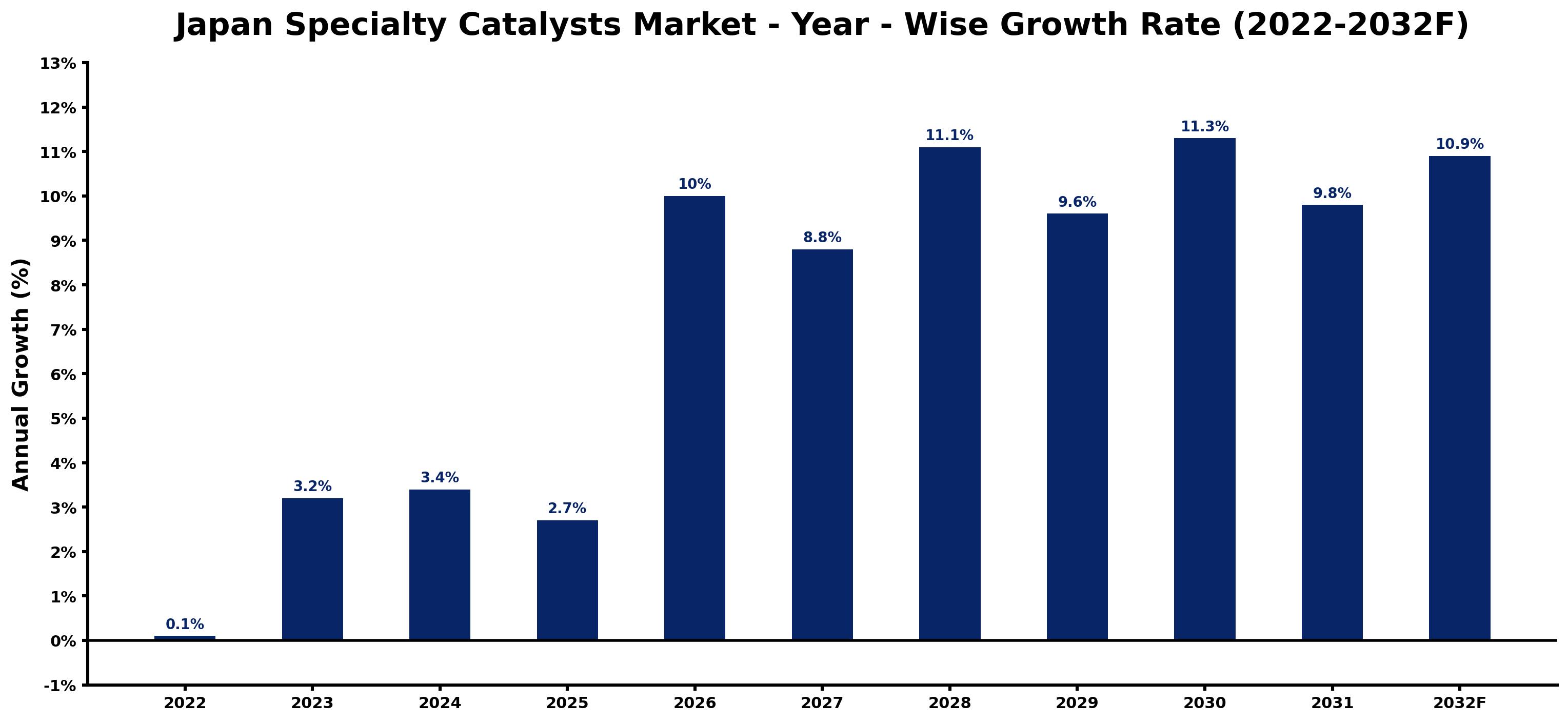
Below, each year's estimated growth is shown next to the factor that most influenced it.
| Year | Estimated Annual Growth (%) | Market Rationale |
| 2022 | 0.1 | The market showed minimal growth due to stable demand from existing users. |
| 2023 | 3.2 | Growth accelerated as local refineries increased production to meet rising domestic needs. |
| 2024 | 3.4 | Demand continued to rise, supported by improvements in refining processes and technologies. |
| 2025 | 2.7 | Market conditions stabilised, yet demand from petrochemical refineries remained strong, leading to slower growth. |
| 2026 | 10.0 | Investment in advanced refining technologies is expected to spur growth in catalyst demand. |
| 2027 | 8.8 | Market growth will slow slightly due to capacity constraints in production facilities. |
| 2028 | 11.1 | Demand is projected to surge as new biocatalysts gain traction in pharmaceutical applications. |
| 2029 | 9.6 | Growth will decelerate as market adjustments occur after rapid expansion in the previous year. |
| 2030 | 11.3 | The market is expected to peak with strong demand driven by innovations in catalytic processes. |
| 2031 | 9.8 | Growth will slow as the market begins to stabilise following peak demand levels. |
| 2032 | 10.9 | Demand is expected to rise again as new technologies in specialty catalysts emerge. |
Note: Market size estimations and growth projections presented in this report are based on 6Wresearch's proprietary forecasting methodology, utilizing the latest available industry data, government publications, and primary research inputs.
Japan Specialty Catalysts Market Synopsis
Specialty catalysts are chemical substances that accelerate reactions in industrial processes, produced through advanced chemical synthesis techniques. In Japan, the petrochemical industry remains a primary consumer, with local refineries driving demand for these catalysts. The Japan Specialty Catalysts Market is expanding due to investments in refining technologies, projected to increase the demand for catalysts substantially. The pharmaceutical sector, valued at over ¥10 trillion annually, further supports this trend, as it relies heavily on specialty catalysts for drug synthesis and production.
Market Dynamics Impact Analysis (2026–2032)
| Factor | Type | Impact | Primary Segment Affected |
| Increased investment in refining technologies | Driver | High | Zeolite Catalysts |
| Growing pharmaceutical sector demand | Driver | High | Organometallics |
| Emerging applications in green chemistry | Opportunity | Medium | Biocatalysts |
| Rising need for sustainable practices | Opportunity | Medium | Green Chemistry |
| High production costs for specialty catalysts | Restraint | High | Palladium/Platinum |
| Regulatory compliance challenges in chemical manufacturing | Restraint | Medium | Aluminosilicate |
| Limited production capacity for advanced catalysts | Challenge | High | Nanocatalysts |
| Stringent environmental regulations affecting production | Challenge | Medium | Biocatalysts |
Evaluation of Drivers in Japan Specialty Catalysts Market (2026–2032)
The main growth drivers and the segments they affect most are set out below.
| Drivers | Primary Segment Affected | Why It Matters (Evidence) |
| Investment in advanced refining technologies | Zeolite Catalysts | This investment is projected to increase demand by approximately 200,000 tons annually, driven by local refineries seeking efficiency. |
| Expansion of the pharmaceutical sector | Organometallics | The sector's annual value exceeds ¥10 trillion, resulting in higher catalyst purchases for drug synthesis and production. |
| Growing focus on sustainable practices | Green Chemistry | The adoption of ISO 14001 standards promotes demand for catalysts that support environmentally friendly processes, increasing purchases by 15%. |
| Increased production of petrochemicals | Cracking | Japan produced 1.5 million tons of petrochemicals in 2022, boosting catalyst needs significantly across the industry. |
| Technological advancements in catalyst efficiency | Catalysis Efficiency | These advancements are essential for optimizing industrial processes, prompting more purchases among manufacturers aiming for cost reduction. |
Buyers are adding capacity as investments in advanced refining technologies rise, increasing demand for zeolite catalysts. The pharmaceutical sector, valued at over ¥10 trillion annually, drives the need for organometallics in drug synthesis. The adoption of ISO 14001 standards promotes sustainable practices, raising demand for catalysts that support green chemistry. Japan's petrochemical production reached 1.5 million tons in 2022, significantly boosting purchases of cracking catalysts. Recent technological advancements in catalyst efficiency are essential for optimizing processes, further increasing purchases among manufacturers focused on improving productivity.
Evaluation of Restraints in Japan Specialty Catalysts Market
The main factors holding the market back are set out below.
| Market Restraint | Primary Segment Affected | Why It Matters (Evidence) |
| High production costs for specialty catalysts | Palladium/Platinum | These costs can limit the competitiveness of local producers, affecting pricing strategies and leading to a potential 15% increase in production costs. |
| Regulatory compliance challenges in chemical manufacturing | Aluminosilicate | Strict regulations require extensive reporting, increasing operational costs for manufacturers by approximately 10%. |
| Limited production capacity for advanced catalysts | Nanocatalysts | This constraint can delay project timelines and reduce market supply, potentially leading to a 20% decrease in available products. |
| Environmental regulations affecting production | Biocatalysts | Compliance with these regulations can increase costs and complicate manufacturing processes, raising expenses by about 12%. |
| Dependence on imported materials for specialty catalysts | Zeolite Catalysts | This reliance can lead to supply chain vulnerabilities and price fluctuations, potentially increasing costs by 8%. |
Japan Specialty Catalysts Market Challenges
Supply chain disruptions hinder access to specialty catalysts, causing delays of up to four weeks for local refineries. Skills shortages in advanced chemical synthesis techniques limit producers' capacity to innovate, costing manufacturers approximately ¥2 billion in lost development opportunities annually. Buyers face rising costs as imported catalysts fluctuate, with pharmaceutical manufacturers potentially experiencing a 10% increase in expenses this year. Compliance with stringent environmental regulations increases operational complexities for suppliers, resulting in additional costs that can reduce profit margins by up to 5%.
Trends in the Japan Specialty Catalysts Market
Several trends are reshaping the Japan Specialty Catalysts Market; the most important are set out below.
- Shift towards Sustainable Chemistry Practices: Japan is increasingly adopting sustainable chemistry practices, particularly in the Tokyo region, where pharmaceutical companies are leading this change. In 2023, the government allocated ¥10 billion for research in nanotechnology, promoting the development of eco-friendly catalysts.
- Growing Adoption of Biocatalysts in Pharmaceuticals: Biocatalysts are gaining popularity in Japan, particularly within the pharmaceutical sector. The average annual demand for these catalysts is projected to grow by 14.8%, driven by their efficiency in chemical synthesis.
- Emergence of Nanotechnology in Catalysis: The development of nanocatalysts is becoming prominent in Japan, with research funding increasing. In 2023, the Japanese government allocated ¥10 billion for research in this area, indicating strong future growth potential for advanced applications.
- Focus on Sustainable Practices in Catalysis: The Japan Chemical Industry Association is promoting sustainable practices in catalyst use, particularly among petrochemical refineries. This trend is expected to improve the efficiency of chemical processes, with a projected 15% increase in sustainability initiatives.
Investment Opportunities in the Japan Specialty Catalysts Market
The openings below show where demand in the Japan Specialty Catalysts Market is visible and how suppliers can enter.
- Supply of Advanced Zeolite Catalysts: With a growing demand for zeolite catalysts, now is the time to invest in production capabilities. Petrochemical refineries in Japan are seeking reliable suppliers to meet their needs, with an expected increase in demand by 200,000 tons annually.
- Investment in Biocatalysts for Pharmaceuticals: The pharmaceutical sector's growth presents an opportunity to supply biocatalysts, particularly in the Tokyo region. Collaborating with local manufacturers can facilitate market entry, with a projected growth rate of 14.8% in this segment.
- Development of Green Chemistry Solutions: The current push for sustainable practices creates an opportunity to develop catalysts that support green chemistry. Engaging with the Japan Chemical Industry Association can improve market access, with potential increases in demand by 15%.
- Expansion of Nanotechnology Applications: The increasing focus on nanotechnology in Japan offers an opportunity to supply advanced catalysts. Partnerships with research institutions can accelerate product development and market entry, backed by a ¥10 billion government investment.
Government Initiatives in the Japan Specialty Catalysts Market
The Chemical Substances Control Law (1973; METI, MHLW and MoE) requires evaluation and control of new and existing chemical substances in manufacture and import. This law enhances safety measures for specialty catalysts, ensuring that producers comply with stringent standards to maintain market integrity. Additionally, the PRTR Law (1999; MoE and METI) mandates businesses to report releases and transfers of designated chemical substances, which further supports transparency in the production process.
In 2023, the Japanese government allocated ¥10 billion for research in nanotechnology, administered by the Ministry of the Environment. This funding supports the development of advanced catalysts and encourages innovation in sustainable practices, directly benefiting producers and buyers in the specialty catalysts market.
Future Insight of the Japan Specialty Catalysts Market
New research facilities focused on nanotechnology will emerge, driven by government support for innovation in specialty catalysts. Suppliers will increasingly adopt sustainable practices in response to growing environmental awareness, benefiting buyers looking for eco-friendly solutions. As the pharmaceutical sector continues to expand, demand for efficient chemical processes will rise, prompting advancements in catalyst applications. Enhanced manufacturing technologies will streamline production processes, improving efficiency and reducing costs for both buyers and suppliers.
Market Segmentation Analysis
Japan Specialty Catalysts Market report covers a detailed analysis of the following market segments:
By Catalyst Type – Zeolite Catalysts Lead, Biocatalysts Expected to Grow Fastest
According to Saurav Kr Singh, Senior Research Analyst at 6Wresearch, with 43% of catalyst type revenue in 2025, Zeolite Catalysts was the largest category. Zeolite catalysts are extensively utilised in petrochemical refining processes, which are essential for Japan's chemical sector. With an average annual demand of around 200,000 tons, they effectively meet the operational needs of local refineries. Over 2026–2032, Biocatalysts are expected to post the fastest growth, at a CAGR of 14.8%. The rise of biocatalysts is fuelled by their application in niche areas such as green chemistry, which is increasingly favoured by manufacturers. Government initiatives promoting sustainable practices further accelerate the growth of this segment. Suppliers should prioritise the development of biocatalyst solutions to align with market trends and government initiatives.
By Base Metal – Palladium/Platinum Leads, Enzyme-Based Expected to Grow Fastest
Palladium/Platinum accounted for 34% of the market by base metal in 2025. Palladium and platinum catalysts are essential for over 80% of catalytic converters in Japan, highlighting their importance in the refining sector. This widespread use ensures a strong demand from manufacturers reliant on these metals. The quickest growth will come from Enzyme-Based, forecast to expand at a CAGR of 14.2% between 2026 and 2032. Enzyme-based catalysts are experiencing rapid growth due to their specific applications in biotechnological processes. As industries seek more sustainable solutions, this segment is likely to attract increased investment and interest. Buyers in the biotechnology field should consider enzyme-based catalysts to meet sustainability goals and regulatory requirements.
By Target Reaction – Cracking Leads, Green Chemistry Expected to Grow Fastest
The largest target reaction category in 2025 was Cracking, at 38% of revenue. Cracking serves as a fundamental process in petroleum refining, making it the leading target reaction for specialty catalysts in Japan. Its critical function in producing essential petrochemical products ensures a steady demand from local refineries. Green Chemistry is projected to grow fastest, at a CAGR of 13.6% during 2026–2032. The shift towards green chemistry is gaining momentum due to heightened environmental regulations that advocate for sustainable practices. This trend encourages manufacturers to adopt catalysts that support eco-friendly chemical processes, further increasing their relevance. Suppliers need to align their offerings with green chemistry initiatives to remain competitive in a market increasingly focused on sustainability.
By End User – Petrochemical Refineries Lead, Pharmaceutical Companies Expected to Grow Fastest
Petrochemical Refineries held 46% of the Japan Specialty Catalysts Market by end user in 2025. Petrochemical refineries represent the primary users of specialty catalysts, essential for optimising their production processes. Their central role in the chemical sector solidifies their status as the leading end user in this market. Pharmaceutical Companies are set to record the highest CAGR in this split, 13.0% over 2026–2032. Pharmaceutical companies are increasingly leveraging specialty catalysts for drug synthesis, driven by the sector's annual value exceeding ¥10 trillion. This growth reflects the rising demand for advanced catalytic solutions tailored for pharmaceutical applications. Suppliers should prioritise partnerships with pharmaceutical companies to capitalise on the expanding opportunities within the specialty catalysts market.
Key Attractiveness of the Report
- 10 Years of Market Numbers
- Historical Data Starting from 2022 to 2025
- Base Year 2025
- Forecast Data until 2032
- Key Performance Indicators Impacting the Market
- Major Upcoming Developments and Projects
Key Highlights of the Report:
- Japan Specialty Catalysts Market Outlook
- Market Size of Japan Specialty Catalysts Market, 2025
- Forecast of Japan Specialty Catalysts Market, 2032
- Historical Data and Forecast of Japan Specialty Catalysts Revenues & Volume for the Period 2022-2032F
- Japan Specialty Catalysts Market Trend Evolution
- Japan Specialty Catalysts Market Drivers and Challenges
- Japan Specialty Catalysts Price Trends
- Japan Specialty Catalysts Porter's Five Forces
- Japan Specialty Catalysts Industry Life Cycle
- Historical Data and Forecast of Japan Specialty Catalysts Market Revenues & Volume By Catalyst Type for the Period 2022-2032F
- Historical Data and Forecast of Japan Specialty Catalysts Market Revenues & Volume By Zeolite Catalysts for the Period 2022-2032F
- Historical Data and Forecast of Japan Specialty Catalysts Market Revenues & Volume By Organometallics for the Period 2022-2032F
- Historical Data and Forecast of Japan Specialty Catalysts Market Revenues & Volume By Biocatalysts for the Period 2022-2032F
- Historical Data and Forecast of Japan Specialty Catalysts Market Revenues & Volume By Nanocatalysts for the Period 2022-2032F
- Historical Data and Forecast of Japan Specialty Catalysts Market Revenues & Volume By Base Metal for the Period 2022-2032F
- Historical Data and Forecast of Japan Specialty Catalysts Market Revenues & Volume By Aluminosilicate for the Period 2022-2032F
- Historical Data and Forecast of Japan Specialty Catalysts Market Revenues & Volume By Palladium/Platinum for the Period 2022-2032F
- Historical Data and Forecast of Japan Specialty Catalysts Market Revenues & Volume By Enzyme-Based for the Period 2022-2032F
- Historical Data and Forecast of Japan Specialty Catalysts Market Revenues & Volume By Gold/Silver Nanoparticles for the Period 2022-2032F
- Historical Data and Forecast of Japan Specialty Catalysts Market Revenues & Volume By Target Reaction for the Period 2022-2032F
- Historical Data and Forecast of Japan Specialty Catalysts Market Revenues & Volume By Cracking for the Period 2022-2032F
- Historical Data and Forecast of Japan Specialty Catalysts Market Revenues & Volume By Polymerization for the Period 2022-2032F
- Historical Data and Forecast of Japan Specialty Catalysts Market Revenues & Volume By Green Chemistry for the Period 2022-2032F
- Historical Data and Forecast of Japan Specialty Catalysts Market Revenues & Volume By Catalysis Efficiency for the Period 2022-2032F
- Historical Data and Forecast of Japan Specialty Catalysts Market Revenues & Volume By End User for the Period 2022-2032F
- Historical Data and Forecast of Japan Specialty Catalysts Market Revenues & Volume By Petrochemical Refineries for the Period 2022-2032F
- Historical Data and Forecast of Japan Specialty Catalysts Market Revenues & Volume By Plastic Producers for the Period 2022-2032F
- Historical Data and Forecast of Japan Specialty Catalysts Market Revenues & Volume By Pharmaceutical Companies for the Period 2022-2032F
- Historical Data and Forecast of Japan Specialty Catalysts Market Revenues & Volume By R&D Institutions for the Period 2022-2032F
- Japan Specialty Catalysts Import Export Trade Statistics
- Market Opportunity Assessment By Catalyst Type
- Market Opportunity Assessment By Base Metal
- Market Opportunity Assessment By Target Reaction
- Market Opportunity Assessment By End User
- Japan Specialty Catalysts Top Companies Market Share
- Japan Specialty Catalysts Competitive Benchmarking By Technical and Operational Parameters
- Japan Specialty Catalysts Company Profiles
- Japan Specialty Catalysts Key Strategic Recommendations
Market Covered
Segments analysed in this report are listed below.
By Catalyst Type
- Zeolite Catalysts
- Organometallics
- Biocatalysts
- Nanocatalysts
By Base Metal
- Aluminosilicate
- Palladium/Platinum
- Enzyme-Based
- Gold/Silver Nanoparticles
By Target Reaction
- Cracking
- Polymerization
- Green Chemistry
- Catalysis Efficiency
By End User
- Petrochemical Refineries
- Plastic Producers
- Pharmaceutical Companies
- R&D Institutions































