Japan Specialty Chemicals Formulation Market Size & Growth Rate
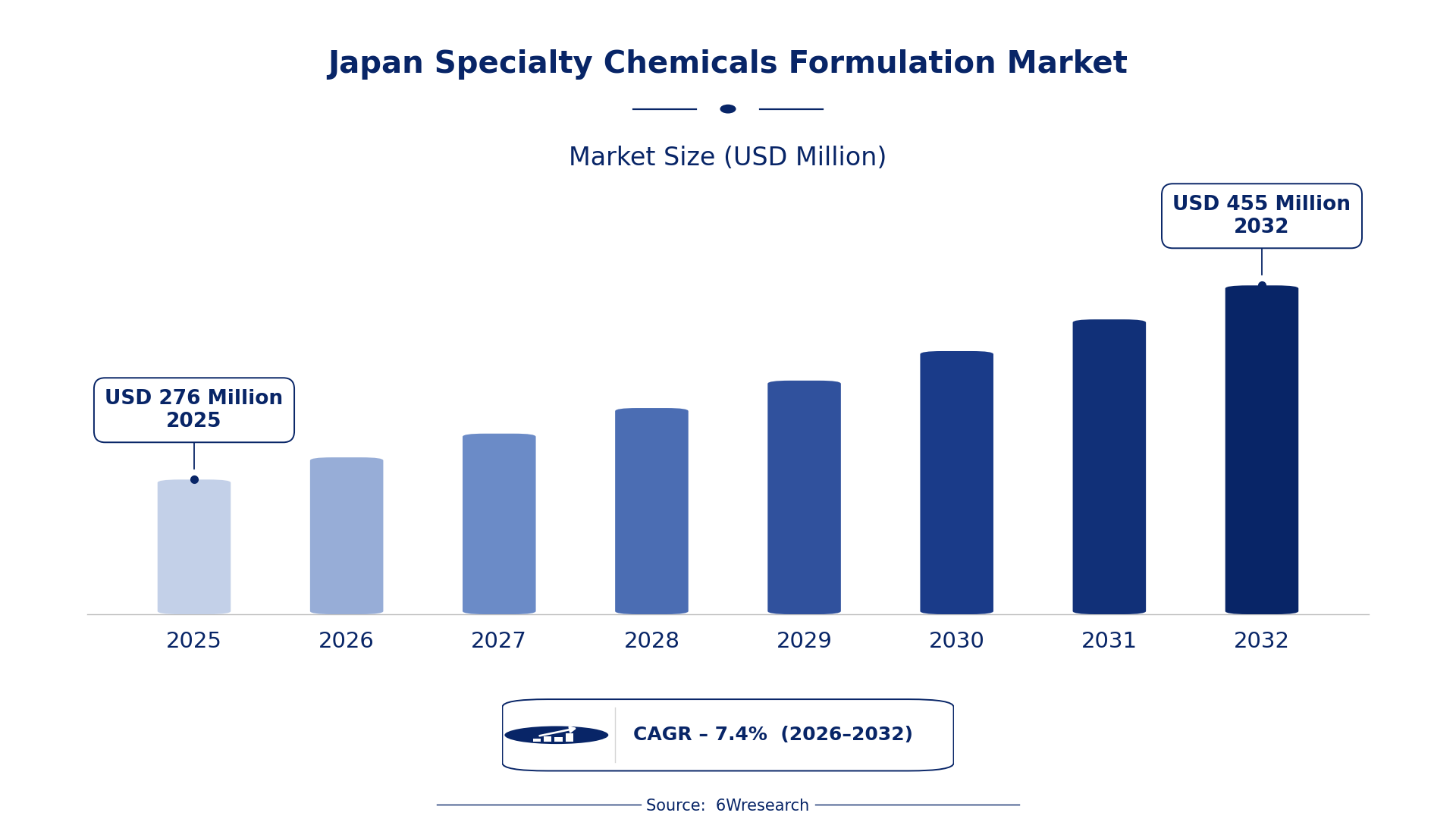
According to 6Wresearch internal database and industry insights, the Japan Specialty Chemicals Formulation Market was valued at USD 276 Million in 2025 and is projected to reach USD 455 Million by 2032, growing at a CAGR of approximately 7.4% during 2026–2032.
Japan Specialty Chemicals Formulation Market Highlights
| Report Metric | Details |
| Report Name | Japan Specialty Chemicals Formulation Market (2026-2032) |
| Market Size 2025 | USD 276 Million |
| Market Size 2032 | USD 455 Million |
| Absolute Growth 2025–2032 | USD 179 Million |
| CAGR 2026–2032 | 7.4% |
| Peak Annual Growth | 8.7% in 2030 |
| Forecast Period | 2026–2032 |
| Historical Data | 2022–2025 |
| Base Year | 2025 |
| Leading Formulation Type, 2025 | Surfactants (49% share) |
| Leading Functional Property, 2025 | Emulsification (36% share) |
| Leading Industry Focus, 2025 | Personal Care (43% share) |
| Leading End User, 2025 | Cosmetic Manufacturers (42% share) |
| Fastest-Growing Formulation Type | Custom Blends (10.5% CAGR) |
| Fastest-Growing Functional Property | Multi-Function (9.6% CAGR) |
| Fastest-Growing Industry Focus | Agrochemical (9.5% CAGR) |
| Fastest-Growing End User | Crop Protection Firms (9.7% CAGR) |
| Growing Sector | Personal Care |
| Key End Users | Cosmetic Manufacturers, Automotive Suppliers, Agrochemical Firms, Textile Producers |
Japan Specialty Chemicals Formulation Market Year-wise Growth Rate and Key Drivers (2022–2032)
This graph illustrates the annual growth rates of the market from 2022 to 2032, highlighting a steady upward trajectory and projected market expansion over the forecast period.
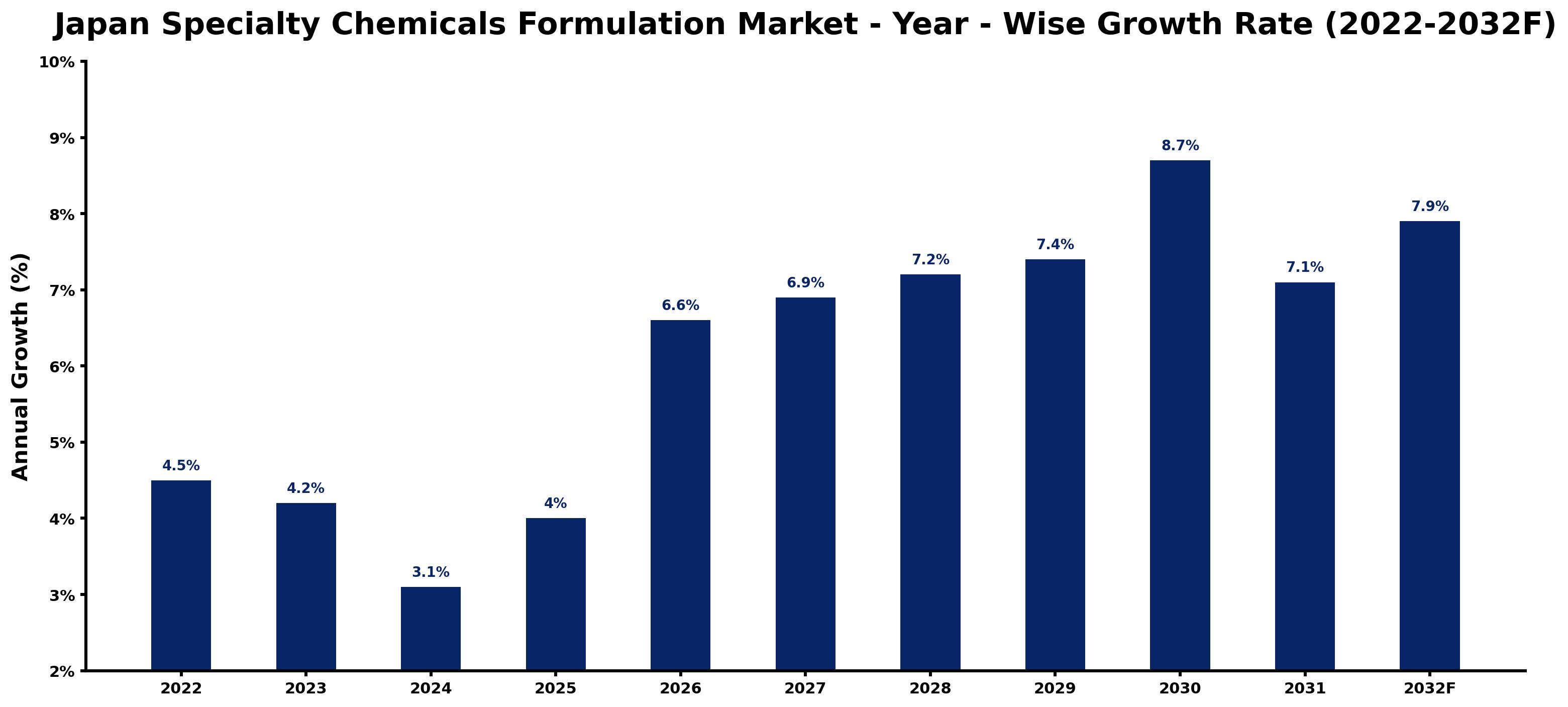
The following figures match every annual growth estimate with the main market development of that year, giving the reasoning behind each rise or slowdown.
| Year | Estimated Annual Growth (%) | Market Rationale |
| 2022 | 4.5 | The market showed strong activity with a notable demand from the personal care sector. |
| 2023 | 4.2 | Growth slowed as manufacturers adjusted to new regulations affecting production processes. |
| 2024 | 3.1 | The market continued to grow but at a reduced pace due to supply chain disruptions. |
| 2025 | 4.0 | Demand increased as manufacturers sought to innovate product formulations for better performance. |
| 2026 | 6.6 | Growth is expected to accelerate with rising investments in sustainable chemical practices across industries. |
| 2027 | 6.9 | Demand will rise further as the automotive sector increases its use of specialty formulations. |
| 2028 | 7.2 | The market is projected to maintain momentum driven by a strong focus on eco-friendly products. |
| 2029 | 7.4 | Growth will continue as agrochemical firms expand their use of specialty formulations. |
| 2030 | 8.7 | The peak growth year will see investments in decarbonisation initiatives boosting demand. |
| 2031 | 7.1 | Growth is expected to slow slightly as the market adjusts to the peak demand levels. |
| 2032 | 7.9 | Demand is projected to rise again as new technologies in formulation are adopted. |
Note: Market size estimations and growth projections presented in this report are based on 6Wresearch's proprietary forecasting methodology, utilizing the latest available industry data, government publications, and primary research inputs.
Japan Specialty Chemicals Formulation Market Synopsis
Specialty chemicals formulation involves creating chemical mixtures for specific applications across various industries, including cosmetics, automotive lubricants, and textiles. The Japan Specialty Chemicals Formulation Market is valued at approximately 1 trillion JPY, with the personal care segment accounting for over 30% of demand. Growth is driven by rising investments in sustainable practices, particularly in the automotive and agrochemical sectors, alongside a strong focus on product performance and innovation.
Market Dynamics Impact Analysis (2026–2032)
| Factor | Type | Impact | Primary Segment Affected |
| Rising investments in sustainable chemical practices | Driver | High | Emulsification |
| Increased demand from the automotive sector for advanced lubricants | Driver | High | Corrosion Inhibitors |
| Growing need for tailored solutions in various industries | Opportunity | High | Custom Blends |
| Expansion of the agrochemical sector due to food security concerns | Opportunity | Medium | Agrochemical |
| Stringent regulations under the Chemical Substances Control Law | Restraint | High | Dyes & Pigments |
| Challenges in sourcing high-quality raw materials | Restraint | Medium | Surfactants |
| High compliance costs associated with safety regulations | Challenge | High | Surfactants |
| Competition from low-cost imports affecting pricing strategies | Challenge | Medium | Surfactants |
Evaluation of Drivers in Japan Specialty Chemicals Formulation Market (2026–2032)
The table below links each growth driver to the segment it affects and the evidence for it.
| Drivers | Primary Segment Affected | Why It Matters (Evidence) |
| Increased focus on product performance in personal care | Surfactants | The personal care segment accounts for over 30% of specialty chemicals demand in Japan. |
| Growing automotive industry requirements for specialty lubricants | Corrosion Inhibitors | The automotive sector is one of the largest consumers of specialty chemicals, valued at over 300 billion JPY. |
| Demand for eco-friendly formulations in cosmetics | Emulsification | Emulsifiers are widely used in over 80% of cosmetic products in Japan, driving innovation in formulations. |
| Rising demand for high-quality dyes in textiles | Dyes & Pigments | The textile industry has a strong demand for high-quality dyes and pigments, accounting for 25% of specialty chemicals usage. |
| Customisation of formulations for specific client needs | Custom Blends | Custom blends are gaining popularity due to tailored solutions for specific applications, with a market share growth of 10%. |
What keeps demand rising is the increased focus on product performance, particularly in the personal care sector, which accounts for over 30% of specialty chemicals demand. The automotive industry, one of the largest consumers, drives growth for specialty lubricants, necessitating advanced formulations. Emulsifiers, widely used in over 80% of cosmetic products, are essential for product stability, prompting innovation. The textile sector's demand for high-quality dyes fuels growth, while custom blends are increasingly sought after for tailored solutions across various applications, reflecting a shift in buyer preferences.
Evaluation of Restraints in Japan Specialty Chemicals Formulation Market
These are the pressures that could keep growth below its potential.
| Market Restraint | Primary Segment Affected | Why It Matters (Evidence) |
| High compliance costs associated with safety regulations | Dyes & Pigments | Stringent regulations under the Chemical Substances Control Law increase production costs for manufacturers. |
| Difficulty in sourcing high-quality raw materials | Surfactants | Sourcing challenges can delay production and affect product quality in the surfactants segment. |
| Regulatory hurdles in the chemical manufacturing process | Corrosion Inhibitors | Compliance with the PRTR Law requires extensive reporting, adding to operational burdens. |
| Market competition from low-cost imports | Surfactants | Local manufacturers face pressure from cheaper alternatives available in the market. |
| Fluctuations in demand due to economic conditions | Agrochemical | Economic downturns can lead to reduced spending on agrochemical products. |
Japan Specialty Chemicals Formulation Market Challenges
Producers in the specialty chemicals market face stringent regulations under the Chemical Substances Control Law, causing product launch delays of up to six months for buyers. Suppliers deal with a skills shortage, as an ageing workforce threatens to eliminate 200,000 skilled jobs by 2030, impacting production efficiency. High technology adoption costs create barriers to innovation, with suppliers needing to invest JPY 150 trillion over the next decade, which can limit their market competitiveness. Local producers confront intense competition from international markets, forcing them to lower prices and significantly reducing profit margins.
Trends in the Japan Specialty Chemicals Formulation Market
Buyers and suppliers in the Japan Specialty Chemicals Formulation Market are adjusting to the following trends.
- Shift towards Sustainable Chemical Practices: The 2023 government programme promotes sustainable practices in chemical manufacturing, targeting a JPY 150 trillion investment over ten years. This shift encourages producers to innovate and adopt eco-friendly formulations.
- Growing Demand for Custom Blends: The trend towards tailored chemical solutions is reflected in the rise of custom blends, projected to grow at a CAGR of 10.5%. This reflects a shift in buyer preferences towards specific formulations.
- Increased Use of Emulsifiers in Cosmetics: Emulsifiers are now used in over 80% of cosmetic products, highlighting the industry's shift towards formulations that improve product stability and performance, responding to consumer demands for quality.
- Expansion of Agrochemical Formulations: The agrochemical sector is projected to grow due to increased focus on food security, with specialty formulations becoming essential for effective crop protection, addressing the needs of farmers.
Investment Opportunities in the Japan Specialty Chemicals Formulation Market
Several openings in the Japan Specialty Chemicals Formulation Market merit attention from investors.
- Market Gap in Eco-Friendly Products: With Japan targeting a 46% cut in greenhouse-gas emissions by 2030, there is an opportunity for suppliers of eco-friendly specialty chemicals, particularly in the automotive sector, which is valued at over 300 billion JPY.
- Rising Demand for Personal Care Products: The personal care segment, accounting for over 30% of demand, presents a timely opportunity for investment in specialty formulations that meet consumer expectations, particularly in urban areas like Tokyo.
- Growth in Agrochemical Sector: The agrochemical sector's projected growth due to food security concerns creates a need for suppliers to develop effective specialty formulations for crop protection, with an estimated market size of 100 billion JPY.
- Custom Blends for Specific Applications: The increasing demand for custom blends offers a lucrative opportunity for manufacturers to cater to specific industry needs, particularly in textiles and personal care, with a market growth rate of 10%.
Government Initiatives in the Japan Specialty Chemicals Formulation Market
The Chemical Substances Control Law, established in 1973, mandates the evaluation and control of chemical substances in manufacture and import. This law ensures that producers adhere to safety standards, impacting the specialty chemicals formulation sector. Additionally, the PRTR Law requires businesses to report chemical releases, promoting transparency and accountability in the industry. Compliance with these regulations can increase operational costs by up to 20%.
Buyers in the specialty chemicals sector benefit from the GX Promotion Act, which supports sustainable practices. The Ministry of Economy, Trade and Industry oversees initiatives that fund projects aimed at reducing environmental impact, encouraging manufacturers to adopt greener technologies. In 2023, the government allocated JPY 50 billion for these initiatives, benefiting over 1,000 companies in the sector.
Future Insight of the Japan Specialty Chemicals Formulation Market
Technological advancements will reshape demand patterns by 2032, as government programmes accelerate decarbonisation initiatives. New quality standards will elevate expectations for product performance, influencing buyers' sourcing decisions. The automotive sector will increasingly require specialty chemicals designed for electric vehicle applications, creating new opportunities for suppliers. As the agrochemical industry grows, innovative formulations will address food security challenges, ensuring ongoing demand for specialty chemicals.
Market Segmentation Analysis
Japan Specialty Chemicals Formulation Market report covers a detailed analysis of the following market segments:
By Formulation Type – Surfactants Lead, Custom Blends Expected to Grow Fastest
According to Saurav Kr Singh, Senior Research Analyst at 6Wresearch, in 2025, Surfactants led the formulation type split with a 49% share. Surfactants dominate the market due to their essential applications in personal care and cleaning products, which are integral to everyday consumer routines. Their significance is underscored by the fact that emulsifiers are present in over 80% of cosmetic products in Japan. Custom Blends are set to record the highest CAGR in this split, 10.5% over 2026–2032. Custom Blends are rapidly gaining traction as manufacturers increasingly seek tailored formulations to meet specific client needs across diverse industries. This growth is indicative of a broader trend towards product differentiation in competitive markets. Suppliers should focus on developing customised solutions to capture the rising demand in the specialty chemicals sector.
By Functional Property – Emulsification Leads, Multi-Function Expected to Grow Fastest
The largest functional property category in 2025 was Emulsification, at 36% of revenue. Emulsification leads the functional property segment because it is crucial for creating stable mixtures in cosmetics and food products, which are vital areas within the specialty chemicals market. The widespread use of emulsifiers in personal care items reinforces its dominant status. Multi-Function is projected to grow fastest, at a CAGR of 9.6% during 2026–2032. The Multi-Function property is experiencing swift growth as formulations require multiple functionalities to address various consumer preferences. This trend suggests a movement towards more efficient and versatile chemical solutions across numerous applications. Suppliers need to innovate by incorporating multi-functional properties into their offerings to align with market demands.
By Industry Focus – Personal Care Leads, Agrochemical Expected to Grow Fastest
With 43% of industry focus revenue in 2025, Personal Care was the largest category. Personal Care is the primary industry focus, accounting for over 30% of specialty chemicals demand in Japan, driven by high consumption of cosmetic products. This sector's robust growth is supported by a strong consumer base that values quality and performance in personal care items. Over 2026–2032, Agrochemical is expected to post the fastest growth, at a CAGR of 9.5%. The Agrochemical sector is projected to grow rapidly due to increasing emphasis on food security and the need for effective crop protection formulations. This growth is further encouraged by government initiatives aimed at enhancing agricultural productivity. Suppliers should consider expanding their product lines to cater to the growing agrochemical market.
By End User – Cosmetic Manufacturers Lead, Crop Protection Firms Expected to Grow Fastest
Cosmetic Manufacturers took 42% of end user revenue in 2025, more than any other category. Cosmetic Manufacturers are the leading end users of specialty formulations, reflecting strong demand for high-quality ingredients within the beauty industry. The growth of this sector is driven by consumer trends favouring innovative and effective cosmetic products. The quickest growth will come from Crop Protection Firms, forecast to expand at a CAGR of 9.7% between 2026 and 2032. Crop Protection Firms are witnessing the fastest growth as they increasingly rely on specialty formulations for effective pesticide products, spurred by rising agricultural demands. This trend is further supported by government initiatives aimed at improving food security. Suppliers must strengthen collaborations with crop protection firms to take advantage of this expanding segment.
Key Attractiveness of the Report
- 10 Years of Market Numbers
- Historical Data Starting from 2022 to 2025
- Base Year 2025
- Forecast Data until 2032
- Key Performance Indicators Impacting the Market
- Major Upcoming Developments and Projects
Key Highlights of the Report:
- Japan Specialty Chemicals Formulation Market Outlook
- Market Size of Japan Specialty Chemicals Formulation Market, 2025
- Forecast of Japan Specialty Chemicals Formulation Market, 2032
- Historical Data and Forecast of Japan Specialty Chemicals Formulation Revenues & Volume for the Period 2022-2032F
- Japan Specialty Chemicals Formulation Market Trend Evolution
- Japan Specialty Chemicals Formulation Market Drivers and Challenges
- Japan Specialty Chemicals Formulation Price Trends
- Japan Specialty Chemicals Formulation Porter's Five Forces
- Japan Specialty Chemicals Formulation Industry Life Cycle
- Historical Data and Forecast of Japan Specialty Chemicals Formulation Market Revenues & Volume By Formulation Type for the Period 2022-2032F
- Historical Data and Forecast of Japan Specialty Chemicals Formulation Market Revenues & Volume By Surfactants for the Period 2022-2032F
- Historical Data and Forecast of Japan Specialty Chemicals Formulation Market Revenues & Volume By Corrosion Inhibitors for the Period 2022-2032F
- Historical Data and Forecast of Japan Specialty Chemicals Formulation Market Revenues & Volume By Dyes & Pigments for the Period 2022-2032F
- Historical Data and Forecast of Japan Specialty Chemicals Formulation Market Revenues & Volume By Custom Blends for the Period 2022-2032F
- Historical Data and Forecast of Japan Specialty Chemicals Formulation Market Revenues & Volume By Functional Property for the Period 2022-2032F
- Historical Data and Forecast of Japan Specialty Chemicals Formulation Market Revenues & Volume By Emulsification for the Period 2022-2032F
- Historical Data and Forecast of Japan Specialty Chemicals Formulation Market Revenues & Volume By Anti-Rust for the Period 2022-2032F
- Historical Data and Forecast of Japan Specialty Chemicals Formulation Market Revenues & Volume By Color Stability for the Period 2022-2032F
- Historical Data and Forecast of Japan Specialty Chemicals Formulation Market Revenues & Volume By Multi-Function for the Period 2022-2032F
- Historical Data and Forecast of Japan Specialty Chemicals Formulation Market Revenues & Volume By Industry Focus for the Period 2022-2032F
- Historical Data and Forecast of Japan Specialty Chemicals Formulation Market Revenues & Volume By Personal Care for the Period 2022-2032F
- Historical Data and Forecast of Japan Specialty Chemicals Formulation Market Revenues & Volume By Automotive for the Period 2022-2032F
- Historical Data and Forecast of Japan Specialty Chemicals Formulation Market Revenues & Volume By Textile for the Period 2022-2032F
- Historical Data and Forecast of Japan Specialty Chemicals Formulation Market Revenues & Volume By Agrochemical for the Period 2022-2032F
- Historical Data and Forecast of Japan Specialty Chemicals Formulation Market Revenues & Volume By End User for the Period 2022-2032F
- Historical Data and Forecast of Japan Specialty Chemicals Formulation Market Revenues & Volume By Cosmetic Manufacturers for the Period 2022-2032F
- Historical Data and Forecast of Japan Specialty Chemicals Formulation Market Revenues & Volume By Lubricant Suppliers for the Period 2022-2032F
- Historical Data and Forecast of Japan Specialty Chemicals Formulation Market Revenues & Volume By Apparel Dye Units for the Period 2022-2032F
- Historical Data and Forecast of Japan Specialty Chemicals Formulation Market Revenues & Volume By Crop Protection Firms for the Period 2022-2032F
- Japan Specialty Chemicals Formulation Import Export Trade Statistics
- Market Opportunity Assessment By Formulation Type
- Market Opportunity Assessment By Functional Property
- Market Opportunity Assessment By Industry Focus
- Market Opportunity Assessment By End User
- Japan Specialty Chemicals Formulation Top Companies Market Share
- Japan Specialty Chemicals Formulation Competitive Benchmarking By Technical and Operational Parameters
- Japan Specialty Chemicals Formulation Company Profiles
- Japan Specialty Chemicals Formulation Key Strategic Recommendations
Market Covered
Segments analysed in this report are listed below.
By Formulation Type
- Surfactants
- Corrosion Inhibitors
- Dyes & Pigments
- Custom Blends
By Functional Property
- Emulsification
- Anti-Rust
- Color Stability
- Multi-Function
By Industry Focus
- Personal Care
- Automotive
- Textile
- Agrochemical
By End User
- Cosmetic Manufacturers
- Lubricant Suppliers
- Apparel Dye Units
- Crop Protection Firms































