Japan Specialty Crop Nutrition Market Size & Growth Rate
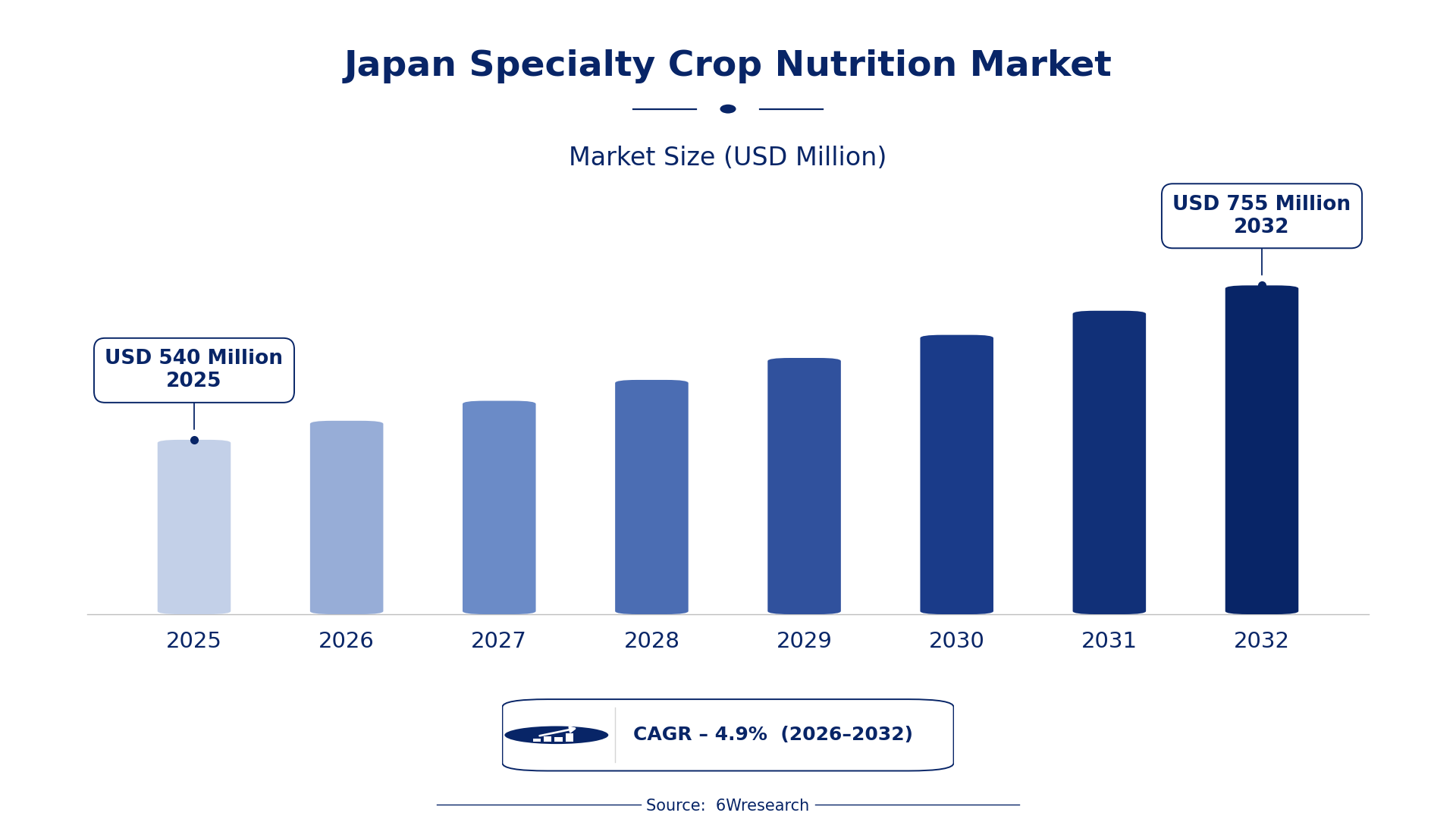
According to 6Wresearch internal database and industry insights, the Japan Specialty Crop Nutrition Market was valued at USD 540 Million in 2025 and is projected to reach USD 755 Million by 2032, growing at a CAGR of approximately 4.9% during 2026–2032.
Japan Specialty Crop Nutrition Market Highlights
| Report Metric | Details |
| Report Name | Japan Specialty Crop Nutrition Market (2026-2032) |
| Market Size 2025 | USD 540 Million |
| Market Size 2032 | USD 755 Million |
| Absolute Growth 2025–2032 | USD 215 Million |
| CAGR 2026–2032 | 4.9% |
| Peak Annual Growth | 5.8% in 2030 |
| Forecast Period | 2026–2032 |
| Historical Data | 2022–2025 |
| Base Year | 2025 |
| Leading Nutrient Type, 2025 | Micronutrient Mixes (46% share) |
| Leading Crop Type, 2025 | Fruits & Vegetables (40% share) |
| Leading Formulation Type, 2025 | Liquid/Soluble (49% share) |
| Leading End User, 2025 | Horticulture Growers (43% share) |
| Fastest-Growing Nutrient Type | Bio-Stimulants (7.1% CAGR) |
| Fastest-Growing Crop Type | High-Value Crops (7.3% CAGR) |
| Fastest-Growing Formulation Type | Granular (7.0% CAGR) |
| Fastest-Growing End User | Organic Farm Operators (6.7% CAGR) |
| Growing Sector | Horticulture |
| Key End Users | Horticulture Growers, Organic Farm Operators, Vertical Farming Units |
Japan Specialty Crop Nutrition Market Year-wise Growth Rate and Key Drivers (2022–2032)
This graph illustrates the annual growth rates of the market from 2022 to 2032, highlighting a steady upward trajectory and projected market expansion over the forecast period.
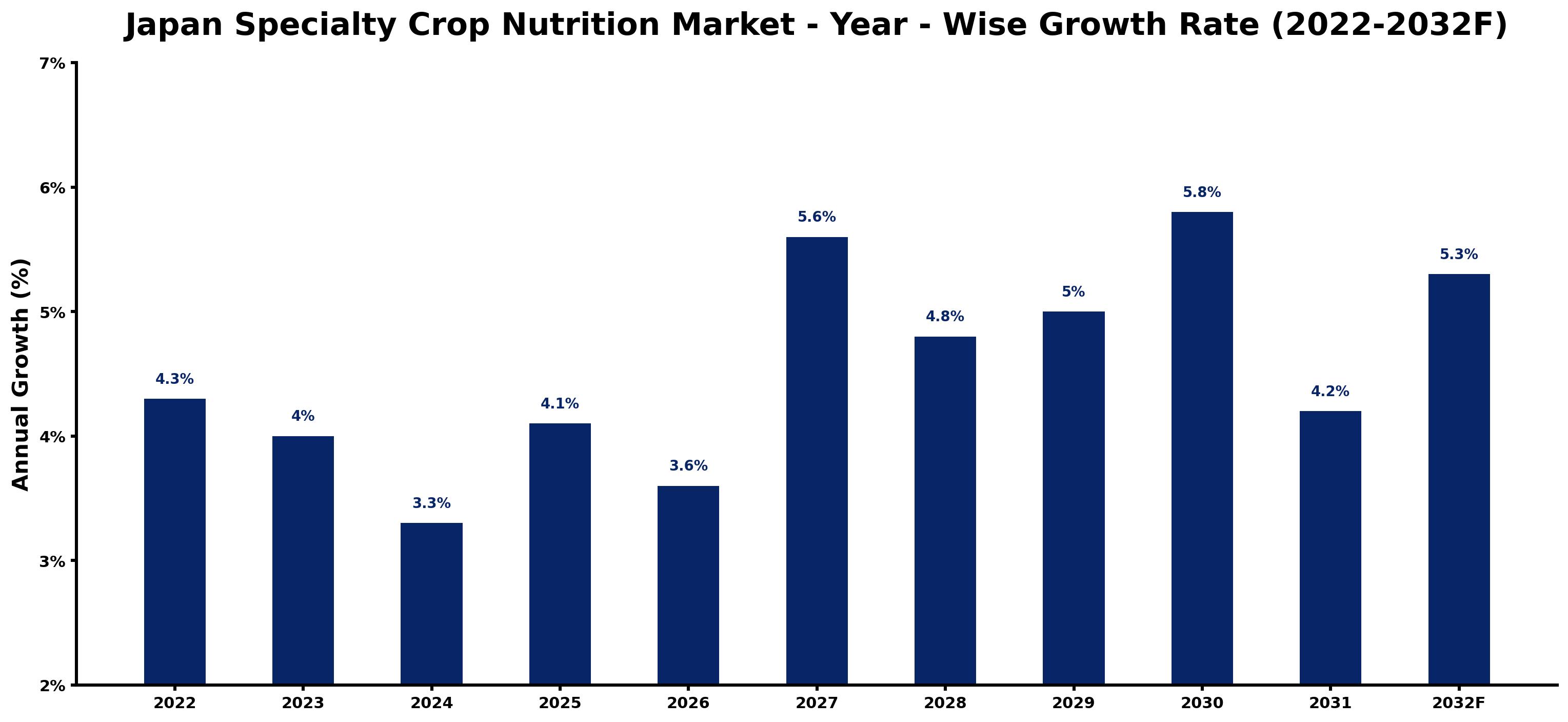
The yearly estimates that follow link every growth rate to its principal driver, so readers can see why the pace changed in each period.
| Year | Estimated Annual Growth (%) | Market Rationale |
| 2022 | 4.3 | The market experienced solid growth due to increased adoption of specialty nutrients among growers. |
| 2023 | 4.0 | Growth slowed as some farmers faced challenges in accessing high-quality inputs. |
| 2024 | 3.3 | The market continued to grow, albeit at a slower pace, as growers adjusted to changing conditions. |
| 2025 | 4.1 | Demand increased as horticulture growers sought to improve crop yields with specialized products. |
| 2026 | 3.6 | Growth is expected to slow again as supply chain issues impact product availability for farmers. |
| 2027 | 5.6 | The market is projected to rebound with faster growth as new technologies gain traction among growers. |
| 2028 | 4.8 | Growth is anticipated to moderate as market saturation begins to affect purchasing decisions. |
| 2029 | 5.0 | Demand is expected to rise again as urban farming initiatives expand in major cities. |
| 2030 | 5.8 | The market is projected to peak with strong growth driven by innovations in crop nutrition technologies. |
| 2031 | 4.2 | Growth is expected to slow as the market begins to stabilise after reaching peak levels. |
| 2032 | 5.3 | Demand is expected to increase as organic farming practices continue to gain popularity. |
Note: Market size estimations and growth projections presented in this report are based on 6Wresearch's proprietary forecasting methodology, utilizing the latest available industry data, government publications, and primary research inputs.
Japan Specialty Crop Nutrition Market Synopsis
Specialty Crop Nutrition products support crop growth and yield by supplying key nutrients and growth stimulants, derived from a mix of organic and inorganic materials. The Japan Specialty Crop Nutrition Market is growing due to increasing demand from domestic growers, especially in horticulture, which encompasses over 1.3 million farms. The total area for vegetable cultivation in Japan is around 200,000 hectares, highlighting growth potential driven by greater adoption of bio-stimulants and government backing for organic farming initiatives.
Market Dynamics Impact Analysis (2026–2032)
| Factor | Type | Impact | Primary Segment Affected |
| Increased adoption of bio-stimulants | Driver | High | Bio-Stimulants |
| Growing focus on organic farming | Driver | High | Custom NPK Blends |
| Expansion of urban farming initiatives | Opportunity | Medium | Vertical Farming Units |
| Rising interest in precision agriculture | Opportunity | Medium | Precision Agri-Farms |
| Supply chain disruptions affecting product availability | Restraint | High | Micronutrient Mixes |
| Fluctuating prices of raw materials impacting production costs | Restraint | Medium | Chelated Fertilizers |
| Competition from alternative agricultural inputs | Challenge | High | Granular |
| Limited awareness of specialty crop nutrition benefits | Challenge | Medium | Foliar Spray |
Evaluation of Drivers in Japan Specialty Crop Nutrition Market (2026–2032)
The main growth drivers and the segments they affect most are set out below.
| Drivers | Primary Segment Affected | Why It Matters (Evidence) |
| Increased investment in bio-stimulants | Bio-Stimulants | In 2022, the market for bio-stimulants grew by 15%, prompting growers to adopt these products for improved crop resilience. |
| Rising organic farming adoption | Custom NPK Blends | With organic farming reaching 1.5% of total farmland, growers are seeking tailored nutrient solutions to meet specific crop needs. |
| Urban farming growth | Vertical Farming Units | Tokyo's urban farming initiatives have led to a 20% increase in vertical farming units, driving demand for specialty nutrients. |
| Precision agriculture technology adoption | Precision Agri-Farms | The government allocated ¥10 billion in 2023 for agricultural innovation projects, encouraging farmers to invest in precise nutrient applications. |
| Focus on high-value crops | High-Value Crops | Fruits and vegetables account for 30% of agricultural output, motivating growers to improve yields with specialty crop nutrition. |
Buyers are adding capacity as the market for specialty crop nutrition products grew by 15% in 2022, prompting growers to adopt these products for improved resilience. The rise in organic farming, which has reached 1.5% of total farmland, has led to increased demand for tailored nutrient solutions. With fruits and vegetables accounting for 30% of agricultural output, growers are motivated to improve yields through specialty crop nutrition solutions.
Evaluation of Restraints in Japan Specialty Crop Nutrition Market
Below are the constraints most often cited by buyers and suppliers, with the segment each affects.
| Market Restraint | Primary Segment Affected | Why It Matters (Evidence) |
| Supply chain disruptions affecting product availability | Micronutrient Mixes | In 2022, supply chain issues led to a 10% increase in delivery times for specialty crop nutrition products. |
| Fluctuating prices of raw materials impacting production costs | Chelated Fertilizers | In 2023, raw material costs rose by 15%, affecting profit margins for producers of chelated fertilizers. |
| Limited awareness of specialty crop nutrition benefits | Foliar Spray | Many growers lack knowledge about the advantages of foliar application methods, limiting market growth. |
| Regulatory hurdles for new product approvals | Bio-Stimulants | The lengthy approval process for bio-stimulants can delay market entry, affecting supply availability. |
| Competition from alternative agricultural inputs | Granular | Alternative inputs have gained popularity, leading to a 5% decline in demand for granular fertilizers. |
Japan Specialty Crop Nutrition Market Challenges
In 2022, supply chain disruptions rose by 15% due to natural disasters, restricting farmers' access to vital nutrients. Buyers, particularly small-scale growers, are experiencing a 10% increase in specialty crop nutrition prices, putting pressure on their budgets. Compliance with JIS standards complicates product approvals, delaying market entry and increasing costs for suppliers by up to 20%. Local producers face competition from imported products, which can be 5-10% cheaper, forcing them to lower prices and potentially compromise on quality.
Trends in the Japan Specialty Crop Nutrition Market
The trends below show where the Japan Specialty Crop Nutrition Market is heading.
- Shift Towards Organic Farming: The rise in organic farming practices has led to increased demand for specialty crop nutrition products. In 2023, organic farming reached 1.5% of total farmland, prompting growers to seek tailored nutrient solutions.
- Growing Adoption of Bio-Stimulants: Bio-stimulants are increasingly recognised for their benefits in crop resilience. Research shows that their adoption has grown by 15% in the last year, influencing purchasing decisions among horticulture growers.
- Expansion of Vertical Farming: Urban farming initiatives have led to a notable rise in vertical farming units. In Tokyo, the number of vertical farms increased by 20% in 2023, driving demand for specialty nutrients.
- Increase in Precision Agriculture: The introduction of advanced agricultural technologies has accelerated the adoption of precision agriculture. This trend has resulted in more precise nutrient applications, improving overall crop yields.
Investment Opportunities in the Japan Specialty Crop Nutrition Market
Below are the investment opportunities with the strongest case in the Japan Specialty Crop Nutrition Market.
- Investment in Urban Farming: Tokyo's urban farming initiatives present a notable opportunity for suppliers of specialty crop nutrition, with a 20% increase in vertical farming units. Collaborating with local partners can facilitate market entry.
- Focus on Organic Crop Nutrients: With organic farming growing to 1.5% of total farmland, there is a pressing need for tailored nutrient solutions. Engaging with organic farm operators can enhance market penetration.
- Supply of Bio-Stimulants: The rising demand for bio-stimulants offers a chance to supply innovative products. Engaging with horticulture growers can lead to increased sales in this segment.
- Expansion of Precision Agriculture Solutions: The government funding for agricultural innovation highlights the need for advanced nutrient application technologies. Partnering with precision agri-farms can open new market avenues.
Government Initiatives in the Japan Specialty Crop Nutrition Market
The Electrical Appliance and Material Safety Act governs the safety of agricultural inputs, ensuring that specialty crop nutrition products comply with safety standards. This legislation, along with the Clinical Trials Act, builds consumer confidence in agricultural innovations and promotes safer practices in the industry. In 2023, the government allocated ¥10 billion for agricultural innovation projects, supporting the development of specialty crop nutrition solutions.
The Ministry of Agriculture, Forestry and Fisheries (MAFF) manages agricultural standards and regulations, approving various agricultural innovation projects. In 2023, the government allocated ¥10 billion for such initiatives, aiding the development of specialty crop nutrition solutions.
Future Insight of the Japan Specialty Crop Nutrition Market
By 2032, urban farming setups will increasingly utilise tailored nutrient blends to meet specific soil conditions, driven by advancements in precision agriculture. Research into bio-stimulants will expand, supported by government funding of ¥10 billion for agricultural innovation projects. Vertical farming will grow in urban areas like Tokyo, enhancing food production efficiency. The adoption of controlled release fertilizers will improve sustainability and productivity, benefiting both buyers and suppliers.
Market Segmentation Analysis
Japan Specialty Crop Nutrition Market report covers a detailed analysis of the following market segments:
By Nutrient Type – Micronutrient Mixes Lead, Bio-Stimulants Expected to Grow Fastest
According to Saurav Kr Singh, Senior Research Analyst at 6Wresearch, with 46% of nutrient type revenue in 2025, Micronutrient Mixes was the largest category. Micronutrient mixes hold the largest market share as they deliver essential trace elements vital for plant growth, particularly in regions like Hokkaido where horticulture thrives. The established JIS standards for fertilizers further solidify their appeal among growers prioritising quality assurance. Bio-Stimulants are set to record the highest CAGR in this split, 7.1% over 2026–2032. Bio-stimulants are rapidly gaining traction due to their proven ability to enhance plant growth and stress resistance, with notable research and adoption rates across Japan. The government's allocation of ¥10 billion for agricultural innovation in 2023 is expected to accelerate this trend. Suppliers should focus on developing bio-stimulant products to meet the increasing demand from agricultural producers.
By Crop Type – Fruits & Vegetables Lead, High-Value Crops Expected to Grow Fastest
Fruits & Vegetables took 40% of crop type revenue in 2025, more than any other category. Fruits and vegetables dominate the market as they account for about 30% of Japan's total agricultural output by value, underscoring their significance in specialty crop nutrition. The extensive area of approximately 200,000 hectares dedicated to vegetable cultivation reflects a strong emphasis on quality and yield enhancement in this segment. Over 2026–2032, High-Value Crops are expected to post the fastest growth, at a CAGR of 7.3%. High-value crops are witnessing rapid growth as farmers aim for premium yield enhancement, driven by the rising demand for quality produce in urban settings. The focus on horticulture, which represents nearly 20% of agricultural production value, supports this upward trajectory. Buyers should invest in specialty nutrition tailored for high-value crops to maximise their returns.
By Formulation Type – Liquid/Soluble Leads, Granular Expected to Grow Fastest
Liquid/Soluble held 49% of the Japan Specialty Crop Nutrition Market by formulation type in 2025. Liquid/soluble formulations are the most widely used as they allow for quick nutrient uptake, making them essential for immediate crop needs. Their popularity among horticulture growers, particularly in urban settings, reinforces their leading position in the market. Granular is projected to grow fastest, at a CAGR of 7.0% during 2026–2032. Granular formulations are gaining traction due to their sustained nutrient release capabilities, appealing to growers looking for long-term solutions. The increasing adoption of these formulations aligns with the trend towards more efficient farming practices. Suppliers should expand their granular product lines to cater to the growing preference for sustained nutrient delivery.
By End User – Horticulture Growers Lead, Organic Farm Operators Expected to Grow Fastest
Horticulture Growers accounted for 43% of the market by end user in 2025. Horticulture growers form the largest end-user group, relying on specialty crop nutrition to improve the quality and yield of their produce. The concentration of farms in key regions like Tokyo and Hokkaido further underscores the significance of this segment in the market. The quickest growth will come from Organic Farm Operators, forecast to expand at a CAGR of 6.7% between 2026 and 2032. Organic farm operators are rapidly embracing specialty nutrients, propelled by government support for organic farming initiatives and the increasing consumer preference for organic products. This trend is expected to persist as organic farming captures a larger share of total farmland. Suppliers must tailor their offerings to meet the specific requirements of organic farm operators to take advantage of this growth opportunity.
Key Attractiveness of the Report
- 10 Years of Market Numbers
- Historical Data Starting from 2022 to 2025
- Base Year 2025
- Forecast Data until 2032
- Key Performance Indicators Impacting the Market
- Major Upcoming Developments and Projects
Key Highlights of the Report:
- Japan Specialty Crop Nutrition Market Outlook
- Market Size of Japan Specialty Crop Nutrition Market, 2025
- Forecast of Japan Specialty Crop Nutrition Market, 2032
- Historical Data and Forecast of Japan Specialty Crop Nutrition Revenues & Volume for the Period 2022-2032F
- Japan Specialty Crop Nutrition Market Trend Evolution
- Japan Specialty Crop Nutrition Market Drivers and Challenges
- Japan Specialty Crop Nutrition Price Trends
- Japan Specialty Crop Nutrition Porter's Five Forces
- Japan Specialty Crop Nutrition Industry Life Cycle
- Historical Data and Forecast of Japan Specialty Crop Nutrition Market Revenues & Volume By Nutrient Type for the Period 2022-2032F
- Historical Data and Forecast of Japan Specialty Crop Nutrition Market Revenues & Volume By Micronutrient Mixes for the Period 2022-2032F
- Historical Data and Forecast of Japan Specialty Crop Nutrition Market Revenues & Volume By Bio-Stimulants for the Period 2022-2032F
- Historical Data and Forecast of Japan Specialty Crop Nutrition Market Revenues & Volume By Chelated Fertilizers for the Period 2022-2032F
- Historical Data and Forecast of Japan Specialty Crop Nutrition Market Revenues & Volume By Custom NPK Blends for the Period 2022-2032F
- Historical Data and Forecast of Japan Specialty Crop Nutrition Market Revenues & Volume By Crop Type for the Period 2022-2032F
- Historical Data and Forecast of Japan Specialty Crop Nutrition Market Revenues & Volume By Fruits & Vegetables for the Period 2022-2032F
- Historical Data and Forecast of Japan Specialty Crop Nutrition Market Revenues & Volume By High-Value Crops for the Period 2022-2032F
- Historical Data and Forecast of Japan Specialty Crop Nutrition Market Revenues & Volume By Leafy Greens for the Period 2022-2032F
- Historical Data and Forecast of Japan Specialty Crop Nutrition Market Revenues & Volume By Plantation Crops for the Period 2022-2032F
- Historical Data and Forecast of Japan Specialty Crop Nutrition Market Revenues & Volume By Formulation Type for the Period 2022-2032F
- Historical Data and Forecast of Japan Specialty Crop Nutrition Market Revenues & Volume By Liquid/Soluble for the Period 2022-2032F
- Historical Data and Forecast of Japan Specialty Crop Nutrition Market Revenues & Volume By Granular for the Period 2022-2032F
- Historical Data and Forecast of Japan Specialty Crop Nutrition Market Revenues & Volume By Foliar Spray for the Period 2022-2032F
- Historical Data and Forecast of Japan Specialty Crop Nutrition Market Revenues & Volume By Controlled Release for the Period 2022-2032F
- Historical Data and Forecast of Japan Specialty Crop Nutrition Market Revenues & Volume By End User for the Period 2022-2032F
- Historical Data and Forecast of Japan Specialty Crop Nutrition Market Revenues & Volume By Horticulture Growers for the Period 2022-2032F
- Historical Data and Forecast of Japan Specialty Crop Nutrition Market Revenues & Volume By Organic Farm Operators for the Period 2022-2032F
- Historical Data and Forecast of Japan Specialty Crop Nutrition Market Revenues & Volume By Vertical Farming Units for the Period 2022-2032F
- Historical Data and Forecast of Japan Specialty Crop Nutrition Market Revenues & Volume By Precision Agri-Farms for the Period 2022-2032F
- Japan Specialty Crop Nutrition Import Export Trade Statistics
- Market Opportunity Assessment By Nutrient Type
- Market Opportunity Assessment By Crop Type
- Market Opportunity Assessment By Formulation Type
- Market Opportunity Assessment By End User
- Japan Specialty Crop Nutrition Top Companies Market Share
- Japan Specialty Crop Nutrition Competitive Benchmarking By Technical and Operational Parameters
- Japan Specialty Crop Nutrition Company Profiles
- Japan Specialty Crop Nutrition Key Strategic Recommendations
Market Covered
Coverage by segment is as follows.
By Nutrient Type
- Micronutrient Mixes
- Bio-Stimulants
- Chelated Fertilizers
- Custom NPK Blends
By Crop Type
- Fruits & Vegetables
- High-Value Crops
- Leafy Greens
- Plantation Crops
By Formulation Type
- Liquid/Soluble
- Granular
- Foliar Spray
- Controlled Release
By End User
- Horticulture Growers
- Organic Farm Operators
- Vertical Farming Units
- Precision Agri-Farms































