Japan Specialty Esters Market Size & Growth Rate
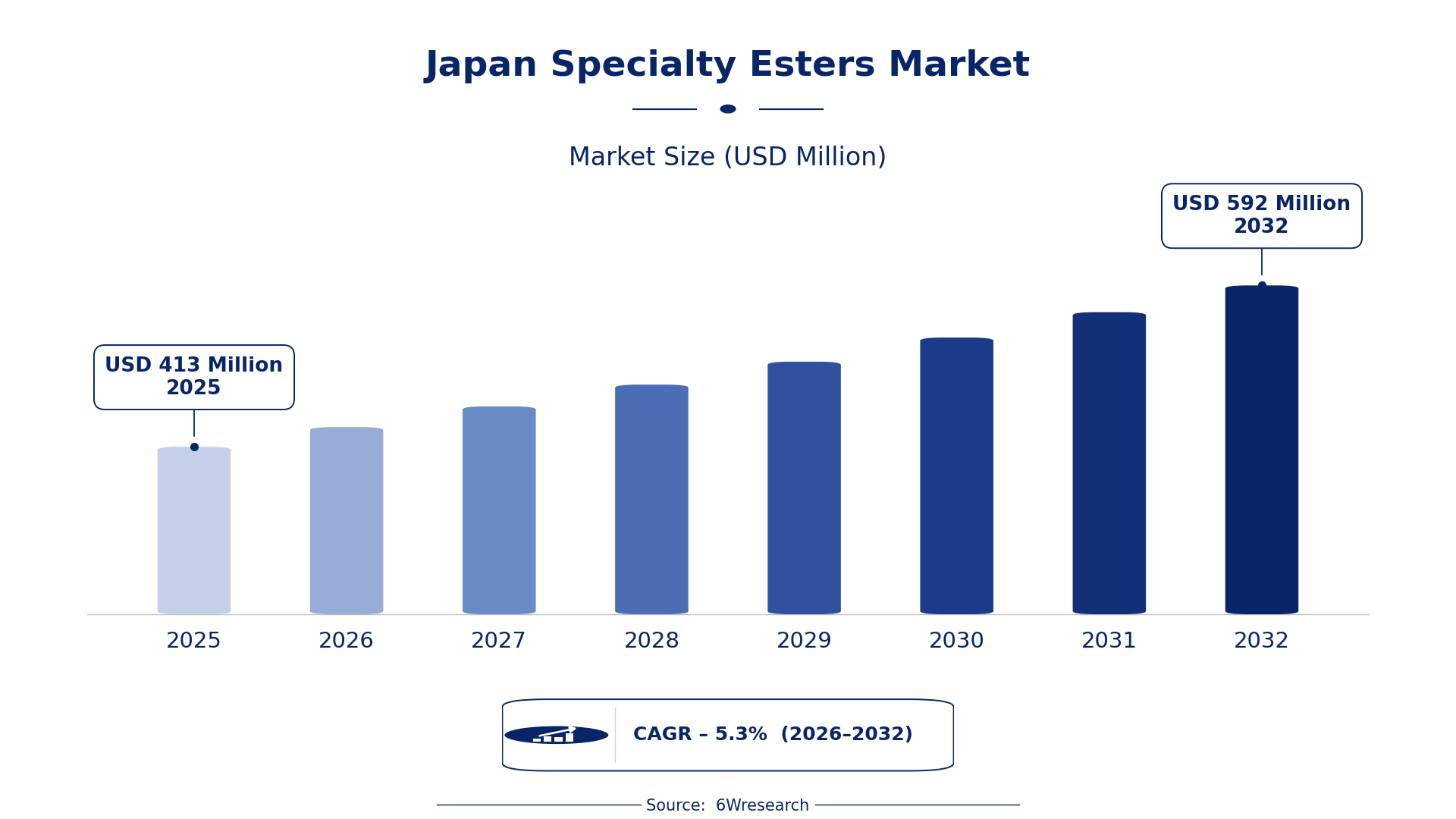
According to 6Wresearch internal database and industry insights, the Japan Specialty Esters Market was valued at USD 413 Million in 2025 and is projected to reach USD 592 Million by 2032, growing at a CAGR of approximately 5.3% during 2026–2032.
Japan Specialty Esters Market Highlights
| Report Metric | Details |
| Report Name | Japan Specialty Esters Market (2026-2032) |
| Market Size 2025 | USD 413 Million |
| Market Size 2032 | USD 592 Million |
| Absolute Growth 2025–2032 | USD 179 Million |
| CAGR 2026–2032 | 5.3% |
| Peak Annual Growth | 6.1% in 2028 |
| Forecast Period | 2026–2032 |
| Historical Data | 2022–2025 |
| Base Year | 2025 |
| Leading Ester Type, 2025 | Polyol Esters (39% share) |
| Leading Application Area, 2025 | Cosmetics (42% share) |
| Leading Raw Material, 2025 | Synthetic Alcohols (39% share) |
| Leading End User, 2025 | Personal Care Brands (43% share) |
| Fastest-Growing Ester Type | Phthalate-Free Esters (7.4% CAGR) |
| Fastest-Growing Application Area | Food Emulsifiers (6.3% CAGR) |
| Fastest-Growing Raw Material | Sorbitol (7.6% CAGR) |
| Fastest-Growing End User | Food Processing Firms (6.8% CAGR) |
| Growing Sector | Food Emulsifiers |
| Key End Users | Cosmetics, Food Emulsifiers, Plasticizers, Lubricants |
Japan Specialty Esters Market Year-wise Growth Rate and Key Drivers (2022–2032)
This graph illustrates the annual growth rates of the market from 2022 to 2032, highlighting a steady upward trajectory and projected market expansion over the forecast period.
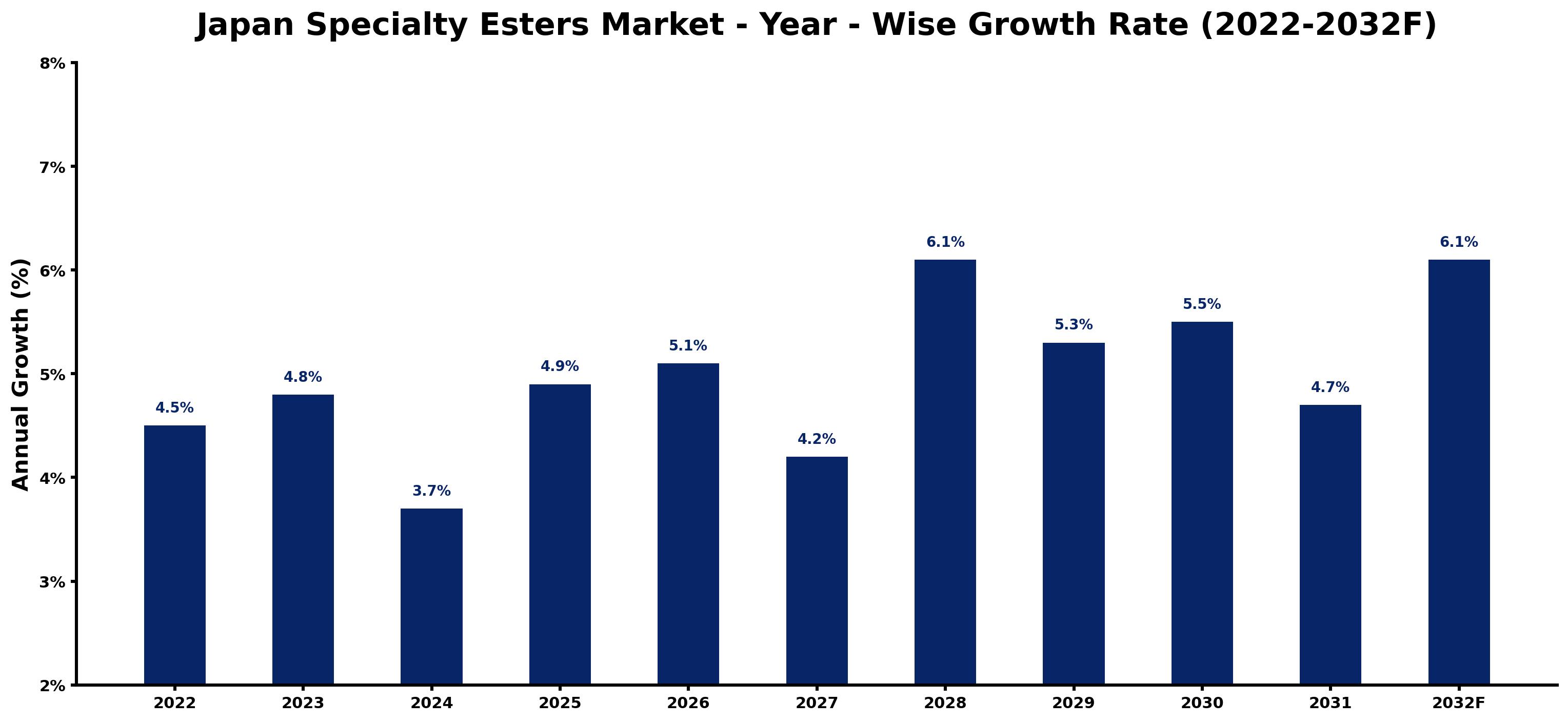
Year by year, the estimates below pair each growth rate with the development that shaped it.
| Year | Estimated Annual Growth (%) | Market Rationale |
| 2022 | 4.5 | Demand was strong, driven by personal care brands focusing on quality ingredients. |
| 2023 | 4.8 | Growth accelerated as the food processing sector increased its use of specialty esters. |
| 2024 | 3.7 | The market saw a slowdown as demand stabilised after rapid growth in previous years. |
| 2025 | 4.9 | A surge in personal care product launches boosted the market's expansion. |
| 2026 | 5.1 | Investment in sustainable materials is anticipated to lead to increased demand for specialty esters. |
| 2027 | 4.2 | Growth is projected to slow as the market adjusts to new supply chain conditions. |
| 2028 | 6.1 | The peak growth year will be driven by rising demand from the cosmetics sector. |
| 2029 | 5.3 | A slight slowdown is expected as the market begins to stabilise after rapid growth. |
| 2030 | 5.5 | Demand will rise again as the food emulsifiers segment expands. |
| 2031 | 4.7 | The market is projected to experience a slowdown as consumer preferences shift slightly. |
| 2032 | 6.1 | Growth is expected to accelerate again, driven by renewed interest in sustainable products. |
Note: Market size estimations and growth projections presented in this report are based on 6Wresearch's proprietary forecasting methodology, utilizing the latest available industry data, government publications, and primary research inputs.
Japan Specialty Esters Market Synopsis
Specialty esters are chemical compounds produced through the esterification of alcohols and acids, primarily used as emulsifiers and stabilizers in cosmetics, food, and lubricants. The Japan Specialty Esters Market is growing due to personal care brands and the food processing industry, valued at approximately 19 trillion JPY. The launch of a programme promoting sustainable materials in 2023 is driving innovation and investment in this sector, increasing the market's growth potential.
Market Dynamics Impact Analysis (2026–2032)
| Factor | Type | Impact | Primary Segment Affected |
| Rising demand from personal care brands for quality ingredients drives market growth. | Driver | High | Cosmetics |
| Increased focus on sustainability creates opportunities for eco-friendly specialty esters. | Opportunity | High | Phthalate-Free Esters |
| Regulatory scrutiny on chemical safety may limit some applications of specialty esters. | Restraint | Medium | Plasticizers |
| The need for innovative food emulsifiers presents growth opportunities for specialty esters. | Opportunity | Medium | Food Emulsifiers |
| Competition from alternative emulsifiers may hinder market expansion. | Restraint | Medium | Lubricants |
| Supply chain disruptions can affect the availability of raw materials for production. | Challenge | High | Synthetic Alcohols |
| Technological advancements in production methods may outpace current manufacturing capabilities. | Challenge | Medium | Polyol Esters |
| Growing demand from food processing firms for specialty esters enhances market potential. | Driver | High | Food Processing Firms |
Evaluation of Drivers in Japan Specialty Esters Market (2026–2032)
Below are the drivers that matter most for revenue growth, with supporting evidence.
| Drivers | Primary Segment Affected | Why It Matters (Evidence) |
| Increased investment in sustainable materials by personal care brands. | Phthalate-Free Esters | This shift is linked to consumer preferences for safer products, leading to higher purchases. |
| Rising demand for food emulsifiers as the food processing industry expands. | Food Emulsifiers | This growth is driven by the need for improved food texture and consistency, with the industry valued at approximately 19 trillion JPY. |
| The cosmetics sector's focus on formulation stability boosts demand for specialty esters. | Cosmetics | As personal care products gain popularity, brands seek quality ingredients, resulting in increased purchases. |
| Innovation in production techniques increases the supply of specialty esters. | Polyol Esters | This advancement allows manufacturers to meet growing market needs efficiently. |
| Compliance with safety standards drives demand for safer, phthalate-free alternatives. | Phthalate-Free Esters | Brands are increasingly adopting these alternatives to align with consumer safety expectations. |
What keeps demand rising is the increasing investment in sustainable materials by personal care brands, which leads to a notable rise in purchases of phthalate-free esters. The food processing industry, valued at approximately 19 trillion JPY, is expanding its use of food emulsifiers, driving demand for specialty esters. Cosmetics brands are focusing on formulation stability, resulting in higher demand for specialty esters. This growth is clear as manufacturers improve their production capabilities to meet market needs effectively. Compliance with safety standards is a crucial factor, as brands adopt safer alternatives to align with consumer expectations.
Evaluation of Restraints in Japan Specialty Esters Market
The key brakes on demand, and where they bite hardest, are shown below.
| Market Restraint | Primary Segment Affected | Why It Matters (Evidence) |
| Regulatory scrutiny on chemical safety may limit applications of certain specialty esters. | Plasticizers | This scrutiny can restrict the use of specific esters in food and personal care products. |
| Competition from alternative emulsifiers may hinder market expansion. | Lubricants | As new emulsifiers enter the market, traditional specialty esters may lose share. |
| Supply chain disruptions can affect the availability of raw materials for production. | Synthetic Alcohols | These disruptions can delay production schedules and increase costs. |
| Technological advancements in production methods may outpace current manufacturing capabilities. | Polyol Esters | This can lead to inefficiencies and increased production costs. |
| Market saturation in certain segments may limit growth opportunities. | Food Emulsifiers | As more players enter the market, competition intensifies, affecting pricing. |
Japan Specialty Esters Market Challenges
Technological gaps in esterification processes hinder efficiency for producers, leading to longer production cycles that delay product availability for buyers. Raw material shortages disrupt supply chains, causing manufacturers to struggle with fulfilling orders on time. Rising costs for fatty acids and alcohols squeeze profit margins for suppliers, forcing them to increase prices for buyers. Competition from lower-priced imports pressures local producers to cut prices, which can jeopardise their profitability and market sustainability.
Trends in the Japan Specialty Esters Market
The following changes are redrawing the Japan Specialty Esters Market.
- Shift towards Sustainable Ingredients in Cosmetics: In Tokyo, there is a noticeable shift towards sustainable ingredients in cosmetics, with a growing number of brands adopting phthalate-free esters. Approximately 60% of consumers prioritise sustainability in their purchases, reflecting changing market preferences.
- Transition from Traditional to Innovative Food Emulsifiers: Since 2023, the food processing sector has begun transitioning from traditional emulsifiers to more innovative specialty esters. This change is driven by the need for improved food texture, with 70% of food manufacturers reporting increased interest in novel emulsifiers.
- Personal Care Brands Prioritising Quality Ingredients: In 2023, personal care brands are increasingly prioritising quality ingredients, leading to a surge in demand for specialty esters. Approximately 80% of brands are reformulating products to include safer, high-quality esters, reflecting changing consumer preferences.
- Emergence of Eco-Friendly Plasticizers: The rise of eco-friendly plasticizers is reshaping the market, with manufacturers focusing on phthalate-free alternatives. This shift is clear in the increasing demand for sustainable plasticizers since 2023.
Investment Opportunities in the Japan Specialty Esters Market
Investors looking at the Japan Specialty Esters Market should consider the following areas.
- Partnership with Local Producers: Establishing partnerships with local producers can facilitate entry into the Japanese specialty esters market, especially as demand for sustainable products rises. The food processing sector is expanding, with a significant need for innovative emulsifiers.
- Focus on Phthalate-Free Alternatives: With the growing consumer preference for safer products, there is a notable gap in the supply of phthalate-free esters. Personal care brands are increasingly seeking these alternatives, creating opportunities for suppliers to meet this demand.
- Investment in Production Innovations: Investing in advanced production technologies can improve the efficiency of specialty esters manufacturing. The market is shifting towards innovative methods, which can reduce production costs and enhance output.
- Certification for Sustainable Practices: Obtaining certifications for sustainable practices can provide a competitive edge in the specialty esters market. The growing emphasis on eco-friendly products among consumers is driving demand for certified sustainable materials.
Government Initiatives in the Japan Specialty Esters Market
The Long-Term Care Insurance Act (1997, in force 2000) impacts buyers of specialty esters by ensuring that manufacturers adhere to safety standards, which can affect product formulations. Compliance with these regulations is essential for producers to access the market and meet consumer expectations.
The Ministry of Health, Labour and Welfare oversees regulations related to food emulsifiers, ensuring that specialty esters meet safety standards. This oversight supports the market by building consumer confidence in the safety and quality of these products.
Future Insight of the Japan Specialty Esters Market
Personal care brands will increasingly seek high-quality emulsifiers by 2032, driven by growing consumer demand. The introduction of new standards for specialty esters will improve product safety and quality, benefiting both buyers and suppliers. By 2030, the food processing industry will require over 19 trillion JPY in specialty esters, prompting suppliers to diversify their product offerings. As Japan's population remains around 125 million, the demand for premium personal care products will continue to fuel market growth.
Market Segmentation Analysis
Japan Specialty Esters Market report covers a detailed analysis of the following market segments:
By Ester Type – Polyol Esters Lead, Phthalate-Free Esters Expected to Grow Fastest
According to Saurav Kr Singh, Senior Research Analyst at 6Wresearch, the largest ester type category in 2025 was Polyol Esters, at 39% of revenue. Polyol esters command the largest share due to their widespread use in lubricants and cosmetics, where their stability and performance are essential. They are particularly prevalent in personal care products, which reflect the strong consumer demand in Japan. Over 2026–2032, Phthalate-Free Esters are expected to post the fastest growth, at a CAGR of 7.4%. Phthalate-free esters are rapidly gaining traction as they are favoured for their safety in personal care and plasticizer applications. The recent initiative promoting sustainable materials in Japan has further accelerated their adoption. Suppliers should prioritise the development of phthalate-free options to align with the increasing demand for safer products.
By Application Area – Cosmetics Lead, Food Emulsifiers Expected to Grow Fastest
Cosmetics accounted for 42% of the market by application area in 2025. Cosmetics dominate the market due to their reliance on specialty esters for formulation stability and enhancing skin feel in personal care products. The robust consumer demand for premium cosmetics in Japan solidifies this segment's position. Food Emulsifiers are set to record the highest CAGR in this split, 6.3% over 2026–2032. Food emulsifiers are witnessing rapid growth as they are crucial for maintaining texture and consistency in food products, particularly in Japan's food processing industry. The increasing consumer focus on food quality is propelling this segment's expansion. Suppliers should prioritise the development of high-quality emulsifiers to cater to the evolving demands of the food sector.
By Raw Material – Synthetic Alcohols Lead, Sorbitol Expected to Grow Fastest
Synthetic Alcohols took 39% of raw material revenue in 2025, more than any other category. Synthetic alcohols are the leading raw material as they are fundamental in producing various esters used across multiple applications. Their versatility and reliability in ester production make them indispensable in the specialty esters market. The quickest growth will come from Sorbitol, forecast to expand at a CAGR of 7.6% between 2026 and 2032. Sorbitol is seeing rapid growth as it serves as a key raw material for sorbitol esters, which are gaining traction in food and cosmetics. This trend is supported by the rising demand for safer and more effective ingredients. Manufacturers should consider diversifying their raw material sources to include sorbitol to meet changing market demands.
By End User – Personal Care Brands Lead, Food Processing Firms Expected to Grow Fastest
In 2025, Personal Care Brands led the end user split with a 43% share. Personal care brands are the largest end users, heavily utilising specialty esters in their formulations for cosmetics and skincare products. The substantial consumer base in Japan drives the demand for high-quality personal care items, reinforcing this segment's dominance. Food Processing Firms are projected to grow fastest, at a CAGR of 6.8% during 2026–2032. Food processing firms are the fastest-growing end users, using specialty esters to enhance food texture and stability. The rising emphasis on food quality and safety in Japan is accelerating this segment's growth. Suppliers must focus on building partnerships with food processing firms to capitalise on the increasing demand for specialty esters in food applications.
Key Attractiveness of the Report
- 10 Years of Market Numbers
- Historical Data Starting from 2022 to 2025
- Base Year 2025
- Forecast Data until 2032
- Key Performance Indicators Impacting the Market
- Major Upcoming Developments and Projects
Key Highlights of the Report:
- Japan Specialty Esters Market Outlook
- Market Size of Japan Specialty Esters Market, 2025
- Forecast of Japan Specialty Esters Market, 2032
- Historical Data and Forecast of Japan Specialty Esters Revenues & Volume for the Period 2022-2032F
- Japan Specialty Esters Market Trend Evolution
- Japan Specialty Esters Market Drivers and Challenges
- Japan Specialty Esters Price Trends
- Japan Specialty Esters Porter's Five Forces
- Japan Specialty Esters Industry Life Cycle
- Historical Data and Forecast of Japan Specialty Esters Market Revenues & Volume By Ester Type for the Period 2022-2032F
- Historical Data and Forecast of Japan Specialty Esters Market Revenues & Volume By Polyol Esters for the Period 2022-2032F
- Historical Data and Forecast of Japan Specialty Esters Market Revenues & Volume By Phthalate-Free Esters for the Period 2022-2032F
- Historical Data and Forecast of Japan Specialty Esters Market Revenues & Volume By Sorbitol Esters for the Period 2022-2032F
- Historical Data and Forecast of Japan Specialty Esters Market Revenues & Volume By Sucrose Esters for the Period 2022-2032F
- Historical Data and Forecast of Japan Specialty Esters Market Revenues & Volume By Application Area for the Period 2022-2032F
- Historical Data and Forecast of Japan Specialty Esters Market Revenues & Volume By Lubricants for the Period 2022-2032F
- Historical Data and Forecast of Japan Specialty Esters Market Revenues & Volume By Plasticizers for the Period 2022-2032F
- Historical Data and Forecast of Japan Specialty Esters Market Revenues & Volume By Cosmetics for the Period 2022-2032F
- Historical Data and Forecast of Japan Specialty Esters Market Revenues & Volume By Food Emulsifiers for the Period 2022-2032F
- Historical Data and Forecast of Japan Specialty Esters Market Revenues & Volume By Raw Material for the Period 2022-2032F
- Historical Data and Forecast of Japan Specialty Esters Market Revenues & Volume By Synthetic Alcohols for the Period 2022-2032F
- Historical Data and Forecast of Japan Specialty Esters Market Revenues & Volume By Organic Acids for the Period 2022-2032F
- Historical Data and Forecast of Japan Specialty Esters Market Revenues & Volume By Sorbitol for the Period 2022-2032F
- Historical Data and Forecast of Japan Specialty Esters Market Revenues & Volume By Sucrose & Fatty Acids for the Period 2022-2032F
- Historical Data and Forecast of Japan Specialty Esters Market Revenues & Volume By End User for the Period 2022-2032F
- Historical Data and Forecast of Japan Specialty Esters Market Revenues & Volume By Automotive OEMs for the Period 2022-2032F
- Historical Data and Forecast of Japan Specialty Esters Market Revenues & Volume By Plastic Manufacturers for the Period 2022-2032F
- Historical Data and Forecast of Japan Specialty Esters Market Revenues & Volume By Personal Care Brands for the Period 2022-2032F
- Historical Data and Forecast of Japan Specialty Esters Market Revenues & Volume By Food Processing Firms for the Period 2022-2032F
- Japan Specialty Esters Import Export Trade Statistics
- Market Opportunity Assessment By Ester Type
- Market Opportunity Assessment By Application Area
- Market Opportunity Assessment By Raw Material
- Market Opportunity Assessment By End User
- Japan Specialty Esters Top Companies Market Share
- Japan Specialty Esters Competitive Benchmarking By Technical and Operational Parameters
- Japan Specialty Esters Company Profiles
- Japan Specialty Esters Key Strategic Recommendations
Market Covered
The study includes the following segmentation.
By Ester Type
- Polyol Esters
- Phthalate-Free Esters
- Sorbitol Esters
- Sucrose Esters
By Application Area
- Lubricants
- Plasticizers
- Cosmetics
- Food Emulsifiers
By Raw Material
- Synthetic Alcohols
- Organic Acids
- Sorbitol
- Sucrose & Fatty Acids
By End User
- Automotive OEMs
- Plastic Manufacturers
- Personal Care Brands
- Food Processing Firms































