Japan Specialty Fibers Market Size & Growth Rate
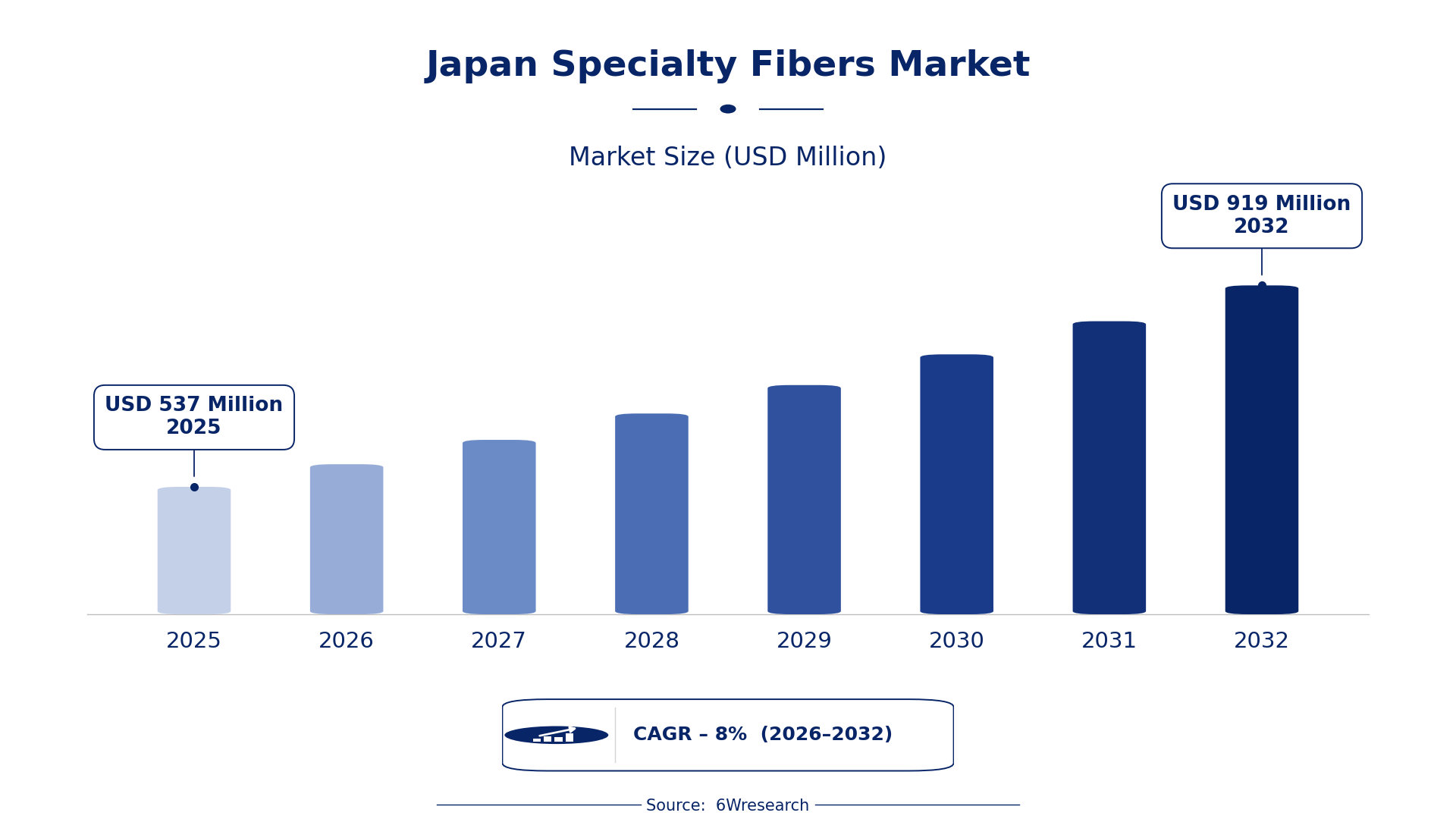
According to 6Wresearch internal database and industry insights, the Japan Specialty Fibers Market was valued at USD 537 Million in 2025 and is projected to reach USD 919 Million by 2032, growing at a CAGR of approximately 8% during 2026–2032.
Japan Specialty Fibers Market Highlights
| Report Metric | Details |
| Report Name | Japan Specialty Fibers Market (2026-2032) |
| Market Size 2025 | USD 537 Million |
| Market Size 2032 | USD 919 Million |
| Absolute Growth 2025–2032 | USD 382 Million |
| CAGR 2026–2032 | 8% |
| Peak Annual Growth | 8.5% in 2026 |
| Forecast Period | 2026–2032 |
| Historical Data | 2022–2025 |
| Base Year | 2025 |
| Leading Fiber Type, 2025 | Carbon Fibers (46% share) |
| Leading Composition, 2025 | Synthetic (39% share) |
| Leading Functionality, 2025 | High-Temperature Resistance (35% share) |
| Leading End User, 2025 | Aerospace OEMs (41% share) |
| Fastest-Growing Fiber Type | Bio-Based Fibers (11.8% CAGR) |
| Fastest-Growing Composition | Cellulose Derivatives (10.2% CAGR) |
| Fastest-Growing Functionality | Eco-Friendly (10.6% CAGR) |
| Fastest-Growing End User | Textile Brands (10.0% CAGR) |
| Growing Sector | Textile Brands |
| Key End Users | Aerospace OEMs, Protective Gear Makers, Circuit Board Producers, Textile Brands |
Japan Specialty Fibers Market Year-wise Growth Rate and Key Drivers (2022–2032)
This graph illustrates the annual growth rates of the market from 2022 to 2032, highlighting a steady upward trajectory and projected market expansion over the forecast period.
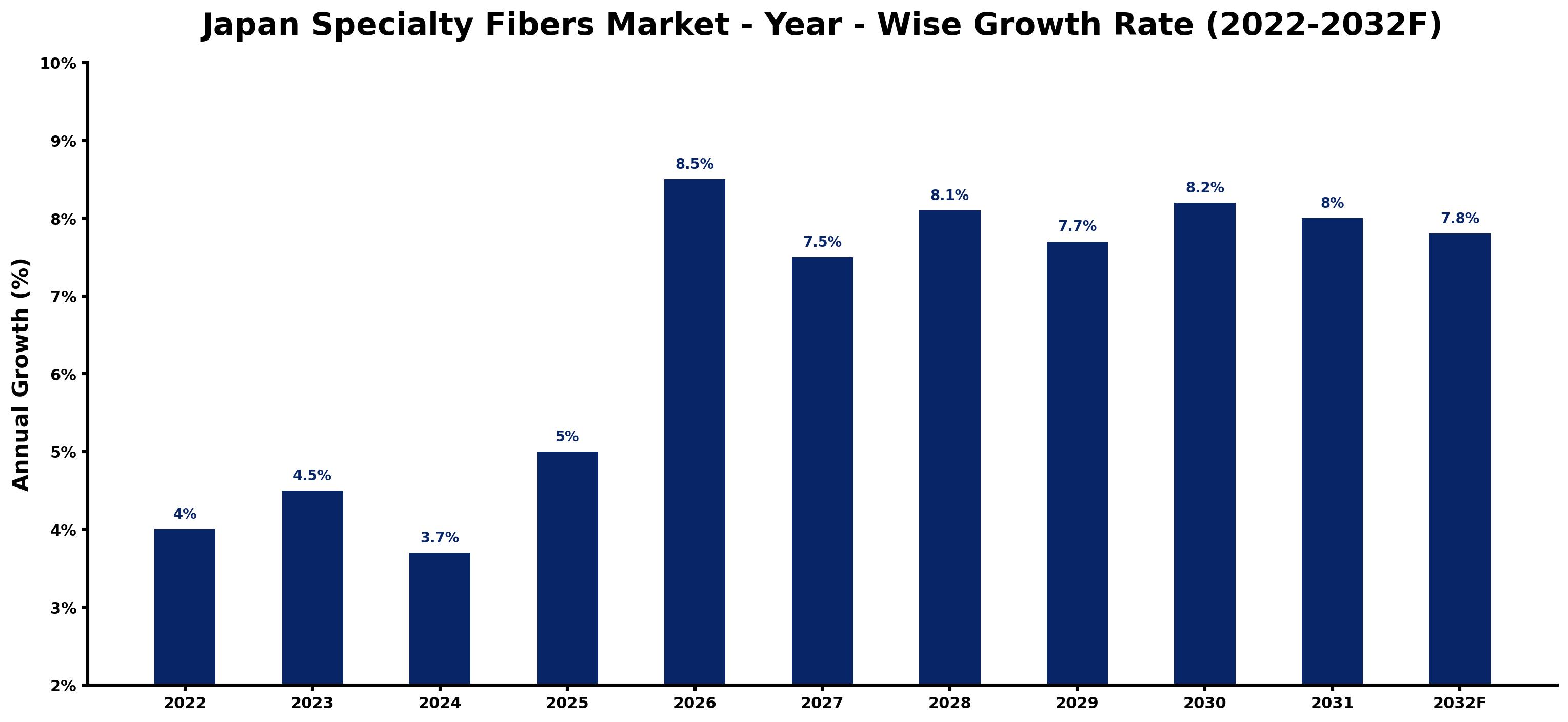
The following figures match every annual growth estimate with the main market development of that year, giving the reasoning behind each rise or slowdown.
| Year | Estimated Annual Growth (%) | Market Rationale |
| 2022 | 4.0 | The market experienced steady growth due to consistent demand from the aerospace sector. |
| 2023 | 4.5 | Increased production of aramid fibers supported a faster growth rate than the previous year. |
| 2024 | 3.7 | A slowdown occurred as demand stabilised, reflecting a more mature market phase. |
| 2025 | 5.0 | The aerospace sector's increased carbon fiber usage drove growth faster than in 2024. |
| 2026 | 8.5 | The peak growth rate is expected to be reached as demand surges for high-temperature resistant fibers. |
| 2027 | 7.5 | Growth will slow slightly as the market adjusts to the previous year's rapid expansion. |
| 2028 | 8.1 | A renewed interest in lightweight materials will lead to faster growth compared to 2027. |
| 2029 | 7.7 | The market will continue to grow, but at a slower rate as demand begins to stabilise. |
| 2030 | 8.2 | Growth is projected to accelerate again due to rising demand for specialty fibers in automotive applications. |
| 2031 | 8.0 | The market will experience a slight slowdown as growth rates normalise after previous peaks. |
| 2032 | 7.8 | Demand for specialty fibers will continue to rise, albeit at a slower pace than in 2031. |
Note: Market size estimations and growth projections presented in this report are based on 6Wresearch's proprietary forecasting methodology, utilizing the latest available industry data, government publications, and primary research inputs.
Japan Specialty Fibers Market Synopsis
Specialty fibers are advanced materials designed for specific applications, characterised by unique properties such as high strength and lightweight. The Japan Specialty Fibers Market is driven by the aerospace sector, which is projected to increase carbon fiber usage by 30% by 2025. This growth stems from the country's strong manufacturing capabilities in aerospace and protective gear, alongside government initiatives promoting eco-friendly fibers under existing regulations.
Market Dynamics Impact Analysis (2026–2032)
| Factor | Type | Impact | Primary Segment Affected |
| Increased demand for lightweight materials in aerospace applications | Driver | High | Carbon Fibers |
| Rising production of aramid fibers for protective clothing | Driver | High | Aramid Fibers |
| Growing interest in bio-based fibers for eco-friendly applications | Opportunity | Medium | Bio-Based Fibers |
| Expansion of the protective clothing market valued at over $1 billion | Opportunity | High | Protective Gear Makers |
| Regulatory compliance costs for specialty fiber manufacturers | Restraint | Medium | Synthetic |
| Limited market share for bio-based fibers in mainstream applications | Restraint | Medium | Bio-Based Fibers |
| High production costs for specialty fibers hinder market entry | Challenge | High | Carbon Fibers |
| Technological advancements require continuous investment in R&D | Challenge | Medium | High-Temperature Resistance |
Evaluation of Drivers in Japan Specialty Fibers Market (2026–2032)
Demand rests on the following drivers, each shown with the segment it touches most.
| Drivers | Primary Segment Affected | Why It Matters (Evidence) |
| Increased aerospace production | Carbon Fibers | The aerospace sector in Japan is projected to use 30% more carbon fibers by 2025, driving demand for lightweight materials. |
| Growing need for protective gear | Aramid Fibers | Japan produced 5,000 tons of aramid fibers in 2022, reflecting strong demand from protective gear makers. |
| Rising demand for lightweight automotive materials | High-Temperature Resistance | The demand for lightweight materials in automotive is increasing by 15% annually, boosting the need for high-temperature resistant fibers. |
| Government support for eco-friendly materials | Bio-Based Fibers | The Ministry of Economy, Trade and Industry promotes eco-friendly fibers, encouraging investment in sustainable materials. |
| Adoption of new standards in the textile industry | Glass Fibers | In 2023, Japan's textile industry adopted new standards for bio-based fibers, improving overall market growth. |
Several shifts outside the market lift sales. The aerospace sector is set to increase carbon fiber usage, driving demand for lightweight materials. In 2022, Japan produced a notable volume of aramid fibers, reflecting strong demand from protective gear makers. The automotive industry is experiencing a notable increase in the demand for lightweight materials, boosting high-temperature resistant fibers. New standards adopted in 2023 for bio-based fibers are expected to support growth in the textile industry.
Evaluation of Restraints in Japan Specialty Fibers Market
The main factors holding the market back are set out below.
| Market Restraint | Primary Segment Affected | Why It Matters (Evidence) |
| High production costs for specialty fibers | Carbon Fibers | Production costs remain elevated, limiting market entry for new manufacturers and impacting pricing strategies. |
| Regulatory compliance costs for manufacturers | Synthetic | Manufacturers face high costs to comply with safety and quality regulations, affecting profitability. |
| Limited market share for bio-based fibers | Bio-Based Fibers | Bio-based fibers struggle to gain traction in mainstream applications due to their niche market focus. |
| Technological advancements require continuous investment | High-Temperature Resistance | Ongoing R&D investments are necessary to keep pace with technological advancements, straining budgets. |
| Market maturity leading to slower growth rates | Glass Fibers | As the market matures, growth rates are normalising, reflecting a stabilisation phase. |
Japan Specialty Fibers Market Challenges
Producers struggle with outdated technology in specialty fiber manufacturing, hindering their ability to meet evolving market demands. High raw material costs, particularly for aramid fibers, can constitute over 20% of production expenses, squeezing profit margins for manufacturers. Supply chain disruptions in sourcing glass fibers from Kyoto Prefecture can delay production schedules, impacting delivery timelines for protective gear makers. Regulatory changes, such as the recent adoption of new standards for bio-based fibers, require compliance investments that divert crucial resources from core production activities.
Trends in the Japan Specialty Fibers Market
These developments are changing demand patterns in the Japan Specialty Fibers Market.
- Shift from Traditional to Eco-Friendly Fibers: Japan is increasingly adopting eco-friendly fibers, supported by government initiatives. Bio-based fibers are projected to grow by 11.8% annually, reflecting a shift in consumer preferences.
- Transition from Conventional to Lightweight Materials: The automotive sector is moving towards lightweight materials, with a 15% annual increase in demand. This shift is evident in the growing use of high-temperature resistant fibers.
- Emergence of New Standards for Bio-Based Fibers: In 2023, Japan's textile industry adopted new standards for bio-based fibers, improving product quality and market competitiveness. This change is expected to attract more investments in sustainable materials.
- Growth in Aerospace Applications: The aerospace sector is increasingly relying on specialty fibers, with carbon fibers projected to see a 30% increase in usage by 2025. This trend highlights the demand for lightweight and high-strength materials.
Investment Opportunities in the Japan Specialty Fibers Market
The openings below show where demand in the Japan Specialty Fibers Market is visible and how suppliers can enter.
- Timing for Eco-Friendly Investments: With the government's focus on sustainable materials, now is the time to invest in bio-based fibers. The protective clothing market, valued at over $1 billion, presents a promising opportunity.
- Supply of Lightweight Materials: The automotive industry's increasing demand for lightweight materials creates an opportunity for suppliers of high-temperature resistant fibers. Engaging with automotive manufacturers in Tokyo can facilitate market entry.
- Focus on Aerospace Components: The projected 30% increase in carbon fiber usage in aerospace applications highlights a timely investment opportunity. Collaborating with aerospace OEMs can enhance market presence.
- Expansion of Protective Gear Production: The growing protective clothing market offers opportunities for manufacturers of aramid fibers. Establishing partnerships with protective gear makers can drive sales.
Government Initiatives in the Japan Specialty Fibers Market
The Building Energy Efficiency Act, amended in 2022, requires that all new buildings adhere to updated energy standards starting April 2025. This measure ensures that manufacturers of specialty fibers used in construction comply with the latest regulations, improving product reliability and market competitiveness.
The Electrical Appliance and Material Safety Act regulates the safety of materials used in electrical appliances. This act ensures that producers of specialty fibers meet safety standards, benefiting buyers by guaranteeing product reliability and compliance with market requirements.
Future Insight of the Japan Specialty Fibers Market
Investment in specialty fibers will increase significantly by 2032, driven by rising demand in aerospace and automotive sectors. The aerospace sector will need 30% more carbon fibers by 2025, creating opportunities for suppliers to expand their product lines. Advances in production technology will lead to the development of more eco-friendly materials, aligning with new industry standards. The Tokyo Metropolitan Government's initiative to promote advanced materials will stimulate collaboration among manufacturers and research institutions, creating a more vibrant market.
Market Segmentation Analysis
Japan Specialty Fibers Market report covers a detailed analysis of the following market segments:
By Fiber Type – Carbon Fibers Lead, Bio-Based Fibers Expected to Grow Fastest
According to Saurav Kr Singh, Senior Research Analyst at 6Wresearch, Carbon Fibers accounted for 46% of the market by fiber type in 2025. Carbon fibers maintain the largest market share due to their critical application in aerospace, where lightweight strength is essential for performance. The aerospace sector's projected 30% increase in carbon fiber usage by 2025 underscores their significance in this industry. The quickest growth will come from Bio-Based Fibers, forecast to expand at a CAGR of 11.8% between 2026 and 2032. Bio-based fibers are experiencing rapid growth as demand for eco-friendly materials rises, particularly in niche applications. The Japanese government's Green Growth Strategy actively promotes these fibers, indicating a strong push towards sustainable alternatives. Suppliers must prioritise the development of eco-friendly fiber options to cater to the increasing demand from environmentally conscious buyers.
By Composition – Synthetic Leads, Cellulose Derivatives Expected to Grow Fastest
Synthetic took 39% of composition revenue in 2025, more than any other category. Synthetic fibers hold the largest share due to their widespread application in various industrial sectors, providing essential properties such as strength and durability. For instance, their dominance in the manufacturing of aerospace components underlines their critical role in high-performance applications. Over 2026–2032, Cellulose Derivatives are expected to post the fastest growth, at a CAGR of 10.2%. Cellulose derivatives are experiencing rapid growth as the textile industry shifts towards more sustainable materials, particularly with the recent adoption of bio-based fiber standards. This trend indicates a growing consumer preference for eco-friendly textiles, further driving demand in this segment. Suppliers should prioritise the development of cellulose derivatives to meet the increasing demand for sustainable textile solutions.
By Functionality – High-Temperature Resistance Leads, Eco-Friendly Expected to Grow Fastest
In 2025, High-Temperature Resistance led the functionality split with a 35% share. High-temperature resistance fibers are vital for aerospace and automotive sectors, where materials must perform reliably under extreme conditions. This functionality guarantees consistent demand from industries that require dependable materials for safety and performance. Eco-Friendly is set to record the highest CAGR in this split, 10.6% over 2026–2032. Eco-friendly fibers are gaining popularity as consumer interest in sustainable products grows, despite their current limited market share. The increasing focus on environmental impact suggests potential for expansion in this segment as consumer awareness rises. Suppliers should invest in eco-friendly solutions to capitalise on the growing market segment focused on sustainability.
By End User – Aerospace OEMs Lead, Textile Brands Expected to Grow Fastest
Aerospace OEMs held 41% of the Japan Specialty Fibers Market by end user in 2025. Aerospace OEMs represent the leading end user group as they require high-performance specialty fibers for aircraft production, ensuring a consistent demand for these advanced materials. The projected growth in the aerospace sector reinforces the importance of this customer base for suppliers. Textile Brands are projected to grow fastest, at a CAGR of 10.0% during 2026–2032. Textile brands are increasingly utilising specialty fibers in premium products, influenced by consumer demand for quality and sustainability. This trend is expected to accelerate as more brands adopt these materials to differentiate their offerings in a competitive market. Suppliers must engage with textile brands to capitalise on the rising trend of incorporating specialty fibers into high-end consumer products.
Key Attractiveness of the Report
- 10 Years of Market Numbers
- Historical Data Starting from 2022 to 2025
- Base Year 2025
- Forecast Data until 2032
- Key Performance Indicators Impacting the Market
- Major Upcoming Developments and Projects
Key Highlights of the Report:
- Japan Specialty Fibers Market Outlook
- Market Size of Japan Specialty Fibers Market, 2025
- Forecast of Japan Specialty Fibers Market, 2032
- Historical Data and Forecast of Japan Specialty Fibers Revenues & Volume for the Period 2022-2032F
- Japan Specialty Fibers Market Trend Evolution
- Japan Specialty Fibers Market Drivers and Challenges
- Japan Specialty Fibers Price Trends
- Japan Specialty Fibers Porter's Five Forces
- Japan Specialty Fibers Industry Life Cycle
- Historical Data and Forecast of Japan Specialty Fibers Market Revenues & Volume By Fiber Type for the Period 2022-2032F
- Historical Data and Forecast of Japan Specialty Fibers Market Revenues & Volume By Aramid Fibers for the Period 2022-2032F
- Historical Data and Forecast of Japan Specialty Fibers Market Revenues & Volume By Carbon Fibers for the Period 2022-2032F
- Historical Data and Forecast of Japan Specialty Fibers Market Revenues & Volume By Bio-Based Fibers for the Period 2022-2032F
- Historical Data and Forecast of Japan Specialty Fibers Market Revenues & Volume By Glass Fibers for the Period 2022-2032F
- Historical Data and Forecast of Japan Specialty Fibers Market Revenues & Volume By Composition for the Period 2022-2032F
- Historical Data and Forecast of Japan Specialty Fibers Market Revenues & Volume By Synthetic for the Period 2022-2032F
- Historical Data and Forecast of Japan Specialty Fibers Market Revenues & Volume By Carbon Composite for the Period 2022-2032F
- Historical Data and Forecast of Japan Specialty Fibers Market Revenues & Volume By Cellulose Derivatives for the Period 2022-2032F
- Historical Data and Forecast of Japan Specialty Fibers Market Revenues & Volume By Silica-Based for the Period 2022-2032F
- Historical Data and Forecast of Japan Specialty Fibers Market Revenues & Volume By Functionality for the Period 2022-2032F
- Historical Data and Forecast of Japan Specialty Fibers Market Revenues & Volume By High-Temperature Resistance for the Period 2022-2032F
- Historical Data and Forecast of Japan Specialty Fibers Market Revenues & Volume By Lightweight Strength for the Period 2022-2032F
- Historical Data and Forecast of Japan Specialty Fibers Market Revenues & Volume By Eco-Friendly for the Period 2022-2032F
- Historical Data and Forecast of Japan Specialty Fibers Market Revenues & Volume By Electrical Insulation for the Period 2022-2032F
- Historical Data and Forecast of Japan Specialty Fibers Market Revenues & Volume By End User for the Period 2022-2032F
- Historical Data and Forecast of Japan Specialty Fibers Market Revenues & Volume By Protective Gear Makers for the Period 2022-2032F
- Historical Data and Forecast of Japan Specialty Fibers Market Revenues & Volume By Aerospace OEMs for the Period 2022-2032F
- Historical Data and Forecast of Japan Specialty Fibers Market Revenues & Volume By Textile Brands for the Period 2022-2032F
- Historical Data and Forecast of Japan Specialty Fibers Market Revenues & Volume By Circuit Board Producers for the Period 2022-2032F
- Japan Specialty Fibers Import Export Trade Statistics
- Market Opportunity Assessment By Fiber Type
- Market Opportunity Assessment By Composition
- Market Opportunity Assessment By Functionality
- Market Opportunity Assessment By End User
- Japan Specialty Fibers Top Companies Market Share
- Japan Specialty Fibers Competitive Benchmarking By Technical and Operational Parameters
- Japan Specialty Fibers Company Profiles
- Japan Specialty Fibers Key Strategic Recommendations
Market Covered
The report covers the following segments.
By Fiber Type
- Aramid Fibers
- Carbon Fibers
- Bio-Based Fibers
- Glass Fibers
By Composition
- Synthetic
- Carbon Composite
- Cellulose Derivatives
- Silica-Based
By Functionality
- High-Temperature Resistance
- Lightweight Strength
- Eco-Friendly
- Electrical Insulation
By End User
- Protective Gear Makers
- Aerospace OEMs
- Textile Brands
- Circuit Board Producers































