Japan Specialty Inorganic Chemicals Market Size & Growth Rate
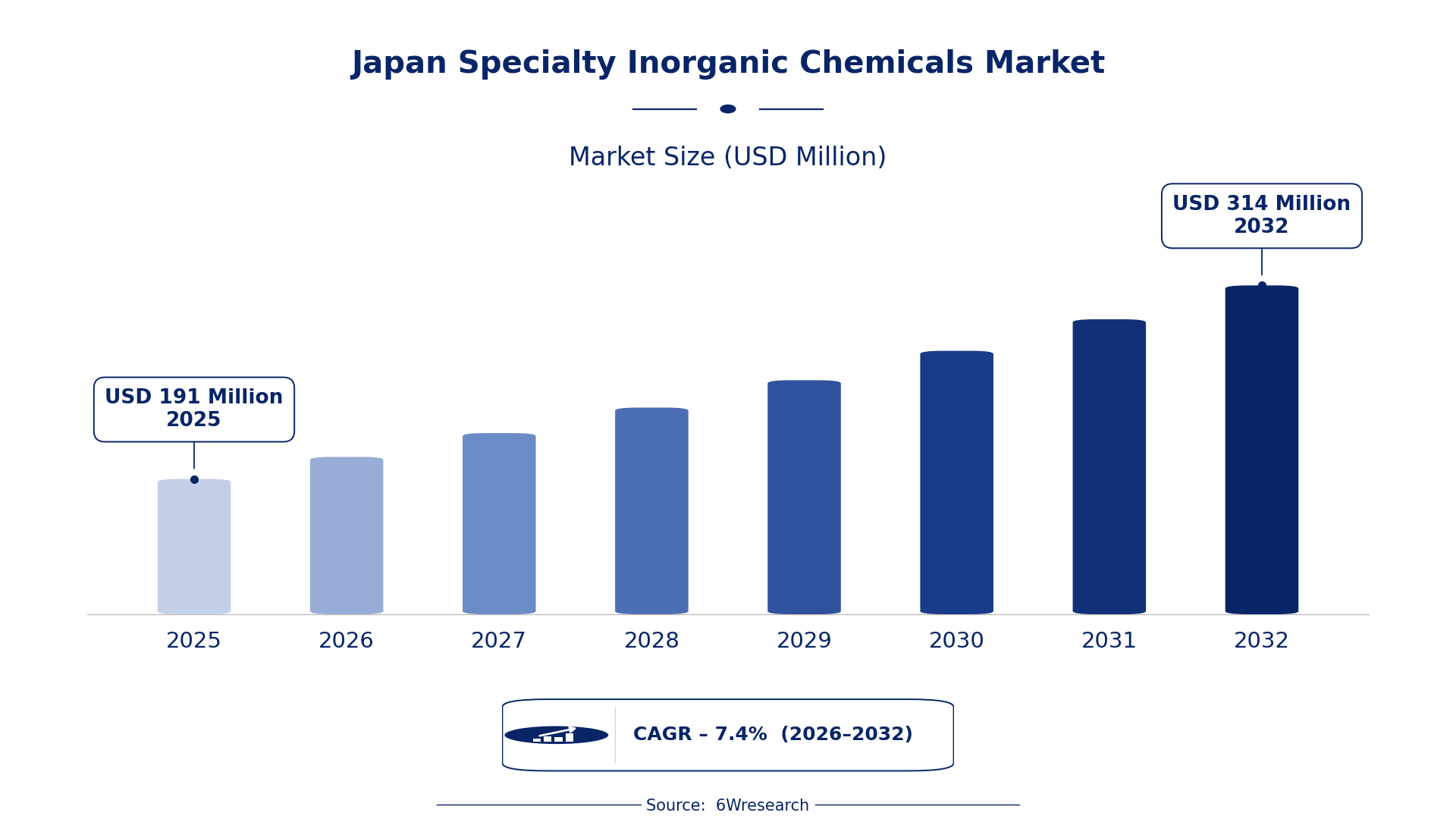
According to 6Wresearch internal database and industry insights, the Japan Specialty Inorganic Chemicals Market was valued at USD 191 Million in 2025 and is projected to reach USD 314 Million by 2032, growing at a CAGR of approximately 7.4% during 2026–2032.
Japan Specialty Inorganic Chemicals Market Highlights
| Report Metric | Details |
| Report Name | Japan Specialty Inorganic Chemicals Market (2026-2032) |
| Market Size 2025 | USD 191 Million |
| Market Size 2032 | USD 314 Million |
| Absolute Growth 2025–2032 | USD 123 Million |
| CAGR 2026–2032 | 7.4% |
| Peak Annual Growth | 8.4% in 2027 |
| Forecast Period | 2026–2032 |
| Historical Data | 2022–2025 |
| Base Year | 2025 |
| Leading Chemical Type, 2025 | Silicates (46% share) |
| Leading Usage Area, 2025 | Glass/Ceramics (41% share) |
| Leading Compound Format, 2025 | Powder (38% share) |
| Leading End User, 2025 | HVAC Manufacturers (51% share) |
| Fastest-Growing Chemical Type | Borates (10.0% CAGR) |
| Fastest-Growing Usage Area | Refrigerants (8.7% CAGR) |
| Fastest-Growing Compound Format | Coatings (10.2% CAGR) |
| Fastest-Growing End User | Tile & Ceramic Firms (9.5% CAGR) |
| Growing Sector | HVAC sector |
| Key End Users | HVAC Manufacturers, Tile & Ceramic Firms, Paint & Coating Companies |
Japan Specialty Inorganic Chemicals Market Year-wise Growth Rate and Key Drivers (2022–2032)
This graph illustrates the annual growth rates of the market from 2022 to 2032, highlighting a steady upward trajectory and projected market expansion over the forecast period.
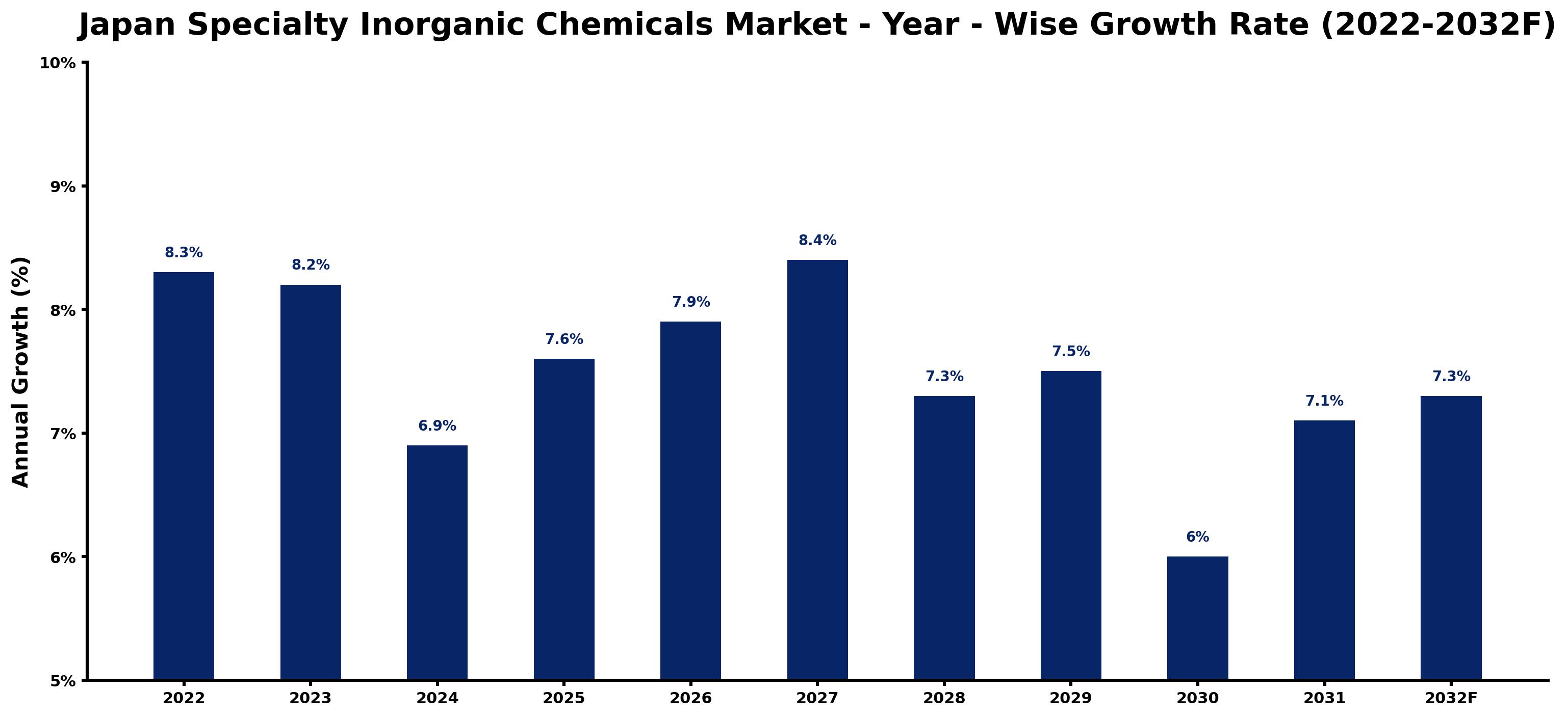
Year by year, the estimates below pair each growth rate with the development that shaped it.
| Year | Estimated Annual Growth (%) | Market Rationale |
| 2022 | 8.3 | The market was characterised by strong demand from the glass and ceramics sectors. |
| 2023 | 8.2 | Growth slowed due to market saturation in certain applications and increased competition. |
| 2024 | 6.9 | Demand continued to decelerate as manufacturers adjusted to changing market conditions. |
| 2025 | 7.6 | Growth accelerated with rising investments in the HVAC sector and construction activities. |
| 2026 | 7.9 | Market expansion continued as demand for specialty chemicals in electronics is expected to rise. |
| 2027 | 8.4 | The peak growth year will see heightened investment in decarbonisation initiatives. |
| 2028 | 7.3 | Growth is projected to slow as market players face regulatory pressures affecting production. |
| 2029 | 7.5 | Demand is expected to increase again due to expanding applications in the construction sector. |
| 2030 | 6.0 | Growth is projected to slow as the market adjusts to new environmental regulations. |
| 2031 | 7.1 | A resurgence in demand from the glass industry will boost growth rates. |
| 2032 | 7.3 | Growth will stabilise as the market adapts to evolving buyer preferences. |
Note: Market size estimations and growth projections presented in this report are based on 6Wresearch's proprietary forecasting methodology, utilizing the latest available industry data, government publications, and primary research inputs.
Japan Specialty Inorganic Chemicals Market Synopsis
Specialty inorganic chemicals are chemical compounds widely used in manufacturing, construction, and electronics. Their production involves chemical synthesis and mineral extraction, with primary applications in glass and ceramics. The Japan Specialty Inorganic Chemicals Market is expanding due to rising demand from HVAC manufacturers and the construction sector, alongside JPY 150 trillion in public and private investments in decarbonisation over ten years. This growth is driven by anticipated increases in applications across key industries, promoting further market development.
Market Dynamics Impact Analysis (2026–2032)
| Factor | Type | Impact | Primary Segment Affected |
| Increased investment in decarbonisation initiatives | Driver | High | Refrigerants |
| Rising demand from the glass and ceramics industries | Driver | High | Glass/Ceramics |
| Growing need for eco-friendly products | Opportunity | High | Fluorochemicals |
| Expansion of the HVAC sector | Opportunity | High | Refrigerants |
| Regulatory challenges affecting production | Restraint | High | Flame Retardants |
| Market saturation in certain applications | Restraint | Medium | Silicates |
| High production costs for specialty chemicals | Challenge | High | Borates |
| Increased competition from international suppliers | Challenge | Medium | Chromates |
Evaluation of Drivers in Japan Specialty Inorganic Chemicals Market (2026–2032)
The table below links each growth driver to the segment it affects and the evidence for it.
| Drivers | Primary Segment Affected | Why It Matters (Evidence) |
| Investment in decarbonisation | Refrigerants | Japan targets JPY 150 trillion in decarbonisation investments over ten years, increasing demand for refrigerants. |
| Growth in glass and ceramics production | Glass/Ceramics | The glass industry is expected to grow by 3% annually, driving demand for silicates. |
| Rising HVAC sector requirements | Refrigerants | The HVAC sector will require 150,000 tons of refrigerants by 2025, boosting market demand. |
| Technological advancements in production | Fluorochemicals | Innovations in production processes lead to higher efficiency and product quality. |
| Increased exports of specialty chemicals | Silicates | Growing international demand for Japanese specialty chemicals boosts local production. |
Orders keep climbing as investments in decarbonisation increase demand for refrigerants, with Japan targeting JPY 150 trillion over ten years. The glass industry, anticipated to grow by 3% annually, drives demand for silicates, essential in manufacturing. The HVAC sector will require 150,000 tons of refrigerants by 2025, spurring production. Innovations in fluorochemical production improve efficiency, while rising exports of specialty chemicals strengthen local manufacturing capabilities.
Evaluation of Restraints in Japan Specialty Inorganic Chemicals Market
The table below lists the restraints and the evidence behind each.
| Market Restraint | Primary Segment Affected | Why It Matters (Evidence) |
| Regulatory challenges under the Chemical Substances Control Law | Flame Retardants | Compliance with strict regulations limits production capabilities and increases operational costs. |
| Market saturation in the silicates sector | Silicates | High competition and limited growth opportunities restrict market expansion. |
| High production costs for borates | Borates | Increased costs of raw materials affect pricing and profitability for manufacturers. |
| Limited domestic demand for certain specialty chemicals | Chromates | Regulatory pressures reduce the market size for chromates in coatings applications. |
| Dependence on traditional manufacturing processes | Fluorochemicals | Outdated methods hinder competitiveness against more advanced international suppliers. |
Japan Specialty Inorganic Chemicals Market Challenges
Producers face rising costs from supply chain disruptions, which can inflate prices by 10% for buyers. These disruptions stem from natural disasters and regulatory changes, leading to delays that extend lead times by 20%. Buyers encounter difficulties due to a lack of skilled workers in the chemical sector, which hampers innovation and can delay new product offerings by two years. Technology adoption lags behind, limiting efficiency improvements and forcing producers to operate at reduced margins, which can decrease profitability by 10%.
Trends in the Japan Specialty Inorganic Chemicals Market
The shifts below are changing how Japan Specialty Inorganic Chemicals Market products are bought and supplied.
- Shift towards Eco-Friendly Refrigerants: The HVAC sector is increasingly adopting eco-friendly refrigerants, influenced by environmental regulations. By 2025, the sector will require 150,000 tons of these chemicals, prompting suppliers to innovate.
- Emergence of Advanced Silicate Applications: Tile and ceramic firms are expanding their use of silicates in new applications, reflecting a growing trend towards sustainable materials. This shift is projected to increase silicate demand significantly.
- Transition to Sustainable Manufacturing Standards: The Japan Chemical Industry Association promotes sustainable practices through JIS standards. This initiative aims to improve product quality and environmental compliance in the industry.
- Growth in Borate Applications: Borates are increasingly utilised to enhance properties of glass and ceramics, with a projected CAGR of 10% in the coming years, indicating a strong market trend.
Investment Opportunities in the Japan Specialty Inorganic Chemicals Market
Several openings in the Japan Specialty Inorganic Chemicals Market merit attention from investors.
- HVAC Manufacturers Seeking Sustainable Solutions: HVAC manufacturers are increasingly looking for eco-friendly refrigerants, with the market projected to require 150,000 tons by 2025. Suppliers can enter through partnerships with local firms.
- Supply of Silicate Products: The glass industry is set to grow by 3% annually, creating a demand for silicate products. Suppliers can target tile and ceramic firms for collaboration.
- Investment in Borate Production Technologies: With a projected CAGR of 10% for borates, there is a significant opportunity to invest in production technologies. This can benefit firms in the glass and ceramics sectors.
- Expansion of Coatings Applications: The coatings segment is projected to grow due to rising demand for specialty chemicals. Investing in advanced coating technologies can attract paint and coating companies.
Government Initiatives in the Japan Specialty Inorganic Chemicals Market
The Chemical Substances Control Law (1973) requires businesses to evaluate and control chemical substances, ensuring safety in production. This law complements the PRTR Law (1999), which mandates reporting of chemical releases, improving transparency and accountability in the industry.
In 2023, JPY 10 billion is allocated for research and development projects by the Ministry of Economy, Trade and Industry. This funding aims to encourage sustainable practices and improve production efficiency in specialty chemicals.
Future Insight of the Japan Specialty Inorganic Chemicals Market
New decarbonisation investment initiatives will emerge by 2032, driven by Japan's commitment to reducing greenhouse gas emissions. The glass industry will experience a 3% annual increase in demand for silicates, creating opportunities for suppliers. The polymer sector will need 200,000 tons of specialty chemicals by 2025, expanding the market for buyers. Stricter JIS standards will elevate quality benchmarks, ensuring consistent product performance and benefiting all stakeholders.
Market Segmentation Analysis
Japan Specialty Inorganic Chemicals Market report covers a detailed analysis of the following market segments:
By Chemical Type – Silicates Lead, Borates Expected to Grow Fastest
According to Saurav Kr Singh, Senior Research Analyst at 6Wresearch, with 46% of chemical type revenue in 2025, Silicates was the largest category. Silicates hold the largest share in Japan's specialty inorganic chemicals market due to their essential role in glass and ceramics production. Their widespread use in Aichi Prefecture's ceramic industry highlights their importance and the established demand for these materials. Borates are set to record the highest CAGR in this split, 10.0% over 2026–2032. Borates are experiencing the fastest growth as they significantly enhance the properties of glass and ceramics, aligning with the glass industry's expected annual growth of 3%. This trend indicates that silicates will continue to lead as their applications remain integral to these sectors. This trend suggests that suppliers should prioritise silicates while also considering the rising demand for borates in their product offerings.
By Usage Area – Glass/Ceramics Lead, Refrigerants Expected to Grow Fastest
Glass/Ceramics took 41% of usage area revenue in 2025, more than any other category. The glass and ceramics sector dominates this area as it is fundamental for manufacturing various products, driving substantial demand for specialty inorganic chemicals. The integration of silicates in these applications further solidifies their market position. Over 2026–2032, Refrigerants are expected to post the fastest growth, at a CAGR of 8.7%. Refrigerants are the fastest-growing segment due to their critical role in HVAC systems, with a projected requirement of 150,000 tons by 2025. This growth in HVAC demand will continue to support the glass and ceramics market. Buyers in the HVAC sector should prepare for increased competition for refrigerants as demand escalates.
By Compound Format – Powder Leads, Coatings Expected to Grow Fastest
The largest compound format category in 2025 was Powder, at 38% of revenue. The powder format leads the market as it is extensively used in ceramics and coatings applications, which are vital for numerous industrial processes. Its adaptability makes it a preferred choice among manufacturers across various sectors. Coatings are projected to grow fastest, at a CAGR of 10.2% during 2026–2032. Coatings are experiencing rapid growth due to their widespread use in diverse industrial applications, highlighting a trend towards more protective and functional materials. This surge in coatings demand will likely boost the overall need for powder formats. Suppliers must innovate in powder formulations to take advantage of the increasing demand for coatings.
By End User – HVAC Manufacturers Lead, Tile & Ceramic Firms Expected to Grow Fastest
HVAC Manufacturers held 51% of the Japan Specialty Inorganic Chemicals Market by end user in 2025. HVAC manufacturers represent the largest consumer of specialty chemicals, particularly refrigerants, which are essential for their operations. Their substantial consumption patterns highlight the significance of this segment within the market. The quickest growth will come from Tile & Ceramic Firms, forecast to expand at a CAGR of 9.5% between 2026 and 2032. Tile and ceramic firms are the fastest-growing end users as they increasingly incorporate silicates and borates into their production processes. This trend indicates a strong demand that will further reinforce the position of HVAC manufacturers. Suppliers should tailor their strategies to meet the specific needs of tile and ceramic firms to seize emerging opportunities.
Key Attractiveness of the Report
- 10 Years of Market Numbers
- Historical Data Starting from 2022 to 2025
- Base Year 2025
- Forecast Data until 2032
- Key Performance Indicators Impacting the Market
- Major Upcoming Developments and Projects
Key Highlights of the Report:
- Japan Specialty Inorganic Chemicals Market Outlook
- Market Size of Japan Specialty Inorganic Chemicals Market, 2025
- Forecast of Japan Specialty Inorganic Chemicals Market, 2032
- Historical Data and Forecast of Japan Specialty Inorganic Chemicals Revenues & Volume for the Period 2022-2032F
- Japan Specialty Inorganic Chemicals Market Trend Evolution
- Japan Specialty Inorganic Chemicals Market Drivers and Challenges
- Japan Specialty Inorganic Chemicals Price Trends
- Japan Specialty Inorganic Chemicals Porter's Five Forces
- Japan Specialty Inorganic Chemicals Industry Life Cycle
- Historical Data and Forecast of Japan Specialty Inorganic Chemicals Market Revenues & Volume By Chemical Type for the Period 2022-2032F
- Historical Data and Forecast of Japan Specialty Inorganic Chemicals Market Revenues & Volume By Fluorochemicals for the Period 2022-2032F
- Historical Data and Forecast of Japan Specialty Inorganic Chemicals Market Revenues & Volume By Silicates for the Period 2022-2032F
- Historical Data and Forecast of Japan Specialty Inorganic Chemicals Market Revenues & Volume By Borates for the Period 2022-2032F
- Historical Data and Forecast of Japan Specialty Inorganic Chemicals Market Revenues & Volume By Chromates for the Period 2022-2032F
- Historical Data and Forecast of Japan Specialty Inorganic Chemicals Market Revenues & Volume By Usage Area for the Period 2022-2032F
- Historical Data and Forecast of Japan Specialty Inorganic Chemicals Market Revenues & Volume By Refrigerants for the Period 2022-2032F
- Historical Data and Forecast of Japan Specialty Inorganic Chemicals Market Revenues & Volume By Glass/Ceramics for the Period 2022-2032F
- Historical Data and Forecast of Japan Specialty Inorganic Chemicals Market Revenues & Volume By Flame Retardants for the Period 2022-2032F
- Historical Data and Forecast of Japan Specialty Inorganic Chemicals Market Revenues & Volume By Corrosion Resistance for the Period 2022-2032F
- Historical Data and Forecast of Japan Specialty Inorganic Chemicals Market Revenues & Volume By Compound Format for the Period 2022-2032F
- Historical Data and Forecast of Japan Specialty Inorganic Chemicals Market Revenues & Volume By Gas/Liquid for the Period 2022-2032F
- Historical Data and Forecast of Japan Specialty Inorganic Chemicals Market Revenues & Volume By Powder for the Period 2022-2032F
- Historical Data and Forecast of Japan Specialty Inorganic Chemicals Market Revenues & Volume By Granules for the Period 2022-2032F
- Historical Data and Forecast of Japan Specialty Inorganic Chemicals Market Revenues & Volume By Coatings for the Period 2022-2032F
- Historical Data and Forecast of Japan Specialty Inorganic Chemicals Market Revenues & Volume By End User for the Period 2022-2032F
- Historical Data and Forecast of Japan Specialty Inorganic Chemicals Market Revenues & Volume By HVAC Manufacturers for the Period 2022-2032F
- Historical Data and Forecast of Japan Specialty Inorganic Chemicals Market Revenues & Volume By Tile & Ceramic Firms for the Period 2022-2032F
- Historical Data and Forecast of Japan Specialty Inorganic Chemicals Market Revenues & Volume By Polymer Industry for the Period 2022-2032F
- Historical Data and Forecast of Japan Specialty Inorganic Chemicals Market Revenues & Volume By Paint & Coating Companies for the Period 2022-2032F
- Japan Specialty Inorganic Chemicals Import Export Trade Statistics
- Market Opportunity Assessment By Chemical Type
- Market Opportunity Assessment By Usage Area
- Market Opportunity Assessment By Compound Format
- Market Opportunity Assessment By End User
- Japan Specialty Inorganic Chemicals Top Companies Market Share
- Japan Specialty Inorganic Chemicals Competitive Benchmarking By Technical and Operational Parameters
- Japan Specialty Inorganic Chemicals Company Profiles
- Japan Specialty Inorganic Chemicals Key Strategic Recommendations
Market Covered
The study includes the following segmentation.
By Chemical Type
- Fluorochemicals
- Silicates
- Borates
- Chromates
By Usage Area
- Refrigerants
- Glass/Ceramics
- Flame Retardants
- Corrosion Resistance
By Compound Format
- Gas/Liquid
- Powder
- Granules
- Coatings
By End User
- HVAC Manufacturers
- Tile & Ceramic Firms
- Polymer Industry
- Paint & Coating Companies































