Japan Specialty Inorganics Market Size & Growth Rate
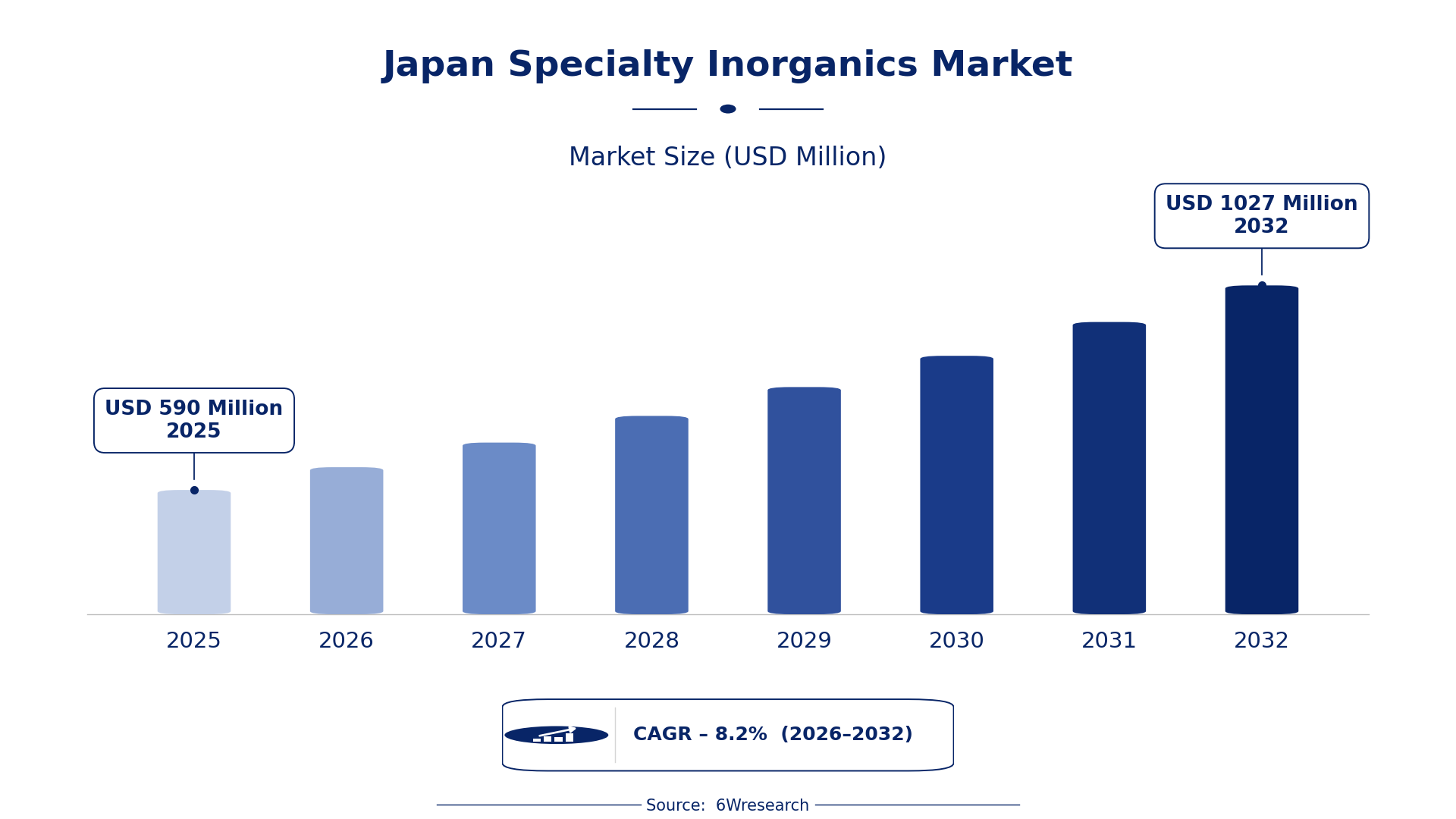
According to 6Wresearch internal database and industry insights, the Japan Specialty Inorganics Market was valued at USD 590 Million in 2025 and is projected to reach USD 1,027 Million by 2032, growing at a CAGR of approximately 8.2% during 2026–2032.
Japan Specialty Inorganics Market Highlights
| Report Metric | Details |
| Report Name | Japan Specialty Inorganics Market (2026-2032) |
| Market Size 2025 | USD 590 Million |
| Market Size 2032 | USD 1,027 Million |
| Absolute Growth 2025–2032 | USD 437 Million |
| CAGR 2026–2032 | 8.2% |
| Peak Annual Growth | 9.2% in 2028 |
| Forecast Period | 2026–2032 |
| Historical Data | 2022–2025 |
| Base Year | 2025 |
| Leading Inorganic Type, 2025 | Specialty Salts (40% share) |
| Leading Base Element, 2025 | Lithium/Zinc (42% share) |
| Leading Application Segment, 2025 | Battery Electrolytes (37% share) |
| Leading End User, 2025 | Battery Makers (43% share) |
| Fastest-Growing Inorganic Type | Oxides (11.6% CAGR) |
| Fastest-Growing Base Element | Titanium/Zinc Oxide (11.7% CAGR) |
| Fastest-Growing Application Segment | Cosmetics (11.3% CAGR) |
| Fastest-Growing End User | Skincare/Automotive Firms (10.7% CAGR) |
| Growing Sector | Cosmetics |
| Key End Users | Battery Electrolytes, Cosmetics, Catalysts, Fertilizer Precursors |
Japan Specialty Inorganics Market Year-wise Growth Rate and Key Drivers (2022–2032)
This graph illustrates the annual growth rates of the market from 2022 to 2032, highlighting a steady upward trajectory and projected market expansion over the forecast period.
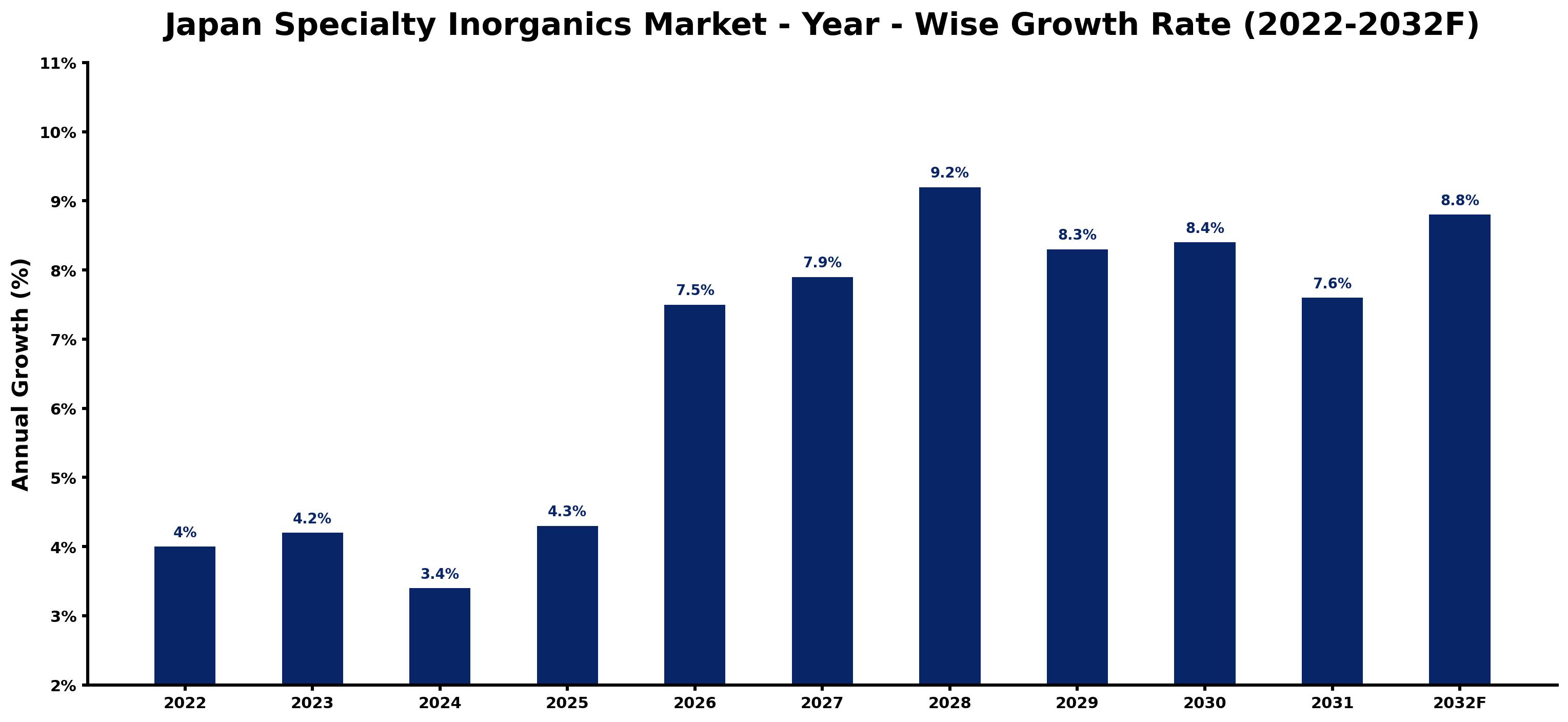
Each row of the following table gives one year's estimated growth and the event or demand shift that explains it.
| Year | Estimated Annual Growth (%) | Market Rationale |
| 2022 | 4.0 | The market experienced steady growth due to strong demand from battery manufacturers. |
| 2023 | 4.2 | Demand for specialty inorganics increased as battery production expanded further. |
| 2024 | 3.4 | Growth slowed as market adjustments occurred following previous expansions. |
| 2025 | 4.3 | The market rebounded with increased investments in battery technologies and agrochemicals. |
| 2026 | 7.5 | Demand surged as the electric vehicle sector is anticipated to accelerate. |
| 2027 | 7.9 | Continued investments in battery production will lead to further market growth. |
| 2028 | 9.2 | The peak growth rate is projected as advanced battery technologies emerge. |
| 2029 | 8.3 | Growth will moderate slightly as the market adjusts to high production levels. |
| 2030 | 8.4 | Demand is expected to increase again as new applications for specialty inorganics are discovered. |
| 2031 | 7.6 | Growth will slow as market saturation begins to affect purchasing patterns. |
| 2032 | 8.8 | The market is projected to grow as sustainability initiatives drive new demand. |
Note: Market size estimations and growth projections presented in this report are based on 6Wresearch's proprietary forecasting methodology, utilizing the latest available industry data, government publications, and primary research inputs.
Japan Specialty Inorganics Market Synopsis
Specialty inorganics are chemical compounds containing inorganic elements, produced through various synthesis and extraction methods. Their primary applications include batteries, cosmetics, and fertilizers. The Japan Specialty Inorganics Market is expanding due to increasing demand from battery makers and agrochemical firms, alongside investments in green technology initiatives. For instance, Japan's battery production reached 100 GWh in 2022, indicating a strong market for specialty inorganics, particularly lithium-based products essential for energy storage solutions.
Market Dynamics Impact Analysis (2026–2032)
| Factor | Type | Impact | Primary Segment Affected |
| Increasing demand for lithium-based products due to electric vehicle growth | Driver | High | Lithium/Zinc |
| Expansion of the cosmetics market, valued at over $30 billion | Driver | High | Silicones |
| Growing agrochemical sector supported by local agricultural production | Opportunity | High | Sulfur/Nitrogen |
| Rising investments in battery technologies driven by government initiatives | Opportunity | High | Battery Electrolytes |
| Strict regulatory standards for specialty chemicals affecting production costs | Restraint | High | Oxides |
| Market saturation in certain segments leading to price competition | Restraint | Medium | Specialty Salts |
| High production costs affecting profitability for manufacturers | Challenge | High | Battery Makers |
| Limited availability of raw materials for specialty inorganics | Challenge | Medium | Agrochemical Firms |
Evaluation of Drivers in Japan Specialty Inorganics Market (2026–2032)
The following drivers explain most of the expected growth.
| Drivers | Primary Segment Affected | Why It Matters (Evidence) |
| Growing demand for electric vehicles | Lithium/Zinc | This demand increases the need for lithium-based products, essential for battery production, as evidenced by Japan's battery production reaching 100 GWh in 2022. |
| Expansion of the cosmetics market | Silicone Inorganics | The cosmetics sector, valued at over $30 billion, drives higher purchases of silicone-based ingredients used in skincare products. |
| Support for local agriculture | Sulfur/Nitrogen | The agrochemical sector's growth increases the demand for sulfur and nitrogen compounds, essential for fertilizers. |
| Green technology initiatives | Battery Electrolytes | The 2023 initiative focusing on battery materials boosts demand for battery electrolytes, critical for energy storage solutions. |
| Rising use of catalysts in chemical processes | Oxides | The anticipated increase in catalysts for chemical processes is expected to elevate the use of oxides, enhancing production efficiency. |
The strongest pull on demand comes from the growing need for electric vehicles, with battery production reaching 100 GWh in 2022, leading to increased purchases of lithium-based products. The cosmetics sector, valued at over $30 billion, drives demand for silicone-based ingredients used in skincare. Support for local agriculture fuels the agrochemical sector, increasing the need for sulfur and nitrogen compounds. The rise in catalysts for chemical processes is expected to boost the use of oxides, as industries strive for greater production efficiency.
Evaluation of Restraints in Japan Specialty Inorganics Market
These restraints slow adoption and weigh on supplier margins.
| Market Restraint | Primary Segment Affected | Why It Matters (Evidence) |
| Strict regulatory standards for specialty chemicals | Oxides | Japan's regulatory framework imposes high compliance costs, affecting profitability for producers of specialty inorganics. |
| Market saturation in certain segments | Specialty Salts | Increased competition leads to price pressures, impacting the profitability of specialty salts producers. |
| High production costs for specialty inorganics | Lithium/Zinc | Rising costs of raw materials and production processes limit margins for battery makers reliant on lithium. |
| Limited availability of raw materials | Agrochemical Firms | Supply chain disruptions restrict access to essential materials, delaying production for agrochemical firms. |
| Environmental regulations increasing operational costs | Silicones | Compliance with environmental standards raises costs for manufacturers of silicone in personal care products. |
Japan Specialty Inorganics Market Challenges
Tokyo's battery producers face challenges with outdated technology, causing production delays of up to three months and reducing competitiveness. Strict JIS and ISO standards raise operational costs for producers by around 15%, impacting their pricing strategies and profitability. Intense competition in the specialty inorganics market compels suppliers to lower prices, resulting in profit margins that limit their ability to invest in research and development. A shortage of skilled workers in the chemical sector constrains production capacity, leading to delays that affect buyers reliant on timely deliveries for their manufacturing processes.
Trends in the Japan Specialty Inorganics Market
The trends below show where the Japan Specialty Inorganics Market is heading.
- Tokyo Emerging as a Specialty Inorganics Hub: The Tokyo metropolitan area is becoming a major hub for specialty inorganic production, accounting for a large portion of consumption, indicating a concentration of manufacturing capabilities.
- Shift Towards Sustainable Battery Materials: The green technology initiative launched in 2023 drives a shift towards sustainable materials in battery production, aiming to reduce carbon emissions and align with Japan's climate targets.
- Increase in Silicone-Based Products in Skincare: The demand for silicone-based products in the skincare industry is rising, reflecting a growing trend towards high-performance ingredients, supported by the cosmetics market's value exceeding $30 billion.
- Growth in Agrochemicals Driven by Local Production: The agrochemical sector is experiencing growth due to support for local agricultural production, enhancing the demand for sulfur and nitrogen compounds in fertilizers.
Investment Opportunities in the Japan Specialty Inorganics Market
The following opportunities in the Japan Specialty Inorganics Market pair current demand with a clear way in.
- Timing for Investment in Battery Materials: With battery production reaching 100 GWh in 2022, there is an opportunity to supply lithium-based products to battery manufacturers, particularly in Tokyo.
- Agrochemical Firms Seeking Sustainable Solutions: Agrochemical firms are increasingly looking for sustainable sulfur and nitrogen compounds, driven by local agricultural production, creating opportunities for suppliers in this sector.
- Silicone Suppliers for Skincare Products: The cosmetics market's value exceeding $30 billion presents opportunities for suppliers of silicone-based products, particularly in skincare, as demand continues to rise.
- Investment in Green Technology Initiatives: The 2023 green technology initiative highlights the need for innovative battery materials, offering opportunities for suppliers to engage with battery manufacturers.
Government Initiatives in the Japan Specialty Inorganics Market
The Economic Security Promotion Act (2022) supports supply-chain resilience for critical products and materials, ensuring that producers of specialty inorganics can maintain consistent access to essential raw materials. The Chemical Substances Control Law (1973) requires evaluation and control of new and existing chemical substances in manufacture and import, ensuring that specialty inorganics meet safety and environmental standards.
In 2023, the Japanese government allocated funding for the green technology initiative, promoting the development of sustainable materials in battery production, administered by the Ministry of Economy, Trade and Industry. This initiative aims to enhance the competitiveness of Japanese manufacturers in the specialty chemicals sector.
Future Insight of the Japan Specialty Inorganics Market
The shift towards green technology will drive advancements in battery materials, prompting suppliers to innovate and comply with new standards. By 2032, Japan's battery production is expected to reach 150 GWh, benefiting both producers and buyers in the electric vehicle sector. Increased demand for lithium-based products will improve production capabilities, creating opportunities for suppliers. The government's carbon emission reduction targets will encourage sustainable practices across the specialty chemicals sector, shaping future market trends.
Market Segmentation Analysis
Japan Specialty Inorganics Market report covers a detailed analysis of the following market segments:
By Inorganic Type – Specialty Salts Lead, Oxides Expected to Grow Fastest
According to Saurav Kr Singh, Senior Research Analyst at 6Wresearch, with 40% of inorganic type revenue in 2025, Specialty Salts was the largest category. Specialty salts dominate the market because of their vital role in fertilizers and industrial applications, particularly in Japan's agricultural sector. The Tokyo metropolitan area significantly contributes to this demand, underlining the importance of local agricultural production. Oxides are projected to grow fastest, at a CAGR of 11.6% during 2026–2032. Oxides are experiencing rapid growth, largely driven by the increase in battery production, which reached 100 GWh in 2022. The government's focus on green technology initiatives for battery materials will likely sustain this upward trend. Suppliers should focus on increasing specialty salts production to meet the robust demand from agricultural users.
By Base Element – Lithium/Zinc Leads, Titanium/Zinc Oxide Expected to Grow Fastest
Lithium/Zinc accounted for 42% of the market by base element in 2025. Lithium and zinc are essential for battery electrolytes, making them the leading sub-segment in the market. The surge in electric vehicle production in Japan has further solidified their importance in the specialty inorganics sector. The quickest growth will come from Titanium/Zinc Oxide, forecast to expand at a CAGR of 11.7% between 2026 and 2032. Titanium and zinc oxide are growing quickly due to their critical applications in coatings and plastics, which are in high demand as industries expand. This growth is indicative of broader trends in manufacturing and consumer products. Buyers should consider securing long-term contracts for lithium and zinc to ensure stable supply amidst rising demand.
By Application Segment – Battery Electrolytes Lead, Cosmetics Expected to Grow Fastest
Battery Electrolytes held 37% of the Japan Specialty Inorganics Market by application segment in 2025. Battery electrolytes occupy the largest share as they are essential for energy storage solutions, especially with the growing electric vehicle market. The substantial battery production in Japan underscores the critical nature of this application segment. Over 2026–2032, Cosmetics are expected to post the fastest growth, at a CAGR of 11.3%. The cosmetics segment is expanding swiftly, propelled by a skincare market valued at over $30 billion. This growth signals a shift in consumer preferences towards specialty inorganics in personal care applications. Suppliers must focus on innovation to address the increasing demand for specialty inorganics in the cosmetics industry.
By End User – Battery Makers Lead, Skincare/Automotive Firms Expected to Grow Fastest
Battery Makers took 43% of end user revenue in 2025, more than any other category. Battery makers are the primary consumers of specialty inorganics, greatly impacting the demand for materials such as lithium and zinc. Their crucial role in the energy sector highlights the significance of this end-user group in Japan's market. Skincare/Automotive Firms are set to record the highest CAGR in this split, 10.7% over 2026–2032. Skincare and automotive firms are rapidly increasing their use of specialty inorganics, particularly silicones, due to their essential roles in product formulations. This trend indicates a shift towards more advanced products in these industries. Suppliers should prioritise building relationships with skincare and automotive firms to capitalise on their increasing demand.
Key Attractiveness of the Report
- 10 Years of Market Numbers
- Historical Data Starting from 2022 to 2025
- Base Year 2025
- Forecast Data until 2032
- Key Performance Indicators Impacting the Market
- Major Upcoming Developments and Projects
Key Highlights of the Report:
- Japan Specialty Inorganics Market Outlook
- Market Size of Japan Specialty Inorganics Market, 2025
- Forecast of Japan Specialty Inorganics Market, 2032
- Historical Data and Forecast of Japan Specialty Inorganics Revenues & Volume for the Period 2022-2032F
- Japan Specialty Inorganics Market Trend Evolution
- Japan Specialty Inorganics Market Drivers and Challenges
- Japan Specialty Inorganics Price Trends
- Japan Specialty Inorganics Porter's Five Forces
- Japan Specialty Inorganics Industry Life Cycle
- Historical Data and Forecast of Japan Specialty Inorganics Market Revenues & Volume By Inorganic Type for the Period 2022-2032F
- Historical Data and Forecast of Japan Specialty Inorganics Market Revenues & Volume By Specialty Salts for the Period 2022-2032F
- Historical Data and Forecast of Japan Specialty Inorganics Market Revenues & Volume By Oxides for the Period 2022-2032F
- Historical Data and Forecast of Japan Specialty Inorganics Market Revenues & Volume By Nonmetallic Compounds for the Period 2022-2032F
- Historical Data and Forecast of Japan Specialty Inorganics Market Revenues & Volume By Silicones for the Period 2022-2032F
- Historical Data and Forecast of Japan Specialty Inorganics Market Revenues & Volume By Base Element for the Period 2022-2032F
- Historical Data and Forecast of Japan Specialty Inorganics Market Revenues & Volume By Lithium/Zinc for the Period 2022-2032F
- Historical Data and Forecast of Japan Specialty Inorganics Market Revenues & Volume By Titanium/Zinc Oxide for the Period 2022-2032F
- Historical Data and Forecast of Japan Specialty Inorganics Market Revenues & Volume By Sulfur/Nitrogen for the Period 2022-2032F
- Historical Data and Forecast of Japan Specialty Inorganics Market Revenues & Volume By Silicone Inorganics for the Period 2022-2032F
- Historical Data and Forecast of Japan Specialty Inorganics Market Revenues & Volume By Application Segment for the Period 2022-2032F
- Historical Data and Forecast of Japan Specialty Inorganics Market Revenues & Volume By Battery Electrolytes for the Period 2022-2032F
- Historical Data and Forecast of Japan Specialty Inorganics Market Revenues & Volume By Cosmetics, Catalysts for the Period 2022-2032F
- Historical Data and Forecast of Japan Specialty Inorganics Market Revenues & Volume By Fertilizer Precursors for the Period 2022-2032F
- Historical Data and Forecast of Japan Specialty Inorganics Market Revenues & Volume By Adhesives/Sealants for the Period 2022-2032F
- Historical Data and Forecast of Japan Specialty Inorganics Market Revenues & Volume By End User for the Period 2022-2032F
- Historical Data and Forecast of Japan Specialty Inorganics Market Revenues & Volume By Battery Makers for the Period 2022-2032F
- Historical Data and Forecast of Japan Specialty Inorganics Market Revenues & Volume By Skincare/Automotive Firms for the Period 2022-2032F
- Historical Data and Forecast of Japan Specialty Inorganics Market Revenues & Volume By Agrochemical Firms for the Period 2022-2032F
- Historical Data and Forecast of Japan Specialty Inorganics Market Revenues & Volume By Construction Industry for the Period 2022-2032F
- Japan Specialty Inorganics Import Export Trade Statistics
- Market Opportunity Assessment By Inorganic Type
- Market Opportunity Assessment By Base Element
- Market Opportunity Assessment By Application Segment
- Market Opportunity Assessment By End User
- Japan Specialty Inorganics Top Companies Market Share
- Japan Specialty Inorganics Competitive Benchmarking By Technical and Operational Parameters
- Japan Specialty Inorganics Company Profiles
- Japan Specialty Inorganics Key Strategic Recommendations
Market Covered
This report examines the market across the segments below.
By Inorganic Type
- Specialty Salts
- Oxides
- Nonmetallic Compounds
- Silicones
By Base Element
- Lithium/Zinc
- Titanium/Zinc Oxide
- Sulfur/Nitrogen
- Silicone Inorganics
By Application Segment
- Battery Electrolytes
- Cosmetics
- Catalysts
- Fertilizer Precursors
- Adhesives/Sealants
By End User
- Battery Makers
- Skincare/Automotive Firms
- Agrochemical Firms
- Construction Industry































