Japan Specialty Metals Market Size & Growth Rate
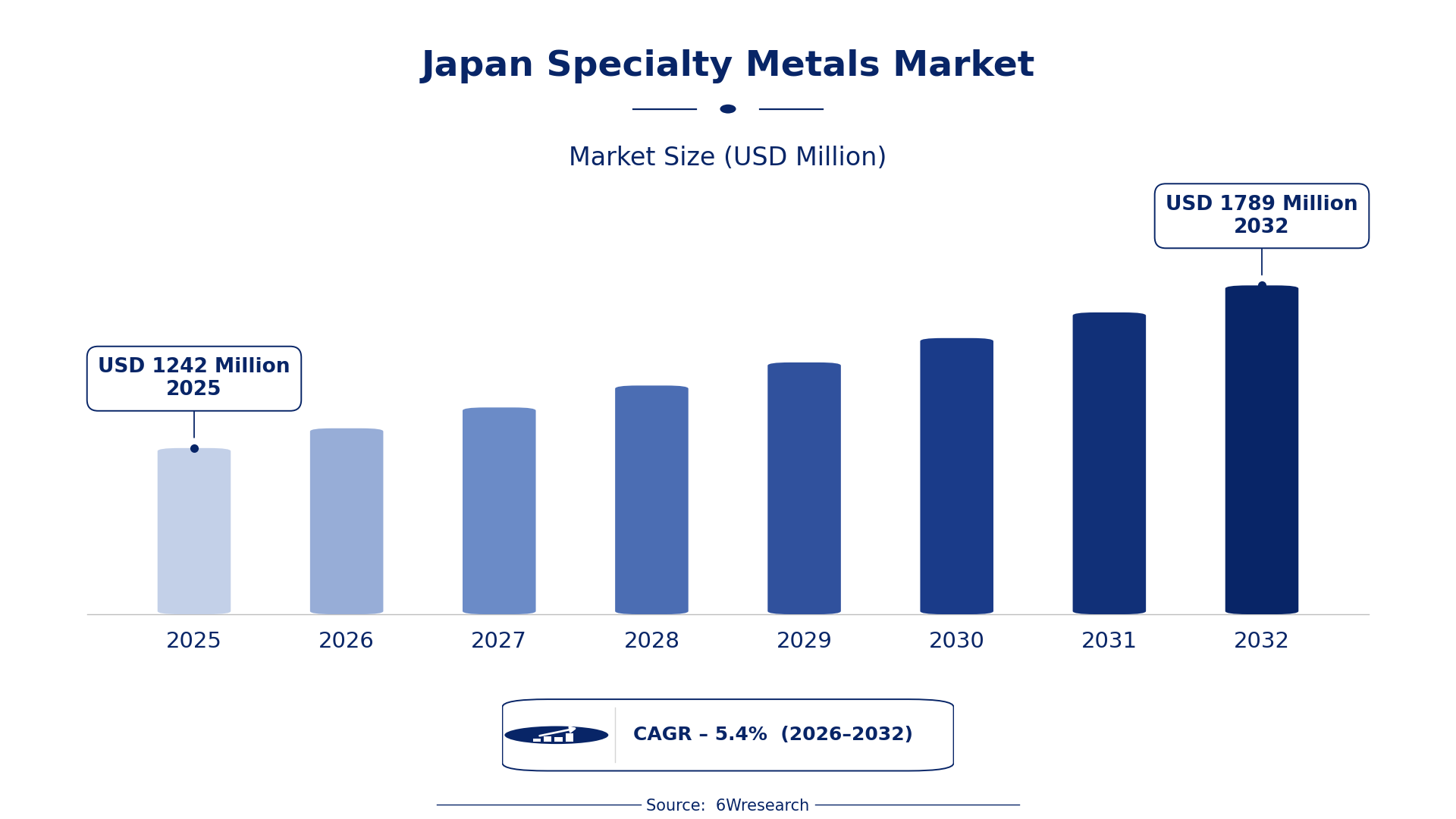
According to 6Wresearch internal database and industry insights, the Japan Specialty Metals Market was valued at USD 1,242 Million in 2025 and is projected to reach USD 1,789 Million by 2032, growing at a CAGR of approximately 5.4% during 2026–2032.
Japan Specialty Metals Market Highlights
| Report Metric | Details |
| Report Name | Japan Specialty Metals Market (2026-2032) |
| Market Size 2025 | USD 1,242 Million |
| Market Size 2032 | USD 1,789 Million |
| Absolute Growth 2025–2032 | USD 547 Million |
| CAGR 2026–2032 | 5.4% |
| Peak Annual Growth | 6.6% in 2032 |
| Forecast Period | 2026–2032 |
| Historical Data | 2022–2025 |
| Base Year | 2025 |
| Leading Metal Type, 2025 | Titanium (39% share) |
| Leading Purity Grade, 2025 | Aerospace Grade (46% share) |
| Leading Application Use, 2025 | Jet Engines (38% share) |
| Leading End User, 2025 | Aircraft OEMs (41% share) |
| Fastest-Growing Metal Type | Tantalum (7.6% CAGR) |
| Fastest-Growing Purity Grade | Electronics Grade (7.9% CAGR) |
| Fastest-Growing Application Use | Capacitors (7.3% CAGR) |
| Fastest-Growing End User | Semiconductor Firms (7.2% CAGR) |
| Growing Sector | Aerospace |
| Key End Users | Aircraft OEMs, Semiconductor Firms, Power Utilities, Energy Equipment Makers |
Japan Specialty Metals Market Year-wise Growth Rate and Key Drivers (2022–2032)
This graph illustrates the annual growth rates of the market from 2022 to 2032, highlighting a steady upward trajectory and projected market expansion over the forecast period.
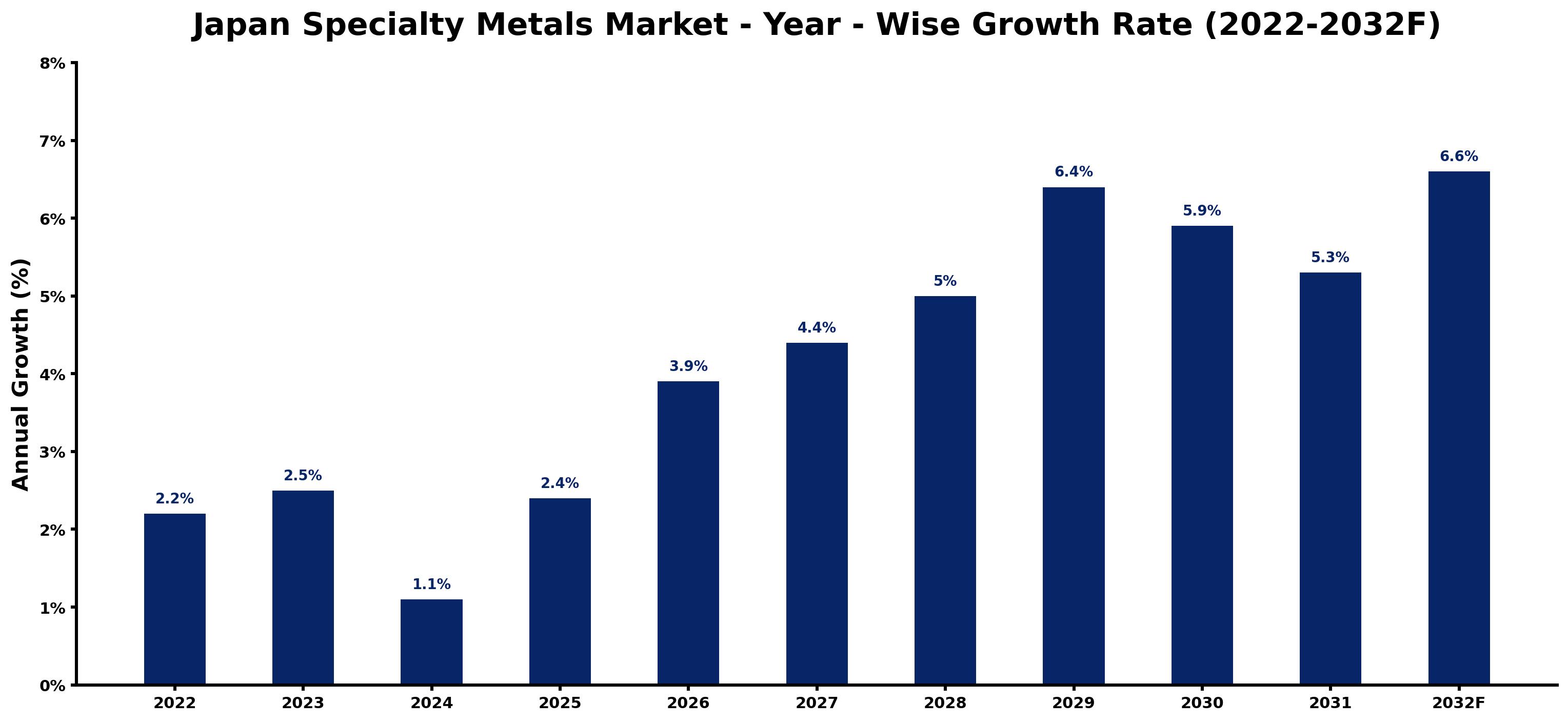
For each year, the table pairs the estimated growth rate with the leading influence on demand, showing how the drivers changed across the period.
| Year | Estimated Annual Growth (%) | Market Rationale |
| 2022 | 2.2 | The market showed steady growth, driven by demand from aerospace applications. |
| 2023 | 2.5 | Growth accelerated as the aerospace sector valued at approximately $40 billion expanded. |
| 2024 | 1.1 | The market experienced a slowdown as demand stabilised after previous gains. |
| 2025 | 2.4 | Demand increased again, supported by investments in advanced materials for aerospace. |
| 2026 | 3.9 | The market is expected to grow as semiconductor firms increase their material investments. |
| 2027 | 4.4 | Demand is projected to rise further due to innovations in power generation technologies. |
| 2028 | 5.0 | The market will continue to grow as the aerospace sector seeks high-performance materials. |
| 2029 | 6.4 | Growth is expected to accelerate as the demand for superalloys in turbine blades rises. |
| 2030 | 5.9 | The market is projected to slow slightly as supply chain adjustments take place. |
| 2031 | 5.3 | Growth is expected to moderate as the market stabilises after rapid expansion. |
| 2032 | 6.6 | Demand is forecasted to peak, driven by increased investments in aerospace technologies. |
Note: Market size estimations and growth projections presented in this report are based on 6Wresearch's proprietary forecasting methodology, utilizing the latest available industry data, government publications, and primary research inputs.
Japan Specialty Metals Market Synopsis
Specialty metals are high-performance alloys produced through advanced metallurgical processes, primarily used in aerospace, electronics, and nuclear applications. The Japan Specialty Metals Market is expanding due to strong demand from the aerospace sector, valued at approximately $40 billion. Japan is targeting about JPY 150 trillion in decarbonisation investment over ten years, which is driving further demand for specialty metals in high-tech applications and manufacturing processes.
Market Dynamics Impact Analysis (2026–2032)
| Factor | Type | Impact | Primary Segment Affected |
| Increasing demand from the aerospace sector drives the need for high-performance materials. | Driver | High | Titanium |
| Rising investments in semiconductor technology boost the consumption of specialty metals. | Driver | High | Tantalum |
| Growing need for advanced materials in energy generation creates opportunities for suppliers. | Opportunity | High | Superalloys |
| The push for decarbonisation in Japan opens avenues for investment in specialty metals. | Opportunity | High | Electronics Grade |
| Supply chain disruptions can limit the availability of critical materials for production. | Restraint | Medium | Zirconium |
| High production costs may deter new entrants into the specialty metals market. | Restraint | Medium | Niobium |
| Competition from alternative materials may affect market share for specialty metals. | Challenge | Medium | Aerospace Grade |
| Technological advancements in material science could shift demand away from traditional specialty metals. | Challenge | Medium | Jet Engines |
Evaluation of Drivers in Japan Specialty Metals Market (2026–2032)
The factors lifting demand, and the evidence behind each, are summarised below.
| Drivers | Primary Segment Affected | Why It Matters (Evidence) |
| Strong demand from the aerospace sector for titanium due to its strength-to-weight ratio. | Titanium | Japan produced 2,500 tons of titanium in 2022, primarily for aerospace applications. |
| Increased investment in semiconductor technology drives the need for tantalum in capacitors. | Tantalum | Japan's semiconductor industry invested $10 billion in advanced materials in 2023. |
| The need for superalloys in turbine blades is rising due to power generation sector demands. | Superalloys | Power utilities in Japan are investing in turbine technology for efficiency improvements. |
| The aerospace sector's growth fuels demand for high-performance materials like zirconium. | Zirconium | Japan's aerospace sector is valued at approximately $40 billion, driving material needs. |
| The push for decarbonisation increases the demand for high-purity metals in electronics. | Electronics Grade | The Electronics Industry Association of Japan promotes the use of high-purity metals. |
Most of the extra volume comes from the aerospace sector, which is valued at approximately $40 billion, leading to increased purchases of titanium for aircraft components. In 2023, the semiconductor industry’s $10 billion investment in advanced materials is driving demand for tantalum in capacitors. Utilities are focusing on superalloys to improve turbine technology, responding to the power generation sector's needs for efficiency. The emphasis on high-purity metals in electronics is growing, as manufacturers seek to enhance product quality and performance.
Evaluation of Restraints in Japan Specialty Metals Market
Several factors work against faster growth; the main ones are summarised below.
| Market Restraint | Primary Segment Affected | Why It Matters (Evidence) |
| Supply chain disruptions limit the availability of zirconium for reactor components. | Zirconium | Japan's nuclear power plants rely on zirconium for reactor components, affecting production timelines. |
| High production costs deter new entrants in the niobium market. | Niobium | Rising costs of extraction and processing make it challenging for new suppliers to compete. |
| Regulatory hurdles can slow down the introduction of new specialty metals. | Superalloys | Compliance with standards set by the Japan Metal Industry Federation can delay market entry. |
| Limited recycling capabilities for specialty metals may constrain supply. | Electronics Grade | The Electronics Industry Association of Japan highlights the need for improved recycling processes. |
| Competition from alternative materials reduces market share for specialty metals. | Aerospace Grade | Innovations in composite materials present alternatives to traditional specialty metals in aerospace. |
Japan Specialty Metals Market Challenges
Japan's stringent regulations from the Ministry of the Environment can delay production timelines for suppliers, resulting in compliance costs that can exceed 15% of operational budgets. Rapid technological advancements in manufacturing processes require continuous investment, which strains budgets for producers aiming to keep pace with innovation. Supply chain disruptions, particularly in sourcing raw materials, can lead to delays for buyers reliant on timely deliveries, potentially extending project timelines by up to 20%. Rising costs of energy and raw materials can inflate prices for clinics and manufacturers, complicating their ability to maintain competitive pricing.
Trends in the Japan Specialty Metals Market
Buyers and suppliers in the Japan Specialty Metals Market are adjusting to the following trends.
- Shift from Conventional to Advanced Materials in Aerospace: Beginning in 2023, the aerospace sector is increasingly adopting advanced materials for aircraft components. The Japan Aerospace Exploration Agency sets stringent standards, driving innovation and improving performance in aircraft design.
- Transition from Traditional to High-Purity Metals in Electronics: Starting in 2022, the electronics industry is prioritising high-purity metals for capacitors. The Electronics Industry Association of Japan reports a growing emphasis on quality, resulting in increased demand for specialty metals.
- Emergence of Sustainable Practices in Specialty Metals Production: Since 2021, there has been a shift towards sustainable production methods in specialty metals. The Green Growth Strategy Through Achieving Carbon Neutrality in 2050 encourages investments in eco-friendly technologies.
- Prioritisation of Superalloys in Power Generation: In 2023, power utilities are focusing on superalloys for turbine blades. Investments in advanced turbine technology are expected to improve efficiency and performance in energy generation.
Investment Opportunities in the Japan Specialty Metals Market
The following opportunities in the Japan Specialty Metals Market pair current demand with a clear way in.
- Investment in Advanced Titanium Alloys: With Japan's aerospace sector expanding, there is a growing opportunity to supply advanced titanium alloys. The sector is projected to require more than 2,500 tons annually, making it a prime target for suppliers.
- Focus on High-Purity Tantalum for Electronics: As the semiconductor industry invests significantly, there is a timely opportunity to supply high-purity tantalum. Semiconductor firms are increasing their material needs, creating a market for suppliers to engage.
- Development of Zirconium for Nuclear Applications: The ongoing demand for zirconium in reactor components presents an opportunity for suppliers. Japan's nuclear power plants require consistent quality, making this a critical area for investment.
- Supply of Superalloys for Turbine Technology: With power utilities investing in turbine technology, there is a strong demand for superalloys. Suppliers can enter this market by partnering with utilities to meet their advanced material needs.
Government Initiatives in the Japan Specialty Metals Market
The Economic Security Promotion Act (2022) supports supply-chain resilience for critical materials, including specialty metals. This law builds on previous regulations by ensuring that producers maintain stable supply chains and can adapt to market fluctuations, thereby supporting the industry’s stability and growth. The act also aims to encourage cooperation between public and private sectors, promoting innovation and investment in the specialty metals market.
The PRTR Law (1999) requires businesses to report chemical substances, benefiting aerospace manufacturers by ensuring compliance with safety standards. This transparency helps improve the quality of specialty metals used in aircraft components.
Future Insight of the Japan Specialty Metals Market
A shift towards a 46% reduction in greenhouse-gas emissions by 2030 will drive demand for advanced materials, prompting suppliers to innovate and adapt. The JPY 150 trillion decarbonisation investment will strengthen the specialty metals sector, enabling buyers to access improved products. By 2032, standards set by the Japan Aerospace Exploration Agency will ensure higher quality and performance in aerospace applications. The semiconductor industry's $10 billion investment in advanced materials will further stimulate growth and innovation in the specialty metals market.
Market Segmentation Analysis
Japan Specialty Metals Market report covers a detailed analysis of the following market segments:
By Metal Type – Titanium Leads, Tantalum Expected to Grow Fastest
According to Saurav Kr Singh, Senior Research Analyst at 6Wresearch, Titanium held 39% of the Japan Specialty Metals Market by metal type in 2025. Titanium leads the market due to its essential use in aerospace applications, where its strength-to-weight ratio is critical for performance. The aerospace sector, valued at approximately $40 billion, heavily relies on titanium for various components. Tantalum is projected to grow fastest, at a CAGR of 7.6% during 2026–2032. Tantalum is witnessing rapid growth, primarily due to its critical role in manufacturing capacitors for electronics. The semiconductor industry's $10 billion investment in advanced materials in 2023 is a major driver of this demand. Suppliers should prioritise their tantalum production to capitalise on the expanding electronics sector.
By Purity Grade – Aerospace Grade Leads, Electronics Grade Expected to Grow Fastest
In 2025, Aerospace Grade led the purity grade split with a 46% share. Aerospace Grade metals dominate the market as they are required for high-performance aircraft components, ensuring safety and efficiency in aviation. The Japan Aerospace Exploration Agency sets rigorous standards that further drive the demand for this grade. Electronics Grade is set to record the highest CAGR in this split, 7.9% over 2026–2032. Electronics Grade metals are experiencing rapid growth due to their necessity in manufacturing capacitors, which are vital for modern electronic devices. The increasing investment in the semiconductor industry underscores the rising need for high-purity metals. Buyers in the electronics sector should secure reliable sources of Electronics Grade metals to meet their production needs.
By Application Use – Jet Engines Lead, Capacitors Expected to Grow Fastest
The largest application use category in 2025 was Jet Engines, at 38% of revenue. Jet Engines represent the foremost application for specialty metals, particularly titanium and superalloys, which are vital for their efficiency and performance. The strong performance of the aerospace industry ensures a stable demand for these materials. The quickest growth will come from Capacitors, forecast to expand at a CAGR of 7.3% between 2026 and 2032. Capacitors are the fastest-growing application, with tantalum being a key material in their production. The surge in semiconductor industry activities is directly linked to the increasing demand for capacitors, propelling this growth. Suppliers must enhance their production capabilities for capacitors to address the rising demand in the electronics market.
By End User – Aircraft OEMs Lead, Semiconductor Firms Expected to Grow Fastest
With 41% of end user revenue in 2025, Aircraft OEMs was the largest category. Aircraft OEMs are the primary consumers of specialty metals, utilising them extensively in aircraft manufacturing to ensure safety and performance. The growth of this sector significantly influences the overall specialty metals market in Japan. Over 2026–2032, Semiconductor Firms are expected to post the fastest growth, at a CAGR of 7.2%. Semiconductor Firms are experiencing the fastest growth, as they rely heavily on tantalum and other specialty metals for their products. The substantial investment in advanced materials by this sector indicates a strong upward trend. Suppliers should establish stronger collaborations with semiconductor firms to capture emerging opportunities in the market.
Key Attractiveness of the Report
- 10 Years of Market Numbers
- Historical Data Starting from 2022 to 2025
- Base Year 2025
- Forecast Data until 2032
- Key Performance Indicators Impacting the Market
- Major Upcoming Developments and Projects
Key Highlights of the Report:
- Japan Specialty Metals Market Outlook
- Market Size of Japan Specialty Metals Market, 2025
- Forecast of Japan Specialty Metals Market, 2032
- Historical Data and Forecast of Japan Specialty Metals Revenues & Volume for the Period 2022-2032F
- Japan Specialty Metals Market Trend Evolution
- Japan Specialty Metals Market Drivers and Challenges
- Japan Specialty Metals Price Trends
- Japan Specialty Metals Porter's Five Forces
- Japan Specialty Metals Industry Life Cycle
- Historical Data and Forecast of Japan Specialty Metals Market Revenues & Volume By Metal Type for the Period 2022-2032F
- Historical Data and Forecast of Japan Specialty Metals Market Revenues & Volume By Titanium for the Period 2022-2032F
- Historical Data and Forecast of Japan Specialty Metals Market Revenues & Volume By Tantalum for the Period 2022-2032F
- Historical Data and Forecast of Japan Specialty Metals Market Revenues & Volume By Zirconium for the Period 2022-2032F
- Historical Data and Forecast of Japan Specialty Metals Market Revenues & Volume By Niobium for the Period 2022-2032F
- Historical Data and Forecast of Japan Specialty Metals Market Revenues & Volume By Purity Grade for the Period 2022-2032F
- Historical Data and Forecast of Japan Specialty Metals Market Revenues & Volume By Aerospace Grade for the Period 2022-2032F
- Historical Data and Forecast of Japan Specialty Metals Market Revenues & Volume By Electronics Grade for the Period 2022-2032F
- Historical Data and Forecast of Japan Specialty Metals Market Revenues & Volume By Nuclear Grade for the Period 2022-2032F
- Historical Data and Forecast of Japan Specialty Metals Market Revenues & Volume By Superalloys for the Period 2022-2032F
- Historical Data and Forecast of Japan Specialty Metals Market Revenues & Volume By Application Use for the Period 2022-2032F
- Historical Data and Forecast of Japan Specialty Metals Market Revenues & Volume By Jet Engines for the Period 2022-2032F
- Historical Data and Forecast of Japan Specialty Metals Market Revenues & Volume By Capacitors for the Period 2022-2032F
- Historical Data and Forecast of Japan Specialty Metals Market Revenues & Volume By Reactor Components for the Period 2022-2032F
- Historical Data and Forecast of Japan Specialty Metals Market Revenues & Volume By Turbine Blades for the Period 2022-2032F
- Historical Data and Forecast of Japan Specialty Metals Market Revenues & Volume By End User for the Period 2022-2032F
- Historical Data and Forecast of Japan Specialty Metals Market Revenues & Volume By Aircraft OEMs for the Period 2022-2032F
- Historical Data and Forecast of Japan Specialty Metals Market Revenues & Volume By Semiconductor Firms for the Period 2022-2032F
- Historical Data and Forecast of Japan Specialty Metals Market Revenues & Volume By Power Utilities for the Period 2022-2032F
- Historical Data and Forecast of Japan Specialty Metals Market Revenues & Volume By Energy Equipment Makers for the Period 2022-2032F
- Japan Specialty Metals Import Export Trade Statistics
- Market Opportunity Assessment By Metal Type
- Market Opportunity Assessment By Purity Grade
- Market Opportunity Assessment By Application Use
- Market Opportunity Assessment By End User
- Japan Specialty Metals Top Companies Market Share
- Japan Specialty Metals Competitive Benchmarking By Technical and Operational Parameters
- Japan Specialty Metals Company Profiles
- Japan Specialty Metals Key Strategic Recommendations
Market Covered
This report examines the market across the segments below.
By Metal Type
- Titanium
- Tantalum
- Zirconium
- Niobium
By Purity Grade
- Aerospace Grade
- Electronics Grade
- Nuclear Grade
- Superalloys
By Application Use
- Jet Engines
- Capacitors
- Reactor Components
- Turbine Blades
By End User
- Aircraft OEMs
- Semiconductor Firms
- Power Utilities
- Energy Equipment Makers































