Japan Specialty Minerals Market Size & Growth Rate
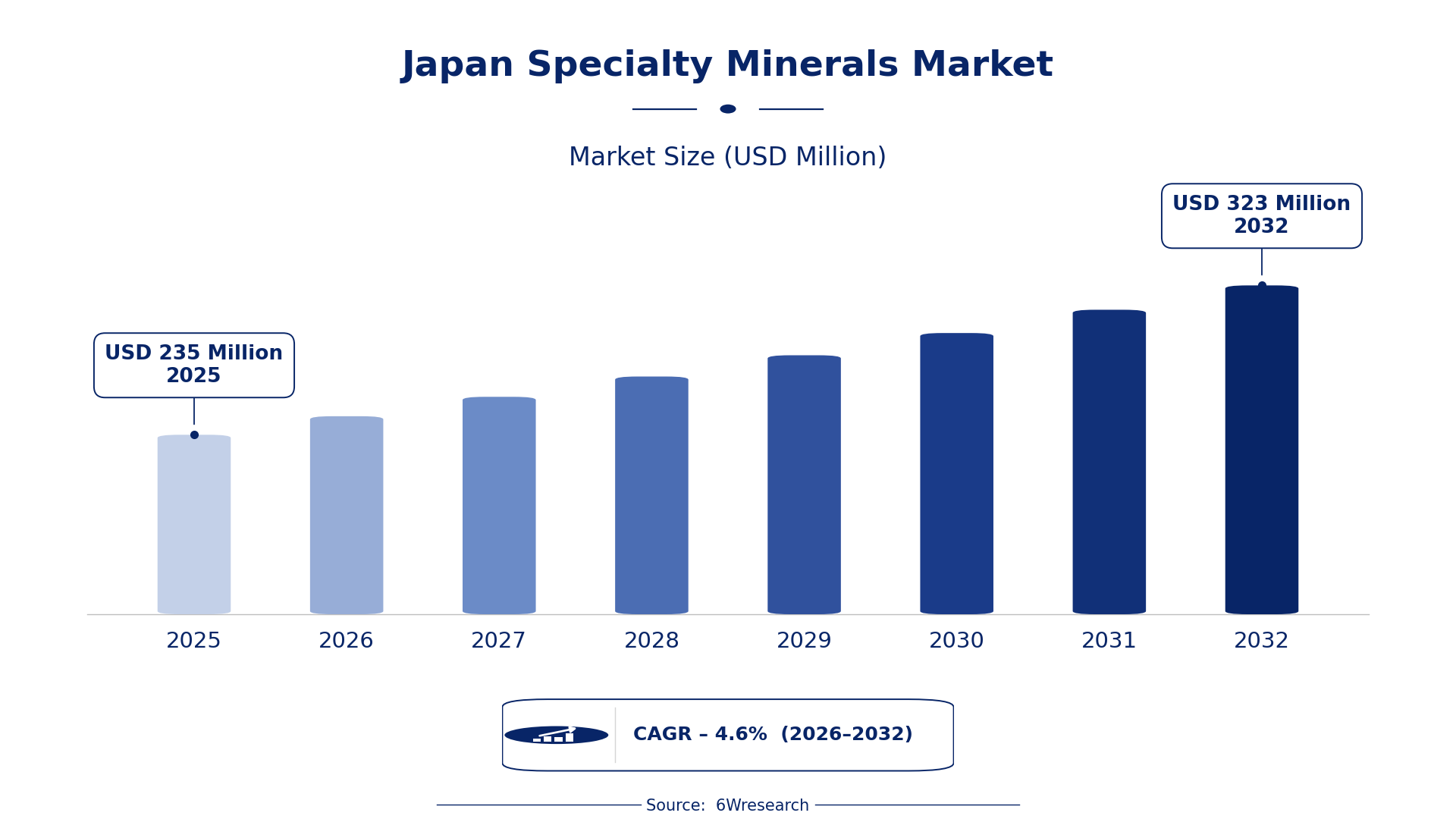
According to 6Wresearch internal database and industry insights, the Japan Specialty Minerals Market was valued at USD 235 Million in 2025 and is projected to reach USD 323 Million by 2032, growing at a CAGR of approximately 4.6% during 2026–2032.
Japan Specialty Minerals Market Highlights
| Report Metric | Details |
| Report Name | Japan Specialty Minerals Market (2026-2032) |
| Market Size 2025 | USD 235 Million |
| Market Size 2032 | USD 323 Million |
| Absolute Growth 2025–2032 | USD 88 Million |
| CAGR 2026–2032 | 4.6% |
| Peak Annual Growth | 5.3% in 2032 |
| Forecast Period | 2026–2032 |
| Historical Data | 2022–2025 |
| Base Year | 2025 |
| Leading Mineral Type, 2025 | Kaolin Clay (40% share) |
| Leading Source, 2025 | Natural/Refined (49% share) |
| Leading Functionality, 2025 | Filler/Whitening (37% share) |
| Leading End User, 2025 | Paper & Paint Industries (50% share) |
| Fastest-Growing Mineral Type | Talc (6.5% CAGR) |
| Fastest-Growing Source | High-Purity (6.6% CAGR) |
| Fastest-Growing Functionality | Lubricant/Powder (6.3% CAGR) |
| Fastest-Growing End User | Cosmetics & Plastics (6.4% CAGR) |
| Growing Sector | Cosmetics |
| Key End Users | Paper & Paint Industries, Cosmetics & Plastics, Oil Drilling Companies |
Japan Specialty Minerals Market Year-wise Growth Rate and Key Drivers (2022–2032)
This graph illustrates the annual growth rates of the market from 2022 to 2032, highlighting a steady upward trajectory and projected market expansion over the forecast period.
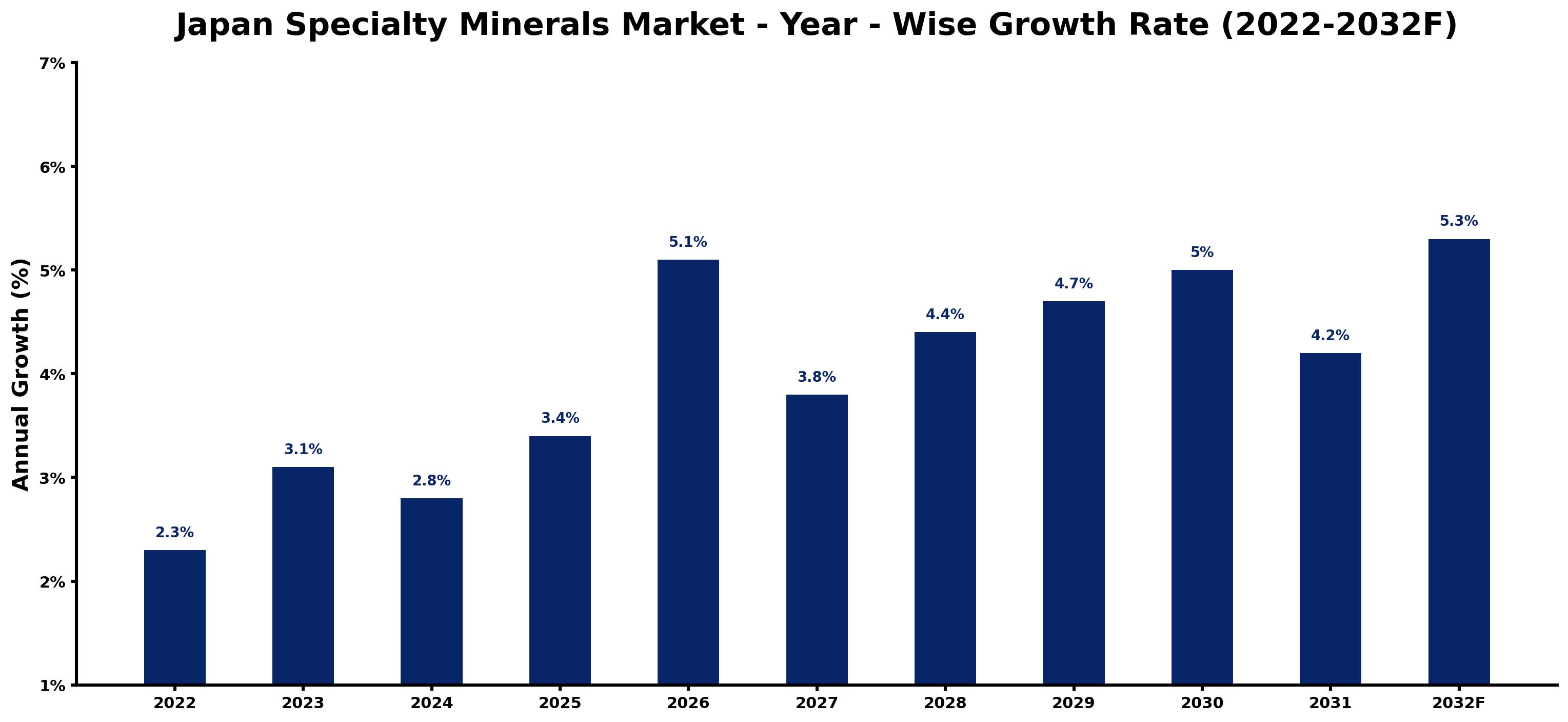
The yearly estimates that follow link every growth rate to its principal driver, so readers can see why the pace changed in each period.
| Year | Estimated Annual Growth (%) | Market Rationale |
| 2022 | 2.3 | The market experienced steady growth, supported by demand from manufacturing sectors. |
| 2023 | 3.1 | Growth accelerated as the paper industry increased its consumption of kaolin clay. |
| 2024 | 2.8 | A slowdown occurred as demand stabilised after previous production increases. |
| 2025 | 3.4 | Demand surged due to the expansion of the cosmetics market, particularly for talc. |
| 2026 | 5.1 | Growth is expected to rise again as high-purity minerals gain traction in electronics. |
| 2027 | 3.8 | A slight slowdown is projected as the market adjusts to previous high growth. |
| 2028 | 4.4 | Demand is expected to increase as the construction sector adopts specialty minerals. |
| 2029 | 4.7 | Growth will continue as demand for lubricants in industrial applications rises. |
| 2030 | 5.0 | An uptick in demand is anticipated as new applications for bentonite develop. |
| 2031 | 4.2 | Growth is projected to slow as the market faces saturation in some segments. |
| 2032 | 5.3 | The market is expected to peak as investments in sustainable practices drive new demand. |
Note: Market size estimations and growth projections presented in this report are based on 6Wresearch's proprietary forecasting methodology, utilizing the latest available industry data, government publications, and primary research inputs.
Japan Specialty Minerals Market Synopsis
Specialty minerals are naturally occurring inorganic materials processed for purity and size, primarily used as fillers in paints, plastics, and cosmetics. The Japan Specialty Minerals Market is experiencing growth driven by rising demand from the paper and cosmetics industries, with the paper sector valued at approximately 1.5 trillion JPY. The increasing use of high-purity minerals in electronics further supports this expansion, indicating a trend towards refined materials across various applications.
Market Dynamics Impact Analysis (2026–2032)
| Factor | Type | Impact | Primary Segment Affected |
| Increased demand from the paper industry for kaolin clay | Driver | High | Kaolin Clay |
| Rising use of talc in cosmetics and personal care products | Driver | High | Talc |
| Growing demand for high-purity minerals in electronics manufacturing | Opportunity | High | High-Purity |
| Expansion of construction projects requiring specialty minerals | Opportunity | Medium | Bentonite |
| Regulatory compliance costs for specialty minerals production | Restraint | High | Natural/Refined |
| Limited domestic sources of certain specialty minerals | Restraint | Medium | Barite |
| Challenges in meeting stringent quality standards for exports | Challenge | High | Filler/Whitening |
| Competition from alternative materials in industrial applications | Challenge | Medium | Lubricant/Powder |
Evaluation of Drivers in Japan Specialty Minerals Market (2026–2032)
The table below links each growth driver to the segment it affects and the evidence for it.
| Drivers | Primary Segment Affected | Why It Matters (Evidence) |
| Increased production of kaolin clay for paper | Kaolin Clay | Kaolin clay is widely used in the paper industry, particularly in Shizuoka Prefecture, boosting demand for local suppliers. |
| Rising demand for talc in cosmetic formulations | Talc | Talc is a key ingredient in over 60% of cosmetic products manufactured in Japan, driving higher purchases from producers. |
| Growth in the electronics sector requiring high-purity minerals | High-Purity | High-purity minerals are increasingly demanded for electronics manufacturing, stimulating purchases from specialized suppliers. |
| Expansion of oil drilling operations requiring bentonite | Bentonite | Bentonite is utilized in drilling mud for oil extraction in offshore regions, increasing demand from oil drilling companies. |
| Increased focus on sustainability in construction materials | Bentonite | The construction sector is adopting specialty minerals for sustainable practices, resulting in higher demand from construction firms. |
Buyers are adding capacity as Japan's paper industry, valued at approximately 1.5 trillion JPY, increasingly relies on kaolin clay for production. The cosmetics market, projected to reach 3 trillion JPY by 2025, drives demand for talc, a key ingredient in over 60% of cosmetic products. High-purity minerals are gaining traction in electronics manufacturing, further boosting purchases. The expansion of oil drilling operations, particularly offshore, increases the need for bentonite in drilling mud. The construction sector is adopting specialty minerals for sustainable practices, resulting in more investments from construction firms.
Evaluation of Restraints in Japan Specialty Minerals Market
The following restraints limit how fast demand can grow.
| Market Restraint | Primary Segment Affected | Why It Matters (Evidence) |
| High compliance costs associated with JIS standards | Natural/Refined | Producers must adhere to stringent JIS standards, increasing production costs and affecting pricing. |
| Limited availability of certain specialty minerals domestically | Barite | Japan primarily sources barite from domestic mines, restricting supply and increasing competition. |
| Challenges in meeting international quality standards for exports | Filler/Whitening | Exporters face difficulties in complying with stringent international quality standards, limiting market access. |
| Competition from alternative materials in industrial applications | Lubricant/Powder | Alternative materials are increasingly used in industrial applications, reducing demand for traditional specialty minerals. |
| Environmental regulations affecting mining operations | Bentonite | Stricter environmental regulations impact mining operations, causing delays and increased operational costs. |
Japan Specialty Minerals Market Challenges
Producers in the paper industry face intense competition from global suppliers, resulting in price reductions that pressure profit margins for local manufacturers. Buyers of kaolin clay are encountering rising costs as domestic sources dwindle, potentially inflating production expenses by up to 15% for paper manufacturers. Supply chain disruptions stem from inconsistent bentonite availability for oil drilling, which could delay project timelines by several weeks for offshore operators. Stringent JIS regulations compel producers to invest in quality assurance processes for specialty minerals, imposing additional compliance costs that may exceed 10% of operational budgets for food and cosmetic applications.
Trends in the Japan Specialty Minerals Market
Below are the shifts with the largest effect on the Japan Specialty Minerals Market.
- Shift in Paper Industry Practices: The paper industry is increasingly adopting kaolin clay for improved brightness and quality, particularly in Shizuoka Prefecture, where demand is rising. In 2023, the industry reported a notable increase in kaolin usage.
- Transition to High-Purity Minerals: High-purity minerals are becoming essential in electronics manufacturing, driven by advancements in technology and production standards. This shift reflects a growing need for refined materials in this sector.
- Emergence of Sustainable Practices in Construction: Construction firms are prioritising sustainable materials, with an increase in the use of specialty minerals for eco-friendly projects reported in 2023, reflecting changing industry standards.
- Growing Demand for Talc in Cosmetics: The cosmetics sector is seeing a rise in talc usage, with over 60% of products incorporating it, indicating a growing trend in the market.
Investment Opportunities in the Japan Specialty Minerals Market
Where to invest in the Japan Specialty Minerals Market: the main openings are set out below.
- Growing Need for High-Purity Minerals: The electronics manufacturing sector is increasingly seeking high-purity minerals, with a notable growth in demand anticipated. Collaborating with local suppliers in regions like Osaka can facilitate market entry.
- Expansion in Construction Sector: The construction industry is investing heavily in specialty minerals, with an increase in demand expected. Forming joint ventures with local construction firms can enhance market presence.
- Rising Demand for Talc in Cosmetics: With the cosmetics market projected to reach 3 trillion JPY by 2025, there is a substantial opportunity to supply talc. Engaging with cosmetics manufacturers in Tokyo can yield significant returns.
- Increased Utilisation of Bentonite in Oil Drilling: Oil drilling companies are expanding their use of bentonite, with a rise in demand anticipated. Establishing partnerships with drilling firms in offshore regions can capture this growing market.
Government Initiatives in the Japan Specialty Minerals Market
The Fire Service Act of 1948 regulates the handling of hazardous materials, including specialty minerals. This law ensures that producers adhere to safety standards, impacting operational practices in the industry. Additionally, the Waste Management and Public Cleansing Act of 1970 governs the treatment and disposal of industrial waste, affecting how specialty minerals are processed and managed.
The Standards for Cosmetics established in 2000 set ingredient restrictions that buyers in the cosmetics sector must follow. This regulation ensures that products meet safety standards, affecting the sourcing of specialty minerals used in formulations. The Ministry of Economy, Trade and Industry also supports research on specialty minerals applications, providing funding for projects that promote sustainability in extraction practices.
Future Insight of the Japan Specialty Minerals Market
New mineral extraction facilities will be operational by 2032, focusing on sustainable practices that align with government initiatives. Demand for high-purity minerals will surge as electronics manufacturing grows, necessitating refined materials to meet industry standards. The cosmetics sector will increasingly rely on compliant talc sources, prompting suppliers to adapt their offerings. Research programmes supported by the Ministry of Economy, Trade and Industry will investigate innovative applications for specialty minerals in construction, broadening their market potential.
Market Segmentation Analysis
Japan Specialty Minerals Market report covers a detailed analysis of the following market segments:
By Mineral Type – Kaolin Clay Leads, Talc Expected to Grow Fastest
According to Saurav Kr Singh, Senior Research Analyst at 6Wresearch, Kaolin Clay held 40% of the Japan Specialty Minerals Market by mineral type in 2025. Kaolin clay holds the largest share due to its extensive use as a filler in the paper industry, particularly in Shizuoka Prefecture. The region's strong paper manufacturing sector relies on kaolin to improve product quality and performance. Talc is projected to grow fastest, at a CAGR of 6.5% during 2026–2032. Talc is rapidly growing as it is a key ingredient in over 60% of cosmetic products manufactured in Japan. The cosmetics market's projected value of 3 trillion JPY by 2025 will further increase talc's demand. Suppliers must focus on ensuring a consistent supply of high-quality talc to meet the rising needs of the cosmetics market.
By Source – Natural/Refined Leads, High-Purity Expected to Grow Fastest
In 2025, Natural/Refined led the source split with a 49% share. Natural/Refined minerals hold the largest market share as they are vital for achieving higher purity in various applications. The consistent demand for refined minerals necessitates that suppliers adhere to high processing standards to meet industry expectations. High-Purity is set to record the highest CAGR in this split, 6.6% over 2026–2032. High-Purity minerals are experiencing rapid growth due to their increasing use in specialised industrial applications. The trend towards high-purity materials is closely linked to advancements in technology and manufacturing practices. Buyers must ensure their suppliers can fulfil the rigorous purity standards required for high-purity minerals.
By Functionality – Filler/Whitening Leads, Lubricant/Powder Expected to Grow Fastest
Filler/Whitening accounted for 37% of the market by functionality in 2025. Filler/Whitening functionality leads the market because it is crucial for enhancing brightness and quality in paper and paint applications. This essential role across major industries solidifies its dominant market position. The quickest growth will come from Lubricant/Powder, forecast to expand at a CAGR of 6.3% between 2026 and 2032. Lubricant/Powder functionality is experiencing rapid growth as it is increasingly used in various industrial applications. The versatility of lubricant and powder forms appeals to manufacturers seeking to improve operational efficiency. Suppliers should explore new formulations to cater to the growing demand for lubricant and powder functionalities.
By End User – Paper & Paint Industries Lead, Cosmetics & Plastics Expected to Grow Fastest
Paper & Paint Industries took 50% of end user revenue in 2025, more than any other category. The Paper & Paint Industries are the largest consumers of specialty minerals, relying heavily on these materials for their production processes. The substantial market value of these industries highlights the importance of specialty minerals in their operations. Over 2026–2032, Cosmetics & Plastics are expected to post the fastest growth, at a CAGR of 6.4%. Cosmetics & Plastics are witnessing the fastest growth, driven by the increasing use of talc and kaolin in cosmetic formulations. The anticipated expansion of the cosmetics market will further accelerate this segment's growth. Suppliers need to align their offerings with the evolving requirements of the cosmetics and plastics sectors to capitalise on emerging opportunities.
Key Attractiveness of the Report
- 10 Years of Market Numbers
- Historical Data Starting from 2022 to 2025
- Base Year 2025
- Forecast Data until 2032
- Key Performance Indicators Impacting the Market
- Major Upcoming Developments and Projects
Key Highlights of the Report:
- Japan Specialty Minerals Market Outlook
- Market Size of Japan Specialty Minerals Market, 2025
- Forecast of Japan Specialty Minerals Market, 2032
- Historical Data and Forecast of Japan Specialty Minerals Revenues & Volume for the Period 2022-2032F
- Japan Specialty Minerals Market Trend Evolution
- Japan Specialty Minerals Market Drivers and Challenges
- Japan Specialty Minerals Price Trends
- Japan Specialty Minerals Porter's Five Forces
- Japan Specialty Minerals Industry Life Cycle
- Historical Data and Forecast of Japan Specialty Minerals Market Revenues & Volume By Mineral Type for the Period 2022-2032F
- Historical Data and Forecast of Japan Specialty Minerals Market Revenues & Volume By Kaolin Clay for the Period 2022-2032F
- Historical Data and Forecast of Japan Specialty Minerals Market Revenues & Volume By Talc for the Period 2022-2032F
- Historical Data and Forecast of Japan Specialty Minerals Market Revenues & Volume By Bentonite for the Period 2022-2032F
- Historical Data and Forecast of Japan Specialty Minerals Market Revenues & Volume By Barite for the Period 2022-2032F
- Historical Data and Forecast of Japan Specialty Minerals Market Revenues & Volume By Source for the Period 2022-2032F
- Historical Data and Forecast of Japan Specialty Minerals Market Revenues & Volume By Natural/Refined for the Period 2022-2032F
- Historical Data and Forecast of Japan Specialty Minerals Market Revenues & Volume By High-Purity for the Period 2022-2032F
- Historical Data and Forecast of Japan Specialty Minerals Market Revenues & Volume By Smectite Clay for the Period 2022-2032F
- Historical Data and Forecast of Japan Specialty Minerals Market Revenues & Volume By Sulfate Mineral for the Period 2022-2032F
- Historical Data and Forecast of Japan Specialty Minerals Market Revenues & Volume By Functionality for the Period 2022-2032F
- Historical Data and Forecast of Japan Specialty Minerals Market Revenues & Volume By Filler/Whitening for the Period 2022-2032F
- Historical Data and Forecast of Japan Specialty Minerals Market Revenues & Volume By Lubricant/Powder for the Period 2022-2032F
- Historical Data and Forecast of Japan Specialty Minerals Market Revenues & Volume By Absorption/Bonding for the Period 2022-2032F
- Historical Data and Forecast of Japan Specialty Minerals Market Revenues & Volume By Drilling Mud for the Period 2022-2032F
- Historical Data and Forecast of Japan Specialty Minerals Market Revenues & Volume By End User for the Period 2022-2032F
- Historical Data and Forecast of Japan Specialty Minerals Market Revenues & Volume By Paper & Paint Industries for the Period 2022-2032F
- Historical Data and Forecast of Japan Specialty Minerals Market Revenues & Volume By Cosmetics & Plastics for the Period 2022-2032F
- Historical Data and Forecast of Japan Specialty Minerals Market Revenues & Volume By Oil Drilling Companies for the Period 2022-2032F
- Historical Data and Forecast of Japan Specialty Minerals Market Revenues & Volume By Oil & Gas Services for the Period 2022-2032F
- Japan Specialty Minerals Import Export Trade Statistics
- Market Opportunity Assessment By Mineral Type
- Market Opportunity Assessment By Source
- Market Opportunity Assessment By Functionality
- Market Opportunity Assessment By End User
- Japan Specialty Minerals Top Companies Market Share
- Japan Specialty Minerals Competitive Benchmarking By Technical and Operational Parameters
- Japan Specialty Minerals Company Profiles
- Japan Specialty Minerals Key Strategic Recommendations
Market Covered
This report examines the market across the segments below.
By Mineral Type
- Kaolin Clay
- Talc
- Bentonite
- Barite
By Source
- Natural/Refined
- High-Purity
- Smectite Clay
- Sulfate Mineral
By Functionality
- Filler/Whitening
- Lubricant/Powder
- Absorption/Bonding
- Drilling Mud
By End User
- Paper & Paint Industries
- Cosmetics & Plastics
- Oil Drilling Companies
- Oil & Gas Services































