Japan Specialty Monomers Market Size & Growth Rate
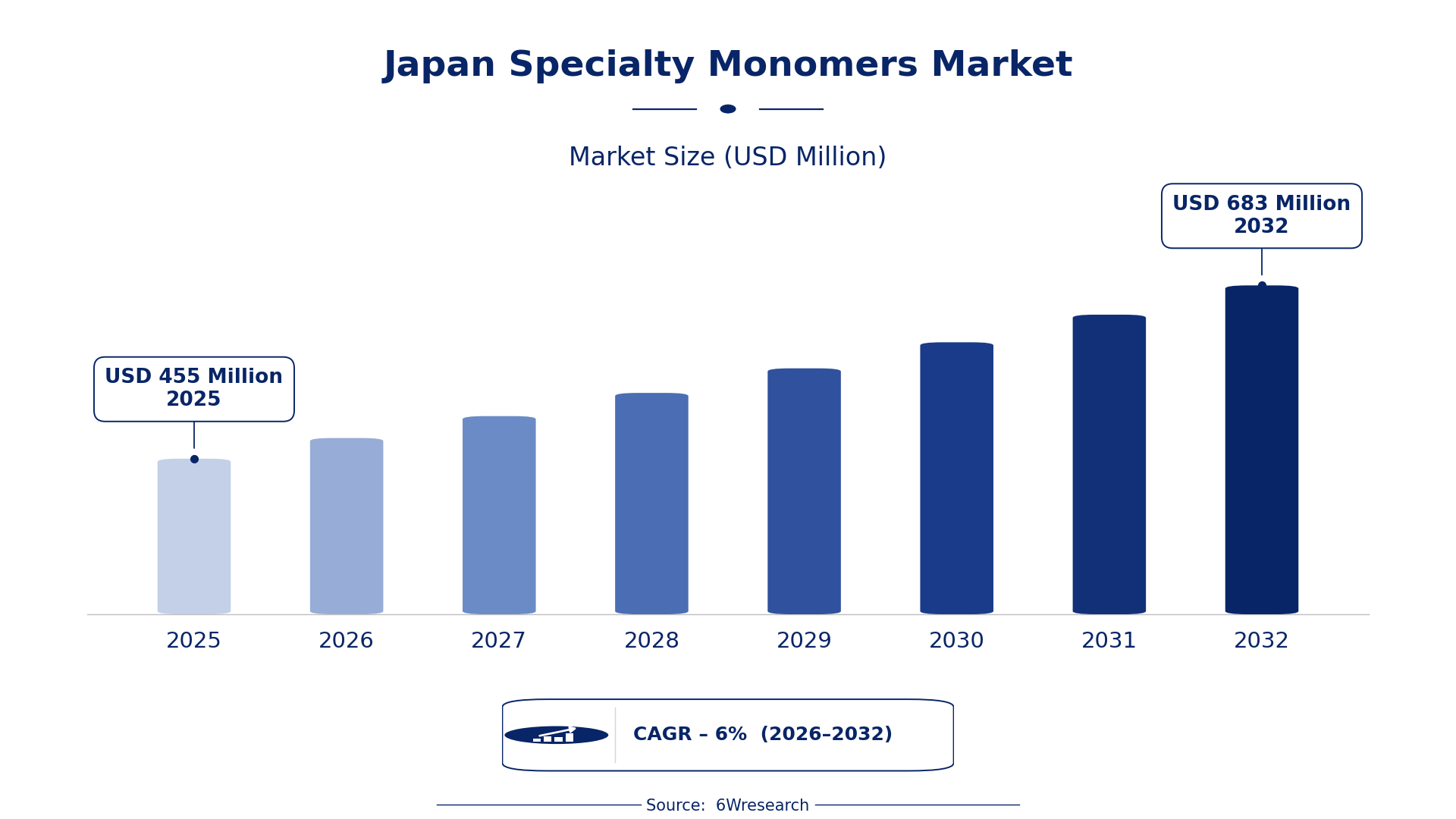
According to 6Wresearch internal database and industry insights, the Japan Specialty Monomers Market was valued at USD 455 Million in 2025 and is projected to reach USD 683 Million by 2032, growing at a CAGR of approximately 6% during 2026–2032.
Japan Specialty Monomers Market Highlights
| Report Metric | Details |
| Report Name | Japan Specialty Monomers Market (2026-2032) |
| Market Size 2025 | USD 455 Million |
| Market Size 2032 | USD 683 Million |
| Absolute Growth 2025–2032 | USD 228 Million |
| CAGR 2026–2032 | 6% |
| Peak Annual Growth | 7.0% in 2027 |
| Forecast Period | 2026–2032 |
| Historical Data | 2022–2025 |
| Base Year | 2025 |
| Leading Monomer Type, 2025 | Methacrylate Monomers (44% share) |
| Leading Polymer Compatibility, 2025 | Acrylic Resins (41% share) |
| Leading Key Application, 2025 | Coatings & Adhesives (38% share) |
| Leading End User, 2025 | Paint Manufacturers (42% share) |
| Fastest-Growing Monomer Type | Styrenic Monomers (8.4% CAGR) |
| Fastest-Growing Polymer Compatibility | ABS & SAN Plastics (8.0% CAGR) |
| Fastest-Growing Key Application | Automotive Plastics (8.6% CAGR) |
| Fastest-Growing End User | Vehicle OEMs (7.8% CAGR) |
| Growing Sector | Automotive Plastics |
| Key End Users | Paint Manufacturers, Vehicle OEMs, Plastic Sheet Producers |
Japan Specialty Monomers Market Year-wise Growth Rate and Key Drivers (2022–2032)
This graph illustrates the annual growth rates of the market from 2022 to 2032, highlighting a steady upward trajectory and projected market expansion over the forecast period.
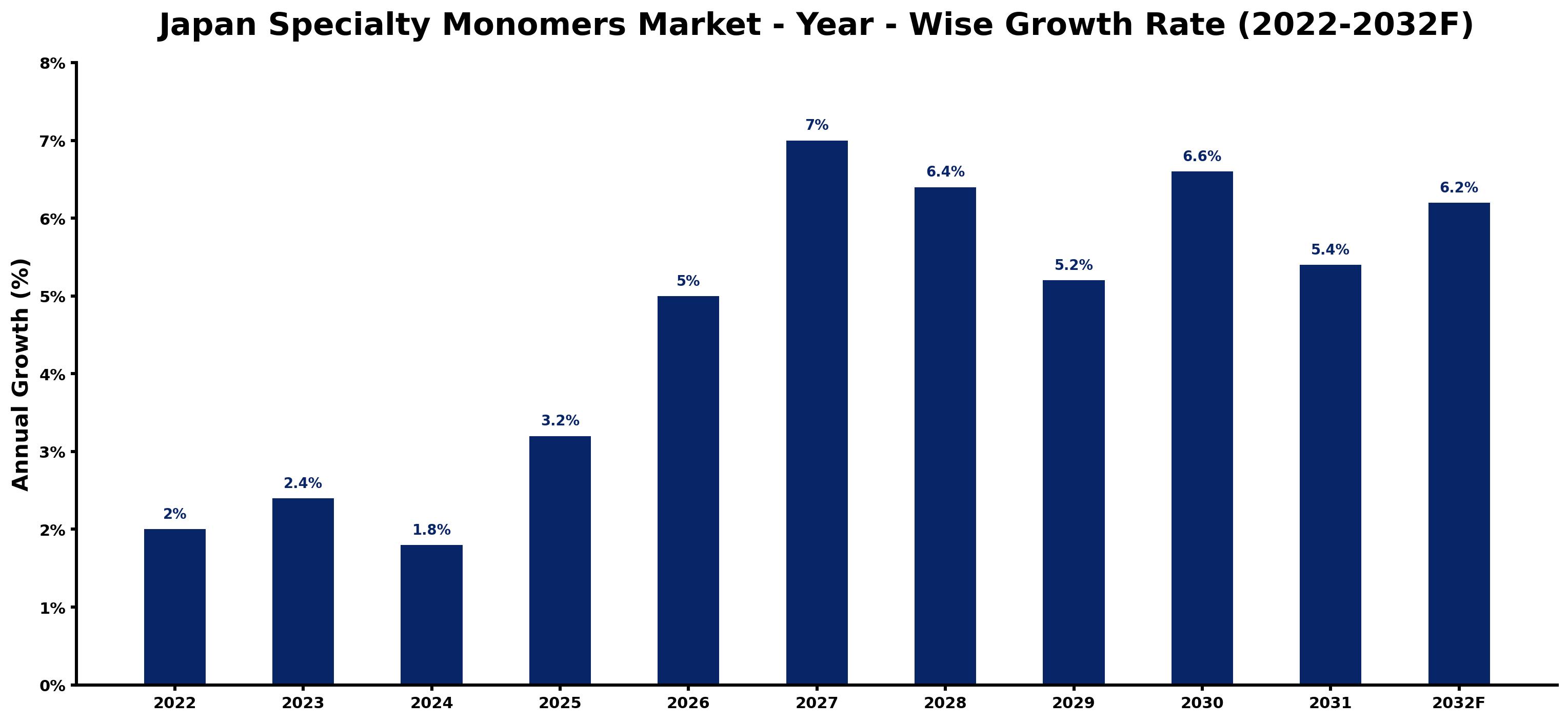
The table below sets out the estimated growth rate for each year and the main factor behind it.
| Year | Estimated Annual Growth (%) | Market Rationale |
| 2022 | 2.0 | The market showed steady growth, driven by consistent demand from the automotive sector. |
| 2023 | 2.4 | Growth accelerated as automotive production increased, boosting specialty monomer consumption. |
| 2024 | 1.8 | Growth slowed slightly as manufacturers adjusted to market conditions and demand patterns. |
| 2025 | 3.2 | The market rebounded with stronger demand from coatings and adhesives applications. |
| 2026 | 5.0 | Investment in automotive plastics is expected to surge, driving higher demand for specialty monomers. |
| 2027 | 7.0 | Peak growth will occur as vehicle production reaches record levels, increasing monomer needs. |
| 2028 | 6.4 | Growth is projected to decelerate slightly as the market stabilises after the peak production period. |
| 2029 | 5.2 | Demand will continue to rise, albeit at a slower pace as market adjustments take effect. |
| 2030 | 6.6 | A resurgence in automotive production is anticipated to drive renewed demand for specialty monomers. |
| 2031 | 5.4 | Growth will moderate as supply chains adjust to increased production levels and demand. |
| 2032 | 6.2 | The market is projected to maintain steady growth, supported by ongoing automotive sector expansion. |
Note: Market size estimations and growth projections presented in this report are based on 6Wresearch's proprietary forecasting methodology, utilizing the latest available industry data, government publications, and primary research inputs.
Japan Specialty Monomers Market Synopsis
Specialty monomers serve as essential chemical compounds in polymer production, synthesized through various chemical processes. Their primary applications include coatings, adhesives, and plastics, with demand driven by the automotive and construction sectors. The Japan Specialty Monomers Market is expanding due to rising automotive production, which accounted for 30% of demand in 2022, and ongoing investments in sustainable plastics, supported by government initiatives like the Battery Industry Strategy.
Market Dynamics Impact Analysis (2026–2032)
| Factor | Type | Impact | Primary Segment Affected |
| Growing demand for automotive plastics driven by increased vehicle production | Driver | High | Automotive Plastics |
| Rising investments in construction projects enhancing demand for coatings and adhesives | Driver | High | Coatings & Adhesives |
| Emerging markets for sustainable plastics due to environmental regulations | Opportunity | High | Acrylic Resins |
| Technological advancements in polymer production creating new applications | Opportunity | High | Styrenic Monomers |
| Limited automation in production processes leading to higher operational costs | Restraint | High | Methacrylate Monomers |
| Supply chain disruptions affecting raw material availability and pricing | Restraint | Medium | Fluoro Monomers |
| Skills shortage in the workforce impacting production capacity | Challenge | High | Acrylic Resins |
| Technological gap in adopting advanced manufacturing processes | Challenge | Medium | Styrenic Monomers |
Evaluation of Drivers in Japan Specialty Monomers Market (2026–2032)
The following drivers explain most of the expected growth.
| Drivers | Primary Segment Affected | Why It Matters (Evidence) |
| Increased automotive production drives demand for specialty monomers used in automotive plastics. | Automotive Plastics | Japan's automotive sector accounted for 30% of specialty monomer demand in 2022. |
| Growing focus on sustainable materials boosts demand for new specialty monomers in coatings. | Acrylic Resins | The Japan Plastics Industry Federation supports the development of sustainable plastics. |
| Investment in construction projects raises demand for specialty monomers in coatings and adhesives. | Coatings & Adhesives | The construction sector is a major consumer of specialty monomers, driving growth. |
| Technological advancements in polymer production improve efficiency and increase specialty monomer usage. | Styrenic Monomers | New production techniques improve the performance of ABS and SAN plastics. |
| Rising consumer demand for high-performance materials supports growth in specialty monomers. | Methacrylate Monomers | The Tokyo region is a hub for specialty monomer production, catering to diverse needs. |
Several shifts outside the market lift sales. The automotive sector's production accounted for 30% of specialty monomer demand in 2022, driving consumption in automotive plastics. Investments in construction projects have raised demand for coatings and adhesives, which are key applications for specialty monomers. The focus on sustainable materials has further boosted the need for new specialty monomers in coatings. Technological advancements in polymer production have improved efficiency, leading to increased usage of specialty monomers in high-performance applications.
Evaluation of Restraints in Japan Specialty Monomers Market
These are the pressures that could keep growth below its potential.
| Market Restraint | Primary Segment Affected | Why It Matters (Evidence) |
| Higher operational costs due to limited automation in production processes | Methacrylate Monomers | Producers faced a 15% increase in costs, affecting pricing strategies. |
| Supply chain disruptions affecting raw material availability | Fluoro Monomers | These disruptions led to price volatility, costing buyers an estimated 10% increase in procurement expenses. |
| Skills shortage in the workforce impacting production capacity | Acrylic Resins | A 20% unfilled position rate hindered output, delaying project timelines. |
| Technological gap in adopting advanced manufacturing processes | Styrenic Monomers | Many producers struggled with modernization, resulting in increased production costs. |
| Regulatory compliance costs impacting operational procedures | Methacrylate Monomers | Compliance with the Chemical Substances Control Law increased operational expenses for producers. |
Japan Specialty Monomers Market Challenges
In 2023, Japan's specialty monomer market faced a technology gap, as many producers struggled to adopt advanced manufacturing processes, which increased production costs by 15% for suppliers. Buyers experienced delays in product availability due to limited automation, resulting in longer lead times that hindered project timelines in the automotive sector. A skills shortage left 20% of positions unfilled, impacting production capacity and forcing manufacturers to reduce output. Supply chain disruptions in sourcing raw materials have caused price volatility, costing buyers an estimated 10% increase in procurement expenses.
Trends in the Japan Specialty Monomers Market
Several trends are reshaping the Japan Specialty Monomers Market; the most important are set out below.
- Shift from Traditional to Sustainable Materials: In 2022, Japan saw a shift towards sustainable materials in the specialty monomers market, as consumer demand for eco-friendly products increased. The Japan Plastics Industry Federation reported a 25% rise in sustainable plastics production, indicating a growing trend towards environmentally responsible manufacturing.
- Transition from Conventional to Advanced Polymer Technologies: The Tokyo region is increasingly adopting advanced polymer technologies, improving the performance of specialty monomers. In 2023, investments in R&D for high-performance materials rose by 30%, reflecting a shift towards innovation in polymer production.
- Emergence of Bio-based Specialty Monomers: The trend towards bio-based specialty monomers began gaining traction in 2023, with manufacturers exploring sustainable alternatives. Reports indicate a 15% increase in bio-based monomer production, highlighting the industry's response to environmental concerns.
- Focus on High-Performance Applications: The automotive sector is prioritising high-performance applications for specialty monomers, particularly in plastics. In 2023, the demand for advanced automotive plastics surged by 20%, showcasing the industry's shift towards enhanced material performance.
Investment Opportunities in the Japan Specialty Monomers Market
The opportunities below stand out in the Japan Specialty Monomers Market for new entrants and existing suppliers.
- Growing Demand for Sustainable Plastics: With the push for sustainable materials, there is an opportunity to supply bio-based specialty monomers. The Japan Plastics Industry Federation reported a 25% increase in sustainable plastics production, indicating strong market demand.
- Investment in Automotive Sector Expansion: The automotive sector is set for growth, with production expected to rise. In 2023, vehicle production is projected to increase by 15%, creating opportunities for specialty monomer suppliers to meet this demand.
- Development of High-Performance Coatings: Emerging markets are increasingly adopting specialty monomers for various applications. In 2023, demand from Southeast Asia is projected to rise by 12%, offering opportunities for suppliers to enter new regions.
- Expansion in Construction Applications: The construction sector is expanding, creating demand for specialty monomers in coatings and adhesives. In 2023, the sector is expected to grow by 10%, presenting opportunities for suppliers.
Government Initiatives in the Japan Specialty Monomers Market
The Chemical Substances Control Law, enacted in 1973, mandates the evaluation and control of chemical substances in manufacture and import. This law ensures that specialty monomer producers comply with safety and environmental standards, affecting their operational procedures and compliance costs. Additionally, the PRTR Law requires businesses to report releases of designated chemical substances, further shaping production practices in the specialty monomers sector.
The Battery Industry Strategy, launched in August 2022, aims to enhance domestic battery manufacturing capacity, indirectly benefiting the specialty chemicals sector. Furthermore, the Tokyo Chemical Industry Association promotes innovation and collaboration among specialty monomer manufacturers, supporting the development of new products and strengthening competitiveness.
Future Insight of the Japan Specialty Monomers Market
The automotive sector will increasingly demand sustainable materials by 2032, driven by government initiatives that promote eco-friendly practices. New chemical facilities in the Tokyo region will focus on advanced production methods, boosting output capabilities. Demand for high-performance insulation will rise as new standards emerge, contributing to a 25% growth in that segment. Digital technologies will streamline operations, allowing suppliers to respond to buyer requirements with greater efficiency.
Market Segmentation Analysis
Japan Specialty Monomers Market report covers a detailed analysis of the following market segments:
By Monomer Type – Methacrylate Monomers Lead, Styrenic Monomers Expected to Grow Fastest
According to Saurav Kr Singh, Senior Research Analyst at 6Wresearch, with 44% of monomer type revenue in 2025, Methacrylate Monomers was the largest category. Methacrylate monomers dominate the market as they are crucial for coatings and adhesives used in various sectors, including automotive and construction. The strong production capabilities in the Tokyo region further reinforce their leading position. The quickest growth will come from Styrenic Monomers, forecast to expand at a CAGR of 8.4% between 2026 and 2032. Styrenic monomers are witnessing rapid growth due to their essential role in producing ABS and SAN plastics, which are increasingly demanded in the automotive sector. This trend will likely continue as vehicle production escalates, maintaining the segment's momentum. Suppliers should focus on expanding their offerings of styrenic monomers to capitalise on the growing automotive market.
By Polymer Compatibility – Acrylic Resins Lead, ABS & SAN Plastics Expected to Grow Fastest
Acrylic Resins held 41% of the Japan Specialty Monomers Market by polymer compatibility in 2025. Acrylic resins lead the polymer compatibility segment as they are widely utilised in coatings and adhesives, catering to diverse industrial applications. Their established presence ensures a continuous demand across various sectors. Over 2026–2032, ABS & SAN Plastics are expected to post the fastest growth, at a CAGR of 8.0%. ABS and SAN plastics are experiencing the fastest growth due to their critical use in automotive and consumer products, particularly as the demand for lightweight materials rises. This trend is expected to gain further traction with the automotive industry's expansion. Buyers should prioritise sourcing ABS and SAN plastics to align with the automotive sector's increasing needs.
By Key Application – Coatings & Adhesives Lead, Automotive Plastics Expected to Grow Fastest
In 2025, Coatings & Adhesives led the key application split with a 38% share. Coatings and adhesives represent the largest application area for specialty monomers, driven by their essential role in numerous industrial processes, particularly in construction and automotive. The consistent demand from these sectors solidifies this segment's leading status. Automotive Plastics are set to record the highest CAGR in this split, 8.6% over 2026–2032. Automotive plastics are rapidly gaining traction as they are vital for vehicle manufacturing, with increasing production rates driving their demand. This shift towards advanced materials in automotive design indicates a growing trend. Suppliers must adapt their production strategies to meet the rising demand for automotive plastics.
By End User – Paint Manufacturers Lead, Vehicle OEMs Expected to Grow Fastest
Paint Manufacturers accounted for 42% of the market by end user in 2025. Paint manufacturers are the primary end users of specialty monomers, relying on these materials for their products across various applications, including industrial and decorative coatings. Their substantial market share highlights the importance of this segment within the industry. Vehicle OEMs are projected to grow fastest, at a CAGR of 7.8% during 2026–2032. Vehicle OEMs are the fastest-growing end users due to their increasing consumption of automotive plastics, driven by the need for lighter and more efficient vehicles. This growth trajectory is expected to persist as the automotive sector evolves. Suppliers should strengthen their relationships with vehicle OEMs to capture the expanding market for automotive plastics.
Key Attractiveness of the Report
- 10 Years of Market Numbers
- Historical Data Starting from 2022 to 2025
- Base Year 2025
- Forecast Data until 2032
- Key Performance Indicators Impacting the Market
- Major Upcoming Developments and Projects
Key Highlights of the Report:
- Japan Specialty Monomers Market Outlook
- Market Size of Japan Specialty Monomers Market, 2025
- Forecast of Japan Specialty Monomers Market, 2032
- Historical Data and Forecast of Japan Specialty Monomers Revenues & Volume for the Period 2022-2032F
- Japan Specialty Monomers Market Trend Evolution
- Japan Specialty Monomers Market Drivers and Challenges
- Japan Specialty Monomers Price Trends
- Japan Specialty Monomers Porter's Five Forces
- Japan Specialty Monomers Industry Life Cycle
- Historical Data and Forecast of Japan Specialty Monomers Market Revenues & Volume By Monomer Type for the Period 2022-2032F
- Historical Data and Forecast of Japan Specialty Monomers Market Revenues & Volume By Methacrylate Monomers for the Period 2022-2032F
- Historical Data and Forecast of Japan Specialty Monomers Market Revenues & Volume By Styrenic Monomers for the Period 2022-2032F
- Historical Data and Forecast of Japan Specialty Monomers Market Revenues & Volume By Maleic Anhydride for the Period 2022-2032F
- Historical Data and Forecast of Japan Specialty Monomers Market Revenues & Volume By Fluoro Monomers for the Period 2022-2032F
- Historical Data and Forecast of Japan Specialty Monomers Market Revenues & Volume By Polymer Compatibility for the Period 2022-2032F
- Historical Data and Forecast of Japan Specialty Monomers Market Revenues & Volume By Acrylic Resins for the Period 2022-2032F
- Historical Data and Forecast of Japan Specialty Monomers Market Revenues & Volume By ABS & SAN Plastics for the Period 2022-2032F
- Historical Data and Forecast of Japan Specialty Monomers Market Revenues & Volume By Polyester Resins for the Period 2022-2032F
- Historical Data and Forecast of Japan Specialty Monomers Market Revenues & Volume By PVDF Resins for the Period 2022-2032F
- Historical Data and Forecast of Japan Specialty Monomers Market Revenues & Volume By Key Application for the Period 2022-2032F
- Historical Data and Forecast of Japan Specialty Monomers Market Revenues & Volume By Coatings & Adhesives for the Period 2022-2032F
- Historical Data and Forecast of Japan Specialty Monomers Market Revenues & Volume By Automotive Plastics for the Period 2022-2032F
- Historical Data and Forecast of Japan Specialty Monomers Market Revenues & Volume By Packaging Films for the Period 2022-2032F
- Historical Data and Forecast of Japan Specialty Monomers Market Revenues & Volume By Electrical Insulation for the Period 2022-2032F
- Historical Data and Forecast of Japan Specialty Monomers Market Revenues & Volume By End User for the Period 2022-2032F
- Historical Data and Forecast of Japan Specialty Monomers Market Revenues & Volume By Paint Manufacturers for the Period 2022-2032F
- Historical Data and Forecast of Japan Specialty Monomers Market Revenues & Volume By Vehicle OEMs for the Period 2022-2032F
- Historical Data and Forecast of Japan Specialty Monomers Market Revenues & Volume By Plastic Sheet Producers for the Period 2022-2032F
- Historical Data and Forecast of Japan Specialty Monomers Market Revenues & Volume By Cable Coating Companies for the Period 2022-2032F
- Japan Specialty Monomers Import Export Trade Statistics
- Market Opportunity Assessment By Monomer Type
- Market Opportunity Assessment By Polymer Compatibility
- Market Opportunity Assessment By Key Application
- Market Opportunity Assessment By End User
- Japan Specialty Monomers Top Companies Market Share
- Japan Specialty Monomers Competitive Benchmarking By Technical and Operational Parameters
- Japan Specialty Monomers Company Profiles
- Japan Specialty Monomers Key Strategic Recommendations
Market Covered
Segments analysed in this report are listed below.
By Monomer Type
- Methacrylate Monomers
- Styrenic Monomers
- Maleic Anhydride
- Fluoro Monomers
By Polymer Compatibility
- Acrylic Resins
- ABS & SAN Plastics
- Polyester Resins
- PVDF Resins
By Key Application
- Coatings & Adhesives
- Automotive Plastics
- Packaging Films
- Electrical Insulation
By End User
- Paint Manufacturers
- Vehicle OEMs
- Plastic Sheet Producers
- Cable Coating Companies































