Japan Specialty Nonwoven Market Size & Growth Rate
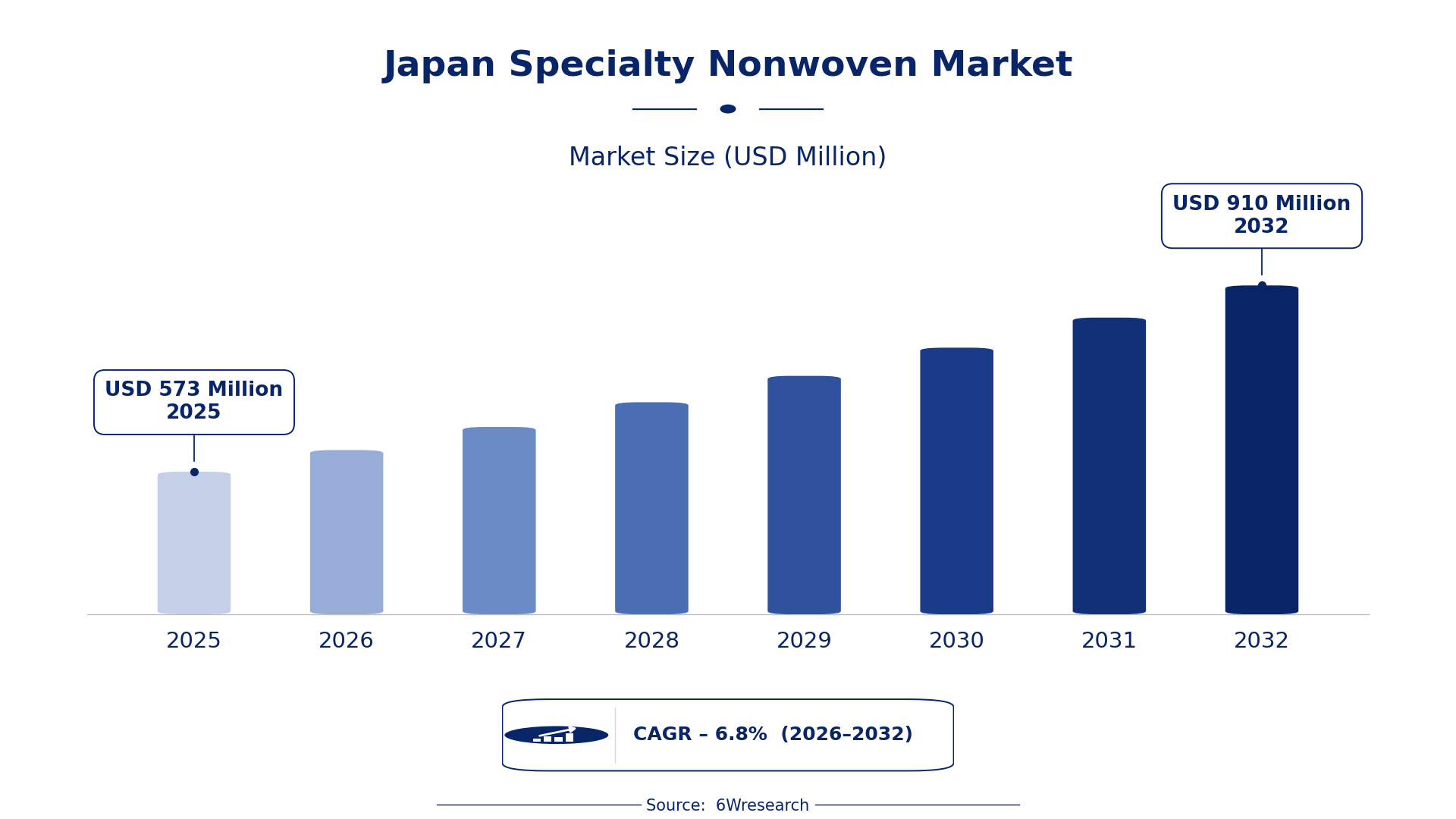
According to 6Wresearch internal database and industry insights, the Japan Specialty Nonwoven Market was valued at USD 573 Million in 2025 and is projected to reach USD 910 Million by 2032, growing at a CAGR of approximately 6.8% during 2026–2032.
Japan Specialty Nonwoven Market Highlights
| Report Metric | Details |
| Report Name | Japan Specialty Nonwoven Market (2026-2032) |
| Market Size 2025 | USD 573 Million |
| Market Size 2032 | USD 910 Million |
| Absolute Growth 2025–2032 | USD 337 Million |
| CAGR 2026–2032 | 6.8% |
| Peak Annual Growth | 8.0% in 2030 |
| Forecast Period | 2026–2032 |
| Historical Data | 2022–2025 |
| Base Year | 2025 |
| Leading Nonwoven Type, 2025 | Meltblown Nonwoven (43% share) |
| Leading Fabric Technology, 2025 | Polypropylene (45% share) |
| Leading Application Area, 2025 | Disposable Hygiene Products (41% share) |
| Leading End User, 2025 | Diaper Manufacturers (38% share) |
| Fastest-Growing Nonwoven Type | Spunbond Nonwoven (9.6% CAGR) |
| Fastest-Growing Fabric Technology | Thermoplastic Polymer (9.8% CAGR) |
| Fastest-Growing Application Area | Medical Dressings (8.2% CAGR) |
| Fastest-Growing End User | Hospitals (9.0% CAGR) |
| Growing Sector | Medical Dressings |
| Key End Users | Disposable Hygiene Products, Medical Dressings, Filtration Media, Automotive Interiors |
Japan Specialty Nonwoven Market Year-wise Growth Rate and Key Drivers (2022–2032)
This graph illustrates the annual growth rates of the market from 2022 to 2032, highlighting a steady upward trajectory and projected market expansion over the forecast period.
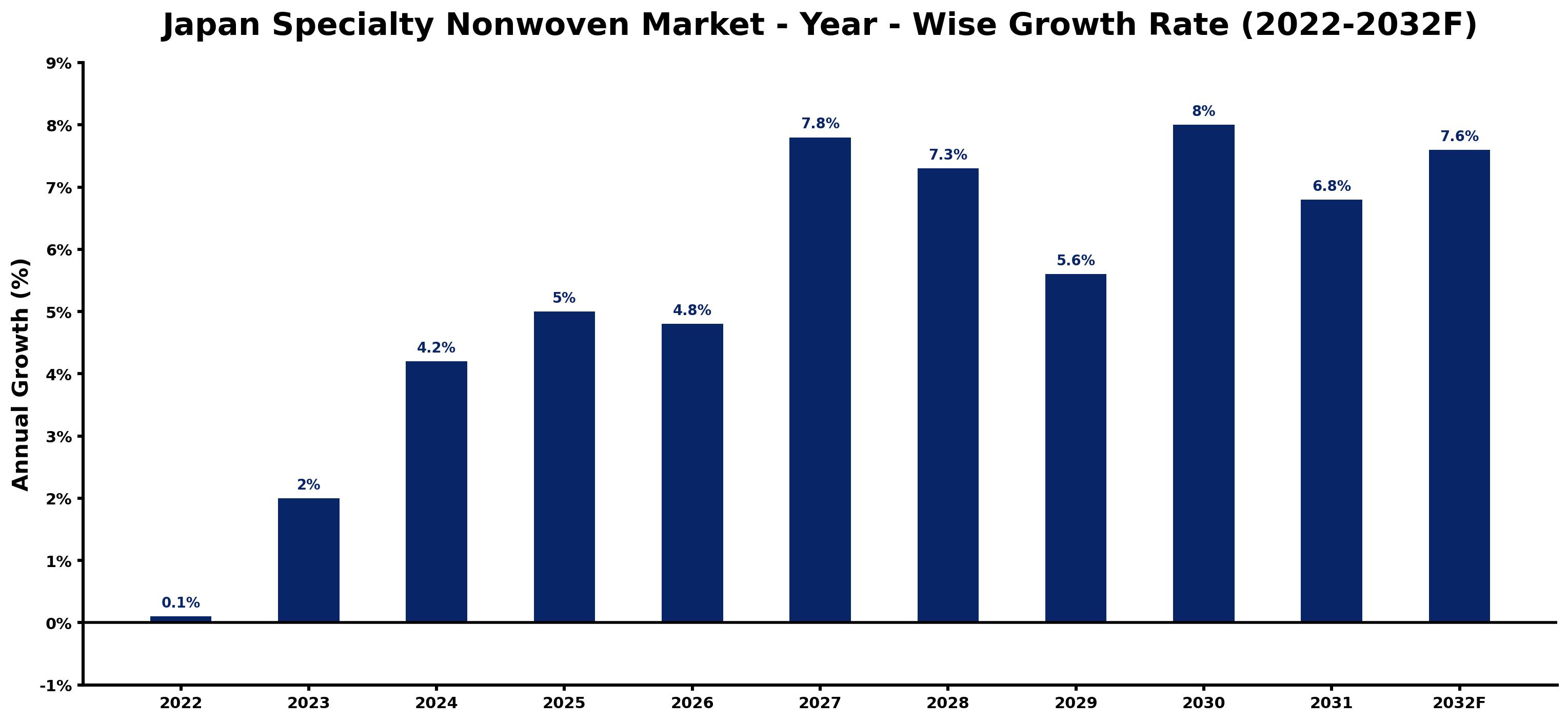
The following figures match every annual growth estimate with the main market development of that year, giving the reasoning behind each rise or slowdown.
| Year | Estimated Annual Growth (%) | Market Rationale |
| 2022 | 0.1 | The market showed minimal growth due to stable demand in healthcare applications. |
| 2023 | 2.0 | Demand increased as healthcare facilities expanded their use of specialty nonwovens. |
| 2024 | 4.2 | Growth accelerated with rising consumer awareness about hygiene products. |
| 2025 | 5.0 | The market peaked due to heightened demand for medical dressings amid health crises. |
| 2026 | 4.8 | Growth is expected to slow as the market adjusts to previous high levels of demand. |
| 2027 | 7.8 | Demand is projected to surge again with increased healthcare spending and innovation. |
| 2028 | 7.3 | Growth will decelerate slightly as the market stabilises after rapid expansion. |
| 2029 | 5.6 | The market is expected to continue growing, driven by consistent demand in hygiene sectors. |
| 2030 | 8.0 | Demand is projected to peak again with investments in medical nonwovens. |
| 2031 | 6.8 | Growth will slow as the market approaches saturation in certain segments. |
| 2032 | 7.6 | Demand remains strong, driven by ongoing healthcare innovations and needs. |
Note: Market size estimations and growth projections presented in this report are based on 6Wresearch's proprietary forecasting methodology, utilizing the latest available industry data, government publications, and primary research inputs.
Japan Specialty Nonwoven Market Synopsis
Specialty nonwovens are engineered fabrics made from synthetic fibers, primarily used in filtration, hygiene, and medical applications. Disposable hygiene products represent a core application area, reflecting strong consumer interest and investment in nonwoven technologies.
Market Dynamics Impact Analysis (2026–2032)
| Factor | Type | Impact | Primary Segment Affected |
| Rising demand for medical dressings in healthcare facilities | Driver | High | Medical Dressings |
| Increased consumer focus on hygiene products | Driver | High | Disposable Hygiene Products |
| Growing investments in healthcare innovation | Opportunity | High | Medical Dressings |
| Expansion of production capacity in the Tokyo region | Opportunity | Medium | Meltblown Nonwoven |
| Competition from alternative materials in hygiene products | Restraint | High | Disposable Hygiene Products |
| Regulatory challenges in product approvals | Restraint | Medium | Medical Dressings |
| Supply chain disruptions affecting raw material availability | Challenge | High | Meltblown Nonwoven |
| Technological advancements requiring constant updates | Challenge | Medium | Meltblown Nonwoven |
Evaluation of Drivers in Japan Specialty Nonwoven Market (2026–2032)
Below are the drivers that matter most for revenue growth, with supporting evidence.
| Drivers | Primary Segment Affected | Why It Matters (Evidence) |
| Increased healthcare spending | Medical Dressings | Japan's healthcare sector is set to require 1.5 billion medical dressings annually, driving demand for specialty nonwovens. |
| Consumer awareness of hygiene | Disposable Hygiene Products | The Japanese population of approximately 126 million drives demand for hygiene products, leading to increased purchases of nonwoven materials. |
| Technological advancements in production methods | Filtration Media | Investments in production methods improve the quality and variety of specialty nonwovens, attracting more buyers. |
| Growth of the filtration market | Meltblown Nonwoven | Meltblown nonwovens account for 30% of the nonwoven fabric market, indicating strong demand for filtration applications. |
| Quality standards promoting product improvement | Meltblown Nonwoven | JIS L 1904 sets quality standards for nonwoven fabrics, encouraging manufacturers to improve product offerings. |
Much of the new demand traces back to the healthcare sector, which is expected to require 1.5 billion medical dressings annually, increasing the need for specialty nonwovens. The Japanese population, around 126 million, drives substantial purchases of hygiene products, leading to heightened demand for nonwoven materials. Recent investments in production methods have improved the quality and variety of specialty nonwovens, attracting more buyers. The filtration market remains strong, with meltblown nonwovens holding a significant share of the market, further boosting demand. Quality standards such as JIS L 1904 promote product improvement, encouraging manufacturers to enhance their offerings.
Evaluation of Restraints in Japan Specialty Nonwoven Market
The table below lists the restraints and the evidence behind each.
| Market Restraint | Primary Segment Affected | Why It Matters (Evidence) |
| High compliance costs due to stringent regulations | Medical Dressings | Compliance with JIS L 1904 can increase production expenses by up to 15% for medical dressings. |
| Rising material costs | Meltblown Nonwoven | Rising costs of thermoplastic polymers lead to a 10% increase in input prices, affecting profit margins. |
| Skills shortage in advanced nonwoven technologies | Spunbond Nonwoven | Only 30% of workers are trained in advanced technologies, delaying production timelines. |
| Fluctuating demand in healthcare | Medical Dressings | The need for 1.5 billion medical dressings annually creates supply chain pressures during peak periods. |
| Limited adoption of niche applications | Hydroentangled | Hydroentangled fabrics are not widely adopted, limiting market expansion opportunities. |
Japan Specialty Nonwoven Market Challenges
Buyers face increased costs due to stringent regulations like JIS L 1904, which can raise production expenses by 15% for medical dressings. Suppliers contend with rising material costs, particularly thermoplastic polymers, resulting in a 10% increase in input prices that pressures their profit margins. A skills gap exists, with only 30% of workers trained in advanced nonwoven technologies, causing delays in production timelines and affecting delivery schedules for clinics. Buyers experience fluctuating demand, as the healthcare sector's need for 1.5 billion medical dressings annually can create supply chain pressures during peak periods.
Trends in the Japan Specialty Nonwoven Market
Below are the shifts with the largest effect on the Japan Specialty Nonwoven Market.
- Growth in Disposable Hygiene Products: The focus on hygiene has led to a surge in disposable hygiene products, particularly in urban areas. Disposable hygiene products accounted for 40% of specialty nonwoven applications in 2023.
- Emergence of Water Jet Bonded Fabrics: Water jet bonded fabrics are gaining traction in medical applications due to their softness and comfort. This trend is reflected in hospitals, where their use has increased by 20% in recent years.
- Shift Towards Medical Applications: Hospitals are increasingly adopting advanced nonwoven materials for medical dressings, reflecting a growing trend. The demand for medical dressings is expected to reach 1.5 billion units in 2023.
- Technological Advancements in Production: Manufacturers are investing in production technologies that enhance the quality of specialty nonwovens. In 2023, investments in production methods are expected to rise significantly.
Investment Opportunities in the Japan Specialty Nonwoven Market
The following opportunities in the Japan Specialty Nonwoven Market pair current demand with a clear way in.
- Investment in Healthcare Innovation: With the government allocating ¥10 billion for healthcare innovation, there is an opportunity to supply advanced nonwoven technologies. Partnerships with healthcare facilities can enhance market presence.
- Development of Filtration Media: The filtration media segment is expanding, presenting opportunities for investment in specialty nonwovens. Focusing on air and liquid filtration applications can attract new clients.
- Growth in Medical Dressing Demand: The demand for medical dressings is expected to increase significantly, creating opportunities for suppliers. Targeting hospitals and healthcare providers can yield substantial returns.
- Expansion in the Tokyo Region: The Tokyo region is a hub for nonwoven fabric production, offering opportunities for new entrants. Collaborating with local manufacturers can facilitate market entry.
Government Initiatives in the Japan Specialty Nonwoven Market
The Battery Industry Strategy, introduced in August 2022, complements existing laws by targeting 150 GWh of domestic battery manufacturing capacity by 2030, which indirectly supports the specialty nonwoven sector through increased demand for filtration applications in battery production. This strategy strengthens the framework established by the PMDA, which regulates medical devices and ensures quality standards for nonwoven materials used in healthcare products.
In 2023, the government allocated ¥10 billion for healthcare innovation, with the PMDA overseeing the approval of medical devices and monitoring safety. This funding aims to enhance the development of nonwoven technologies, benefiting manufacturers and ensuring that buyers have access to high-quality medical dressings and filtration products.
Future Insight of the Japan Specialty Nonwoven Market
Investment in healthcare innovation is set to rise, with the government allocating ¥10 billion towards advancements in nonwoven technologies, driving demand for specialty nonwovens. By 2032, the healthcare sector will require more efficient manufacturing processes, such as water jet bonding, to ensure product quality. Suppliers will increasingly pursue ISO 9001 certification to enhance product reliability. As Japan's population continues to grow, the demand for hygiene products will prompt manufacturers to innovate and diversify their offerings.
Market Segmentation Analysis
Japan Specialty Nonwoven Market report covers a detailed analysis of the following market segments:
By Nonwoven Type – Meltblown Nonwoven Leads, Spunbond Nonwoven Expected to Grow Fastest
According to Saurav Kr Singh, Senior Research Analyst at 6Wresearch, with 43% of nonwoven type revenue in 2025, Meltblown Nonwoven was the largest category. Meltblown nonwovens hold the largest market share due to their extensive use in filtration applications, which are crucial for maintaining air and liquid quality. The high demand from sectors like healthcare further solidifies this segment's dominance in Japan. Over 2026–2032, Spunbond Nonwoven is expected to post the fastest growth, at a CAGR of 9.6%. Spunbond nonwovens are witnessing rapid growth driven by their widespread use in disposable hygiene products, which represent 40% of specialty nonwoven applications. As the need for hygiene products continues to rise, this segment's growth trajectory is expected to strengthen. This suggests that suppliers should focus on expanding their offerings in both meltblown and spunbond nonwovens to meet the growing market demands.
By Fabric Technology – Polypropylene Leads, Thermoplastic Polymer Expected to Grow Fastest
The largest fabric technology category in 2025 was Polypropylene, at 45% of revenue. Polypropylene is the leading material for nonwoven fabrics, serving as the primary component for various nonwoven types used in multiple applications. Its versatility and cost-effectiveness make it a preferred choice among manufacturers in Japan. The quickest growth will come from Thermoplastic Polymer, forecast to expand at a CAGR of 9.8% between 2026 and 2032. Thermoplastic polymers are experiencing rapid growth due to their increasing application in specialised nonwoven products, driven by innovations in material science. This segment's expansion reflects the industry's shift towards more versatile and adaptable fabric technologies. Manufacturers should invest in thermoplastic polymer technologies to capitalise on emerging opportunities in the market.
By Application Area – Disposable Hygiene Products Lead, Medical Dressings Expected to Grow Fastest
Disposable Hygiene Products took 41% of application area revenue in 2025, more than any other category. Disposable hygiene products dominate the application area as they are a core use for specialty nonwovens, driven by high consumer demand for items like diapers. The average annual spending on diapers in Japan is around ¥300 billion, highlighting the significance of this segment. Medical Dressings are projected to grow fastest, at a CAGR of 8.2% during 2026–2032. Medical dressings are the fastest-growing application area, essential for healthcare, with the sector projected to require 1.5 billion medical dressings annually. This growth is indicative of the increasing focus on healthcare quality and patient care in Japan. Suppliers must prioritise the development of medical-grade nonwovens to align with the healthcare sector's expanding needs.
By End User – Diaper Manufacturers Lead, Hospitals Expected to Grow Fastest
In 2025, Diaper Manufacturers led the end user split with a 38% share. Diaper manufacturers are the largest end-users of nonwoven materials, as they require substantial quantities for the production of disposable diapers. This demand is further amplified by Japan's ageing population and the associated need for hygiene products. Hospitals are set to record the highest CAGR in this split, 9.0% over 2026–2032. Hospitals represent the fastest-growing end-user segment, driven by the increasing need for medical nonwovens in healthcare settings. As healthcare standards rise, the demand for high-quality medical dressings will continue to escalate. Suppliers should strengthen partnerships with hospitals to ensure a steady supply of medical nonwovens.
Key Attractiveness of the Report
- 10 Years of Market Numbers
- Historical Data Starting from 2022 to 2025
- Base Year 2025
- Forecast Data until 2032
- Key Performance Indicators Impacting the Market
- Major Upcoming Developments and Projects
Key Highlights of the Report:
- Japan Specialty Nonwoven Market Outlook
- Market Size of Japan Specialty Nonwoven Market, 2025
- Forecast of Japan Specialty Nonwoven Market, 2032
- Historical Data and Forecast of Japan Specialty Nonwoven Revenues & Volume for the Period 2022-2032F
- Japan Specialty Nonwoven Market Trend Evolution
- Japan Specialty Nonwoven Market Drivers and Challenges
- Japan Specialty Nonwoven Price Trends
- Japan Specialty Nonwoven Porter's Five Forces
- Japan Specialty Nonwoven Industry Life Cycle
- Historical Data and Forecast of Japan Specialty Nonwoven Market Revenues & Volume By Nonwoven Type for the Period 2022-2032F
- Historical Data and Forecast of Japan Specialty Nonwoven Market Revenues & Volume By Meltblown Nonwoven for the Period 2022-2032F
- Historical Data and Forecast of Japan Specialty Nonwoven Market Revenues & Volume By Spunbond Nonwoven for the Period 2022-2032F
- Historical Data and Forecast of Japan Specialty Nonwoven Market Revenues & Volume By Needle-Punched for the Period 2022-2032F
- Historical Data and Forecast of Japan Specialty Nonwoven Market Revenues & Volume By Hydroentangled for the Period 2022-2032F
- Historical Data and Forecast of Japan Specialty Nonwoven Market Revenues & Volume By Fabric Technology for the Period 2022-2032F
- Historical Data and Forecast of Japan Specialty Nonwoven Market Revenues & Volume By Polypropylene for the Period 2022-2032F
- Historical Data and Forecast of Japan Specialty Nonwoven Market Revenues & Volume By Thermoplastic Polymer for the Period 2022-2032F
- Historical Data and Forecast of Japan Specialty Nonwoven Market Revenues & Volume By Mechanical Bonding for the Period 2022-2032F
- Historical Data and Forecast of Japan Specialty Nonwoven Market Revenues & Volume By Water Jet Bonded for the Period 2022-2032F
- Historical Data and Forecast of Japan Specialty Nonwoven Market Revenues & Volume By Application Area for the Period 2022-2032F
- Historical Data and Forecast of Japan Specialty Nonwoven Market Revenues & Volume By Filtration Media for the Period 2022-2032F
- Historical Data and Forecast of Japan Specialty Nonwoven Market Revenues & Volume By Disposable Hygiene Products for the Period 2022-2032F
- Historical Data and Forecast of Japan Specialty Nonwoven Market Revenues & Volume By Automotive Interiors for the Period 2022-2032F
- Historical Data and Forecast of Japan Specialty Nonwoven Market Revenues & Volume By Medical Dressings for the Period 2022-2032F
- Historical Data and Forecast of Japan Specialty Nonwoven Market Revenues & Volume By End User for the Period 2022-2032F
- Historical Data and Forecast of Japan Specialty Nonwoven Market Revenues & Volume By Mask & Air Filter Makers for the Period 2022-2032F
- Historical Data and Forecast of Japan Specialty Nonwoven Market Revenues & Volume By Diaper Manufacturers for the Period 2022-2032F
- Historical Data and Forecast of Japan Specialty Nonwoven Market Revenues & Volume By Car Upholstery Suppliers for the Period 2022-2032F
- Historical Data and Forecast of Japan Specialty Nonwoven Market Revenues & Volume By Hospitals for the Period 2022-2032F
- Japan Specialty Nonwoven Import Export Trade Statistics
- Market Opportunity Assessment By Nonwoven Type
- Market Opportunity Assessment By Fabric Technology
- Market Opportunity Assessment By Application Area
- Market Opportunity Assessment By End User
- Japan Specialty Nonwoven Top Companies Market Share
- Japan Specialty Nonwoven Competitive Benchmarking By Technical and Operational Parameters
- Japan Specialty Nonwoven Company Profiles
- Japan Specialty Nonwoven Key Strategic Recommendations
Market Covered
The following segment groups are covered in the report.
By Nonwoven Type
- Meltblown Nonwoven
- Spunbond Nonwoven
- Needle-Punched
- Hydroentangled
By Fabric Technology
- Polypropylene
- Thermoplastic Polymer
- Mechanical Bonding
- Water Jet Bonded
By Application Area
- Filtration Media
- Disposable Hygiene Products
- Automotive Interiors
- Medical Dressings
By End User
- Mask & Air Filter Makers
- Diaper Manufacturers
- Car Upholstery Suppliers
- Hospitals































