Japan Specialty Pulp Market Size & Growth Rate
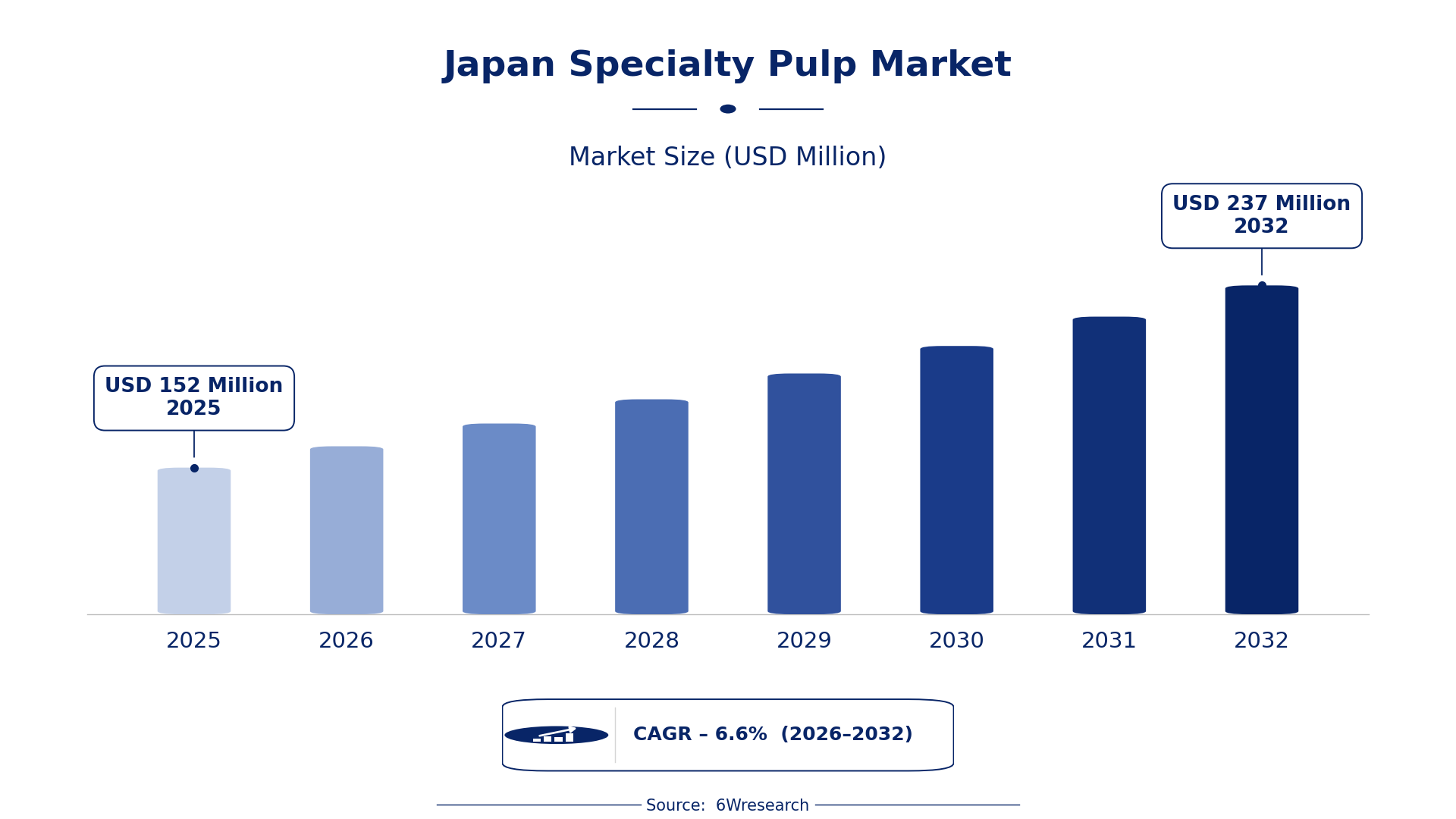
According to 6Wresearch internal database and industry insights, the Japan Specialty Pulp Market was valued at USD 152 Million in 2025 and is projected to reach USD 237 Million by 2032, growing at a CAGR of approximately 6.6% during 2026–2032.
Japan Specialty Pulp Market Highlights
| Report Metric | Details |
| Report Name | Japan Specialty Pulp Market (2026-2032) |
| Market Size 2025 | USD 152 Million |
| Market Size 2032 | USD 237 Million |
| Absolute Growth 2025–2032 | USD 85 Million |
| CAGR 2026–2032 | 6.6% |
| Peak Annual Growth | 7.4% in 2028 |
| Forecast Period | 2026–2032 |
| Historical Data | 2022–2025 |
| Base Year | 2025 |
| Leading Pulp Type, 2025 | Dissolving Pulp (45% share) |
| Leading Source Material, 2025 | Wood/Non-Wood (40% share) |
| Leading Application Use, 2025 | Viscose/Rayon (42% share) |
| Leading End User, 2025 | Textile Manufacturers (43% share) |
| Fastest-Growing Pulp Type | Fluff Pulp (9.4% CAGR) |
| Fastest-Growing Source Material | Softwood (9.6% CAGR) |
| Fastest-Growing Application Use | Hygiene Products (9.2% CAGR) |
| Fastest-Growing End User | Diaper & Feminine Care (8.6% CAGR) |
| Growing Sector | hygiene products |
| Key End Users | textile manufacturers, hygiene product producers, eco-packaging brands |
Japan Specialty Pulp Market Year-wise Growth Rate and Key Drivers (2022–2032)
This graph illustrates the annual growth rates of the market from 2022 to 2032, highlighting a steady upward trajectory and projected market expansion over the forecast period.
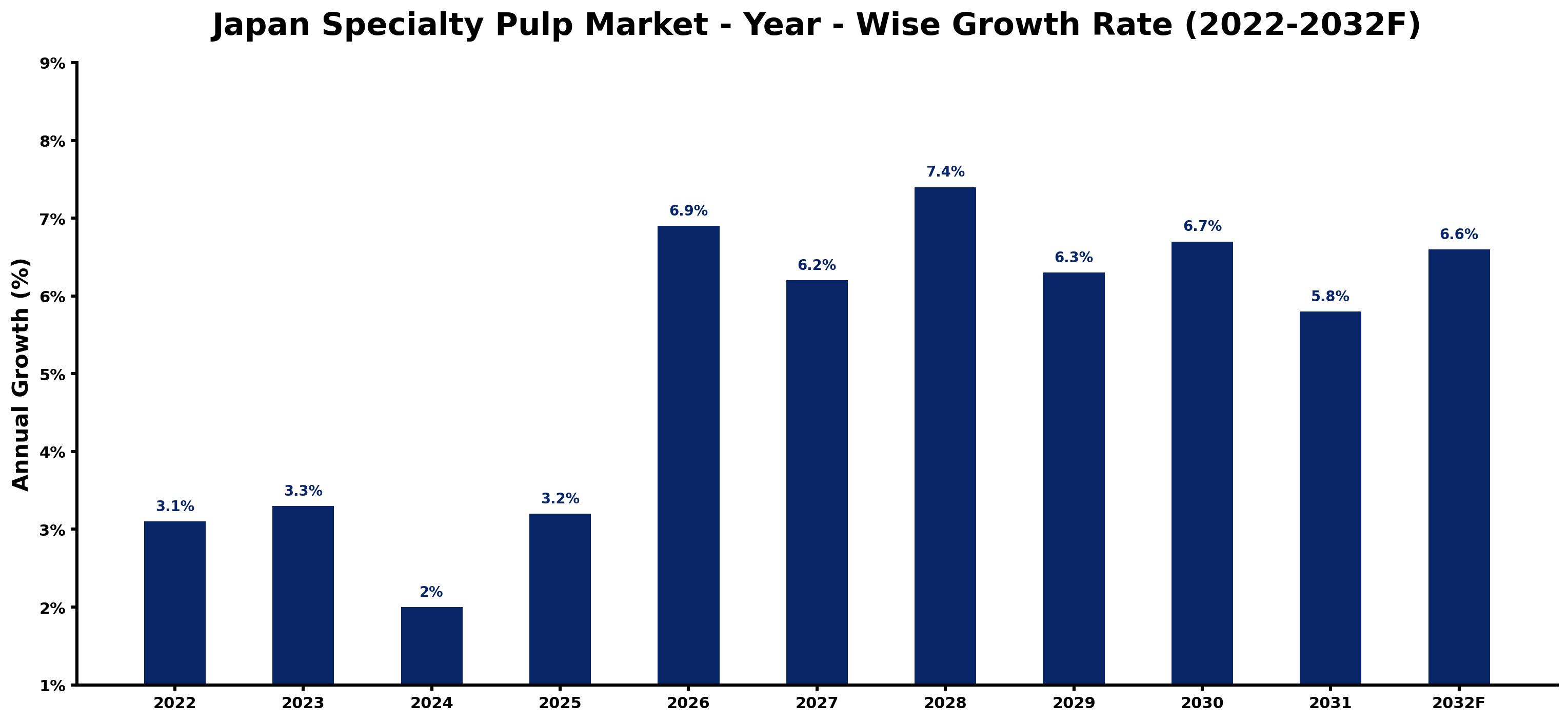
Below, each year's estimated growth is shown next to the factor that most influenced it.
| Year | Estimated Annual Growth (%) | Market Rationale |
| 2022 | 3.1 | The market showed steady demand, driven by the textile industry's needs. |
| 2023 | 3.3 | Growth was supported by increased production in the viscose sector. |
| 2024 | 2.0 | A slowdown occurred as the market adjusted to production capacities. |
| 2025 | 3.2 | Demand rose again due to a resurgence in hygiene product manufacturing. |
| 2026 | 6.9 | Growth is anticipated to accelerate as investments in sustainable packaging gain traction. |
| 2027 | 6.2 | A slight slowdown is expected as the market stabilises after rapid growth. |
| 2028 | 7.4 | The market will peak with strong demand for dissolving pulp in textiles. |
| 2029 | 6.3 | Growth is expected to decelerate as the market faces saturation in certain applications. |
| 2030 | 6.7 | Demand is projected to increase again, driven by innovations in eco-packaging. |
| 2031 | 5.8 | A slowdown is expected as the market adjusts to new production standards. |
| 2032 | 6.6 | Growth is anticipated to remain strong due to ongoing sustainability trends. |
Note: Market size estimations and growth projections presented in this report are based on 6Wresearch's proprietary forecasting methodology, utilizing the latest available industry data, government publications, and primary research inputs.
Japan Specialty Pulp Market Synopsis
Specialty pulp, derived from wood or non-wood sources, is crucial for producing viscose/rayon, hygiene products, and sustainable packaging solutions. The Japan Specialty Pulp Market is expanding, driven by the textile and hygiene sectors, which employ over 500,000 people. The eco-packaging market is projected to grow annually by 10%, further increasing the demand for specialty pulp. Government initiatives that promote sustainable practices are contributing to this growth, ensuring a steady supply of eco-friendly materials.
Market Dynamics Impact Analysis (2026–2032)
| Factor | Type | Impact | Primary Segment Affected |
| Rising demand for viscose/rayon in the textile sector | Driver | High | Dissolving Pulp |
| Increased focus on sustainable packaging solutions | Driver | High | Specialty Packaging Pulp |
| Growth in the hygiene products market | Opportunity | High | Fluff Pulp |
| Expansion of eco-packaging initiatives | Opportunity | High | Specialty Packaging Pulp |
| Regulatory compliance costs for high-purity cellulose | Restraint | Medium | High-Purity Cellulose |
| Limited availability of quality recycled pulp sources | Restraint | Medium | Recycled/Bleached |
| High production costs affecting profitability | Challenge | High | Dissolving Pulp |
| Competition from alternative materials in packaging | Challenge | Medium | Specialty Packaging Pulp |
Evaluation of Drivers in Japan Specialty Pulp Market (2026–2032)
Key forces behind demand, with the segment each one moves most, are listed below.
| Drivers | Primary Segment Affected | Why It Matters (Evidence) |
| Increased production of viscose/rayon | Dissolving Pulp | Japan's annual demand for viscose is about 300,000 tons, driving pulp purchases. |
| Support for sustainable packaging initiatives | Specialty Packaging Pulp | The eco-packaging market is expected to expand by 10% annually, boosting demand. |
| Growing consumption of hygiene products | Fluff Pulp | The hygiene products market in Japan is valued at around $5 billion, increasing pulp demand. |
| Advancements in pulp processing technology | High-Purity Cellulose | High-purity cellulose is essential for medical applications, necessitating strict quality standards. |
| Increasing recycling initiatives | Recycled/Bleached | Japan's recycling rate for paper products is 80%, supporting pulp availability. |
The strongest pull on demand comes from the textile sector, where the annual demand for viscose reaches approximately 300,000 tons, prompting increased purchases of dissolving pulp. The hygiene products market, valued at around $5 billion, boosts the need for fluff pulp. Japan's recycling rate for paper products at 80% supports the availability of recycled pulp sources, facilitating market growth. Technological advancements in processing high-purity cellulose for medical applications also contribute to rising demand, as strict quality standards are enforced.
Evaluation of Restraints in Japan Specialty Pulp Market
The key brakes on demand, and where they bite hardest, are shown below.
| Market Restraint | Primary Segment Affected | Why It Matters (Evidence) |
| High compliance costs for quality standards | High-Purity Cellulose | Producers face elevated costs to meet strict regulations, impacting pricing strategies. |
| Limited supply of quality recycled materials | Recycled/Bleached | The availability of quality recycled pulp sources is inadequate to meet market needs. |
| Production costs impacting profitability | Dissolving Pulp | High production costs constrain profit margins for manufacturers in the textile sector. |
| Competition from alternative packaging materials | Specialty Packaging Pulp | The emergence of alternative materials threatens market share for specialty pulp producers. |
| Market saturation in certain applications | Fluff Pulp | Saturation in the hygiene market restricts growth potential for fluff pulp producers. |
Japan Specialty Pulp Market Challenges
Japan produced about 1 million tons of specialty pulp in 2022, yet rising production costs are straining producers, which could lead to price hikes for textile buyers. Strict regulations like JIS P 8201 impose heavy compliance costs on manufacturers, resulting in delays that hinder their market competitiveness. Disruptions in sourcing raw materials can cause producers to operate below capacity, limiting their ability to fulfil orders. Buyers in the $5 billion hygiene products market struggle to secure reliable supplies as competition for pulp resources escalates, pushing prices higher and restricting availability.
Trends in the Japan Specialty Pulp Market
Four trends stand out in the Japan Specialty Pulp Market.
- Shift towards Sustainable Packaging Solutions: Japan's eco-packaging market is expanding rapidly, with a projected annual growth rate of 10%. This change is driven by consumer demand for environmentally friendly products and initiatives from the government to promote sustainable practices.
- Transition from Traditional to High-Purity Cellulose: High-purity cellulose is increasingly used in medical applications, reflecting a trend towards higher quality standards. This shift requires producers to invest in advanced processing technologies to comply with tightening regulations.
- Focus on Recycling Innovations: The recycling rate for paper products in Japan stands at 80%, prompting a growing emphasis on utilizing recycled materials. This trend is reshaping supply chains and encouraging innovations in pulp production to meet demand.
- Growing Demand for Hygiene Products: The hygiene products market, valued at around $5 billion, is driving demand for fluff pulp. This growth is evident in the increasing production of diapers and feminine care products.
Investment Opportunities in the Japan Specialty Pulp Market
Where to invest in the Japan Specialty Pulp Market: the main openings are set out below.
- Timing for Eco-Packaging Innovations: With the eco-packaging market expected to grow by 10% annually, there is an opportunity to supply specialty packaging pulp. Collaborating with eco-packaging brands can facilitate market entry.
- Entry into High-Purity Cellulose Market: Given the strict regulations governing high-purity cellulose, there is a need for certified suppliers. Establishing partnerships with medical and chemical firms can enhance market presence.
- Investment in Recycling Facilities: The limited availability of quality recycled pulp sources presents an opportunity for investment in recycling facilities. Targeting regions like Tokyo and Osaka can yield substantial returns.
- Investing in Fluff Pulp Production: The hygiene products market's growth offers a chance to expand fluff pulp production. Engaging with diaper and feminine care manufacturers can drive demand.
Government Initiatives in the Japan Specialty Pulp Market
The PRTR Law, enacted in 1999, mandates businesses to report the release of designated chemical substances. This law impacts specialty pulp producers by ensuring compliance with environmental standards, necessitating investments in monitoring and reporting systems. The Chemical Substances Control Law requires the evaluation of new chemical substances, affecting production processes in the specialty pulp sector, with a focus on safety and compliance.
The Japan Paper Association supports sustainable practices in the pulp industry, providing assistance for eco-friendly initiatives. This agency helps manufacturers comply with environmental regulations and access funding for projects, enabling them to improve production capabilities and meet market demands.
Future Insight of the Japan Specialty Pulp Market
By 2032, a government programme promoting eco-friendly packaging will drive suppliers to innovate in production techniques, enhancing material quality. The eco-packaging market is projected to grow by 10% annually, offering new avenues for buyers focused on sustainability. With annual viscose demand around 300,000 tons, suppliers will need to adapt to shifting consumer preferences for eco-conscious products. Improved recycling initiatives will support the industry's transition towards sustainable practices, benefiting both buyers and suppliers.
Market Segmentation Analysis
Japan Specialty Pulp Market report covers a detailed analysis of the following market segments:
By Pulp Type – Dissolving Pulp Leads, Fluff Pulp Expected to Grow Fastest
According to Saurav Kr Singh, Senior Research Analyst at 6Wresearch, Dissolving Pulp accounted for 45% of the market by pulp type in 2025. Dissolving pulp holds the largest share as it is crucial for producing viscose and rayon, which are fundamental to Japan's textile industry. The employment of over 500,000 people in this sector ensures a steady demand for dissolving pulp. Fluff Pulp is projected to grow fastest, at a CAGR of 9.4% during 2026–2032. Fluff pulp is experiencing rapid growth due to a surge in demand for hygiene products, which represent a market valued at around $5 billion. This trend is expected to continue as consumer preferences shift towards products that prioritise hygiene. This means suppliers should focus on enhancing their offerings in fluff pulp to capitalise on the growing hygiene market.
By Source Material – Wood/Non-Wood Leads, Softwood Expected to Grow Fastest
With 40% of source material revenue in 2025, Wood/Non-Wood was the largest category. Wood and non-wood sources dominate the market as they are the primary materials for producing specialty pulp, ensuring a consistent supply chain. This is particularly important in regions like Tokyo and Osaka, where industrial activities are concentrated. Over 2026–2032, Softwood is expected to post the fastest growth, at a CAGR of 9.6%. Softwood is the fastest-growing source material, primarily because it serves as the main input for dissolving pulp production. The increasing focus on sustainable practices in the pulp industry further supports this growth. Buyers should consider sourcing from softwood suppliers to meet the rising demand for dissolving pulp.
By Application Use – Viscose/Rayon Leads, Hygiene Products Expected to Grow Fastest
Viscose/Rayon held 42% of the Japan Specialty Pulp Market by application use in 2025. Viscose and rayon applications lead the market as they are major uses of dissolving pulp, which is vital for the textile industry. The annual demand for viscose in Japan is approximately 300,000 tons, highlighting its importance. Hygiene Products are set to record the highest CAGR in this split, 9.2% over 2026–2032. Hygiene products are the fastest-growing application due to the rising consumer demand for personal care items, particularly in the diaper and feminine care segments. This trend is expected to continue as awareness of hygiene increases. Suppliers must adapt to the growing needs of the hygiene products market to remain competitive.
By End User – Textile Manufacturers Lead, Diaper & Feminine Care Expected to Grow Fastest
Textile Manufacturers took 43% of end user revenue in 2025, more than any other category. Textile manufacturers are the primary end users of dissolving pulp, which is essential for producing viscose and rayon fabrics. Their substantial workforce and production capabilities ensure a strong and consistent demand for this pulp type. The quickest growth will come from Diaper & Feminine Care, forecast to expand at a CAGR of 8.6% between 2026 and 2032. Diaper and feminine care segments are the fastest-growing end users, driven by increasing consumer awareness and demand for hygiene products. This growth is likely to accelerate as the market expands further. Suppliers should align their strategies to cater to the evolving needs of diaper and feminine care manufacturers.
Key Attractiveness of the Report
- 10 Years of Market Numbers
- Historical Data Starting from 2022 to 2025
- Base Year 2025
- Forecast Data until 2032
- Key Performance Indicators Impacting the Market
- Major Upcoming Developments and Projects
Key Highlights of the Report:
- Japan Specialty Pulp Market Outlook
- Market Size of Japan Specialty Pulp Market, 2025
- Forecast of Japan Specialty Pulp Market, 2032
- Historical Data and Forecast of Japan Specialty Pulp Revenues & Volume for the Period 2022-2032F
- Japan Specialty Pulp Market Trend Evolution
- Japan Specialty Pulp Market Drivers and Challenges
- Japan Specialty Pulp Price Trends
- Japan Specialty Pulp Porter's Five Forces
- Japan Specialty Pulp Industry Life Cycle
- Historical Data and Forecast of Japan Specialty Pulp Market Revenues & Volume By Pulp Type for the Period 2022-2032F
- Historical Data and Forecast of Japan Specialty Pulp Market Revenues & Volume By Dissolving Pulp for the Period 2022-2032F
- Historical Data and Forecast of Japan Specialty Pulp Market Revenues & Volume By Fluff Pulp for the Period 2022-2032F
- Historical Data and Forecast of Japan Specialty Pulp Market Revenues & Volume By Filter Pulp for the Period 2022-2032F
- Historical Data and Forecast of Japan Specialty Pulp Market Revenues & Volume By Specialty Packaging Pulp for the Period 2022-2032F
- Historical Data and Forecast of Japan Specialty Pulp Market Revenues & Volume By Source Material for the Period 2022-2032F
- Historical Data and Forecast of Japan Specialty Pulp Market Revenues & Volume By Wood/Non-Wood for the Period 2022-2032F
- Historical Data and Forecast of Japan Specialty Pulp Market Revenues & Volume By Softwood for the Period 2022-2032F
- Historical Data and Forecast of Japan Specialty Pulp Market Revenues & Volume By High-Purity Cellulose for the Period 2022-2032F
- Historical Data and Forecast of Japan Specialty Pulp Market Revenues & Volume By Recycled/Bleached for the Period 2022-2032F
- Historical Data and Forecast of Japan Specialty Pulp Market Revenues & Volume By Application Use for the Period 2022-2032F
- Historical Data and Forecast of Japan Specialty Pulp Market Revenues & Volume By Viscose/Rayon for the Period 2022-2032F
- Historical Data and Forecast of Japan Specialty Pulp Market Revenues & Volume By Hygiene Products for the Period 2022-2032F
- Historical Data and Forecast of Japan Specialty Pulp Market Revenues & Volume By Industrial Filters for the Period 2022-2032F
- Historical Data and Forecast of Japan Specialty Pulp Market Revenues & Volume By Sustainable Packaging for the Period 2022-2032F
- Historical Data and Forecast of Japan Specialty Pulp Market Revenues & Volume By End User for the Period 2022-2032F
- Historical Data and Forecast of Japan Specialty Pulp Market Revenues & Volume By Textile Manufacturers for the Period 2022-2032F
- Historical Data and Forecast of Japan Specialty Pulp Market Revenues & Volume By Diaper & Feminine Care for the Period 2022-2032F
- Historical Data and Forecast of Japan Specialty Pulp Market Revenues & Volume By Medical & Chemical Firms for the Period 2022-2032F
- Historical Data and Forecast of Japan Specialty Pulp Market Revenues & Volume By Eco-Packaging Brands for the Period 2022-2032F
- Japan Specialty Pulp Import Export Trade Statistics
- Market Opportunity Assessment By Pulp Type
- Market Opportunity Assessment By Source Material
- Market Opportunity Assessment By Application Use
- Market Opportunity Assessment By End User
- Japan Specialty Pulp Top Companies Market Share
- Japan Specialty Pulp Competitive Benchmarking By Technical and Operational Parameters
- Japan Specialty Pulp Company Profiles
- Japan Specialty Pulp Key Strategic Recommendations
Market Covered
This report examines the market across the segments below.
By Pulp Type
- Dissolving Pulp
- Fluff Pulp
- Filter Pulp
- Specialty Packaging Pulp
By Source Material
- Wood/Non-Wood
- Softwood
- High-Purity Cellulose
- Recycled/Bleached
By Application Use
- Viscose/Rayon
- Hygiene Products
- Industrial Filters
- Sustainable Packaging
By End User
- Textile Manufacturers
- Diaper & Feminine Care
- Medical & Chemical Firms
- Eco-Packaging Brands































